A chunky knit throw has thick, rope-like loops that show off the stitch and fill a sofa corner. Most are made from chenille polyester yarn, and many are described as hand knit or crocheted. Sizes, weights and care vary more than the photos suggest.
The six throws below range from a light 50 by 60 inch throw to a 60 by 80 inch one that the listing weighs at over ten pounds. Details come from each product’s listing page. We have not used these blankets ourselves. Handmade and certification claims are the makers’ own.
As an Amazon Associate we earn from qualifying purchases. Links below are affiliate links, and they do not change the product information we give.
What to Look For
| Feature | Why it matters |
|---|---|
| Size | Throws run from 40 x 60 to 60 x 80 inches |
| Weight | Heavier knits drape thick; light ones fold small |
| Loop and hole pattern | Open knits can snag on rings and pet claws |
| Care | Some are machine washable; one is spot clean only |
In this guide
Specs at a Glance
| Blanket | Size and weight | Fiber | Care |
|---|---|---|---|
| Madison Park | 50 x 60 in | 100% polyester chenille | Spot clean |
| SAMIAH LUXE | 50 x 60 in; 6 lb; about 1 in thick | 100% chenille polyester | Machine wash |
| YnM | 60 x 80 in; 10.6 lb on the detail page | 100% polyester | Machine wash, low tumble or line dry |
| Bigacogo | 40 x 60 in (six sizes offered) | 100% chenille polyester | Machine wash, hand wash or spot clean |
| L’AGRATY | 50 x 60 in | 100% polyester chenille | Machine wash |
| Carriediosa | 50 x 60 in | 100% polyester chenille | Machine wash |
The 6 Best Chunky Knit Blankets

Top pickBest for a light decorative layer
1. Madison Park Chenille Chunky Knit Throw Blanket
A 50 by 60 inch handmade chenille throw in 100 percent polyester, described as lightweight and breathable. The listing cites OEKO-TEX certification and gives the care as spot clean.
Suits: a light decorative layer. Strengths: a known home-goods brand and a gift-ready set. Weaknesses: spot clean only. Skip it if you want to machine wash it.
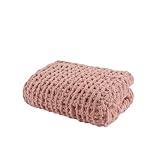
View Madison Park Chenille Chunky Knit All Season Throw Blanket, 50 x 60″, Blush on Amazon
Best for a heavy knit that stays put
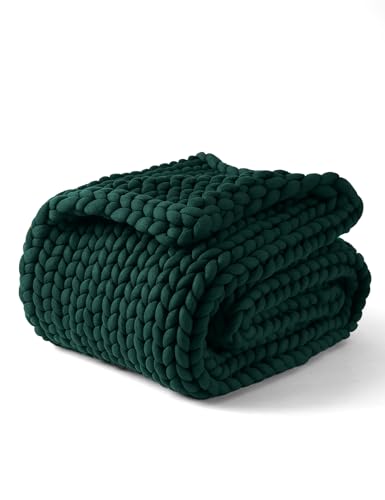
2. SAMIAH LUXE Chunky Knit Throw Blanket 50×60 in, 6 lb
A dense 50 by 60 inch throw that the listing puts at 6 pounds and about 1 inch thick. It is made of chenille polyester with hand-finished edges, ships with a canvas storage bag and is machine washable.
Suits: a heavy knit that stays put. Strengths: weight and a storage bag. Weaknesses: bulky to fold. Skip it if you want a light throw.
View SAMIAH LUXE Chunky Knit Throw Blanket 50×60 in, 6 lb Buttercream Cream on Amazon
Best for a big throw for a bed or sectional
3. YnM Chunky Throw Blanket, Medium-Weight, Hand Knitted
The largest throw here at 60 by 80 inches, hand knitted in 100 percent polyester. The detail page lists it at 10.6 pounds even though the title says medium-weight, so check the weight before ordering. Care is machine wash, then low tumble or line dry.
Suits: a big throw for a bed or sectional. Strengths: size and machine washable care. Weaknesses: the listed weight is heavy. Skip it if you want a small blanket.

Best for a narrower throw with many size options
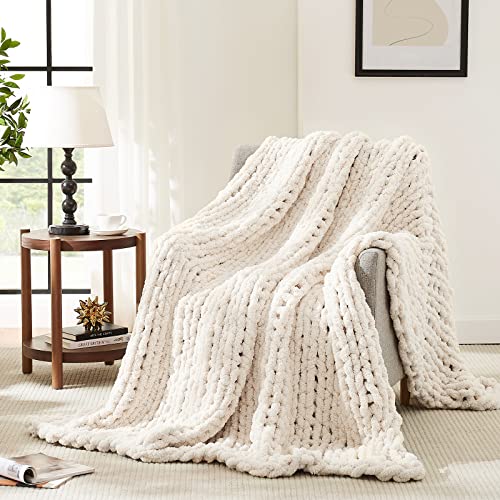
4. Bigacogo Chunky Knit Throw Blanket for Couch
A 40 by 60 inch hand-knit chenille throw with an open holey pattern; the listing notes that the holes are a design feature, and offers six sizes from 40 by 40 to 80 by 90 inches. It can be machine washed, hand washed or spot cleaned.
Suits: a narrower throw with many size options. Strengths: six sizes and flexible care. Weaknesses: open holes can catch. Skip it if you want a tight weave.

View Bigacogo Chunky Knit Throw Blanket for Couch, 40×60 inches, Beige on Amazon
Best for a cable knit look
5. L’AGRATY Chunky Knit Throw Blanket for Couch
A 50 by 60 inch cable knit crochet-style throw in polyester chenille, with small open holes that the listing says make it breathable. The care line is machine wash, and the page does not state a weight.
Suits: a cable knit look. Strengths: machine washable. Weaknesses: no weight listed. Skip it if you need to know the weight first.

View L’AGRATY Chunky Knit Throw Blanket for Couch, 50” x 60” Knit Throw, Ivory on Amazon

Best for a farmhouse look
6. Carriediosa Chunky Knit Throw Blanket 50″ x 60″
A 50 by 60 inch throw described as handcrafted with a braided sweater weave and loose rope texture in chenille loop yarn. The listing marks it reversible and machine washable, and it arrives in a vacuum bag.
Suits: a farmhouse look. Strengths: a rope-style texture. Weaknesses: no weight listed. Skip it if you want a smooth surface.

View Carriediosa Chunky Knit Throw Blanket 50″ x 60″, 100% Hand Made, Taupe on Amazon
Care and Setup
- Read the care line before washing; one throw here is spot clean only.
- Use a gentle cycle and mild detergent where machine washing is allowed.
- Dry on low heat or line dry, as the YnM listing advises.
- Fluff the loops by hand after washing.
Mistakes to Avoid
- Ignoring the weight when the title and detail page disagree.
- Choosing an open knit where claws or jewelry can snag.
- Washing a spot clean only blanket in the machine.
- Drying on high heat.
Weight, Warmth and How a Chunky Throw Drapes
Chunky knit throws look similar in photos but behave differently once they are on your lap. Weight is the clearest difference. A heavier throw has thick, dense loops and tends to stay where you put it, hang straight over the arm of a sofa and feel substantial. A lighter one folds smaller, moves more easily and suits warmer rooms or a decorative role. If a listing gives a weight, use it, and if the title and detail page disagree, treat the number as unconfirmed until you can check.
Warmth depends on more than weight. An open knit with large holes lets air pass through, so it feels cozy but not as insulating as a tight weave. A dense knit traps more warmth, which some people love in winter and others find heavy. Polyester chenille is soft and fluffy, but it can hold heat and feel warm quickly, so consider your room temperature and whether you tend to run hot or cold.
Drape matters for appearance. A thick throw looks sculptural draped over a chair or folded at the end of a bed, while a thinner one lies flat. Think about how you will use it: wrapped around you on the couch, laid over a bed for texture, or draped for display. Heavier throws also take up more room in a basket or storage bag, so plan where it will live between uses.
Sizing for the Couch, the Bed and Your Lap
Size is easy to underestimate. A throw around 50 by 60 inches covers one adult sitting on a sofa, and it is a common size for a living room. A narrower throw around 40 by 60 inches suits a chair arm or a child. Larger throws, such as 60 by 80 inches, can cover two people on a sectional or sit across the foot of a bed. Check the dimensions in inches and compare them with your furniture rather than relying on words such as large or oversized.
Measure the piece of furniture where the blanket will rest. For the foot of a bed, check the bed width and the drop you want; a throw that is too short will look lost. For a sofa, consider whether you want it to hang over the back and sides or sit folded on one arm.
- One person on a couch: a throw in the 50 by 60 inch range is usually enough.
- Two people: look for the larger sizes and check the weight, since they get heavy.
- Bed decoration: choose a width that covers at least a third of the bed.
Chunky knits can shrink a little after washing, so allow a margin if you need an exact size, and check the care label.
Knit Structure, Snags and Shedding
The way a throw is made affects how it wears. Thick chenille yarn forms loops, and an open pattern leaves large gaps between them. Those gaps are part of the look, but fingers, toes, jewelry, rings, zippers and pet claws can catch in them. If you have cats, dogs or small children, or you wear sharp rings, consider a tighter knit or a pattern with smaller holes. A snag in chunky yarn can pull a loop out of place and leave a visible tug.
Some shedding is normal with new chenille. Loose fibers may collect on clothes and furniture for the first few uses. Shake the throw outside and run a lint roller over dark upholstery. If a throw sheds heavily after washing, check the care instructions, since heat and friction affect it.
If a loop catches, do not pull it. Gently work the slack back through the neighboring loops, or use a crochet hook or a blunt needle to ease it back into place. Cutting a snag usually makes it worse. Look at the edges too: hand-finished edges can fray or unravel if they are loose, so check the finish on arrival and trim any stray threads carefully rather than tugging them.
Washing, Drying and Keeping the Shape
Always read the care label first, because the listings in this guide differ: some are machine washable and one is spot clean only. Washing a spot-clean throw in a machine can ruin its shape. Where machine washing is allowed, a gentle cycle with cool or lukewarm water and a mild detergent is the usual approach. Use a large machine so the throw can move freely, and avoid mixing it with items that have hooks, zippers or rough fabric.
Drying is where chunky knits most often go wrong. High heat can mat chenille and shrink or warp the loops. Follow the label: low tumble or line drying is common advice. If you air dry, lay the throw flat on a clean towel or a drying rack and reshape it, because hanging a wet heavy blanket can stretch it. Fluff the loops by hand once it is dry.
- Spot clean spills right away with a damp cloth and mild soap, blotting rather than rubbing.
- Avoid bleach and fabric softeners unless the label allows them.
- Wash only when needed, since repeated washing wears chunky yarn.
For storage, fold the throw loosely and keep it in a breathable bag or basket, away from direct sun and damp.
Quality Checks and When to Replace a Throw
When a throw arrives, check it before you commit. Look for even stitching, consistent loop size and finished edges. Check that the color matches the photos and that there is no strong chemical smell, which may fade with airing. Compare the size and weight with the listing. If a listing mentions certifications, treat that as the seller’s claim and check the exact wording on the page.
Ask a few questions before buying: What is the exact fiber? What is the stated weight? Can it be machine washed? Is the knit open or tight? What is the return policy if the size or feel is wrong? These questions help you avoid a throw that looks right but does not suit how you live.
Signs it is time to replace a chunky knit throw:
- Large areas where loops are pulled or the yarn has thinned.
- Matted, flattened patches that do not fluff up after washing.
- Stretching that makes the throw hang unevenly.
- Unraveling edges that cannot be repaired.
- A persistent smell after washing.
Light wear can often be tidied with careful trimming and a gentle wash, so decide based on how much the damage bothers you and how you use the throw.
Choosing a Throw by Room and Use
A chunky knit blanket does different jobs in different rooms, so decide what you want it to do before you compare the Madison Park, SAMIAH LUXE, YnM, Bigacogo, L’AGRATY and Carriediosa options.
- Living room sofa: a 50 by 60 inch throw drapes across a lap or the arm of a couch and looks tidy when folded.
- Bedroom styling: a longer throw across the foot of the bed adds texture and gives you something to pull up on a cool night.
- Reading nook: a medium weight throw suits an armchair, where it needs to cover your legs but not overwhelm the seat.
- Guest room: a neutral color is easy to match with different bedding.
- Gift: pick a color that fits the recipient’s home, and check the washing instructions so they know how to care for it.
Look at the listing for the exact size, the weight and the fiber content. Chunky throws vary a lot in weight, from light and airy to quite heavy, and the photo alone will not tell you which you are getting.
Reading Weight and Size Claims on a Listing
Chunky blanket listings often give sizes such as 50 by 60 inches or 60 by 80 inches, and a weight in pounds. Treat these as the seller’s stated measurements, and keep in mind that loose knits can stretch slightly in handling, so the real dimensions can feel a bit different.
Weight tells you how the blanket will feel. A heavier throw drapes with more presence, and it may feel warmer on your lap. A lighter one is easier to toss over your shoulders and to wash. If you plan to carry it around the house, a lighter weight may be more practical.
Check the fiber content, too. Many chenille throws are made from polyester, and the listing should say so. Look for the care instructions and note whether the maker suggests a gentle cycle, a mesh laundry bag or hand washing. If the page does not say, look at the label when it arrives, and follow it before the first wash.
Finally, read any note about shedding. Loose fibers can appear on new knits, and a listing that mentions this honestly is a good sign.
Snags, Pets and Everyday Wear
The big loops that make a chunky throw so appealing also catch easily. Jewelry, rough fingernails and pet claws can pull a loop out of line. If you have a cat or a dog that kneads, keep the blanket where it is less likely to be used as a scratching post, or drape a smooth cover over the sofa when pets are around.
When a loop does snag, do not cut it. Gently work the slack back along the stitch with a blunt tool, such as a crochet hook or a large-eyed needle, until the loop sits level with its neighbors. Follow this approach carefully and patiently.
Rotate the blanket so that wear is spread out, and shake it out now and then to loosen dust. If a throw begins to look flattened, shed heavily or develop holes along the stitches, it may be time to replace it. A throw that you use daily will naturally age faster than one that sits on a bed for decoration.
Folding and Storing a Chunky Knit
These blankets are bulky, so storage takes planning. Fold the throw in thirds lengthwise, then roll or fold it loosely so you do not crease the loops. A large basket, a ladder rack or a shelf in a closet all work well.
Avoid hanging the blanket by one corner for long periods, because the weight can stretch the knit. Avoid vacuum bags that squash the fibers flat for long periods, and keep the throw away from sharp zippers and rough surfaces.
Before you store it for a season, make sure it is fully clean and completely dry, following the maker’s washing and drying advice. A breathable cotton bag is a sensible container, and a sachet kept nearby can keep the cupboard smelling fresh. If you ever notice a musty smell, air it out in a well-ventilated spot before use.
Deciding on Knit blankets: A Slower, Smarter Way to Choose
Most disappointing purchases in this category happen in the first five minutes, when a single attractive feature crowds out the questions that actually decide whether the product will work in your home. A chunky knit is as much a texture you live with as a blanket you use, so how the loops behave under hands, pets and washing matters as much as how warm it feels on the first evening. A slower decision does not need to be a long one. It simply means working through the job, the space, the people and the upkeep in that order, and only then comparing the picks in this guide against the answers you have written down.
Start with the job in one plain sentence. Write down what the knit blankets has to do on an ordinary day, not on the best day or the worst day. Ordinary use is where products earn their keep, and a choice that fits the ordinary day usually stretches to cover the unusual one, while the reverse is rarely true. If two people will use it in different ways, write both jobs down and notice where they agree, because the overlap is the safest ground to buy for.
Then be honest about the feature you are most tempted by. Tempting features are not bad features, but they should have to justify themselves against the job sentence you just wrote. If the feature does not make the ordinary day easier, calmer, warmer, cooler, safer or tidier, it belongs in the nice to have column, and it should not be allowed to overrule size, fit or ease of use when those point the other way.
Measure First, Then Read the Picks Again
Before you compare any of the options above, measure the seat or bed area you actually want covered, from where it should reach on your shoulders to where it should end at your feet or lap, rather than guessing from the size name alone. Write the numbers where you can see them while you shop, and keep them in the same units the listing uses, converting carefully if you have to, because most sizing mistakes are really unit or rounding mistakes that felt too small to matter.
Leave yourself a margin. A product that only just fits the couch, bed or favourite chair leaves no room for the way real homes behave: things get moved, other items share the space, and people reach, sit, walk or lean in ways no diagram predicts. A comfortable margin is not wasted space. It is the difference between a product that slots into your routine and one that has to be negotiated with every day.
Once you have your numbers, read the pick descriptions at the top of this guide a second time with a pen in hand, literally or mentally. Mark each pick as a clear fit, a possible fit or a poor fit on size alone, and let that shortlist, rather than the order the picks appear in, drive the rest of your reading. Reviews and comparisons get much more useful once half the field has been honestly eliminated.
Picture the Ordinary Week, Not Just the First Day
New purchases are usually judged on day one, when everything is novel and everyone is being careful. A better test is the ordinary week that follows. Picture the knit blankets on a tired weekday, when you are in a hurry, the room is not tidy and nobody is performing good habits for the benefit of a new purchase. If the product still makes sense in that picture, it is a product you will still be using in six months.
Now picture the busiest version of its job: guests in the house, children or pets underfoot, a trip being packed for, a deadline looming, or the season at its hottest, coldest or wettest, depending on what this product has to handle. Busy moments expose weak points that calm moments hide, such as awkward controls, slow setup, fragile parts or care routines that take longer than the use itself. You do not need the product to be perfect under pressure, but you do need to know in advance where it will struggle.
Finally, picture the quiet version of its job, the early morning or late evening when the house is still. Products used at the edges of the day are judged on different qualities: how much noise they make, how much light they give off, how they feel half asleep, and whether using them disturbs anyone else. Running these three pictures, the ordinary week, the busy peak and the quiet edge, takes two minutes and prevents most mismatches between a good product and the wrong home.
Comparing the Picks in This Guide, Head to Head
The picks above were chosen to cover different needs rather than to repeat the same product six times, so the most useful comparison is not a hunt for a single winner. It is a process of elimination driven by your job sentence, your measurements and your tolerance for upkeep. Work through the pairs below in that spirit, keeping the pick whose described strengths match your ordinary week and letting go of any pick whose described weakness lands on something you do every day.
Set the Madison Park Chenille Chunky Knit Throw Blanket beside the SAMIAH LUXE Chunky Knit Throw Blanket 50×60 in, 6 lb and ask what each one is really for. The notes above give each pick a clear suits, strengths and skip it if summary, and those three lines are the honest comparison: if the skip it if line describes your household, believe it, even if the strengths sound appealing. If neither skip line applies, decide on the strength you will actually use weekly rather than the strength that merely sounds impressive, and check the size and care details of your preferred one a final time before ordering.
Set the YnM Chunky Throw Blanket, Medium-Weight, Hand Knitted beside the Bigacogo Chunky Knit Throw Blanket for Couch and ask what each one is really for. The notes above give each pick a clear suits, strengths and skip it if summary, and those three lines are the honest comparison: if the skip it if line describes your household, believe it, even if the strengths sound appealing. If neither skip line applies, decide on the strength you will actually use weekly rather than the strength that merely sounds impressive, and check the size and care details of your preferred one a final time before ordering.
Set the L’AGRATY Chunky Knit Throw Blanket for Couch beside the Carriediosa Chunky Knit Throw Blanket 50″ x 60″ and ask what each one is really for. The notes above give each pick a clear suits, strengths and skip it if summary, and those three lines are the honest comparison: if the skip it if line describes your household, believe it, even if the strengths sound appealing. If neither skip line applies, decide on the strength you will actually use weekly rather than the strength that merely sounds impressive, and check the size and care details of your preferred one a final time before ordering.
If two picks are still tied after that, choose on the unglamorous details: which one is easier to clean, easier to move, easier to live with when it is not the centre of attention, and easier to replace or pass on if your needs change. Ties are usually broken better by daily friction than by features, because features are used occasionally while friction is felt constantly.
Care Habits That Keep It Working Longer
Follow the care label for the first wash and treat that wash as a test: wash the blanket on its own, use a gentle cycle where the label allows it, and check afterwards whether the texture, edges and drape still feel the way they did when it arrived.
Store a clean, fully dry blanket in a breathable spot rather than sealing a damp one away, because trapped moisture is what creates stale smells that are hard to shift later. Folding loosely, instead of compressing the blanket tightly for months, helps lofty fibres recover when it comes back out.
Deal with snags and pulls early. A small pull that is eased back into place or secured as the maker directs stays a small thing, while the same snag caught on jewellery, pet claws or a zipper week after week becomes the weak point where the blanket starts to look tired.
Build the care into a rhythm you already keep rather than inventing a new one. A task attached to an existing habit, such as laundry day, the weekly clean or the change of a season, actually happens. A care routine that depends on remembering a separate schedule quietly stops happening, and the product pays for it months later in ways that look like poor quality but are really postponed maintenance.
When Something Feels Wrong: A Calm Troubleshooting Order
If a blanket feels warmer or cooler than expected, change one variable at a time: the layer underneath, the room temperature, or how much of your body it covers. Small changes usually explain the difference better than the fabric name does.
If shedding or pilling appears, a separate wash and a gentler drying routine often settle it; persistent heavy shedding after several careful washes is a sign the blanket is not going to suit daily use in your home.
Whatever the problem, change one thing at a time and give the change a fair trial before changing another. Swapping three things at once leaves you with no idea which one helped, and it often creates a new problem while solving the old one. Keep a short note of what you tried, even if it is only a line on your phone, because the pattern across a week is far more informative than any single frustrating evening.
Know the point at which troubleshooting should stop. If the item is damaged, unsafe, electrically suspect, structurally unsound or simply miserable to use after honest adjustments, replacing it is not a failure of effort. It is the correct conclusion of the process, and the notes you kept about what went wrong are exactly what makes the next choice a better one.
The Return Trip: Mistakes That Send Good Products Back
The most common reason products like these go back is not defects. It is a mismatch discovered too late: the size that was guessed instead of measured, the care routine nobody in the house was willing to keep, or the feature bought for a version of life the household does not actually live. Every one of those is visible before ordering if you use the job sentence, the measurements and the ordinary week picture described above, which is why this guide returns to them so often.
A second, quieter mistake is buying for a single person in a shared home. If other people will use, move, wash, sit on, walk over or sleep beside the knit blankets, their habits are part of the specification whether they were consulted or not. A five minute conversation before ordering, covering who uses it most, who maintains it and where it lives when not in use, prevents the slow resentment that builds around a purchase only one person wanted.
When the product arrives, keep the packaging until you have lived with it through at least a few ordinary days and one honest test of its main job. First impressions reward novelty, but returns windows are spent on real life, and the household that tests promptly, while keeping its options open, is the one that ends up keeping the right product instead of merely keeping the first product.
A Short Decision Worksheet You Can Actually Finish
Before you order, answer five prompts in writing, on paper or in a note: the job in one sentence; the three measurements that matter; the person who will use it most; the care task you are committing to and when it will happen; and the one weakness from the pick descriptions you are knowingly accepting. That last prompt matters most. Every pick in this guide has a stated weakness, and a purchase made with a weakness chosen in advance ages far better than one where the weakness arrives as a surprise.
If you cannot fill in one of the prompts, that is the research you still need to do, and it is almost always a five minute job: a measurement, a look at the care label information in the listing, or a question to the person who shares the space. Resist the urge to fill the gap with optimism. Optimism is not a measurement, and in this category the difference between a product that delights and one that gets returned is very often a single honest number or a single honest conversation.
Keep the worksheet after you buy. If the product works, it becomes the template for the next purchase in the category. If it does not, it tells you exactly which assumption was wrong, which turns a disappointing purchase into useful information rather than a lesson you have to pay to learn twice.
When the Household Changes Around It
A purchase that fits today has to survive the household changing around it: a new work schedule, a child growing into a new routine, a pet arriving, a room being rearranged, or a season turning and changing what you ask of the knit blankets every day. Before you buy, run one change scenario in your head and ask whether the pick you favour would still work, would work with a small adjustment, or would become the wrong product entirely. Picks that bend are usually better long term buys than picks that are perfect only for today.
Sharing deserves the same forward thinking. If the knit blankets will be used by people with different heights, habits, sensitivities or standards of tidiness, the right choice is rarely the one tuned perfectly to a single person. It is the one whose adjustments are quick, whose controls or setup make sense to a newcomer without a lecture, and whose care routine does not depend on one conscientious owner remembering everything. Write the shared rules down once, where the item lives, and the daily friction drops for everyone.
If the household is genuinely split, with two people wanting opposite things from the same purchase, name that split before ordering rather than after. Sometimes the honest answer is the more adjustable pick. Sometimes it is accepting the priority of the person who uses it most, with the other person’s need met in a smaller, separate way. What rarely works is a compromise chosen vaguely in the hope that both people will somehow be satisfied, because vague compromises tend to satisfy nobody every single day.
The First Month, the Sixth Month and the First Year
Ownership has a rhythm worth planning for. In the first month, everything is about adjustment: finding the right position, setting or arrangement, learning the quirks, and doing the first proper clean or check while the instructions are still fresh in your mind. Keep notes during this month, even rough ones, because the things that annoy you slightly in week one are the things that will decide in month six whether the product still gets used.
By the sixth month, novelty has gone and the product has either joined the furniture of your life or started to be worked around. Working around a product is the clearest signal that something in the original decision was off: the size, the care burden, the placement or the fit with the people using it. That is the moment for an honest adjustment, a relocation, a change of routine, or a frank admission that a different pick from this guide would have suited the house better, while the lesson is still cheap.
At the first year, do the review you wish listings included: what wore, what surprised you, what you would measure differently, and what you would never again buy without checking. A year of ordinary use teaches more about this category than any amount of pre purchase reading, and households that capture those lessons in a sentence or two make every later purchase in the category faster, cheaper and more accurate.
Reading the Listing One More Time, With Better Questions
Before ordering, reread the listing for your chosen pick with a sceptical eye and a short list of questions. Are the dimensions given for the whole product or only part of it? Is the care method described for the whole item or only a removable part? Which pieces are included, which are merely shown, and which must be bought or already owned? Listings are usually accurate about what they state and silent about what they do not, so the gaps you notice are the questions worth asking the seller before money changes hands.
Photographs deserve the same scepticism. Look at what the room in the photograph is doing to make the product look good: the scale of surrounding furniture, the light, the styling items that will not be in your home. Then look for the plain photographs, the ones showing backs, undersides, seams, fixings, controls or edges, because those unglamorous views are where quality and shortcuts both live. A listing with honest plain photographs is usually a better sign than one with only beautiful ones.
Finally, check the practical tail of the purchase: delivery size, assembly or setup demands, what you need on the day it arrives, and how a return would actually work if the ordinary week test fails. None of this is pessimism. It is the difference between a purchase planned as a whole, from doorstep to daily use, and a purchase that was only ever planned as far as the checkout button.
Knowing What Good Looks Like, So You Can Repeat It
When you find a version of this product that works, record why, in plain terms, while the reasons are still obvious: the measurements that turned out right, the feature that genuinely gets used, the weakness you accepted and barely notice, and the care routine that proved sustainable. Products in this category get replaced eventually, through wear, moving house or changing needs, and that short record turns the replacement purchase from a fresh research project into a ten minute confirmation.
It also protects you from the most common replacement mistake, which is drifting. When a good product wears out, the temptation is to buy something noticeably different for the sake of novelty, and to rediscover, one by one, the reasons the original worked. Different is only better when it answers a specific complaint you actually have. If you cannot name the complaint, replacing like with like, updated where the picks in this guide have improved on it, is usually the wiser and cheaper path.
That is the real purpose of a guide like this one: not just to name six respectable options, but to give you a way of thinking about the knit blankets that survives any single model coming and going. Jobs, measurements, ordinary weeks, honest weaknesses and sustainable care will still be the right questions when the next generation of picks arrives, and a household that asks them consistently buys well in this category almost by habit.
Chunky Knit Blanket FAQ
What are these made of?
All six list polyester chenille. None lists cotton or wool.
Are the holes a defect?
The Bigacogo listing says the holes are part of the design. Other open knits look similar.
Will a chunky knit throw shrink in the wash?
It can, especially with heat. Follow the care label, use a gentle cycle and low heat or air drying, and allow a little margin if size matters.
How do I fix a snagged loop?
Do not pull or cut it. Gently work the slack back through the nearby loops, or use a crochet hook or blunt needle to ease the loop back into place.
Are these throws good for pets?
Open knits can catch claws, so a tighter knit is safer for cats and dogs. Pet hair also clings to chenille, so keep a lint roller handy.
Why is my new throw shedding?
New chenille often sheds loose fibers at first. Shake it outside and use a lint roller, and shedding usually lessens with use.
Is a heavier throw better?
Not for everyone. Heavier throws stay put and feel substantial but can be warm and bulky, while lighter ones are easier to move and store.
How should I store a chunky knit blanket?
Fold it loosely and keep it in a basket or breathable bag, away from sun and damp. Avoid hanging it for long periods, which can stretch the yarn.
Can I use one as a bed covering?
A large size can work as a decorative layer or an extra blanket. Check dimensions against your bed and remember that open knits provide less warmth than tight ones.
How many blankets does one couch or bed actually need?
One well chosen blanket that suits the season and the people using it beats several mediocre ones in rotation. Add a second only when the household genuinely divides, for example one person who runs warm sharing with one who runs cold, or a guest and travel rotation that a single blanket cannot cover.
Should a new blanket be washed before first use?
Many makers recommend it and it is rarely a bad idea where the care label allows, because a first wash removes loose fibres and factory finishes and gives you an early, honest look at how the fabric behaves. Follow the label method for that first wash rather than your usual routine.
Why does my blanket feel different after a few weeks?
Fibres settle, loft compresses where bodies press it nightly, and finishes from manufacturing wash and wear away. A small change is normal settling; a dramatic change in warmth, texture or size points to a care routine that does not match the fabric, so revisit the label before blaming the blanket.
Can one blanket suit both the couch and the bed?
It can, if the size honestly covers both jobs and you are willing to move it back and forth daily. Most households find the moving lasts a fortnight before the blanket takes up permanent residence in one place, so buy for the place it will really live and treat the other use as a bonus.
How do I know a blanket is worn out rather than just dirty?
Wash it properly first, then judge it dry and in daylight. Thin patches, persistent odours after a correct wash, edges that no longer hold, or a texture that stays flat and lifeless are wear. Dirt washes out; wear does not, and that difference tells you whether to clean or replace.
The Short Version
For a light spot-clean layer, the Madison Park. For a heavy knit, the SAMIAH LUXE. For the largest size, the YnM. For many size choices, the Bigacogo. For a cable knit look, the L’AGRATY. For a rope texture, the Carriediosa.