Interlocking foam floor mats are tiles that snap together to cover a garage corner, home gym, playroom or workshop. They are sold as separate squares or as larger sets with edge and corner pieces. The foam density, surface pattern and tile size all change how a finished floor looks and wears.
We have not used these products ourselves, so this page is a buying guide and not a verdict on any set. Below are the features to compare, a table for use on product pages, and simple tips for laying and caring for tiles. Follow the maker’s instructions for the exact set you buy.
As an Amazon Associate we earn from qualifying purchases. Links on this site are affiliate links, and they do not change the information we give.
In this guide
Quick Picks
| Pick | Product | Best For |
|---|---|---|
| 1 | ProsourceFit Puzzle Exercise Mat 1/2 in (6 Tiles, 24 Sq Ft) | Best all-round starter set |
| 2 | BalanceFrom Puzzle Exercise Mat 1/2 in (6 Tiles, 24 Sq Ft) | Best value with color options |
| 3 | We Sell Mats Multipurpose Tiles 3/8 in | Best thin tiles for play areas |
| 4 | We Sell Mats Martial Arts Tiles 1 in Tatami | Best thick tiles for training and impact |
| 5 | ProsourceFit Wood Grain Puzzle Mat 1/2 in | Best wood-look tiles for living spaces |
Our Picks
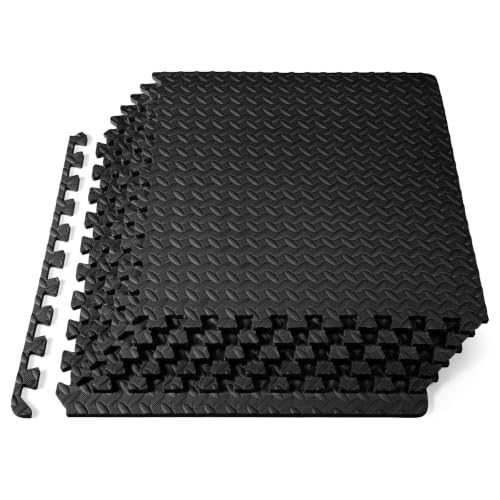
1. ProsourceFit Puzzle Exercise Mat 1/2 in (6 Tiles, 24 Sq Ft) — Best all-round starter set
The ProsourceFit Puzzle Exercise Mat is the standard half-inch option the guide uses as its baseline. Six tiles at 24 by 24 inches each cover 24 square feet, and the high-density EVA foam gives firm cushioning that protects knees, elbows and the floor itself during bodyweight work, stretching and light equipment use. The textured surface adds grip, and the tiles interlock with end borders included, so the finished area has the clean edges the guide tells you to check for instead of exposed puzzle teeth. Coverage expands by adding more sets, with the line sold in 24, 48 and 144 square foot configurations, and the standard black finish fits most home gyms and garages. The foam is water-resistant and wipes clean after workouts. Because a half-inch mat compresses under very heavy racks, treat it as a general-purpose surface rather than a deadlift platform. Choose this set if you want a proven, expandable starting point for a home gym or workout corner.
View ProsourceFit Puzzle Exercise Mat 1/2 in (6 Tiles, 24 Sq Ft) on Amazon

2. BalanceFrom Puzzle Exercise Mat 1/2 in (6 Tiles, 24 Sq Ft) — Best value with color options
The BalanceFrom Puzzle Exercise Mat covers the same half-inch, 24-square-foot footprint as our top pick, with a focus on value and color choice. Its six 24 by 24-inch tiles are made from high-density EVA foam that cushions the spine, hips, knees and elbows on hard floors, and both sides carry a non-slip texture, matching the guide’s points on density and surface grip. Twelve end borders come in the box, giving a finished edge without buying accessories separately. BalanceFrom sells the line in several thicknesses and coverage sizes up to large multi-tile layouts, so a small starter area can grow into a full room by adding matching sets later. The blue finish here brightens playrooms and kids’ areas where a black gym look is not wanted. The foam surface is water-resistant and easy to wipe down after use. Pick the BalanceFrom set if you want the standard home-gym specification with more color options and straightforward expansion.

View BalanceFrom Puzzle Exercise Mat 1/2 in (6 Tiles, 24 Sq Ft) on Amazon

3. We Sell Mats Multipurpose Tiles 3/8 in — Best thin tiles for play areas
The We Sell Mats Multipurpose tiles are the thinner 3/8-inch option, and the guide explains exactly where that thickness makes sense: playrooms, classrooms, laundry rooms and light bodyweight exercise, where a soft, warm surface matters more than heavy impact absorption. The EVA foam tiles measure 24 by 24 inches, interlock tightly, and ship with two border pieces per tile for the finished edges the guide recommends. This set covers a large area, suited to flooring a whole play space in one purchase. Sixteen color options run from black and charcoal to bright playroom colors, the widest palette among these picks. The surface wipes clean, and the tiles are intended for indoor use on hard floors rather than over carpet. Because they are thinner, they are not the choice for dropped weights or heavy equipment. Choose these tiles if you are flooring a kids’ area, classroom or multi-use room and want light cushioning with real color choice.


4. We Sell Mats Martial Arts Tiles 1 in Tatami — Best thick tiles for training and impact
The We Sell Mats Martial Arts tiles are the one-inch option, the thickness the guide reserves for higher-impact training. Each 24 by 24-inch tile is high-density EVA foam with a tatami-textured surface, the traditional martial arts finish that adds grip for hands and feet during drills, throws and ground work. That extra density and thickness absorb more impact than standard exercise tiles, making the set suitable for MMA, gymnastics practice and home dojos, as well as under heavier workout equipment. Every tile includes two border pieces, a straight edge and a corner edge, for the finished perimeter the guide recommends checking before you buy. The tiles are made for indoor use on hard floors and are not recommended over carpet. They cost and weigh more than thinner tiles, so they are overkill for a simple stretching corner. Pick the one-inch tatami tiles if your training involves falls, rolls or repeated impact.


5. ProsourceFit Wood Grain Puzzle Mat 1/2 in — Best wood-look tiles for living spaces
The ProsourceFit Wood Grain Puzzle Mat solves the problem the guide raises about foam tiles in shared living areas: it looks like flooring. The dark oak wood-grain finish lets a workout or play area blend into a living room, office or bedroom instead of announcing itself as gym equipment. Under the print it is the same half-inch EVA foam format as the standard ProsourceFit mat, with 24 by 24-inch interlocking tiles, six in this set covering 24 square feet, and end borders for a finished edge. The foam cushions floor exercises and protects hard floors from equipment and foot traffic, and the surface is water-resistant and wipes clean, which suits the cleaning guidance in this article. The material is phthalate-free, a detail worth noting for play areas. As with any half-inch foam, it suits bodyweight training and light gear rather than heavy dropped weights. Choose the wood-grain set if the tiles will live in a visible room and appearance matters as much as cushioning.

What to Look For
| Factor | Why it matters | What to check |
|---|---|---|
| Thickness | Changes cushioning and how well the mat handles weight. | The maker’s stated thickness and whether it suits your use, such as exercise or play. |
| Foam density | Dense foam resists dents from furniture and gear. | Material type, such as EVA, and any density information provided. |
| Tile size and count | Sets how much floor you can cover and how many seams show. | Tile dimensions, pieces per pack and whether border pieces are included. |
| Surface texture | Affects grip, look and how easy the mat is to clean. | Smooth, textured or wood-grain finish and whether the top is two-sided. |
| Edge pieces | Give a finished border and reduce lifted corners. | Included edge and corner pieces, and how firmly they lock. |
| Odor and cleaning | New foam can carry a smell, and spills happen. | Maker’s cleaning notes, water resistance and any stated material details. |
Setup and Care Tips
- Measure the space and sketch the layout so you know how many tiles and edges you need.
- Lay the tiles on a clean, flat, dry floor and let them rest flat for a day if they arrive rolled or bent.
- Press the joints together firmly and work from one corner across the room.
- Clean with a mild solution as the maker recommends and let the surface dry.
- Use a utility knife with care and a straight edge to trim tiles for odd corners.
Mistakes to Avoid
- Choosing tiles that are too thin for heavy equipment or furniture feet.
- Skipping a few spare tiles in case of damage or later layout changes.
- Laying them over a damp or uneven floor.
- Dragging heavy items across the foam surface.
- Ignoring edge pieces, then finding exposed sides catch and lift.
Which interlocking foam floor mats should you buy?
The right interlocking foam floor mats depend on what you will do on them, how much floor you need to cover and how the room should look. Match the use first, then the color and finish.
- If you want a proven, expandable set for a home gym or workout corner, go for the ProsourceFit Puzzle Exercise Mat 1/2 in.
- If you want the same standard spec with more color choice for a playroom or kids’ area, choose the BalanceFrom Puzzle Exercise Mat 1/2 in.
- If you are flooring a classroom, laundry room or play space and want light cushioning, the We Sell Mats Multipurpose Tiles 3/8 in fit that job.
- If your training involves falls, rolls or repeated impact, pick the We Sell Mats Martial Arts Tiles 1 in Tatami.
- If the tiles will sit in a visible living space, the ProsourceFit Wood Grain Puzzle Mat 1/2 in looks more like flooring than gym gear.
When two sets seem close, let thickness and appearance decide. Thicker tiles cushion more, while thinner tiles keep a lower profile and suit lighter use.
Check the listing for the exact tile count and the edge pieces included, because those details decide how finished the floor looks and how much more you need to buy.
How thick should interlocking foam floor tiles be?
Most home users do well with a mid-thickness foam tile for exercise and play, while thicker tiles are better for impact and thinner tiles for light use. The right thickness follows the activity, not the room.
The picks above cover three common levels. A thinner tile gives a soft, warm surface for children and light stretching. A mid-thickness tile suits bodyweight work and general home gym use. A thick tile is designed for training with falls and heavier impact.
- Thin tiles: light cushioning, low edge, good for play areas and utility rooms.
- Mid-thickness tiles: a balance of comfort and stability for workouts and general use.
- Thick tiles: more impact absorption, but they raise the floor height and take more effort to move.
Thickness is not the only factor. Foam density decides how well the tile resists dents from furniture feet and equipment. A thick but soft tile can compress under a heavy rack, so check the maker’s guidance on weight and use.
Also think about transitions. A raised floor can catch at doorways, so look at how the tile edges meet the neighboring floor and whether border pieces create a gentle slope.
EVA foam vs rubber flooring: which is the better choice?
EVA foam tiles are lighter, softer and easier to lay yourself, while rubber flooring is firmer and better suited to heavy equipment. Choose foam for comfort and ease, and rubber for durability under weight.
Foam tiles are common in home gyms, playrooms and workshops because they interlock without tools and can be lifted and moved later. They are warm underfoot and wipe clean, which suits families.
Rubber flooring is denser and more resistant to compression. It is often considered when weights will be dropped or heavy machines will sit in one spot, though it can be heavier to carry and may have a stronger smell at first.
- Foam is a good fit for: bodyweight workouts, kids’ areas, stretching, standing comfort.
- Rubber may be a better fit for: heavy lifting, dropped weights and equipment that must not dent the surface.
- Either way: check the maker’s notes on use and weight limits.
If your use sits in between, consider thicker, denser foam rather than switching material. Read the product description for density and intended use before deciding.
What to check before you buy foam floor mats
Before you buy interlocking foam floor mats, measure the room, confirm the tile size and check that edge pieces are included. Those three checks avoid most surprises.
- Room size: measure length and width, then divide by the tile size to estimate the number of tiles.
- Spare tiles: plan for a few extra in case of trimming mistakes or later damage.
- Edge and corner pieces: confirm they come with the set or must be bought separately.
- Subfloor: check the maker’s guidance for hard floors, carpet and uneven surfaces.
- Surface texture: decide between a grippy textured top and an easy-to-wipe smooth one.
- Color matching: if you may add sets later, check that the same color stays available.
- Odor and materials: read the material details, and air out new foam as the maker advises.
- Returns: confirm the return terms on the listing, since a bulky box is harder to send back once opened.
- Care: note the cleaning method the maker recommends.
Lay the tiles flat for a day if they arrive bent, and test the fit in a corner before you commit to the full layout.
How do you lay interlocking foam floor tiles?
Lay interlocking foam floor tiles by cleaning the floor, planning the layout, then pressing the tiles together from one corner outward. The job usually needs no tools beyond a knife for trimming.
Start by sweeping and drying the floor, since grit and moisture under foam can cause problems later. Dry-fit a few tiles to see where the cut pieces will land, and aim for cuts at the least visible edges rather than the middle of the room.
- Pick a starting corner: begin where two straight walls meet and work across the room.
- Press joints firmly: make sure each tab sits fully in its slot so the surface stays flat.
- Add borders last: edge and corner pieces give a finished look and reduce lifted corners.
- Trim carefully: use a sharp blade and straight edge, and cut slowly.
- Leave small gaps if advised: some makers suggest room at walls for expansion.
Once the floor is down, walk across it and look for any raised tabs or gaps. Press them flat before moving furniture or equipment in.
If you plan to move the floor later, keep the box and a few notes on the layout. Tiles lift out by pulling apart at the joints, and it helps to keep them clean and dry during storage.
Are foam floor mats worth it, and who should skip them?
Foam floor mats are worth it if you want an affordable-feeling, comfortable, easy-to-lay surface, and they are not the right pick for permanent, seamless or very heavy-duty flooring. The trade-offs are fair and worth knowing.
- Do the seams show? Yes, tiles have seams and edges. Border pieces help the look but do not hide the pattern.
- Do they dent? Furniture feet and heavy gear can leave marks, especially on thinner or softer foam.
- Are they permanent? No. That is a plus if you rent or want to move them, and a drawback if you want a fixed floor.
- Are they for wet areas? Surfaces are often water-resistant, but check the maker’s guidance, as seams can let liquid through.
Skip foam if you need a seamless floor, plan frequent wet use or will place heavy equipment on the tiles. A denser flooring type may suit those cases better.
Is it worth paying more? A higher price may bring thicker or denser tiles and more included pieces, but only pay up for the feature your use actually needs.
Compare the picks above, check the current listing for tile size and what is included, then choose the set that fits how you will use the space.
Going Deeper: Matching Interlocking foam floor mats to Real Life
The shortlist above gives you the headline differences between these interlocking foam floor mats, but the right choice usually becomes obvious only when you picture an ordinary week with the product in your home. Think about where it will live, who will use it most often, and what will make you stop using it if you get that part wrong. A product that looks ideal on a listing page can still be the wrong fit if it fights your space, your routine or the other people and things around it. The sections below walk through that thinking in the order experienced buyers tend to use, so you can test each pick on this page against your own situation before you commit.
Start with the job you actually need done
Write down, in one plain sentence, the main job you want these interlocking foam floor mats to do, and then a second sentence for the job you hope they will also handle occasionally. Most disappointment comes from buying for the occasional job and living every day with the compromise that creates. If the main job is daily and demanding, favour the pick that handles that job with the least fuss, even if another option looks more versatile on paper. If the main job is light and occasional, ease of storage, simple setup and low-maintenance care usually matter more than maximum capability. Keep those two sentences beside you as you re-read the picks above, and score each one honestly against them rather than against an idealised version of your routine.
Next, think about the conditions around the job. Will these interlocking foam floor mats be used indoors, outdoors, or moved between the two? Will they be used by one person or shared, by beginners or by people who already know what they are doing? Will they be used in short bursts or for long stretches at a time? Each answer quietly rules some designs in and others out: shared and frequent use rewards sturdiness and simple controls, while occasional solo use rewards compact size and quick setup. None of this appears in a headline feature list, yet it decides how satisfied you will feel a few months from now, when the novelty has worn off and only the everyday experience remains.
Measure the space, then measure it again
Space is the most common reason purchases like these get returned or quietly abandoned, so measure before you fall for any particular model. Note the full footprint the product needs in use, not just at rest: allow room to walk around it, to open anything that opens, to plug in, load, adjust or get on and off safely, and to store the accessories that come with it. Check doorways, hallways and storage spots it must pass through or live in, and compare those numbers with the dimensions the maker lists, in the same units, before ordering. If two people will use the space at once, allow for both of them. A few minutes with a tape measure now is far cheaper than repacking a bulky box later.
It also helps to think about what the product displaces. Few homes have genuinely empty space waiting, so these interlocking foam floor mats will usually push something else aside, share a corner, or need a small reorganisation to work well. Decide in advance where the displaced things go, and whether the new arrangement still leaves the room comfortable to move through. Consider light, airflow and noise as well: a spot that is technically big enough can still be a poor home if it is gloomy, cramped to reach, or likely to disturb people in the next room. Choosing the location first, and the model second, reverses the order most people use, and it prevents the classic mistake of a good product exiled to a bad corner.
Match the design to the user, not the brochure
Every design in this category involves a trade-off between capability, convenience and care. Simpler designs tend to be lighter, cheaper to maintain and easier to learn, but they may ask more of the user in patience or technique. More elaborate designs can take work off your hands or add comfort and control, yet they usually bring more parts to clean, more settings to understand and more that can wear or fail over time. Neither direction is better in the abstract. The better question is which trade-offs you personally mind least. If you know you abandon fiddly routines, choose the option you will actually use on a tired weekday, not the one that impresses on the first weekend.
If the product will be shared, involve the other users before you buy rather than after. People differ in height, strength, confidence and patience, and a design that suits the person who did the research can quietly exclude everyone else. Where the maker lists sizes, capacities or user limits, check them against the real people involved, including whoever is likely to grow, join in or help with setup and cleaning. Where adjustability is offered, value it properly: a little flexibility in fit or configuration often matters more over years of use than a small difference in headline features, because it lets one purchase keep working as people and habits change around it.
How the Picks Above Compare in Everyday Use
With that groundwork done, the picks in this guide sort themselves more clearly. Each one below earned its place for a different kind of buyer, so instead of asking which is best overall, ask which description sounds most like your household. The notes that follow use only what this guide has already said about each product, reframed around daily use, so you can compare them on the things that will actually decide your experience.
ProsourceFit Puzzle Exercise Mat 1/2 in (6 Tiles, 24 Sq Ft) is this guide’s choice for best all-round starter set. Read its description above with your two job sentences in mind: if that best-for use is your main job, this is the benchmark the others have to beat. Pay attention to how it is meant to be set up and stored, because that routine is the one you would repeat most often, and to any sizing or user guidance the maker gives, since a good match there matters more than small feature differences. If its best-for use sounds like your occasional job rather than your main one, keep it on the list by all means, but let a pick aimed squarely at your everyday need lead, and treat this one as the alternative to choose only if its particular strengths genuinely outweigh that focus.
BalanceFrom Puzzle Exercise Mat 1/2 in (6 Tiles, 24 Sq Ft) is this guide’s choice for best value with color options. Read its description above with your two job sentences in mind: if that best-for use is your main job, this is the benchmark the others have to beat. Pay attention to how it is meant to be set up and stored, because that routine is the one you would repeat most often, and to any sizing or user guidance the maker gives, since a good match there matters more than small feature differences. If its best-for use sounds like your occasional job rather than your main one, keep it on the list by all means, but let a pick aimed squarely at your everyday need lead, and treat this one as the alternative to choose only if its particular strengths genuinely outweigh that focus.
We Sell Mats Multipurpose Tiles 3/8 in is this guide’s choice for best thin tiles for play areas. Read its description above with your two job sentences in mind: if that best-for use is your main job, this is the benchmark the others have to beat. Pay attention to how it is meant to be set up and stored, because that routine is the one you would repeat most often, and to any sizing or user guidance the maker gives, since a good match there matters more than small feature differences. If its best-for use sounds like your occasional job rather than your main one, keep it on the list by all means, but let a pick aimed squarely at your everyday need lead, and treat this one as the alternative to choose only if its particular strengths genuinely outweigh that focus.
We Sell Mats Martial Arts Tiles 1 in Tatami is this guide’s choice for best thick tiles for training and impact. Read its description above with your two job sentences in mind: if that best-for use is your main job, this is the benchmark the others have to beat. Pay attention to how it is meant to be set up and stored, because that routine is the one you would repeat most often, and to any sizing or user guidance the maker gives, since a good match there matters more than small feature differences. If its best-for use sounds like your occasional job rather than your main one, keep it on the list by all means, but let a pick aimed squarely at your everyday need lead, and treat this one as the alternative to choose only if its particular strengths genuinely outweigh that focus.
ProsourceFit Wood Grain Puzzle Mat 1/2 in is this guide’s choice for best wood-look tiles for living spaces. Read its description above with your two job sentences in mind: if that best-for use is your main job, this is the benchmark the others have to beat. Pay attention to how it is meant to be set up and stored, because that routine is the one you would repeat most often, and to any sizing or user guidance the maker gives, since a good match there matters more than small feature differences. If its best-for use sounds like your occasional job rather than your main one, keep it on the list by all means, but let a pick aimed squarely at your everyday need lead, and treat this one as the alternative to choose only if its particular strengths genuinely outweigh that focus.
A useful final comparison is to imagine the worst ordinary moment with each pick: the rushed morning, the crowded room, the day something needs cleaning or putting away quickly. The right choice is usually the one whose worst ordinary moment you can live with easily. Also weigh how forgiving each design is of mistakes. Beginners, guests and children rarely use things exactly as intended, so a design that tolerates imperfect setup, rough handling or skipped steps gracefully will feel better in a real home than a more delicate design that demands everything be done just so. When two picks still seem equal after all this, choose the one that is simpler to care for and easier to store, because those are the qualities you will still be benefiting from long after the first impressions fade.
Setup, First Use and Settling In
When your choice arrives, resist the urge to rush it into full use. Unpack it somewhere with room to work, lay the parts out, and check everything against the maker’s list before you throw any packaging away; keep the box and paperwork until you are sure the product suits you, in case it needs to go back. Read the instructions all the way through once before starting, because the order of steps often matters and a step skipped early can be awkward to undo later. Assemble or set up on a clean, level surface with the tools the maker specifies, tighten and adjust things gradually rather than forcing them, and stop to re-read whenever something does not feel right. A careful first setup is the cheapest quality control there is.
Then give the product an honest breaking-in period. First uses are for learning, not judging: work out the settings, positions or techniques that suit you, expect a little awkwardness, and make small adjustments rather than large ones so you can tell what helped. Show anyone else who will use it how it works and agree the basic ground rules while enthusiasm is high, including where it lives, what it should never be used for, and who deals with cleaning and putting it away. If something seems wrong rather than merely unfamiliar, check the troubleshooting section of the manual before assuming a fault, since most early problems trace back to a setup step. Within a short time the routine should feel natural, and that, more than any first impression, tells you the purchase was right.
Safety checks worth making a habit
Whatever model you choose, build a few simple checks into your routine. Before use, glance over the parts that bear weight, move, heat up, plug in or fasten, and deal with anything loose, worn or damaged rather than working around it. Keep the area around the product clear while it is in use, follow the maker’s guidance on who should and should not use it, and never modify fixings, guards or safety features to make a setup fit; if the setup does not fit safely, change the setup, not the product. Store small parts, cords and accessories where they cannot trip, tangle or be reached by anyone too young to use them safely. These habits take seconds, they cost nothing, and they are the difference between a product that serves your home for years and one that causes an avoidable scare.
Care, Cleaning and Storage
Long life in this category is mostly about small, regular care rather than occasional heroic effort. After use, a quick wipe, shake-out, airing or tidy, following the maker’s guidance for the materials involved, stops dirt and moisture becoming the ingrained kind that is hard to shift later. Set a simple rhythm: a light clean as part of putting the product away, a slightly deeper clean on a regular cycle that suits how often you use it, and a periodic check of fastenings, surfaces and moving parts while you clean, so wear is spotted early when it is usually cheapest and easiest to address. Use only the cleaning methods and products the maker allows, because the wrong solvent, temperature or abrasive can damage finishes and fabrics in ways that are not covered by any warranty.
Storage deserves the same thought as use. Keep these interlocking foam floor mats somewhere dry, out of harsh sunlight and away from heat sources, in the position the maker recommends rather than balanced, squashed or loaded with other things. If the product folds, breaks down or comes apart for storage, practise the routine once while you are not in a hurry, and keep any tools, caps or small fittings together in one labelled place so they are not lost. Before a long break from use, clean everything thoroughly, let it dry fully, and check it over; before using it again, repeat the safety glance rather than assuming it is exactly as you left it. Treated this way, most products in this category repay their cost over a long period, and staying tidy also means the product is ready the moment you want it, which is half of why you bought it.
When something goes wrong
If performance drops or something breaks, work through the simple causes first: correct setup, correct settings, cleanliness, and whether anything has loosened, filled up, worn smooth or been stored badly. Consult the manual’s troubleshooting guidance and the maker’s support channels before paying for repairs or deciding the product is finished, and keep your proof of purchase and any warranty paperwork together from the start so that conversation is easy. If a part is replaceable, replacing it promptly usually protects the rest of the product from knock-on damage. And if the honest conclusion is that the product no longer suits your needs, that is useful information rather than failure: the notes you have made about what worked and what did not are exactly what will make your next choice in this category a better one.
A Calm Decision Checklist Before You Order
- I can state the main job I need these interlocking foam floor mats to do, in one sentence.
- I have measured the space in use and in storage, including access and clearance.
- I have checked the maker’s sizing, capacity and user guidance against the real people involved.
- I know how the product is set up, cleaned and put away, and I am willing to do that routine.
- I have compared the picks above by their best-for use, not by headline features alone.
- I have read the full description of my chosen pick on this page, including its limitations.
- I will check the current details, options and availability on the product page before ordering, since listings change.
- I will keep the packaging and paperwork until I am sure the product suits my home.
FAQ
Do the tiles stay in place on a smooth floor?
Interlocking joints hold tiles to each other, while the backing and floor type decide how much they shift. Check the maker’s notes on grip and any accessories they suggest.
Can I use them outdoors?
That depends on the material and the maker’s guidance. Some sets are described for indoor use only, so read the product details first.
How many foam tiles do I need for my room?
Measure the floor, then divide the area by the area of one tile and round up. Add a few extras for trimming and future replacement. Check whether border pieces are included, since they do not always count toward coverage.
Can you put interlocking foam mats over carpet?
Some makers advise against it because carpet can shift and the tiles may not lie flat. Read the listing, since several sets are described for hard floors. If you must use carpet, follow the maker's guidance.
Do foam floor tiles smell?
New foam can carry a smell at first. Unpack the tiles and let them air out in a ventilated room before laying them. If the odor stays strong, check the maker's material notes and contact them.
How do you clean interlocking foam mats?
Wipe them with a mild solution as the maker recommends, then let them dry fully. Avoid harsh chemicals unless the manual says they are safe. Regular sweeping helps keep grit from scratching the surface.
How do you cut foam floor tiles to fit?
Use a sharp utility knife and a straight edge, and cut slowly over a protected surface. Measure twice before cutting. Check that the maker allows trimming.
Will foam floor mats damage hardwood floors?
Foam is soft, but trapped moisture or grit under the tiles could mark a floor. Make sure the floor is clean and dry before laying them. Check the maker's guidance for your floor type.
Are foam floor mats safe for kids?
Many are sold for play areas, but check the material details on the listing. Make sure edges lock and that small pieces are not loose. Follow the maker's guidance on age and use.
Matching It to Your Space and Use
Foam tiles can serve very different jobs, so decide the main one before comparing sets.
Home Gyms
Consider the equipment on the floor. Heavy machines can compress soft foam, so thickness and density descriptions matter. Check the maker’s guidance on weight and use.
Play Areas
Look for edge pieces so the border feels finished, and consider how easily spills can be wiped clean.
Workshops and Garages
Standing comfort is the draw here. Think about oils, dropped tools and sharp debris that may mark the surface.
Compatibility Checks
- Room dimensions: measure the space and divide by tile size to estimate how many tiles you need.
- Edge pieces and corners: confirm they are included or sold separately.
- Subfloor type: hardwood, tile, carpet and concrete may each behave differently.
- Thickness: check door clearances and transitions to other flooring.
- Cleaning: read the maker’s instructions for suitable cleaning methods.
Seasonal and Storage Notes
Foam can expand or contract with temperature changes, so leave a small gap at walls if the maker suggests it. If you take the tiles up for the summer, stack them flat in a dry place and avoid heavy items on top. Clean and dry them fully before storing.
Who Should Skip It
If you need a very firm surface for heavy equipment, rubber flooring may be a better match. Those who want a permanent, seamless floor, or who plan on frequent wet use, might look at other flooring types. Always check the manual for use guidance.
Questions to Ask Before You Buy
- Do I want a smooth top, a textured top, or a reversible set?
- Are the tiles meant for exercise, play, or standing comfort?
- How will the edges look against walls and furniture?
- Can I trim a tile with a utility knife, and does the maker suggest it?
- Will I want to lift the floor and move it later?
Feature Trade-offs
| Choice | Upside | Consideration |
|---|---|---|
| Thicker tiles | More cushioning underfoot | Raised edge to manage |
| Thinner tiles | Lower profile | Less give |
| Textured surface | Grippy feel | Harder to wipe clean |
| Smooth surface | Simple to clean | Can feel slick when wet |
How do I choose the right size or capacity?
Start from the people and the space, not from the biggest option available. Use the maker’s sizing and capacity guidance, compare it honestly with who will use the product and how much room you measured, and remember that a slightly generous fit usually feels better than one that only just works on paper. If you fall between two options, favour the one that leaves comfortable clearance in use and in storage, because a product that is awkward to live around gets used less, however capable it is.
What should I check first when the product arrives?
Check the contents against the maker’s list, look everything over for damage, and read the instructions fully before setting anything up. Confirm that fixings, accessories and any tools you need are present, keep the packaging until you have used the product a few times, and register or file the warranty paperwork somewhere you will find it later. A slow first half hour prevents most of the problems people blame on the product itself.
How often does this kind of product need cleaning?
Little and often works best. A quick clean as part of putting the product away, plus a deeper clean on a regular cycle matched to how heavily you use it, keeps dirt and wear from building up. Always follow the maker’s guidance for the materials involved, and use the cleaning time to glance over fastenings and surfaces, so small issues are caught while they are still small.
Can I use it in a smaller home or a rented property?
Often, yes, but let the space lead the decision. Measure carefully, favour designs that store compactly or set up without permanent changes where that matters to you, and check any rules that apply to your home before choosing a model that fixes, hangs or installs in a lasting way. The descriptions above note which picks suit tighter or less permanent setups, and those are the ones to shortlist first if space or renting is your main constraint.
What is the most common mistake buyers make in this category?
Buying for features instead of fit. Shoppers compare headline specifications, choose the most capable option, and then discover it is too big for the room, too involved for their routine, or wrong for the people actually using it. Measuring first, being honest about how often and how carefully the product will be used, and choosing by best-for use rather than by specification lists avoids nearly all of it.
How long should a product like this last?
That depends far more on use and care than on the badge. Set up correctly, used within the maker’s guidance, cleaned little and often and stored dry and unstressed, a well-chosen product in this category should give long, uneventful service. Neglect, overloading and poor storage shorten life quickly, which is why the care and storage sections above are worth following even when everything seems fine.
What if the product turns out not to suit us?
First, check whether the problem is setup or fit rather than the product: re-read the instructions, try the maker’s troubleshooting steps, and make the small adjustments suggested in the guide above. If it genuinely does not suit, keeping the packaging, paperwork and proof of purchase makes returning or exchanging far easier, and the notes you made about why it did not work will point you straight to the pick that will.
The Short Version
Match thickness and density to your use, then check tile size, texture and edge pieces. Buy a little extra and prepare the floor, and the finished surface will look neat and wear well.