Most blender guides compare brands against each other, which quietly assumes the shopper has not yet chosen a badge for the counter. A large group of buyers has, though, and for reasons that have little to do with loyalty theatre. Hamilton Beach machines share jars, blades, gaskets, and control logic across much of the catalogue, the brand publishes its parts lists openly, and its prices sit in the part of the market where a replacement jar costs less than a service call on a premium rival. Once a household decides that its next blender will wear this badge, the useful question changes completely. It stops being which brand wins and becomes which shelf of one catalogue a kitchen actually belongs on. This guide answers that second question, placing six current Hamilton Beach blenders where they sit inside their own family.
One disclosure before the picks. This site may earn an affiliate commission when readers buy through links on the page, at no extra cost to the reader. That commission is the business model, and it is stated plainly so the reasoning below can be judged on its merits. The selections come from research: manufacturer specifications and use-and-care documents, stated capacities and peak-power figures as the brand itself defines them, parts documentation, and the physics of what a blade assembly does to ice and frozen fruit at each power tier. Nothing here rests on a popularity score, and the order of the picks follows the catalogue’s own ladder from flagship to entry point rather than a claim that one machine wins for every kitchen.
Two boundaries keep the comparison honest. Every pick below is a Hamilton Beach machine, with no guest appearances from rival brands, and every pick is a jar blender in the countertop or personal format rather than an immersion stick. Readers of this site may also know the companion guide to blenders with a glass jug, which filtered the whole market by jar material and included two of the models below. That article asked which machines wear glass; this one asks a different question — where each model stands in the Hamilton Beach line — so the overlap is deliberate and the analysis is not. A model that appeared there as a glass-jar answer appears here as a rung on a ladder, judged on what its position in the family gives and withholds.
In this guide
Quick picks: best hamilton beach blenders
| # | Product | Where to buy |
|---|---|---|
| 1 | Hamilton Beach Professional 58870 | Check on Amazon |
| 2 | Hamilton Beach Power Elite 58148 | Check on Amazon |
| 3 | Hamilton Beach Wave Crusher 54221 | Check on Amazon |
| 4 | Hamilton Beach Smoothie Smart 56206 | Check on Amazon |
| 5 | Hamilton Beach Single-Serve 51131 | Check on Amazon |
| 6 | Hamilton Beach Power Elite 58163 | Check on Amazon |
One catalogue, four tiers: how the Hamilton Beach line is organised
The catalogue reads simply once its ladder is visible. At the bottom sits the personal tier, small single-serve machines built around a jar that doubles as a travel cup, with modest motors and one-button controls. Above it stretches the broad mainstream shelf, a family of full-size countertop blenders that share a 700-watt peak-power motor class, a 40-ounce jar format, and the brand’s Wave-Action blending system, differentiated by controls, blade branding, and bundled attachments rather than by raw force. Beside that shelf stand the combo systems, which bolt a food processor bowl or a travel jar onto the same mainstream base. At the top, separated by a wide gap in both power and price, sits the Professional tier, where the brand fields its high-performance machines with programmed cycles, variable-speed dials, and warranties twice the mainstream length.
Understanding the ladder matters because Hamilton Beach model names do not climb it in any obvious order. The Power Elite name appears on the mainstream shelf and on the combo system alike, while the Wave Crusher name describes a sibling of the Power Elites rather than a step above them. Model numbers carry the real information, and they sit close together: the mainstream machines in this guide answer to 58148, 54221, 56206, and 58163, four codes a hurried shopper could transpose without noticing. Each code is a different machine with a different control panel and, in one case, a different jar entirely. The sections below treat the model number as part of each pick’s name, because inside this catalogue the number is the identity and the marketing name is only the family surname.
Shared engineering runs underneath the ladder and explains why brand-first shopping works here at all. Wave-Action, the brand’s patented system, uses jar geometry and blade placement to pull the mixture down into the cutting assembly continuously, and it appears on machines from the mainstream shelf upward. The mainstream models share a jar footprint and a threaded collar design, which is why their lids, jars, and blade assemblies are stocked as ordinary replacement parts rather than exotic special orders. Even the manuals share a voice: the same peak-power explanation, printed in guide after guide, defines the wattage figure as an input measure taken in the first seconds of operation. A buyer who learns to read one Hamilton Beach specification sheet has effectively learned to read them all.
What to look for when every pick wears the same badge
Start with the tier, because within one brand the tier decides more than any feature list. The gap between the personal machines and the mainstream shelf is a gap in kind: a 175-watt single-serve motor is built for soft fruit, protein powder, and liquid, and no blade design turns it into an ice crusher for a crowd. The gap between the mainstream shelf and the Professional tier is a gap in degree that shows up with frozen loads, thick mixtures, and daily use over years. Shoppers who blend a smoothie each morning and little else are buying far more machine than they need at the top of the ladder, while households crushing ice for weekend drinks in batches will feel the mainstream ceiling quickly. Naming the household’s heaviest regular job, honestly, places the purchase on the right shelf before any model is compared.
Jar capacity deserves the same honesty, read against serving counts rather than headline ounces. The mainstream 40-ounce jar blends two generous smoothies or three modest ones, and its working fill for frozen drinks sits lower than its brim, because a frozen load needs headroom to fold. The Professional pick in this guide inverts the usual flagship pattern: its jar is the smallest full-format jar here, a 32-ounce vessel chosen to suit its quiet shield, so a household blending for four should notice that the most powerful machine is not the most capacious one. The personal tier’s 14-ounce jar is a single serving by design. Capacity mistakes in this catalogue are rarely about buying too little machine; they are about buying a jar shaped for a different household.
Jar material, in this guide, is a specification to verify rather than the axis of choice. The mainstream shelf is largely a glass-jar family, which brings the familiar glass virtues of stain resistance and a settled weight on the counter, while the Professional tier’s jar is a BPA-free shatterproof plastic and the personal tier’s travel jar is plastic by necessity. What matters for the buyer is that material follows the model number, not the family name: Hamilton Beach sells near-identical names over different jars in the wider market, and the only reliable confirmation is the specification published for the exact code being bought. That discipline — number first, name second — recurs throughout this guide because it is the single most common way a one-brand purchase goes wrong.
Controls separate the mainstream siblings more than power does. All four mainstream picks share the same 700-watt peak class, so the choice among them is really a choice about how blending decisions get made. Push-button panels with a dozen or more labelled functions hand the decisions to the cook, who picks a speed and watches the jar. A programmed cycle hands them to the machine, which runs a fixed pattern of pulses and ramps and then stops itself. A combo system changes the question again by adding a second appliance’s controls to the same base. None of these is objectively superior; they suit different temperaments, and a household that blends while packing school bags will value automation that a salsa maker, stopping and starting to judge texture, would find obstructive.
Noise deserves a paragraph of its own, because it is the mainstream shelf’s shared blind spot. Every 700-watt machine in this guide is loud in the way of its class — a frozen load at full speed is a brief, intense event that carries through a flat or a small house — and none of the four mainstream models attempts to answer it. Only the flagship treats sound as a design problem, which quietly makes noise a tier question rather than a model question. A household blending at dawn with sleepers behind thin walls should therefore not shop the mainstream shelf hoping one sibling is gentler than another; the honest choices are to blend at a kinder hour, to move up to the shielded machine, or to accept the minute of noise as part of the routine.
Counter fit is the unglamorous check that decides whether a blender lives on the counter or in a cupboard, and the ladder’s rungs differ here too. The mainstream machines stand at a height that slides under standard wall cabinets with the jar seated, which is one reason the 40-ounce format persists across the shelf. The flagship’s shield adds height and a second object to store when it is off the jar, and the personal machine breaks the pattern entirely by wrapping its cord and retreating into a drawer. Measure the vertical space between counter and cabinet before choosing a tier, because a blender stored out of sight is a blender used monthly, whatever its specification promised.
Parts and warranty complete the picture, and they are where a one-brand catalogue quietly rewards its owner. Hamilton Beach sells replacement jars, blade assemblies, lids, and gaskets for its mainstream lines through ordinary retail and its own parts channel, and the shared footprint across the shelf means those parts stay in production as long as the family sells. Warranty length maps neatly onto the ladder: the personal tier carries the shortest cover, the mainstream shelf carries a three-year limited warranty, and the Professional tier doubles that to five years. Read as a whole, the catalogue is designed so that a mainstream machine is a maintainable appliance rather than a disposable one, and the picks below are judged partly on how well each model honours that design.
The six Hamilton Beach blenders, placed in the lineup
The six picks are ordered the way the catalogue itself is organised, from the Professional flagship down through the mainstream shelf and its combo branch to the personal tier. Two of the mainstream machines share a surname and nearly share a specification, so their sections are written to be read against each other; the differences between them are small, real, and exactly the kind a one-brand shopper needs spelled out.
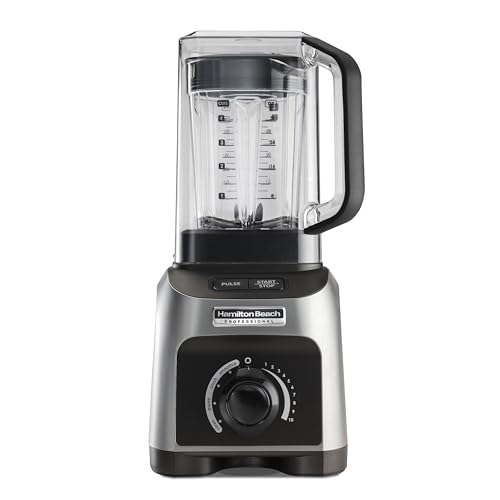
Hamilton Beach Professional 58870 Quiet Shield: the flagship that turns the volume down
The 58870 is the machine Hamilton Beach builds when it wants to argue with the premium brands, and its defining feature is not power but the management of power’s side effects. A removable shield encloses the jar during blending, damping the noise that a 1500-watt peak motor — rated at 2.0 peak horsepower, with hardened stainless blades the brand describes as spinning past 105 miles per hour — would otherwise broadcast across an open-plan home. The shield lifts off and doubles as a serving pitcher, a small piece of design intelligence that acknowledges where blended drinks actually go. Under the shield sits a 32-ounce BPA-free jar, a variable-speed dial supplemented by four programmed cycles for smoothies, ice crushing, purées, and cleaning, plus a pulse function and a tamper for thick mixtures that need physical encouragement.
Its position in the catalogue is unambiguous: this is the only pick here that leaves the 700-watt class behind, and the only one whose warranty runs to five years. The programmed cycles matter more than their count suggests, because at this power level the difference between a smoothie cycle that ramps speed gradually and a cook stabbing at buttons is the difference between a vortex that forms and a jar that splashes its load against the lid. The clean cycle deserves its mention too, since a jar under a shield is a jar nobody wants to scrub by hand. What the flagship does not offer is volume. Thirty-two ounces is a deliberate constraint imposed by the shield’s geometry, and it makes this a machine for households of one to three, or for quality-over-quantity blending in larger ones.
Strengths
- 1500 watts of peak power and 2.0 peak horsepower place it in a different performance class from the rest of the catalogue
- The removable quiet shield meaningfully reduces blending noise and doubles as a serving pitcher
- Four programmed cycles, including a self-cleaning cycle, plus a variable-speed dial and tamper
- A five-year limited warranty, the longest cover in this guide
Trade-offs
- The 32-ounce jar is the smallest full-format jar among these picks, limiting batch size
- It costs several times what a mainstream model costs, for power many households will rarely use
- The shield is one more component to store, wash, and keep track of in a crowded kitchen
Who it suits
Early risers blending before the household wakes, smoothie devotees working with frozen fruit daily, and cooks who purée soups and sauces to a fine finish will find this the one machine in the line that never asks them to compromise on force or on volume of sound. It is equally the right answer for a buyer who keeps appliances for a decade and reads a five-year warranty as the brand’s own estimate of the machine’s working life. Households whose blending is occasional, or whose batches regularly serve four or more, should let their eyes travel further down the ladder, where capacity grows as power falls. Anyone ready to make the flagship the loudest-quietest resident of the counter can check price on Amazon.
Check price on Amazon: Hamilton Beach Professional 58870

Hamilton Beach Power Elite 58148: the mainstream default
If the catalogue has a centre of gravity, the 58148 is it. The specification is the mainstream template from which the shelf’s variations are drawn: a 700-watt peak-power motor, a 40-ounce glass jar with a no-mess pour spout, the Wave-Action system pulling the mixture down into stainless steel blades, and a push-button panel offering twelve blending functions. Nothing in that list is exotic, and that is precisely the point. This is the configuration Hamilton Beach has refined across years of production, the one whose jars, lids, and blade assemblies are stocked everywhere blender parts are sold, and the one against which its own siblings must justify their existence.
Read against the rest of the shelf, the 58148’s virtues are balance and legibility. Twelve functions sound like abundance, but in practice they resolve into a ladder of speeds with labelled starting points, which suits cooks who blend by eye and stop when the texture looks right. The glass jar brings the mainstream family’s standard benefits — no staining from berry or turmeric loads, no lingering scent of garlic in the next morning’s shake, and a weight that keeps the base planted when ice starts moving. The removable blade assembly and jar collar come apart for washing and go back together without tools, and the gasket between them is a cheap, stocked wear part rather than a fatal failure. A three-year limited warranty completes a specification that makes no dramatic claims and keeps the ones it makes.
Strengths
- The catalogue’s most proven configuration, with replacement jars and blade assemblies widely stocked
- A 40-ounce glass jar that resists stains and odours and pours through a no-mess spout
- Twelve blending functions give cooks direct, legible control over texture
- Dishwasher-safe jar, lid, and blades keep daily cleanup uncomplicated
Trade-offs
- It shares its 700-watt ceiling with the whole mainstream shelf, so frozen loads need liquid and patience
- No programmed cycle means the cook attends the blend from start to finish
- The glass jar’s weight, filled, is noticeable for smaller or older hands
Who it suits
This is the pick for the household that blends several times a week across the ordinary range of jobs — morning smoothies, weekend salsas, soups, shakes, and the occasional tray of ice — and wants one machine that handles all of it without ceremony or special pleading. It suits buyers who value the ability to replace a jar or a gasket years from now over any single headline feature, and cooks who prefer their own judgement to a program’s. Shoppers whose blending centres on ice above all else, or who want the machine to run itself, have siblings waiting in the next two sections. As the reference point of the entire mainstream shelf, the 58148 is where a one-brand search most naturally begins, and current listings for it can be compared when you check price on Amazon.
Check price on Amazon: Hamilton Beach Power Elite 58148

Hamilton Beach Wave Crusher 54221: the ice specialist on the mainstream shelf
The Wave Crusher is the 58148’s closest sibling and its most direct internal rival, built on the same 700-watt peak motor and the same 40-ounce glass jar, then angled deliberately at one job. Its stainless blades carry the Ice Sabre name, its panel stretches to fourteen functions, and the brand supports the ice brief with a durability claim the Power Elite does not make: a motor life-tested, in Hamilton Beach’s own words, to blend 8,000 frozen drinks. Whether a household ever approaches that count is beside the point. The figure tells the shopper where the engineering emphasis went — into a blade-and-motor pairing expected to spend its life chewing frozen loads rather than merely tolerating them.
Distinguishing the two siblings honestly matters, because a careless comparison makes them sound identical. The Wave Crusher’s extra functions are refinements of the same speed ladder rather than new abilities, and both machines lean on Wave-Action to keep a frozen mixture circulating instead of bridging over the blades. Where the Wave Crusher pulls ahead is intent: its blade geometry is the ice-crushing design, its marketing and manual centre frozen drinks, and its durability claim is stated in units of frozen drinks rather than years. Where it falls behind is nowhere dramatic, which is itself informative — the choice between the siblings is a coin weighted by workload. A kitchen whose blender meets ice daily should weight it toward this side; a kitchen blending mostly soft ingredients gains nothing it can detect.
Strengths
- Ice Sabre stainless blades and a motor life-tested to blend 8,000 frozen drinks, per the brand’s own literature
- Fourteen functions, the broadest labelled control set on the mainstream shelf
- The same 40-ounce glass jar, Wave-Action system, and three-year limited warranty as its sibling
- Removable blades and jar collar are dishwasher safe, which matters after frozen fruit sugars dry
Trade-offs
- The same 700-watt peak ceiling as the Power Elite, so dense frozen loads still need adequate liquid
- Its advantages over the 58148 are matters of emphasis, not capability, and vanish for soft-ingredient blending
- No programmed cycle, so frozen drinks still require the cook’s attention
Who it suits
Frozen-drink households are the audience: families blending smoothies from frozen fruit every morning, home bartenders working through bags of ice on summer weekends, and anyone whose previous blender died the characteristic death of a motor strained past its design brief. The 8,000-drink figure is best read as the brand telling such buyers, in writing, that this is the mainstream machine built for their workload. Households blending mostly fresh ingredients, soups, and sauces will find the same money buys the same results from the plainer sibling above. For kitchens where the ice tray empties faster than the fruit bowl, the Wave Crusher is the mainstream shelf’s considered answer, and its current listings reward a moment spent to check price on Amazon.
Check price on Amazon: Hamilton Beach Wave Crusher 54221

Hamilton Beach Smoothie Smart 56206: the mainstream shelf learns to run itself
The Smoothie Smart takes the mainstream formula — the same 700-watt peak class, the same 40-ounce thermal-shock-resistant glass jar, the same Wave-Action circulation — and changes the one thing its siblings leave manual: the blending itself. Its headline feature is a programmed 45-second smoothie cycle that begins with a series of pulses to break the load apart, drops to a lower speed, then ramps gradually upward before switching itself off. Beside that button sit the ordinary manual controls for everything else, a smooth touchpad that wipes clean instead of trapping smoothie residue around raised buttons, a patented no-mess pour spout with a hinged cap, and cord storage in the base.
Automation of this kind is easy to dismiss as a gimmick until its actual user is pictured clearly. The cycle’s pulse-then-ramp pattern is exactly the sequence an experienced cook performs by hand to keep a frozen smoothie moving without an air pocket forming over the blades, and encoding it in a button means the result no longer depends on who is standing at the counter. A parent blending one-handed while a toddler occupies the other arm, or a commuter who starts the smoothie and leaves the kitchen to find keys, gets the texture the program was tuned for. The trade is control: the cycle runs its full course regardless of what is in the jar, and cooks who blend salsa or sauces to a judged consistency will simply ignore the smart button and use the manual speeds, at which point they own a well-mannered mainstream blender with an unusually cleanable panel.
Strengths
- The 45-second Auto Smoothie cycle pulses, ramps, and shuts off without supervision
- A wipe-clean touchpad instead of raised buttons that trap residue
- The patented no-mess spout with hinged cap pours without dripping down the jar
- Mainstream hardware underneath: 700-watt peak power, 40-ounce glass jar, Wave-Action
Trade-offs
- The programmed cycle is tuned for smoothies; other jobs still run manually
- A fixed 45 seconds cannot adapt to an unusually thick or thin load
- Touchpads give less tactile feedback than physical buttons for cooks who blend by feel
Who it suits
Routine is the deciding word. Households where a smoothie happens at the same pressured hour every morning, made by whoever is free, benefit most from a result that does not vary with the operator. The Smoothie Smart also suits small kitchens where the blender lives beside the sink and its panel gets wiped often, and anyone who has ever scraped dried smoothie from around a forest of buttons will understand the touchpad’s appeal without further argument. Cooks who blend varied textures and judge each batch by eye are better served by the manual siblings. For the set-it-running morning household, though, this is the mainstream shelf’s most thoughtful variation, and comparing its current offers takes only a moment to check price on Amazon.
Check price on Amazon: Hamilton Beach Smoothie Smart 56206

Hamilton Beach Single-Serve 51131: the personal tier, honestly sized
Every ladder needs its bottom rung described without embarrassment, and the 51131 is Hamilton Beach’s: a personal blender whose 14-ounce BPA-free jar blends one serving and then, with its travel lid swapped on, becomes the cup that serving leaves the house in. The motor is the smallest in this guide by a wide margin, the controls reduce to a single touch, and the base wraps its own cord for storage in a drawer or a crowded cupboard. The jar is sized to fit most car cup holders, marked with measuring lines, and dishwasher safe along with its blades and lid. Overheat protection guards the small motor against the one abuse it reliably suffers, which is a user asking it to chew through a jar packed solid with frozen chunks.
Judged inside its tier rather than against the shelf above, the design is coherent. A personal blender’s real competitor is not a countertop machine but the washing-up created by using one for a single drink, and the blend-in-jar format abolishes that cost entirely: blend, swap the lid, rinse nothing until evening. Its honest limits follow from its wattage, and the brand’s own materials position it for shakes, smoothies from soft or lightly frozen fruit, dressings, and small grinding jobs like flax seed or oats. Within those borders it is complete. Outside them — full ice cubes in quantity, frozen fruit by the bag, drinks for two — the correct response is not disappointment but a step up the ladder, which is what the ladder is for.
Strengths
- Blending directly in the 14-ounce travel jar removes the separate washing-up a single serving usually creates
- One-touch operation and a cord-wrapping base make it the simplest machine in the catalogue to live with
- The jar fits most car cup holders and carries measuring lines for repeatable recipes
- Overheat protection suits a small motor’s most common failure mode
Trade-offs
- The smallest motor in the lineup, intended for soft ingredients and modest frozen loads
- One serving per blend, with no path to batch work
- The shortest warranty cover in this guide, matching its entry position in the line
Who it suits
Solo households, dorm rooms, office desks, and gym-bag routines are its natural territory, along with the second-blender role in a larger kitchen where the countertop machine is overkill for one protein shake. It also suits the buyer testing whether a smoothie habit will stick before committing counter space and money to the mainstream shelf — a cheap experiment with a clear upgrade path, since its recipes scale directly into the 40-ounce jars above. Anyone blending for a family, or freezing fruit in bulk, should start their reading several sections earlier. For the one-person, one-drink morning it was designed around, the little machine asks very little and delivers its whole brief, and shoppers speccing exactly that routine can check price on Amazon.
Check price on Amazon: Hamilton Beach Single-Serve 51131

Hamilton Beach Power Elite 58163: the mainstream base grows two extra appliances
The 58163 keeps the Power Elite surname and the mainstream 700-watt peak base, then spends its budget on attachments rather than on a different blender. Onto that base mount three vessels: the familiar 40-ounce glass blending jar with its patented drip-free pour spout, a 3-cup food processor bowl fitted with both a chopping blade and a reversible slicing and shredding disc, and a 20-ounce blend-in travel jar with a leak-proof lid. One motor, one footprint, three jobs. In the catalogue’s logic this is the combo branch of the mainstream shelf, aimed at kitchens where the counter, not the budget alone, is the scarce resource.
The honest way to judge a combo is to ask what each attachment replaces and what it concedes. The food processor bowl will not match a dedicated processor’s capacity or feed-tube width, but the jobs small kitchens actually hand a processor — shredding cheese, slicing onions, chopping a salsa base or a bowl of nuts — sit comfortably inside a 3-cup bowl driven by a 700-watt base. The travel jar borrows the personal tier’s blend-and-go convenience without asking the household to store a second motor. What the system concedes is simultaneity and storage of a different kind: only one vessel works at a time, and three vessels with their blades and discs need a cupboard even if they spare the counter. For a small kitchen that would otherwise own a blender alone and improvise the rest with a knife, the arithmetic usually favours the combo.
Strengths
- Three appliances on one mainstream base: blender, 3-cup food processor, and blend-in travel jar
- The processor bowl includes both a chopping blade and a reversible slicing and shredding disc
- The full-size 40-ounce glass jar keeps the standard Power Elite blending performance
- One footprint and one cord for kitchens where counter space is the binding constraint
Trade-offs
- The 3-cup processor bowl is sized for small batches, not for feeding a crowd
- Attachments multiply the pieces to wash, store, and eventually keep track of
- Only one vessel can run at a time, since everything shares a single base
Who it suits
Small kitchens, first apartments, and cooks who prepare food for one or two people will extract the most from this system, because its compromises are sized exactly to their batches. It also suits the methodical buyer who would rather maintain one motor and one parts relationship than three, since the base, jars, and attachments all live inside the same Hamilton Beach parts ecosystem as the rest of this guide. Households that process in bulk, or that already own a full-size food processor they love, gain little from the extra vessels. As the mainstream shelf’s answer to the crowded counter, the 58163 makes a compact case for itself, and shoppers weighing that case can check price on Amazon.
Check price on Amazon: Hamilton Beach Power Elite 58163
The six picks side by side
The table compresses the ladder into one view, using the manufacturers’ own published figures and plain descriptions rather than scores. Read it by tier first and by feature second, because the tier is what the money actually buys.
| Pick | Place in the line | Power, as published | Jar | Defining trait |
|---|---|---|---|---|
| Hamilton Beach Professional 58870 | Professional tier | 1500 watts peak, 2.0 peak HP | 32 oz, BPA-free shatterproof | Quiet shield and programmed cycles |
| Hamilton Beach Power Elite 58148 | Mainstream shelf | 700 watts peak | 40 oz glass | The balanced default configuration |
| Hamilton Beach Wave Crusher 54221 | Mainstream shelf | 700 watts peak | 40 oz glass | Ice Sabre blades, frozen-drink brief |
| Hamilton Beach Smoothie Smart 56206 | Mainstream shelf | 700 watts peak | 40 oz glass | 45-second self-running smoothie cycle |
| Hamilton Beach Single-Serve 51131 | Personal tier | Smallest motor in the line | 14 oz travel jar | Blends in the cup it serves in |
| Hamilton Beach Power Elite 58163 | Mainstream combo branch | 700 watts peak | 40 oz glass, plus two more vessels | Blender, processor, and travel jar on one base |
Two patterns stand out once the ladder is flattened this way. First, the mainstream shelf is one hardware platform wearing four control philosophies, which is why the sections above spend their words on panels, cycles, and attachments rather than on power. Second, the catalogue’s extremes are defined by their jars rather than their motors: the flagship’s jar is small because silence demanded it, and the personal machine is nothing but a jar with ambitions. Shoppers who read the table and still cannot choose are usually stuck between the two Power Elite siblings, and the tie-breaker is workload — ice daily, take the Wave Crusher; everything else, take the default.
Wave-Action, explained without the marketing
Nearly every pick in this guide carries the same patented system, so it deserves one clear explanation. In a conventional blender jar, a spinning blade creates a vortex that can leave ingredients riding the walls or bridged above the blades in a frozen arch, which is why cooks learn to stop, tamp, and shake. Wave-Action attacks that geometry problem rather than the power problem: the jar’s profile and the blade assembly are shaped so the mixture is continuously folded downward into the cutting zone, keeping the whole load in circulation. Hamilton Beach has built the system into its mainstream line for years, and its presence across the shelf is one reason the 700-watt machines perform beyond what their headline figure suggests to a shopper comparing raw numbers across brands.
Technique still matters inside the system, and the manuals quietly teach it. Frozen loads circulate best when liquid reaches roughly the level of the solids, giving the vortex something to carry, and a short pulse before sustained speed breaks a frozen arch into pieces the circulation can then manage. Thick mixtures — nut butters, hummus, dense purées — sit at the edge of what circulation alone can do, which is why the flagship ships with a tamper and the mainstream machines ask for patience and a spatula through the lid opening instead. A cook who learns these two habits gets mainstream results that approach the tier above; a cook who ignores them can make even the flagship feel underpowered, because no jar geometry defeats a load with nothing liquid in it.
The system’s limits are as instructive as its strengths. Circulation helps a blade meet the food; it does not multiply the force behind each meeting, which is why a mainstream jar still wants liquid around a frozen load and why the Professional tier exists for cooks who refuse that compromise. Wave-Action also explains a small maintenance fact: because the system depends on jar geometry, the jar is part of the machine’s engineering rather than a passive container, and a chipped or incorrect replacement jar can quietly degrade the circulation the buyer paid for. Ordering the jar by model number, from the brand’s own parts list, is not pedantry. It is how the system survives its own replacement parts.
Reading Hamilton Beach model numbers and wattage claims
The brand’s manuals perform an unusual act of honesty, and it is worth learning from them directly. Their peak-power note explains that the wattage figure is determined by an Underwriters Laboratory test, reflects input power measured around the first seconds of operation, and that the blender as provided may draw significantly less in ordinary use. In other words, the number on every box in this guide — 700, 1500 — describes a momentary ceiling, not a cruising speed. Within one brand that definition is at least consistent, so the figures rank the tiers reliably even though they flatter every machine equally. Across brands, where definitions differ, the same numbers would mislead, which is one more argument for the one-brand comparison this guide is built on.
Model numbers demand the same literal reading. The four mainstream codes in this guide differ by a few digits and describe machines with different panels, different blades, and in the 58163’s case an entirely different box of attachments. Colour variants and jar variants multiply the codes further in the wider market, and a family name like Power Elite can sit over glass and plastic jars alike depending on the code that follows it. The companion guide on this site to blenders with a glass jug approaches the same catalogue from the material side, and the two articles agree on the working rule: the code is the product, and the name is only its family.
The wider catalogue: relatives that did not make this list
Six picks draw a map, not a census, and a one-brand shopper will meet relatives of these machines on the same shelves and listings pages. The Professional tier itself has a sibling worth knowing: a larger Professional model built around a 64-ounce jar and an even higher peak-power figure, without the quiet shield that defines the 58870. It suits the buyer who wants the tier’s force at family batch sizes and accepts the noise as the price. Choosing between the two Professional machines is the flagship version of this guide’s recurring trade — capacity against quiet — and neither answer is wrong, because the tier’s warranty and programmed cycles carry across both.
The mainstream shelf extends sideways as well. Sibling codes beside the four chosen here mostly encode colour finishes, bundled extras such as a second jar or a dispensing spout, and retailer-specific configurations of the same hardware, which is why listings pages show a thicket of near-identical Power Elites. The rule from the model-number section applies with full force: compare codes, not names, and treat any sibling as the same machine until a specification — jar material, jar size, panel — proves it different. The personal tier likewise has a cordless branch, built around a rechargeable battery and a slightly larger jar for blending away from the counter entirely; it trades the 51131’s simplicity and price for freedom from the cord, and it belongs to a different daily routine than the one this guide’s personal pick serves.
What was excluded matters as much as what was included. Hamilton Beach sells food processors, stand mixers, and immersion blenders under the same badge, and none of them appear here, because this guide’s question was which jar blender to buy, not how far the badge stretches. The 58163’s processor bowl earns its place as an attachment to a blender, judged by blender standards. A household whose centre of gravity is food processing rather than blending should shop the brand’s processor line directly instead of stretching a combo past its brief — the same discipline, applied in the other direction, that keeps this list honest.
Living inside one brand’s parts ecosystem
A blender’s first year is governed by its specification sheet; its fifth year is governed by its parts list. Hamilton Beach publishes parts diagrams for its models and sells the wear items — jars, lids, blade assemblies, collars, and gaskets — through its own channel and ordinary retailers, and the mainstream shelf’s shared design language means those parts remain available long after a given model’s production run. The practical consequences are mundane and valuable. A cracked jar is an order, not a funeral. A flattened gasket that weeps at the base is a small packet in the post. A blade assembly dulled by years of ice is a replaceable module on the mainstream machines, whose collars unscrew by hand.
Wear arrives differently at each rung, and knowing the pattern prevents misdiagnosis. On the mainstream shelf, the glass jars keep their clarity for years while the gaskets beneath them slowly flatten, so a base that weeps is almost always asking for the cheapest part in the catalogue rather than signalling a dying machine. The flagship’s plastic jar shows the opposite pattern: the vessel itself gradually clouds and scuffs under frozen loads while its seals hold, which is a cosmetic decline the owner can schedule a replacement around. Blade assemblies dull by accumulation rather than event, and the honest symptom is a smoothie that takes twenty seconds longer than it used to — a reason to order a part, not to replace a blender.
Warranty length, read earlier as a ladder of cover, doubles as a map of the brand’s own expectations: the personal machine is priced and warranted as a light appliance, the mainstream shelf as a durable household tool, and the Professional tier as a long-service machine. Owners serve those expectations best with unglamorous habits — registering the product, keeping the model number somewhere retrievable, and washing the blade assembly promptly after sugary frozen loads, since dried smoothie in a collar thread is the mainstream jar’s most common slow injury. None of this is exciting, and all of it is the actual substance of owning the same brand for a decade.
Matching a tier to how a household actually blends
Consider the profiles in turn. A household blending smoothies for three or four people every morning belongs on the mainstream shelf, choosing between the default Power Elite and the Wave Crusher by how much of the fruit arrives frozen. A single professional making one shake before a commute belongs either at the personal tier, if the shake is simple, or at the Professional tier, if it is frozen, daily, and made at an hour when noise is a genuine social cost. A small kitchen cooking for two, chopping and shredding weekly, belongs on the combo branch. A cook who purées hot soups in quantity should note that the mainstream glass jars carry the family’s thermal-shock-resistant specification, while the flagship’s smaller plastic jar asks for more care with temperature swings.
One profile sits outside the ladder entirely, and naming it protects a few readers from a wrong purchase. A household whose blending centres on soup made in large pots, puréed where it cooked, is not shopping for a jar at all; the immersion format serves that kitchen better than any pick here, and this site’s guide to hand blenders for soup covers that branch of the family tree. Everyone else can locate themselves on the ladder by answering two questions honestly: what is the heaviest load blended in a normal week, and how many mouths does the jar feed. The tier follows from those answers, and the model follows from the tier.
Frequently asked questions
Is the Wave Crusher actually stronger than the Power Elite?
No, and the catalogue does not claim otherwise once its numbers are read literally. Both machines publish the same 700-watt peak figure and share the Wave-Action system and the 40-ounce glass jar. The Wave Crusher’s difference is emphasis: Ice Sabre blades shaped for frozen loads and a motor the brand describes as life-tested to blend 8,000 frozen drinks. Buy it for an ice-heavy workload; expect no advantage for soups, sauces, or fresh-fruit blending.
Why does the most expensive model have the smallest jar?
Because the 58870’s defining feature, its quiet shield, is a physical enclosure built around a 32-ounce jar. Silence at 1500 watts of peak power requires containing the jar’s noise, and the enclosure’s size sets the jar’s size. The trade is deliberate: the flagship exchanges batch capacity for power and quiet, which suits small households and early hours better than family-scale blending.
Can the personal blender handle frozen fruit?
Within limits the brand itself states plainly. The 51131 is positioned for shakes, smoothies, and icy drinks built from soft or lightly frozen ingredients, with liquid to help the small motor. A jar packed with solid frozen chunks is outside its brief, and its overheat protection exists precisely for that misunderstanding. Households blending frozen fruit daily should start at the mainstream shelf instead.
Do jars and parts fit across these models?
Sometimes, and the model number decides. The mainstream machines share a design language, and many jars, lids, and blade assemblies are common across the shelf, but common is not universal, and the brand’s parts diagrams are organised by exact model code for a reason. Order parts against the code printed on the machine, never against the family name alone, and treat any listing that promises universal fit with suspicion.
What does peak power mean in these specifications?
Hamilton Beach’s own manuals define it as an input measure taken around the first seconds of operation, determined by an Underwriters Laboratory test, and they note that the machine may draw significantly less in normal use. Treat the figure as a tier marker that ranks machines within the brand reliably, not as a promise about sustained force — and expect every brand’s definition to flatter its own boxes in a similar way.
Choosing among the six
The ladder, restated plainly, asks for one decision at a time. Choose the tier by the heaviest load of an ordinary week: personal for one soft drink a day, mainstream for the general run of family blending, Professional for frozen work at volume or in silence, and the combo branch when counter space outranks every other concern. Then choose within the tier by temperament — manual control, ice emphasis, or a program that runs itself — and verify the model number and jar against the manufacturer’s specification before money moves. A catalogue this coherent rewards that order of operations, because each step discards most of the shelf and leaves a decision small enough to make well.
What a single brand buys its owner, in the end, is not a logo but a legible system: shared parts, shared logic, and a ladder whose rungs can be climbed one at a time as a household’s habits grow. The blender chosen from this guide will sit on the counter for years, and its jar, blades, and gaskets will remain ordinary purchasable things for most of that life. Choose the rung that matches the kitchen as it is, and the machine will still make sense when the kitchen changes around it.


