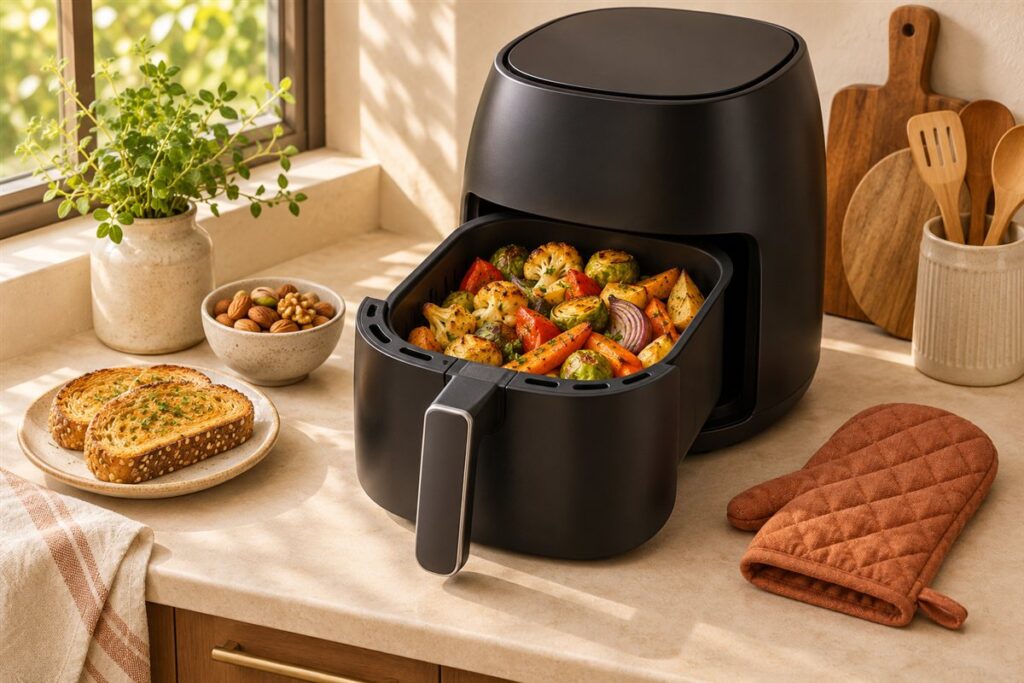
An air fryer accessory kit is a bundle of add-on tools, often a rack, a baking pan, liners, tongs, and a few extras. Contents vary by maker, so read the list before you buy. A kit makes sense if it covers several things you will use, and not much sense if half of it stays in the box.
Pieces You Often See
- Cake or baking pan: a round pan for small cakes and casseroles.
- Rack or trivet: raises food or creates a second level.
- Skewers: metal rods for kebabs.
- Liners: paper or silicone sheets for the basket.
- Tongs or a gripper: for turning food and lifting hot dishes.
- Silicone mitts or a brush: small helpers for handling and basting.
- Recipe booklet: ideas and timing guides.
Not every kit has all of these, and sizes differ, so confirm the numbers.
What Each Piece Is For
Knowing the job of each item makes it easier to decide whether you need it. The pan holds batters and loose mixtures that would drip through the basket. The rack lets you place a second layer of food or raises a single layer so air reaches the underside. Skewers hold pieces of meat and vegetables upright or flat so they cook evenly. Liners catch drips and make the basket easier to wash. Tongs and grippers keep your hands away from hot surfaces, and a brush spreads a thin coat of oil or sauce.
A recipe booklet is the least important item, though it can show typical timing ideas for a beginner. Treat any times as a rough guide and adjust to your own unit and your food.
How to Judge a Kit
| Factor | Why it matters | What to check |
|---|---|---|
| Size match | Pans and racks must fit your basket | Listed dimensions against your own measurements |
| Piece count | More pieces are not always more useful | How many items you would use weekly |
| Materials | Heat limits and coatings differ | Product notes and care instructions |
| Storage | Many small pieces are easy to lose | Whether it nests or comes with a case |
When a Kit Makes Sense
A kit can be a good fit when you are new to air frying and want to try baking, skewers, and layering without hunting for each piece. It can also suit someone who wants one matching set for a gift. In both cases, the pieces still need to fit the appliance.
It makes less sense if you already own oven-safe dishes that fit, or if you mostly cook frozen snacks and vegetables. Single items bought later may give you a better match.
Questions to Ask Before You Buy
- Which three items in this kit would I use in a typical week?
- Do the dimensions fit my basket with a gap around the sides?
- Are heat limits stated for each piece?
- Can I clean everything easily?
- Does my air fryer manual allow these items?
Checking Quality Details
Look at how the pieces are made. Welded joints, smooth edges, and clear care notes are good signs. Be wary of kits that do not list materials or heat limits, since you will not know how to use them with care. Photos and the maker’s description should show the pieces at a readable scale.
A Walkthrough: Unboxing a New Kit
- Lay out every piece and compare it with the contents list.
- Read the care sheet, noting which items are hand-wash only.
- Wash each piece in warm soapy water and dry it, as makers often advise before first use.
- Measure your basket and hold each piece against the numbers to confirm it fits.
- Place one piece at a time into the empty basket and check that the drawer closes smoothly.
- Keep the manual for your air fryer next to the kit so you can look up limits.
- Store everything together and note which pieces you actually use over the first month.
Storage is the part people forget. Keep the set in one box or drawer, with small items inside the pan so nothing wanders. Note which pieces are dishwasher friendly and which are not, and write that on a label inside the box. A tidy kit gets used, while a jumble tends to be forgotten, and the pieces you never find are the pieces you never use.
Common Scenarios
The first-time owner
A kit with a pan, a rack and tongs gives room to experiment. After a month, you will know which pieces suit your cooking.
The experienced home cook
Someone with oven dishes may only need a rack and a gripper, which are easy to find as single items.
The gift buyer
A kit can be a convenient gift, but only if you know the basket size. Keep the receipt details in case something does not fit.
The small-kitchen owner
Choose a kit that nests together or ask whether you really need ten pieces. Compact storage matters as much as the contents.
Mistakes to Avoid
- Counting pieces, not uses: a long list looks generous, but only the pieces you use have value.
- Skipping the measurements: a pan that is too wide can block airflow or stop the basket closing.
- Using paper liners loose: light sheets can lift in moving air, so keep food on them and trim to fit.
- Ignoring care notes: some pieces are hand-wash only, and the dishwasher can warp them.
Care and Upkeep Over Time
Let each piece cool before washing. Use warm soapy water and a soft sponge, and avoid abrasive pads on coated items. Dry thoroughly to stop spots and rust on metal. Inspect silicone for tears and metal for bending, and replace worn pieces. A small bag or box keeps the set together.
Care Notes for Specific Pieces
Metal racks and pans usually clean up with warm soapy water and a soft brush, and a soak helps with baked-on residue. Silicone items can hold oils, so a longer soak and a second wash often helps. Wooden or bamboo handles, where a kit includes them, usually should not soak, so wipe them instead. Skewers need a brush for the ends, and tongs need attention at the hinge where food collects. Always follow the care sheet that came with the kit.
FAQ
Are kits made for a specific brand?
Some are, and some are described as fitting a range of sizes. Match the numbers to your own model instead of relying on a general claim.
Can I add to a kit later?
Yes. Many cooks begin with a small set and add single pieces as needs appear.
Are metal skewers safe to use?
They are designed for this purpose, but they get hot. Use tongs or mitts, make sure they sit below the heating area, and follow the maker’s guidance.
Should the pan be dishwasher safe?
It is convenient, but not essential. Check the care notes and wash by hand if there is any doubt.
What if a piece does not fit?
Do not force it. Check the seller’s return policy before you open the whole set, and consider buying a single piece that matches your measurements.
The Short Version
A kit helps if you will use several of its pieces and they fit your model. Compare the contents with your cooking habits, measure your basket, and follow the manual. Store the set together and keep only what proves useful.