Where to buy: The vacuum sealer black friday deals worth opening first are the FoodSaver FM2100 Vacuum Sealer for most kitchens, the Bonsenkitchen Vacuum Sealer if the budget is the whole question, and the FoodSaver V4400 2-in-1 Vacuum Sealer if you seal in bulk and want the machine to do more of the work. All six picks below are sold on Amazon during Black Friday Week, and prices move hourly, so check the live price on the listing before you check out.
As an Amazon Associate, airfryerkitchensupply.com earns from qualifying purchases. When you buy through links on this page, we may earn a commission at no extra cost to you.
Vacuum Sealer Black Friday Deals: Seal the Savings Before They Evaporate
Amazon Black Friday Week runs from November 19 to November 30, 2026, with Black Friday itself on Friday, November 27 and Cyber Monday on Monday, November 30. A vacuum sealer is the rare Black Friday purchase whose entire purpose is saving money after Black Friday: it is the tool that lets you buy meat, cheese, produce and leftovers at sale prices, in sale quantities, and still be eating them in excellent condition months later. That makes the category a natural fit for the season — the appliance that preserves bargains is itself bargained — and it also makes honest pricing doubly important, because a sealer bought at a fake discount undermines the arithmetic that justified buying it.
So here is how this guide was built.
The list spans the full working range of the category. The middle holds the mainstream names and the interesting specialists: the FoodSaver FM2100 with roll storage and a cutter built in, a handheld Chef Preserve system built around reusable bags, a 95kPa Gasbye machine with a double heat seal for heavy batch work, and the Nesco VS-12, a 130-watt sealer with a viewing lid that has a loyal following among hunters, anglers and bulk buyers. At the top, the FoodSaver V4400 automates bag detection and sealing for people who process a whole freezer’s worth of food in a session. One of these is the right sealer for your kitchen; the sections below are organised to help you find it by how you actually shop and cook, and Black Friday Kitchen Appliance Deals 2026 covers the rest of the counter if you are equipping a kitchen in one pass.
Who gets real value from a vacuum sealer? Bulk shoppers splitting warehouse-club purchases into meal-sized portions. Hunters and anglers processing a season’s catch. Sous vide cooks, for whom a proper vacuum seal is the difference between a bag that floats and a bag that cooks evenly. Meal preppers sealing a week of lunches on Sunday. Gardeners freezing a harvest at its peak, and anyone who has ever thrown away freezer-burned meat and done the miserable arithmetic on what it cost. If your freezer holds three items and your shopping is daily and small, a sealer will gather dust; for almost everyone else, it is among the most defensible purchases in this entire sale.
In this guide
Before You Buy
| Deal | Key spec | Price |
|---|---|---|
| FoodSaver FM2100 Vacuum Sealer | One-touch sealing, roll storage and cutter, dry and moist modes, accessory port and hose | Check current price on Amazon |
| Bonsenkitchen Vacuum Sealer | Compact, multiple modes, external vacuum system, starter bags included | Check current price on Amazon |
| Chef Preserve Compact Vacuum Sealer | Handheld sealer with 30 reusable vacuum bags, portable | Check current price on Amazon |
| Gasbye 95kPa Precision Vacuum Sealer | 95kPa, double heat seal, built-in storage and cutter, pulse mode, drip tray | Check current price on Amazon |
| Nesco Deluxe VS-12 Vacuum Sealer | 130 watts, kit bags included, viewing lid, compact silver body | Check current price on Amazon |
| FoodSaver V4400 2-in-1 Vacuum Sealer | 2-in-1 system, automatic bag detection, starter kit included | Check current price on Amazon |
How These Picks Were Chosen
These picks come from comparing product listings and maker specifications for different needs. We have not physically tested them. Prices and availability change quickly, especially during sale events, so check the current price on Amazon before you buy.
The Deals in Detail

1. FoodSaver FM2100 Vacuum Sealer — Best Overall
Spec mini: One-touch sealing; built-in roll storage and cutter; dry and moist food modes; accessory port and hose included; starter bags and roll included; suited to sous vide preparation.
FoodSaver effectively created this category for home kitchens, and the FM2100 is the model that shows why the brand still anchors it. The design centres on the workflow of a real sealing session: the roll lives inside the machine, the built-in cutter sizes each bag as you pull it, and one-touch operation runs the vacuum-and-seal cycle without a sequence of buttons to memorise. Dry and moist modes adjust the seal for the food in front of it, which is the difference between a clean seal on flour-dusted chicken portions and a compromised one. The accessory port and hose extend the same machine to jars, canisters and containers, so marinades, coffee, flour and leftovers in rigid containers join the bags in one system.
The starter kit matters more than starter kits usually do. Because bags and a roll are in the box, the machine earns its keep the day it arrives — you can break down a bulk shop the same evening rather than after a second order. For sous vide cooks, the FM2100’s seals are the point of the exercise: a properly evacuated bag sinks, cooks evenly and stores flat. See FoodSaver FM2100 for current details.
Strengths: complete workflow in one unit, with roll storage and cutter; dry and moist modes; accessory hose broadens the system to jars and canisters; starter consumables included; the category’s most established brand and bag ecosystem. Trade-offs: it is a full countertop footprint, so very small kitchens will store it between uses; heavy daily commercial-style volume belongs with the double-seal Gasbye below; like all heat-seal machines, its bags are an ongoing consumable cost to budget for.
Best for: most households, bulk shoppers, meal preppers and sous vide cooks wanting one proven machine. Not suited for: minimalists who seal twice a year — the budget pick below costs far less. Check the live price on Amazon before Black Friday pricing moves.
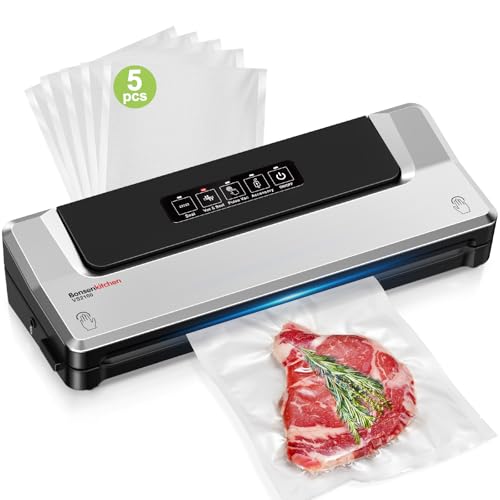
2. Bonsenkitchen Vacuum Sealer — Best Budget
Spec mini: Compact countertop body in silver; multiple sealing modes for meal prep; external vacuum system for containers; starter set of 5 vacuum bags included; aimed at food storage and sous vide.
Not every kitchen needs a flagship, and the Bonsenkitchen is the guide’s honest answer for the household that seals a handful of bags a week and would rather keep the difference in the grocery budget. It covers the fundamentals properly: multiple modes for meal prep, a compact body that fits a drawer-adjacent counter or a cupboard shelf, and an external vacuum system so the same unit can pull air from compatible containers as well as bags. Five starter bags are included, enough to learn the machine on real food the day it arrives.
The right way to judge this pick is by the jobs it is for. Portioning chicken breasts bought on offer, sealing cheese, freezing a double batch of soup stock in flat bags, packing leftovers for the freezer — these are the tasks that make up most home sealing, and a compact machine handles them without ceremony. Where it steps back is volume and refinement: long batch sessions of a whole animal or a market-day haul will feel slower than on the FoodSaver or Gasbye, and the finish and controls are functional rather than premium. See Bonsenkitchen vacuum sealer for current details.
Strengths: lowest verified price in the guide; compact storage-friendly size; multiple modes plus external vacuum for containers; starter bags included. Trade-offs: not built for marathon batch sessions; fewer automation and storage conveniences than the FoodSaver models; bag ecosystem is generic rather than brand-deep.
Best for: first-time sealers, small households, apartment kitchens and anyone testing whether vacuum sealing fits their routine. Not suited for: hunters, bulk processors or daily sous vide cooks, who should step up to the FM2100 or Gasbye. Check the live price on Amazon — small moves at this price are proportionally big.

3. Chef Preserve Compact Vacuum Sealer — Best for Reusable Bags and Small Spaces
Spec mini: Handheld vacuum sealer unit; supplied with 30 reusable vacuum bags; portable, counter-free operation; designed for meal saving and everyday food storage.
The Chef Preserve takes a genuinely different approach to the category, and for some kitchens it is the smartest design here. Instead of a countertop heat-seal machine consuming single-use rolls, it is a compact handheld unit that evacuates reusable vacuum bags — thirty of them included in the box. There is no roll to store, no cutter, no counter footprint at all: the sealer lives in a drawer, comes out for the bag in your hand, and goes back. For households whose sealing is about leftovers, opened ingredients, cheese, deli meats and the half-used bag of salad — frequent, small, fridge-side jobs — that immediacy beats a countertop machine that must be fetched, plugged in and threaded with roll stock.
The reusable-bag model also changes the running-cost story. Heat-seal systems spend money continuously on rolls and precut bags; a reusable system front-loads the bags in the box and reuses them, which suits both budgets and anyone trying to cut single-use plastic in the kitchen. The honest trade-off is scope: this is a system for bags, not a platform for canisters, jars and wide batch processing, and very large cuts of meat belong to the countertop machines. See Chef Preserve compact sealer for current details.
Strengths: no counter footprint; 30 reusable bags included change the running-cost equation; fast for frequent small fridge jobs; portable for travel, caravans and second homes. Trade-offs: bag-system only, with no heat-seal roll workflow or canister platform; less suited to whole-joint bulk freezing; you are buying into its bag format for replacements.
Best for: small kitchens, leftover-driven households, and anyone who prefers reusable bags to consumable rolls. Not suited for: bulk processors and sous vide cooks who need heat-sealed bags in custom sizes. Check the live price on Amazon and confirm the bag count in the box.
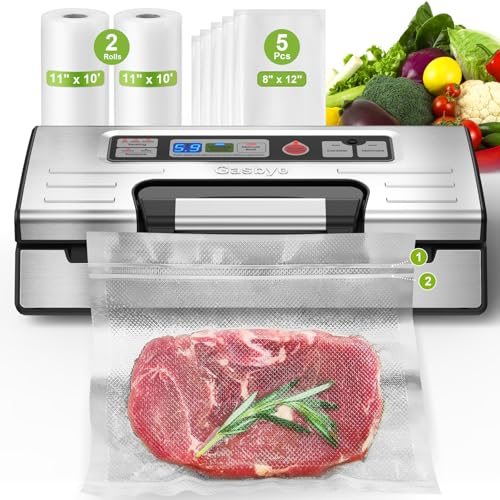
4. Gasbye 95kPa Precision Vacuum Sealer — Best for Heavy Batch Sealing
Spec mini: 95kPa vacuum power; double heat seal for dry and moist food; built-in bag storage and cutter; easy-lock handle; progress display; pulse mode; removable drip tray; silver finish.
When a sealing session means forty portions rather than four, the specification that matters stops being convenience and starts being sealing integrity at speed — and that is the brief the Gasbye was built to. Its 95kPa vacuum figure is the strongest headline number in this guide, and the double heat seal lays down two seal lines instead of one, which is exactly the insurance you want on bags that will sit in a freezer for six months or ride in a sous vide bath for twelve hours. A failed seal discovered in month four is not a saving; the Gasbye’s design treats that failure as the enemy.
The supporting features are chosen for the same user. Built-in bag storage and a cutter keep the roll workflow fast, the easy-lock handle reduces the hand force needed across a long session — a detail anyone who has sealed fifty bags in an evening will respect — and the progress display replaces guesswork about where a cycle stands. Pulse mode hands control back for delicate items that a full automatic vacuum would crush, and the removable drip tray acknowledges the reality of sealing marinated and juicy foods: liquid gets places, and a machine you can clean properly is a machine that keeps sealing properly. See Gasbye 95kPa sealer for current details.
Strengths: highest stated vacuum power here; double heat seal for long storage and sous vide confidence; batch-friendly storage, cutter, lock handle and display; pulse control for delicate foods; cleanable drip tray. Trade-offs: more machine than a light user needs, in size and price; the brand lacks FoodSaver’s long retail history; the percentage trim is modest even though the absolute specification is high.
Best for: bulk buyers, hunters and anglers, sous vide enthusiasts and meal preppers working in long sessions. See Check the live price on Amazon for current details.

5. Nesco Deluxe VS-12 Vacuum Sealer — Best for Game, Fish and Bulk Meat
Spec mini: 130 watts; kit bags included; viewing lid so the bag position is visible as it seals; compact silver body.
Nesco’s VS-12 has the kind of following that marketing cannot buy: it is the sealer that shows up in hunting camps, fishing lodges and farm kitchens, recommended person to person by people who process food in serious quantities and cannot afford seal failures. The design explains the loyalty. At 130 watts it has the power for sustained work, the kit bags in the box start you immediately, and the viewing lid — a simple idea executed well — lets you watch the bag sit correctly in the channel before and during the cycle, catching the misaligned seal that on other machines you only discover when the bag inflates in the freezer.
Positioning it honestly among these six: it lacks the FM2100’s internal roll storage theatre and the Gasbye’s double seal and headline vacuum figure, and in exchange it offers a compact, durable, get-on-with-it machine from a brand whose food-preservation catalogue runs deep. For the buyer processing a deer, a case of salmon or a quarter of beef across a weekend, that temperament is the feature. For the buyer sealing leftovers twice a week, it is more sealer than the job requires. See Nesco VS-12 for current details.
Strengths: proven with bulk meat, game and fish processors; viewing lid prevents mis-sealed bags; strong power for sustained sessions; compact for its capability; kit bags included. Trade-offs: fewer storage and automation conveniences than the FoodSaver pair; styling is utilitarian; the discount percentage is among the guide’s smaller ones.
Best for: hunters, anglers, gardeners freezing harvests, and bulk meat buyers who value reliability over features. Not suited for: style-led kitchens or light users better served by the budget pick. Check the live price on Amazon and look at the kit contents before ordering extra bags.
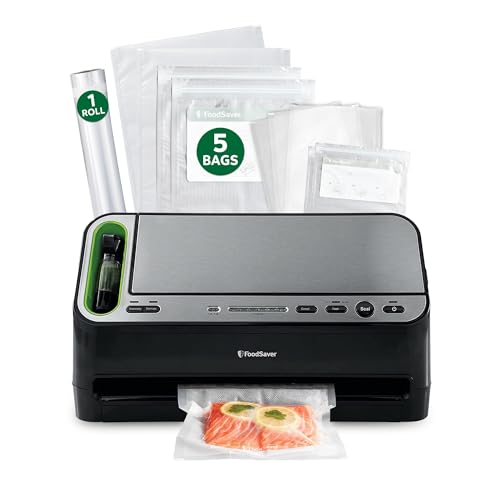
6. FoodSaver V4400 2-in-1 Vacuum Sealer — Best Premium Automation
Spec mini: 2-in-1 vacuum sealing system; automatic bag detection that starts the cycle when a bag is inserted; starter kit included; full-size countertop format.
The V4400 is what the category looks like when the goal is to remove steps. Its automatic bag detection senses the inserted bag and begins the vacuum-and-seal process, which sounds like a small thing until you multiply it by every bag in a long session: less aligning, fewer button presses, fewer half-started cycles, and a rhythm that lets one person process a bulk shop at a pace the manual machines cannot match. As a 2-in-1 system it folds the handheld-style jobs — containers, jars, resealing — into the same appliance, so the premium buys consolidation as well as automation: one machine on the counter doing the work of two.
Who should pay the premium is a clear question with a clear answer. If you seal weekly or in bulk — warehouse shops divided monthly, garden harvests, hunting seasons, a sous vide habit — the time and failure-rate savings are real and recur every session. If you seal occasionally, the same money buys the FM2100 and a generous stock of rolls, and that is the wiser basket; we say so plainly because a guide that recommends its most expensive pick to everyone is advertising, not advising. See FoodSaver V4400 for current details.
Strengths: automatic bag detection speeds and simplifies every session; 2-in-1 versatility covers bags and containers in one unit; FoodSaver’s bag and accessory ecosystem; strong verified discount against list.
Best for: frequent and bulk sealers who value speed and automation, and households consolidating two sealers into one. Not suited for: occasional users — the FM2100 covers their needs for notably less. Check the live price on Amazon, because premium models are often repriced first as the sale week peaks.
What Owning a Vacuum Sealer Actually Changes
The economics of sealing are simple enough to state without invented figures. Food bought in bulk costs less per portion than food bought in small packs; food that freezer-burns or spoils costs everything. A vacuum sealer attacks the second half of that equation: by removing the air that drives freezer burn and slows quality loss, it stretches the useful life of frozen meat, fish, cheese and produce from weeks into months, which is what makes the bulk price in the first half of the equation safely available. The machine pays its way not in a single dramatic moment but in the steady absence of waste — the steak that is still excellent in month five, the grated cheese that never moulded, the soup frozen flat in bags that stack like books instead of leaning like icebergs.
Technique decides how much of that promise you collect, and three habits matter more than any feature list. First, freeze liquids and very wet foods briefly before sealing, or use the moist mode and leave generous headroom in the bag, because liquid drawn toward the seal is the leading cause of seals that look fine and fail later. Second, label everything with contents and date before it enters the freezer; vacuum bags are anonymous by design, and a freezer full of identical silver parcels is a library without a catalogue. Third, portion before you seal, not after: bags sized to a meal defrost evenly, cook predictably in a sous vide bath, and mean the freezer gives back exactly what tonight requires. The machines above differ in power and automation, but all six reward these habits equally, which is why this guide spends as much of your attention on how you will seal as on what you will seal with.
Sealing by Season: Where These Machines Earn Their Keep
Autumn and the holidays. The sealer’s busiest honest work begins exactly when this sale does. Turkeys bought at seasonal prices portion and freeze without burn; the post-holiday ham becomes January’s soups because it was sealed in meal-sized bags while it was still at its best; bulk baking ingredients — nuts, dried fruit, chocolate, flour for anyone who buys the large sacks — stay fresh in accessory-port canisters instead of slowly staling in opened packaging. A machine bought this week is not a speculative purchase for some future organised self; it is equipment for the most food-heavy month of the year, arriving precisely when there is the most food to protect.
Hunting, fishing and the garden. For the households that produce food rather than only buy it, sealing is the step that decides whether a season’s effort keeps its value. Game processed at home, fish caught faster than it can be eaten, beans and corn and berries picked at a peak that lasts days — all of it depends on excluding air before freezing, and all of it tends to happen in long sessions where the differences between these six machines stop being theoretical. That is the natural territory of the Nesco’s viewing lid and the Gasbye’s double seal, and it is why this guide refuses to judge sealers on price alone: the cost of a failed seal is not a bag, it is a share of a harvest.
The weekly rhythm. Between the big seasons sits the ordinary week, where a sealer quietly changes shopping behaviour. You stop buying the small, expensive pack because the large pack is no longer a spoilage risk. You cook double because the second half has somewhere dignified to go. Cheese stops moulding at the back of the fridge drawer; coffee stays in a vacuum canister instead of a rolled-down bag; the marinade does its work in a fraction of the time under vacuum when guests are coming. None of these moments is dramatic, and together they are the actual return on the purchase — which is why the best sealer in this guide is ultimately the one matched to the rhythm you already live, bought at a price somebody verified, rather than the one with the largest badge in the sale.
Sous vide, briefly and honestly. Because several picks mention it: vacuum sealing and water-bath cooking are natural partners, since an evacuated bag sinks, transfers heat evenly and keeps aromatics against the food. If sous vide is your main purpose, weight seal integrity and moist-food handling above every other feature, freeze juicy items briefly before sealing so liquid stays out of the seal line, and favour the double-seal or established-brand machines in the middle and top of this list.
A Note on Bags, Rolls and Running Costs
The machine’s price is the part of vacuum sealing you pay once, and Black Friday rightly focuses on it — but the honest guide also prices the marriage, not just the wedding. Heat-seal owners buy rolls and precut bags for as long as they own the machine, and the cost per bag falls when rolls are bought in sensible quantities and cut to size rather than wasted on oversized precut formats. Two habits keep that running cost low. Cut bags only as long as the food plus headroom requires, because every spare inch is film you paid for and threw away. And reuse the top of a roll bag where hygiene allows: a bag that held dry goods can be washed, dried and resealed for the same duty, while bags that held raw meat should be retired without debate. The reusable-bag pick in this guide exists precisely because some households prefer to step off the consumables treadmill altogether, and neither choice is wrong — but going in with your eyes open about which cost model you are buying is the difference between a sealer that saves money and one that merely moves the spending from the butcher’s counter to the bag drawer.
Storage of the machine itself deserves the same realism. A countertop sealer that lives out gets used for the two-bag jobs; one that must be lifted from a low cupboard gets used for the twenty-bag jobs and skipped for the small ones, and the small ones are where the daily waste lives. If your kitchen cannot give a countertop model a permanent home near an outlet, that is not a failure of tidiness — it is information, and it points directly at the compact and handheld picks above.
Comparison Table
| Pick | Type | Best for | Standout feature | Price |
|---|---|---|---|---|
| FoodSaver FM2100 | Countertop | Most households | Roll storage, cutter, accessory hose | Check current price on Amazon |
| Bonsenkitchen Vacuum Sealer | Compact countertop | Budgets and beginners | Check the listing | Check current price on Amazon |
| Chef Preserve Compact | Handheld, reusable bags | Small spaces, leftovers | 30 reusable bags included | Check current price on Amazon |
| Gasbye 95kPa | Countertop, high power | Heavy batch sealing | 95kPa, double heat seal | Check current price on Amazon |
| Nesco VS-12 | Countertop | Game, fish and bulk meat | Viewing lid, 130W | Check current price on Amazon |
| FoodSaver V4400 | Countertop, automatic | Frequent bulk sealers | Automatic bag detection, 2-in-1 | Check current price on Amazon |
How to Choose the Right Vacuum Sealer
Start with your sealing volume. Count honestly: bags per week, and the length of your longest session. A few bags a week points to the Bonsenkitchen or the Chef Preserve handheld. A weekly bulk shop points to the FM2100. Sessions measured in dozens of bags — harvests, game, warehouse hauls — point to the Gasbye’s double seal or the V4400’s automation, because in long sessions the costs are fatigue and failed seals, and those are the machines built to suppress both.
Decide between rolls and reusable bags. Heat-seal machines use rolls and precut bags: flexible, custom-sized, and a continuing consumable cost. The Chef Preserve’s reusable-bag system inverts that: bags are capital, not consumables, and the format suits fridge-side, repeated, smaller jobs. Neither is universally better; the right answer is the one matching where your food actually goes — freezer in bulk, or fridge in rotation.
Match the machine to wet work. If you seal marinated meats, juicy roasts or sauced leftovers, prioritise a moist mode, a pulse control for delicate control of the vacuum, and a removable drip tray you can actually wash. Dry-goods sealers pressed into wet service are how pumps die young. Sous vide cooks should weight seal integrity above all: a double heat seal, or FoodSaver’s proven single seal, is the feature your twelve-hour bath depends on. If your plans include jars and canisters, confirm the accessory port — the FM2100 includes the hose in the box.
Measure the counter and the cupboard. Countertop sealers are wide appliances. If yours will live out, measure the run of counter; if it will be stored, measure the cupboard and be honest about whether a heavy fetch precedes every use. The handheld pick exists for kitchens where the honest answer is that no countertop machine would be used enough to justify its space. For the rest of a Black Friday kitchen plan, the pressure-cooking coverage in the related reading below pairs naturally with a sealer for batch cooking households.
How to Get Seals That Actually Hold
Leave headroom. Food expands the bag’s job, not its size: leave several inches between the food and the seal line, more for liquids and powders, so the sealing area stays clean and dry. A contaminated seal line is the quiet cause of most failures blamed on machines.
Flatten and freeze in shape. Seal ground meat and sauces flat, freeze them flat, and store them upright like files. You will fit dramatically more in the same freezer, defrost in a fraction of the time, and stop excavating. Sharp bones are the exception that needs a fold of bag material or a paper barrier over the points before sealing, so the vacuum does not pull a corner through the film.
Double-check the first bag of every session. Tug the seal, look for channels or wrinkles across it, and confirm the bag stays evacuated for a minute before you commit forty more to the same setup. One inspected bag is the cheapest quality control in the kitchen, and it is how experienced processors keep their failure rate near zero across a whole season’s work.
Common Mistakes
Buying suction you will never use, or too little that you will. Occasional sealers overbuying a flagship waste money; bulk processors underbuying a compact waste food. The volume question in the section above is the whole game — answer it honestly before the discount percentages start talking.
Sealing liquids on the dry setting. Liquid pulled into the seal area or the pump ruins seals and machines. Use the moist mode, pre-freeze soups and marinades until slushy, or hang the bag over the counter edge so gravity works for you instead of against the seal.
Forgetting the consumables budget. A heat-seal machine’s purchase is the beginning, not the total: rolls and bags recur. Factor a starter stock into the Black Friday basket — the FM2100 and V4400 include starter kits, the Nesco includes kit bags — and remember the reusable-bag pick replaces that line item almost entirely.
Storing bags unlabelled. Date and contents, every time, in marker on the bag’s label area before filling. Future you, holding two identical frozen parcels in February, will be grateful in direct proportion to how unnecessary it felt in November.
Final Recommendation
Frequently Asked Questions
How long does vacuum-sealed food actually keep?
Substantially longer than the same food in ordinary freezer wrapping, because removing air slows the freezer burn and quality loss that set the practical limit — frozen meats and fish keep their quality for many months rather than weeks when the seal is sound. The seal is the variable: inspect bags when you freeze and again when you defrost, and discard anything that has lost its vacuum and shows spoilage.
Can I vacuum seal liquids and soups?
Yes, with technique. Use the machine’s moist mode where it has one, leave generous headroom, or pre-freeze the liquid in the bag or a container until firm and then seal. Sealing free-flowing liquid on a dry setting risks pulling liquid into the seal and the pump, which is the most common way owners damage these machines.
Are reusable vacuum bags as good as heat-sealed bags?
For fridge storage and shorter freezer runs, a reusable system like the Chef Preserve’s works well and cuts consumable costs and plastic use. For very long freezer storage and sous vide cooking, heat-sealed bags — especially a double seal — remain the more robust format. Many households end up using the handheld for daily fridge jobs and nothing else, which is a legitimate end state.
Do I need special bags for these machines?
Heat-seal machines need textured vacuum bags or roll stock, which are widely available in the brands’ own lines and generic equivalents; the FoodSaver and Nesco picks include starter bags, and the FM2100 includes a roll. The Chef Preserve uses its own reusable bags, thirty of which are in the box. Check the listing for exactly what is included before ordering extras.
Should I wait for Cyber Monday?
Cyber Monday is November 30, 2026, the last day of the window.
Related reading: Best Black Friday Deals On Kitchen Gadgets · Best Kitchen Gifts Black Friday 2026 · Instant Pot Black Friday Deals 2026 · Ninja Air Fryer Black Friday Deals


