Where to buy
Check the latest price, availability and delivery on Amazon. Orders are placed on Amazon. We may earn a commission from qualifying purchases.
- Best overall: Philips Hue Twilight Smart Sleep and Wake-Up Lamp — Check on Amazon
- Lumie Bodyclock Luxe 700FM Wake-Up Light — Check on Amazon
- Philips Hue Gradient Signe Table Lamp — Check on Amazon
- Philips SmartSleep Sleep and Wake-Up Light HF3650/60 — Check on Amazon
See 2 more Amazon options
- Hatch Restore 3 Sunrise Alarm Clock and Sound Machine — Check on Amazon
- BenQ WiT e-Reading Lamp — Check on Amazon
Read the full guide ↓
Disclosure: As an Amazon Associate, airfryerkitchensupply.com earns from qualifying purchases. Links to Amazon on this page are affiliate links; they cost you nothing extra. Listing details such as price and availability change often, so check the current Amazon listing before you buy.
A guest room is judged twice: once from the doorway, in the first ten seconds, and once at 6 a.m., when your guest wakes in a strange bed, in a strange house, to whatever the room does about morning. At the under-$100 end of the market a host fixes the basics — a matched pair, warm light, charging in the base. Four hundred dollars per lamp buys something else entirely: the boutique-hotel wake-up. A sunrise that builds over the pillow instead of a phone alarm buzzing on an unfamiliar nightstand. A gradient of colour washing the wall while guests dress for dinner. A lamp a visitor can operate completely — on, off, dim, snooze — without learning a single thing, because nobody should need a tutorial, an app or a call down the hall to work the light in the room they are sleeping in.
That last rule shapes this whole guide: a guest must never need to learn anything. No app downloads, no accounts, no pairing, no manual in the drawer. Everything a guest touches must be on the lamp itself — a button, a dial, a tap — and everything cleverer is the host’s job, done before the guest arrives. Judged that way, the six lamps below are the strongest we could verify with live Amazon listings at or under $400 in November 2026, re-judged for hosting rather than for the owner’s own bedside. For most guest rooms we would start with the Philips Hue Twilight, programmed by the host before arrival, because its dawn is the closest thing to a hotel wake-up call that light can make. If guests should run every feature themselves with zero setup, the Lumie Bodyclock Luxe 700FM is the pick to beat. One honesty note: the famous designer lamps — Artemide, FLOS, &Tradition — mostly do not sell on Amazon in any verifiable form at this budget, and they are discussed openly, unlinked, in the section on what $400 cannot buy.
In this guide
Quick Picks
Short on time, or comparing several options at once? Each row below names a hosting situation and the product that suits it, with a link to the listing.
| Buyer type | Pick | Why it stands out | Link |
|---|---|---|---|
| Best overall | Philips Hue Twilight Smart Sleep and Wake-Up Lamp | A host-programmed sunrise and sunset that guests experience, never operate | Check on Amazon |
| Best zero-learning lamp | Lumie Bodyclock Luxe 700FM | Every feature on the device — glass globe, radio, no app or account anywhere | Check on Amazon |
| Best ambient light for hosting | Philips Hue Gradient Signe Table Lamp | A slim stem that washes the guest-room wall in blended colour gradients | Check on Amazon |
| Best for guests with early starts | Philips SmartSleep Sleep and Wake-Up Light HF3650/60 | The brightest verified sunrise here, plus a USB port for a guest’s phone | Check on Amazon |
| Best for light sleepers and noisy houses | Hatch Restore 3 Sunrise Alarm Clock and Sound Machine | Host-built light-and-sound routines with two big buttons a guest cannot get wrong | Check on Amazon |
| Best for guests who read | BenQ WiT e-Reading Lamp | A wide, auto-dimming pool of light that asks nothing of the reader | Check on Amazon |
How These Picks Were Chosen
The first filter was the budget, applied to real Amazon prices rather than launch press releases. Every product below had a live Amazon.com listing at or under $400 when we checked in November 2026, sold by the brand or a mainstream retailer. Where a lamp’s price moves — and premium lamps move a lot, especially around sale events — check the live price on Amazon before you buy, rather than relying on any older figure. Two well-known lamps were deliberately left out on exactly this test: the Philips SmartSleep Connected HF3670, whose Amazon offer at research time was a third-party listing priced above this budget, and every Artemide, FLOS and &Tradition lamp we checked, none of which had a verifiable Amazon offer under this budget. They are named, unlinked, in the designer section further down.
We did not use these lamps ourselves. We compared maker listings, specification pages, independent measurements where they exist, and long-running review coverage — then applied the guest test, which decided most of the ranking. Could a tired stranger, in an unfamiliar room, turn this lamp on, dim it to a glow, snooze or silence it in the morning, and turn it off again, without asking the host and without touching a phone? Lamps pass in two ways: either everything lives on the device, as with the Lumie and the HF3650, or the host absorbs the complexity in advance — programming the Twilight’s sunrise, building the Hatch’s routine in the app the guest will never open — leaving the guest two big buttons and nothing to learn. A lamp that needs the guest’s phone, account or patience fails, whatever its light is like, and the one pick with a genuine guest-proofing gap — the Signe, which has no switch on the lamp at all — is flagged in its review with the host-side fix.
Pairs deserve an honest note, because guest rooms so often have two nightstands. Every pick below is sold singly, so $400 here is a per-lamp budget: a matched pair of Twilights or Lumies costs twice the single-lamp price, well beyond a single-lamp budget. Many hosts buy one full-featured lamp for the side that matters most — the early riser, the reader, the phone that needs charging — and keep a simpler lamp on the other side. What we would not do is split this budget across two mid-range lamps that do nothing memorably; a single remarkable lamp outperforms two adequate ones, because the guest only ever experiences the one beside them.
The 6 Best Bedside Lamps for Guest Rooms Under $400
Philips Hue Twilight Smart Sleep and Wake-Up Lamp
Who it suits: Hosts who want to hand a guest the boutique-hotel morning — a dawn that arrives on schedule, in a room that was clearly prepared — and who are happy doing ten minutes of setup in an app the guest will never see.
The Twilight is the rare premium bedside lamp designed for the nightstand first, and its two light sources divide the hosting work neatly. The front-facing lamp is the one a guest reads by; the rear gradient light throws blended colour up the wall, so the lamp can glow like a sunset while guests wind down and build like a sunrise while they sleep — light that wakes by filling the room rather than shining in a stranger’s face. The dimming goes exceptionally low, low enough to leave on all night as an orientation glow for the midnight trip to a bathroom whose switch your guest does not know, and rises smoothly through warm colours. Two physical buttons on top handle the basics — on, off, a scene change — and that is the whole of the guest’s job. Everything deeper lives in the Hue app on the host’s phone: before the visit, ask one question at dinner (“what time do you need to be up?”), set the Wake Up automation once, and the lamp keeps the appointment.
Check the price on Amazon before you buy. The Twilight is a premium pick, its price moves often, and third-party sellers have pushed the same listing above this budget at times. Buy from Amazon or the Philips Hue storefront, and treat a high offer as a reason to wait for the next sale cycle, because this lamp discounts several times a year.
- Two light sources — a reading light in front, a colour gradient washing the wall behind — so the sunrise fills the room instead of glaring at the sleeper.
- The host programs wake and wind-down automations once; the guest meets only two top buttons and a lamp that keeps its own schedule.
- Exceptionally deep, smooth dimming: a genuine all-night orientation glow at the bottom, a real dawn at the top.
- Joins the full Hue ecosystem: scenes and voice control with Alexa, Apple Home and Google Assistant, if the room already has them.
Honest limitation: Scheduled wake-up automations need a Hue Bridge (sold separately) — out of the box you get Bluetooth app control — and the price has spiked above this budget from third-party sellers, so check the price on Amazon and check who is actually selling it before you pay. A host who will not do the app setup should not buy this lamp for a guest room; unprogrammed, its best trick never happens.
Choose it if you want the guest-room morning to feel like a good hotel’s and you will spend ten minutes setting it up before each visit. Skip it if you refuse apps and accounts anywhere near the bedroom, or your guests stay for weeks and would rather run their own alarm — that is the Lumie below.

Lumie Bodyclock Luxe 700FM Wake-Up Light
Who it suits: Hosts who want the guest to be able to do everything — set the alarm, change the dawn, play the radio, snooze — with nothing to learn, no app to download and no question to ask, however long the stay.
Lumie invented this category in 1992, and the Luxe 700FM is its flagship in the US line: a frosted glass globe, with a sunrise and sunset you can stretch from 15 to 90 minutes, more than 25 sleep and wake sounds, an FM radio with a telescopic antenna, and a Bluetooth speaker. For hosting, the decisive fact is what is absent: there is no app, because there is nothing for an app to do. Every control is a dial or a button on the unit, so a guest who stays a fortnight can set their own wake time without involving you — and a guest who stays one night can ignore everything except the tap-control snooze on top. It also has a low-blue-light evening mode, plus a clock display that dims itself at night so the room goes properly dark. Lumie backs it with a 3-year warranty and a 45-day trial, the longest cover in this guide.
Check the price on Amazon — the Luxe 700FM is a premium pick, and Lumie’s own store runs sales from time to time, so check there as well. What it does need is one measured honesty note: independent lab testing of the US Bodyclock range measured the Luxe 700FM at about 173 lux at pillow distance at the end of its sunrise — respectable, and plenty for most sleepers in a dark room, but well below the Philips HF3650 below, which measured roughly double. You are paying for the glass, the audio, the radio and the total absence of an ecosystem, not for the brightest dawn here. For a guest with a genuinely early start and a heavy sleep, that trade matters, and its review says which lamp to choose instead.
- The complete standalone package: sunrise, sunset, FM radio, Bluetooth speaker and 25+ sounds in a glass globe.
- Zero learning curve in either direction — no app for the host to configure, no app for the guest to be asked about; everything is dials and buttons.
- Low-blue-light evening mode and a 15–90 minute adjustable sunrise — the widest timing range here, settable by the guest themselves.
- 3-year warranty and 45-day trial from the company that invented wake-up lights.
Honest limitation: Measured sunrise brightness (about 173 lux at the pillow in independent tests) trails the Philips HF3650, and the frosted globe is real glass — beautiful, and the one lamp here you would not want a rolling suitcase to knock off the nightstand.
Choose it if your guests stay long, keep their own hours, or simply should never have to ask how anything in the room works. Skip it if your typical guest is a heavy sleeper with a 5 a.m. start, or you want the lamp tied into a smart home — neither is this lamp’s job.

Philips Hue Gradient Signe Table Lamp
Who it suits: Hosts whose guest room also hosts in the evening — drinks before dinner, a reading chair, family gathered in the best room in the house — and who want the light itself to be the welcome.
The Signe is the opposite philosophy to the wake-up lights: no clock, no sounds, no sunrise program, just a slim aluminium stem that washes the wall behind it with a flowing gradient of blended colours. Hue rates it at up to 1,040 lumens, the most powerful light source in this guide — bright enough to genuinely light a bedroom, not just decorate it — and the gradient effect is still the one rival systems imitate. On a nightstand it reads as sculpture; against the wall it turns the whole surface into the lampshade, and a room lit that way at dusk says this room was prepared for someone. The host sets a warm gradient scene before guests arrive, and a Hue automation can also turn it into a perfectly respectable sunrise lamp, even though Philips does not sell it as one.
Check the price on Amazon — the Signe is a mid-to-premium Hue pick, it appears in sale events regularly, and prices at other retailers have risen lately, so a high offer is a reason to wait. The guest-room caveat is the one design decision that divides owners, and in a room for strangers it matters more, not less: there is no switch on the lamp itself. Control is by app, voice, or a Hue dimmer switch bought separately. At noon that is elegance; at midnight, for a guest whose phone is not your phone, it is a problem — so treat the dimmer switch (sold separately) as part of the purchase, mount it by the bed before the visit, and the Signe becomes as guest-proof as anything here. Without it, it is the one pick in this guide a guest cannot fully operate, and its place in the ranking reflects exactly that.
- The strongest light here — up to 1,040 lumens — in the slimmest footprint on the list, so it suits a small guest-room nightstand.
- Hue’s gradient wall-wash: the ambient welcome no bulb in a shade can copy, set by the host before arrival.
- Aluminium build in black, white or oak finishes; a lamp that earns its place as decor in the room guests see first.
Honest limitation: No on-lamp controls at all — a guest needs the host’s app, a voice assistant already in the room, or the separate Hue dimmer switch — and it is an ambient lamp, not a reading light: the light goes at the wall, not onto your guest’s book.
Choose it if the guest room’s evening atmosphere is the point and you will add the dimmer switch as part of the setup. Skip it if your guests read in bed every night, or the room has no smart-home presence and no plans for one.

Philips SmartSleep Sleep and Wake-Up Light HF3650/60
Who it suits: Guests with early starts — the flight to catch, the train to make, the grandchild’s school run to help with — and hosts who want the strongest dawn on the list with no app anywhere in the arrangement.
This is the lamp Philips’ wake-up reputation rests on (formerly sold as the Somneo). The sunrise runs through real colour — deep red, orange, warm yellow, bright white — across up to 40 minutes and 25 brightness levels, and it is the brightest verified wake-up light here: Philips rates it around 300 lux, and independent measurements at pillow distance recorded roughly 359 lux, about double the Lumie flagship. In a guest room that brightness is a service: the guest who must be up at five gets woken by light alone, gradually, without a phone alarm’s jolt or asking the host for a wake-up call. At night it reverses the trick with a sunset fade and RelaxBreathe, plus a midnight-light setting dim enough for finding an unfamiliar bathroom. There are seven wake-up sounds and an FM radio, every control is on the device — no account, no Wi-Fi, no subscription — and a USB charging port, so a guest’s phone charges beside the bed without unplugging the lamp.
Check the price on Amazon — the HF3650 sits comfortably within this budget for arguably its most effective alarm, and it dips in sale events. A word of care about the listing family: the cheaper HF3520 is the older generation, the HF3500 is the basic model, and the app-connected HF3670 is a different product whose Amazon offers we found inflated above this budget by third-party sellers. The ASIN linked here is the HF3650/60 itself; confirm the model number before you pay.
- The brightest sunrise verified here — around 300 lux rated, roughly 359 lux measured at the pillow — for guests who absolutely cannot oversleep.
- Full-colour sunrise and sunset, RelaxBreathe wind-down, seven sounds and FM radio, all on-device: a guest can run everything, or nothing, as they please.
- USB charging port and a midnight light — the two small features a stranger in an unfamiliar room actually uses.
Honest limitation: The design is a rounded clock, not a piece of furniture — it looks like the appliance it is, in the room you most want to look composed — and the controls, while complete, are fiddlier to programme than an app, so a host setting it for a guest should allow a few minutes rather than a few seconds. It also throws its light forwards, so it wants to face the bed rather than sit decoratively sideways.
Choose it if your guests rise early, sleep heavily, or both, and you want the alarm handled by light with zero involvement from anyone’s phone. Skip it if the guest room’s appearance is the point of the purchase, or you want coloured ambient light and smart-home scenes.
Hatch Restore 3 Sunrise Alarm Clock and Sound Machine
Who it suits: Light sleepers, nervous sleepers and anyone hosting in a house with noises a guest is not used to — pipes, traffic, the dog, other people’s children — who would trade dawn brightness for a calmer night and a gentler morning.
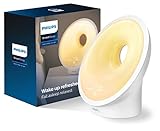
The Restore 3 is built around routines rather than specifications: the host builds them, the guest simply lives inside them. In the Hatch app — on the host’s phone, before the visit — you build an evening sequence: a warm reading light that fades into a sunset paired with rain sounds, then steady sound for the night, masking the unfamiliar noises that keep guests awake in a strange house. The morning sequence brightens a gradual sunrise ahead of a gentle alarm sound. On the device there are just two large controls on top: one to start the routine, one for the alarm. That is the entire guest interface, and it cannot be got wrong. The fabric-covered body (Putty, Greige and Cocoa finishes) looks like homeware rather than a clock, the display dims right down, and as a sound machine it is genuinely good.
Check the price on Amazon — the Restore 3 is the most affordable pick in this guide, and the honesty paragraph is about what happens after the box, a cost that falls on the host, never the guest. The core sunrise, sunset and a starter library of sounds work without paying more, but the full content library sits behind the Hatch+ subscription, charged monthly or yearly after the included trial — check the current subscription price on Hatch’s site. Over time that subscription adds up, so count it alongside the hardware. The second note is brightness: independent comparisons put the Restore 3’s sunrise well below the Philips and Lumie lamps, so a guest who sleeps heavily, or a room that gets bright early anyway, should treat this as a routine and sound device first and an alarm second — set the guest’s phone alarm as backup without embarrassment, or choose the HF3650 for the early riser and keep the Hatch for the light sleeper in the other room.
- Routines pair light and sound into one-tap evenings and mornings — the best wind-down system here, built by the host and invisible to the guest.
- All-night sound masking for unfamiliar houses, behind two big on-device controls a guest cannot misoperate.
- A soft fabric design that hides the clock at night and reads as homeware, not equipment, from the doorway.
Honest limitation: The full sound and content library needs the host’s Hatch+ subscription (after a trial), and its sunrise is the gentlest here — light sleepers only need apply for alarm duty.
Choose it if your guests sleep lightly, your house makes noises, and a calmer night matters more than a forceful dawn. Skip it if you hate subscriptions on principle — take the Lumie — or your typical guest needs maximum wake-up brightness.

BenQ WiT e-Reading Lamp (Matte Gold)
Who it suits: The guest who reads — the parent who finishes a novel a visit, the friend mid-way through a long series, anyone for whom an hour with a book is the guest room’s real purpose — and who should never have to adjust anything to do it well.
The WiT comes from the task-light world, and it shows in the optics. Its curved head throws an extra-wide, even field of light — BenQ’s “smile curve” covers roughly a 35-inch span — so a whole open book sits in one shadow-free pool instead of a bright circle with dark edges. For a guest, the decisive feature is the ambient sensor: the lamp reads the room and auto-dims itself, so the light is simply right without the guest touching a control or asking what the dial does. Colour temperature adjusts from 2700K to 5700K, the light is flicker-free and high-CRI, and the ball-jointed metal arm stays where the host aimed it. The linked listing is the Matte Gold finish, with Matte Blue and Silver versions on sibling listings.
Check the price on Amazon — the WiT is a premium task-light pick, with pricing that varies by finish — which buys a great deal of engineering and no smart features whatsoever. That trade is the review in one line: there is no app, no sunrise, no colour, no speaker, and the wide head is a desk lamp’s silhouette rather than a decorator’s, in the room where looks are half the job. What the money buys instead is the thing the other five lamps treat as secondary — light itself, measured and controlled better than any of them, delivered with the least guest effort of all: none. For a reading guest, that is not a compromise; for a guest who will never open a book in your house, it is money spent on the wrong virtue, and the wake-up lights above will host them better.
- The best reading light here by a distance: a roughly 35-inch-wide, even, shadow-free pool of light across the whole page.
- Auto-dimming ambient sensor means the guest never adjusts anything — the light is right on arrival and stays right.
- Flicker-free, high-CRI output with 2700K–5700K adjustment for long, comfortable reading sessions.
- Weighted metal build with a ball-joint arm that holds the host’s aim; finishes include Matte Gold, Blue and Silver.
Honest limitation: It is a task lamp in shape and spirit — no sunrise, no smart features, no ambient glow — and its wide head takes more nightstand presence than the sleep lamps, which matters on a small guest-room table. It also does nothing about waking your reader up in the morning.
Choose it if your guests are readers and the in-bed hour with a book is the visit’s ritual. Skip it if you want help waking a guest up, settling them down, or lighting the room’s mood — every other pick here does those jobs better.

Comparison Table
| Product | Type | Best use | Link |
|---|---|---|---|
| Philips Hue Twilight | Smart sleep and wake-up lamp | A host-programmed hotel dawn and sunset, inside the Hue ecosystem | Check on Amazon |
| Lumie Bodyclock Luxe 700FM | Wake-up light with radio | Premium standalone sunrise a guest runs entirely themselves | Check on Amazon |
| Philips Hue Gradient Signe Table Lamp | Smart gradient lamp | Wall-washing colour gradients and evening ambience for a room that hosts | Check on Amazon |
| Philips SmartSleep HF3650/60 | Wake-up light | The brightest classic sunrise, plus phone charging, no app required | Check on Amazon |
| Hatch Restore 3 | Routine clock and sound machine | Phone-free routines and all-night sound for light sleepers | Check on Amazon |
| BenQ WiT e-Reading Lamp | Reading and task lamp | Wide, even, auto-dimming light for guests who read in bed | Check on Amazon |
How to Choose a Bedside Lamp for a Guest Room Under $400
- Apply the midnight test before anything else. Could a tired stranger work this lamp at 3 a.m. with no instructions and no phone? On-device lamps — the Lumie, the HF3650 — pass outright. Host-programmed lamps pass if the guest’s side of the bargain is two buttons, as with the Twilight and the Hatch. A lamp a guest cannot operate is a lamp for your own bedroom, whatever its price.
- Decide who sets the alarm: the host or the guest. For one-night and weekend guests, host-programmed is a kindness — ask the wake time at dinner, set it once, and nobody thinks about it again. For guests who stay a week or keep irregular hours, an on-device alarm they control themselves, like the Lumie’s or the HF3650’s, respects their autonomy and saves the nightly negotiation.
- If waking matters, ask for lux, not lumens. What wakes a sleeper is light reaching their eyes. Independent measurements put the HF3650 near 359 lux at the pillow and the Lumie Luxe near 173; the Hatch’s sunrise is gentler still. Match the dawn to the guest: heavy sleeper with an early start, buy brightness; light sleeper, buy gentleness.
- Test the bottom of the dimmer, not the top. Guests need a glow for the unfamiliar trip to the bathroom and a low step that lets one person read while another sleeps. The Twilight dims low enough to leave on all night; the wake-up lights all have midnight or sunset modes. A lamp whose lowest setting is a glare will be unplugged by the second night.
- Price the whole system, not the lamp. A Hue Bridge for the Twilight’s scheduled automations, a Hue dimmer switch to make the switchless Signe guest-operable, a Hatch+ subscription for the full sound library — check the price on Amazon for each extra the lamp quietly assumes before comparing headline prices.
- Count the nightstands, then be honest about the pair. All six picks are sold singly, and a matched pair of the premium lamps doubles every price here. One remarkable lamp on the side that needs it, plus a decent simple lamp on the other, is the spend most guest rooms actually reward.
- Solve charging somewhere in the room. At this tier only the HF3650 builds a USB port into the lamp. For the others, add a small charging station or a lamp-side outlet within reach, or accept that guests will unplug things — the negotiation this guide’s cheaper sibling tiers solved in the base, and this one solves by planning.
- Check who is selling it. Premium lamps attract third-party marketplace offers far above list — we have seen the Twilight’s listing pushed above this budget and a sibling Philips model priced well above it too. Buy the brand’s own listing or a mainstream seller, and check the price on Amazon before you pay.
- Mind the light’s direction and the room’s layout. Forward-facing wake-up lights want to face the bed; the Signe lights the wall behind it; the BenQ lights the page. Put the lamp where its light does its job for the person in the bed, not where it looks best from the door — though in a guest room, happily, the two are often the same nightstand.
- Measure the table. The BenQ’s wide head and the Lumie’s glass globe both need real nightstand space, while the Signe and Twilight stand in a few square inches. Premium prices do not shrink footprints, and a guest room’s table also holds a water glass, a phone and a book.
The Boutique-Hotel Wake-Up: A Dawn Instead of an Alarm
Good hotels stopped waking guests with noise a long time ago. The lesson boutique hotels teach is not about luxury fittings, it is about sequence: light first, sound second, urgency last. A guest who surfaces gradually into a brightening room arrives at breakfast in a different mood from one startled upright by a phone alarm buzzing on an unfamiliar nightstand. The sunrise lamps here reproduce that sequence: the Twilight and HF3650 build a coloured dawn over up to forty minutes; the Lumie stretches its sunrise as far as ninety; the Hatch pairs the gentlest brightening with sound chosen in advance. The mechanism is ordinary physiology — light is the main signal that sets the body clock, and a gradual dawn raises exposure before any sound, so most people wake feeling less jolted — and the products are comfort products, not medical devices: they do not treat sleep disorders or seasonal conditions, and if either is part of a guest’s life, a clinician’s advice comes before a purchase.
The hosting ritual that makes it work costs nothing and takes one question. At dinner, ask what time your guest needs to be up — then set it, on the device or in the app, while they unpack, and say nothing more. The guest never sees a settings menu and never has to admit they do not know how your lamp works; they simply wake as if the room had been expecting them. That invisibility is why this guide ranks host-programmed lamps highly for short stays despite their apps: the app is the host’s backstage, where complexity belongs. For longer stays the courtesy inverts — hand over the Lumie or HF3650, whose controls sit on the device, and let the guest keep their own hours. Knowing which kind of stay you are hosting is most of choosing between the picks here.
Gradient Light: The Guest Room After Dark, Before Bed
A guest room does two shifts. The night shift — sleep, waking, the midnight trip to the bathroom — is what the wake-up lights are for. But the room also works an evening shift: where guests change for dinner, where the family gathers, where a visiting friend sits and talks after everyone else has gone to bed. That shift is lit, or failed, by ambient light — the one job the classic bedside lamp does only adequately. Gradient light is the premium answer this budget buys. The Signe washes the wall behind it in colours that melt into one another, and the Twilight’s rear light does the same trick for a sunset; both turn a flat wall into the largest lampshade in the house, and both let the host set the room’s evening state in advance — warm, low, welcoming — so the room is already composed when a guest walks in.
Two honest qualifications apply. First, direction: gradient light goes at the wall, not onto a page, so a room whose guest reads in bed still needs a forward light source — the Twilight’s front lamp is that pairing in one body, a large part of why it tops this guide. Second, operation, the Signe’s known gap: with no switch on the lamp, the gradient must be reachable through a voice assistant already in the room or the host-added Hue dimmer switch, or the prettiest light here belongs to the host’s phone alone. Solved that way — switch mounted by the bed, scene set before arrival — the Signe is the most transformative object here for a room that hosts in the evening. Unsolved, it is a beautiful lamp your guest will admire at dusk and curse at midnight, and the difference is an inexpensive separate switch and ten minutes of the host’s time.
What Guests Never Need to Learn: No Apps at the Bedside
Every other section assumes a rule; this one states it. A guest-room lamp must be fully operable by a person who has never seen it, at the least capable moment of their day, with nothing but the lamp itself. No app — a guest cannot be asked to download software, create an account or pair a device to turn a light off. No manual — if the instructions live in the drawer, the lamp has already failed. No host — the 11 p.m. question down the hall (“sorry, how does the lamp…?”) is the sound of a purchase that did not fit its room. Ranked by that rule, the six picks fall into three classes. The Lumie and HF3650 are fully on-device: every feature is reachable from dials and buttons on the unit. The Twilight and Hatch are host-mediated: their complexity lives in the host’s app, and the guest meets two large buttons — compliant, provided the host does the work before the visit. The BenQ is the special case: its auto-dimming sensor means there is, in effect, nothing to operate — the light is simply right.
The Signe stands alone in the third class: a lamp with no switch cannot be guest-proof by itself, and it joins this guide only with its fix attached — a Hue dimmer switch mounted where a guest’s hand expects one. That exception proves the rule’s usefulness, because it converts a vague worry (“will my guests cope with a smart lamp?”) into a checklist question (“can my guest turn it off, in the dark, without me?”). At every price, the winning lamp is the one whose intelligence the guest never has to meet. Buy the cleverness, by all means — at $400 it is genuinely impressive — but buy it on the host’s side of the wall, and leave the guest a lamp that is just a lamp.
Common Buying Mistakes
- Putting an app-only lamp in the guest room, so turning the light off requires the host’s phone, the host’s account, or a download no guest should ever be asked to make.
- Buying the Signe without the dimmer switch — the one pick here a guest cannot operate at all until the host adds the control it lacks.
- Confusing Philips’ model numbers: the HF3650, HF3520, HF3500 and HF3670 are four different lamps at four different prices, and the app-connected HF3670’s Amazon offers were above this budget at research time.
- Paying a third-party marketplace price far above list — premium lamp listings spike, and the same Twilight listing has at times been pushed well above this budget. Check the seller and check the price on Amazon before you pay.
- Assuming the budget buys a pair. Every pick here is sold singly; two Twilights cost twice the single-lamp price, and a guest room with one hero lamp and one simple lamp is usually the smarter allocation.
- Judging a wake-up lamp by its looks from the doorway. The HF3650 is the plainest object here and the strongest alarm; the prettiest lamps are not always the ones that get a guest to the airport.
- Forgetting the subscription cost on the host’s side: Hatch+ adds up over the years and can become a significant part of the total cost of ownership. It may be worth it — but count it before the first guest, not after.
- Setting nothing up. A host-programmed lamp bought and never programmed delivers a fraction of what was paid for; the ten minutes before the visit are part of the purchase.
- Putting a wall-washing lamp like the Signe on reading duty, or a forward-facing wake-up light sideways against a wall where its sunrise misses the bed entirely.
- Chasing designer names through unauthorised marketplace sellers and ending up with no warranty, or worse, a counterfeit. The Artemide Tolomeo Micro is priced above this budget for the lamp body alone at the maker’s own store, and the FLOS Bellhop and &Tradition Flowerpot VP9 are premium designer lamps that sell through authorised design retailers, with no verifiable Amazon offer; buy them there if they are what you want.
Final Recommendation
- Most guest rooms: Philips Hue Twilight Smart Sleep and Wake-Up Lamp, programmed by the host before arrival.
- Guests who stay long and keep their own hours: Lumie Bodyclock Luxe 700FM.
- Evening atmosphere in a room that hosts: Philips Hue Gradient Signe Table Lamp, with the dimmer switch added.
- Early starts and heavy sleepers: Philips SmartSleep Sleep and Wake-Up Light HF3650/60.
- Light sleepers in a noisy house: Hatch Restore 3.
- Guests who read: BenQ WiT e-Reading Lamp.
Our top two are the Philips Hue Twilight and the Lumie Bodyclock Luxe 700FM, because between them they state the real choice for a guest room at this budget. The Twilight is the host’s lamp: the deepest dimming, the prettiest sunsets, a sunrise inside the most capable smart-lighting ecosystem there is — provided you do the setup, add the Bridge for scheduled automations, and hand your guest nothing but two buttons and a dawn that arrives on time. The Lumie is the guest’s lamp: glass, radio, Bluetooth audio and a 3-year warranty, everything in the box and nothing on a server, operable by any visitor for any length of stay with nothing learned and nothing asked. Pick the Twilight for the guest room you run like a hotel, in short stays with known wake times; pick the Lumie for the guest room you hand over, to family who stay for weeks and keep their own hours. Hosts furnishing the same room on a tighter budget will find the next tier down in Best Bedside Lamp For Guest Rooms Under $200 and this guide’s per-lamp ceiling explored from the owner’s side in Best Bedside Lamp Under $400. And if your problem is narrower — a guest who cannot wake up, or one who cannot put the book down — the HF3650 and the BenQ WiT respectively are not runners-up; they are the correct answers to those specific questions.
Frequently Asked Questions
What makes a bedside lamp good for a guest room, specifically?
Three things an owner’s lamp does not need. It must be operable by a stranger, half asleep, with no instructions — on-device controls, or a host-programmed routine behind two big buttons. Its light must be warm and able to go genuinely low, for the late arrival and the unfamiliar midnight trip to the bathroom. And it must not depend on the guest’s phone, account or patience for any basic function. Every pick in this guide was ranked against those tests before it was ranked against anything else.
Should the host set the guest’s alarm, or should the guest?
It depends on the stay. For a night or a weekend, host-set is the boutique-hotel courtesy: ask the wake time at dinner, programme the Twilight or the Hatch once, and the guest simply wakes. For a week or more, hand over a lamp the guest controls entirely — the Lumie’s and the HF3650’s alarms are set on the device itself — so they can keep their own hours without a nightly negotiation. The mistake is the middle ground: a lamp whose alarm lives in an app on the host’s phone, reset by request, like a favour.
Which of these lamps is best for waking a guest up?
The Philips SmartSleep HF3650, on the evidence: it is rated around 300 lux and independent measurements at pillow distance recorded roughly 359 lux, about double the Lumie Luxe 700FM’s measured figure — and it sits comfortably within this budget; check the price on Amazon. The Hue Twilight’s sunrise is the most pleasant and the most customisable, and the Hatch Restore 3’s is the gentlest, which suits light sleepers and suits heavy ones not at all. If your guest has a plane to catch, brightness is the specification to buy.
Are wake-up lights a medical product?
No. The mechanism is ordinary physiology — light is the main signal that sets the body clock, and a gradual dawn means waking less jolted than from darkness and a buzzer — and Philips’ and Lumie’s lamps have long track records as comfort products. They are not medical devices: they do not treat sleep disorders or seasonal conditions, and if either is part of your guest’s life, a clinician’s advice comes before a purchase, however thoughtful the gift.
Do I need a Hue Bridge for the Twilight or the Signe in a guest room?
Not to switch them on: both work over Bluetooth with the Hue app out of the box. You do need a Bridge for the Twilight’s scheduled wake-up automations — which, in a guest room, is the feature the lamp was bought for — and the Signe separately wants a Hue dimmer switch, sold separately, so a guest can control it without your phone. Count both extras in the budget from the start, especially the Bridge you will end up wanting anyway if the house has other Hue lights.
Is the Hatch Restore 3 worth it for guests, with the subscription?
Check the price on Amazon — the hardware is fairly priced for its routines, sound machine and design, in the more affordable tier of this guide, and the sunrise, sunset and starter sounds work without paying more. The subscription is the host’s maths: Hatch+ (monthly or yearly, after a trial — check the current price on Hatch’s site) unlocks the full content library, and over time it adds significantly to the cost of ownership compared with the subscription-free Lumie. If your guests are light sleepers who will benefit from the deep sound library nightly, it can be worth it; if you mainly want a sunrise and masking noise, the starter library may be enough.
Why are there no Artemide or FLOS lamps in the picks?
Because we could not verify them on Amazon under $400. The Artemide Tolomeo Micro is priced above this budget for the lamp body alone at the maker’s US store, before the base it needs, and the single complete Amazon marketplace listing we found was from a third-party seller at a premium price; the FLOS Bellhop and &Tradition Flowerpot VP9 are premium designer lamps that sell through authorised design retailers, with no verifiable Amazon.com offer. Those are good lamps sold through a different channel — buy them there, with the warranty, rather than through a marketplace listing nobody can stand behind.
Should I buy a matched pair for the guest bed?
Only if both sides of the bed need the same lamp — and at this tier, be sure you mean it: every pick here is sold singly, so a pair of Twilights or Lumies costs twice the single-lamp price, not a single-lamp budget. Most guest rooms are better served by one full-featured lamp on the side that needs it — the early riser, the reader — and a simpler dimmable lamp on the other side. If both guests genuinely need waking, a pair of HF3650s is the most budget-friendly pairing in this guide — check the price on Amazon for each lamp to confirm the total — and they are an excellent answer.
- Best Bedside Lamp Under $200
- Best Bedside Lamp For Guest Rooms Under $200
- Best Bedside Lamp For Guest Rooms Under $100
- Best Bedside Lamp For Apartments Under $400
- Best Bedside Lamp For Side Sleepers Under $400
- Best Bedside Lamp For Small Bedrooms Under $400
- Best Bed Sheet Set For Guest Rooms Under $400
- Best Bed Frame For Guest Rooms Under $400
Related Guides
- Best Bedside Lamp For Guest Rooms Under $30
- Best Bedside Lamp For Guest Rooms Under $75
- Best Bedside Lamp For Guest Rooms Under $100
- Best Bedside Lamp For Guest Rooms Under $200
- Best Bedside Lamp For Guest Rooms Under $700