Where to buy
Check the latest price and availability on Amazon. We may earn a commission from qualifying purchases.
- Best overall: Philips SmartSleep Wake-Up Light, HF3520/60 — Check on Amazon
- JONATHAN Y Trevor 22.5″ Marble and Brass Gold Table Lamp — Check on Amazon
- Lumie Bodyclock Shine 300 Sunrise and Sunset Alarm Clock — Check on Amazon
- Hatch Restore 3 Sunrise Alarm Clock and Sound Machine — Check on Amazon
See 2 more Amazon options
- SAFAVIEH Lighting Karlen Double Gourd Glass Table Lamps, Set of 2 — Check on Amazon
- SAFAVIEH Lighting Turner Rustic Farmhouse Table Lamps, Set of 2 — Check on Amazon
Read the full guide ↓
Disclosure: As an Amazon Associate, airfryerkitchensupply.com earns from qualifying purchases. Links to Amazon on this page are affiliate links; they cost you nothing extra. Listing details such as price and availability change often, so check the current Amazon listing before you buy.
A small bedroom does not need a smaller lamp. It needs a lamp that understands what the nightstand is actually for. In a small room the nightstand is 14, 16 or 18 inches of surface wedged between the bed and the wall, already spoken for: a phone, a book, a glass of water, glasses, and very often a separate alarm clock. A lamp that takes up room without giving any back is a bad tenant however pretty it looks at noon. At a $200 budget, the interesting question is not which lamp is nicest. It is which lamp earns its square inches.
So this guide re-judges the six lamps of our Best Bedside Lamp Under $200 guide through the small room’s own questions. Does the lamp delete something else from the nightstand — most valuably, the alarm clock? Is its profile slim enough to stand against the wall on a narrow surface without swallowing the space your book and glass need? Is one genuinely good lamp a better plan than two cheap ones, in a room that may only fit one nightstand at all? And does the light behave at close range, because in a small bedroom the lamp is always close to someone’s eyes and every wall bounces its light straight back? For most small bedrooms we would start with the Philips SmartSleep Wake-Up Light: it is a lamp and an alarm clock in a single footprint, it replaces the separate clock outright, — check price on Amazon — and it sits comfortably inside the budget for the device that frees the most surface. If your room wants furniture rather than a sleep device, the JONATHAN Y Trevor is the small room’s designer answer: real marble and brass on a console profile only about 8 inches deep, made for exactly the narrow nightstand this guide is about.
In this guide
Quick Picks
Each row below names a small-bedroom situation and the product that suits it, with a link to the listing.
| Buyer type | Pick | Why it stands out | Link |
|---|---|---|---|
| Best overall | Philips SmartSleep Wake-Up Light, HF3520/60 | A lamp and an alarm clock in one footprint; check price on Amazon | Check on Amazon |
| Best slim designer single | JONATHAN Y Trevor 22.5″ Marble and Brass Gold Table Lamp | Real marble base on a console profile only about 8 inches deep, for narrow nightstands | Check on Amazon |
| Best light quality, no app | Lumie Bodyclock Shine 300 | 15–90 minute adjustable sunrise and low-blue sunset; one device instead of lamp plus clock — check price on Amazon | Check on Amazon |
| Best smart routines | Hatch Restore 3 Sunrise Alarm Clock and Sound Machine | App-built wind-down and wake routines plus 80+ sleep sounds in one compact body — check price on Amazon | Check on Amazon |
| Best designer pair | SAFAVIEH Lighting Karlen Double Gourd Glass Table Lamps, Set of 2 | Cream and gold-leaf glass gourds with LED bulbs included, for two — check price on Amazon | Check on Amazon |
| Best farmhouse pair | SAFAVIEH Lighting Turner Rustic Farmhouse Table Lamps, Set of 2 | 25-inch rustic pair with rectangular shades — check price on Amazon; measure the footprint first | Check on Amazon |
How These Picks Were Chosen
The first filter was the budget, applied to the configuration you would actually buy. Every product below is a real Amazon listing whose relevant configuration — the single lamp, or the pair — fits this guide’s $200 budget in the United States. Check price on Amazon for the current figure, because lamp prices move. One product we wanted in this guide, Safavieh’s Arwen pair, sits near the top of this budget band as a pair that spends nearly the whole budget, but we could not verify a stable listing identifier for it, so it is discussed by name in the diminishing-returns section below and deliberately not linked.
The second filter was the small bedroom itself, and it re-ordered the base guide’s priorities in three ways. First, consolidation: a lamp that is also your alarm clock, your sunset wind-down and your reading light is worth more on 16 inches of nightstand than a lamp that only lights, because every device it replaces hands surface back. Second, profile: we weighed depth and footprint ahead of height, because height costs a small room nothing — the air above a nightstand is the one volume the room is not using — while every extra inch of depth is an inch your book, phone and water glass do not get. That is why a console-profile lamp about 8 inches deep ranks second here rather than fifth. Third, honesty about pairs: two of the six picks are matched pairs, and they stay in this guide because some small bedrooms do have two narrow nightstands and a shared bed that needs light on both sides — but they are ranked as what they are, a two-surface plan, and the sections below argue plainly that a room with one surface should buy one premium lamp and stop.
We did not use these products ourselves. We compared maker listings, specification pages and independent sunrise-clock testing, and we favored the qualities that separate lamps at this price in a small room: how low and how smoothly a lamp dims (the single biggest difference between a lamp that wakes you gently and one that startles you, felt double at close range), whether the light is warm at low levels or stays a flat electronic white, the honesty of the materials — real marble and glass versus finishes photographed to look like them — and whether a pair genuinely includes two complete lamps with bulbs, or is two shades and a surprise trip to the bulb aisle. Near the top of this budget, extra money buys routines, materials, brand and design rather than better light — and a small bedroom has to choose whether its one lamp is hired as an alarm clock that emits light or as furniture that emits light.
The 6 Best Bedside Lamps for Small Bedrooms Under $200
Philips SmartSleep Wake-Up Light, HF3520/60
Who it suits: Small bedrooms where the alarm clock is taking up nightstand space — which is to say, most of them — and anyone who wants the proven, app-free sunrise lamp that defined the category.
Philips has made wake-up lights longer than almost anyone, and the HF3520 is the model the whole category is still measured against. Over about half an hour before your alarm time it builds a colored sunrise — deep red through orange to a warm white — across 20 brightness settings, then backs it with one of five natural sounds or the FM radio. In the evening it runs the process backwards as a sunset wind-down, and the rest of the time it is a perfectly good reading lamp. There is no app, no account, no microphone and no subscription, ever: you set it with taps on the unit, tap the top to snooze, and forget it exists until it glows.
The small-bedroom case for making it this guide’s hero is consolidation, and it is worth stating in square inches. A conventional setup is three objects: a lamp, an alarm clock, and often a phone doing one of those jobs badly. The Philips is one object doing all three, in a single dome footprint, and the alarm clock it replaces goes to a drawer. On an 18-inch nightstand, that is the difference between a surface that also holds a book and a glass, and a surface that is full. Its clock display is part of the unit rather than a second glowing box, and with no app involved, the phone can charge in another room entirely.
On price, check price on Amazon — it sits comfortably inside this guide’s budget for the lamp that roundup after roundup still names the default sunrise pick. It carries a 2-year Philips warranty. What the money buys here is the quality of the dimming curve itself: the HF3520 starts its sunrise at a genuinely faint red glow rather than snapping on at 10 percent brightness, and that first five minutes is the entire difference between waking gradually and being woken by a dim but sudden light — a difference a small room amplifies, because there is no far corner of the bedroom for the light to be gentle in first.
- Colored sunrise and sunset simulation with 20 brightness settings and five natural sounds, plus FM radio.
- Replaces the separate alarm clock outright — one footprint doing the nightstand’s two biggest jobs.
- Check the current price on Amazon — comfortably inside the budget for the category benchmark.
- No app, no account, no subscription; tap snooze and a 2-year warranty.
Honest limitation: The design is a smooth plastic dome that looks like a piece of sleep equipment, not furniture, and there is no battery backup worth the name — a power cut loses your settings. Heavy sleepers should also note it is a reading lamp, not a 10,000-lux light-therapy box.
Choose it if you want the gentlest, simplest wake-up and a nightstand with one less device on it. Skip it if you want sound-machine variety, phone control, or a lamp that decorates the room.
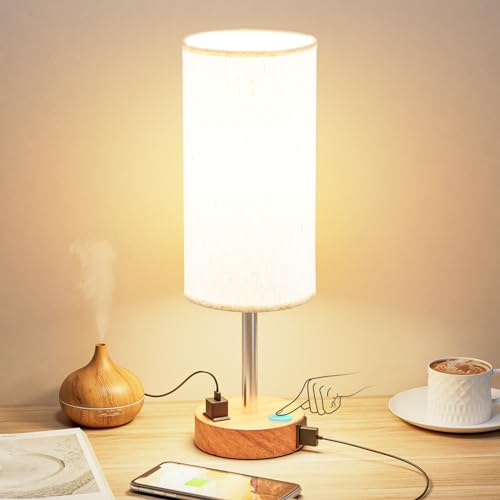
JONATHAN Y Trevor 22.5″ Marble and Brass Gold Table Lamp (JYL5054A)
Who it suits: Style-first buyers with narrow nightstands, who want one genuinely handsome lamp rather than two ordinary ones — and whose surface cannot spare depth.
The Trevor is the designer single of this guide, and its specification is the kind cheaper lamps imitate in photographs: a real marble base — white stone with its natural veining — banded in brass-gold iron, a slim rectangular linen shade, a pull-chain switch, and an LED bulb in the box. Its cleverest dimension, and the reason it climbs to second place in a small-bedroom guide, is depth: at only about 8 inches deep it is a console-profile lamp, designed to sit against a wall on a narrow nightstand or entry table without swallowing the surface your book, phone and water glass also need. This one is drawn as a shallow rectangle for exactly the furniture a small bedroom actually has. Pushed back against the wall, it leaves the front half of a narrow nightstand genuinely usable, which no dome-shaped or round-based lamp at any price can claim.
The stone does small-room work too. A marble base is heavy, and on a narrow surface reached across in the dark, weight is stability: the Trevor stays where it is put when you fumble for its pull chain at 3 a.m. The pull chain is the right bedside control — findable by touch, half-asleep, with no app and no inline switch lost down the back of the nightstand. Jonathan Y sells it on Amazon under its own brand store, and the identical model is also sold at Target — check price on Amazon for the current figure. The point of this pick is that genuine stone and metal inside this budget is the bargain of the guide.
Judge it for what it is. There is no dimmer, no USB port, no sunrise and no app; the pull chain turns it on and off, and the light quality is entirely the included LED bulb’s. What the money buys is the object: stone that stays cool and heavy in the hand, metal with a brushed warmth resin cannot fake, and proportions drawn by a brand that sells into the design trade. On a small nightstand, this is the lamp guests ask about — and it leaves much of the budget unspent.
- Real marble base with brass-gold banding — materials the rest of the price band usually only photographs.
- Slim 8-inch-deep console profile made for narrow nightstands; heavy stone base stays put when reached for in the dark.
- Pull-chain switch you can work half-asleep; LED bulb included.
- Same model also sold at Target — check the current price on Amazon on the live listing.
Honest limitation: On/off only, with no dimming, charging or wake-up features of any kind, — check price on Amazon on the live listing first.
Choose it if the lamp is a piece of furniture you will look at for a decade and your nightstand is narrow. Skip it if you read in bed nightly and need real dimming control at the pillow.

Lumie Bodyclock Shine 300
Who it suits: Light-quality connoisseurs and winter-morning sufferers in small rooms, who want the most adjustable sunrise on sale, no app anywhere near it, and the alarm clock gone from the nightstand.
Lumie is a British light-therapy specialist, and the Shine 300 is its craft-first answer to the Philips. The headline difference is control: the sunrise and sunset ramps adjust from 15 to 90 minutes, so a heavy sleeper can take the long dawn and a light sleeper the short one, and the sunset fades toward a low-blue light intended to be easier on a winding-down brain. Fifteen sounds and an FM radio cover the audio side, the display auto-dims, a tap on the unit snoozes, and weekly alarm scheduling handles weekday-versus-weekend life without nightly reprogramming. There is no app and no subscription — the full feature set is in the box, permanently.
For a small bedroom, the auto-dimming display matters, because a clock face is a light source whether you invited it or not: in a small room a glowing display is a nightlight two feet from your pillow, all night. The Shine 300’s display dims itself away — in a small room, darkness is a feature you have to engineer, and every always-on glow spends it.
Check price on Amazon — it sits in the upper part of this budget band, shoulder to shoulder with the Hatch while spending its money on the light curve instead of the content library. It also carries the longest warranty story of the three wake-up lamps here — three years, though Lumie asks you to register, and buying direct from the brand adds a 45-day trial that an Amazon purchase does not include, so weigh the channel as well. In independent scoring it tends to land as the connoisseur’s pick: not the brightest, not the smartest, but the most finely graded dawn of the three.
- Sunrise and sunset ramps adjustable from 15 to 90 minutes — the widest range in this guide.
- Low-blue sunset light, 15 sounds plus FM radio, weekly scheduling, auto-dimming display — darkness preserved in a small room.
- Three-year warranty on registration; no app and no subscription, ever.
Honest limitation: It is a clock that glows rather than a lamp that decorates, its menus reward a careful read of the manual, and the brand’s 45-day trial is a direct-purchase perk an Amazon order does not get.
Choose it if the dawn itself is the whole point and you want to tune its length. Skip it if you want app convenience or a big library of sleep sounds.

Hatch Restore 3 Sunrise Alarm Clock and Sound Machine
Who it suits: Phone-down routine builders in small rooms who want one device to run the last hour of the evening and the first minutes of the morning — and to retire the clock, the sound machine and the lamp in a single purchase.
The Restore 3 is the bedside lamp reimagined as a routine machine. In the Hatch Sleep app you build a wind-down sequence — dimming warm light paired with audio — then sleep sounds through the night from a library of 80-plus, then a sunrise that brightens ahead of your chosen alarm sound in the morning. A large dial on top handles the basics without your phone, the clock face dims itself away at night, and the fabric-covered body in Putty, Greige or Cocoa looks like a designed object rather than a gadget. Independent side-by-side testing cited in recent comparisons measured its sunrise at roughly 250 lux at 18 inches — enough to change how a dark bedroom feels, and comparable to the Philips above.
Its consolidation count is the highest in this guide: where the Philips replaces lamp plus clock, the Hatch replaces lamp plus clock plus sound machine, three devices that in a small bedroom would otherwise be three footprints, three cords and three glowing things. If your nightstand currently holds a white-noise machine — a common small-room tenant, because thin walls make other people’s noise your problem — the Hatch is the only pick here that hands that surface back too.
Check price on Amazon for the current figure. The honest catch is the business model. A trial of Hatch+ is included; after that the full content library and extra routines sit behind a Hatch+ subscription. The core sunrise, the basic sounds and your routines keep working without it, so the subscription buys depth rather than function — but a buyer comparing sticker prices should know the Philips and Lumie in this guide will never ask for another cent.
- Full routine system: app-built wind-down, overnight sleep sounds and a sunrise wake-up in one device.
- Replaces three nightstand devices — lamp, clock and sound machine — in one compact, fabric-finished body.
- Check the current price on Amazon; big top dial for phone-free control of the essentials.
Honest limitation: The complete library sits behind Hatch+ after the included trial, and everyday brightness adjustment lives in the app rather than on the device.
Choose it if you will actually build and keep an evening routine. Skip it if subscription prompts on a lamp annoy you on principle — the Lumie above does its one job forever for the same money.

SAFAVIEH Lighting Karlen Double Gourd Glass Table Lamps, Set of 2
Who it suits: Small bedrooms that do have two nightstands, however narrow, and a buyer furnishing both sides of the bed who wants a decorator brand’s glass and finish.
Everything changes when the budget is spent on a pair. The Karlen set puts two double-gourd glass lamps — a classic decorator silhouette — in a cream and gold-leaf finish on the two nightstands, with LED bulbs included in the box, from Safavieh’s lighting line rather than an anonymous marketplace brand. Glass has weight and catches the light through the shade, and a gourd pair flanking a bed is the most recognizable “finished bedroom” arrangement there is. This is the pick for readers who looked at the three sunrise devices above and wanted lamps.
The small-room reading of a pair is stricter than the large-room one, and this set survives it better than most. The gourd body is a vertical shape — its presence is height and curve, not width — so on a narrow nightstand each lamp occupies a modest circle while still looking like furniture rather than equipment. What a pair cannot do is consolidate: two Karlen lamps light two surfaces beautifully and replace nothing, so the alarm clock keeps its corner and the phone keeps its cable. That is the honest trade this guide keeps returning to. If both sides of your bed genuinely need light — two readers, two different wake times — the pair is the right spend.
Check price on Amazon for the current figure. This pair’s pricing has historically moved around within this budget band, so it is worth checking on the day. Read it as a pair positioned in the lower-to-middle part of the budget, well inside the limit, leaving room in a $200 spend for the good dimmable bulbs these lamps deserve — because like most decorative lamps, the Karlen’s own control is a simple switch, and the dimming quality of the finished setup will be decided by the bulb you choose, not the base you bought.
- A matched pair of double-gourd glass lamps in cream and gold leaf, LED bulbs included.
- Check price on Amazon — two decorator lamps positioned in the lower-to-middle part of the budget.
- A vertical, gourd profile that reads as furniture while asking a modest circle of each narrow nightstand.
Honest limitation: The price has historically moved around, so check the current price on Amazon, and there is no built-in dimmer — plan on dimmable bulbs or a plug-in dimmer for bedside duty.
Choose it if symmetry and a finished look matter more than wake-up features, and both sides of the bed need light. Skip it if you have only one nightstand, or need stepless dimming out of the box.
SAFAVIEH Lighting Turner Rustic Farmhouse Table Lamps, Set of 2
Who it suits: Farmhouse and rustic small bedrooms that need a taller, matched pair with proper shades — and the nightstand width to stand them on.
The Turner pair is the Karlen’s country cousin: 25-inch lamps in a rustic brown farmhouse finish with rectangular fabric shades, sold as a set of two with LED bulbs included. The extra height matters more than it sounds, and in a small bedroom it matters in the guide’s favorite direction — upward, where space is free. Short lamps strand their light below mattress level on a tall modern bed, while a 25-inch lamp puts the shade near eye level for reading and throws its light across the bed instead of into the nightstand. In a wood-and-linen bedroom, this is the pair that looks like it was chosen rather than inherited.
The caution is the shade, and it is a measurement rather than a taste. A 25-inch lamp carries a wide rectangular shade, and on a narrow nightstand wedged between bed and wall the shade — not the base — is what overhangs the edge, brushes the wall or leans over the sleeper. The base guide’s own advice for this pair was to respect its footprint, and in a small bedroom that advice doubles: measure the shade’s width against the gap the lamp will actually stand in before ordering, and if the nightstand is under about 16 inches wide, take the Karlen pair or the Trevor single instead and let this one go. A tall lamp that fits is a small room’s best trick; a tall lamp whose shade crowds the bed is just a large object in a small room.
Check price on Amazon for the current figure. This pair’s pricing has historically moved around within this budget band, so checking the live listing matters. As with the Karlen, control is a simple switch and dimming is a bulb decision — allow for two good dimmable LEDs or a pair of plug-in dimmers if these will be your reading lamps, and the finished setup should still sit inside the $200 budget.
- 25-inch height suits tall beds and reading in bed better than stubby nightstand lamps — height a small room gets for free.
- Matched farmhouse pair with rectangular shades and LED bulbs included.
- Check the current price on Amazon — positioned in the lower-to-middle part of the budget.
Honest limitation: Check the current price on Amazon when you shop, as its position within the band can vary; there is no dimmer in the lamp itself; and the wide rectangular shade needs a nightstand wide enough to respect it.
Choose it if your bedroom is rustic or farmhouse and both sides of the bed need light. Skip it if your nightstands are small; a 25-inch lamp with a rectangular shade needs its footprint respected.

Comparison Table
| Product | Type | Best use | Link |
|---|---|---|---|
| Philips SmartSleep Wake-Up Light, HF3520/60 | Sunrise alarm lamp | Lamp plus alarm clock in one footprint — check price on Amazon | Check on Amazon |
| JONATHAN Y Trevor Table Lamp | Decorative single, marble and brass | Slim 8-inch-deep console profile for a narrow nightstand | Check on Amazon |
| Lumie Bodyclock Shine 300 | Sunrise alarm lamp | The most adjustable dawn, 15–90 minutes — check price on Amazon | Check on Amazon |
| Hatch Restore 3 | Smart sunrise lamp and sound machine | Lamp, clock and sound machine in one body — check price on Amazon | Check on Amazon |
| SAFAVIEH Karlen Table Lamps, Set of 2 | Decorative glass pair | Decorator symmetry for two narrow nightstands — check price on Amazon | Check on Amazon |
| SAFAVIEH Turner Table Lamps, Set of 2 | Decorative farmhouse pair | Taller rustic pair for reading height — check price on Amazon | Check on Amazon |
How to Choose a Bedside Lamp for a Small Bedroom Under $200
- Count the devices on your nightstand before you count lamps. If a lamp, a clock and a sound machine are three separate objects on 16 inches of surface, the best lamp purchase may be the one that deletes two of them. Consolidation is the small room’s first feature.
- Measure depth before height. Height costs a small room nothing; depth is taken straight out of your book, phone and water glass. Note the nightstand’s depth, then the lamp’s — a console profile around 8 inches deep exists precisely for this furniture.
- Measure the shade, not just the base. On a narrow nightstand wedged between bed and wall, the shade is usually the widest part and the part that overhangs, brushes the wall or leans over the sleeper. Check its width against the gap the lamp will stand in.
- Count your nightstands before you count lamps. Two surfaces can take a pair. One surface takes one good lamp — and the discipline to stop there. Zero surfaces takes a lamp that shares a shelf, a sill or a dresser corner, which argues for the slimmest profile in this guide.
- Decide what the lamp is for. Waking, reading, or decorating — at this budget each job has a different winner, and in a small room there is no surface spare for a lamp bought for the wrong job.
- Judge dimming at the bottom, not the top. Every lamp is bright enough at full power. What separates the good ones is the lowest setting: a bedside lamp in a small room should glow faintly enough to find the floor at 3 a.m. without waking a partner two feet away.
- For sunrise lamps, check the ramp. Look for a colored sunrise that starts from a near-dark red, a duration you can adjust (the Lumie spans 15–90 minutes), and a sunset mode for the evening — a lamp that only brightens is half a product.
- Count the ongoing costs. A smart lamp with a subscription library costs more over time than its purchase price alone. App-free lamps cost their purchase price once. Neither is automatically wrong; just consider the ongoing cost before, not after.
- Take materials claims literally. “Marble” should mean stone, “glass” should mean glass. If a listing says “marble finish” or “faux,” you are buying a photograph of the material, priced accordingly — fine at the low end of the band, not near the top.
- Weigh the base, literally. On a narrow surface that gets reached across in the dark, a heavy stone or glass base stays put and a featherweight one skates toward the edge. Stability is a small-room specification, not a luxury.
- Plan the dimming the lamp does not have. Most decorative lamps are on/off devices. A quality dimmable LED bulb, a plug-in dimmer or a smart bulb turns any of them into a bedside lamp; allow a small extra amount for it rather than rejecting good lamps for a missing dial.
- Check the switch at pillow distance. Pull chains, top dials and tap controls can be worked half-asleep; a small inline cord switch two feet down the back of a narrow nightstand cannot. This unglamorous detail decides daily satisfaction.
Slim Console-Profile Lamps: The Shape a Narrow Nightstand Asks For
Most table lamps are round, and round is a large room’s shape: on a rectangular nightstand it wastes the corners and crowds the front edge where your hands work. The console-profile lamp is the correction. Lamps drawn for shallow console tables are shallow too: a wide, slim rectangle, deep enough to be stable and no deeper. The Trevor in this guide, at about 8 inches deep with a rectangular linen shade, is the type specimen — a lamp whose footprint is a strip along the wall rather than a circle in the middle of your surface.
A slim lamp pushed back against the wall leaves a continuous usable band across the front of the nightstand: book flat, glass stable, phone face-down, glasses where your hand expects them. A round lamp fragments that band into leftovers. A lamp against the wall also throws its light forward across the bed rather than wasting half of it on the wall behind it. If your nightstand is a console, a shelf, a windowsill or the top of a low dresser — all common small-bedroom improvisations — the slim profile is not a style preference. It is the difference between a lamp that fits the furniture and a lamp that merely stands on it.
The honest limits are two. A shallow base is stable front-to-back only if it is heavy or well-proportioned, which is why the Trevor’s marble matters and why a featherweight slim lamp is a worse idea than either — check that any console-profile lamp you consider has real weight in its base. And a rectangular shade lights a rectangular patch: it is excellent across a bed and poor at pretending to be a room light, so a small bedroom that needs its bedside lamp to double as the main evening light for dressing and tidying should know the slim lamp is a specialist.
One Premium Lamp Instead of Two Cheap Ones
The matched pair is the default assumption of bedside lighting, and small bedrooms break it constantly: one side of the bed is against the wall, the second nightstand is a stool or a crate, or the room has one usable outlet on the wrong side. In each case the pair is a solution to a room you do not have, and money split across two cheap lamps buys two sets of compromises. The alternative this budget makes possible is concentration. Two hundred dollars spent on one lamp buys the things a pair split across two cheaper lamps cannot have at all: a sunrise curve engineered from near-darkness, real stone and brass, a three-year warranty, a dimmer that reaches a true glow. In a room with one nightstand, one premium lamp is not half a lighting plan. It is the whole plan, done properly.
In a one-nightstand room, the second lamp of a pair usually gets stored, lent, or stood somewhere it was never meant to be. The “buy its twin later” plan also fails on schedule, because models and finishes change. Either buy a pair as a pair, or commit to the single premium lamp as the finished answer. The unfinished middle is the only wrong one.
There is one exception, and it is the mixed setup, which suits more shared small bedrooms than the symmetric one. Put the wake lamp on the side of the earlier riser — a Philips — check price on Amazon — and let the other side keep a small, simple lamp or none, for the partner who wakes by phone and reads rarely. The two sides will not match, but in a real small bedroom that asymmetry reads as intentional. What does not work is a sunrise lamp asked to be the only light source for two committed readers — if both sides read nightly, that is the Karlen pair’s job.
The Wake Light That Retires Your Alarm Clock
The separate alarm clock is the most quietly wasteful object in a small bedroom. It occupies the best corner of the nightstand, glows all night, competes for the one reachable outlet, and does exactly one thing — badly enough that most people keep a phone alarm as its backup. A wake-up light deletes it entirely, and the deletion is worth more than the sunrise it replaces it with. The clock’s functions — time display, alarm, snooze — move inside the lamp you were buying anyway; the display dims itself away at night on the Lumie, folds into the routine machine on the Hatch, and on the Philips exists only as part of a unit that earns its glow. One footprint, one cord, one object to dust, and a nightstand corner handed back to a book.
What the sunrise itself adds is control over time, which no ordinary lamp and no alarm clock offers. A wake light’s brightness is engineered to begin at a fraction of a percent of full output — a deep red ember — and climb smoothly for 15 to 90 minutes without steps, flicker or a sudden jump at the bottom of the range, because the entire experiential claim lives in those first faint minutes. Ordinary dimmers and smart bulbs bottom out around 5 to 10 percent and step visibly; switched on at 6 a.m. they are simply a lamp turning on. In a small bedroom the effect is amplified: the light has less room to fill, and the sunset run in reverse gives a genuine evening dimming ritual rather than a choice between full light and dark.
The three wake lamps in this guide are three philosophies, and the small-room choice among them is mostly about what else they retire. The Philips sells the curve and nothing else — check price on Amazon — with no app and no subscription — the purest swap for lamp plus clock. The Lumie sells the most adjustable curve, 15 to 90 minutes, tuned by a company that began in light therapy — check price on Amazon, positioned in the upper part of the budget. The Hatch sells the routine around the curve — sounds, sequences, an app — and retires the sound machine as well — check price on Amazon — plus whatever you decide the subscription library is worth. None of these is a medical device and none treats a sleep disorder; persistent insomnia, loud snoring with breathing pauses, or exhaustion that survives a week of good sleep hygiene are conversations for a clinician, not a lamp. But as furniture economics, a well-shaped dawn that also empties your nightstand is the one upgrade in this guide that changes both the morning and the room.
Where the Money Stops Improving the Light
At the lower end of this budget, money buys real things: a sunrise curve instead of a switch, glass and stone instead of resin and foil, shades that diffuse instead of glaring, bulbs included, warranties that exist. In the middle of the band it buys refinement — a longer, smoother ramp, a sound library, weekly scheduling, better industrial design. Near the top of the budget, in this guide’s research, it stops buying light altogether. The Hatch and Lumie sit near the top of the band not because their photons are finer but because their systems are complete; and at the decorative end, the pair that would spend the whole budget — Safavieh’s Arwen set of two, named here without a link — buys height, scale and finish, not a better bulb.
We name the Arwen without a link deliberately: we could not verify a stable listing identifier in this research, and this series does not guess at links. It stands in this guide as the honest marker of the ceiling — proof that the whole $200 budget can be spent on two lamps, and that what the extra spend over a Karlen pair purchases is presence, not illumination. For a small bedroom the conclusion cuts even cleaner: the room cannot display presence the way a large one can. Buy the lamp whose job description matches your mornings and your nightstand, and let the leftover money go — a Philips, check price on Amazon, plus money left toward other bedroom needs will improve more nights than a top-of-budget lamp bought to satisfy a budget line.
Common Buying Mistakes
- Buying a small lamp for a small room — a short lamp saves no surface, strands its light below mattress level, and lights the sleeper’s eyes instead of the book. Footprint is the constraint, not height.
- Keeping a separate alarm clock out of habit after buying a wake-up light, and leaving the nightstand as crowded as it was before the purchase.
- Buying a matched pair for a room with one nightstand — or none — and storing the second lamp in a closet for a year.
- Measuring the lamp’s base but never its shade, then discovering the shade overhangs the narrow nightstand or crowds the wall.
- Choosing a round lamp for a rectangular nightstand when a slim console-profile lamp would leave the front of the surface usable.
- Comparing a pair’s price with a single’s price and concluding the pair is “more expensive” — divide by the number of lamps first.
- Paying for a smart lamp’s hardware and sleepwalking into its subscription; read the post-trial subscription terms before the trial starts.
- Judging a lamp by its full-brightness output when bedside life is lived at the bottom of the dimmer, where cheap lamps flicker, buzz and jump — at close range, inescapably.
- Believing “marble finish,” “gold look” and similar phrases describe materials; at this budget, insist the listing name the actual stone, glass or metal.
- Forgetting the bulb. A decorative lamp’s warmth, dimming and flicker are the bulb’s, and the included bulb is a starting point, not a verdict.
- Expecting a wake-up light to treat insomnia, apnea or winter depression. These are comfort products; symptoms that persist belong in a clinician’s office.
Final Recommendation
- Most small bedrooms: Philips SmartSleep Wake-Up Light, HF3520/60.
- Narrow nightstands, furniture-grade looks: JONATHAN Y Trevor 22.5″ Marble and Brass Gold Table Lamp.
- Light-quality purists: Lumie Bodyclock Shine 300.
- Routine builders: Hatch Restore 3 Sunrise Alarm Clock and Sound Machine.
- Both sides of the bed, decorator style: SAFAVIEH Lighting Karlen Double Gourd Glass Table Lamps, Set of 2.
- Farmhouse bedrooms: SAFAVIEH Lighting Turner Rustic Farmhouse Table Lamps, Set of 2.
Our top two are the Philips SmartSleep and the JONATHAN Y Trevor, because between them they answer the only two shapes a small bedroom’s bedside problem comes in. If the nightstand is crowded with devices, the Philips consolidates it — lamp, clock, alarm and wind-down in one footprint — check price on Amazon — with no app and no subscription — and the surface it frees is worth more than any feature in this guide. If the nightstand is simply narrow and the room wants furniture, the Trevor’s marble, brass and 8-inch-deep console profile put a decade-grade object on it while leaving the front of the surface yours. If neither shape is yours — if both sides of the bed read nightly and symmetry is the point — the Karlen pair will make the room look finished at a similar position in the budget. Measure your nightstand’s depth, count the devices on it, decide which job you are hiring for, check the live price and the warranty terms on the listing, and spend what the job costs rather than what the budget allows.
Frequently Asked Questions
Is one lamp really enough for a small bedroom?
Often, yes — and it is the room, not the budget, that decides. Count surfaces, not sides of the bed. A small bedroom with one nightstand is best served by one premium lamp for that surface: a wake light if it also carries a clock, a slim console-profile lamp if the surface is narrow. If the room has two nightstands and two readers, take a matched pair, bought together so the finishes match.
What lamp shape suits a narrow nightstand?
A slim, console-profile lamp: wide and shallow rather than round, designed to stand against the wall and leave the front of the surface usable. The Trevor in this guide is about 8 inches deep with a rectangular shade, and that profile — not its marble — is its small-room credential. Whatever you choose, measure the shade as well as the base: on a narrow nightstand the shade is usually the widest part, and it is the part that overhangs or crowds the wall.
Can a wake-up light really replace my alarm clock?
Yes — that is half of what you are paying for. All three wake lamps in this guide are full alarm clocks: settable alarms, snooze, time displays that dim at night, and in the Lumie’s case weekly scheduling for weekday-versus-weekend life. Retiring the separate clock frees the best corner of a small nightstand and one of its outlets. The honest caveats are power and habit: none has a battery backup worth the name, so a power cut loses settings, and very heavy sleepers should keep a phone alarm as a backstop at first.
Philips, Lumie or Hatch: which sunrise lamp should a small bedroom choose?
Choose the Philips HF3520 for the proven, app-free default positioned lowest in this budget — check price on Amazon — and the simplest nightstand swap. Choose the Lumie Shine 300 if you want to tune the sunrise from 15 to 90 minutes, value its three-year warranty, and want a display that dims itself away in a small, dark room. Choose the Hatch Restore 3 if you want one device to run wind-down routines and overnight sleep sounds as well — it retires the sound machine too — and you accept that its full library sits behind a subscription after the included trial.
How much should a small bedroom actually spend on a bedside lamp?
Less than this budget allows, in most cases. The category benchmark sunrise lamp in this guide sits comfortably inside the budget — check price on Amazon — the slim marble single sits in the lower part of the band, and a decorator-brand pair of glass lamps sits in the lower-to-middle part of the band. Spending toward the top of the $200 budget buys a more adjustable dawn, a routine system, taller pairs or finer materials — all legitimate, none of them brighter in any way that matters, and none of them smaller, which in a small bedroom is the specification that counts.
Are lamp pairs ever right for a small bedroom?
Yes, when the room genuinely has two nightstands and both sides of the bed need light — two readers, two schedules. A verified pair positioned in the lower-to-middle part of the budget lights both surfaces with matching lamps for less than one premium single, and symmetry does most of the visual work in a finished bedroom. Pairs fail in small rooms only when they are bought by default for a one-nightstand layout. Measure the shade against the nightstand before ordering, especially with the 25-inch Turner pair, whose rectangular shades need their footprint respected.
Can a wake-up light treat insomnia or seasonal depression?
No. These are comfort products, not medical devices, and none of the lamps in this guide is a 10,000-lux light-therapy box. Many people find a regular dawn cue helps their routine, but insomnia, suspected sleep apnea or low mood that persists should be discussed with a clinician rather than shopped for.
What if a listing shows a different price or no offer?
Prices at this tier move, and premium listings occasionally rotate sellers. Check the current price on Amazon for each product: if the live price sits well outside its position in this budget band, wait or choose the alternative named in its review, and never substitute an unverified lookalike listing that merely borrows the product’s name. For the Trevor specifically, treat the live Amazon listing as the only price that counts.
- Best Bedside Lamp Under $200
- Best Bedside Lamp Under $100
- Best Bedside Lamp For Small Bedrooms Under $100
- Best Bedside Lamp For Small Bedrooms Under $400
- Best Bedside Lamp For Apartments Under $200
- Best Bed Frame For Small Bedrooms Under $200
- Best Bed Sheet Set For Small Bedrooms Under $200
Related Guides
- Best Bedside Lamp For Small Bedrooms Under $30
- Best Bedside Lamp For Small Bedrooms Under $75
- Best Bedside Lamp For Small Bedrooms Under $100
- Best Bedside Lamp For Small Bedrooms Under $400
- Best Bedside Lamp For Small Bedrooms Under $700