Where to buy
Check the latest price, availability and delivery on Amazon. Orders are placed on Amazon. We may earn a commission from qualifying purchases.
- Best overall: Philips SmartSleep Wake-Up Light, HF3520/60 — Check on Amazon
- Hatch Restore 3 Sunrise Alarm Clock and Sound Machine — Check on Amazon
- Lumie Bodyclock Shine 300 Sunrise and Sunset Alarm Clock — Check on Amazon
- SAFAVIEH Lighting Karlen Double Gourd Glass Table Lamps, Set of 2 — Check on Amazon
See 2 more Amazon options
- JONATHAN Y Trevor 22.5″ Marble and Brass Gold Table Lamp — Check on Amazon
- SAFAVIEH Lighting Turner Rustic Farmhouse Table Lamps, Set of 2 — Check on Amazon
Read the full guide ↓
Disclosure: As an Amazon Associate, airfryerkitchensupply.com earns from qualifying purchases. Links to Amazon on this page are affiliate links; they cost you nothing extra. Listing details such as price and availability change often, so check the current Amazon listing before you buy.
A guest room is judged twice: once from the doorway, in the first ten seconds, and once at 6 a.m., when your guest is waking up in a strange bed, in a strange house, possibly for an early flight — and discovering how they are expected to get up. The under-$100 tier of this guide fixed the midnight test: light a guest can work half asleep, and charging that needs no negotiation. Two hundred dollars fixes the morning test, and adds the polish the doorway test rewards. This is the first bedside-lamp budget where a sunrise alarm lamp — a lamp that wakes your guest with a gradual dawn instead of a phone alarm buzzing against an unfamiliar nightstand — sits comfortably alongside designer pairs in real glass and marble. The hosting luxury at this tier is not brightness. It is a guest who wakes gently, in a room that looks considered, without configuring anything.
The guest-room rules still apply, and at this price they apply harder, because the technology gets cleverer. The guest must never be asked to download an app, create an account, or learn a routine: the host pre-sets everything before the visit, and what the guest touches is a tap, a dial or a pull chain. That rule shapes every pick below. The Philips SmartSleep Wake-Up Light — check price on Amazon — is set once by the host and then runs itself — colored sunrise, natural sounds, tap to snooze, no account in sight. The Hatch Restore 3 — check the current price on Amazon — is the polished routine machine, and its app lives on the host’s phone, where it belongs: the host builds the wind-down and wake-up before guests arrive, and the guest simply enjoys them. And if the lamp is furniture first, the Safavieh pairs below put real glass gourds or a tall farmhouse silhouette on both nightstands well inside this budget, which is the doorway test won outright. Below you will find the quick picks, detailed reviews of all six, a comparison table, a buying checklist written for hosts, and answers to the questions that come up again and again.
In this guide
Quick Picks
Short on time, or comparing several options at once? Each row below names a hosting situation and the product that suits it, with a link to the listing.
| Buyer type | Pick | Why it stands out | Link |
|---|---|---|---|
| Best overall | Philips SmartSleep Wake-Up Light, HF3520/60 | The original colored sunrise lamp; the host sets it once, the guest just wakes — check price on Amazon | Check on Amazon |
| Best smart routines | Hatch Restore 3 Sunrise Alarm Clock and Sound Machine | Host-built wind-down and wake routines plus 80+ sleep sounds — check price on Amazon — the guest never touches the app | Check on Amazon |
| Best light quality, no app | Lumie Bodyclock Shine 300 | 15–90 minute adjustable sunrise and low-blue sunset from a light-therapy specialist — check price on Amazon | Check on Amazon |
| Best designer pair | SAFAVIEH Lighting Karlen Double Gourd Glass Table Lamps, Set of 2 | Cream and gold-leaf glass gourds with LED bulbs included for two — check price on Amazon | Check on Amazon |
| Best designer single | JONATHAN Y Trevor 22.5″ Marble and Brass Gold Table Lamp | Real marble base, slim 8-inch-deep profile for a single narrow guest nightstand | Check on Amazon |
| Best farmhouse pair | SAFAVIEH Lighting Turner Rustic Farmhouse Table Lamps, Set of 2 | 25-inch rustic pair with rectangular shades — check price on Amazon | Check on Amazon |
How These Picks Were Chosen
The first filter was the budget, applied to the configuration you would actually buy. Every product below is a real Amazon listing whose relevant configuration — the single lamp, or the pair — sells at or regularly near $200 in the United States. Listing prices and availability change often, so check the current price on Amazon for each pick before you buy. One product we wanted in this guide, Safavieh’s Arwen pair — a pair that spends nearly the whole budget — could not be verified with a stable listing identifier, so it is discussed by name in the designer section below and deliberately not linked.
We did not use these products ourselves. We read the maker listings and specification pages, compared sunrise durations, dimming ranges, materials and what is actually in the box, and cross-checked them against independent sunrise-clock testing and roundups. Then we applied the guest test, in the two forms this tier demands. The midnight test: could a tired stranger work this lamp at 3 a.m. with no instructions? And the morning test, new at this budget: does this lamp improve how the guest wakes, or does it merely sit there while their phone does the waking? A lamp that needs the guest to install an app fails both tests no matter how good its light is — which is why every smart feature in this guide is framed the way a host will actually use it: configured by the host, in advance, on the host’s account.
Two judgments run through the whole guide and are worth stating up front. First, near the top of this budget, extra money stops buying better light in any measurable sense — it buys routines, materials, brand and design, which may be exactly what a guest room wants, but you should know that is what you are paying for. Second, a sunrise lamp and a decorative lamp are not rivals in a guest room either: one is an alarm clock that emits light, the other is furniture that emits light, and the best-hosted rooms at this budget often contain one of each — a wake-up lamp on the guest’s nightstand, a handsome pair’s second lamp across the room or in the host’s own bedroom. The picks below are ordered so that the three wake-up lamps come first, then the lamps bought for how they look at noon as much as how they glow at night.
The 6 Best Bedside Lamps for Guest Rooms Under $200
Philips SmartSleep Wake-Up Light, HF3520/60
Who it suits: Most hosts. If your guests wake for flights, trains, school runs or simply at a civilized hour — and you want them woken kindly, in a house that is not theirs — this is the default recommendation of the tier.
Think about how a guest usually wakes in your house: a phone alarm they set themselves, buzzing and flashing on an unfamiliar nightstand, in the dark, in a room where they do not know where the door is. The Philips replaces that small rudeness with hospitality. The evening before, the host sets the wake time — ask your guest when they need to be up, the way you would ask how they take coffee — and in the morning the lamp builds a colored sunrise over about half an hour, deep red through orange to warm white, across 20 brightness settings, finishing with one of five natural sounds or the FM radio. The guest wakes gradually, oriented, in a room already softly lit, and taps the top of the lamp to snooze. In the evening the same lamp runs the process backwards as a sunset wind-down, and the rest of the time it is a perfectly good reading lamp. There is no app, no account, no microphone and no subscription, ever — which in a guest room is not a missing feature but the entire point: there is nothing for the guest to configure, pair, download or break.
Check price on Amazon — it sits comfortably inside this budget, well below the top of the tier, for the lamp that defined the sunrise category and still anchors roundup after roundup. It carries a 2-year Philips warranty. What the money buys is the quality of the dimming curve itself: the HF3520 starts its sunrise at a genuinely faint red glow rather than snapping on at 10 percent brightness, and that first five minutes is the whole difference between a guest waking gradually and a guest being woken by a dim but sudden light.
- Colored sunrise and sunset simulation with 20 brightness settings and five natural sounds, plus FM radio.
- Check price on Amazon — comfortably inside the budget for the category benchmark.
- No app, no account, no subscription; the host sets it once, the guest taps to snooze. 2-year warranty.
Honest limitation: The design is a smooth plastic dome that looks like a piece of sleep equipment, not furniture, there is no USB charging for the guest’s phone, and there is no battery backup worth the name — a power cut loses the settings, so a host relying on it for a guest’s early flight should re-check it after any outage.
Choose it if you want the gentlest, simplest guest wake-up and could not care less about apps. Skip it if you want sound-machine variety, phone control, or a lamp that decorates the room.
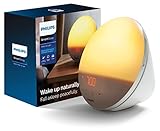
Hatch Restore 3 Sunrise Alarm Clock and Sound Machine
Who it suits: Hosts who enjoy setting a room up properly — and guests who will never know an app was involved. If you will spend ten minutes before a visit building the perfect evening, this is the lamp that rewards you.
The Restore 3 is the bedside lamp reimagined as a routine machine, and the guest room is where its model makes the most sense — provided the roles are assigned correctly. The host builds the routine in the Hatch Sleep app, on the host’s phone and the host’s account: a wind-down sequence of dimming warm light paired with audio for the guest’s first evening, sleep sounds through the night from a library of 80-plus, then a sunrise that brightens ahead of the chosen alarm sound in the morning. The guest’s entire job is the large dial on top, which handles the basics without a phone, while the clock face dims itself away at night and the fabric-covered body in Putty, Greige or Cocoa looks like a designed object rather than a gadget. Independent side-by-side testing cited in recent comparisons measured its sunrise at roughly 250 lux at 18 inches — enough to change how a dark bedroom feels, and comparable to the Philips above. A guest who has slept under a routine someone built for them remembers it the way they remember good towels: as evidence the visit was thought about.
Check the current price on Amazon. The honest catch is the business model, and hosts should hear it plainly. A 30-day trial of Hatch+ is included; after that, the full content library and extra routines are available on a paid subscription. That subscription is the host’s ongoing cost, never the guest’s, and the core sunrise, the basic sounds and your built routines keep working without it — so Hatch+ buys depth rather than function. But a buyer comparing total costs should know the Philips and Lumie in this guide will never ask for another cent. Hatch also moved brightness control into the app on the Restore 3, dropping the side buttons the Restore 2 had: for a guest room that means the host should set the evening brightness at a level that works for reading and for winding down, because a guest at 2 a.m. has the dial, not the slider.
- Full routine system: host-built wind-down, overnight sleep sounds and a sunrise wake-up in one device.
- Check price on Amazon — in a fabric finish that suits a styled guest nightstand.
- Big top dial for phone-free control of the essentials — the only control the guest needs.
Honest limitation: The complete library sits behind Hatch+ on a paid subscription after a 30-day trial, everyday brightness adjustment lives in the host’s app rather than on the device, and the whole arrangement depends on the host setting it up before the visit — an unconfigured Hatch is the least guest-proof object in this guide.
Choose it if you will actually build the routine before your guests arrive. Skip it if subscription prompts on a lamp annoy you on principle — the Lumie below does its one job forever for the same money.

Lumie Bodyclock Shine 300
Who it suits: Hosts whose guests keep different hours from each other — the early-rising parent one weekend, the lie-in teenager the next — and who want the dawn tuned to the guest, not the house.
Lumie is a British light-therapy specialist, and the Shine 300 is its craft-first answer to the Philips. The headline difference is control: the sunrise and sunset ramps adjust from 15 to 90 minutes, so the host can give a heavy sleeper the long dawn and a light sleeper the short one, and the sunset fades toward a low-blue light intended to be easier on a winding-down guest. Fifteen sounds and an FM radio cover the audio side, the display auto-dims so the clock face does not glow at a sleeping guest all night, a tap on the unit snoozes, and weekly alarm scheduling lets the host program a whole visit — weekday dawn for the guest who is working from your spare room, weekend mercy for the same guest on Saturday — without touching the lamp again between. There is no app and no subscription: the guest meets a clock that glows, and the full feature set is in the box, permanently.
Check price on Amazon — it sits in the upper part of this budget, shoulder to shoulder with the Hatch in positioning, while spending its money on the light curve instead of the content library. It also carries the longest warranty story of the three wake-up lamps here — three years, though Lumie asks you to register, and buying direct from the brand adds a 45-day trial that an Amazon purchase does not include, so weigh the channel as well as the price. In independent scoring it tends to land as the connoisseur’s pick: not the brightest, not the smartest, but the most finely graded dawn of the three — and in a guest room, where you cannot ask the sleeper to adapt to the lamp, adjustability is a hosting feature, not a specification.
- Sunrise and sunset ramps adjustable from 15 to 90 minutes — tune the dawn to each guest.
- Low-blue sunset light, 15 sounds plus FM radio, weekly scheduling, auto-dimming display.
- Three-year warranty on registration; no app and no subscription, ever.
Honest limitation: It is a clock that glows rather than a lamp that decorates, its menus reward a careful read of the manual — the host’s job, before the visit, not the guest’s at midnight — and the brand’s 45-day trial is a direct-purchase perk an Amazon order does not get.
Choose it if the dawn itself is the whole point and your guests wake at wildly different hours. Skip it if you want app convenience or a big library of sleep sounds.

SAFAVIEH Lighting Karlen Double Gourd Glass Table Lamps, Set of 2
Who it suits: Hosts furnishing both sides of the guest bed who want the doorway test won outright — a decorator brand’s glass and finish at a per-lamp cost that stays well inside this budget.
Everything changes when the budget is spent on a pair. The Karlen set puts two double-gourd glass lamps — a classic decorator silhouette — in a cream and gold-leaf finish on the two guest nightstands, with LED bulbs included in the box, from Safavieh’s lighting line rather than an anonymous marketplace brand. Glass is the honest material story here: it has weight, it catches and colors the light through the shade, and a gourd pair flanking a bed is the single most recognizable “finished bedroom” arrangement there is. Guests may not know the word for what they are noticing, but a matched pair of real glass lamps registers as a room that was composed for someone, which is the entire first impression a host is buying. This is the pick for the reader who looked at the three sunrise devices above and thought, correctly for them, that their guests wake happily enough to a phone alarm and what the room lacks is polish.
Check the current price on Amazon — this pair sits well inside the budget, leaving room in a $200 spend for the good dimmable bulbs these lamps deserve — because like most decorative lamps, the Karlen’s own control is a simple switch, and the dimming quality of the finished setup will be decided by the bulb you choose, not the base you bought. For guest duty that is a manageable trade: fit warm dimmable bulbs before the visit and the guest gets a lamp that behaves, even if the lamp itself never learned any tricks.
- A matched pair of double-gourd glass lamps in cream and gold leaf, LED bulbs included.
- Check price on Amazon — two decorator lamps that sit well inside the budget.
- A real brand’s finish and proportions, sized for nightstands rather than consoles.
Honest limitation: Pricing can vary, so check the current price on Amazon before you commit, there is no built-in dimmer or charging, and a decorative pair does nothing for the guest’s morning — waking is still their phone’s job.
Choose it if symmetry and a finished look matter more than wake-up features. Skip it if you need stepless dimming out of the box.
JONATHAN Y Trevor 22.5″ Marble and Brass Gold Table Lamp (JYL5054A)
Who it suits: Style-first hosts with one narrow guest nightstand — the single-bed spare room, the daybed room — who want one genuinely handsome lamp rather than two ordinary ones.
The Trevor is the designer single of this guide, and its specification is the kind cheaper lamps imitate in photographs: a real marble base — white stone with its natural veining — banded in brass-gold iron, a slim rectangular linen shade, a pull-chain switch, and an LED bulb in the box. Its cleverest dimension is depth: at only about 8 inches deep it is a console-profile lamp, designed to sit against a wall on a narrow nightstand without swallowing the surface the guest’s book, phone and water glass also need. The pull chain deserves its sentence in a guest room: it is the most discoverable control ever fitted to a lamp, findable by a stranger’s hand in the dark on the first try, with nothing to configure and nothing to explain. Jonathan Y sells it on Amazon under its own brand store, and the identical lamp also lists at Target — check price on Amazon to confirm the current listing, because the point of this pick is that genuine stone and metal in this tier is the bargain of the guide.
Judge it for what it is. There is no dimmer, no USB port, no sunrise and no app; the pull chain turns it on and off, and the light quality is entirely the included LED bulb’s. What the money buys is the object: stone that stays cool and heavy in the hand, metal with a brushed warmth resin cannot fake, and proportions drawn by a brand that sells into the design trade. On a small guest nightstand, next to a bed dressed with any care at all, this is the lamp guests ask about — and it leaves half the budget unspent, which the final section of this guide will argue is a feature, not a failure.
- Real marble base with brass-gold banding — materials the rest of the price band usually only photographs.
- Slim 8-inch-deep console profile made for narrow nightstands; pull-chain switch; LED bulb included.
- Same model also lists at Target — check price on Amazon for the current listing.
Honest limitation: On/off only, with no dimming, charging or wake-up features of any kind — check the live listing on Amazon first before you commit.
Choose it if the lamp is a piece of furniture your guests will admire for a decade. Skip it if your guests read in bed nightly and need real dimming control at the pillow.

SAFAVIEH Lighting Turner Rustic Farmhouse Table Lamps, Set of 2
Who it suits: Farmhouse and rustic guest rooms that need a taller, matched pair with proper shades — and hosts who want a matched pair that sits well inside this budget.
The Turner pair is the Karlen’s country cousin: 25-inch lamps in a rustic brown farmhouse finish with rectangular fabric shades, sold as a set of two with LED bulbs included. The extra height matters more in a guest room than it sounds. Short lamps strand their light below mattress level on a tall modern guest bed, while a 25-inch lamp puts the shade near eye level for a guest reading in bed and throws its light across the bed instead of into the nightstand. In a wood-and-linen spare room — the room that hosts the in-laws, the college friends, the holiday overflow — this is the pair that looks like it was chosen rather than inherited, and matching height on both sides is what makes a guest bed read as a bed for two adults rather than a bed with a lamp near it.
Check price on Amazon — this pair sits well inside this budget. As with the Karlen, control is a simple switch and dimming is a bulb decision — budget for two good dimmable LEDs if these will be your guests’ reading lamps, and the finished setup will still land far under $200.
- 25-inch height suits tall guest beds and reading in bed better than stubby nightstand lamps.
- Matched farmhouse pair with rectangular shades and LED bulbs included.
- Check price on Amazon — a matched pair that sits well inside the budget.
Honest limitation: Check the current price on Amazon before you commit, and — again — there is no dimmer, no charging and no wake-up help in the lamp itself.
Choose it if your guest room is rustic or farmhouse and both sides of the bed need light. Skip it if your guest nightstands are small; a 25-inch lamp with a rectangular shade needs its footprint respected.

Comparison Table
| Product | Type | Best use | Link |
|---|---|---|---|
| Philips SmartSleep Wake-Up Light, HF3520/60 | Sunrise alarm lamp | Gentle, host-set wake-ups — check price on Amazon | Check on Amazon |
| Hatch Restore 3 | Smart sunrise lamp and sound machine | Host-built evening and morning routines — check price on Amazon | Check on Amazon |
| Lumie Bodyclock Shine 300 | Sunrise alarm lamp | The most adjustable dawn, 15–90 minutes — check price on Amazon | Check on Amazon |
| SAFAVIEH Karlen Table Lamps, Set of 2 | Decorative glass pair | Decorator symmetry for both guest nightstands — check price on Amazon | Check on Amazon |
| JONATHAN Y Trevor Table Lamp | Decorative single, marble and brass | One handsome lamp for a narrow guest nightstand | Check on Amazon |
| SAFAVIEH Turner Table Lamps, Set of 2 | Decorative farmhouse pair | Taller rustic pair for guest reading height — check price on Amazon | Check on Amazon |
How to Choose a Bedside Lamp for a Guest Room Under $200
- Assign the roles before you shop. At this tier the guest room wants two jobs done — a lamp that wakes kindly and a room that looks finished. Decide whether one lamp must do both, or whether a wake-up lamp and a decorative lamp split the work between the two nightstands.
- Apply the stranger test to every control. Could a tired guest work this lamp at 3 a.m. with no instructions? Tap snooze, a top dial and a pull chain pass outright. Anything whose basics live in an app passes only when the host has pre-set it — a guest must never need to download anything, pair anything or create an account in your house.
- Pre-set the wake-up, like you make the bed. Ask your guest when they need to be up, set the sunrise the evening before, and check it after any power cut — sunrise lamps without battery backup lose their settings silently, and a missed 5 a.m. dawn before a flight is a hosting failure, not a product failure.
- Count the ongoing costs as the host’s. A smart lamp with a paid library subscription adds an ongoing cost on top of its purchase price — the host’s arithmetic, never the guest’s problem. App-free lamps cost their purchase price once. Neither is automatically wrong; just consider the ongoing costs before, not after.
- Solve charging separately at this tier. None of the picks in this guide builds USB ports into the base — the money goes to light curves and materials instead. A guest still needs to charge a phone, so leave a small charging station or a spare cable on the nightstand, or the guest will unplug the lamp and undo the room.
- Price pairs per lamp, singles per object. A pair’s price covers two lamps; a single’s price covers one object. Compare like with like, and check whether bulbs are included — at this level they should be.
- Match the height to the guest mattress. With the lamp on the nightstand, the bottom of the shade should sit near the eye level of a guest sitting up in bed. Tall modern guest beds want the 25-inch class of lamp; a slim console-profile single like the Trevor suits the narrow nightstand in a single-bed spare room.
- Take materials claims literally. “Marble” should mean stone, “glass” should mean glass. If a listing says “marble finish” or “faux,” you are buying a photograph of the material — fine at entry level, not at this tier.
- Plan the dimming the lamp does not have. Most decorative lamps are on/off devices. A quality dimmable LED bulb or a plug-in dimmer, fitted by the host before the visit, turns any of them into a proper bedside lamp; set aside a small amount for them rather than rejecting good lamps for a missing dial.
- Read the warranty and the channel. Two years from Philips, three from Lumie on registration, brand trials that apply only to direct purchases — at $200 these terms are part of what you are buying, so confirm them on the listing.
The Wake-Up Light: A Hosting Luxury Your Guests Will Talk About
Ask people about the best guest room they ever stayed in and they rarely mention the mattress. They mention the small evidences of forethought — and of those, the gentlest is being woken well. The default guest wake-up is a phone alarm: a noise designed to be impossible to ignore, going off in the dark in an unfamiliar room, followed by the guest fumbling for a light switch they have never used. A sunrise lamp replaces every part of that sequence. The room brightens gradually, in warm colors, over fifteen minutes to an hour and a half depending on the lamp and the setting; the guest surfaces slowly, already able to see the room, the door, their bag, the way to the bathroom; and a soft sound, not a siren, confirms it is time. It is the one upgrade in this guide that guests reliably comment on afterward, unprompted, because it is the one that happened to them rather than merely being looked at.
What the money buys, technically, is control over time. A sunrise lamp’s light is engineered to begin at a fraction of a percent of full brightness — a deep red ember — and climb smoothly without steps, flicker or a sudden jump at the bottom of the range, because the entire experience lives in those first faint minutes. Ordinary dimmers and most smart bulbs bottom out around 5 to 10 percent and step visibly; switched on at 6 a.m. they are simply a lamp turning on, which the guest’s phone flashlight already does for free. The three wake-up lamps in this guide are three philosophies of that curve. The Philips sells the curve and nothing else. The Lumie sells the most adjustable curve, tuned by a company that began in light therapy. The Hatch sells the routine around the curve — sounds, sequences, an app — and rents the deepest version of it by the month. None of these is a medical device and none treats a sleep disorder; a guest whose exhaustion survives a week of good sleep, or who snores with breathing pauses, needs a clinician’s conversation, not a lamp. But as comfort technology offered by a host, a well-shaped dawn is the closest thing this category has to a signature.
The Host Pre-Sets Everything: Routines a Guest Never Has to Configure
There is one rule that separates a smart guest room from a smart host’s bedroom with a guest in it: the guest configures nothing. Every account, app, pairing and preference in this guide belongs to the host. The Hatch’s routines are built in the host’s app, on the host’s phone, days before the visit if necessary. The Lumie’s weekly schedule is programmed by the host, once, from the manual, for the shape of the visit. The Philips’ alarm is set by the host the evening before, after the small conversation — “what time do you need to be up?” — that good hosts have always had and that a sunrise lamp simply gives a kinder ending. What remains for the guest is a tap to snooze, a dial to turn, a chain to pull: controls a hand can find in the dark, in a strange room, at any hour, with no instructions taped to anything.
This is not a limitation to apologize for; it is the hospitality itself. A guest who has to download an app to dim the light has been handed a chore and a small piece of homework, and the room’s message flips from “we prepared this for you” to “here is our system, learn it.” The pre-set model also protects the host: your routines, your schedules and your subscription stay yours, untouched by a well-meaning guest exploring menus at midnight, and the room resets for the next visit by changing one alarm time rather than by untangling someone else’s settings. Two habits complete the system. First, after any power cut, re-check the lamp — sunrise lamps without battery backup lose their settings silently, and the failure only announces itself at the worst possible hour. Second, leave the room in its resting state before guests arrive: wake time set, evening brightness set, the lamp’s low glow as the first thing the guest meets. A guest who walks into a softly lit room whose lamp already knows when they need to wake has been told, without a word of doorway briefing, that the visit was thought about. That sentence, delivered by objects, is the entire effect hosts are buying at this tier.
Designer Polish: What the Doorway Test Rewards at $200
Not every guest room needs a dawn. Some guests wake happily to their own alarms, some spare rooms host readers and night owls rather than early risers, and some hosts simply know their room’s deficit is not the morning — it is the doorway. The first ten seconds in a guest room are a materials judgment: weight, finish, symmetry. That is what the decorative half of this guide buys, and at $200 it buys it honestly. The Karlen pair puts real glass — cream and gold-leaf double gourds, a silhouette borrowed from the decorator trade — on both nightstands well inside this budget. The Turner pair puts height and a farmhouse finish there well inside this budget. The Trevor puts actual stone and brass-gold metal on a single nightstand. None of these is a finish pretending to be a material, and that is precisely the line this tier draws: below $100, “marble” is usually a photograph; at $200, it had better be a quarry product.
Matching pairs do the heaviest work, for the reason hotel rooms discovered long ago: two identical lamps tell the eye, before it has consciously registered anything, that the room was composed rather than accumulated. A pair also gives both guests the same light at the same height, so neither side of the guest bed is the good side, and it gives the host one bulb type to keep a spare of and one switch to not explain. There is a ceiling marker worth naming. Safavieh’s Arwen pair — 30.5-inch lamps with fabric shades and bulbs included — is a pair that spends nearly this entire budget; we name it without a link because we could not verify a stable listing identifier for it, and this series does not guess at links. It stands here as proof of what the last dollars of the tier buy: height, scale and finish. Presence, not illumination — which, for the doorway test, may be exactly the purchase.
The two halves of this guide also combine, and the combination suits more guest rooms than either alone. Put the wake-up lamp on the guest’s nightstand — the side where the alarm matters — and spend the rest on one decorative lamp for the other side or the dresser: a Philips plus a Trevor leaves room in the budget and covers the morning test and the doorway test in a single room. What does not work is the reverse compromise — a decorative lamp asked to wake somebody, or a sunrise dome asked to make the room look dressed. Each lamp in this guide is excellent at its own job. Hosting is assigning them correctly.
Common Buying Mistakes
- Putting an app-controlled lamp in the guest room without pre-setting it, so the guest’s first evening includes a download, an account and a pairing ritual.
- Forgetting to set the guest’s wake time — or setting it and never checking it again after a power cut silently wiped the lamp’s memory.
- Buying a sunrise lamp as the room’s only light, then discovering its maximum brightness is tuned for dawn, not for a guest unpacking or reading at midnight.
- Paying for a smart lamp’s hardware and sleepwalking into its subscription; read the post-trial price — the host’s price — before the trial starts.
- Comparing a pair’s price with a single’s price and concluding the pair is “more expensive” — divide by the number of lamps first.
- Believing “marble finish,” “gold look” and similar phrases describe materials; at this budget, insist the listing name the actual stone, glass or metal.
- Forgetting the bulb. A decorative lamp’s warmth, dimming and flicker are the bulb’s, and the included bulb is a starting point, not a verdict.
- Ordering a 25- to 30-inch lamp for a small guest nightstand without measuring, then living with a shade that overhangs the bed.
- Leaving the guest’s phone charging unsolved because the lamp has no ports — and finding the lamp unplugged on the first morning.
- Expecting a wake-up light to treat insomnia, apnea or winter depression. These are comfort products; symptoms that persist belong in a clinician’s office.
Final Recommendation
- Most guest rooms: Philips SmartSleep Wake-Up Light, HF3520/60.
- Routine-building hosts: Hatch Restore 3 Sunrise Alarm Clock and Sound Machine.
- Guests on different schedules: Lumie Bodyclock Shine 300.
- Both sides of the bed, decorator style: SAFAVIEH Lighting Karlen Double Gourd Glass Table Lamps, Set of 2.
- One beautiful object, one nightstand: JONATHAN Y Trevor 22.5″ Marble and Brass Gold Table Lamp.
- Farmhouse guest rooms: SAFAVIEH Lighting Turner Rustic Farmhouse Table Lamps, Set of 2.
Our top two are the Philips SmartSleep and the Hatch Restore 3, because between them they cover the two ways a host can spoil a guest at this budget: wake them gently, and wind them down on purpose. The Philips does the first with no app and no subscription — check price on Amazon — set it the evening before and it is the easiest recommendation in this guide. The Hatch does both ends of the night as one designed routine — check price on Amazon — provided the host builds that routine in advance and accepts the library’s paid subscription after the trial. If your guests wake happily to their own alarms and the room’s deficit is looks, skip the technology entirely: the Karlen pair will make the room read finished for about the price of the Philips, and the Trevor will make one nightstand look expensive for less than either. Hosts furnishing the same room on a tighter budget will find the under-$100 version of this guide in Best Bedside Lamp For Guest Rooms Under $100. Ask your guest when they need to wake, set the lamp before they arrive, check the live price and the warranty terms on the listing, and spend what the visit costs rather than what the budget allows.
Frequently Asked Questions
Is a wake-up light really worth it in a guest room?
For guests who wake to an alarm, it is the upgrade they notice most. Instead of a phone buzzing on an unfamiliar nightstand in a dark, strange room, the guest surfaces gradually into a softly lit space where they can already see the door and their things. The host sets the wake time the evening before — one question, asked like asking about coffee — and the guest configures nothing. Guests who prefer their own alarms lose nothing: the same lamp is a reading lamp and an evening sunset the rest of the time.
Should I let my guest control a smart lamp with an app?
No — and you should not need to. The working pattern for a smart lamp in a guest room is that the host builds everything in the host’s app in advance: the Hatch Restore 3’s wind-down routine, sleep sounds and sunrise are all set before the visit, and the guest’s only control is the dial on top of the device. A lamp whose basics require a guest to download an app, join your smart home or use your phone is a lamp for your own bedroom, not the guest room.
Does the Hatch Restore 3 require a subscription?
No. The sunrise, basic sounds and the routines the host builds work without one. Hatch+ — on a paid subscription after the included 30-day trial — unlocks the full content library and additional routine features, and it is the host’s cost, never the guest’s. Budget-minded hosts should compare the ongoing cost of the Hatch plus subscription against the one-time purchase cost of the Philips and Lumie in this guide.
Philips, Lumie or Hatch: which wake-up lamp suits a guest room best?
Choose the Philips HF3520 for the proven, app-free default — the host sets it once and the guest taps to snooze. Choose the Lumie Shine 300 if your guests wake at very different hours and you want to tune the sunrise from 15 to 90 minutes per visit, with a three-year warranty behind it. Choose the Hatch Restore 3 if you want one device to run a full wind-down and wake routine you have built for your guests, and you accept the subscription arithmetic for its deepest library.
Are lamp pairs or a single wake-up lamp better for a guest room?
They do different jobs. A matched pair — the Karlen and the Turner, both check price on Amazon — wins the doorway test: symmetry, real materials, the same light at reading height on both sides of the bed. A wake-up lamp wins the morning test: one guest woken gently beats two guests woken by phone alarms in a prettier room. Many hosts split the budget — a Philips on the guest’s nightstand and a decorative lamp on the other side — and at this tier that combination still fits under $200.
Can a wake-up light help a guest with jet lag or poor sleep?
A regular dawn cue is a comfort many travelers appreciate, and a gentle wake in a strange house is kinder than an alarm for any guest. But these lamps are comfort products, not medical devices, and none of them is a 10,000-lux light-therapy box. They do not treat jet lag as a condition, insomnia or sleep apnea; a guest whose sleep problems persist should be talking to a clinician, not relying on the spare room’s lamp.
What if a listing shows a different price or no offer?
Prices at this tier move, and premium listings occasionally rotate sellers. Check the current price on Amazon for each product: if the live price sits far above this budget or the listing looks unfamiliar, wait or choose the alternative named in its review, and never substitute an unverified lookalike listing that merely borrows the product’s name.
- Best Bedside Lamp Under $200
- Best Bedside Lamp For Guest Rooms Under $100
- Best Bedside Lamp For Guest Rooms Under $400
- Best Bedside Lamp For Small Bedrooms Under $200
- Best Bed Sheet Set For Guest Rooms Under $200
- Best Bed Frame For Guest Rooms Under $200
Related Guides
- Best Bedside Lamp For Guest Rooms Under $30
- Best Bedside Lamp For Guest Rooms Under $75
- Best Bedside Lamp For Guest Rooms Under $100
- Best Bedside Lamp For Guest Rooms Under $400
- Best Bedside Lamp For Guest Rooms Under $700