Where to buy
Check the latest price, availability and delivery on Amazon. Orders are placed on Amazon. We may earn a commission from qualifying purchases.
- Best overall: Philips SmartSleep Wake-Up Light, HF3520/60 — Check on Amazon
- Hatch Restore 3 Sunrise Alarm Clock and Sound Machine — Check on Amazon
- Lumie Bodyclock Shine 300 Sunrise and Sunset Alarm Clock — Check on Amazon
- SAFAVIEH Lighting Karlen Double Gourd Glass Table Lamps, Set of 2 — Check on Amazon
See 2 more Amazon options
- JONATHAN Y Trevor 22.5″ Marble and Brass Gold Table Lamp — Check on Amazon
- SAFAVIEH Lighting Turner Rustic Farmhouse Table Lamps, Set of 2 — Check on Amazon
Read the full guide ↓
Disclosure: As an Amazon Associate, airfryerkitchensupply.com earns from qualifying purchases. Links to Amazon on this page are affiliate links; they cost you nothing extra. Listing details such as price and availability change often, so check the current Amazon listing before you buy.
Two hundred dollars is the first bedside-lamp budget where the question stops being “which lamp is least bad” and becomes “what is the money actually for.” Below $75 you are mostly buying a shade, a socket and a switch, and the light itself is whatever bulb you screw in. At $200 three genuinely different products compete for the same nightstand: sunrise alarm lamps that replace your clock and change how you wake, designer-style lamps in real glass, marble and brass that happen to hold a bulb, and matched pairs that light both sides of the bed for less than one premium single. None of them is the “best lamp” in the abstract. Each spends the budget on a different thing, and this guide’s job is to make the trade-offs plain.
For most people we would start with the Philips SmartSleep Wake-Up Light, the original sunrise lamp — check price on Amazon — the gentlest wake-up in this guide, sitting comfortably inside the budget. If you want the lamp to run your whole evening and morning routine, the Hatch Restore 3 — check the current price on Amazon — is the polished smart option, subscription caveats and all. And if the lamp is furniture first and technology never, the Safavieh pairs below put real glass and proper fabric shades on both nightstands for well inside the budget. Below you will find a quick picks table, detailed notes on each of the six products, a comparison table, a buying checklist, an honest account of where the money stops improving the light, and the mistakes shoppers make most at this price.
In this guide
Quick Picks
Short on time, or comparing several options at once? Each row below names a buyer type and the product that suits it, with a link to the listing.
| Buyer type | Pick | Why it stands out | Link |
|---|---|---|---|
| Best overall | Philips SmartSleep Wake-Up Light, HF3520/60 | The original colored sunrise lamp — check price on Amazon | Check on Amazon |
| Best smart routines | Hatch Restore 3 Sunrise Alarm Clock and Sound Machine | App-built wind-down and wake routines plus 80+ sleep sounds — check price on Amazon | Check on Amazon |
| Best light quality, no app | Lumie Bodyclock Shine 300 | 15–90 minute adjustable sunrise and low-blue sunset from a light-therapy specialist — check price on Amazon | Check on Amazon |
| Best designer pair | SAFAVIEH Lighting Karlen Double Gourd Glass Table Lamps, Set of 2 | Cream and gold-leaf glass gourds with LED bulbs included, for two — check price on Amazon | Check on Amazon |
| Best designer single | JONATHAN Y Trevor 22.5″ Marble and Brass Gold Table Lamp | Real marble base, slim 8-inch-deep console profile for narrow nightstands | Check on Amazon |
| Best farmhouse pair | SAFAVIEH Lighting Turner Rustic Farmhouse Table Lamps, Set of 2 | 25-inch rustic pair with rectangular shades — check price on Amazon | Check on Amazon |
How These Picks Were Chosen
The first filter was the budget, applied to the configuration you would actually buy. Every product below is a real Amazon listing whose relevant configuration — the single lamp, or the pair — fits this guide’s under-$200 budget in the United States; check the current price on Amazon before you buy, because listing prices and availability change. One product we wanted in this guide, Safavieh’s Arwen pair — a pair positioned at the top of this budget tier, spending nearly the whole budget — could not be given a verified stable listing identifier, so it is discussed by name in the pairs section below and deliberately not linked.
We did not use these products ourselves. We compared maker listings and specification pages, price-tracker records, and independent sunrise-clock testing and roundups, and we favored the qualities that actually separate lamps at this price: how low and how smoothly a lamp dims (the single biggest difference between a lamp that wakes you gently and one that startles you), whether the light is warm at low levels or stays a flat electronic white, the honesty of the materials — real marble and glass versus finishes photographed to look like them — and whether a pair’s price is genuinely for two complete lamps with bulbs, or for two shades and a surprise trip to the bulb aisle.
Two judgments run through the whole guide and are worth stating up front. First, above roughly $170, extra money stops buying better light in any measurable sense — it buys routines, materials, brand and design, which may be exactly what you want, but you should know that is what you are paying for. Second, a sunrise lamp and a decorative lamp are not rivals: one is an alarm clock that emits light, the other is furniture that emits light, and the happiest bedrooms at this budget often contain one of each. The picks below are ordered so that the three wake-up lamps come first, then the lamps bought for how they look at noon as much as how they glow at night.
The 6 Best Bedside Lamps Under $200
Philips SmartSleep Wake-Up Light, HF3520/60
Who it suits: Anyone who hates their alarm clock and wants the proven, app-free sunrise lamp that defined the category.
Philips has made wake-up lights longer than almost anyone, and the HF3520 is the model the whole category is still measured against. Over about half an hour before your alarm time it builds a colored sunrise — deep red through orange to a warm white — across 20 brightness settings, then backs it with one of five natural sounds or the FM radio. In the evening it runs the process backwards as a sunset wind-down, and the rest of the time it is a perfectly good reading lamp. There is no app, no account, no microphone and no subscription, ever: you set it with taps on the unit, tap the top to snooze, and forget it exists until it glows.
Its position in the tier is the pleasant surprise: check price on Amazon — this lamp, which roundup after roundup still names the default sunrise pick, sits comfortably inside this guide’s budget, well below its top end. It carries a 2-year Philips warranty. What the money buys here is the quality of the dimming curve itself: the HF3520 starts its sunrise at a genuinely faint red glow rather than snapping on at 10 percent brightness, and that first five minutes is the entire difference between waking gradually and being woken by a dim but sudden light.
- Colored sunrise and sunset simulation with 20 brightness settings and five natural sounds, plus FM radio.
- Check price on Amazon — comfortably inside the budget for the category benchmark.
- No app, no account, no subscription; tap snooze and a 2-year warranty.
Honest limitation: The design is a smooth plastic dome that looks like a piece of sleep equipment, not furniture, and there is no battery backup worth the name — a power cut loses your settings. Heavy sleepers should also note it is a reading lamp, not a 10,000-lux light-therapy box.
Choose it if you want the gentlest, simplest wake-up and could not care less about apps. Skip it if you want sound-machine variety, phone control, or a lamp that decorates the room.
Hatch Restore 3 Sunrise Alarm Clock and Sound Machine
Who it suits: Phone-down routine builders who want one device to run the last hour of the evening and the first minutes of the morning.
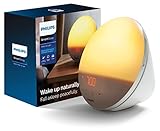
The Restore 3 is the bedside lamp reimagined as a routine machine. In the Hatch Sleep app you build a wind-down sequence — dimming warm light paired with audio — then sleep sounds through the night from a library of 80-plus, then a sunrise that brightens ahead of your chosen alarm sound in the morning. A large dial on top handles the basics without your phone, the clock face dims itself away at night, and the fabric-covered body in Putty, Greige or Cocoa looks like a designed object rather than a gadget. Independent side-by-side testing cited in recent comparisons measured its sunrise at roughly 250 lux at 18 inches — enough to change how a dark bedroom feels, and comparable to the Philips above.
Check the current price on Amazon for the Restore 3. The honest catch is the business model. A 30-day trial of Hatch+ is included; after that the full content library and extra routines sit behind the paid Hatch+ subscription. The core sunrise, the basic sounds and your routines keep working without it, so the subscription buys depth rather than function — but a buyer comparing prices should know the Philips and Lumie in this guide will never ask for another cent. Hatch also moved brightness control into the app on the Restore 3, dropping the side buttons the Restore 2 had, which some owners genuinely miss at 2 a.m.
- Full routine system: app-built wind-down, overnight sleep sounds and a sunrise wake-up in one device.
- Check price on Amazon, in a fabric finish that suits a styled nightstand.
- Big top dial for phone-free control of the essentials.
Honest limitation: The complete library sits behind the paid Hatch+ subscription after a 30-day trial, and everyday brightness adjustment lives in the app rather than on the device.
Choose it if you will actually build and keep an evening routine. Skip it if subscription prompts on a lamp annoy you on principle — the Lumie below does its one job forever without a subscription.

Lumie Bodyclock Shine 300
Who it suits: Light-quality connoisseurs and winter-morning sufferers who want the most adjustable sunrise on sale and no app anywhere near it.
Lumie is a British light-therapy specialist, and the Shine 300 is its craft-first answer to the Philips. The headline difference is control: the sunrise and sunset ramps adjust from 15 to 90 minutes, so a heavy sleeper can take the long dawn and a light sleeper the short one, and the sunset fades toward a low-blue light intended to be easier on a winding-down brain. Fifteen sounds and an FM radio cover the audio side, the display auto-dims, a tap on the unit snoozes, and weekly alarm scheduling handles weekday-versus-weekend life without nightly reprogramming. There is no app and no subscription — the full feature set is in the box, permanently.
Check the current price on Amazon — it sits in the upper part of this budget tier, shoulder to shoulder with the Hatch, while spending its money on the light curve instead of the content library. It also carries the longest warranty story of the three wake-up lamps here — three years, though Lumie asks you to register, and buying direct from the brand adds a 45-day trial that an Amazon purchase does not include, so weigh the channel as well as the price. In independent scoring it tends to land as the connoisseur’s pick: not the brightest, not the smartest, but the most finely graded dawn of the three.
- Sunrise and sunset ramps adjustable from 15 to 90 minutes — the widest range in this guide.
- Low-blue sunset light, 15 sounds plus FM radio, weekly scheduling, auto-dimming display.
- Three-year warranty on registration; no app and no subscription, ever.
Honest limitation: It is a clock that glows rather than a lamp that decorates, its menus reward a careful read of the manual, and the brand’s 45-day trial is a direct-purchase perk an Amazon order does not get.
Choose it if the dawn itself is the whole point and you want to tune its length. Skip it if you want app convenience or a big library of sleep sounds.

SAFAVIEH Lighting Karlen Double Gourd Glass Table Lamps, Set of 2
Who it suits: Buyers furnishing both sides of the bed who want a decorator brand’s glass and finish in a matched pair well inside this budget.
Everything changes when the budget is spent on a pair. The Karlen set puts two double-gourd glass lamps — a classic decorator silhouette — in a cream and gold-leaf finish on the two nightstands, with LED bulbs included in the box, from Safavieh’s lighting line rather than an anonymous marketplace brand. Glass is the honest material story here: it has weight, it catches and colors the light through the shade, and a gourd pair flanking a bed is the single most recognizable “finished bedroom” arrangement there is. This is the pick for the reader who looked at the three sunrise devices above and thought, correctly for them, that they wanted lamps.
Check the current price on Amazon before you buy. This pair sits well inside the budget, leaving room in a $200 spend for the good dimmable bulbs these lamps deserve — because like most decorative lamps, the Karlen’s own control is a simple switch, and the dimming quality of the finished setup will be decided by the bulb you choose, not the base you bought.
- A matched pair of double-gourd glass lamps in cream and gold leaf, LED bulbs included.
- Check price on Amazon — two decorator lamps for well inside the budget.
- A real brand’s finish and proportions, sized for nightstands rather than consoles.
Honest limitation: This pair’s price can move, so check the current price on Amazon before you commit, and there is no built-in dimmer — plan on dimmable bulbs or a plug-in dimmer for bedside duty.
Choose it if symmetry and a finished look matter more than wake-up features. Skip it if you need stepless dimming out of the box or a verified today’s-price before you commit.
JONATHAN Y Trevor 22.5″ Marble and Brass Gold Table Lamp (JYL5054A)
Who it suits: Style-first buyers with narrow nightstands, who want one genuinely handsome lamp rather than two ordinary ones.
The Trevor is the designer single of this guide, and its specification is the kind cheaper lamps imitate in photographs: a real marble base — white stone with its natural veining — banded in brass-gold iron, a slim rectangular linen shade, a pull-chain switch, and an LED bulb in the box. Its cleverest dimension is depth: at only about 8 inches deep it is a console-profile lamp, designed to sit against a wall on a narrow nightstand or entry table without swallowing the surface your book, phone and water glass also need. Jonathan Y sells it on Amazon under its own brand store, and the identical lamp is also listed at Target. Check price on Amazon on the live listing, because the point of this pick is that genuine stone and metal inside this budget tier is the bargain of the guide.
Judge it for what it is. There is no dimmer, no USB port, no sunrise and no app; the pull chain turns it on and off, and the light quality is entirely the included LED bulb’s. What the money buys is the object: stone that stays cool and heavy in the hand, metal with a brushed warmth resin cannot fake, and proportions drawn by a brand that sells into the design trade. On a small nightstand, next to a bed dressed with any care at all, this is the lamp guests ask about — and it leaves half the budget unspent, which the final section of this guide will argue is a feature, not a failure.
- Real marble base with brass-gold banding — materials the rest of the price band usually only photographs.
- Slim 8-inch-deep console profile made for narrow nightstands; pull-chain switch; LED bulb included.
- Same model is also listed at Target — check price on Amazon on the live listing.
Honest limitation: On/off only, with no dimming, charging or wake-up features of any kind — check the current price on Amazon on the live listing before you buy.
Choose it if the lamp is a piece of furniture you will look at for a decade. Skip it if you read in bed nightly and need real dimming control at the pillow.

SAFAVIEH Lighting Turner Rustic Farmhouse Table Lamps, Set of 2
Who it suits: Farmhouse and rustic bedrooms that need a taller, matched pair with proper shades.
The Turner pair is the Karlen’s country cousin: 25-inch lamps in a rustic brown farmhouse finish with rectangular fabric shades, sold as a set of two with LED bulbs included. The extra height matters more than it sounds. Short lamps strand their light below mattress level on a tall modern bed, while a 25-inch lamp puts the shade near eye level for reading and throws its light across the bed instead of into the nightstand. In a wood-and-linen bedroom, this is the pair that looks like it was chosen rather than inherited.
Check the current price on Amazon before you buy. This pair sits inside this budget, in the lower-to-middle part of the tier for a matched decorator pair. As with the Karlen, control is a simple switch and dimming is a bulb decision — plan for two good dimmable LEDs or a pair of plug-in dimmers if these will be your reading lamps, and the finished setup will still land well under $200.
- 25-inch height suits tall beds and reading in bed better than stubby nightstand lamps.
- Matched farmhouse pair with rectangular shades and LED bulbs included.
- Check price on Amazon — a matched pair well inside this budget.
Honest limitation: Check the current price on Amazon before you buy, and — again — there is no dimmer in the lamp itself.
Choose it if your bedroom is rustic or farmhouse and both sides of the bed need light. Skip it if your nightstands are small; a 25-inch lamp with a rectangular shade needs its footprint respected.

Comparison Table
| Product | Type | Best use | Link |
|---|---|---|---|
| Philips SmartSleep Wake-Up Light, HF3520/60 | Sunrise alarm lamp | Gentle, app-free wake-ups — check price on Amazon | Check on Amazon |
| Hatch Restore 3 | Smart sunrise lamp and sound machine | Full evening and morning routines — check price on Amazon | Check on Amazon |
| Lumie Bodyclock Shine 300 | Sunrise alarm lamp | The most adjustable dawn, 15–90 minutes — check price on Amazon | Check on Amazon |
| SAFAVIEH Karlen Table Lamps, Set of 2 | Decorative glass pair | Decorator symmetry for both nightstands — check price on Amazon | Check on Amazon |
| JONATHAN Y Trevor Table Lamp | Decorative single, marble and brass | One handsome lamp for a narrow nightstand | Check on Amazon |
| SAFAVIEH Turner Table Lamps, Set of 2 | Decorative farmhouse pair | Taller rustic pair for reading height — check price on Amazon | Check on Amazon |
How to Choose a Bedside Lamp Under $200
- Decide what the lamp is for. Waking, reading, or decorating — at this budget each job has a different winner, and a lamp bought for the wrong job disappoints at any price.
- Judge dimming at the bottom, not the top. Every lamp is bright enough at full power. What separates the good ones is the lowest setting: a bedside lamp should be able to glow faintly enough to find the floor at 3 a.m. without waking a partner.
- For sunrise lamps, check the ramp. Look for a colored sunrise that starts from a near-dark red, a duration you can adjust (the Lumie spans 15–90 minutes), and a sunset mode for the evening — a lamp that only brightens is half a product.
- Count the ongoing costs. A smart lamp with a paid content library keeps costing after the purchase. App-free lamps cost their purchase price once. Neither is automatically wrong; just weigh the ongoing cost before, not after.
- Price pairs per lamp, singles per object. Compare a pair’s total with the two lamps it gives you, and a single’s total with the one object you get. Compare like with like, and check whether bulbs are included — at this level they should be.
- Measure the nightstand, then the lamp. Note the footprint first (the Trevor is only about 8 inches deep for a reason) and the height second: for reading, the bottom of the shade should sit near shoulder level when you are propped up in bed.
- Take materials claims literally. “Marble” should mean stone, “glass” should mean glass. If a listing says “marble finish” or “faux,” you are buying a photograph of the material, priced accordingly — fine in a budget tier, not in a premium one.
- Plan the dimming the lamp does not have. Most decorative lamps are on/off devices. A quality dimmable LED bulb, a plug-in dimmer or a smart bulb turns any of them into a bedside lamp; budget a little for it rather than rejecting good lamps for a missing dial.
- Check the switch at pillow distance. Pull chains, top dials and tap controls can be worked half-asleep; a small inline cord switch two feet down the back of the nightstand cannot. This unglamorous detail decides daily satisfaction.
- Read the warranty and the channel. Two years from Philips, three from Lumie on registration, brand trials that apply only to direct purchases — at $200 these terms are part of what you are buying, so confirm them on the listing.
Sunrise Lamps vs Ordinary Lamps: What the Extra Money Actually Buys
A basic bedside lamp and a premium sunrise lamp can produce the same number of lumens, and if lumens were the product, the comparison would end there. What the sunrise lamp sells is control over time. Its light is engineered to begin at a fraction of a percent of full brightness — a deep red ember — and climb smoothly for 15 to 90 minutes without steps, flicker or a sudden jump at the bottom of the range, because the entire therapeutic and experiential claim lives in those first faint minutes. Ordinary dimmers, including most smart bulbs, bottom out around 5 to 10 percent and step visibly; switched on at 6 a.m. they are simply a lamp turning on, which your alarm clock’s flashlight already does for free.
The second thing the money buys is choreography: the sunset that reverses the process at night, the audio that fades with the light, the alarm that exists so your phone can sleep in another room. That is why the three wake-up lamps in this guide are really three philosophies. The Philips sells the curve and nothing else. The Lumie sells the most adjustable curve, tuned by a company that began in light therapy. The Hatch sells the routine around the curve — sounds, sequences, an app — and offers the deepest version of it by subscription. None of these is a medical device and none treats a sleep disorder; persistent insomnia, loud snoring with breathing pauses, or exhaustion that survives a week of good sleep hygiene are conversations for a clinician, not a lamp. But as comfort technology, a well-shaped dawn is the one upgrade in this guide that owners consistently describe as changing their mornings rather than merely lighting them.
Where the Money Stops Improving the Light
Here is the honest shape of this price band. From $30 to about $100, money buys real things: a sunrise curve instead of a switch, glass and stone instead of resin and foil, shades that diffuse instead of glaring, bulbs included, warranties that exist. From $100 to about $170 it buys refinement — a longer, smoother ramp, a sound library, weekly scheduling, better industrial design. Above $170, in this guide’s research, it stops buying light altogether. The Hatch and Lumie sit near the top of this tier not because their photons are finer but because their systems are complete; Philips’ connected step-up model sits above this budget entirely, selling app control of the same dawn; and at the decorative end, the pair that would spend the whole budget — Safavieh’s Arwen set of two, positioned at the top of this budget tier on Amazon — buys height, scale and finish, not a better bulb.
We name the Arwen without a link deliberately: it was identified through deal coverage of an Amazon listing, but we could not verify a stable listing identifier in this session, and this series does not guess at links. It stands in this guide as the honest marker of the ceiling — proof that the whole $200 budget can be spent on two lamps, and that what the extra over a Karlen pair purchases is presence, not illumination. The practical conclusion is liberating: at this tier, buy the lamp whose job description matches your mornings, and let the leftover money go. A Philips bought well inside the budget, with the leftover going toward the mattress fund, will improve more nights than a $200 lamp bought to satisfy a budget line.
Pairs vs Singles: Lighting Both Sides of the Bed
Two of this guide’s six picks are pairs, and that is not padding — it is the arithmetic of shared beds. A couple needs light on both sides, and $200 buys either one excellent lamp and one compromise, or two good lamps that match. The Karlen pair and the Turner pair — both well inside the budget, check price on Amazon for each — both deliver the second option with a decorator brand’s proportions, which is why they beat a long tail of prettier singles for anyone furnishing a shared primary bedroom. Matching lamps also solve the visual problem singles cannot: symmetry is most of what “designed bedroom” means in photographs, and it is cheapest to buy in a box of two.
The exception is the mixed setup, and it suits more couples than the symmetric one. Put the sunrise lamp on the side of the earlier riser — a Philips, check price on Amazon — and a decorative lamp on the other side for the partner who wakes by alarm clock and reads by lamplight: a Trevor in marble and brass, or one lamp from a pair with its twin in the guest room. The two sides will not match, and in a real bedroom that asymmetry reads as intentional long before it reads as unfinished. What does not work is the reverse compromise — a sunrise lamp asked to be the room’s only light source. Wake-up lamps are dim, directional and clock-faced; a bedroom still needs an ordinary lamp that can simply be bright, which is the deepest reason this guide refuses to crown any single product for every reader.
Common Buying Mistakes
- Buying a sunrise lamp as a reading lamp, then discovering its maximum brightness is tuned for dawn, not for a novel at midnight.
- Comparing a pair’s price with a single’s price and concluding the pair is “more expensive” — divide by the number of lamps first.
- Paying for a smart lamp’s hardware and sleepwalking into its subscription; read the post-trial price before the trial starts.
- Judging a lamp by its full-brightness output when bedside life is lived at the bottom of the dimmer, where cheap lamps flicker, buzz and jump.
- Ordering a 25- to 30-inch lamp for a small nightstand without measuring, then living with a shade that overhangs the bed.
- Believing “marble finish,” “gold look” and similar phrases describe materials; at this budget, insist the listing name the actual stone, glass or metal.
- Forgetting the bulb. A decorative lamp’s warmth, dimming and flicker are the bulb’s, and the included bulb is a starting point, not a verdict.
- Expecting a wake-up light to treat insomnia, apnea or winter depression. These are comfort products; symptoms that persist belong in a clinician’s office.
Final Recommendation
- Most buyers: Philips SmartSleep Wake-Up Light, HF3520/60.
- Routine builders: Hatch Restore 3 Sunrise Alarm Clock and Sound Machine.
- Light-quality purists: Lumie Bodyclock Shine 300.
- Both sides of the bed, decorator style: SAFAVIEH Lighting Karlen Double Gourd Glass Table Lamps, Set of 2.
- One beautiful object: JONATHAN Y Trevor 22.5″ Marble and Brass Gold Table Lamp.
- Farmhouse bedrooms: SAFAVIEH Lighting Turner Rustic Farmhouse Table Lamps, Set of 2.
Our top two are the Philips SmartSleep and the Hatch Restore 3, because between them they cover the two reasons most people spend $200 beside a bed: to wake up better, and to wind down on purpose. The Philips does the first — check price on Amazon — with no app and no subscription, and remains the easiest recommendation in this guide. The Hatch does both ends of the night as one designed routine — check the current price on Amazon — plus whatever you decide the library subscription is worth. If neither job is yours — if your alarm clock is fine and your evenings are your own — skip the technology entirely: the Karlen pair will make the room look finished for about the price of the Philips, and the Trevor will make one nightstand look expensive for less than either. Measure your nightstand, decide which job you are hiring for, check the live price and the warranty terms on the listing, and spend what the job costs rather than what the budget allows.
Frequently Asked Questions
Is a sunrise alarm lamp really better than a normal bedside lamp?
For waking, yes — that is the one job it is engineered for. A gradual, colored brightening over 15 to 90 minutes is a gentler signal than a sudden light or a loud alarm, and owners consistently rate the experience highly. For reading, decorating or lighting the room, a normal lamp is better: sunrise lamps are dimmer at maximum, shaped like clocks, and priced for their dimming curve rather than their output.
How much should I actually spend on a bedside lamp?
Less than this budget allows, in most cases. The category benchmark sunrise lamp in this guide sits comfortably inside the budget — check price on Amazon — and a decorator-brand pair of glass lamps also sits well inside it. Spending toward the top of the $200 budget buys a more adjustable dawn, a routine system, taller pairs or finer materials — all legitimate, none of them brighter in any way that matters.
Philips, Lumie or Hatch: which sunrise lamp should I choose?
Choose the Philips HF3520 for the proven, app-free default. Choose the Lumie Shine 300 if you want to tune the sunrise from 15 to 90 minutes and value its three-year warranty. Choose the Hatch Restore 3 if you want one device to run wind-down routines and overnight sleep sounds, and you accept that its full library sits behind the paid Hatch+ subscription after a 30-day trial.
Does the Hatch Restore 3 require a subscription?
No. The sunrise, basic sounds and your core routines work without one. Hatch+, the paid subscription after the included 30-day trial, unlocks the full content library and additional routine features. Budget-minded buyers should compare the ongoing cost of the Hatch plus subscription against the one-time purchase of the Philips and Lumie in this guide.
Are lamp pairs better value than singles?
For a shared bed, usually. A pair like the ones in this guide — check price on Amazon — lights both nightstands with matching lamps for less than one premium single, and symmetry does most of the visual work in a finished bedroom. Singles win when one lamp is the point — a marble-and-brass piece like the Jonathan Y Trevor — or when the two sides of the bed have different jobs, such as a sunrise lamp for the early riser and a reading lamp for the night owl.
Can a wake-up light treat insomnia or seasonal depression?
No. These are comfort products, not medical devices, and none of the lamps in this guide is a 10,000-lux light-therapy box. Many people find a regular dawn cue helps their routine, but insomnia, suspected sleep apnea or low mood that persists should be discussed with a clinician rather than shopped for.
What if a listing shows a different price or no offer?
Prices at this tier move, and premium listings occasionally rotate sellers. Check the current price on Amazon before you buy: if the live price no longer fits this guide’s under-$200 budget, wait or choose the alternative named in its review, and never substitute an unverified lookalike listing that merely borrows the product’s name.
- Best Bedside Lamp Under $100
- Best Bedside Lamp Under $400
- Best Bedside Lamp For Small Bedrooms Under $200
- Best Bedside Lamp For Apartments Under $200
- Best Bed Frame Under $200
- Best Bed Sheet Set Under $200
Related Guides
- Best Bedside Lamp Under $30
- Best Bedside Lamp Under $75
- Best Bedside Lamp Under $100
- Best Bedside Lamp Under $400
- Best Bedside Lamp Under $700