Where to buy
Check the latest price, availability and delivery on Amazon. Orders are placed on Amazon. We may earn a commission from qualifying purchases.
- Best overall: California Design Den 400 Thread Count Cotton Sateen Sheet Set, Queen — Check on Amazon
- Threadmill 500 Thread Count Cotton Sheet Set, Damask Stripe, Queen — Check on Amazon
- Bedsure PureWoven Rayon from Bamboo Cooling Sheet Set, Queen — Check on Amazon
- California Design Den 100% Organic Cotton Percale Sheet Set, Queen — Check on Amazon
See 2 more Amazon options
- Mayfair Linen 600 Thread Count Egyptian Cotton Sheet Set, Queen — Check on Amazon
- Linen Home 2-Pack Cotton Percale Sheet Sets, Queen (8 Pieces) — Check on Amazon
Read the full guide ↓
Disclosure: As an Amazon Associate, airfryerkitchensupply.com earns from qualifying purchases. Links to Amazon on this page are affiliate links; they cost you nothing extra. Listing details such as price and availability change often, so check the current Amazon listing before you buy.
The best bed sheet sets under $100 sit on a plateau, and it helps to know you are standing on one. Below this budget, sheet shopping is a lottery of thin microfiber, mystery “Egyptian” blends and thread counts that climb into four figures by counting each ply of a twisted yarn as a separate thread. Somewhere around fifty to seventy dollars, the lottery ends: genuine long-staple cotton appears, woven by brands willing to say exactly what the fabric is, how the count was measured and how deep the pockets are. A hundred dollars buys you the finished version of that idea — better elastic, cleaner stitching, dyes that survive the wash, and a choice of weaves that is really a choice about how you sleep.
What this guide will not do is sell you a number. Thread count is the most abused statistic in bedding, and at this price the honest sets are the ones that treat it modestly: 400 or 500 threads of single-ply, long-staple cotton will out-sleep and out-last a “1,500 thread count” set built from split microfiber or multi-ply yarns, every night of the week. So the six sets below were chosen on fiber, weave, construction and verifiable claims first, and on the headline number last. For most people we would start with the California Design Den sateen set, a lab-verified 400 count in long-staple cotton — check the current price on Amazon for the queen. If you sleep hot, the Bedsure bamboo set and the organic percale set are the two honest cooling routes — one silky, one crisp. Below you will find the quick picks, detailed reviews of all six sets, a comparison table, a buying checklist, an honest account of what thread count does and does not mean, and answers to the questions that come up again and again.
In this guide
Quick Picks
Short on time, or comparing several options at once? Each row below names a buyer type and the product that suits it, with a link to the listing.
| Buyer type | Pick | Why it stands out | Link |
|---|---|---|---|
| Best overall | California Design Den 400 Thread Count Cotton Sateen Sheet Set, Queen | Lab-verified 400 count, single-ply long-staple cotton, deep pockets | Check on Amazon |
| Best hotel style | Threadmill 500 Thread Count Cotton Sheet Set, Damask Stripe, Queen | Extra-long staple cotton in a woven stripe, 16-inch elasticized pocket | Check on Amazon |
| Best for hot sleepers | Bedsure PureWoven Rayon from Bamboo Cooling Sheet Set, Queen | Silky bamboo rayon that wicks moisture, 360-degree elastic, 16-inch pocket | Check on Amazon |
| Best crisp percale | California Design Den 100% Organic Cotton Percale Sheet Set, Queen | GOTS-certified organic cotton in a cool, matte one-over-one weave | Check on Amazon |
| Best Egyptian cotton | Mayfair Linen 600 Thread Count Egyptian Cotton Sheet Set, Queen | Extra-long staple Egyptian cotton sateen with 16-inch pockets | Check on Amazon |
| Best value bundle | Linen Home 2-Pack Cotton Percale Sheet Sets, Queen (8 Pieces) | Two complete long-staple percale sets in one box, under the line together | Check on Amazon |
How These Picks Were Chosen
The first filter was the budget, applied per size, because sheet pricing is as size-sensitive as frame pricing was in our other guides. Every set below was chosen to fit the under $100 budget for the queen size named in its review. Queen is the reference size throughout; twin sets are positioned lower and king sets higher, sometimes by enough to cross the line, so check the current price on Amazon for your own size rather than trusting the headline figure, which almost always belongs to the twin.
The second filter was fiber honesty. Every pick here is a natural-fiber set — cotton in sateen or percale weaves, or rayon spun from bamboo — from a brand that states its fiber content plainly and, in the best cases, backs its numbers with independent testing. We left out the entire “1,800 thread count” microfiber class, not because microfiber is useless (it can be a fine budget sheet) but because its thread-count claims are meaningless: microfiber quality is measured in GSM, fabric weight, and any brand quoting a four-figure count for it is telling you how it markets, not how it weaves. We also left out sets whose “Egyptian cotton” turned out, in the fine print, to be a blend with a minority of cotton in it. Where a claim could not be fully audited — and Egyptian cotton provenance is the famous example — the review says so rather than repeating the claim as fact.
The third filter was construction, because that is what the step up from $75 actually buys. At this level a fitted sheet should have elastic all the way around, not just at the corners; the pocket depth should be printed and should match a modern mattress; pillowcases should close with an envelope flap or a proper hem rather than an open end; and the flat sheet should be cut generously enough to tuck. We favored sets that publish those details, and we treated maker claims throughout as claims — thread counts, cooling effects and softness rankings are the seller’s words, useful for comparing listings, not laboratory results we generated. We did not sleep on these sheets ourselves; we compared specifications, fiber and weave data and independent coverage, and we say plainly where a claim rests on maker or listing material rather than independent verification.
The 6 Best Bed Sheet Sets Under $100
California Design Den 400 Thread Count Cotton Sateen Sheet Set, Queen
Who it suits: Most shoppers, most beds. If you want one safe, well-documented cotton set and no further research, this is the default recommendation of the tier.
The specification is the review, because this brand publishes the things the rest of the category hides. The fabric is 100% long-staple cotton in a sateen weave, single-ply, at a stated 400 thread count — and the count is not just stated, it is verified by independent labs with a published tolerance of plus or minus five percent. That single detail separates this set from nearly everything else on Amazon, where counts are routinely inflated by counting multi-ply yarns two or three times. Long-staple fiber matters more than the number anyway: longer fibers spin into smoother, stronger yarns that pill less and feel silkier than the same count woven from short-staple cotton, which is why this 400 count set feels like a step up from nominally “600 count” sets built on cheaper fiber. The set is a Good Housekeeping bedding award winner, and you can check the current price on Amazon for the queen, where color choice affects where it sits within this tier.
The construction keeps pace with the fabric. The fitted sheet is a genuine deep pocket — the line is built for mattresses up to about 16 inches — with elastic all the way around rather than corner straps, so it grips instead of tenting. The flat sheet carries a tailored four-inch hem, the kind of finishing detail that disappears entirely in cheaper sets, and the pillowcases close properly instead of gaping. Sateen is the warmer, smoother of the two cotton weaves: the four-over-one thread arrangement floats more yarn on the surface, which gives the slight sheen and the buttery hand, at the cost of a little breathability versus percale. In a cool or air-conditioned bedroom that trade is pure pleasure; in a hot room with no cooling, read the percale review below before deciding. Care is ordinary machine washing, and cotton sateen’s known habit — softening across the first dozen washes — works in the buyer’s favor here.
- Single-ply, long-staple cotton at a lab-verified 400 thread count — the most honest spec sheet in this guide.
- Deep-pocket fitted sheet with all-around elastic, a tailored hem on the flat sheet and finished pillowcases.
- Check the current price on Amazon for the queen — positioned comfortably inside this tier.
Honest limitation: Sateen sleeps warmer than percale, and the smooth surface shows it: committed hot sleepers in uncooled rooms will prefer the percale or bamboo picks, and the sheen dulls gradually over a couple of years of washing.
Choose it if you want the best-documented cotton set at the tier and sleep neutral-to-cool. Skip it if you run hot at night or know you love the crisp, matte feel of percale — buy its sibling below instead.

Threadmill 500 Thread Count Cotton Sheet Set, Damask Stripe, Queen
Who it suits: Anyone chasing the specific feel of a good hotel bed — smooth, substantial, with that woven tone-on-tone stripe — and guest-room hosts who want the bed to look made by a professional.
Threadmill builds this set from extra-long staple cotton at a stated 500 thread count, woven into a damask stripe: the stripe is not printed or dyed on, it is created by alternating sateen and plain-weave bands in the cloth itself, which is why it survives washing that would fade a printed pattern to grey. The hand is the hotel hand — dense, smooth, a little weighty — and you can check the current price on Amazon for the queen set, with solid-color versions of the same 500 count line positioned similarly within this tier. The four pieces are a flat sheet (a generous 92 by 102 inches), a fitted sheet with a 16-inch elasticized deep pocket, and two pillowcases, and the set ships with a tote bag instead of a plastic brick, a small thing that tells you something about the brand’s priorities. Threadmill also publishes OEKO-TEX certification for its lines, meaning the finished fabric is tested for harmful substances — not a guarantee of softness, but a guarantee about what is not in the cloth against your skin.
Judged against the California Design Den set above, the honest differences are weave character and documentation style. The Threadmill’s extra density gives it a more substantial drape and a slightly warmer sleep; the damask stripe gives a made bed a tailored look that plain sateen has to borrow from the duvet cover. Its 500 count is stated by the maker rather than lab-verified in the listing material we read, and 500 sits at the top of the range where single-ply counts remain physically plausible in a smooth cotton — beyond it, skepticism should grow. Extra-long staple fiber is doing the real work in both sets, and in both cases that is the point this guide keeps making: at honest counts, fiber length is the quality, and the number is the receipt. Warm sleepers should note the density, and everyone should note that the stripe reads formal — in a relaxed, rumpled-linen bedroom it can look like it is trying slightly too hard.
- Extra-long staple cotton in a woven damask stripe that cannot fade or wash out.
- Sixteen-inch elasticized deep pocket and a generously cut 92 by 102 inch flat sheet.
- Check the current price on Amazon — the hotel look at a mid-tier position in this tier.
Honest limitation: The denser weave sleeps warm, the stripe is a formal look not every bedroom wants, and the 500 count is maker-stated rather than independently verified in the material we could check.
Choose it if the hotel bed is your reference point and your room runs cool. Skip it if you sleep hot or prefer a plain, matte, informal bed — the percale picks are your weave.

Bedsure PureWoven Rayon from Bamboo Cooling Sheet Set, Queen
Who it suits: Hot sleepers — the people who flip the pillow hunting for the cool side — who want the silky, moisture-moving feel of bamboo rayon without crossing into the premium territory where the famous bamboo brands live.
A naming honesty note first, because this category needs it: “bamboo sheets” are rayon. The bamboo plant is pulped and regenerated into viscose/rayon fiber, and reputable brands — Bedsure included — say exactly that on the listing: 100% rayon derived from bamboo. What survives the chemistry is the fiber’s character: a smooth, round filament that feels cool and slippery against skin, absorbs moisture readily and releases it fast, which is the entire cooling story. There is no refrigeration in any sheet; there is only how quickly fabric moves heat and sweat away from you, and bamboo rayon does it better than cotton and far better than microfiber, which mostly holds moisture against the skin. The PureWoven set is woven at a stated 225 thread count in a twill weave — a low number that means nothing negative here, because thread count comparisons only work inside one fiber family, and rayon filaments are thicker and smoother than cotton yarns. Check the current price on Amazon for the white queen — this is positioned as an everyday set inside this tier rather than a premium-brand option.
The fitted sheet is the other reason this set earns its place: a 16-inch deep pocket with a full 360-degree elastic band, the construction detail that decides whether a silky sheet stays on a thick mattress or slowly walks off the corner by Thursday. Silky fabrics are the worst offenders for fitted-sheet escape, so the elastic matters more here than in any cotton review in this guide. The feel in use is the cool, liquid drape hot sleepers describe as the cold side of the pillow, all over. The costs are care and longevity. Rayon is weaker wet than dry, so the set wants a gentle cycle and a low-heat dry, and it will not take the years of hot washing that cotton shrugs off; expect a shorter service life than the cotton picks, and expect the fabric to feel less crisp — it drapes rather than stands. For a sleeper whose problem is heat, that is the right trade, made knowingly. For a buyer whose problem is durability, it is the wrong one.
- Genuine 100% rayon from bamboo, honestly labeled, with the cool, moisture-moving hand hot sleepers want.
- Sixteen-inch pocket with full 360-degree elastic — the grip a slippery fabric needs.
- Check the current price on Amazon for the queen — positioned inside this tier as an everyday option.
Honest limitation: Rayon demands gentle washing and low heat, pills sooner than good cotton under friction, and will not last as many years as the cotton sets in this guide — you are buying feel per night, not decades.
Choose it if heat is the thing ruining your sleep and you will follow the care label. Skip it if you wash everything hot, share the bed with restless friction (or pets’ claws), or want a set that lasts five-plus years.
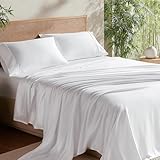
California Design Den 100% Organic Cotton Percale Sheet Set, Queen
Who it suits: Crisp-sheet people and hot sleepers who prefer their cooling the cotton way — airflow through an open weave rather than a silky surface — plus anyone who wants organic certification they can check.
This is the same brand as our top pick wearing the opposite weave, and the pairing is deliberate: sateen versus percale is the oldest argument in cotton bedding, and at this tier you can settle it for the price of one set each. Percale is a one-over, one-under plain weave, which produces a matte, crisp fabric with a naturally open structure — air moves through it, heat leaves with the air, and the sheet feels cool and papery-crisp rather than smooth and warm. This set is woven from 100% organic cotton at a stated 300 thread count, and it carries GOTS certification, the Global Organic Textile Standard, which audits the fiber’s organic status through the supply chain rather than taking the grower’s word for it; the brand also holds the Good Housekeeping Seal. Three hundred is the honest count for percale — the weave physically cannot pack threads the way sateen can, and any percale claiming 800 should be read as fiction. Check the current price on Amazon for the queen, where the position within this tier varies by color.
The construction mirrors its sateen sibling with one adjustment for the weave’s character: pockets run to about 15 inches with wide gripper elastic, and the matte fabric grips a mattress more cooperatively than slippery sateen anyway. What you live with is the crispness itself. Fresh percale can feel almost stiff — some sleepers hear it rustle — and it softens across the first several washes into the broken-in hotel feel its fans describe; it also wrinkles honestly, because there is no synthetic in it to pretend otherwise, and the made bed looks relaxed rather than pressed. Temperature-wise it is the coolest cotton in this guide, the set warm sleepers who dislike rayon’s drape should buy. It will not feel luxurious in the silky sense on night one. By night thirty, percale people would not trade it for anything else in this article.
- GOTS-certified 100% organic cotton in a true percale weave — certification you can look up, not a vibe.
- The coolest-sleeping cotton here: an open one-over-one weave that breathes instead of draping warm.
- Check the current price on Amazon — organic cotton positioned accessibly within this tier.
Honest limitation: Percale starts crisp to the point of rustle, wrinkles visibly, and never develops sateen’s sheen — if your reference luxury is a silky hotel sheet, this will feel like the opposite of an upgrade.
Choose it if you sleep warm, love a crisp sheet, or want certified organic fiber. Skip it if you want smooth and silky from the first night — that is the sateen set at the top of this guide.

Mayfair Linen 600 Thread Count Egyptian Cotton Sheet Set, Queen
Who it suits: Shoppers who specifically want Egyptian cotton — the genuine extra-long staple article — in a dense, weighty sateen, and who are willing to buy it from a specialist linen brand rather than a household name.
Mayfair Linen’s Voyage Collection set is specified as 100% extra-long staple Egyptian cotton at a stated 600 thread count in a sateen weave, with 16-inch deep pockets — check the current price on Amazon for the queen. The fabric story, if the specification holds, is the connoisseur’s version of the top pick’s: Egyptian-grown extra-long staple fiber is the longest and finest cotton commonly woven, producing yarns that are simultaneously thinner and stronger, so a dense sateen made from them feels heavy and smooth without the fragility that density usually brings. The cotton is described as mercerized, a finishing treatment that swells the fiber for better dye uptake and a slight luster, which is why the colors in this line read deeper than budget sateen. In hand, owners describe exactly what the spec predicts: a substantial, cool, hotel-weight sheet that softens over the first washes.
Now the honesty this price tier demands. Six hundred is above the range where single-ply counts are easy to achieve, and Amazon’s Egyptian cotton category has a documented history of generous counting and loose provenance — “Egyptian” has been used for cotton grown far from Egypt and for blends with a token Egyptian fraction. Mayfair Linen states 100% extra-long staple Egyptian cotton and publishes its model numbers and specifications like a real linen house, which is why it is here and the anonymous 800 and 1,000 count sets are not; but we could not independently audit the fiber’s origin or the count’s ply structure, and neither can you from a listing page. Read the pick in those terms: a well-specified, well-reviewed set from a specialist brand, positioned like the honest cotton in this guide, whose paper claims run ahead of what any buyer can verify. If the claims hold, it is the densest luxury in the article. If some of the count is ply arithmetic, it is still a heavy ELS sateen positioned fairly within this tier — which is more than can be said for the four-figure sets.
- Specified as 100% extra-long staple Egyptian cotton, mercerized, in a dense 600 count sateen.
- Sixteen-inch deep pockets and a substantial, hotel-weight hand that softens with washing.
- Check the current price on Amazon — Egyptian cotton positioning at a mid-tier position in this tier.
Honest limitation: The 600 count and the Egyptian provenance are maker claims we could not independently audit, and this category’s history argues for reading them with measured trust; the dense sateen also sleeps warm.
Choose it if you want the heaviest, smoothest cotton hand in this guide and accept the verification limits. Skip it if you want every number on the label independently backed — the California Design Den sateen publishes lab verification instead.

Linen Home 2-Pack Cotton Percale Sheet Sets, Queen (8 Pieces)
Who it suits: Anyone furnishing two beds, running a guest room alongside their own, or simply done with laundry-day sheet Tetris — the pick that treats the real problem, which is that one set is never enough.
Every other pick in this guide is one set. This one is two: the box holds two complete queen sets — two flat sheets, two fitted sheets and four pillowcases, eight pieces — woven from 100% long-staple combed cotton in a percale weave on air-jet looms, per the maker’s specification. Check the current price on Amazon for the bundle — as a two-set bundle it is positioned as stronger value than buying a single percale or sateen set above on its own, for long-staple cotton in the weave hot sleepers prefer. The bundle logic is the review. A second set is not a luxury in practice: it is the difference between remaking the bed on laundry day and sleeping on the spare, between a guest room that is ready and one that is assembled in a panic, between rotating two sets (which roughly doubles the life of each, since rest and rotation are how textiles survive) and wearing one set to transparency.
The honest cautions are about depth of specification rather than quality of idea. The maker’s published detail is thinner than California Design Den’s — no lab-verified count is claimed (a restraint we count in its favor), and the exact pocket depth should be confirmed on the live listing against your mattress before ordering, because a two-pack doubles the consequences of a fit mistake. The percale is the crisp, matte, breathable kind described in the organic review above, in an ivory colorway; expect the same first-wash crispness and the same softening curve. What this pick will not give you is a choice of weaves, a sateen sheen or a famous name on the label. What it gives you is the most sleep for the budget in the entire guide, and the quiet logistical upgrade of a linen closet that actually works. Households with two queen beds, a rental property or a teenager about to take a set to a first apartment should start here and spend the savings elsewhere in the room.
- Two complete long-staple cotton percale sets — eight pieces — in one bundle; check the current price on Amazon.
- Percale weave: crisp, matte and breathable, the hot sleeper’s cotton.
- Rotation doubles practical life: one set on the bed, one in the wash, none worn to death.
Honest limitation: The specification sheet is thinner than the top picks’ — confirm the pocket depth on the live listing before ordering, because a bundle doubles any fit mistake — and there is no sateen option in the deal.
Choose it if you have two beds, a guest room, or a laundry routine that a single set keeps defeating. Skip it if you have one bed and want the single best-documented set — that is the sateen at the top of this guide.

Comparison Table
| Product | Type | Best use | Link |
|---|---|---|---|
| California Design Den 400 Thread Count Cotton Sateen Sheet Set, Queen | Cotton sateen, 400 TC | Best-documented all-rounder; lab-verified count | Check on Amazon |
| Threadmill 500 Thread Count Cotton Sheet Set, Damask Stripe, Queen | Cotton sateen, woven stripe | The hotel bed look and hand | Check on Amazon |
| Bedsure PureWoven Rayon from Bamboo Cooling Sheet Set, Queen | Bamboo rayon twill | Hot sleepers who want a silky, cool surface | Check on Amazon |
| California Design Den 100% Organic Cotton Percale Sheet Set, Queen | Organic cotton percale | Crisp, cool, certified organic cotton | Check on Amazon |
| Mayfair Linen 600 Thread Count Egyptian Cotton Sheet Set, Queen | Egyptian cotton sateen | The densest, heaviest cotton hand | Check on Amazon |
| Linen Home 2-Pack Cotton Percale Sheet Sets, Queen | Cotton percale, two sets | Two beds, guest rooms and laundry rotation | Check on Amazon |
How to Choose a Bed Sheet Set Under $100
- Choose the fiber before the number. Cotton for durability and easy care, bamboo rayon for cool silkiness with gentler care, and microfiber only in its own budget tier — under $100, your money should be buying natural fiber.
- Choose the weave by how you sleep. Sateen is smooth, slightly warm and a little lustrous; percale is crisp, matte and cool; rayon drapes cold and slippery. There is no best weave, only a best match — the weave section below lays out the trade.
- Read thread count like an auditor. Between 300 and 500 in single-ply cotton is the honest sweet spot. Ask what the count is made of: multi-ply yarns counted two or three times, and four-figure counts on anything, are marketing, not weaving.
- Weight fiber length over count. Long-staple and extra-long staple cotton spin smoother, stronger yarns that pill less. A 400 count long-staple set will feel better in year two than a 600 count short-staple set — fiber is the quality, count is the density.
- Measure your mattress, then read the pocket. Mattress depth plus any topper is the number the fitted sheet must beat, ideally with an inch to spare. This guide’s picks run 15 to 16 inches; very thick pillow-top stacks can exceed even that.
- Demand elastic all the way around. Corner-only elastic is the budget tell. A full elastic band — Bedsure’s 360-degree version is the explicit example — is what keeps a fitted sheet on a modern mattress through a week of sleep.
- Check the flat sheet’s cut and the cases’ closures. A queen flat around 90 to 102 inches wide tucks properly; pillowcases should have an envelope closure or a deep hem so the pillow stays dressed. These finishing details are exactly what this tier adds over lower-tier sets.
- Check the price for your size, never the headline. The headline usually belongs to the twin. Select queen or king on the listing and check the current price on Amazon against your budget — king versions of this guide’s picks can sit higher in, or above, this tier.
- Match the care label to your laundry reality. Cotton forgives hot washes and high heat; bamboo rayon wants gentle cycles and low heat and repays it with feel, not longevity. Buy the care routine you will actually follow.
- Buy the second set before the second pillow. Rotation is the cheapest durability there is. The two-pack in this guide, or two of any pick here, will outlast a single “luxury” set used every single week.
Thread Count, Honestly: What the Number Means and Where It Lies
Thread count is the number of yarns in one square inch of fabric — vertical warp threads plus horizontal weft threads. In a perfect world it would be a clean density measure, and in the 300 to 500 range, woven from single-ply yarns, it roughly is: more threads of good fiber, packed well, make a smoother and more durable cloth, which is why this guide’s cotton picks live exactly there. The trouble starts with how the number can be manufactured. A yarn can be made by twisting two or three thinner strands together — a multi-ply yarn — and nothing in the labeling rules most sellers follow stops them from counting each strand as if it were a separate thread. A fabric woven from 250 two-ply yarns becomes “500 thread count”; a three-ply construction turns 300 yarns into a “900 count” sheet that is, in physical fact, a coarse cloth made of ropey twisted yarn, heavier and less breathable than the honest 400 beside it. This is how listings reach 1,200, 1,500 and 1,800: not with finer weaving, which has physical limits — there is a maximum number of yarns that fit in a square inch before the loom is simply full — but with arithmetic.
Microfiber completes the lesson. Microfiber is split synthetic filament, and its quality is properly described by weight (GSM, grams per square meter), not by threads per inch at all; a “1,800 thread count microfiber” label is a number attached to a fabric it does not describe, which tells you everything about the label’s purpose. The practical rules that fall out of all this are simple, and they are the rules this guide applied. Trust counts between 300 and 500 from brands that name their fiber and its staple length. Trust them more when a brand submits to independent verification, as our top pick does. Treat every count above roughly 600 as a claim to be discounted rather than a specification to be admired, and treat four-figure counts as a confession. And remember that count says nothing by itself about the two things your skin actually reports: the fiber’s length and smoothness, and the weave’s structure. A number was never going to tell you how a sheet sleeps. Fiber and weave do.
Sateen, Percale or Bamboo: Choosing a Weave by Sleeper
Strip away the marketing and this tier offers three honest fabrics, and the choice between them is a choice about temperature and texture, not quality. Sateen — the California Design Den 400, the Threadmill and the Mayfair Linen in this guide — floats extra yarn across the surface, which makes it smooth, slightly lustrous and a touch warm, because the denser face traps a little more air against the skin. It is the weave of the classic luxury-hotel bed, it drapes heavily and forgives wrinkles, and it suits cool bedrooms, cold sleepers and anyone whose reference comfort is silk-adjacent smoothness. Its weakness is the same density: in a warm room it can feel like it is holding the day’s heat, and its smooth face shows wear as a gradual loss of sheen.
Percale — the organic set and the Linen Home two-pack — is the plain one-over-one weave, and its virtues are the sateen’s opposites: matte instead of lustrous, crisp instead of smooth, and genuinely cooler, because the open structure lets air and heat move through the cloth. It is the weave of the summer house and the good old-fashioned hotel, it wrinkles with complete honesty, and it suits hot sleepers, warm climates and anyone who finds sateen clingy. Bamboo rayon — the Bedsure — leaves cotton’s terms entirely: a regenerated filament with a cool, wet-silk hand that absorbs moisture and moves it off the skin faster than either cotton weave, at the price of delicate care and a shorter life. Hot sleepers who run truly warm, rather than merely preferring crispness, are its people. Notice what is not on this list: a “cooling” microfiber, whose plastic filaments do the opposite of wicking, and any fabric whose temperature claims require the word “technology.” At under $100, temperature is managed by fiber and weave, and the three above are the whole honest menu.
What the Step From $75 Buys — and Where the Returns Run Out
It is worth being precise about what changes as sheet prices climb through this guide’s budget, because the pattern is not linear. From $30 to about $60, nearly every dollar is visible: microfiber gives way to real cotton, corner elastic gives way to all-around elastic, pockets deepen to fit actual mattresses, hems and envelope closures appear, and fiber upgrades from short-staple to long-staple — the single biggest feel difference in bedding. From $60 to $100, the gains turn into finish and choice: lab-verified counts and certifications, organic fiber, woven rather than printed patterns, deeper colors that hold, and the freedom to pick your weave instead of taking the one weave a cheap line offers. The fabric does not transform again; it refines. That is the plateau this guide is named for, and it is a good place to stand.
Above $100 the returns diminish in a specific way worth naming, because our Best Bed Sheet Set Under $200 guide lives up there. What the next hundred buys is real but narrower: linen’s texture and longevity, the famous bamboo brands’ polish and packaging, longer trial periods and more generous returns, and thread counts that — audited honestly — often land in the same 300 to 500 territory as this guide’s picks, woven from fiber that is better by degrees rather than by kind. None of that is worthless; some of it is worth every cent to the right sleeper. But a shopper who buys the verified 400 count sateen or the GOTS percale in this guide is not sleeping on a draft version of the $200 bed. They are sleeping on the same plateau, a few refinements earlier — and the money left over buys the second set, which improves a real household’s sleep more reliably than any refinement does.
Common Buying Mistakes
- Chasing the biggest thread count on the page — the four-figure sets are counting plies, not quality, and usually sleep worse than an honest 400.
- Buying “Egyptian cotton” without reading the fiber line in the specifications, where blends quietly disclose a minority of cotton.
- Assuming bamboo sheets are a natural plant fiber; they are rayon regenerated from bamboo — a fine fabric that deserves to be bought under its real name and cared for accordingly.
- Comparing thread counts across fibers: 225 in bamboo rayon, 300 in percale and 500 in sateen describe different cloths, and the lowest number is not the worst sheet.
- Forgetting the topper when measuring pocket depth, then fighting a fitted sheet that pops off the corner every second night.
- Judging a set by the twin’s headline and discovering the queen or king sits in a different position in the tier at checkout.
- Washing bamboo rayon like cotton — hot water and high dryer heat — and blaming the fabric when it tires early.
- Expecting percale to feel silky on night one, or sateen to sleep cool in August; weave mismatch is the most common return in this category.
- Buying one premium set instead of two good ones, then wearing the single set out with weekly washing while the bed stands unmade on laundry day.
- Skipping the return-window test: sleep on the set for the first week, wash it once, and judge the fabric after the wash — that is the sheet you actually bought.
Final Recommendation
- Most buyers: California Design Den 400 Thread Count Cotton Sateen Sheet Set — the verified spec, the safe hand, and a position well inside this tier.
- Hotel-bed chasers: Threadmill 500 Thread Count Damask Stripe Sheet Set.
- Hot sleepers who want silkiness: Bedsure PureWoven Rayon from Bamboo Cooling Sheet Set.
- Hot sleepers who want crisp cotton: California Design Den 100% Organic Cotton Percale Sheet Set.
- The densest cotton hand: Mayfair Linen 600 Thread Count Egyptian Cotton Sheet Set.
- Two beds or a working linen closet: Linen Home 2-Pack Cotton Percale Sheet Sets.
Our top two are the California Design Den sateen, because it is the most honestly documented sheet set we could verify in this tier — single-ply long-staple cotton with a lab-checked count — and the Bedsure PureWoven, because it solves the hot sleeper’s problem with a real fiber at an everyday position in this tier rather than a premium-brand toll. Between them they cover the two sleepers this tier mostly serves: the one who wants the classic cotton bed done properly, and the one who wants to stop waking up warm. If your instincts run crisp rather than smooth, promote the organic percale to first place without hesitation; if your household runs on rotation, start with the two-pack and let everything else in this guide be the upgrade you buy later. Whichever you choose, read the fiber line before the thread count, measure the mattress before the pocket, and let the first wash — not the first touch — cast the deciding vote.
Frequently Asked Questions
What is the best thread count for sheets under $100?
For cotton, 300 to 500 in single-ply yarn is the honest sweet spot, and fiber quality matters more than the exact number inside that range: a 400 count set woven from long-staple cotton will feel smoother and last longer than a 600 count set from short-staple fiber. Treat counts above 600 with suspicion — they are usually achieved by counting multi-ply yarns several times — and ignore thread count entirely for microfiber, where weight (GSM) is the real measure, and for bamboo rayon, where a 225 count twill is normal and good.
Are expensive sheets really better than $40 sheets?
Up to this guide’s plateau, yes, in ways you can point to: natural long-staple fiber instead of microfiber or short-staple cotton, elastic all the way around the fitted sheet, pockets deep enough for modern mattresses, finished hems and pillowcase closures, and colors that survive washing. Above $100 the improvements continue but narrow — better finishing, linen and premium bamboo options, longer trials — which is why this tier is where most shoppers should stop unless they know exactly which refinement they are paying for.
Sateen or percale: which should I buy?
Buy by temperature and texture. Sateen is smooth, slightly lustrous and a little warm — the classic luxury feel, best for cool rooms and cold sleepers. Percale is crisp, matte and noticeably cooler, best for warm rooms and hot sleepers, with honest wrinkles as part of the character. If you have never thought about it, you probably have a preference already: the smooth hotel sheet you remember fondly was sateen, and the crisp one at a summer rental was percale.
Are bamboo sheets worth it for hot sleepers?
For genuinely hot sleepers, yes — with the name understood. Bamboo sheets are rayon regenerated from bamboo pulp, and the resulting fabric feels cool on contact and moves moisture off the skin faster than cotton, which is the real mechanism behind the cooling claim. The trade is care and lifespan: gentle washing, low heat, and a shorter service life than good cotton. If your heat problem is mild, crisp percale cools nearly as well and lasts longer; if you wake up sweating, the Bedsure set in this guide is the honest fix in this tier.
How deep should the pockets be?
Measure your mattress, add the thickness of any topper or protector you actually use, and choose a fitted sheet rated at least an inch deeper than that sum. Most modern mattresses with a modest topper land between 12 and 15 inches, which is why this guide’s 15 and 16 inch pockets fit most beds; very thick pillow-top stacks can exceed them, and no elastic fully compensates for a pocket that is simply too shallow.
How many sheet sets should I own?
Two per bed is the practical standard: one on the bed, one in the wash or the closet, so laundry day never leaves a bed unmade and each set rests between uses — rotation noticeably extends a set’s life. Three is comfortable; one is a weekly emergency in slow motion. That arithmetic is why this guide includes a two-pack: at this tier, the second set is the highest-value purchase in the whole category.
- Best Bed Sheet Set Under $75
- Best Bed Sheet Set Under $200
- Best Bed Sheet Set For Apartments Under $100
- Best Bed Sheet Set For Guest Rooms Under $100
- Best Bed Sheet Set For Side Sleepers Under $100
- Best Bed Frame Under $100
Related Guides
- Best Bed Sheet Set Under $30
- Best Bed Sheet Set Under $75
- Best Bed Sheet Set Under $200
- Best Bed Sheet Set Under $400
- Best Bed Sheet Set Under $700