Where to buy
Check the latest price, availability and delivery on Amazon. Orders are placed on Amazon. We may earn a commission from qualifying purchases.
- Best overall for side sleepers: Zinus Joseph 10 Inch Metal Platform Bed Frame, Twin — Check on Amazon
- Zinus Yelena 14 Inch Metal Platform Bed Frame, Twin — Check on Amazon
- Amazon Basics Foldable 14 Inch Metal Platform Bed Frame, Twin — Check on Amazon
- Zinus SmartBase Compack Mattress Foundation, Narrow Twin — Check on Amazon
See 2 more Amazon options
- SageNest 14 Inch Metal Platform Bed Frame, Twin — Check on Amazon
- HLIPHA 14 Inch Metal Platform Bed Frame, Twin — Check on Amazon
Read the full guide ↓
Disclosure: As an Amazon Associate, airfryerkitchensupply.com earns from qualifying purchases. Links to Amazon on this page are affiliate links; they cost you nothing extra. Listing details such as price and availability change often, so check the current Amazon listing before you buy.
Side sleepers ask more of a bed frame than anyone else, and they ask it quietly, in the small hours. A back sleeper spreads their weight across the widest surface the body offers; a side sleeper balances the whole night on two narrow points — one shoulder and one hip — and feels every flaw underneath those points at full magnification. A slat that sits a fraction lower than its neighbours, a gap wide enough for foam to dip into, a joint that creaks each time you roll from one side to the other: a back sleeper sleeps through all of it, and a side sleeper is awake at 3 a.m. wondering why. That is the lens this guide applies to the cheapest bed frames on Amazon, and it changes the judging. At $30 the frame is not furniture and it is certainly not a comfort feature. Its whole job is to not undermine the mattress — to hold it flat, even and silent, so the mattress you already own can do the pressure-relief work you bought it for.
Two honest conditions come with the budget, and this guide states them up front the way our general guide does. First, a complete new frame under $30 is a twin-size story: every pick below is a twin chosen for this budget tier — check price on Amazon for the current figure for your size — and no complete new full, queen or king frame could be verified anywhere near $30. Listings headline the twin price, so read every figure per size. Second, at this level the differences that matter are not finishes or headboards; they are slat spacing, support under the shoulder-and-hip zone, joint noise and capacity margin. For most side sleepers we would start with the Zinus Joseph 10 inch, the one frame here that combines a budget-tier listing — check price on Amazon — with published slat spacing a foam mattress warranty will accept. Below are the quick picks, detailed reviews of all six frames, a comparison table, a side-sleeper buying checklist, the mistakes that waste the most money at this price, and answers to the questions side sleepers actually ask.
In this guide
Quick Picks
Short on time, or comparing several options at once? Each row below names a side-sleeper need and the product that suits it, with a link to the listing.
| Buyer type | Pick | Why it stands out | Link |
|---|---|---|---|
| Best overall for side sleepers | Zinus Joseph 10 Inch Metal Platform Bed Frame, Twin | Wood slats 3–3.4 in apart — even support under shoulder and hip; check price on Amazon | Check on Amazon |
| Best steel-slat support | Zinus Yelena 14 Inch Metal Platform Bed Frame, Twin | Steel slats that cannot crack or slip; check price on Amazon | Check on Amazon |
| Best tool-free guest setup | Amazon Basics Foldable 14 Inch Metal Platform Bed Frame, Twin | Unfolds with no tools and folds flat away; check price on Amazon | Check on Amazon |
| Best for narrow mattresses | Zinus SmartBase Compack Mattress Foundation, Narrow Twin | A 30 in wide frame for RV and cot mattresses; check price on Amazon | Check on Amazon |
| Best just over the line | SageNest 14 Inch Metal Platform Bed Frame, Twin | Budget-tier option — check price on Amazon, with about 12 in of clearance | Check on Amazon |
| Best capacity claim for heavier sleepers | HLIPHA 14 Inch Metal Platform Bed Frame, Twin | Marketed around a 660 lb rating; check price on Amazon | Check on Amazon |
How These Picks Were Chosen
The first filter was the budget, applied per size. Every frame below is a genuine Amazon listing whose twin size fits this budget tier — check price on Amazon for the current figure for your size. Where a frame spends most of its time in a higher tier and only visits this budget on a deep discount, the review says so in qualitative terms, because a price you can only catch twice a year is a different product from a price that is simply the price. The larger sizes of these same models cost more, in most cases a great deal more, and nothing in this guide should be read as a full or queen price.
On top of that filter, this guide applied the tests a side sleeper’s night actually runs. Support came first: slats spaced closely enough that a foam or hybrid mattress does not sag between them — most mattress makers want gaps of about 3 inches or less, and several warranty terms say so — because the dip a wide gap allows forms exactly where a side sleeper’s hip lands. Evenness came second: a frame that flexes or rocks concentrates load instead of spreading it, and side sleepers, who load two points rather than a whole back, are the first to feel it. Noise came third, and it is not a cosmetic concern: side sleepers change position more often than back sleepers, every roll re-loads the frame’s joints, and a creak that fires on each turn is a sleep problem, not a character trait. Capacity came last but matters more here than in a general guide, because point loading is unforgiving — the maker’s rating has to cover mattress plus sleeper with margin to spare at the two points doing the work.
We did not use these products ourselves. We compared specifications, dimensions, slat layouts, capacities and price histories from maker listings, retailer pages and price trackers, and we treated maker capacity claims in this price class as claims: useful for comparing listings, not laboratory results. One judgment call is worth stating openly. You will not find a product below that claims to realign your spine or treat a sleep condition, because a $30 frame does neither. These are support products. Chosen well, they remove the small mechanical annoyances — the dip, the creak, the hammock in the middle — that stand between a side sleeper and the mattress they already own. Amazon prices in this category swing weekly and cheap frames sell out in waves; the live listing is the final word on what you will actually pay.
The 6 Best Bed Frames for Side Sleepers Under $30
Zinus Joseph 10 Inch Metal Platform Bed Frame, Twin
Who it suits: Side sleepers on a twin who want the support question answered properly — published slat spacing, a real warranty, and a budget-tier listing — check price on Amazon.
The Joseph leads this guide for the reason it leads our general one, sharpened by the side-sleeper lens: it is the only frame here whose support geometry is fully documented. The design is a steel frame carrying plywood slats spaced 3 to 3.4 inches apart — right at the spacing foam mattress makers ask for — so the mattress rests on near-continuous support with no box spring, and there is no wide gap waiting under the hip zone for foam to sink into over the months. That evenness is the whole side-sleeper case. A mattress can only relieve pressure at the shoulder and hip if the surface beneath it is uniformly firm; the moment support dips in one stripe across the bed, the sleeper’s weight follows the dip and the pressure concentrates instead of spreading. Zinus rates the twin at 350 lb, which covers a twin mattress and one sleeper honestly, and backs the frame with a 5-year limited warranty, the longest paper in this guide. Check the current price on Amazon for this twin listing.
The details around the slats suit this audience too. Wood slats have a trace of give that steel does not, which takes a small amount of harshness out of the platform feel without introducing sag — a subtle difference a shoulder notices more than a back does. The 10-inch height is the low-profile member of a family that also comes in 6, 14 and 18 inches, and the low stance pairs well with thicker modern mattresses and makes sitting on the edge to dress a feet-flat, knees-bent affair rather than a dangle. You give up most under-bed storage — figure on roughly 9 inches of clearance, enough for flat bins and shoes rather than storage boxes. Assembly is the usual Zinus routine, parts and tools in the box and under an hour, and the squeak discipline in the checklist below applies: tighten fully, fit the slat caps, re-tighten after the first week. If you catch this frame in this budget tier, it is the easiest recommendation in the guide; if its current listing places it in a higher tier, it belongs to the Best Bed Frame Under $75 conversation instead, and the review is written so you can tell which situation you are in.
- Wood slats spaced 3–3.4 in apart — the spacing foam mattress warranties ask for, with no wide gap under the hip.
- Maker-rated 350 lb in twin, with a published 5-year limited warranty.
- Budget-tier twin listing — check price on Amazon.
Honest limitation: Pricing in this tier can vary — check price on Amazon — and the low 10-inch profile leaves only about 9 inches of under-bed clearance.
Choose it if you sleep on a twin and can catch or wait for the deal pricing. Skip it if your mattress plus sleeper total approaches the 350 lb rating, or you need tall storage clearance — the 14-inch frames below fit better.

Zinus Yelena 14 Inch Metal Platform Bed Frame, Twin
Who it suits: Side sleepers who prefer the unvarying support of steel slats — and the storage height of a 14-inch frame — and who can shop on the deal cycle rather than on a deadline.
The Yelena is the taller, all-steel counterpart to the Joseph: a 14-inch steel platform frame whose mattress support comes from steel slats rather than plywood. For a side sleeper, steel slats trade a little forgiveness for a lot of consistency. A wooden slat can crack, warp or slip its holder months into ownership, and when one does, the failure announces itself under exactly one body zone — usually the hip — as a dip you feel before you can see it. Steel does not do that; the support on night three hundred is the support from night one, uniform from head to foot. The cost is feel: steel slats make a platform feel a touch firmer under a thin mattress, which the firmness section below discusses, and which a side sleeper with a sensitive shoulder should weigh against the consistency. Fourteen inches of height is the storage configuration: standard under-bed boxes slide beneath it, and in a small room that recovered floor-level volume is often worth more than the frame itself. Check the current price on Amazon, as this twin’s listing moves between this budget tier and a higher tier.
Read that record honestly and the buying strategy writes itself. The Yelena is a higher-tier frame at its typical positioning that periodically falls off a pricing cliff, and the shoppers who get it under $30 are the ones who can wait for the cliff — a spare room being prepared over a month, a student shopping before the semester rather than during it. If you need a frame this week, its ordinary price belongs to a higher tier and the Joseph’s deal or the just-over picks below are the realistic routes. On noise, a steel-slat frame has more metal-on-metal contact points than a wood-slat one, so the assembly discipline matters double here: every bolt fully tight, every included cap and pad fitted rather than binned, and the one-week re-tightening pass treated as part of the purchase. Done properly, it is a quiet frame; done in a hurry, it will comment on every roll you make. The frame itself has no headboard, and brackets or a wall-leaned arrangement are separate decisions.
- All-steel slat support — no wooden slats to crack, warp or slip under one body zone.
- 14-inch height fits standard under-bed storage boxes.
- Budget-tier drops occur on deal cycles — check price on Amazon.
Honest limitation: It sits in a higher tier much of the time — the budget-tier price is a recurring deal event, not the going rate — and steel slats feel firmer under thin mattresses.
Choose it if you want steel consistency and storage height and your timeline lets you wait for a price drop. Skip it if you need a frame at this price today, or your shoulder already finds firm platforms harsh — check the Joseph and SageNest first.

Amazon Basics Foldable 14 Inch Metal Platform Bed Frame, Twin
Who it suits: Guest rooms, dorms and occasional beds — a side-sleeping guest gets a real platform instead of a sofa, and the frame vanishes into a closet afterward.
The foldable Amazon Basics frame solves a different problem from the other picks: not nightly support, but existence. It arrives folded, the legs swing and lock into place, and the mattress goes straight on top — no tools, no hardware bag, no forty minutes on the floor — and when the guest leaves it folds flat again for storage, which no bolted frame in this guide can do. For the side sleeper who visits twice a year, that is a genuine upgrade over the alternatives it replaces: a sofa’s uneven cushions, an air mattress slowly deflating onto one shoulder, a futon with a bar where a hip wants to be. Fourteen inches of height gives roughly 13 inches of clearance beneath, the tallest storage space here. The limits deserve equal billing: roundup testing puts its twin capacity at about 250 lb, the lowest figure in this guide, and a side sleeper concentrates load rather than spreading it, so this is a one-sleeper, ordinary-mattress, lighter-sleeper frame — respect the number rather than rounding it. Check the current price on Amazon for the twin, as its typical positioning is well above this budget tier.
The folding design also carries the guide’s one structural caution about flex. A frame that folds has hinges, and hinges are joints, and joints are where movement — and eventually creak — lives. For a guest bed used a few weekends a year, that is a theoretical concern. For a nightly bed under a restless side sleeper who rolls a dozen times a night, every roll works those joints, and a frame chosen for a daily sleeper should be a bolted one. Read its pricing the same way: as an everyday purchase this is a mid-range convenience product, and a good one; as a sub-$30 purchase it is a lightning strike, the kind of price that appears in a warehouse deal or a one-day promotion and is gone before a guide can link to it twice. We include it because the fold-flat function is genuinely unmatched at any budget in this article, and because a shopper who sees it anywhere near $30 should understand they are looking at the best accidental bargain in the category.
- Tool-free fold-out setup and fold-flat storage — unique in this guide.
- About 13 in of under-bed clearance, the most here.
- Budget-tier deal drops occur occasionally — check price on Amazon.
Honest limitation: The lowest capacity in the guide at about 250 lb in twin, folding joints that are not the choice for a restless nightly sleeper, and a typical positioning far above this budget tier.
Choose it if the bed is for guests and must store away between visits, or you catch the rare deep discount. Skip it if it will be slept on nightly, the sleeper is heavy, or you are shopping to a strict $30 today.

Zinus SmartBase Compack Mattress Foundation, Narrow Twin (74 x 30 Inch)
Who it suits: Side sleepers on a genuinely narrow mattress — RVs and campers, daybed corners, cot-width beds in tight rooms — where a standard 38-inch twin is eight inches too wide.
Every other frame here assumes a standard twin mattress, 38 inches wide. This SmartBase variant is built for the narrower 30-inch mattress — the narrow twin used in RVs, boats, cots and genuinely small rooms — and it is the only pick whose smaller size is the product rather than a limitation. The SmartBase design is Zinus’s tool-free folding platform: steel slat support on a frame that assembles without a hardware hunt, at the same 14-inch storage height as its standard-width siblings. The side-sleeper consideration is width itself, and it cuts honestly in both directions. Thirty inches is enough for a side sleeper who sleeps compactly, knees drawn, on a mattress that was always this width — the frame supports it evenly and the steel slats do the same consistent job as the Yelena’s. It is not enough for a side sleeper used to sprawling across a standard twin, because the bent-knee, semi-fetal position most side sleepers default to wants lateral room, and a sleeper who keeps retreating from the far edge sleeps tensely. Buy this frame for the mattress you own, not as a space-saving downgrade from one you don’t. Check the current price on Amazon — this is a just-over pick, positioned just above this budget tier rather than below it.
Its presence in a sub-$30 guide is a measurement warning as much as a recommendation. Narrow-twin shoppers are the most mis-served buyers in the category, because standard-twin frames dominate search results and a 38-inch frame under a 30-inch mattress leaves eight inches of exposed steel platform to bark shins on and collect dust — and an exposed hard edge beside the mattress is a particular hazard for a sleeper who sits on the edge and swings their legs out in the dark. If your mattress measures 30 inches wide, this is your frame family and the $75 tier will not serve you better; the specialist size matters more than the budget line. If your mattress is a standard twin, walk past: the width is not adjustable, and no discount makes the wrong footprint right.
- The only narrow-twin (30 in wide) frame in the guide — the correct footprint for RV and cot mattresses.
- Tool-free SmartBase folding design with steel slat support.
- Just over this guide’s budget tier — check price on Amazon.
Honest limitation: It fits narrow twin mattresses only, its positioning sits just above this guide’s budget tier, and 30 inches is genuinely snug for side sleepers who sprawl; standard-twin owners should not consider it at any price.
Choose it if your mattress genuinely measures about 30 inches wide. Skip it if you have a standard twin — every other pick in this guide is your size.
SageNest 14 Inch Metal Platform Bed Frame, Twin
Who it suits: Side sleepers furnishing a twin this week as a budget-tier option just over the line rather than a deal-cycle away.
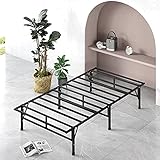
SageNest is one of the generic steel-frame brands that Amazon’s budget end runs on, and its 14-inch twin platform is the category’s standard recipe: steel slats on a black metal frame, about 12 inches of usable clearance beneath, no box spring, and assembly from a flat-packed box. What earns it a place here is its positioning: it is a budget-tier listing — check price on Amazon — and the closest thing in this guide to a walk-in option in this tier. For a buyer furnishing a room this weekend, a frame available now in this tier can be worth more than waiting for a deal-cycle drop, and this review exists to make that trade explicitly rather than pretend it away. As a sleeping platform it is the standard design doing the standard job: a level steel deck at storage height, and a side sleeper’s night on it will be decided less by the brand than by the two checks the next paragraph insists on.
Those checks matter more here than with the Zinus picks, because the generic-brand trade-off is documentation. The listing’s published detail is thinner than Zinus’s — dimensions and clearance are stated, but slat spacing and a formal capacity figure are not documented the way the Joseph documents them, and the warranty paper is correspondingly plain. For a side sleeper, unpublished slat spacing is not a paperwork quibble: it is the measurement that decides whether foam dips under the hip. So the routine on delivery day is specific — measure the gaps between slats before the mattress goes on (about 3 inches or less is what foam makers want), confirm every leg is present and level, and sleep the first week inside the return window with the packaging kept, because with a generic listing the return policy is the warranty. None of that makes it a bad frame; the steel-slat platform design is so standardized that the differences between brands at this level are mostly paperwork and quality control. It means the buyer supplies the inspection that a documented brand supplies on paper.
- Budget-tier everyday option — check price on Amazon for the current listing.
- Standard 14-inch steel-slat platform with about 12 in of clearance.
- No box spring needed; flat-pack assembly.
Honest limitation: Published specifications are thin — no documented slat spacing or formal capacity figure in the listing material reviewed — and it sits just above this guide’s budget tier rather than under it.
Choose it if you need a standard twin frame now and a small stretch beats a long wait — and you are willing to measure the slats on arrival. Skip it if published capacity and warranty figures matter to you — the Joseph is the documented pick.

HLIPHA 14 Inch Metal Platform Bed Frame, Twin
Who it suits: Heavier side sleepers who read the Joseph’s 350 lb rating, do their own sum, and decide to spend a little more on margin — because their load lands on two points, not a whole back.
Its headline is capacity: review coverage describes it as the cheapest route to a 14-inch steel platform marketed around a 660 lb rating, nearly double the Joseph’s published figure. It is the stretch pick in this guide — check price on Amazon — and the review’s job is to say what that stretch does and does not buy. For a side sleeper, the case is stronger than it is for anyone else. Capacity ratings are whole-bed numbers, but side sleeping is not a whole-bed load: at any moment most of the weight passes through the slats under one shoulder and one hip, and a frame running close to its rating flexes exactly there — a small, nightly give that reads as restlessness and morning stiffness rather than as a frame problem. Margin is not an abstraction for this audience; it is the difference between a platform that feels dead level and one that breathes under you.
What the extra money does not buy is paperwork. Capacity figures in this class are maker claims, not test results, and no independent lab has loaded this frame to failure — a frame engineered and marketed to a higher number generally carries its steel in thicker sections and its slats closer together, but like the SageNest, the listing’s formal documentation is thinner than the big brands’, and the 660 lb figure should be read as a claim to compare against other claims, not a guarantee to lean on. Slat spacing is likewise unpublished in the material reviewed, so the same delivery-day measurement applies. Treat this pick as the bridge it is — the frame for buyers who have done the capacity sum, found the strict-$30 picks wanting, and would rather stretch a little here than move to the next tier for the same reassurance.
- Marketed around a 660 lb capacity claim — the largest figure in this guide, and margin matters most to point-loading side sleepers.
- 14-inch steel platform with heavy-duty slat support — check price on Amazon.
Honest limitation: The capacity is a maker claim without independent verification, the formal listing documentation is thin, and it is a stretch pick, not a sub-$30 one.
Choose it if your load total makes the 350 lb frames a tight fit. Skip it if you are a lighter solo sleeper — the Joseph does the same job when it is in this budget tier.

Comparison Table
| Product | Type | Best use | Link |
|---|---|---|---|
| Zinus Joseph 10 Inch Metal Platform Bed Frame, Twin | Steel frame, wood slats | Documented 3–3.4 in slat spacing and warranty; check price on Amazon | Check on Amazon |
| Zinus Yelena 14 Inch Metal Platform Bed Frame, Twin | Steel platform, steel slats | Consistent steel support at storage height; check price on Amazon | Check on Amazon |
| Amazon Basics Foldable 14 Inch Metal Platform Bed Frame, Twin | Folding steel platform | Tool-free guest bed that stores flat | Check on Amazon |
| Zinus SmartBase Compack, Narrow Twin | Folding steel platform, 30 in wide | RV, cot and narrow-room mattresses | Check on Amazon |
| SageNest 14 Inch Metal Platform Bed Frame, Twin | Steel platform, steel slats | Nearest everyday option to this budget tier — check price on Amazon | Check on Amazon |
| HLIPHA 14 Inch Metal Platform Bed Frame, Twin | Steel platform, heavy-duty slats | Highest capacity claim (660 lb marketed) for heavier sleepers | Check on Amazon |
How to Choose a Bed Frame for Side Sleepers Under $30
- Start with the size, because the size decides whether this budget exists. Twin and narrow twin: this guide applies. Full, queen or king: no complete new frame was verified anywhere near $30 in our research — go straight to Best Bed Frame Under $75, where those sizes honestly begin, or to Best Bed Frame For Side Sleepers Under $75 for the side-sleeper view of that tier.
- Price your size, never the listing’s headline. Multi-size listings lead with the twin price. Select your size on the listing and read the number that belongs to it before comparing anything.
- Check the slat spacing against your mattress warranty. Most foam and hybrid makers want slats no more than about 3 inches apart; wider gaps let foam sag between slats — under your hip first — and can void the warranty you paid for. The Joseph publishes 3–3.4 in; where a listing does not publish spacing, measure on arrival.
- Do the capacity sum with real numbers, then add a side-sleeper margin. Mattress plus sleeper plus a margin for sitting on the edge, compared against the maker’s rating. Because your load concentrates on two points, a total that merely fits a rating will flex more for you than for a back sleeper — that is what the HLIPHA’s bigger claim is for.
- Count the support points. On a twin, look for legs at the corners plus support along the length; a long frame carried only at four corners will flex at the middle, and the middle is where a side sleeper’s hip lives.
- Test the edge before you commit. Sit on the edge of the made bed inside the return window: you should be able to sit to dress and stand up without the edge diving or the frame shifting. Side sleepers sit on the edge every morning and many sleep near it every night.
- Decide the height by the room’s job and your hips. Fourteen inches buys real under-bed storage (roughly 12–13 in of clearance) and a higher sit; 10 inches suits thick mattresses and low-profile rooms. Measure your storage bins before choosing, not after.
- Plan for squeak prevention at assembly, not after. Squeaks come from metal-on-metal joints that are slightly loose, and side sleepers work those joints with every roll. Tighten every bolt fully, fit the plastic slat caps or pads the listing includes rather than discarding them, and re-tighten after the first week as the frame settles.
- Ask the headboard question early. Most frames at this price have no headboard and some have no bracket holes. If a headboard matters, confirm brackets exist for the model or plan a wall-mounted or freestanding one.
- Keep the return window sacred. With generic brands especially, the first week’s sleep is the inspection: level legs, silent joints under a deliberate roll from side to side, slats seated, edges steady. Problems found inside the window are returns; problems found after it are furniture repair.
Slats, Sag and the Shoulder-Hip Zone
A bed frame’s most important specification is the one printed smallest: the distance between its slats. A mattress is engineered to rest on near-continuous support, and foam in particular remembers insults — rest a memory foam mattress on slats five inches apart and it will slowly work its way into the gaps, developing soft stripes across the bed that owners blame on the mattress. For most sleepers those stripes are a vague disappointment. For a side sleeper they are a map of the night: the body’s two load points, shoulder and hip, press deeper than any other zone, so the foam above a wide gap gives way exactly where the hip lands, the pelvis drops a fraction below the line of the shoulders, and the sleeper spends the night in a shallow hammock they cannot see and cannot stop feeling. Mattress makers know this, which is why so many warranty documents specify maximum slat spacing, commonly around 3 inches, and why a frame that violates it can quietly void the warranty of a mattress that cost ten times the frame. The Joseph’s published 3 to 3.4 inch spacing is the kind of number to look for; where a budget listing does not publish spacing at all, the tape measure on delivery day is your specification sheet, and a frame with wide gaps and a foam mattress is a return, not a compromise.
Support geometry is the second half of the same story. A twin can be carried by a perimeter frame with legs at the corners and support along its length; what it cannot survive is a middle carried by nothing, because a twin’s middle is precisely where a side sleeper’s hip zone sits. Flex there does not feel like a broken bed — it feels like restlessness, like waking on the other side of the bed without remembering the journey, like a shoulder that is mysteriously the sore one every morning. The diagnostic is free and takes ten seconds: kneel on the bare frame’s slats at the center and at the corners before the mattress goes on, and compare the give. A frame that is honest at the corners and spongy in the middle is telling you where your hip will be spending the year. None of this requires spending more than $30; it requires spending the $30 on a frame whose support is published, measured or both.
Why a Platform Frame Makes Your Mattress Feel Firmer
Almost every buyer in this guide is moving a mattress from something else — usually an old box spring — onto a platform for the first time, and almost all of them report the same surprise: the mattress feels firmer than it did. Nothing is wrong. A traditional box spring, especially a tired one, is itself a suspension system that absorbs part of every load; a platform frame absorbs almost none, so the mattress does all the work and presents its true firmness, undiluted. For a side sleeper the change is double-edged and worth planning for. The gain is support integrity: on slats, the foam under your hip compresses against something that does not also sag, so the pressure relief the mattress was designed to give is the pressure relief you actually get, and it stays consistent instead of degrading as a box spring tires. The cost is that a mattress that felt plush on a giving foundation can feel a notch firmer on a platform, and the shoulder — the body’s least forgiving pressure point — is where a notch is noticed.
The practical advice is sequencing. Do not judge the mattress, the frame or your life choices on the first two nights; a week is the honest trial, because your body is recalibrating as much as the bedding is. If the platform feel is still too firm after that week, the fix is a surface adjustment, not a frame replacement — a thin topper restores the plush layer the box spring used to fake, and the candidates live in Best Mattress Topper For Side Sleepers Under $30. The reverse error is worse: buying a softer mattress to compensate for a frame that is actually sagging, which stacks a support problem under a comfort purchase and fixes neither. Foam and hybrid mattresses are the natural partners for these frames — they are designed for slatted support — while a stiff traditional innerspring built for a box spring may feel board-like on slats and should be checked against its maker’s guidance. Get the platform honest first; then tune the surface.
Squeaks, Creaks and the Light Sleeper’s Roll Test
Noise is the complaint that ends more budget-frame ownerships than breakage, and side sleepers generate more of it than anyone. The mechanics are simple: every change of position transfers your weight across the frame’s joints, and a side sleeper changes position by rolling — a full load shift from one set of slats and legs to the other, several times a night, every night. A back sleeper’s frame is loaded once and rests; a side sleeper’s frame is exercised. Squeak itself deserves demystifying: it is almost never the steel failing. It is movement — a bolt a quarter-turn loose, a slat shifting in its holder, a leg a fraction out of level rocking on a hard floor, two metal surfaces meeting without the plastic cap that was supposed to separate them. Nearly all of it is preventable at assembly with full tightening, included caps and pads fitted rather than binned, and one re-tightening pass a week later as the frame settles into its working shape.
Two habits separate quiet budget frames from loud ones, and both are in the buyer’s hands rather than the listing’s. The first is the roll test during the return window: lie on the made bed, roll deliberately from your left side to your right and back, slowly, and listen. Silence under that provocation is a frame that will stay silent under sleep; a creak located now is a bolt to tighten now, not a mystery at 3 a.m. in month three. The second is floor discipline: a leg that rocks because the floor dips will creak no matter how tight the bolt is, and a felt pad or a shim under the short leg is a two-minute fix that outperforms any warranty claim. A budget frame assembled carefully is quiet for years; a premium frame assembled carelessly is not — at $30, your twenty minutes with the Allen key is the noise-reduction feature, and it is included in every box.
Common Buying Mistakes
- Reading the twin headline price on a multi-size listing and ordering a queen at a price that never existed for that size.
- Putting a foam mattress on wide-spaced slats — the foam dips under the hip first, and the mattress warranty may go with it.
- Skipping the capacity sum, or doing it with back-sleeper assumptions: side sleepers load two points, so buy margin, not a bare fit.
- Judging a platform frame on the first night and returning it for feeling firmer — that firmness is the box spring’s absence, and a week plus a thin topper is the honest test.
- Buying a folding frame for nightly use by a restless sleeper; hinges are joints, and joints worked a dozen times a night eventually comment on it.
- Discarding the plastic slat caps and joint pads during assembly, then blaming the frame for squeaking.
- Never re-tightening the bolts after the first week, as the frame settles into its working shape.
- Buying a narrow-twin frame for a standard twin mattress — or the reverse — without measuring the mattress first.
- Choosing the 14-inch height for storage without measuring the bins that are supposed to fit underneath.
- Trying to fix a sagging frame with a softer mattress or a thicker pillow, stacking a comfort purchase on top of a support problem.
Final Recommendation
- Most side sleepers on a twin: Zinus Joseph 10 Inch Metal Platform Bed Frame — documented slat spacing, a real warranty, and a budget-tier listing — check price on Amazon.
- Consistent steel support and storage height: Zinus Yelena 14 Inch Metal Platform Bed Frame — if your timeline can wait for its price drops.
- Guest rooms and temporary beds: Amazon Basics Foldable 14 Inch Metal Platform Bed Frame.
- Narrow mattresses (30 in): Zinus SmartBase Compack, Narrow Twin.
- Need it this week: SageNest 14 Inch Metal Platform Bed Frame — check price on Amazon.
- Heavier loads on two points: HLIPHA 14 Inch Metal Platform Bed Frame, for the bigger capacity claim.
Our top two are the Joseph, because it is the only pick that combines a budget-tier listing with published slat spacing and a 5-year warranty — the three things a side sleeper’s mattress actually asks of a frame — and the SageNest, because a budget-tier frame available on the live listing — check price on Amazon — answers the deadline the deal-cycle picks cannot, provided you measure its slats on arrival. If your bed is larger than a twin, let this guide’s honest answer stand: your tier is Best Bed Frame Under $75, and the money is better saved than spent chasing a price that does not exist for your size. Whatever you order, remember what the frame is for. It will not cushion your shoulder, align your spine or treat anything; it will hold your mattress flat, even and silent, or it will quietly undo it. Measure the mattress, read the price for your size, check the slat spacing, tighten every bolt twice, and run the roll test before the return window closes.
Frequently Asked Questions
Can you really buy a complete bed frame for under $30?
In twin size, yes — on deal pricing. The Zinus Joseph, Zinus Yelena and Amazon Basics foldable twins in this guide have all appeared in this budget tier on deal cycles — check price on Amazon for the current figure for each. What you cannot buy new under $30 is a full, queen or king frame; those sizes start honestly in the $75 tier. Read every price per size, because listings headline the twin figure.
What slat spacing does a side sleeper need?
The same spacing your mattress maker specifies — commonly slats no more than about 3 inches apart — but a side sleeper feels violations of it first and worst, because the foam dips under the hip and shoulder, the two points carrying the load. The Joseph publishes 3–3.4 in. Where a listing publishes nothing, measure the gaps when the frame arrives, before the mattress goes on, and treat wide gaps under a foam mattress as a return.
Why does my mattress feel firmer on a platform frame?
Because the box spring it replaced was absorbing part of every load, and the platform does not. The mattress is presenting its true firmness, with the gain that its support no longer degrades as a spring unit tires. Give it a week before judging; if it is still too firm for your shoulder after that, a thin topper is the fix — not a different frame, and not a softer mattress bought to compensate for a foundation change.
How much weight can a $30 bed frame hold — and does side sleeping change the answer?
Read the maker’s figure for your exact model and treat it as a claim to compare, not a test result. The documented picks here span about 250 lb (Amazon Basics foldable twin) and 350 lb (Zinus Joseph twin) up to a marketed 660 lb (HLIPHA twin). Side sleeping does change how the load is delivered: it concentrates on the slats under one shoulder and one hip rather than spreading across the bed, so a total that merely fits a rating will flex more for you. Add mattress plus sleeper, leave margin for sitting on the edge, and if your total crowds a rating, buy the bigger number.
Will a cheap metal frame squeak every time I roll over?
It can, and the cause is almost always assembly rather than materials: a slightly loose bolt, a slat cap left in the box, a leg a fraction out of level on a hard floor. Side sleepers roll more than most, so the discipline matters more: tighten everything fully at setup, fit every included cap and pad, re-tighten after the first week, and shim any leg that rocks. Run a deliberate roll test inside the return window — silence under provocation is the frame you keep.
Do I still need a box spring with these frames?
No. Every pick in this guide is a platform frame whose slats support the mattress directly, which is most of their value: the box spring a traditional rail frame requires would cost more than the frame itself. Expect the mattress to feel a notch firmer than it did on the old foundation, for the reasons in the firmness section above. If you already own a rails-and-box-spring setup, a platform frame replaces both parts, so plan the old box spring’s exit.
What if my mattress is a full or queen — is there any $30 route?
Not for a complete new frame, based on everything our research could verify. Your honest options are repairing your current frame with components (slats, center legs), buying used locally, or saving to the $75 tier where full and queen platform frames with proper center support begin. A listing that appears to offer a new queen frame under $30 is showing you its twin price.
- Best Bed Frame Under $30
- Best Bed Frame For Side Sleepers Under $75
- Best Bed Frame Under $75
- Best Adjustable Bed Frame For Side Sleepers Under $30
- Best Cooling Pillow For Side Sleepers Under $30
- Best Bed Sheet Set Under $30
Related Guides
- Best Bed Frame For Side Sleepers Under $75
- Best Bed Frame For Side Sleepers Under $100
- Best Bed Frame For Side Sleepers Under $200
- Best Bed Frame For Side Sleepers Under $400
- Best Bed Frame For Side Sleepers Under $700