Where to buy
Check the latest price, availability and delivery on Amazon. Orders are placed on Amazon. We may earn a commission from qualifying purchases.
- Best overall: Nachell Adjustable Bed Furniture Risers (3, 5 or 8 Inch) — Check on Amazon
- Debercu Bed Frame Support System, 3 Cross Rails and 6 Adjustable Legs — Check on Amazon
- Smipam Adjustable Height Bed Support Legs, 6-Piece Steel (7.3–12 Inch) — Check on Amazon
- Utopia Bedding Adjustable Bed Risers, 8-Piece Set — Check on Amazon
See 2 more Amazon options
- BTSD-home Adjustable Bed Risers, 3 or 6 Inch (Set of 4) — Check on Amazon
- Bedluxe Wedge Pillow, Adjustable 9 & 12 Inch Foldable — Check on Amazon
Read the full guide ↓
Disclosure: As an Amazon Associate, airfryerkitchensupply.com earns from qualifying purchases. Links to Amazon on this page are affiliate links; they cost you nothing extra. Listing details such as price and availability change often, so check the current Amazon listing before you buy.
The best adjustable bed frame for a small bedroom under $75 is not a smaller version of a motorized base, and this guide will not pretend otherwise. A powered adjustable base needs a steel frame, motors, a control box and a remote, and even the most basic of those sit well above this budget — before you ask how you would get one through the door of a 9-by-11-foot bedroom. What this budget genuinely buys, and what a small room actually needs, is adjustment that works vertically instead of horizontally: risers that lift the whole bed high enough to turn dead space underneath into real storage, support systems that replace a bulky frame’s footprint with slim steel that hugs the mattress, and a wedge that folds flat and disappears when it is not earning its keep. In a small bedroom, floor space is the one thing you cannot buy more of. Every product in this guide either gives some back or costs you none.
That last point is the filter for everything below. A big room forgives a wide headboard rail, a storage bed whose drawers need two feet of clearance to open, or a frame that sits three inches out from the wall. A small room does not. So this guide favors parts that live inside the bed’s existing footprint: tall stackable risers rated for serious loads, a cross-rail support system that can retire a sagging frame’s weakest parts without replacing the bed, six-piece steel leg sets that spread support across the whole underside instead of four corners, and one foldable wedge that stores in the gap it creates. For most small bedrooms we would start with the Nachell risers, because the jump from a typical 7 inches of under-bed clearance to 12 or 15 inches is the single biggest storage win available at any price. If your frame itself is the problem — sagging, creaking, eating floor space with a chunky base — the Debercu support system is the more surgical fix. Below you will find a quick picks table, the storage math that should drive the decision, detailed notes on each product, a comparison table, measuring and layout guidance, the mistakes small-room shoppers make most, and answers to the questions that come up again and again.
In this guide
Quick Picks
Short on time, or comparing several options at once? Each row below names a buyer type and the product that suits it, with a link to the listing.
| Buyer type | Pick | Why it stands out | Link |
|---|---|---|---|
| Best overall | Nachell Adjustable Bed Furniture Risers (3, 5 or 8 Inch) | Serious lift with a 2,500 lb maker rating | Check on Amazon |
| Best frame rebuild | Debercu Bed Frame Support System, 3 Cross Rails and 6 Legs | Replaces sagging support without replacing the bed | Check on Amazon |
| Best full-length support | Smipam Adjustable Height Bed Support Legs, 6-Piece Steel | Six steel legs spread the load across the whole frame | Check on Amazon |
| Best value lift | Utopia Bedding Adjustable Bed Risers, 8-Piece Set | Three heights from one inexpensive set | Check on Amazon |
| Best compact lift | BTSD-home Adjustable Bed Risers, 3 or 6 Inch (Set of 4) | Low-profile lift rated to 2,200 lb | Check on Amazon |
| Best fold-away wedge | Bedluxe Wedge Pillow, Adjustable 9 & 12 Inch Foldable | Folds between two inclines and stores flat | Check on Amazon |
How These Picks Were Chosen
The first filter was the room, not the budget. Every product below works inside the footprint of the bed you already own: nothing here widens the frame, pushes the bed further from the wall, or needs swing clearance to function. Products that solve a small-room problem by creating a bigger one — storage beds with drawers that cannot open against a wall, wide platform bases that overhang the mattress — were left out on principle, however well reviewed they are elsewhere.
The second filter was the budget, applied honestly. Every product is a real Amazon listing chosen for this budget tier; check the current price on Amazon on each listing before you buy, because prices change often. A budget like this in a small bedroom is often best used as a combination — risers plus a wedge, or legs plus the pads and bins that make a lift usable — and the reviews below flag the pairings that make sense rather than pushing you to put everything into one part. Anything that called itself an adjustable bed frame but turned out to be a full motorized base far above this tier was excluded, because it does not answer the search you actually made.
We did not use these products ourselves. We read the maker listings and specification pages, compared lift heights, leg ranges, load ratings and pack contents, and favored products where “adjustable” means something you can genuinely change after delivery: stacking or removing a riser section, screwing a leg longer or shorter, sliding a cross rail to width, or folding a wedge between two heights. We also weighted load ratings and leg counts more heavily than we would for a large bedroom, for a simple physical reason: in a small room the bed is usually also the sofa, the desk chair and the laundry-folding table, so it works harder per square foot than a bed in a spare-room-sized space. Where a listing was vague about a dimension, we say so in the review rather than guess, and the measuring section below tells you exactly what to check before ordering.
The 6 Best Adjustable Bed Frames for Small Bedrooms Under $75
Nachell Adjustable Bed Furniture Risers (3, 5 or 8 Inch)
Who it suits: Small-bedroom owners whose closets are full and whose floor has disappeared under storage boxes that have nowhere else to live.
Start with the arithmetic, because in a small bedroom the arithmetic is the whole argument. Every inch of lift across the footprint of a bed creates roughly 1.6 cubic feet of new storage volume under a twin, 2.3 under a full and 2.8 under a queen — and even after you discount a third of that for rails, legs and the room you need to slide a box in and out, a 5-inch lift on a queen still nets you around 9 usable cubic feet. That is a dresser’s worth of storage that takes up zero additional floor. The Nachell set is built for exactly this move: four 3-inch and four 5-inch ABS risers that stack to a full 8 inches, with a maker-stated bearing capacity of 2,500 lb — the highest rating in this guide — so the lift does not become the weak point once the bed is loaded with sleepers, a heavy mattress and the contents of a wardrobe underneath it.
The practical detail that matters in a tight room is how the lift changes what fits. A typical frame leaves about 7 inches of clearance underneath, which excludes most storage bins ever sold. Add the 5-inch risers and you have roughly 12 inches — enough for the standard lidded under-bed boxes and most small suitcases standing on their sides. Stack to the full 8 inches and clearance approaches 15 inches, which swallows stacked bins, a spare duvet in a vacuum bag and the out-of-season clothes that were colonizing your only chair. Because the heights are modular, you can also lift in stages: run the 3-inch pieces for a month, live with the bed, then stack up when you are sure the room’s sightlines still work. In a small bedroom that reversibility is worth real money, because a bed raised too high makes a low-ceilinged room feel smaller, not bigger.
- Three heights — 3, 5 or 8 inches — from one stackable set, so the lift can grow with your storage needs.
- Maker-rated to 2,500 lb, the strongest rating in this guide, for loaded beds and heavy mattresses.
- Turns the space under the bed into roughly a dresser’s worth of storage without touching the floor plan.
Honest limitation: At the full 8-inch stack the bed sits tall, and in a small room that height is visually loud — the bed becomes the room’s dominant object, and shorter sleepers will feel the climb. The middle setting is where most small bedrooms should land.
Choose it if under-bed storage is the point of the purchase and you want the strongest risers in this tier. Skip it if your frame has no legs for the cups to hold, or your ceiling is low enough that a tall bed would crowd the room.

Debercu Bed Frame Support System — 3 Cross Rails and 6 Adjustable Legs
Who it suits: Anyone whose small bedroom is stuck with a sagging, creaking frame — and who cannot afford the floor space, or the money, for a whole new bed.
In a big bedroom, a tired frame is an annoyance. In a small one it is a trap: the bed dominates the room, so its dip, squeak and wobble dominate your sleep, yet replacing it means maneuvering a bulky new frame through a narrow door and finding somewhere to stand while you build it. The Debercu system attacks the problem from underneath instead. Three steel cross rails span the width of the bed and six adjustable legs carry them, with the leg height adjustable from about 5.9 inches up to 11 inches measured to where the box spring or slats rest. The maker lists it as a universal center support for Full, Queen, King and California King beds with metal, wood or upholstered frames, which covers most of what small bedrooms actually contain — including the hand-me-down frames that need it most.
What this buys a small room, beyond a flat sleeping surface, is footprint discipline. A sagging frame usually gets “fixed” with a thicker, heavier replacement base or a platform that overhangs the mattress and eats the walkway on both sides. The Debercu rails live entirely under the mattress outline: nothing sticks out past the bed you already have, nothing new competes for the two feet of floor between the bed and the wall, and the adjustable legs let you level the support on the uneven floorboards that old, small rooms specialize in. Set the six legs so each one is genuinely bearing weight — a leg that spins freely is decoration — and a frame that rolled you toward the middle becomes a flat, quiet platform. It is also the one product in this guide that can extend a bed’s life by years, which in a small home matters twice: once for the money, and once because you never have to repeat the delivery-day furniture shuffle.
- Three cross rails plus six adjustable legs rebuild support across the whole bed, not just the corners.
- Leg height adjusts from about 5.9 to 11 inches, so it levels on uneven small-room floors.
- Sized for Full through California King, in metal, wood or upholstered frames, per the maker.
Honest limitation: This is the most involved install in the guide. You need access under the bed, a frame or box spring for the rails to support, and the patience to level six legs one by one. In the smallest rooms, that means sliding the mattress off and working in the space the bed normally occupies.
Choose it if your frame sags or creaks and you want a repair that adds no bulk to the room. Skip it if your bed is a platform with solid sides the rails cannot sit under, or you want a no-tools change.

Smipam Adjustable Height Bed Support Legs, 6-Piece Steel (7.3–12 Inch)
Who it suits: Owners of wide or heavily used beds in small rooms — the ones where four corner legs were never going to be enough.
The Smipam set takes the support-leg idea and scales it to how a small-room bed is actually used. You get six legs, not four, built from thickened square carbon-steel tube, each adjusting across a 7.3 to 12 inch range, with a maker-stated maximum capacity of 1,000 lb for the set and non-slip bases that matter on the bare wood and laminate floors small bedrooms usually have. The package includes six auxiliary mounting plates and twelve screws, so the legs can be fitted under a center rail, under slats, or as straight replacements for bent and missing originals. Six legs spread the load the way a frame designer would have if cost had not intervened: two sleepers’ worth of weight no longer funnels through four corners and one overworked center stub.
The small-room angle is stability in tight quarters. A bed that flexes does not just creak — in a room where the bed is pushed near a wall, every rock and shift migrates the frame until a leg is grinding the skirting board or the bed is wedged diagonally with a dead gap behind the headboard you cannot reach into. Firm, level, six-point support stops the migration. It also quiets the bed, which in a studio or a room sharing a wall with the living room is a quality-of-life upgrade out of proportion to the effort. Fitting is honest DIY: mark the rail, fix the plates, screw the legs out to length, and check each one is loaded. The 7.3-inch minimum height is the number to verify before ordering — measure the gap under your rail, because a leg whose shortest setting is taller than your clearance cannot be made to fit by enthusiasm.
- Six carbon-steel legs share the load across the frame instead of concentrating it at four corners.
- Adjustable from 7.3 to 12 inches each, with mounting plates and screws included in the box.
- Non-slip bases help stop the frame migration that plagues beds in tight rooms.
Honest limitation: The 7.3-inch minimum height excludes low-slung frames, and fitting six legs is a screwdriver-and-measurements job, not a five-minute slide-under fix. The maker’s 1,000 lb figure is a set rating — heavy solid-wood frames plus sleepers should be summed honestly against it.
Choose it if you want the most complete leg-based support in this tier and your rail clearance fits the range. Skip it if your frame sits lower than about 7 inches underneath, or you rent and cannot screw into the frame.

Utopia Bedding Adjustable Bed Risers, 8-Piece Set (3, 5 or 8 Inch)
Who it suits: Budget-first small-room shoppers who want a proven lift now, and plan to pair it with the bins that make the lift useful.
Not every small bedroom needs the maximum-rated riser, and the Utopia Bedding set remains the sensible value benchmark in this category. Eight heavy-duty plastic risers — four short 3-inch and four tall 5-inch pieces — stack for 3, 5 or 8 inches of lift, with a maker rating of 1,300 lb and a recessed cup on top of each riser that cradles the bed leg or caster so the frame stays seated instead of skating sideways. That cup is the detail to respect: it accepts legs up to about 2.8 inches wide, which covers most metal frame legs and slim wooden posts, but chunky square posts will not seat fully, and a leg that does not seat fully is a leg planning its escape.
Why include a budget-tier set in this guide? Because in a small bedroom the risers are only half the purchase. The lift creates the volume; flat lidded bins sized to the new clearance are what turn volume into storage instead of a dust-collecting cave you shove things into and never retrieve. Pairing the Utopia set with two or three bins that actually fit your new clearance will leave a small room more organized than premium risers alone. The set is also the easiest in this guide to live with experimentally: no tools, no screws, fully reversible in minutes, so you can test the 5-inch setting for a week and unstack to 3 if the room feels top-heavy — a trial-and-error freedom that matters when a few inches either way changes how a tiny room feels. One caution from the category generally: at the full 8-inch stack on hard floors, check the legs are still seated after the first few nights, and consider furniture pads underneath.
- Three real heights — 3, 5 or 8 inches — from one inexpensive, widely sold set.
- Maker-rated to 1,300 lb, enough for most frames, mattresses and two sleepers.
- Pairs well with the storage bins that complete the under-bed system.
Honest limitation: The cups accept legs up to about 2.8 inches wide, so wide wooden posts are out; and the plastic build, while strong, is less confidence-inspiring at maximum stack than the heavier-rated Nachell set above.
Choose it if you want a proven, reversible lift without overcomplicating the purchase. Skip it if your bed is heavily loaded and lives at maximum height full-time — step up to the Nachell set instead.
BTSD-home Adjustable Bed Risers, 3 or 6 Inch (Set of 4)
Who it suits: Small bedrooms where the bed only needs a modest lift — and where a towering bed would swallow what little visual space the room has.
Every other riser conversation in this guide runs toward maximum height, but plenty of small bedrooms have the opposite problem: the room is short on ceiling as well as floor, the bed already dominates, and what is actually needed is just enough clearance to slide a standard storage box underneath and make getting out of bed a little easier on the knees. The BTSD-home set is the measured answer — four stackable risers giving a 3-inch lift on their own or 6 inches stacked, with a maker-stated capacity of 2,200 lb that is remarkable for a set of four and well beyond what most beds will ever ask of it. Six inches of lift on a typical frame takes clearance from about 7 inches to about 13, which quietly crosses the threshold that matters: the standard lidded under-bed box fits, with fingers’ room to spare.
The set-of-four format suits the small-room reality that most compact frames stand on four legs; there are no leftover pieces to store in a home that has no storage to spare, which is a small but genuine virtue in a room where every object needs a home. The lower maximum height also keeps the room’s proportions honest — the bedside lamp stays at a sensible height relative to the mattress, the headboard still reads as a headboard, and the bed does not turn into a platform you mount rather than a bed you get into. As with every riser here, measure your leg width against the cup before ordering, seat every leg fully, and remember that a frame with center legs needs those supported at the new height too — a four-piece set covers four legs, and a six-leg frame is a job for an eight-piece set or added support legs from this guide.
- Modest 3 or 6 inch lift that suits low-ceilinged rooms and keeps proportions natural.
- Maker-stated 2,200 lb capacity from a set of just four risers.
- No surplus pieces to store — the set matches a standard four-leg frame exactly.
Honest limitation: Four risers means four legs; frames with six legs or a center leg need additional support at the lifted height, and the 6-inch ceiling on lift gives you less storage growth than the 8-inch sets if your needs expand.
Choose it if a moderate, strong, no-fuss lift is all your room wants. Skip it if your frame has more than four legs or you are chasing maximum storage volume.

Bedluxe Wedge Pillow, Adjustable 9 & 12 Inch Foldable
Who it suits: Small-room sleepers who want head elevation for reading, reflux comfort or recovery — but refuse to give a permanent foam block a permanent home.
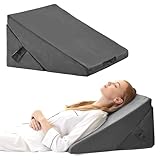
A rigid wedge pillow is roughly the size of a carry-on suitcase, and in a small bedroom that volume has to come from somewhere: the corner already holding the laundry basket, the gap beside the wardrobe, the top of the closet that is already full. The Bedluxe wedge solves the storage problem by folding. Built from memory foam over a firmer support core in a 22 by 22 by 12 inch format, it converts between a 9-inch and a 12-inch incline with its adjustable fastener — folded one way it is a long, low ramp for sleeping; folded the other, a more upright backrest for reading or working in bed; and folded flat for storage, it slides into the very under-bed space this guide’s risers create, or stands in the narrow gap between bed and wall that fits nothing else. The cover removes for washing, which matters for a product that lives against skin and hair.
On the bed, it does what a wedge is honestly for. The gentle incline keeps the head and shoulders above the stomach — the reason so many reflux and snoring shoppers start here — and props you up for a book or a laptop without the nightly engineering of stacked pillows that migrate by 2 a.m. Flip it to the foot of the bed and it elevates tired legs after a day on your feet. What it cannot do deserves the same clarity as in every guide in this series: a wedge is a comfort product, not a medical device, and it does not treat sleep apnea or reflux disease. In a small bedroom its real luxury is optionality — elevation on the nights you want it, and on the mornings after, it folds away and the room gets its floor back. No other product in this guide can make that claim, and in a tight room it is the difference between a tool and a tenant.
- Foldable design converts between 9-inch and 12-inch inclines and stores flat.
- Works as a sleep ramp, a sitting backrest and a leg elevator in one piece.
- Removable, washable cover over a memory foam top layer.
Honest limitation: At 22 inches wide it serves one sleeper per wedge, and it elevates the person, not the bed — it does nothing for storage, height or a sagging frame.
Choose it if you want incline comfort that disappears when the day starts. Skip it if both partners want elevation from one purchase, or your problem is the bed rather than the sleeper.
Comparison Table
| Product | Type | Best use | Link |
|---|---|---|---|
| Nachell Adjustable Bed Furniture Risers | Stackable risers | Maximum under-bed storage in a small room | Check on Amazon |
| Debercu Bed Frame Support System | Cross rails + adjustable legs | Rebuilding a sagging frame with no added bulk | Check on Amazon |
| Smipam Adjustable Support Legs, 6-Piece | Steel support legs | Six-point support and stability on hard floors | Check on Amazon |
| Utopia Bedding Adjustable Bed Risers | Stackable risers | Proven value lift that pairs well with fitted bins | Check on Amazon |
| BTSD-home Adjustable Bed Risers | Stackable risers | Modest lift for low-ceilinged rooms | Check on Amazon |
| Bedluxe Wedge Pillow, Foldable | Folding foam wedge | Head elevation that folds away by day | Check on Amazon |
How to Choose an Adjustable Bed Frame for a Small Bedroom Under $75
- Diagnose before you spend. Low bed with no storage: risers. Sagging or creaking frame: rails or legs. Sleeper needs raising: wedge. In a small room a wrong-mechanism purchase is not just wasted money, it is clutter you have nowhere to put.
- Do the storage math first. Roughly 1.6 cubic feet per inch of lift under a twin, 2.3 under a full, 2.8 under a queen — then discount a third for rails and sliding room. Buy the lift your boxes need, not the tallest lift on the page.
- Measure your current clearance and your boxes. A typical frame leaves about 7 inches underneath; standard under-bed boxes need about 6 to 7 inches of height and your hands need another inch to slide them. The gap between those numbers is the lift you actually need.
- Measure leg width against the riser cup. Cups commonly accept legs up to about 2.8 to 3 inches. A leg that does not seat fully will eventually walk out, usually at 3 a.m.
- Count every leg, including the middle ones. Six-leg frames and center rails must be supported at the new height. Risers for four corners plus support legs for the center is a legitimate combination.
- For legs and rails, measure the gap under the rail. Support legs have minimum heights — about 5.9 inches for the Debercu system, 7.3 for the Smipam legs. A leg that cannot shorten to your gap cannot be fitted at all.
- Sum the real load. Frame plus mattress plus sleepers plus the storage you are about to add underneath is the number to compare with the maker’s rating. Small-room beds work as seating too, so be honest about the total.
- Protect the floor you have. On wood or laminate, look for non-slip bases and add furniture pads under risers. In a tight room the bed gets bumped constantly, and a creeping riser is a failing riser.
- Think of the purchase as a system. Risers plus fitted bins, or legs plus pads, usually beat one premium part bought alone. This tier rewards combinations.
The Storage Math: What an Inch of Lift Is Really Worth
Small-bedroom advice usually waves at under-bed storage as “extra space” without putting a number on it, so here are the numbers. A bed’s footprint is fixed: a twin covers about 38 by 75 inches, a full 54 by 75, a queen 60 by 80. Multiply that area by one inch of height and divide by 1,728 and you get the volume each inch of lift creates — roughly 1.6 cubic feet for a twin, 2.3 for a full and 2.8 for a queen. Now be honest with the discount: legs, rails and the clearance your hands need to slide a box in and out consume about a third of it, so plan on keeping two-thirds. A queen lifted 5 inches still nets around 9 usable cubic feet. For scale, a medium dresser drawer holds about 1.5 to 2 cubic feet — so that modest lift is four to five drawers you did not have to find floor space for, in a room that demonstrably had none.
The math also tells you when to stop. Going from a typical 7 inches of clearance to 12 unlocks the entire category of standard storage bins, suitcases on their sides and vacuum-bagged bedding — the big, boxy things that otherwise live on your floor. Going from 12 to 15 inches adds volume, but mostly for stacking a second layer of smaller boxes, which are harder to reach and easier to forget. Meanwhile the costs of height are real and they are visual as much as physical: every inch makes the bed a larger object in a small visual field, raises the climb for shorter sleepers, and can leave a standard headboard looking stubby. The sweet spot for most small bedrooms is the lift that fits one layer of the bins you already own or can buy cheaply — measure the boxes first, then choose 3, 5 or 8 inches to clear them with an inch to spare. Storage you can reach beats storage you can only admire in a spreadsheet.
Measuring and Laying Out a Small Bedroom Around a Lifted Bed
Before anything arrives, take four measurements. First, the clearance under your frame today, measured at the lowest rail, not the highest leg gap. Second, the width of each bed leg, for the riser cup check. Third, the height of the storage boxes you intend to use, lid included. Fourth — the one everyone forgets — the height from the floor to the top of the mattress once lifted, compared against your bedside table and lamp. An 8-inch lift that leaves your alarm clock eight inches below the mattress and your lamp shining up from beneath you has not improved the room; it has just moved the inconvenience. If the numbers say the full lift breaks the bedside setup, the 5-inch setting usually preserves it, which is another argument for stackable sets over fixed-height ones.
Layout deserves the same care. Keep at least one side of the bed walkable — in the tightest rooms that means pushing the other side close to the wall and accepting the sheet-changing gymnastics as the price of a path to the door. Remember that a lifted bed’s storage only works if you can kneel and pull boxes toward you, so the side you access storage from needs floor space in front of it, not the wall. Think about the door swing and the wardrobe doors too: in many small bedrooms the bed, the door arc and the closet doors form a three-way negotiation, and two inches of frame migration from an unleveled leg set can jam the whole treaty. Finally, plan the install itself. Raising a bed in a room barely bigger than the bed means working corner by corner, sliding the mattress against the wall, and having the risers or legs within arm’s reach before you lift — small-room DIY is choreography, and five minutes of staging saves an hour of wrestling.
What the Extra Budget Buys: Stability in Tight Spaces
Shoppers who have read the lower-tier version of this guide reasonably ask what moving up a tier actually adds, because the product families look similar. The honest answer is stability, coverage and load headroom — three things a small room values more than a large one. At the lower tier, support legs come in sets of four with modest ratings; at this tier, the Smipam set gives you six steel legs with plates and screws, and the Debercu system replaces the support concept entirely with three cross rails, so the mattress is carried across its whole width instead of at points. Risers follow the same pattern: ratings climb from around 1,300 lb to 2,200 and 2,500 lb, which is the difference between a lift that tolerates a loaded bed and one that shrugs at it.
Why does stability matter more in a small room? Proximity. In a large bedroom a slightly lively bed is an abstract quality issue; in a small one the bed is inches from the wall it keeps tapping, the wardrobe it keeps nudging, and the walkway it keeps shrinking as it migrates. A bed in a tight room is also furniture-multi-tasked — sat on to dress, worked on, piled on — so its frame cycles through far more loading angles than a bed that is only slept in. Choosing six legs instead of four, or rails instead of a single center leg, is buying the bed’s stillness, and stillness is what makes a small room feel calm rather than improvised. If your frame is already rock solid and all you need is height, the simpler riser sets remain the smart buy, paired with fitted bins. This tier is not about buying more; it is about being able to fix the support properly when support is the actual problem.
Common Buying Mistakes
- Buying a storage bed or platform frame for a small room without checking drawer and footprint clearance — then living with drawers that open four inches.
- Chasing the maximum 8-inch lift without measuring boxes, ceiling feel or the bedside table height it leaves behind.
- Lifting the four corners of a six-leg frame and leaving the center legs dangling an inch above the floor, carrying nothing and bending the rails.
- Ordering support legs whose minimum height is taller than the gap under the rail — the one measurement that cannot be fudged.
- Forgetting that under-bed storage needs an access side: boxes entombed behind a wall-side gap might as well be in another home.
- Stacking risers from two different brands in one pile to chase extra height, mixing cup shapes that were never designed to lock together.
- Skipping the load sum because the rating sounds huge — then adding a hybrid mattress, two sleepers, seating duty and 60 lb of stored books underneath.
- Buying a rigid wedge for a room with nowhere to store it, instead of the folding model that gives the space back every morning.
Final Recommendation
- Most small bedrooms: Nachell Adjustable Bed Furniture Risers (3, 5 or 8 Inch).
- Sagging frame, no space for a new one: Debercu Bed Frame Support System.
- Heaviest use and hard floors: Smipam Adjustable Height Bed Support Legs, 6-Piece.
- Best value lift: Utopia Bedding Adjustable Bed Risers, 8-Piece Set.
- Low ceilings, modest needs: BTSD-home Adjustable Bed Risers, 3 or 6 Inch.
- Elevation without the storage problem: Bedluxe Wedge Pillow, Adjustable 9 & 12 Inch Foldable.
Our top two are the Nachell risers and the Debercu support system, because between them they cover the two situations that define small-bedroom bed shopping: a sound bed sitting on wasted space, and a failing frame in a room with no room for a replacement. Start by measuring — clearance, leg width, box height, rail gap — because in a small bedroom the measurements are the decision, and every product in this guide is the right answer to one specific set of numbers. If you are combining purchases, our suggested pairing is in Best Adjustable Bed Frame Under $75, and the storage-first route pairs naturally with the picks in Best Adjustable Bed Frame For Small Bedrooms Under $30. None of these products will motorize your bed or make the room bigger. They will make the bed you have stand at the right height, on a frame that sits still, over storage you can actually reach — which, in a small bedroom, is most of what a good night’s sleep is built on.
Frequently Asked Questions
Can you really buy an adjustable bed frame for a small bedroom under $75?
Not a motorized one — powered bases sit well above this budget and are bulky besides. What this budget genuinely buys is manual adjustment in three forms: stackable risers that lift the bed by a choice of heights, adjustable legs and cross-rail systems that level and support the frame, and folding wedges that raise your head. For small bedrooms those are usually the more useful purchases anyway, because they work inside the bed’s existing footprint.
How much storage does lifting the bed actually add?
Each inch of lift creates roughly 1.6 cubic feet under a twin, 2.3 under a full and 2.8 under a queen before you discount for rails and access room; keeping two-thirds of that is a realistic plan. A 5-inch lift on a queen works out to around 9 usable cubic feet — comparable to a small dresser — provided you use bins sized to the clearance and keep one side of the bed accessible for pulling them out.
Will risers make a small bedroom feel smaller?
They can if you overdo it. A moderate lift usually makes a small room feel better organized, because floor clutter moves out of sight underneath. The maximum 8-inch stack in a low-ceilinged room can make the bed loom, though, and it raises the climb noticeably. Stackable sets are the safeguard: start at the middle height, live with it for a week, and only stack higher if the room still feels balanced.
Do I need risers or support legs — or both?
They fix different problems. Risers raise a sound frame; legs and rails repair a frame that sags, creaks or rolls you toward the middle. Both together make sense in one common small-room case: risers under the four corners for height, plus support legs under the center rail so the middle is carried at the new height instead of hanging. What never makes sense is risers under a frame whose support is already failing — lift a sagging frame and you own a taller sagging frame.
Will these support systems fit my bed?
Check three things against the listing: your bed size (the Debercu system is listed for Full through California King), your frame type (metal, wood and upholstered frames are covered by that system), and the gap under your rail compared with the legs’ minimum height — about 5.9 inches for the Debercu legs and 7.3 inches for the Smipam set. Platform beds with solid sides and frames with no legs at all rule out risers and some leg fittings; measure before ordering, not after.
Is a wedge pillow practical in a small bedroom?
A folding one is — that is precisely its advantage. A rigid wedge occupies carry-on-suitcase volume around the clock, while the Bedluxe in this guide folds between its two inclines and stores flat under the bed or in a narrow gap when the day starts. If your room has a genuine home for a rigid wedge, a fixed model is simpler; if every cubic foot is spoken for, folding is the feature that matters most.
What if I raise the bed and hate it?
That is the quiet strength of everything in this guide: it reverses. Risers unstack, legs unscrew, rails lift out, and the wedge folds away — nothing here cuts, glues or permanently modifies the bed. Buy through a listing with clear return terms, keep the packaging for the first week, and judge foam products after their full 24 to 48 hour expansion window rather than in the first hour out of the vacuum pack.
- Best Adjustable Bed Frame Under $75
- Best Adjustable Bed Frame For Small Bedrooms Under $30
- Best Bed Frame For Small Bedrooms Under $200
- Best Blackout Curtains For Small Bedrooms
Related Guides
- Best Adjustable Bed Frame For Small Bedrooms Under $30
- Best Adjustable Bed Frame For Small Bedrooms Under $100
- Best Adjustable Bed Frame For Small Bedrooms Under $200
- Best Adjustable Bed Frame For Small Bedrooms Under $400
- Best Adjustable Bed Frame For Small Bedrooms Under $700