Acrylic paint dries fast, cleans up with water while wet and works on canvas, wood, paper and many craft surfaces. Sets differ in container type: small tubes suit palette work, while 2 ounce bottles squeeze out easily for crafts and larger areas.
The six sets below range from a 24-tube artist range to a 60-tube palette and a craft kit that ships with brushes. Color counts, sizes and finishes come from each product’s listing page. We have not used these paints ourselves. Quality claims are the makers’ own.
As an Amazon Associate we earn from qualifying purchases. Links below are affiliate links, and they do not change the product information we give.
What to Look For
| Feature | Why it matters |
|---|---|
| Color count | More colors reduce mixing; fewer sets teach color mixing |
| Container | Tubes suit palette work; bottles pour and squeeze easily |
| Finish | Matte, satin and semi-gloss change the look of dry work |
| Included tools | Some sets add brushes and palettes |
| Surface | Check that the paint suits canvas, wood or paper |
In this guide
Specs at a Glance
| Set | Colors and size | Finish | Notes |
|---|---|---|---|
| Caliart 36 | 36 x 2 oz bottles | Matte and metallic | 12 brushes; includes metallic gold and silver |
| Mont Marte Signature | 24 x 36 ml | Semi-matte | Creamy; listing table says watercolor type but the title says acrylic |
| Liquitex BASICS | 24 x 22 ml tubes | Matte | Maker says artist pigments; surface field lists only paper |
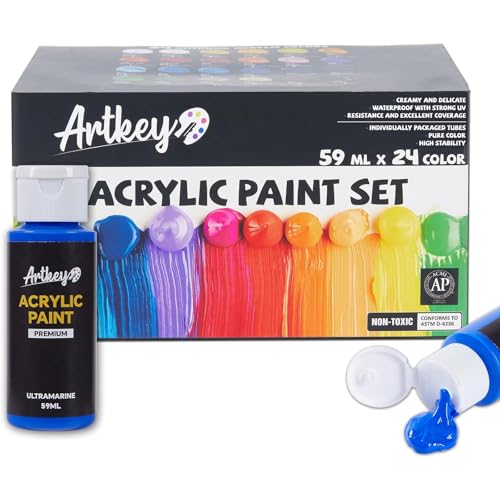
| Artkey 24 | 24 x 2 oz bottles | Semi-gloss | Surface list includes canvas, wood, fabric and ceramic |
| Apple Barrel 36 piece | 24 x 2 oz colors plus 12 brushes | Matte | Brush set with flat, round, angle and liner shapes |
| ARTEZA 60 | 60 x 22 ml tubes | Metallic and gloss | 5 metallics; high-viscosity; tubes in trays |
The 6 Best Acrylic Paint Sets
Top pickBest for a start-up kit with brushes
1. Caliart Acrylic Paint Set of 36 Colors With 12 Brushes
Thirty-six colors in 2 ounce bottles, including metallic gold and silver, with 12 brushes. The maker describes a creamy, fast-drying formula for canvas, rocks, ceramic, wood and fabric.
Suits: a start-up kit with brushes. Strengths: 36 colors and brushes included. Weaknesses: brush quality is not described in detail. Skip it if you already own brushes.
View Caliart Acrylic Paint Set of 36 Colors with 12 Brushes on Amazon
Best for a named, mixable palette
2. Mont Marte Signature Acrylic Set, 24 Colors
Twenty-four colors in 36 ml containers with a creamy consistency that dries to a semi-matte finish. The listing names pigments such as Titanium White, Yellow Ochre, Phthalo Blue and Burnt Sienna. Its spec table says watercolor, which conflicts with the acrylic title.
Suits: a named, mixable palette. Strengths: 24 colors with named pigments. Weaknesses: a conflicting paint type in the table. Skip it if you need a brush included.
View Mont Marte Acrylic Colour Paint Set Signature 24pc x 1.21 US fl.oz (36ml) on Amazon

Best for palette work
3. Liquitex BASICS Acrylic Set, 24 Tubes
Twenty-four 22 ml tubes from a maker that says acrylics are all it specializes in. The listing says the pigments follow its professional process, and that the paint can be cleaned from tools with water while wet. Its surface field says only paper, but the description lists canvas, wood and more.
Suits: palette work. Strengths: an artist-focused line in small tubes. Weaknesses: small tubes and no brushes. Skip it if you paint large areas.

View Liquitex BASICS Acrylic Paint Set, 24 x 22ml (0.74-oz) Tube Paint Set on Amazon
Best for mixed-surface crafts
4. Artkey Acrylic Paint Set, 24 Colors
Twenty-four 2 ounce bottles in a semi-gloss finish. The listing says the paint suits canvas, wood, rock, clay, fabric and ceramics and notes bottles with tightly sealed caps. It arrives in a boxed set.
Suits: mixed-surface crafts. Strengths: a wide surface list and 2 ounce bottles. Weaknesses: no brushes noted. Skip it if you prefer a matte finish.
View Artkey Acrylic Paint Set, 24 Colors 2 oz/59 ml Acrylic Paint Kit on Amazon

Best for matte craft projects
5. Apple Barrel 36 Piece Acrylic Craft Paint Kit
A craft kit with 24 colors in 2 ounce bottles plus 12 brushes (flat, round, angle and liner shapes), which together make the 36 pieces. The paint dries matte and washes from tools with soap and water while wet. The size field lists 4.78 fl oz, which does not match 24 bottles of 2 ounces, so treat it as a listing error.
Suits: matte craft projects. Strengths: brushes in several shapes. Weaknesses: a confusing size field. Skip it if you want artist tubes.

View Apple Barrel 36 Piece Acrylic Craft Paint Kit for DIY Arts and Crafts, Matte Finish on Amazon

Best for a large palette
6. ARTEZA Acrylic Paint Set, 60 Colors
Sixty 22 ml tubes in trays, with 55 classic colors and 5 metallic shades. The maker calls it high-viscosity, with creamy paint that holds brushstrokes for blending and palette knife work on canvas, wood, paper and mixed media.
Suits: a large palette. Strengths: 60 colors and metallics. Weaknesses: small tubes. Skip it if you want a few large bottles.

View ARTEZA Acrylic Paint Set, 60 Colors, 22 ml Tubes, High-Viscosity on Amazon
Care and Setup
- Close caps and tubes tightly after use.
- Wash brushes with water before the paint dries.
- Use a palette and add a little at a time.
- Work on a primed canvas or sealed surface.
Mistakes to Avoid
- Letting paint dry on brushes.
- Squeezing out more than you will use.
- Skipping a base coat on bare wood.
- Assuming every surface field on a listing is complete.
Heavy Body Versus Fluid Acrylics
Acrylic paint is sold in a range of thicknesses, and the thickness changes how a set feels in use more than almost any other trait. Thick, buttery paint holds the mark of a brush or palette knife, which suits textured, layered work and bold strokes. Thinner, pourable paint levels out smoothly, which suits fine lines, washes, airbrush-style effects and covering craft surfaces evenly.
Tube sets tend to be thicker because the paint has to stay put in a small opening. Squeeze bottles tend to be looser so they flow from the nozzle, though this is a tendency and not a rule. Product listings often use words such as creamy, high-viscosity or fluid. Treat those as the maker’s description and read them alongside the container type.
If you paint on canvas and like visible brushwork, a thicker paint is easier to build up without it sliding. If you mostly decorate wood, ceramics, signs or craft pieces, a bottle paint that spreads easily will save effort. Many painters keep one thick set and thin it as needed.
You can adjust thickness yourself. A little water loosens paint for glazing, but too much weakens the film and can cause it to bead or dry patchy. A flow or glazing medium thins the paint while keeping the binder strong. A gel or modeling paste thickens it. Because you can shift paint in either direction, choose the thickness closest to your main use and add mediums later if you need something different.
Student Versus Artist Quality and What Pigment Means
Paint is made of pigment, binder and additives. The share of pigment, and the type of pigment used, is what separates many budget craft paints from professional-leaning sets. Higher pigment load usually means stronger color that stays vivid after drying, while lower pigment load can look chalky or need extra coats to cover.
Student and craft ranges are designed to be affordable and easy to use. They are a sensible choice for beginners, children, practice and decorative projects. Artist ranges use more pigment and often list pigment names, which lets you compare the same hue across makers. If a listing shows pigment codes or a lightfastness rating, that is useful information, but confirm the details on the listing or the paint tube itself instead of assuming.
Lightfastness describes how well a color resists fading in light. For work you intend to hang or sell, it matters. For a children’s craft afternoon or a prop, it hardly does.
Another point is the word hue in a color name. It usually signals that the color is a blend that imitates a more expensive pigment. That is not a flaw, only a reason to expect slightly different behavior when mixing. Large sets with many colors often use such blends to keep the cost reasonable, and that tradeoff is worth accepting if you value variety over professional consistency.
Building a Palette and Learning to Mix
A set with many colors is convenient, but a smaller set teaches you more. With a warm and a cool version of each primary, plus white and a dark neutral, you can mix a very wide range of secondary and tertiary colors. Learning to do that saves money over time and gives you harmonious paintings, since mixed colors share common pigments.
A larger set makes sense when you want ready-made tones for craft projects, when you work with children who want to grab a color and go, or when you want metallics and fluorescents that are hard to mix. Large kits are also useful for classroom or group use, where speed matters.
Check the white. White is used up faster than anything else because it is added to lighten almost every mix. A set with a single small white tube can run out first, and buying a bigger tube separately is common practice. The same applies to black and to any color you lean on heavily.
When you mix, add dark paint to light paint in small amounts, since dark colors overpower quickly. Mix more than you think you need for large areas, because matching a mix a second time is difficult. Keep a scrap sheet nearby to test swatches, and remember that acrylics often dry slightly darker than they look wet.
Surfaces, Priming and Preparation
Acrylic adheres to many materials, but results depend on preparation. The surface should be clean, dry and free of grease or dust. Raw wood benefits from sanding and a coat of sealer or gesso so it does not soak up paint unevenly. Glossy surfaces such as glazed ceramic or glass usually need light scuffing and a primer made for them, or the paint may scratch off later.
Canvas that is sold pre-primed is ready to use. Paper works for light applications, but thick paint can cause buckling, so use heavier paper or mixed-media sheets if you want to paint generously. Fabric needs a textile medium or paint made for fabric if the item will be washed. Check the manual or listing and the instructions on the container before assuming a set suits a surface. The post’s specs notes list the surfaces some sets mention, so use those as a starting point.
Some surfaces need a barrier. Newspaper, cardboard and bare plaster can absorb paint and leach color, so seal them first. Outdoor items need paint and varnish rated for exterior use, because ordinary craft paint may crack or fade in weather.
- Sand and wipe raw wood, then seal.
- Scuff and prime slick surfaces.
- Use a textile medium for anything washable.
- Test on a hidden spot or a scrap piece first.
Finishing, Varnishing and Protecting Finished Work
Dried acrylic is durable, but it is not fully protected. Surfaces can scratch, stay slightly tacky in warm conditions, or pick up dust. A coat of varnish seals the paint, evens out differences in sheen between colors, and protects against handling and light.
Varnishes come in gloss, satin and matte. Gloss deepens colors, matte reduces glare and satin sits between them. Pick the finish that matches how you want the piece to look, and apply thin, even coats with a clean soft brush, letting each coat dry fully. Work in a well-ventilated area, and follow the instructions on the product. Spray varnishes should be used outdoors or with good airflow and the correct protective equipment as the label advises.
Wait until the paint is fully dry and cured before varnishing. Thick layers can feel dry on top while remaining soft underneath, so give them extra time. If you varnish too soon, you can trap moisture and cause cloudiness.
For storage, keep finished canvases upright and away from heat and direct sun. Interleave stacked pieces with paper that will not stick. For craft items that get handled often, such as painted boxes or ornaments, a protective sealer is worth the extra step, because bare acrylic can show wear from fingers and wiping sooner than you expect.
Tubes, Bottles or Kits With Brushes: Choosing a Format
Acrylic paint arrives in a few formats, and each suits a different way of working. Tubes hold thicker, denser paint, which is helpful for layering and mixing on a palette. Bottles contain a softer, more fluid paint that squeezes out easily, which is convenient for beginners, craft projects and large surfaces. Kits that bundle paints with brushes, a palette and a canvas make it easy to begin with a single purchase.
| Format | Feel | Good for |
|---|---|---|
| Tubes | Thick and buttery | Layering, texture and fine art |
| Bottles | Fluid and easy to dispense | Crafts, school and large coverage |
| Pots or jars | Medium body | Studio use and refilling |
| Kit with brushes | Mixed items | Gifts and first-time painters |
Color Range and Mixing Basics
A well-chosen set should let you mix most other colors. A selection that includes a warm and cool version of each primary, plus white and black, gives plenty of mixing options. Larger sets add convenience through ready-made tones, metallics and neutrals. Think about what you plan to paint, since landscapes call for greens and earth tones, while portraits and abstracts draw on a different mix.
- Check whether the set includes white, which is used heavily in mixing.
- Look for details on pigment quality as described by the maker.
- See whether colors are labeled as opaque or transparent.
- Check for lightfastness information if you want paintings to last.
Brushes, Palettes and Surfaces
Brushes in a kit are often basic, and you can add better ones later. Look for a variety of shapes, such as flat, round and filbert, and sizes that suit your canvases. A palette keeps colors organized, and a damp palette paper helps slow drying. Acrylics work on canvas, wood, paper designed for them and many craft surfaces. Prepare surfaces as the paint maker advises.
Using and Cleaning Acrylics
Acrylic paint dries quickly, so squeeze out only what you need and keep a water jar and spray bottle nearby. Wash brushes right away with soap and water, because dried paint is difficult to remove and can ruin bristles. Work in a ventilated space, and check the maker’s labels about safe use, especially around children. Close tubes and bottles tightly after use to prevent drying.
Storing Your Supplies
Keep paints in a cool, dry place and avoid freezing, which can damage the paint. A simple tray or box keeps tubes together, and labeling bottles helps if the original labels wear off.
Mistakes Beginners Often Make
New painters sometimes squeeze out far too much paint and watch it dry on the palette. Others thin their paint with too much water, which weakens the film and can make it patchy. Painting in layers before the previous one has dried can lift paint off the surface, so patience pays off.
- Prime or prepare the surface if the paint maker recommends it.
- Mix a little more of a color than you think you need.
- Keep a clean water jar for rinsing and a second for mixing.
- Do not leave brushes resting on their bristles in water.
- Protect your table and clothing with a cover.
Practice on scrap paper or a small canvas before moving to a larger piece.
Choosing Acrylic paint sets in Practice: A Deeper Look
The shortlists and tables above give you the facts about each option. This section is about turning those facts into a decision that fits your studio or kitchen table, your routine and the people who will use acrylic paint sets with you. None of it requires specialist knowledge; it mostly requires slowing down at the points where buyers most often rush, and checking the details that listings present in the order that suits the seller rather than the order that matters to you.
Colour range you will actually use. A wide range looks exciting, but the colours you reach for weekly matter more, so check that the set’s everyday colours are well covered rather than padded with shades you will open once. Measure the space you actually have before you fall for any particular option, and write the numbers down so you can check them against each listing instead of guessing from memory later. Keeping the packaging and instructions until you are sure the item suits you makes returns, adjustments and warranty questions far simpler if they arise. Ranking your priorities before you compare listings keeps a minor feature from outweighing the thing you actually cared about when you started looking.
Tube or bottle size against your pace. Small tubes suit occasional painting and testing colours, while larger formats suit bigger canvases and frequent sessions, so match the format to how much paint your typical piece actually consumes. If several people will share it, a middle-ground choice that everyone finds acceptable usually outlasts a specialist choice that only one person loves. If a detail that matters to you is missing from the listing, treat that as information in itself and favour an option whose maker states the point clearly. Every option in this guide trades something away, so decide in advance which compromise you mind least rather than discovering it after the box is open.
Pigment and consistency. Thicker paints hold brush marks and mix differently from fluid ones, so think about the style you paint in and whether the set’s consistency serves it or fights it. Leave a little breathing room around the item once it is in place, because a fit that only just works on paper tends to feel cramped or awkward in daily use. Check what arrives in the box before you order, especially fixings, accessories and spare parts, so the first day of use does not start with a second, unplanned purchase. It is worth rereading the weaknesses noted for each pick above with your own situation in mind, because a flaw that rules an item out for one home may not matter at all in another.
What else is in the box. Brushes, canvases and palettes in a set vary from genuinely useful to packing filler, so judge the extras by whether you would buy them separately rather than by the count on the box. Households rarely agree on everything, so weigh the preference of the person who will live with the item every day more heavily than a visitor’s passing opinion. Think a season or two ahead as well, because the right choice tends to be the one that still makes sense when routines, weather or household members change. If two options look evenly matched, let the tie be broken by the detail you will notice most often in use, not by the one that photographs best.
Lightfastness and permanence. Work you intend to keep or hang deserves colours that resist fading, so check what the maker says about permanence for the pieces that matter rather than for practice sketches. Measure the space you actually have before you fall for any particular option, and write the numbers down so you can check them against each listing instead of guessing from memory later. Look for the version of the listing that matches the size, finish or configuration in the product name, since options on one page can differ more than the shared title suggests. Ranking your priorities before you compare listings keeps a minor feature from outweighing the thing you actually cared about when you started looking.
How the Picks Compare in Everyday Use
Specifications only tell half the story. Below, each pick from the main list is revisited with one question in mind: what is it actually like to live with? Everything here is drawn from the descriptions and notes in the reviews above, reorganised so the contrasts between the acrylic paint sets are easier to see before you commit.
Caliart Acrylic Paint Set of 36 Colors With 12 Brushes. Thirty-six colors in 2 ounce bottles, including metallic gold and silver, with 12 brushes. The maker describes a creamy, fast-drying formula for canvas, rocks, ceramic, wood and fabric. Suits: a start-up kit with brushes. Strengths: 36 colors and brushes included. Weaknesses: brush quality is not described in detail. Skip it if you already own brushes. Compared with the alternatives, it is the pick whose compromises are easiest to predict before it arrives. Picture who will use it most often, not who might use it once, because a choice tuned to the daily user stays satisfying long after a novelty choice has worn thin.
Mont Marte Signature Acrylic Set, 24 Colors. Twenty-four colors in 36 ml containers with a creamy consistency that dries to a semi-matte finish. The listing names pigments such as Titanium White, Yellow Ochre, Phthalo Blue and Burnt Sienna. Its spec table says watercolor, which conflicts with the acrylic title. Suits: a named, mixable palette. Strengths: 24 colors with named pigments. Weaknesses: a conflicting paint type in the table. Skip it if you need a brush included. Against the other options, it stands out less for novelty than for how directly it answers one specific need. Households rarely agree on everything, so weigh the preference of the person who will live with the item every day more heavily than a visitor’s passing opinion.
Liquitex BASICS Acrylic Set, 24 Tubes. Twenty-four 22 ml tubes from a maker that says acrylics are all it specializes in. The listing says the pigments follow its professional process, and that the paint can be cleaned from tools with water while wet. Its surface field says only paper, but the description lists canvas, wood and more. Suits: palette work. Strengths: an artist-focused line in small tubes. Weaknesses: small tubes and no brushes. Skip it if you paint large areas. In the context of the full list, it rewards buyers who know exactly which job they are hiring it to do. Consider how the item behaves on an ordinary, tired weekday rather than on its first day, since that is the version of it you will actually live with.
Artkey Acrylic Paint Set, 24 Colors. Twenty-four 2 ounce bottles in a semi-gloss finish. The listing says the paint suits canvas, wood, rock, clay, fabric and ceramics and notes bottles with tightly sealed caps. It arrives in a boxed set. Suits: mixed-surface crafts. Strengths: a wide surface list and 2 ounce bottles. Weaknesses: no brushes noted. Skip it if you prefer a matte finish. Read alongside its rivals, it is a reminder that the best fit is usually a match of priorities rather than a contest of features. If several people will share it, a middle-ground choice that everyone finds acceptable usually outlasts a specialist choice that only one person loves.
Apple Barrel 36 Piece Acrylic Craft Paint Kit. A craft kit with 24 colors in 2 ounce bottles plus 12 brushes (flat, round, angle and liner shapes), which together make the 36 pieces. The paint dries matte and washes from tools with soap and water while wet. The size field lists 4.78 fl oz, which does not match 24 bottles of 2 ounces, so treat it as a listing error. Suits: matte craft projects. Strengths: brushes in several shapes. Weaknesses: a confusing size field. Skip it if you want artist tubes. Weighed against the others, its appeal is clearest when that strength matches the job you have in mind most often. Picture who will use it most often, not who might use it once, because a choice tuned to the daily user stays satisfying long after a novelty choice has worn thin.
ARTEZA Acrylic Paint Set, 60 Colors. Sixty 22 ml tubes in trays, with 55 classic colors and 5 metallic shades. The maker calls it high-viscosity, with creamy paint that holds brushstrokes for blending and palette knife work on canvas, wood, paper and mixed media. Suits: a large palette. Strengths: 60 colors and metallics. Weaknesses: small tubes. Skip it if you want a few large bottles. Set beside the rest of the list, it makes most sense for buyers who value that particular balance over all-round ability. Households rarely agree on everything, so weigh the preference of the person who will live with the item every day more heavily than a visitor’s passing opinion.
Acrylic paint sets in Real Life: Four Common Situations
A beginner’s first real paintings
New painters learn fastest with a forgiving set that mixes cleanly and does not punish mistakes, because early enthusiasm dies quickly when every session feels like a struggle with the materials. Notice what you reach for, move or work around in this setting, because those small workarounds point straight at the feature your next purchase should have. A choice you can clean, adjust or repair easily will usually serve you longer than a slightly prettier one that resists every attempt at maintenance.
Painting with children
Shared sessions with children reward washable cleanup, lids that small hands can manage and colours that survive enthusiastic mixing without turning every painting to mud. Comfort and convenience in this situation come less from any single feature than from the item fitting the space and the routine without demanding attention. Households rarely agree on everything, so weigh the preference of the person who will live with the item every day more heavily than a visitor’s passing opinion.
Larger canvases and murals
Big work eats paint at a rate small sets never anticipate, so coverage and tube size become the deciding factors long before subtle differences in shade matter. In practice this is where small differences between the picks stop being abstract, because the setting dictates which features earn their keep and which ones never get used. Think a season or two ahead as well, because the right choice tends to be the one that still makes sense when routines, weather or household members change.
Travel and painting outdoors
A portable set earns its place by packing flat, sealing reliably and surviving a bag, because the best colours in the world are no use if they leak over everything else you own. Give the item a week of normal use before judging it in this situation, since first impressions often reverse once the novelty wears off and real habits take over. If several people will share it, a middle-ground choice that everyone finds acceptable usually outlasts a specialist choice that only one person loves.
Setting Up, Using and Looking After Your Acrylic paint set
Most acrylic paint sets disappoint for preventable reasons: a rushed setup, a skipped instruction or a cleaning routine that never quite becomes a habit. The points below are deliberately general, because the maker’s instructions for your specific model always come first, but they cover the ground where everyday care makes the biggest difference.
Seal tubes and bottles properly
Acrylic dries by exposure to air, so wiping the neck and closing lids fully after each session prevents the dried plugs and skinned-over paint that waste the top of every tube. Inspect the item while you clean it, because loose parts, early wear and small damage are far easier to deal with when you catch them at this stage. Measure the space you actually have before you fall for any particular option, and write the numbers down so you can check them against each listing instead of guessing from memory later.
Keep a painting order that protects the set
Work with a palette and return colours to their places as you go, because a set that stays organised gets used more and loses fewer tubes to the bottom of a bag. Let everything dry fully before it goes back into storage or against a wall, because trapped moisture causes more quiet damage than everyday use ever does. Durability is hard to judge from a photograph, so pay attention to the parts that move, flex, carry weight or meet water, as those are the places wear shows first.
Clean brushes before the paint sets
Acrylic that dries in a brush is nearly permanent, so rinse and reshape brushes during natural pauses rather than leaving them until the end of a long session. Always follow the maker’s own care instructions where they are given, since materials and finishes that look similar can need quite different treatment. Leave a little breathing room around the item once it is in place, because a fit that only just works on paper tends to feel cramped or awkward in daily use.
Store away from heat and frost
Paint stored in hot lofts or freezing garages separates and thickens, so a steady indoor spot keeps the consistency you bought instead of a texture you have to fight. Keep the tools and products you use for upkeep near the item itself, so the routine takes minutes and actually happens instead of being postponed. Keeping the packaging and instructions until you are sure the item suits you makes returns, adjustments and warranty questions far simpler if they arise.
More Mistakes Worth Avoiding
Judging a set by colour count alone. Fifty colours with weak everyday shades serve most painters worse than a smaller set built around the colours real paintings are actually made from. The frustrating part is that this mistake usually only becomes obvious after the return window feels very near, which is why it is worth pausing on before you order. Ranking your priorities before you compare listings keeps a minor feature from outweighing the thing you actually cared about when you started looking.
Mixing brands without testing. Different makers’ paints can behave differently in consistency and drying, so test a mixed passage on scrap before committing it to a piece you care about. If you recognise your own plan in this mistake, it does not mean starting again; it usually means adjusting one decision before it hardens into a permanent annoyance. If two options look evenly matched, let the tie be broken by the detail you will notice most often in use, not by the one that photographs best.
Letting water do all the thinning. Over-thinned acrylic loses its binding strength and can crack or lift later, so thin gradually and stop while the paint still feels like paint. A quick test in the first few days of use will usually reveal whether you have fallen into this trap while changing your mind is still straightforward. It is worth rereading the weaknesses noted for each pick above with your own situation in mind, because a flaw that rules an item out for one home may not matter at all in another.
Buying for a style you do not paint. Heavy-body paints for palette-knife work will frustrate a detail painter and vice versa, so buy for the work on your easel rather than the work you admire online. The frustrating part is that this mistake usually only becomes obvious after the return window feels very near, which is why it is worth pausing on before you order. Every option in this guide trades something away, so decide in advance which compromise you mind least rather than discovering it after the box is open.
None of these points will choose a acrylic paint set for you on their own. Used together, though, they turn a long list of similar-looking options into a short decision you can defend: you know what you measured, what you prioritised, which compromises you accepted and how you will look after the result. That is usually the difference between a purchase that quietly satisfies for years and one that is replaced within months.
One useful habit is to shortlist two options rather than one and live with the comparison for a day, because the differences that matter tend to surface once the first excitement of choosing fades and you start imagining ordinary use instead of the unboxing.
Think about what you are replacing, if anything, and what you liked and disliked about it, since your own history with a similar item is a more honest guide than any stranger’s enthusiasm, and it stops you paying twice for the same disappointment.
Consider the total footprint of the decision, including storage when the item is not in use, the accessories it needs and the space it takes from everything around it, because an item that earns its place only while in use still has to live somewhere the rest of the time.
If you are buying for a household rather than yourself alone, a short conversation about expectations before ordering prevents the common pattern where one person’s priority quietly becomes everyone else’s daily irritation.
Seasonal timing can matter more than shoppers expect: needs feel urgent in the week they arise, but a choice made to solve this month’s problem should still make sense when the season turns and the item is used differently or stored away.
When you compare listings side by side, keep a simple written note of the two or three points that separate your finalists, because after an hour of tabs and photographs every option blurs into the same average and the deciding details are the first thing forgotten.
It is also worth deciding in advance what would make you return or replace the item, since setting that line while you are calm is far easier than improvising it later when you are already frustrated and inclined to keep something that does not suit you.
Finally, remember that the most suitable choice is rarely the one with the longest feature list; it is the one whose strengths line up with your most frequent use and whose weaknesses fall in places you will seldom notice.
One useful habit is to shortlist two options rather than one and live with the comparison for a day, because the differences that matter tend to surface once the first excitement of choosing fades and you start imagining ordinary use instead of the unboxing.
Think about what you are replacing, if anything, and what you liked and disliked about it, since your own history with a similar item is a more honest guide than any stranger’s enthusiasm, and it stops you paying twice for the same disappointment.
Consider the total footprint of the decision, including storage when the item is not in use, the accessories it needs and the space it takes from everything around it, because an item that earns its place only while in use still has to live somewhere the rest of the time.
If you are buying for a household rather than yourself alone, a short conversation about expectations before ordering prevents the common pattern where one person’s priority quietly becomes everyone else’s daily irritation.
Seasonal timing can matter more than shoppers expect: needs feel urgent in the week they arise, but a choice made to solve this month’s problem should still make sense when the season turns and the item is used differently or stored away.
When you compare listings side by side, keep a simple written note of the two or three points that separate your finalists, because after an hour of tabs and photographs every option blurs into the same average and the deciding details are the first thing forgotten.
Acrylic Paint FAQ
Tubes or bottles?
Tubes suit palette work; bottles are easy to squeeze for crafts.
Which set has the most colors?
The ARTEZA with 60. The Caliart and Apple Barrel kits include brushes.
Can I mix different brands of acrylic paint?
Yes, acrylics from different makers are generally compatible because they share a water-based binder. Differences in thickness and sheen can show up in the mix, so test a small amount first. Mixing a thin craft paint with a thick tube paint may give an uneven result.
Do acrylic paints need a special brush?
No, but synthetic brushes are usually recommended because they tolerate water and the paint film better than natural hair. Rinse brushes during use and wash them before the paint dries, since dried acrylic is hard to remove. Flat, round and fine liner shapes cover most needs.
Why does my acrylic paint look darker once it dries?
Many acrylics shift slightly darker as the water evaporates and the binder clears. Test swatches on scrap paper and let them dry before judging a color match. This is especially noticeable with light tints.
How do I stop acrylic paint from drying on the palette?
Use a stay-wet palette or mist the paint lightly with water as you work. Put only as much paint out as you need and close tubes and bottles tightly afterward. A retarder medium can also slow drying.
Is acrylic paint safe for children?
Many sets are labeled for children, but labels vary, so read the packaging and the maker's safety information. Use in a ventilated room, cover surfaces, and supervise young children so paint stays out of mouths. Wash hands after painting.
Can I use acrylic paint on fabric?
Regular acrylic can stiffen and crack on fabric and may wash out. Mixing in a textile medium or using paint made for fabric gives better results. Heat-set according to the product instructions before washing.
How long does acrylic paint take to dry?
Thin layers can dry to the touch fairly quickly, while thick layers take much longer to dry through. Humidity and temperature change the time. Wait until the paint is fully dry before layering, varnishing or stacking work.
More Acrylic paint sets Questions, Answered
How many colours does a beginner actually need?
Fewer than most sets suggest: a core of mixing colours teaches more than a wall of tubes, and extra shades can be added once you know which ones your work keeps asking for. Think a season or two ahead as well, because the right choice tends to be the one that still makes sense when routines, weather or household members change.
Can acrylic paint go bad in the tube?
It can thicken or separate with age and poor storage, and paint that smells off or will not mix smooth again is telling you it is past its best for important work. If several people will share it, a middle-ground choice that everyone finds acceptable usually outlasts a specialist choice that only one person loves.
What is the difference between student and artist grade?
Artist grades generally carry more pigment and stronger colour, while student grades use more filler to keep sets affordable; both have a place depending on whether the work is practice or permanent. A choice you can clean, adjust or repair easily will usually serve you longer than a slightly prettier one that resists every attempt at maintenance.
Do I need mediums as well as paint?
Not at first, but a simple medium to extend drying time or adjust gloss helps once you know what limitation of plain paint you are trying to solve. Households rarely agree on everything, so weigh the preference of the person who will live with the item every day more heavily than a visitor’s passing opinion.
How should leftover paint on a palette be handled?
Covering a palette keeps paint workable for a while, and a stay-wet arrangement stretches that further, but dried acrylic cannot be revived, so mix modest amounts for short sessions. Think a season or two ahead as well, because the right choice tends to be the one that still makes sense when routines, weather or household members change.
The Short Version
For a kit with brushes, the Caliart. For named pigments, the Mont Marte. For artist tubes, the Liquitex BASICS. For many surfaces, the Artkey. For matte crafts, the Apple Barrel. For the biggest palette, the ARTEZA.