An electric griddle is a flat, heated surface that lets you cook several items at once. When choosing one, look at surface size, heat control, how grease drains away and where it will be stored. Below is a quick walk through the questions, followed by a worked example, common mistakes and care.
Surface Size and Shape
Surface area decides how much you can cook at once. A large rectangle suits pancakes, eggs and bacon for several people. A smaller square suits couples. Remember that a large griddle needs a large counter and a big cupboard.
- Measure counter depth and width.
- Check the height with the lid on, if a lid comes with it.
- Note the weight so you can lift it comfortably.
In this guide
Heat Control
Most griddles use a removable probe and dial. A few have a fixed control. Look at how the heat is shown: a light, a numbered dial or a temperature scale. Even heat across the surface matters, but each design differs, so read how the maker describes the heating element.
Grease and Cleaning
Many griddles tilt slightly toward a drip channel or tray. Check the tray size and how easily it comes out. Some plates lift off for washing, while others must be wiped. Do not put electrical parts in water, and follow the maker’s cleaning steps.
Features Compared
| Feature | Useful when | Check |
|---|---|---|
| Drip tray | Cooking bacon or sausage | Size and release method |
| Removable probe | Washing the plate | Where the probe plugs in |
| Lid | Keeping food warm | Storage space for the lid |
| Cool-touch handles | Moving the unit | Maker description |
| Folding legs | Tight cupboards | Stability when open |
Using It Calmly
Place it on a heat-tolerant, level counter with space around it. Keep the cord away from hot surfaces and out of reach of children. Hot oil can splatter, so use utensils recommended by the maker and follow the manual.
Think about the meals you cook most. Pancakes and eggs need a flat, even surface, while burgers and sausages create more grease, so a deeper drip channel helps. If you cook for a crowd, a long rectangular plate lets you keep some food warm at one end while you cook at the other.
Check the power details too. Griddles draw a fair amount of electricity, so the label will show the electrical needs of the plug and cord. Use a wall socket suited to the unit and avoid sharing it with other heat-producing appliances. If you are unsure about your wiring, ask a licensed electrician.
Finally, consider counter height. A griddle with legs raises the cooking surface, so make sure you can reach it comfortably and that nothing hangs above it.
A Worked Walkthrough of a Family Breakfast
Picture a weekend breakfast for four and follow the steps below. They show where a good design helps and where a poor one gets in the way.
- Set the griddle on a level, heat-tolerant counter and check that the drip tray is fitted and the plate sits flat. A tilt toward the tray lets grease drain, so check that it is on the correct side.
- Insert the heat probe fully, plug in and set the dial to the temperature the recipe or manual suggests. Allow it to warm up until the indicator shows it is ready.
- Lightly oil or butter the surface only if the maker says it is needed, using a brush or paper towel. Keep the amount small.
- Cook the items that need the most time first, such as bacon or sausage, on one side, and keep the other side free for quicker foods.
- Pour or place pancakes and eggs with enough space between them to turn them freely. Use a flat tool the maker approves for the plate surface.
- Move finished food to a warm plate or push it to the cooler end, if your model has one, while the rest cooks.
- When finished, turn the dial to the lowest setting, remove the probe and unplug. Let the plate cool before cleaning.
Common Scenarios
- A couple who cook weekend pancakes: a compact plate does the job, and a smaller footprint is easier to store.
- A family of five: a long plate lets several people eat at once, though it needs a deeper cupboard.
- Bacon-heavy breakfasts: a deep drip channel and a sizable tray reduce the risk of grease overflowing.
- Cooking at the table: check that the cord can reach safely without crossing walkways, and that the surface below can take heat.
Mistakes to Avoid
- Skipping the preheat. Food added to a plate that has not reached working heat can stick and cook unevenly.
- Using metal tools on a coating. Scratches can wear the surface. Use tools the maker approves.
- Immersing the base. The heating parts and socket must stay dry. Follow the cleaning steps in the manual.
- Overloading the drip tray. A full tray can overflow. Empty it between batches when it is safe to do so.
- Leaving it unattended. Hot surfaces and oil need attention, especially around children and pets.
Care and Troubleshooting
After each use, unplug the griddle and let the plate cool. Wipe away loose food with a soft cloth, then wash according to the care guide. Dry the plate before storing so moisture does not linger. Empty and wash the drip tray each time, and check the cord for damage before putting it away.
| Symptom | Likely cause | What to try |
|---|---|---|
| Food sticks | Plate not ready or worn coating | Allow full warm-up, use a little fat and check the care notes |
| One side cooks faster | Uneven counter or heat variation | Check the unit is level and move food around the plate |
| Grease overflows | Tray full or plate tilted wrongly | Empty the tray and check the tilt direction |
| Does not heat | Probe not seated or outlet issue | Reinsert the probe and test the outlet with another item |
| Smoke from the plate | Too much oil or old residue | Use less fat and clean the plate |
Storage deserves a plan. Let the griddle cool completely before putting it away, and wind the cord loosely instead of tightly so the wire inside does not strain. If the lid has a vent, keep it clean. Store the probe where it will not be lost, since many models will not heat without it.
Glossary
- Heat probe: the removable control that sets and holds the temperature.
- Drip channel: a groove that carries grease to the tray.
- Nonstick coating: a slick layer that helps food release.
- Preheat: warming the plate before adding food.
- Warming zone: a cooler area where cooked food can wait.
Plate Materials and Coatings
The cooking plate is the heart of an electric griddle, and the material it is made from affects how you cook, how you clean and how long the surface stays in good shape. Most home griddles use a coated aluminium plate or a similar metal base with a non-stick finish. Some models use cast metal plates, which are heavier and tend to hold heat steadily once warm.
A non-stick coating is popular because eggs, pancakes and soft foods release easily with little added fat. The trade-off is care. Coatings can scratch if you cut food on them or scrub them hard, so the maker’s advice on utensils and cleaning pads is worth reading before the first use. Wood, silicone or nylon tools are often suggested for coated surfaces, but check the manual for your model.
Heavier plates take longer to warm up and cool down, but they recover well when cold food lands on them. Lighter plates warm quickly but may lose heat when you load a lot of food at once. Neither is wrong. The right choice depends on whether you cook small quick batches or fill the surface in one go. The product listing should describe the plate material and any coating, and that detail is worth confirming before you decide.
Even Heat and Warm-Up Behaviour
A good griddle spreads heat evenly across the plate, yet in practice every machine has slightly warmer and cooler areas. Heating elements run beneath the plate in a pattern, and the edges near the frame can run cooler than the centre. You will learn your own machine’s map quickly by watching where pancakes brown first.
Give the plate time to warm before adding food. Many models have an indicator light that switches off when the chosen temperature is reached, then cycles on and off as the thermostat holds the heat. Following the light is more reliable than guessing, and the manual will explain how your model signals readiness.
- Place a first test portion, such as a small spoonful of batter, to see how the surface behaves.
- Rotate or move items from cooler spots to warmer ones if browning looks uneven.
- Avoid stacking cold food in one corner, which can drag the temperature down locally.
If the listing mentions a wide temperature range with clear markings, that is helpful, but remember that printed numbers are guides. Your own eyes and the maker’s instructions are the final word.
Power, Plugs and Kitchen Circuits
Electric griddles are large heating appliances, and they draw a good deal of power. This matters in a home where several devices share one circuit. If a kettle, toaster and griddle all run together on the same line, a breaker may trip, which is annoying at the busiest moment of breakfast.
Read the power rating in the listing and compare it with what else you typically run at the same time. If you are unsure about your home wiring, ask a licensed electrician rather than guessing. Follow the maker’s guidance on extension cords, which many manuals advise against for heating appliances.
Cord length and position also deserve attention. A short cord that dangles over the counter edge invites accidents, particularly in a home with children. Many griddles use a detachable temperature control with a plug-in end, which should be fully seated and kept dry. Never submerge the control unit, and follow the manual on what may be washed and what may not.
Comparing Griddle Styles Side by Side
Griddles come in several shapes, and the table below sets out how common styles tend to differ. It is a planning aid, not a ranking.
| Style | Typical strength | Typical drawback |
|---|---|---|
| Large rectangular plate | Room for many items at once | Needs a lot of counter and storage space |
| Compact single-person plate | Easy to store and quick to warm | Several batches needed for a family |
| Reversible plate | Flat on one side, ridged on the other | Plate is heavier and needs careful handling |
| Removable plate model | Simpler to wash at the sink | Check the manual for washing limits |
| Fixed plate with drip channel | Fewer loose parts | Cleaning must be done on the unit |
Use the table to decide which strengths matter in your kitchen. A large family may accept the storage cost of a big plate, while a flat with limited cupboards might choose a compact one and cook in rounds.
Cooking in Batches Without Chaos
A griddle makes it tempting to cook everything simultaneously, but a plan helps. Think about the order of foods and where each belongs on the plate. Items that need the longest time, such as thick slices of bread to toast or sausages, go on first and toward the centre. Quick items follow later.
Keep a warm spot ready for finished food. An oven set to a low temperature, if your oven manual allows it, or a covered dish can hold the first batch while the second cooks. Cover with a lid or foil to reduce drying.
- Warm the plate fully and wipe it with a small amount of fat if the maker suggests it.
- Load slower foods first, leaving space between pieces for turning.
- Add quicker foods once the first group is partly cooked.
- Move finished food to the warm dish, wipe or scrape the plate, and repeat.
For meat and eggs, always follow official food safety guidance on doneness and holding times, not just the look of the surface.
Storage and Counter Planning
Many people buy a griddle and then discover it lives in a cupboard that is too small. Before ordering, measure your cupboard shelf, the height of any shelf above it and the clear depth. Include the control unit and cord in your thinking, because they may stack awkwardly.
Some designs are built to stand on their side for storage, and some have feet that fold or lock. Others are simply a flat tray that needs a flat resting place. If you will carry it from a cupboard to a table, check the handles. Cool-touch handles help, but they are only useful if they are well placed for your grip.
Also consider where you will use it. A table-top setup for a weekend brunch needs a heat-safe surface and a nearby outlet. The cord must not cross a walking route. If the only practical spot is the kitchen counter, make sure nothing flammable, such as paper towels or curtains, sits close by during use.
Reading Listings with a Critical Eye
A listing can be crowded with claims, so look for the plain facts. First, the cooking surface dimensions, which show whether the plate will hold the number of pancakes or sandwiches you imagine. Second, the power rating and cord length. Third, the plate material and whether parts are removable. Fourth, what is in the box, such as a spatula, a drip tray or a lid.
Photos can mislead through angle, so compare the plate to something familiar. A listing that shows a griddle next to a loaf of bread or a dinner plate gives a better sense of scale. Look for pictures of the underside and the control unit, since these show how well the machine is built.
Customer comments can add context, particularly about how the coating behaves after months of use and how easy the unit is to store. Look for repeated points rather than a single strong opinion, and keep in mind that a person who cooks daily will judge differently from one who cooks monthly.
Beyond Breakfast: Other Uses
Although breakfast is the obvious job, a griddle can help with other meals when the table needs more cooking space. Toasted sandwiches, flatbreads, sliced vegetables, quesadilla-style wraps and similar flat foods all suit a wide, heated plate. It can also give you extra capacity when the stove is crowded during a family gathering.
Keep the manual in mind, though. Some makers advise against certain foods or very high-moisture cooking, and a plate with a drip channel will behave differently from one without. Marinades with a lot of sugar can burn on a hot surface, so watch them closely and keep the heat moderate.
If you plan to cook raw meat on the griddle, keep separate utensils and boards for raw and cooked foods, and follow official food handling advice. Wash hands and surfaces thoroughly as your local guidance suggests.
A Quick Pre-Purchase Checklist
Before you decide, ask yourself a handful of practical questions.
- How many people do I usually feed at one sitting?
- Do I have a safe, dry, heat-resistant spot and a nearby outlet?
- Is the plate material and coating care something I am comfortable with?
- Where will it be stored, and does it fit with the control unit?
- Can the circuit in my kitchen handle another heating appliance at busy times?
When the answers are clear, the choice usually becomes simple. A griddle that matches your household size, your storage space and your care habits will earn its place on the counter far more often than one chosen on size alone.
Utensils and Small Accessories
A griddle is only as pleasant as the tools you use with it. Because many plates have a coating, metal spatulas and sharp knives are usually discouraged, and the manual will say what your model can take. A flat, thin-edged spatula made of silicone, nylon or wood slides under pancakes and eggs without scraping.
A scraper designed for non-stick surfaces helps move food residue off the plate when you finish a batch. A small brush or a folded paper towel held with tongs can spread a thin layer of oil without burning your fingers. Heat-resistant gloves are useful if you ever need to move a hot plate or lid.
- Choose tools with long handles so your hand stays clear of the hot surface.
- Keep a plate or tray nearby to hold finished food away from the heat.
- Have a clean, damp cloth on hand for the cooled exterior, not the hot plate.
Check whether your griddle comes with a lid, because a lid helps melt cheese, steam vegetables and finish thicker items. If a lid is sold separately, make sure it is designed for your model so it fits the edges.
Common Buying Regrets and How to Avoid Them
People who regret a griddle purchase usually mention the same few things. The plate was bigger than the cupboard, the cord was too short for the table, or the cleaning routine was more work than expected. Each of these can be avoided with a few minutes of measuring and reading.
Another common regret is buying for an occasion that rarely happens. A very large griddle bought for a yearly party may sit unused for months. If you cook for two most days, a smaller model that gets used weekly will bring more value than a large one stored away. The reverse also applies: if your household is large and breakfasts are busy, a compact plate will leave you cooking in many rounds.
Finally, avoid assuming that more power always means better cooking. What counts is how well the thermostat holds a steady temperature, and that is difficult to judge from specifications alone. Look at customer remarks about steady heat and about how the surface behaves after repeated washing, and treat repeated comments as the useful signal.


Ready to Buy? Start Here
If this guide helped you decide what to look for, these products are a place to start.

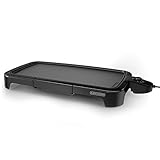
View Black+Decker Family-Sized Electric Griddle GD2011B on Amazon
As an Amazon Associate we earn from qualifying purchases. Prices and availability are shown on Amazon.
Reading the Picks Above Like a Buyer, Not a Browser
By the time you reach this point in the guide, you have seen the main types, the features that matter and a shortlist of products worth a look. The next step is to slow down and read those picks the way an owner would, rather than the way a browser skimming a shop page would. Start by ignoring the order the products appear in. Order on a page is not a promise that the first option suits your home, your habits or your kitchen counter or dining table for shared cooking. Instead, line each pick up against the three or four jobs you actually need done. In this category, that usually means cooking pancakes, eggs, bacon and grilled sandwiches for several people at once. If a pick does not clearly serve your top jobs, it does not matter how many extra settings or accessories it carries.
A useful exercise is to write a short sentence for each pick, in your own words, saying who it suits and what you would give up by choosing it. Every design in this category involves a trade. A larger or more powerful option may handle bigger loads but be harder to store, louder in use or slower to set up. A compact option may fit your space beautifully yet ask you to work in smaller batches. Neither trade is wrong in itself. What matters is whether the trade matches the way you live. If you find you cannot write that sentence for a pick, you probably do not yet understand it well enough to buy it, and it is worth rereading the relevant section above before you decide.
Pay close attention to the honest limitations already noted for each product in this guide. Limitations are more useful than headline features because they describe the moments when you will feel friction: the awkward load, the tight cupboard, the noisy early morning, the part that needs regular attention. Picture those moments in your own week. A limitation that would only appear once or twice a year is easy to live with. A limitation that would appear every single time you use the product will wear you down, however good the product looks on paper. Buyers rarely regret choosing the option with the limitation they barely notice; they often regret choosing the one whose limitation meets them daily.
Finally, compare the picks on total ownership, not just on the day of delivery. Ask what each one needs from you over the following years: space when it is stored, attention when it is cleaned, replacement parts or consumables where the design uses them, and time each time you set it up and put it away. The guide above already gives you the raw material for that comparison. The pick that asks the least of you, while still doing your main jobs well, is very often the pick you will still be pleased with long after the novelty has worn off.
Planning Around Your Space and Routine Before You Order
Most disappointing purchases in this category are not badly made products; they are good products bought for the wrong space or the wrong routine. Before you order anything, measure the place where your electric griddle will live and the place where it will be used, and write both sets of measurements down. Include the awkward details people forget: the swing of a cupboard door, the slope of a ceiling, the socket that sits just too far away, the doorway the product has to pass through on its way in and out of storage. A product that fits on paper but fights you every time you move it will slowly stop being used.
Next, think honestly about when the work happens. Your main use is cooking pancakes, eggs, bacon and grilled sandwiches for several people at once. Does that work happen in a rush before school or work, in a calm hour at the weekend, or in small bursts through the day? Timing changes what matters. A rushed routine rewards quick set-up, simple controls and easy emptying or tidying afterwards. A slower routine can absorb a product that takes longer to prepare but gives a better finish. Be suspicious of any choice that only works if your routine changes. Routines rarely change to suit appliances; appliances have to fit the routines that already exist.
Consider the other people in the household, too. If a partner, housemate, teenager or grandparent will also use the electric griddle, its controls, weight and storage spot need to work for them as well, not just for you. The same applies if you have pets or small children: think about where the product will sit when it is not in use, what can be pulled, knocked or chewed, and whether hot, sharp or moving parts are safely out of reach during and after use. Following the maker's safety guidance is the baseline; arranging your space so that safe use is also the easy use is what makes it stick.
It also helps to plan the unglamorous end of the job. Where will wet, dirty, hot or finished items go the moment you are done? Where will the product itself rest while it cools, dries or charges, if that applies to the design you choose? Homes that answer those questions in advance tend to keep the area around the kitchen counter or dining table for shared cooking calm and clear. Homes that improvise usually end up with the product living permanently on a worktop or floor, quietly resented by everyone. A few minutes of planning now is cheaper than a replacement purchase later.
Everyday Use: Building a Routine That Actually Sticks
The difference between a electric griddle that earns its keep and one that gathers dust is rarely the product itself. It is whether using it becomes a small, repeatable routine. The pattern that works for most households is simple: prepare the area, do the main job in a steady order, finish with a two-minute reset, and put everything back in the same place every time. That reset matters more than it sounds. The care basics for this category — wiping the cooking surface, emptying any drip tray, and storing the griddle flat so the surface is not scratched — take far less time when they happen in small pieces after each use than when they are left to become a monthly excavation.
Work in a consistent order so the job becomes automatic. For this category, most people settle into a rhythm of dealing with the biggest or dirtiest items first, while their energy and patience are highest, and finishing with the small, quick items. If you share the work with others, agree the order once and keep it; a shared routine means anyone can pick the job up mid-way without confusion. If you live alone, the same consistency saves you decision-making on tired evenings, which is when corners get cut and products get blamed for poor results that really came from a rushed process.
Learn the early warning signs that something needs attention. In this category they are usually ordinary things: results taking longer than they used to, a new noise, a smell that was not there before, a part that no longer sits quite flush, or a finish that has quietly got worse over a few weeks. Those signs almost always point to a simple cause — something that needs emptying, cleaning, drying, tightening or replacing — rather than a failing product. Checking the maker's troubleshooting guidance at the first sign, instead of pushing on, protects both the product and your patience.
Keep the supplies for the job together, near the kitchen counter or dining table for shared cooking. A small caddy, box or drawer containing whatever your chosen design needs — cleaning cloths, the right detergent or consumable where one is used, and any small tools the maker supplies — removes the friction of hunting around before you start. Friction is the enemy of routines. Every extra minute spent fetching things is a minute that makes you more likely to skip the job, rush it, or leave the product out afterwards. Set the area up once, properly, and the routine will largely run itself.
Use Cases Buyers Often Overlook
The small home where everything must earn its space
In a flat or small house, the winning electric griddle is the one that disappears gracefully between uses. That means thinking as hard about the stored size and shape as about performance in use. Check whether it folds, stacks, hangs or stands in a narrow gap, and whether getting it out is a one-handed job or a wrestling match. Small-home owners also benefit from choosing designs that handle cooking pancakes, eggs, bacon and grilled sandwiches for several people at once without needing a collection of extra attachments that each demand their own storage spot. One versatile product, stored well, beats three specialised products stored badly.
The busy family home
Family use is heavier, messier and less predictable. Loads are bigger, sessions are more frequent, and the product is more likely to be used by someone in a hurry. Prioritise sturdiness, simple controls that a tired person can operate without thinking, and parts that can be cleaned quickly. It is also worth choosing a design that tolerates interruption well, because family jobs rarely run start to finish without a pause. If the product will be used daily, treat durability and easy care as performance features in their own right, not as boring extras.
The renter who cannot change the room
Renters face a particular set of limits: no drilling, no plumbing changes, no replacing fixed fittings, and the need to leave everything as it was found. For this category, that points towards freestanding, movable designs that work with the room as it is, and towards checking the weight and footprint against floors and surfaces you do not own. Keep the packaging until you are sure the product suits the space, and photograph your set-up when it works well, so you can recreate it quickly if you move. A renter-friendly choice is one you could take with you and use just as happily in the next home.
The occasional user who needs it to just work
Not everyone uses their electric griddle every week. If yours will come out mainly for guests, seasonal jobs or occasional deep efforts, your priorities shift again. You want a product that stores compactly, starts reliably after sitting unused, and does not demand a complicated set-up you have to relearn each time. Keep the maker's quick-start guidance with the product, and run it briefly every so often if the maker recommends doing so. For the occasional user, simplicity is not a compromise; it is the feature that decides whether the product gets used at all.
Cleaning, Care and Storage That Protect Your Purchase
Good care in this category is mostly about little and often. The core routine — wiping the cooking surface, emptying any drip tray, and storing the griddle flat so the surface is not scratched — sounds unremarkable, but it is what keeps performance steady and prevents the slow build-up that eventually makes a product feel tired. Where the maker gives a cleaning schedule or names specific parts to wash, rinse or replace, follow that schedule rather than your own guess. Makers design those intervals around how the product actually wears, and stretching them rarely saves effort in the long run; it usually converts a two-minute task into a twenty-minute one.
Be careful with cleaning products themselves. Mild detergent and water suit most parts in this category, while harsh scouring, strong solvents or very hot water can damage finishes, seals and flexible parts. If a part is described as washable, that does not automatically mean it can go in a dishwasher or be soaked overnight; check the maker's wording for that specific part. Anything electrical should be unplugged and kept dry in the ways the manual describes, and anything washed should be completely dry before the product is used or stored. Damp storage is one of the most common causes of stale smells and shortened life in home equipment generally.
Storage deserves the same thought as use. Store the electric griddle in its working shape where you can, rather than forcing it into a space that bends, crushes or strains part of it. Keep cords loosely coiled rather than tightly wound, keep small parts and accessories together in a labelled bag or box, and keep the manual — paper or a photo of its key pages — somewhere you can actually find it. If the product lives in a garage, shed or other unheated space for part of the year, check the maker's guidance on temperature and damp before assuming that is fine.
Once or twice a year, give the product a proper once-over: look for wear on the parts that flex, rub or seal; check fixings are snug; clean the places your weekly routine does not reach; and deal with small issues while they are still small. This is also the moment to ask whether your needs have changed. Households change — children grow, pets arrive, routines shift — and the honest answer might be that a different size or type would now serve you better. Looking after a product well and knowing when it no longer fits your life are both parts of owning things sensibly.
Mistakes That Make a Good Choice Feel Like a Bad One
The most common mistake is buying for the household you wish you had rather than the one you have. A electric griddle chosen for occasional marathon sessions, imaginary guests or a future bigger home will usually be the wrong size, weight or complexity for your real week, which centres on cooking pancakes, eggs, bacon and grilled sandwiches for several people at once. Buy for your typical week, and check that the product can stretch to your busiest week without breaking you. The reverse mistake exists too: buying the smallest or simplest option when your loads are genuinely heavy, then working the product far harder than it was designed to be worked.
A second mistake is judging the first use too harshly — or too kindly. Many products in this category have a learning curve: the first few sessions are slower and messier while you find your rhythm, and some parts need a first clean, charge, rinse or run-in exactly as the manual describes. Give the product a fair handful of proper uses, following the guidance, before you judge it. At the same time, do not excuse real problems as learning curve. If something leaks, slips, overheats, smells wrong or simply does not do the job after correct use, that is a fault or a mismatch, and it is better raised with the seller promptly than lived with.
Third, people often neglect the cheap, boring parts of ownership: the filters, seals, pads, blades, liners or other replaceable bits a design may use. Performance in this category often fades not because the main product wears out but because a small supporting part is long past its best. If results decline, check those parts first, in the order the maker's troubleshooting section suggests. Keeping one spare of anything you replace regularly means a worn part never turns into a week of waiting and a job left undone.
Finally, avoid the upgrade spiral. It is easy, a month after buying, to start reading about the next model up and convincing yourself you chose wrong. Resist it. If your electric griddle does your main jobs reliably, fits your kitchen counter or dining table for shared cooking and is easy for your household to live with, it was the right choice, whatever newer features appear. The best product in any home category is the one that quietly does its work for years. Chasing marginal improvements costs money, creates waste and rarely changes how your home actually feels day to day.
How the Picks in This Guide Differ in Daily Life
Specification tables have their place, and you will find the key details for each pick in the reviews above. But daily life is decided by smaller differences, and it is worth drawing those out before you choose. Think first about set-up and put-away. Between the picks in this guide, some designs are ready almost the moment you reach for them, while others ask for assembly, filling, plugging in, unfolding or positioning first. If your jobs tend to be short and frequent, set-up time can quietly exceed working time, and the readier design will feel dramatically better even if its headline performance is similar.
More Questions Buyers Ask Before They Commit
How long should a good electric griddle last with normal home use?
There is no single honest number, because life depends far more on how often it is used and how well it is cared for than on the calendar. A electric griddle used daily for cooking pancakes, eggs, bacon and grilled sandwiches for several people at once and looked after with the routine described in this guide — wiping the cooking surface, emptying any drip tray, and storing the griddle flat so the surface is not scratched — should give years of steady service. The usual pattern is that small replaceable parts wear first, while the main body keeps going. If performance fades, check those parts and the maker's troubleshooting guidance before assuming the product itself is finished.
Is it worth paying more for a larger or more advanced model?
Only if the extra capacity or features match jobs you genuinely do. Bigger is not automatically better in this category: a larger electric griddle can be heavier to move, slower to set up and harder to store in your kitchen counter or dining table for shared cooking. Pay more when the step up removes a problem you actually have — loads that do not fit, sessions that take too long, results that disappoint. If your current shortlist already covers your typical week comfortably, the simpler model is usually the smarter buy.
What should I check in the first week of owning it?
Use it properly several times, following the maker's instructions exactly, and pay attention to fit, comfort and results rather than speed. Check that all parts are present and undamaged, that everything sits, locks or connects as described, and that storage works in the real space you planned, not just on paper. Keep the receipt, packaging and warranty details until you are confident, and register the product if the maker offers registration. Small concerns are far easier to resolve in the first week than in the sixth month.
Can I use it in a rented home or a small flat?
Usually yes, provided you choose a freestanding, movable design and respect the limits of the space. Measure carefully, protect floors and surfaces you do not own, and avoid any set-up that needs drilling, plumbing changes or permanent fixings unless your landlord agrees. Renters often do best with designs that fold, stack or stand in a narrow gap, and that would move with them to a different home without becoming useless.
How do I know when a part needs replacing rather than cleaning?
Clean first, then judge. Many parts in this category look tired when they are simply dirty or damp, and recover fully once washed and dried as the maker directs. Replace a part when it stays damaged, distorted, cracked, loose or ineffective after proper cleaning, or when the maker's schedule says its time is up. If you are unsure, the maker's support pages usually describe the signs for each part. Keeping a note of when parts were last cleaned or changed makes the judgement much easier.
What is the best way to get consistent results every time?
Consistency comes from routine, not talent. Prepare the same way, work in the same order, and finish with the same short reset: wiping the cooking surface, emptying any drip tray, and storing the griddle flat so the surface is not scratched. Most disappointing results in this category trace back to a skipped preparation step, an overloaded session or a part that needed attention. When a result disappoints, change one thing at a time so you learn what actually caused it. Within a few weeks, most owners find their results become predictable — which is when the product starts to feel effortless.
FAQ
Can I use metal spatulas?
Not on coated plates unless the maker says it is fine. Many guides suggest wood or heat-tolerant plastic tools.
Is a griddle better than a pan?
They suit different needs. A griddle gives more flat area at once, while a pan is easier to store and use on a stove.
Can I wash the plate in the dishwasher?
Only if the maker says it is allowed, and the electrical parts must always stay out. Check the care section and, when in doubt, wash by hand.
How much counter space do I need?
The griddle’s footprint plus the clearance in the manual around it and above it. Also leave room for the cord and a spot to rest utensils.
What can I cook besides breakfast foods?
Many people cook sandwiches, sliced vegetables and flatbreads. Follow the manual for suitable foods and temperatures.
The Short Version
Match surface size to your household, check heat controls and grease drainage, and make sure it fits your storage. Follow the maker’s safety and cleaning instructions, and consult a licensed electrician if you have doubts about the outlet.