
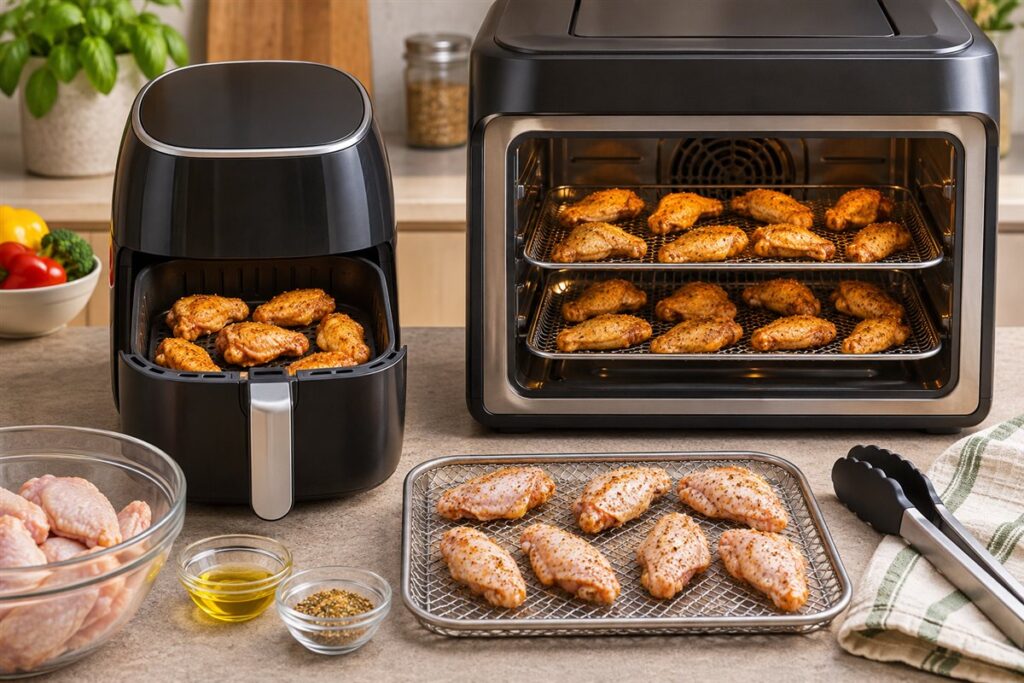
A recipe written for a small air fryer can be scaled up for a bigger model, but you should scale the amount of food and not just the time. Keep food in a single layer, expect some areas to cook faster than others, and check early. The goal is to keep air moving around every piece.
What Changes in a Bigger Unit
A larger air fryer has more room, more air volume and often more than one rack level. It can handle more food, but the air takes longer to even out. Pieces near the fan or the top element may brown faster, while those at the back or on lower racks may lag.
Scaling Steps
- Decide how much more food you want to cook compared with the original recipe.
- Spread the food in a single layer across the tray or racks.
- Keep the seasoning and oil in proportion to the food amount.
- Keep the first temperature the same as the recipe suggests.
- Check about two thirds of the way through the original time.
- Rotate or swap trays, then continue until done.
Time and Layout Guide
| Change | Likely effect | What to do |
|---|---|---|
| Double the food in one layer | Time often similar | Check at the usual time |
| Stacked layers in one tray | Slower, uneven | Avoid; spread out instead |
| Two rack levels | Top browns faster | Swap levels midway |
| Thicker pieces | Longer cook | Add a few minutes and check |
These are loose rules of thumb. Check the maker’s guide, because airflow design varies between models.
Common Traps
- Overcrowding: it steams food rather than crisping it.
- Blocking vents or the fan with a large tray.
- Assuming that doubling the food means doubling the time.
- Skipping the midway turn, which causes uneven color.
Handling in a Larger Unit
Heavier trays and racks can be awkward. Let the unit cool a little before moving them, and use mitts or long tongs. Follow the maker’s manual and safety instructions for the maximum load, the clearance around the unit and the rack positions.
Examples by Food Type
Roasted vegetables are the easiest to scale: spread them over a larger tray and check on the usual schedule. Wings and other pieces with skin do well on a rack so fat can drain. Baked goods are trickier, because pan size and depth matter more than the size of the air fryer, so keep the recipe pan the same.
When you are not sure, cook one test tray before filling every level, and note how the color differs between the front and back.
Reading a Recipe Written for a Smaller Unit
Before changing anything, work out what the recipe assumes. Many online recipes are written with a small or medium basket in mind, and they often give a quantity, a temperature, a time and a note about shaking. Treat these as clues rather than rules. Ask how deep the food sat in the original basket, whether it was in a single layer, and whether any step relied on food being close to the fan.
Next, find the part of the recipe that is most sensitive to scale. Crisp coatings, thin cuts and sugary glazes react fast to changes in airflow, while stews, baked dishes and thick roasts are more forgiving but may need longer for heat to reach the center. Mark those steps and plan to check them earlier than the written time.
Also look at the ingredient quantities. If you plan to cook more food in a larger basket, increase ingredients in proportion, but do not assume everything scales evenly. Seasoning, oil and sauce often need less than a straight multiplication, because you want a coating and not a puddle. Add in stages, taste where it is safe to do so, and write notes beside the recipe so you can repeat the result.
Airflow and Layout in Wider Baskets
A larger unit usually offers more floor space, and the food can be spread in a flatter layer. That tends to help browning, since hot air reaches more of each piece. It can also cause uneven results if the fan pushes air harder in one area than another. If your unit has hot spots, you may notice the food near the center or back cooking faster.
Spread pieces with gaps between them rather than filling every space. Leave an edge margin if the manual suggests it, and avoid stacking unless the recipe is designed for it. For round or oval baskets, arrange pieces like spokes, with thicker parts toward the outside if that suits your unit.
- Rotate the basket or tray halfway through if your unit has uneven heat.
- Swap racks between upper and lower levels if your model has more than one.
- Keep pieces a similar size so they finish together.
- Do not block the air path with foil or large parchment sheets unless the maker allows it.
If you add an accessory such as a rack, check that it is designed for your unit, and that there is still room above for air to move.
Doubling and Halving Quantities Sensibly
When you double a recipe in a bigger air fryer, the cook time rarely doubles, but it may rise a little because more food absorbs more heat and releases more moisture. The best approach is to start checking at the original time and extend in short steps. For halving, the opposite often applies: smaller amounts can finish earlier, so check ahead of time.
If the larger amount fills the basket, consider cooking in two rounds instead. A packed basket slows airflow and leads to pale or soggy results. It is better to cook two good batches than one crowded one. Keep the first batch warm, covered loosely, and avoid letting it sit too long.
For items that need turning, plan more frequent checks in a bigger load, as the outer pieces may cook faster than those in the middle. Use a thermometer for meat and poultry and follow current food safety guidance for doneness, not just time. After each change, write down what you did and what happened. These notes become your own reference for your particular unit, which is more reliable than any general conversion chart.
Multi-Rack and Multi-Zone Cooking
Some larger units have multiple racks, or two cooking zones that can run different settings. These features are useful but require a plan. With racks, the top level is closer to the heat source and may brown faster, while the lower level may cook slower. Switching trays halfway through can even things out, depending on the model.
With dual zones, you can cook two foods at once, but they may not finish at the same moment. If one needs less time, start the longer-cooking item first and add the other later. Some models include a function to sync finish times, so check the manual for what yours offers.
- Do not mix foods with strong flavors in the same compartment if you do not want taste transfer.
- Keep raw meat away from ready-to-eat foods, and wash trays between uses.
- Check that the total load stays within the maker’s limits for weight and volume.
- Look at how heat is shared between zones, since running both may change performance.
Test with a low-stakes meal before relying on multi-level cooking for an important dinner. The first try is often a learning round.
Fine-Tuning With Notes and Small Experiments
The most reliable way to adjust recipes is to run small experiments and keep notes. Choose one familiar food, such as fries or chicken pieces, and cook it at a setting recommended in the manual. Record the amount, arrangement, temperature, time and result. Change only one thing next time, such as the amount or the time, and compare.
Note what the food looked like at each check, not only the end result. This teaches you how your unit browns and where its quirks are. Over a few meals you will build a personal guide for your own basket, such as “wings need a flip at the halfway point” or “the left side runs hotter”.
Include safety checks in your notes. Record when you used a thermometer and what you learned about thick pieces. Keep a record of the cleaning you did afterward, particularly if a recipe made a lot of smoke or splatter. If a change caused smoke or an off smell, back off and clean the unit. The goal is not perfection on the first try but steady improvement with food that is safe and enjoyable to eat.
FAQ
Do I need to lower the temperature in a larger unit?
Not always. Some people reduce it slightly if the top browns too fast. Make small changes and note the result.
Can I cook two different foods at once?
Yes, if they need similar settings. Place the quicker food where it is easiest to remove.
Should I double the cooking time if I double the food?
Usually not. Start checking near the original time and add short increments, since the real time depends on layout and thickness.
Is it better to cook in batches or fill the basket?
A crowded basket often cooks unevenly. Batches with space around the food usually give better browning, even if it takes longer.
How do I know if my unit has hot spots?
Cook an even layer of something simple, such as slices of bread or similar pieces, and watch which areas brown first. Rotating or swapping trays can help compensate.
Can I use the same pan from a smaller unit?
Only if it fits with space for air to move and is allowed by the maker. Measure it before use and keep it clear of the heating element.
Do bigger air fryers use more oil?
Not necessarily. Most recipes still call for a light coating, and extra oil can lead to smoke or soggy food.
What if the food is done on the outside but not the middle?
Lower the setting a little and extend the time, or cut pieces smaller. A thermometer helps you check the center.
How can I convert an oven recipe?
Use it as a starting point, then check early since air fryers often cook faster. Follow the manual if it provides conversion advice.
The Short Version
Scale the food, not just the time, cook in single layers and rotate trays. Check early and adjust as you learn how your larger unit behaves.









