
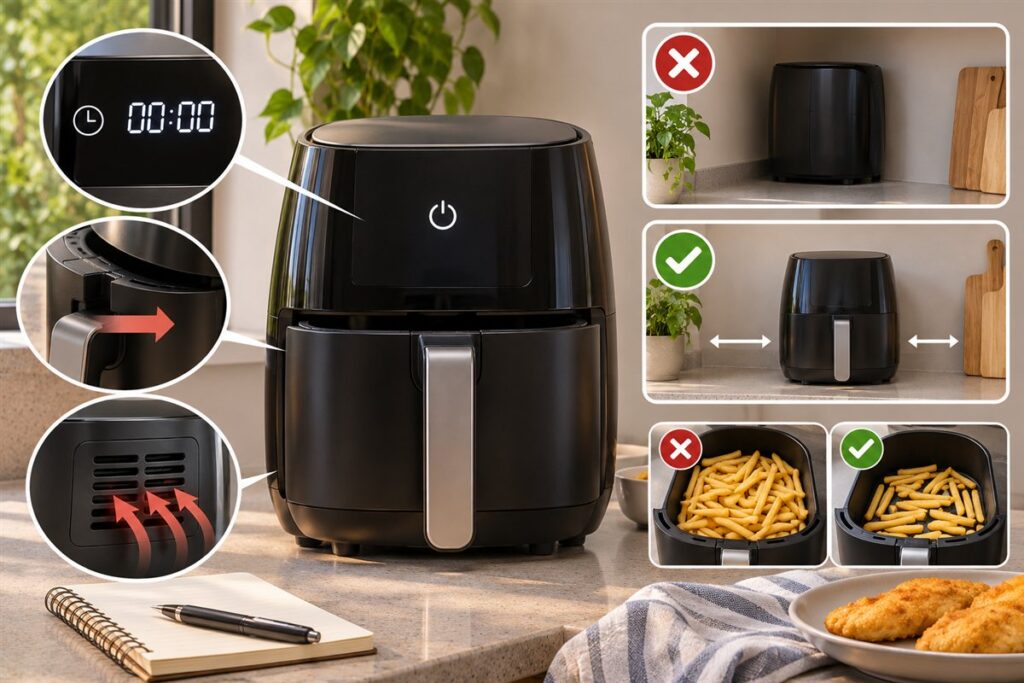
An air fryer that shuts off mid-cook is often responding to something simple, such as a finished timer, a basket that moved, or heat that could not escape. The general checks below cover the usual cases. If it keeps happening, follow the manual and contact the maker.
Normal Reasons for a Shut-Off
- The timer ran out, or a preset program ended on its own.
- The basket or drawer was nudged out of position, which can cut power to the heater.
- An automatic safety feature turned the unit off after it got too hot.
- A power-saving feature switched it off after a period of no use.
Checks You Can Run
- Confirm the timer and program settings, and read what the display shows when it stops.
- Seat the basket fully and avoid bumping it during the cook.
- Move the unit away from walls so the rear vent has open space, as the manual advises.
- Do not stack items on top of it or put it under a cabinet while it runs.
- Plug it straight into a wall outlet, not a loose extension lead.
- Cook a lighter load and see if the shut-off still happens.
Reading the Pattern
| Pattern | Possible meaning | General guidance |
|---|---|---|
| Stops at the same time each cook | A timer or program end | Check settings and the manual’s chart |
| Stops after long, hot cooks | Heat protection | Allow cooling and improve airflow |
| Stops when touched or moved | Basket position sensing | Reseat the basket |
| Stops with no clear cause | Possible fault | Contact the maker |
What to Avoid
Do not open the casing, bypass any safety feature, or try to fix electrical parts. If the unit smells of burning, shows damage, or trips your household circuit, stop using it and contact the maker. Let the unit cool fully before you handle it.
Keep a short note of when the shut-off happens: how long into the cook, which setting, and what food. A pattern is useful information for the maker and may point to a simple cause such as poor ventilation. Also check that your household circuit is not shared with other high-power appliances running at the same time, since that can trip a breaker and look like the air fryer is at fault. Never keep trying a unit that stops repeatedly with a burning smell.
Remember that a hot kitchen can add to the problem. If the room is warm and the unit sits in a tight corner, heat has nowhere to go. Move it to an open spot, give it time to cool between long cooks, and see whether the behavior changes.
Placement, Airflow, and Room Heat
Many shut-offs trace back to where the unit sits. An air fryer pulls in air and pushes hot air out through vents, and if those vents face a wall, a cabinet, or a stack of items, heat has no place to go. Internal protection may then switch the unit off to prevent overheating. This is a design feature, not a defect, but it means the position matters.
Check your manual for the clearance it requires at the back, sides, and top, and measure your own setup. Pull the unit forward on the counter so that the rear vent has open space. Do not place it under a wall cabinet while it is running, because rising heat can collect there and may damage the cabinet. Keep it away from other heat sources such as a stove top, toaster, or kettle.
- Avoid placing the unit on a soft surface or on a cloth.
- Keep curtains, towels, and paper clear of the vents.
- Do not cover the unit during or just after use.
A warm kitchen, direct sun on the counter, or long cooking sessions back to back can add to the problem. Give the unit time to cool between long cooks and see if the behavior changes.
Load Size, Food Type, and How Hard the Unit Works
How much and what kind of food you cook can influence shut-offs. A packed basket restricts airflow, so the unit runs hotter inside and may reach its protection limit sooner. Very fatty foods can create smoke or heavy vapor, which may affect temperature sensing. Heavy, long cooks at high settings push the unit harder than short, light ones.
Try cooking a smaller amount at a moderate setting and watch whether the unit behaves differently. If a lighter load runs without problems, the issue may be linked to how hard the unit is being used. Check the maximum fill level in the manual and follow it. Cut food into pieces that leave gaps for air to move, and shake or turn food as the manual suggests.
Also look at the temperature and time you are choosing. Some units have maximum run times or limits on how long they can operate at the highest setting. If your cooking regularly requires the top of the range for a long period, look at what the manual says about that use. Changing the way you cook, such as using two rounds instead of one, can avoid pushing the unit to its limit.
Power Supply, Cords, and Outlets
An air fryer draws substantial power, and an unstable supply can look like a fault in the appliance. A loose plug, a worn outlet, or an extension lead can interrupt the current. Start by plugging the unit directly into a wall outlet and making sure the plug is pushed in fully. If the plug feels loose, or the outlet is warm to the touch, stop using that outlet and have it checked by a qualified person.
Think about what else shares the circuit. Running a kettle, microwave, or toaster at the same time as the air fryer can trip a breaker or cause a voltage drop. If the shut-off coincides with another appliance starting up, that is a clue. Try using the air fryer alone on that circuit, or use another outlet on a different circuit.
- Inspect the cord for kinks, cuts, or discoloration without pulling on it.
- Do not use a unit with a damaged cord or plug.
- Avoid wrapping the cord tightly around the body.
If the household breaker trips repeatedly, stop using the appliance and ask a qualified electrician to check the circuit. Contact the maker if the problem seems tied to the appliance.
Reading Displays, Beeps, and Error Codes
Digital air fryers often tell you why they stopped, if you look. A display message, a flashing light, or a series of beeps may signal an error. Write down exactly what you see before you unplug the unit, because clearing the display erases the clue. Then look up the code or pattern in the manual.
Codes commonly relate to temperature sensing, basket position, or overheating, but the meanings differ by model, so check yours rather than guess. If the manual suggests a specific action, such as letting the unit cool or reseating the basket, follow it. If the code is not listed, check the maker’s support page for an updated manual or contact support with the code and model number.
For models without a display, note the behavior instead. Does a light go off? Does the fan keep running? Does it happen at a certain time in the cook? Record what you notice and the settings you used. This turns a vague complaint into useful information. Resist the urge to experiment with reset procedures that the manual does not describe, because they may not be safe or may void the warranty. A clear note of what happened helps the maker decide if it is a simple cause or a fault.
When It Is Time to Contact the Maker or Replace It
If you have checked placement, load, power supply, and any codes, and the unit still shuts off, it is time to involve the maker. Gather your model number, purchase date, and the notes you have kept. Describe the pattern, such as how many minutes into a cook the shut-off occurs and what food you were cooking. Mention what you have already tried, so the support team does not repeat the basics.
Stop using the unit immediately if you notice a burning smell, sparks, melted plastic, a damaged cord, or repeated breaker trips. These signs suggest a safety issue. Do not open the casing or attempt repairs. Unplug it once it is safe to do so, and let it cool.
Look at your warranty and return options. If the unit is new, you may be able to exchange it. If it is older, ask whether service is available and whether the cost is reasonable compared with a replacement. When you shop for a new model, check what the manual says about overheating protection, ventilation needs, and error codes, and choose a unit that fits the space and the load you actually use.
FAQ
Is a short shut-off after heavy use normal?
Some units have heat protection that pauses operation. Your manual should describe this, so read that section.
Could grease build-up be involved?
It can affect airflow and smoke. Clean the removable parts and reachable surfaces as the maker describes.
Can a dirty air fryer shut off by itself?
Heavy grease can affect airflow and smoke, which may trigger protection in some units. Clean removable parts and reachable areas following the manual.
Why does my air fryer stop when I open the drawer?
Many models cut power when the drawer or basket is out of position, which is a normal safety feature. Close it fully to resume.
Should I use an extension lead with my air fryer?
Many manuals advise against it because of the high power draw. Plug the unit directly into a wall outlet unless your manual says otherwise.
Does a hot kitchen affect the air fryer?
It can, since heat has less room to escape. Move the unit to an open spot and let it cool between long cooks.
What do I do if the display shows an error?
Write down the code, then look it up in the manual. If it is not listed, contact the maker.
Is it safe to keep using a unit that shuts off randomly?
If it happens without a clear cause, stop and contact the maker. Do not use it if you notice burning smells, damage, or tripped breakers.
Could a power cut or surge be the cause?
A brief interruption in supply can stop a cook. If other appliances are affected too, the cause is likely the supply, not the air fryer.
The Short Version
Check timers, basket position, ventilation, and the outlet. If it still shuts off, follow the manual and contact the maker rather than attempting a repair.









