
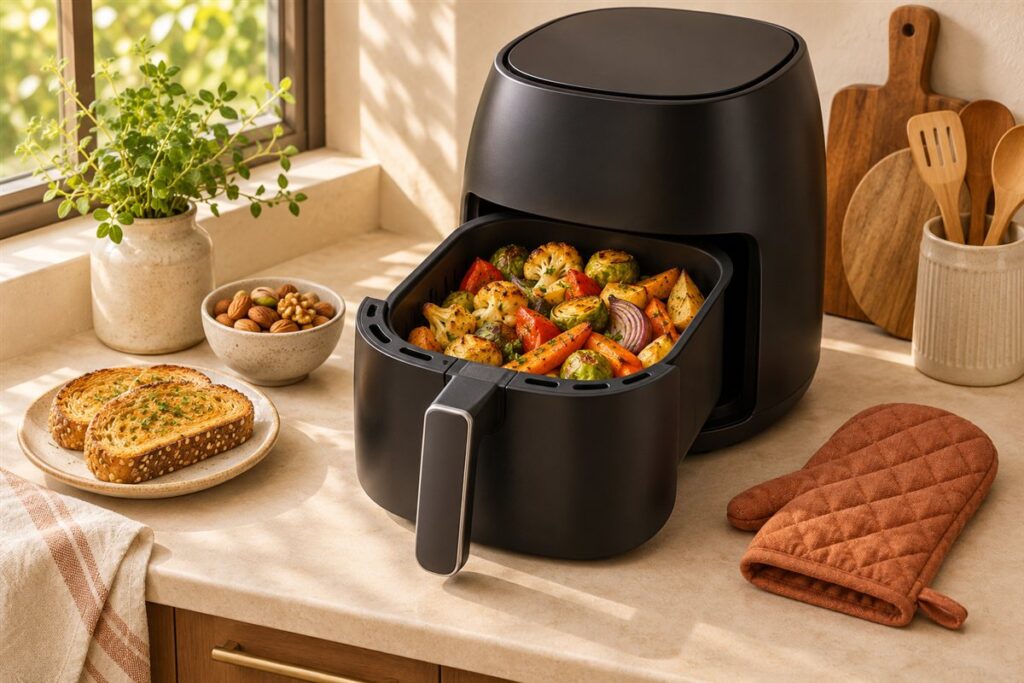
An air fryer works by moving hot air around every piece of food, so the basket should never be packed tight. Aim for a single layer with small gaps, or a loose pile that you shake often, and cook in batches whenever you need to.
Why Space Matters
When pieces press against each other, air cannot reach the touching surfaces. Steam gets trapped, the coating stays soft, and the food near the edges cooks faster than the food in the middle. A crowded basket can also block the airflow the fan depends on, which makes the unit work harder for worse results.
Different foods need different amounts of room:
- Breaded and battered foods need the most space, ideally a single layer with no touching.
- Fries, cubes, and florets can form a shallow, loose layer that is shaken during cooking.
- Small items such as nuts or peas can be a little deeper, but still need regular shaking.
How to Judge a Good Load
- Look at the basket floor. You should be able to see gaps between most pieces.
- Keep the food below the top edge of the basket and away from the heating element.
- Check your manual for any maximum fill line or stated capacity.
- Do a first batch smaller than you think you need, then adjust upward if results are even.
Batch Cooking Without Losing Heat
Cooking in two rounds takes extra time, but the results are better than one soggy load. To keep things moving, prepare the second batch while the first one cooks. Keep finished food warm on a rack set over a tray in a low oven, rather than in a covered dish, since covers trap steam and soften crisp surfaces.
Because the unit is already hot, the second batch may cook a little faster, so check early.
Load Guide
| Food type | Layout | Shake or turn |
|---|---|---|
| Breaded pieces | Single layer, spaced | Flip once |
| Fries and wedges | Loose shallow layer | Shake every few minutes |
| Chopped vegetables | Shallow layer | Toss halfway |
| Small snacks | Thin, even spread | Shake often |
Signs the Basket Is Too Full
Watch for pale spots where pieces touch, a pool of liquid in the drawer, or food that looks steamed instead of browned. Another sign is a longer cooking time than the recipe suggests. If you see any of these, remove a portion and cook it separately. Over time you will learn the right amount for your own unit.
Basket Shape and Capacity When Buying
Crowding is partly a habit and partly a hardware question. If you often cook for several people, the shape and size of the basket decide how many rounds you will need. Capacity figures in listings are often given in liters or quarts, but the usable floor area for a single layer is what matters for crisp food. A deep, narrow basket can hold a lot of volume yet offer little floor space, so it suits piles of fries that you shake, not rows of breaded pieces.
Wide, shallow baskets and drawers give more surface for single-layer cooking. Dual-basket models let you cook two foods at once, or split one batch across both, which reduces crowding. Oven-style units offer trays and racks and can handle more food on separate levels, although they still need air gaps between pieces.
- Check the listing for basket dimensions, not just total capacity.
- Consider how many people you typically feed.
- Look at whether a rack or divider is included and how it affects airflow.
- Think about the counter space needed for a larger unit.
If your kitchen is small, a mid-size unit with good cooking habits often beats a bulky one that stays in a cupboard. Match the appliance to your typical meals instead of the rare big event.
How Food Shape and Size Affect Spacing
Not all foods need the same space. Flat, uniform pieces, such as fish fillets, cutlets and burger patties, need clear gaps on all sides because they release steam from large surfaces. Round or irregular pieces, such as meatballs and florets, leave natural gaps, but they can nest together and still block air if packed in deep.
Cutting food to a similar size helps. When some pieces are much thicker than others, the thin ones overcook while the thick ones lag, no matter how well spaced. Cut vegetables to a similar size, and sort mixed foods by cooking time so they do not share a basket unless they take about the same time.
Light foods can blow around. Leafy greens, small herbs and thin crumbs can lift in the fan and settle against the element, so keep them below the rim, weigh them down with heavier pieces or use a rack if the maker provides one. Sticky or coated foods can fuse together when they touch, so leave a small gap and flip them carefully. Take a moment to look at the basket after loading, and ask whether air can pass between pieces. If you cannot see space, reduce the load.
Cooking Two Foods Without Overloading
Cooking a main and a side together is tempting, but it is a classic way to overfill the basket. Foods with different moisture levels and cooking times can disrupt each other. A moist vegetable can steam a crisp coating, and strongly flavored items can pass their taste to others.
A better approach is to stage the cook. Start the food that needs the longest time, then add the quicker food later, at the point when it will finish at the same time. Keep both in a loose layer, not stacked. If you have a divider and your manual allows it, it can separate foods, but check that it does not block airflow.
- Cook the longest item first and add others later.
- Keep wet items on one side and dry items on the other, if the layout permits.
- Check that flavors will not clash, as strong spices can carry over.
- Keep raw meat and ready-to-eat foods separate for food safety.
When in doubt, cook the sides first and keep them warm uncovered, then cook the main. Alternatively, use the oven for part of the meal. The air fryer is a tool for part of the job, not the only one, and splitting the work leads to better results than cramming everything into one load.
Using Racks and Accessories Wisely
Accessories can help or hurt, depending on how you use them. A rack designed for your model creates a second level, allowing you to cook more food at once. The risk is that the upper level blocks air from reaching the lower one, and the food on top may brown more quickly. Swap levels halfway if the manual suggests it, and check both layers.
Baking dishes and silicone liners can also affect airflow. A solid dish blocks the holes in the basket, so air cannot circulate beneath the food. If you use a dish, make sure it leaves room around the edges and that the maker permits it. Liners should lie flat and have holes if designed for air circulation, and they must never cover the whole base unless the manual says so.
Skewers and racks for kebabs can raise food off the floor, helping air reach all sides, but pieces still need gaps. Foil is another accessory that must be handled with care. Some makers allow it in limited ways, and others do not, and it can block airflow or touch the element. Read the manual and avoid improvising. If an accessory makes the basket feel crowded, remove it and cook in smaller batches instead.
Adjusting Recipes for Smaller Batches
Recipes often assume a bigger quantity than your basket allows. When you reduce the amount, the cooking time can change. A smaller load usually cooks a little faster, because there is less food absorbing heat, so check early. Write down what you do, so you can repeat it next time.
Scale seasoning and oil in proportion. A common mistake is to keep the original amount of oil or sauce when halving a recipe, which leaves food greasy or wet. Mix the smaller portion in a bowl and keep to a thin coat.
If a recipe serves four and your basket holds half, plan two rounds, not one crowded cook. Prepare everything in advance, divide it into portions and keep the second portion chilled until its turn. Between rounds, empty the drawer, wipe away excess grease and let the unit recover its heat if the recipe calls for preheating.
Over time, you will learn the effective capacity of your unit for each type of food. Record it on a note inside a cupboard, such as how many wings, how many cups of vegetables or how many breaded pieces give a good result. That personal chart is more useful than any generic guide.
FAQ
Is a bigger air fryer the only way to avoid crowding?
No. A larger basket helps with big meals, but batches and good spacing solve the problem in any size. Rack-style units add layers, which also need space between pieces.
Can I stack food using a rack?
Only if your maker offers a rack for your model. Follow the manual, and swap positions during cooking so both levels cook evenly.
How do I know how much my basket holds?
Look at the floor area and the manual's fill guidance, then test with a small first batch. Adjust upward only if the results are even.
Does a dual-basket model solve crowding?
It helps because you can split a load across two baskets or cook two foods at once. You still need gaps between pieces in each basket.
Can I mix different foods in one load?
Only if they need similar times and temperatures, and ideally stagger the start. Keep raw meat away from ready-to-eat foods.
Why is food undercooked in the middle of a full basket?
Air cannot reach the center of a packed load. Reduce the amount, spread it out and shake or turn it more often.
Do small items like peas need space too?
They can be a little deeper, but still need shaking so air reaches them. Keep the layer below the rim.
Should I preheat when cooking in batches?
Follow the manual. The unit is already hot for later rounds, so they may cook slightly faster, and checking early prevents overcooking.
Is it okay to use foil to hold food in place?
Check the manual first. Some makers restrict foil because it can block airflow or touch the heating element.
The Short Version
Give food room, keep it below the fill line, and cook in batches when needed. Better airflow means crisper, more even results.









