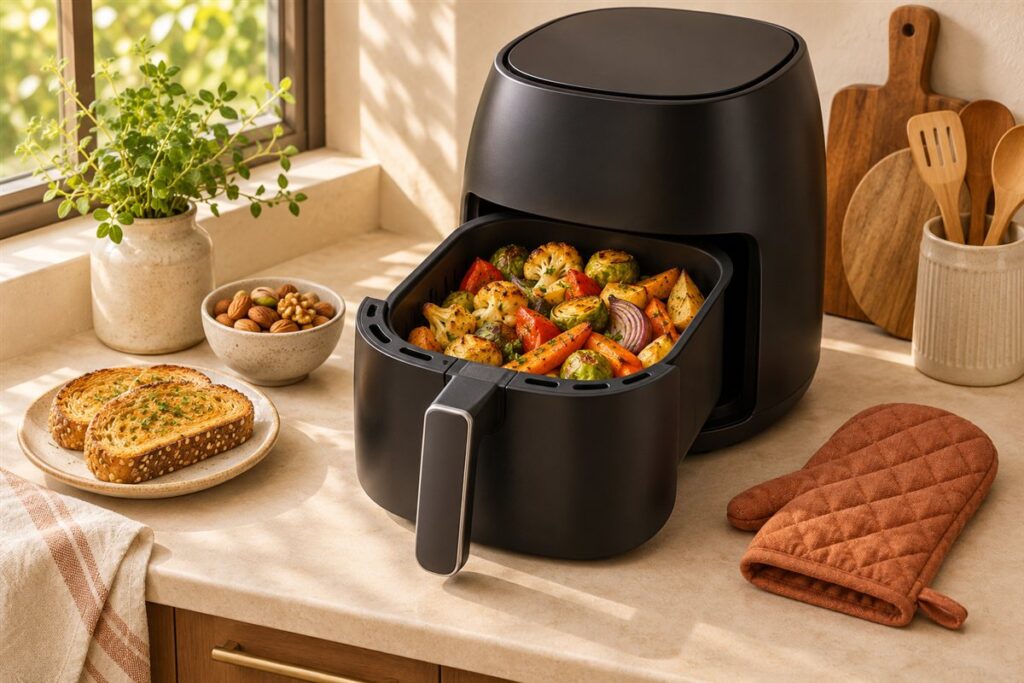
A basket air fryer is a compact unit with a pull-out basket, while an oven-style model has a door and removable trays or racks. Basket models suit small kitchens and snacks, and oven-style models suit larger meals and baking. The details below help you decide.
What Each Design Is For
A basket model holds food in a deep container that you shake or turn during cooking. It is quick to warm up and easy to move. An oven-style model works like a small countertop oven with a fan, offering several levels so food can spread out in flat layers.
Key Differences
| Feature | Basket style | Oven style |
|---|---|---|
| Footprint | Usually smaller | Usually wider and deeper |
| Cooking layout | One deep container | Flat trays on one or more levels |
| Turning food | Shake or flip by hand | Often less needed on flat trays |
| Cleaning | Basket is easy to wash, but crevices can trap grease | Trays wash easily, interior needs wiping |
| Versatility | Great for snacks and sides | Handles baking, toasting, and larger dishes |
| Storage | Easier to put away | Takes a permanent spot |
How Cooking Results Differ
Both rely on hot air moving around food. In a basket, food is stacked in a deeper pile, so shaking helps cook all sides. In an oven-style unit, food sits in a flatter layer, which can brown more evenly across a tray. Results still depend on the model, the amount of food, and your recipe, so the manual is the best guide.
Who Should Choose Which
- Choose a basket model if you have limited counter space, cook for one or two people, and mostly make snacks and sides.
- Choose an oven-style model if you cook for a family, bake, or want to toast bread and cook several items at once.
- If you already own a full oven you love, a basket model may be a better add-on.
- If you want to replace a toaster oven, an oven-style model fits that role.
Space and Ventilation
Oven-style units are larger and need clear space around the sides and top for hot air to escape. Basket models also need room behind and above the vents. Measure your counter, check the clearance listed in the manual, and make sure the cord reaches an outlet without a long extension cord. Keep both away from walls, curtains, and anything that could be affected by heat or steam.
Think too about where you will keep the unit between uses. A heavy oven-style model is not something most people want to lift in and out of a cabinet every day.
Capacity Versus Usable Cooking Space
Listed capacity can mislead when you compare the two designs. A basket model may state a volume in quarts or liters, but food sits in a pile, and a pile only cooks well when air can reach most of its surface. An oven-style unit spreads food across flat trays, so the usable surface area can matter more than the total volume. Look at tray or basket dimensions in the listing and picture how many chicken thighs, fries or cookies fit in a single layer.
Think in terms of a typical meal. If you usually cook a protein and a side together, an oven-style unit with two levels can handle both in one go, while a basket may need two rounds. If you mostly cook one item at a time, such as a batch of wings, a basket model is simple and quick.
Some basket models offer dividers or dual compartments, which blur the line between types. Check how the divider works and whether both sides share one fan or temperature. Do not assume the biggest number is best, because a larger interior can take longer to heat and use more counter space. Match the cooking area to the number of people you feed most nights, and keep occasional hosting as a secondary concern.
Baking, Toasting and Roasting Range
If your cooking goes beyond frozen snacks, think about what each design does well. Oven-style units often include rack positions, a door you can open to check progress, and settings for toasting or baking. They are generally better matched to bread, sheet-pan meals, small pizzas and trays of cookies. A flat pan can sit level, and you can slide it out without tipping food.
Baskets are good for fries, wings, nuggets, vegetables and reheating. Baking in a basket is possible with a small, suitable pan or dish, but the depth and shape limit the options. Delicate batters can also be awkward if the pan is deep.
- Toast and bagels: easier on a rack in an oven-style unit.
- Baked goods: better on flat trays, with the manual as your guide for settings.
- Frozen snacks: work well in both, with a basket often quicker to heat.
- Whole roasts or larger cuts: check the maximum size in the listing for either type.
Rather than expecting a single appliance to replace everything, decide which two or three jobs matter most and choose the design that does those well.
Noise, Heat and Kitchen Comfort
Every air fryer has a fan, and sound levels vary between models and designs. Makers rarely describe noise in consistent terms, so read customer feedback with care and keep in mind that people judge loudness differently. If you live in a small apartment or have an open-plan space, quiet operation may be worth considering.
Heat output is a separate matter. Oven-style units have a door and a larger cavity, and the outer surfaces, especially around the door, can get hot. Baskets also warm on the outside and at the vents. Neither design should be touched without caution while in use or just after. Check what the manual says about surface temperature and about keeping children and pets away.
Think about the room as well. A larger unit running for a long time can warm up a small kitchen slightly, and strong cooking smells may linger either way. A range hood or an open window can help. If you will use the appliance in a shared space, such as a rental with open shelving, consider where hot air and steam will go. Keep the vents clear, and do not place either design beneath low cabinets that could be affected.
Cleaning Effort Over the Long Term
Cleaning is where daily experience can differ from the product photo. Basket models usually have a basket and drawer you can wash by hand or, if the manual permits, in the dishwasher. The challenge is reaching corners where grease collects, and the nonstick coating needs gentle treatment. Avoid abrasive scrubbers unless the maker says they are fine.
Oven-style units have trays and racks to wash, but also an interior with walls, a door and sometimes a heating element that needs careful wiping. Spatter on the door glass and ceiling can build up if you do not clean regularly. Check how easy it is to reach the interior and whether the crumb tray slides out.
A few habits help with either design: wipe out the interior or drawer when it has cooled, soak stubborn residue rather than scraping, and never submerge the main body. Do not use sprays or cleaners the manual warns against. If a unit has many small removable parts, expect more steps. Think about whether you are happy to do a quick clean after each use, because that will keep any design in good shape for longer.
Budget Tiers and Warranty Checks
Without quoting prices, you can think of the market in loose tiers. Entry-level models usually keep controls simple and may offer fewer presets, a smaller interior or basic materials. Mid-range ones often add better build, more cooking modes or extra accessories. Higher tiers may add larger capacity, multi-function cooking, digital displays or smarter controls. Oven-style units tend to sit toward the upper tiers because of their size and extra functions, though this varies.
Spend on the features you will use. A baker benefits from good temperature control and rack options, while a snack cook benefits from a quick-heating basket. Extra modes you never touch do not add value.
- Check the warranty length and what it covers, such as parts and the heating element.
- Look at how the seller handles returns and replacements.
- Check whether replacement baskets, trays or racks are available separately.
- Read the manual online if the listing offers it before you buy.
Replace an air fryer when the coating is flaking, the door or basket no longer seals or fits properly, the controls misbehave, or it smokes persistently even after cleaning. Do not keep using a damaged cord or plug.
FAQ
Do accessories fit both types?
Not always. Racks, pans, and liners are usually sized for a certain model, so check dimensions before you buy.
Which is easier to clean?
Each has its own challenges. Baskets have deep corners, while oven-style units have larger interiors. Follow the care steps in your manual.
Can an oven-style air fryer replace a toaster oven?
Many oven-style models are designed to toast, bake and air fry, so they can fill that role. Check the listing for the functions and rack positions you need.
Are basket models louder than oven-style ones?
There is no reliable rule, since noise varies by model and fan. Read user feedback and the product details, and remember that perception of loudness differs.
Which type heats up faster?
Basket models often warm up quickly because the space is small, but this depends on the specific unit. Check the manual for any preheating advice.
Is shaking food necessary in both designs?
Baskets usually need shaking or turning to cook evenly, while flat trays often need less handling. Follow the recipe or manual for your model.
Can I cook for a family with a basket model?
You can if you cook in batches, but it takes longer. A larger basket or an oven-style unit may suit bigger households better.
Do both types need space around them?
Yes, both require clearance for air to circulate. Check the manual for the distances to walls and cabinets and never block the vents.
Which design is better for a small kitchen?
A basket model usually takes less counter and storage space. If you want one appliance to replace others, a compact oven-style unit may still be worth the room.
The Short Version
Choose a basket air fryer for compact, quick cooking and an oven-style model for volume and variety. Match the design to your space, your household, and the meals you make most.