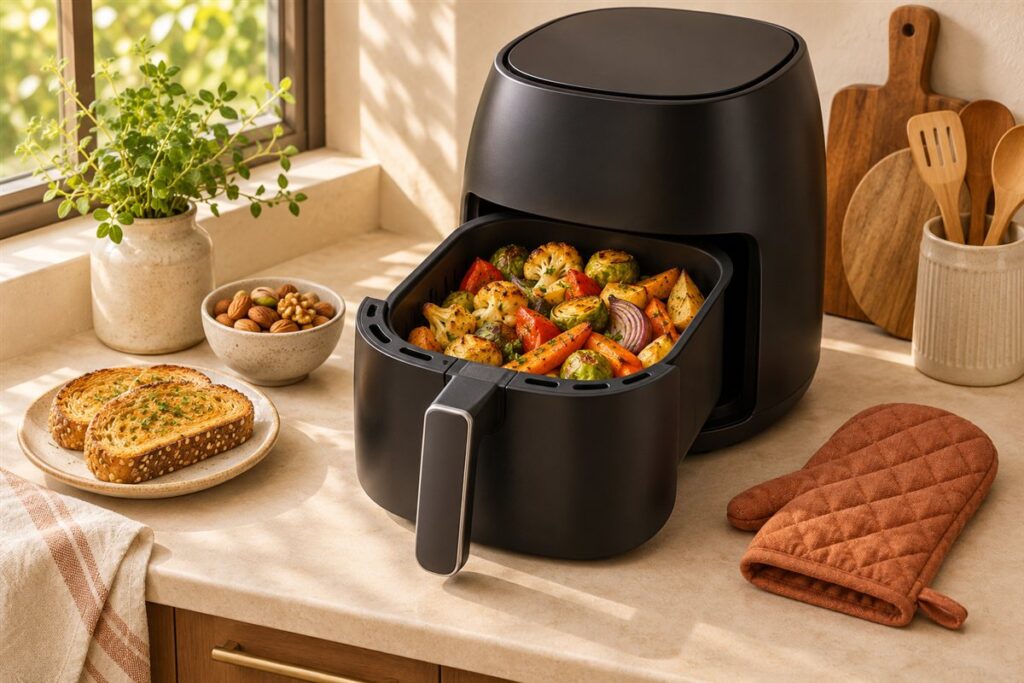
The best spot for an air fryer is a flat, hard, heat-tolerant counter area with open space around it, near a wall outlet, and away from anything that can melt or burn. Your maker’s manual lists the exact clearances, so check it before you settle on a place.
What the Spot Needs
- A stable, level surface. Avoid wobbly or sloped areas.
- Room for airflow. The unit pulls in and pushes out air, so leave space at the back, sides, and top as your manual describes.
- Nothing above it. Hot air and steam can rise, so do not run it under low cabinets or shelves.
- A nearby wall outlet. Plug directly into the wall where possible, and keep the cord out of walkways and away from hot surfaces.
Spots to Avoid
- Directly under wall cabinets, where steam can build up.
- Next to the stove burners or any heat source.
- Beside the sink, where water splashes may reach the cord or plug.
- On top of other appliances, a stove, or a fridge’s warm top.
- Against a wall with no gap, which blocks the back vent.
- On delicate counter surfaces, such as some laminates, without a heat-tolerant mat beneath.
Making the Spot Work Day to Day
Think about how you use it. If you cook with it often, keeping it on the counter saves lifting. Choose a spot where you can pull the drawer fully out and open lids without bumping into cabinets. Leave a clear landing area next to it for hot trays and dishes, and keep towels, paper, and light plastic away from the vents.
If counter space is tight, a small movable cart or a dedicated corner can help, as long as the surface is sturdy and the airflow is not blocked.
Placement Checklist
| Factor | Why it matters | What to check |
|---|---|---|
| Clearance | Lets vents release hot air | Gap listed in your manual |
| Overhead space | Steam rises | No cabinet directly above |
| Outlet | Power draw is high | Wall outlet, no crowded strips |
| Surface | Heat and weight | Level and heat-tolerant |
| Water nearby | Splashes near electrics | Distance from the sink |
Small Kitchen Tricks
If space is limited, mark a spot on the counter that is always clear, so you can set the unit down without moving things around. A silicone mat or a heat-tolerant board under it can protect the surface and catch crumbs. Keep a hook nearby for mitts, and leave enough room to open the drawer fully without it hitting anything.
Counter Surface Materials and Heat
The material under your air fryer decides how much protection you need. The outside of the unit and the area below it can get warm during use, and hot air leaves through the vents. Stone, solid surface, and tile generally tolerate heat well, but even these can be stained by grease or scratched by dragging the feet. Laminate, wood, and some coated surfaces are more sensitive, and heat or steam can cause discoloration, bubbling, or warping over time.
A heat-tolerant mat, a trivet, or a dedicated board can protect the surface. Choose one that is flat, stable, and larger than the footprint so the unit does not slide. Avoid materials that can melt or burn, and do not block the unit’s bottom vents if it has any. Check your manual for guidance on what the surface under the unit should be.
Points to consider:
- Check your countertop maker’s care guidance for heat limits.
- Use a mat with a non-slip underside for stability.
- Wipe the area after cooking to remove grease and crumbs.
- Avoid placing the unit over a seam or gap where steam could creep in.
If you are renting or have a delicate surface, a protective board is a low-effort solution. Let the unit cool before moving it, and lift rather than drag it across the counter to avoid scratches.
Clearance and Ventilation Details
Air fryers breathe. They draw in air, heat it, and push it out through vents, so blocked airflow can lead to overheating, poor cooking, and smoke. Your manual should give minimum clearances for the back, sides, and top, and these numbers vary by model. Follow them exactly, because general rules cannot cover every design.
Look at where the vents are on your unit. Some exhaust at the back, some at the top, and some at the sides. Keep that side clear of walls, appliances, and objects. Do not push the unit tight against a backsplash, and do not store items on top of it. Steam rising from the unit can damage cabinets above, which is why placing it under wall cabinets is generally discouraged.
Simple ventilation habits:
- Pull the unit out from the wall before turning it on.
- Keep towels, paper, and light plastic away from vents.
- Open a window or run a range hood fan if cooking produces smoke.
- Do not cover the unit during use, even partially.
If you must use a spot with limited space, consider whether you can pull the unit forward when cooking and push it back afterward. That small habit gives airflow when it is needed without taking over the counter permanently.
Outlets, Cords, and Power Access
Where you place the unit depends heavily on where you can plug it in. Air fryers draw significant power, so a wall outlet is generally better than a power strip or extension cord, and many manuals say so directly. If the nearest outlet is on the other side of the sink or stove, a different location may be safer than stretching the cord.
Keep the cord short enough that it does not hang over the counter edge where it can be snagged, but long enough that it does not pull taut. Route it away from the hot sides and top of the unit, away from water, and out of walkways. Do not run the cord under mats or appliances.
When assessing an outlet location, check:
- Whether the outlet is protected as required in kitchens near water in your region.
- Whether other high-power appliances share the same circuit.
- Whether the plug fits snugly and the outlet is undamaged.
- Whether you can reach the plug to disconnect quickly.
If your kitchen has few outlets, think about rearranging which appliances live where rather than relying on adapters. If you are unsure about the wiring, ask a qualified electrician.
Household Factors: Children, Pets, and Traffic
The surfaces and vents of an air fryer can be hot, which matters in households with young children or pets. Place the unit toward the back of the counter, with the cord out of reach, so small hands cannot tug on it. Make sure the unit cannot be pulled or tipped, and keep the area in front clear of toys, bags, and other things that could cause a trip while you carry a hot basket.
Think about traffic in the kitchen. A unit placed near a doorway or a busy path increases the chance of bumps and spills. Put it where you can work without people reaching past it. If the family often gathers around the counter, keep the unit where you can see it, and avoid leaving it running unattended.
Useful practices:
- Teach children to stay away from the unit while it is running and cooling.
- Keep pets off the counter and away from vents and cords.
- Do not store food or utensils on top of the unit.
- Allow the unit to cool fully before cleaning or moving it.
A fixed, clear spot also reduces the chance of someone leaving a hot basket in an unsafe place or knocking it as they pass.
Permanent Counter Spot or Stored Away
Decide whether the air fryer will live on the counter or in a cabinet. A permanent spot means you will use it more, because there is no lifting or setting up. But it uses counter space all the time and collects grease and dust, so it needs regular wiping. Stored units free up room but need a place that fits the size and weight, and you will need to pull it out each time.
If you store it, make sure the unit is cool and dry before putting it away, and keep the cord loose rather than tightly wrapped, which can strain the wires. Pick a shelf that is easy to reach, since lifting a heavy appliance above shoulder height is awkward and risky.
Consider these points:
- Weight of the unit and how often you will move it.
- Cabinet height and depth for the closed unit.
- Whether you have a heat-safe landing spot when you pull it out.
- How often you cook with it each week.
If you use it several times a week, a dedicated counter spot is usually worth it. If you use it occasionally, storing it keeps the kitchen tidy, and you can still set it up in a good spot when needed.
FAQ
Can I use an extension cord?
Many makers advise against it because air fryers draw a lot of power. Check your manual and use a wall outlet if you can.
Should I move it after cooking?
Let it cool fully first. The outside, the drawer, and the basket all stay hot for a while.
Can I put my air fryer on top of the stove?
It is generally better not to. Heat from burners or the oven below can affect the unit, and the surface may not be stable. Use a flat counter area with open space.
Is it safe to use an air fryer on a wooden countertop?
Wood can be damaged by heat and steam. Use a heat-tolerant mat or board, and check the countertop's care guidance and your air fryer manual.
How far from the wall should an air fryer be?
Your manual gives the exact distance for your model. Follow it and keep the vent area clear so hot air can escape.
Can I run the air fryer under a range hood?
A hood can help move steam and smoke away, but the unit still needs the clearances in your manual. Do not place it where the hood or cabinet is too close above.
What should I do if my counter is too small?
Choose a smaller model, use a movable cart that is stable, or store the unit and set it up for cooking. Never block vents to make it fit.
Should I plug the air fryer into a power strip?
Many manuals advise against it. Use a wall outlet if possible, and check your manual for the maker's guidance.
The Short Version
Choose a level, heat-tolerant spot with open space around it, no cabinet overhead, and a wall outlet close by. Follow the manual for the exact gaps.