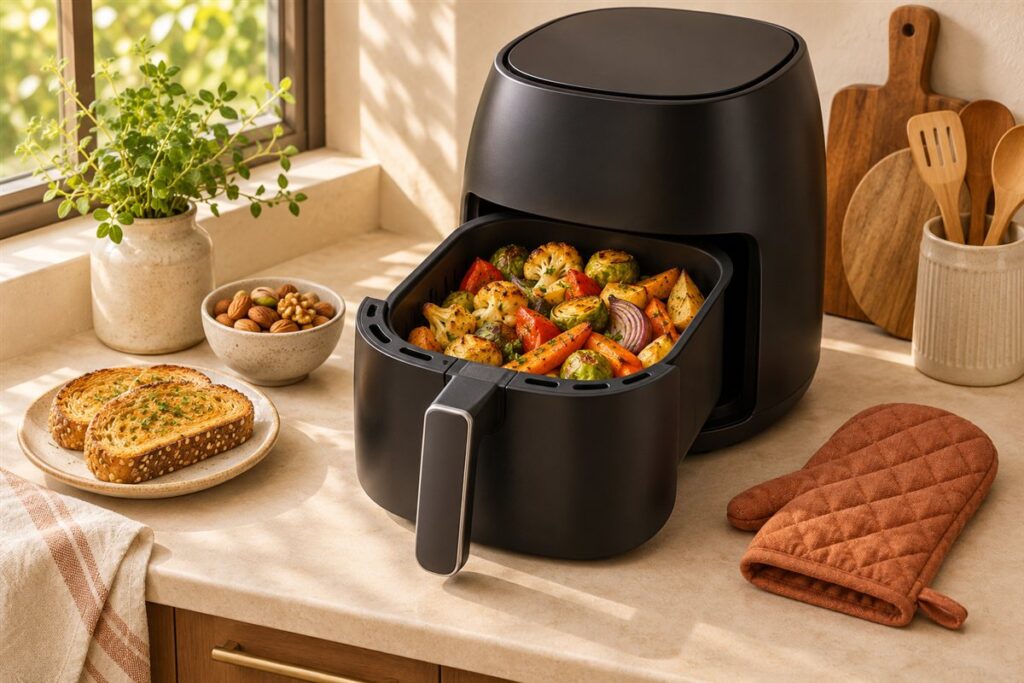
Wattage is a measure of how much electrical power an appliance uses while running. For an air fryer, a higher number usually means the heating part can produce more heat, which may help it warm up faster. It does not decide cooking quality alone, since airflow and design matter too.
Plain Definitions
- Watt: a unit of power. One thousand watts is one kilowatt.
- Voltage: the electrical supply level at your outlet, which depends on your country.
- Amps: how much current flows. Roughly, watts equal volts times amps.
- Circuit: the wiring that feeds your outlet, with a limit on total load.
For example, a unit that draws a certain number of watts on a household supply will pull a matching number of amps. The label on the appliance and the manual show the exact figures.
What Wattage Affects
| Area | Effect of higher wattage | Other factors |
|---|---|---|
| Warm-up speed | Often faster | Basket size and insulation |
| Recovery after opening | May regain heat faster | Fan strength |
| Browning | Can help | Airflow and food shape |
| Energy use | Draws more while heating | Cook time and batch size |
Wattage and Your Kitchen
Most air fryers plug into a regular outlet, but they can draw a lot of power compared with small gadgets. Running one at the same time as a kettle, toaster, or microwave on the same circuit can overload it and trip a breaker. Plug it directly into a wall outlet, avoid sharing the line with other heating devices, and avoid long or thin extension cords.
If you are unsure about your wiring, ask a qualified electrician. Follow the safety instructions in your manual.
How to Use the Number When Choosing
- Find the wattage on the label or in the manual.
- Think about your home circuit and what else runs at the same time.
- Compare it with capacity, because a bigger basket may need more power to heat.
- Do not treat it as a quality score. Two units with the same wattage can cook differently.
Reading the Label
The label plate on the bottom or back of the unit lists voltage, wattage, and sometimes frequency. Match the voltage to your outlet, especially if you moved from another country or bought a model made for a different market. Using the wrong supply can damage the appliance, so confirm the details in the manual before you plug in.
Wattage and Warm-Up in Practice
The practical effect of wattage is easiest to see during warm-up. A unit with more heating power can bring the cooking space to temperature in less time, while a lower-powered unit may take longer, especially when the basket is full or the room is cold. This affects daily routines: if you cook quick meals, a faster warm-up saves minutes, and if you cook longer dishes, the difference matters less.
Power also affects how quickly the unit recovers when you open the drawer. Every time you open it to shake or check food, hot air escapes. A stronger heating element may regain temperature sooner, though fan design and insulation also matter. A small, well-insulated unit can match a larger, higher-powered one for some foods.
When comparing models on warm-up, remember:
- Wattage is one input, and basket size and design change the outcome.
- Preheat guidance in the manual tells you what the maker expects.
- A full basket slows recovery compared to a light load.
- A cold kitchen can lengthen warm-up a little.
Treat the wattage figure as a clue to power, not as a measure of cooking quality. Look at how the unit performs for the food you cook, and read the listing for details on heat-up and temperature range.
Circuit Limits and Shared Outlets
Air fryers draw significant power compared to small kitchen tools, so the wiring behind your outlet matters. A household circuit has a limit on total load, and all outlets on that circuit share it. Running an air fryer at the same time as a kettle, toaster, microwave, or space heater can trip a breaker, interrupt your cooking, or in a worst case overheat wiring that is not in good condition.
Plug the unit directly into a wall outlet rather than an extension cord or power strip, unless your manual states that it is safe. Thin or long cords can heat up when carrying high current. Keep the cord away from hot surfaces, sink areas, and walkways.
Simple precautions:
- Check the label for the unit’s power rating and compare with your circuit.
- Avoid using other heating appliances on the same circuit at the same time.
- Do not use damaged outlets, loose plugs, or frayed cords.
- If a breaker trips repeatedly, stop and have the wiring checked.
If your kitchen has older wiring or you are unsure about the circuit, ask a qualified electrician. It is a small step compared with the risk of an overloaded line, and it gives you confidence to use the appliance regularly.
Voltage, Plugs, and Using an Appliance Abroad
Wattage depends on the voltage the unit expects, and electrical supply differs between countries. An air fryer built for one supply may not work correctly, or safely, on another. If you move or travel with an appliance, check the label for the voltage and frequency range it supports and compare it with the supply at your destination.
A plug adapter only changes the shape of the pins, not the voltage. Using an adapter with an appliance that is not rated for the local supply can damage it or create a hazard. A voltage converter or transformer may be required, but high-power heating appliances are demanding, and many converters are not rated for them. Check the converter’s rating against the appliance’s wattage, or consider buying a locally rated unit.
Before using an appliance abroad:
- Read the rating label and manual for supported voltage and frequency.
- Do not assume that a plug that fits will work safely.
- Choose a converter rated well above the appliance’s power draw, if one is needed.
- Consult the maker if the manual does not say.
When in doubt, buying an appliance sold for your local market is simpler and more reliable than relying on adapters and converters.
Running Cost and Efficiency
Wattage also hints at running cost, although the real figure depends on time more than power. An appliance uses energy only while its element is heating, and air fryers cycle on and off to hold temperature. A higher-powered unit may use more while heating but finish sooner. A lower-powered unit may take longer but draw less at once.
To estimate cost, multiply the unit’s power by the hours it runs, then use your electricity rate from your bill. Because cooking times are short, a single meal typically accounts for a small amount of energy, though a rate that varies by time of day can change the calculation. Compared with heating a large oven for a small meal, a compact air fryer often looks efficient, but the exact comparison depends on your appliances and habits.
To keep use efficient:
- Skip preheating when your manual says it is unnecessary.
- Cook full but not overcrowded batches.
- Keep the unit clean so airflow is not blocked.
- Avoid opening the drawer more than needed.
If you want a more precise picture, check the rating label and your tariff, then use a simple calculation or a plug-in energy monitor. Do not let energy use alone decide your choice, since fit and function matter more.
Choosing a Wattage for Your Needs
When you shop, the wattage figure should be one of several details you weigh. For small households that cook snacks and sides, a modest-power compact model may be enough. For families that cook larger batches or like faster preheating, a higher-powered or larger unit might feel more responsive. Check what the listing says about temperature range and preheat time, rather than relying on the number alone.
Compare wattage across similar sizes, because a large unit and a small one are not comparable at a glance. Consider your kitchen too. If your circuit is shared or older, a very high-powered unit can be a problem, and a moderate one may fit better. Also note whether a model has dual drawers, which may split power between two cooking zones.
Questions to ask before buying:
- Does the listing give the wattage and the supply it is built for?
- Does the temperature range match the foods I cook?
- Can my outlet and circuit handle it alongside my other appliances?
- Does the maker publish clear safety and care guidance?
Pick the unit that suits your cooking and kitchen, and follow the manual for installation and use.
FAQ
Does a higher wattage always cook faster?
Not always. It can reduce warm-up time, but cooking speed also depends on fan design, basket shape, and how full the basket is.
Will an air fryer raise my electric bill a lot?
It uses power only while heating, and cook times are often short. Your actual cost depends on how often you use it and local electricity rates.
How do I find my air fryer's wattage?
Look at the rating label, usually on the underside or back of the unit, or check the manual. It lists the power and the voltage the unit is built for.
Can I use an air fryer on an extension cord?
Many makers advise against it because of the high current drawn. Check your manual and plug directly into a wall outlet where possible.
Why does my breaker trip when the air fryer runs?
The circuit may be carrying too much load, for example from a kettle or microwave on the same line. Stop, unplug other appliances, and have the wiring checked if it keeps happening.
Does a higher wattage mean a bigger air fryer?
Not always. Power depends on design as well as size, so compare units of similar capacity and read the listing.
Is it worth paying attention to wattage for a small kitchen?
Yes, mainly for the circuit. A shared or older circuit may limit what you can run at once, so check the rating against your wiring.
Can a voltage converter let me use my air fryer abroad?
Only if the converter is rated for the appliance's full power draw, and many are not. Check the manual and the converter's rating, or ask the maker.
The Short Version
Wattage shows power draw, which can affect warm-up speed but not overall quality. Check the number against your circuit and follow the manual for safe use.