
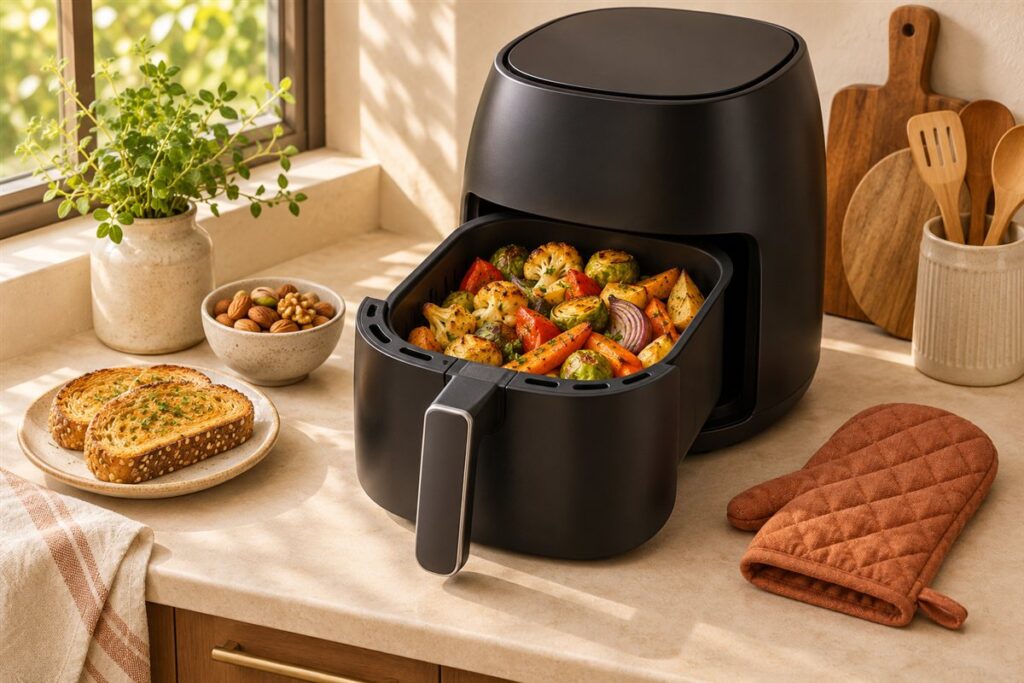
The right cake pan is one that fits inside your basket with a small gap all around and room above for the cake to rise. Measuring takes a few minutes and avoids a lot of trouble. Here is how to do it.
Measure Your Air Fryer First
- Remove the basket or tray and place it on a flat surface.
- Measure the width across the widest flat part of the floor, not the top rim.
- Measure the depth from the floor to the lowest part of the heating area above it.
- Note whether the basket has a handle or divider that takes up space.
- Write the numbers down in one unit, such as inches or centimeters.
Measure the Pan
Measure the outside of the pan, including any handles or lips, because those parts need to fit too. Then measure the height of the sides. A cake that rises needs extra room, so subtract the pan height from the depth you noted and see how much space is left.
Sizing Rules of Thumb
| Factor | Why it matters | What to check |
|---|---|---|
| Width gap | Air needs to flow around the pan | A small space on every side |
| Height clearance | Batter rises as it bakes | Space between the cake top and heat source |
| Handles | They can stop the drawer closing | Whether they fold or lift out |
| Weight | Heavy pans can be hard to lift hot | Whether you can grip it firmly |
Smaller Pans and Alternatives
Many air fryer baking recipes use small round pans because they fit common baskets and cook through before the top darkens. If your basket is narrow, try ramekins or mini loaf molds. Make half a recipe instead of squeezing the full amount into a tall pan.
Oven-sized cake pans rarely fit well. Rather than forcing one in, scale the recipe down.
Checking the Result
After your first bake, look at the cake. If the sides touched the basket, choose a slightly smaller pan next time. If the top browned long before the middle set, the cake may be too close to the heat, so use a shallower batter layer or a lower setting. Keep notes on the pan size and what worked, so later recipes need less guessing.
Pan Materials for Air Fryer Baking
The material of a pan changes how a cake bakes as much as its size does. Metal pans, including aluminum and steel, heat quickly and give a defined edge, so the outside of the cake can set before the middle is done. Dark metal absorbs more heat than light metal, which means browning can speed up. If your cakes darken early, a lighter pan or a slightly lower temperature may help.
Silicone molds are popular because they are flexible and easy to lift out. They heat more slowly, so cakes often need a little extra time and may brown less. Because silicone is floppy, set it on a firm base or rack so you can move it without spilling batter. Glass and ceramic dishes hold heat well but heat up slowly, and some are not designed for the quick temperature changes of a small, fan-driven oven. Check the maker’s guidance on whether a dish is rated for high heat and whether it suits air fryer use at all.
Whatever you choose, read the label for a stated maximum temperature, and avoid anything with plastic parts, wooden handles, or paper-based sides unless the listing clearly says they are safe at your cooking temperature. Remember also that thick, heavy pans take longer to warm and are harder to lift out when hot, so match the material to how comfortable you are handling it.
Shapes That Suit a Basket
Basket shape decides which pans work. A round basket takes round pans easily, while a square or rectangular drawer is better matched to square pans or small loaf tins. Putting a round pan in a square drawer wastes corner space but still works if the width gap is right. Putting a square pan in a round basket can leave the corners pressed against the sides, which blocks airflow, so measure the diagonal rather than just the side length.
- Small round pans: The most common choice and the easiest to fit. Good for single-layer cakes and cheesecakes.
- Mini loaf tins: Useful for banana bread or small pound cakes when a full loaf is too long for the drawer.
- Ramekins and muffin cups: Help with single portions and are forgiving if your basket is narrow.
- Springform pans: Handy for cheesecake and delicate cakes, but check that the latch and rim do not catch on the basket.
- Ring or bundt shapes: The center tube helps heat reach the middle, but the height can be a problem, so check clearance first.
Shallow pans bake faster and leave more room above, which usually suits an air fryer better than a tall, narrow pan. If you are unsure, trace the pan on paper and lay it over the basket floor to see the gaps before you buy.
Preparing the Pan Before Baking
Good preparation prevents a cake from sticking and makes lifting out safer. Grease the pan lightly with butter, oil, or a baking spray that the maker of your pan and air fryer both allow, then add a thin dusting of flour if the recipe calls for it. A round of parchment cut to fit the floor of the pan helps the cake release cleanly.
Loose paper is a hazard in a fan-driven oven. If you line the pan, make sure the paper is cut to fit inside it, with no overhang, and that the batter weighs it down. Paper that hangs over the edge can lift in the airflow and touch the heating area. A foil or paper sling is sometimes used to lift a pan out, but keep any strips short and tucked down while cooking, and only use them if your manual permits.
Before baking, check that the pan sits flat and level in the basket. A tilted pan gives a cake with one thick side and one thin side. Set the pan on the basket or on a rack as your manual advises, and use tongs, a lifting sling, or heat-resistant gloves when you take it out. Let the cake rest in the pan for a few minutes before turning it out so it firms up and does not crack.
Scaling Recipes Down to Fit
Most cake recipes are written for oven-sized pans, so you will usually need to reduce the amounts. Halving a recipe is the easiest start, because it works with simple measurements and eggs can be divided by beating one and using about half. If the recipe uses an odd number of eggs, consider choosing a recipe designed for a small pan instead of guessing.
Smaller batches bake faster. As a general habit, lower the temperature compared with the oven version and begin checking earlier than the recipe suggests. The fan in an air fryer dries the surface quickly, so a cake can look done outside while the middle is still wet. Test with a skewer or toothpick near the center, and if it comes out with wet batter, give it a few more minutes at a gentle setting.
If the top browns too fast, cover it loosely with a small piece of foil only if your manual allows foil, and make sure it is weighed down so it cannot lift. Otherwise, reduce the temperature for the remaining time. Keep a note of the pan, the amount of batter, the temperature, and the time, so you can repeat a good result or adjust the next one.
Troubleshooting Common Baking Problems
Most air fryer baking problems come from heat arriving too fast or too close. A dome that cracks open usually means the outside set before the center had risen, so lower the temperature a little or use a shallower layer of batter. A sunken middle can mean the cake was taken out too early, or that the door or drawer was opened repeatedly during the first part of the bake.
- Burnt top, raw middle: The pan is too close to the heat or the setting is too high. Use a shorter pan or lower the temperature.
- Dry edges: The batter layer is thin or the bake ran long. Check earlier next time.
- Stuck cake: The pan was not greased well enough, or the cake was turned out while still too hot.
- Uneven rise: The pan was tilted, or air could not flow evenly around it. Re-check the gap on every side.
- Batter on the heating area: The pan was overfilled. Use less batter and give the cake room to rise.
Change only one thing at a time, so you can tell which adjustment helped. After a few tries, you will know what your model likes. Keep your notes short but specific, so a good result is easy to repeat later on.
FAQ
How much batter should I use?
Fill the pan about halfway for most batters, and follow the recipe for your pan. Overfilled cakes can touch the heating area.
Should the pan sit directly on the basket?
Many recipes do this, but some cooks use a trivet or rack. Check what your manual advises and use a lifting tool, since the pan will be hot.
Can I use a silicone cake mold in an air fryer?
Many people do, as long as the mold is labeled for the temperatures you are using and the manual does not forbid it. Place it on a firm base so you can lift it safely, and expect to add a little time because silicone heats slowly.
Is it safe to use a glass dish?
Only if the maker states the dish is rated for the heat and for use in a small fan-driven oven. Some glass can crack with rapid temperature changes, so do not guess and check the label before using it.
How much space should be left above the cake?
Leave enough that the risen top stays clear of the heating area, with extra room for a dome. Your manual or a quick measurement tells you the available depth, and a shallow pan is the safest choice.
Why does my cake brown before it cooks through?
The surface is getting more heat than the middle can keep up with. Lower the temperature, use a shallower layer of batter, and check the cake with a skewer before taking it out.
Can I bake two small cakes at once?
Only if both pans fit with a gap between them and around the sides. Blocked airflow leads to uneven results, so if the pans are tight, bake them one after the other.
Do I need to adjust the time for a smaller pan?
Usually yes. Smaller or shallower cakes cook faster, so start checking well before the oven-sized recipe time and add minutes as needed.
The Short Version
Measure the basket floor and depth, then choose a pan that leaves a gap on every side and room above. When a pan is too big, scale the recipe down and follow the manual.









