A whole room air circulator is built to push air across an entire space instead of blowing on one person. Unlike a basic desk fan, it uses a tight, focused airflow that travels the length of a room, bounces off the far wall, and pulls still air back into the loop. That makes it useful in kitchens, bedrooms, and living areas where air tends to sit.
We have not used these products ourselves, so this guide does not rank anything by personal results. Instead, it shows you how to compare models on paper: what each feature does, which numbers on a listing deserve attention, and which details are easy to overlook. Use it to narrow your list before you buy.
As an Amazon Associate we earn from qualifying purchases. Links on this site are affiliate links, and they do not change the information we give.
In this guide
Quick Picks
| Pick | Product | Best For |
|---|---|---|
| 1 | Vornado 660 Large Air Circulator | Best Overall |
| 2 | Vornado 633DC Energy Smart Air Circulator | Best for Energy Savings |
| 3 | Vornado 560 Medium Air Circulator | Best Mid-Size |
| 4 | Vornado 460 Small Air Circulator | Best for Bedrooms and Desks |
| 5 | Vornado 660 AE Air Circulator | Best Smart Controls |
Our Picks

1. Vornado 660 Large Air Circulator — Best Overall
The 660 is Vornado’s large whole-room model and the reference point for this category. Its deep-pitched blades, inlet guide cone and spiral grille shape the air into a tight vortex beam that Vornado rates to move air up to 100 feet, far enough to cross a living room, bounce off the far wall and keep the whole space circulating. Four push-button speeds cover everything from a quiet overnight low to a strong daytime blast, and the head tilts through 90 degrees on a chrome glide bar so you can aim the stream at a far upper corner. The grille removes for cleaning, which matters on a fan that runs daily. At about 13.5 inches wide, 15 inches tall and roughly 7 pounds, it sits happily on the floor or a sturdy table. Vornado backs it with a five-year satisfaction guarantee.

2. Vornado 633DC Energy Smart Air Circulator — Best for Energy Savings
The 633DC swaps the stepped speeds of the standard models for a brushless DC motor and a variable speed dial, so you can set exactly the airflow you want instead of choosing between presets — useful at night, when the right setting sits between two clicks on a normal fan. Vornado’s Energy Smart line is built to use far less energy than its standard AC circulators, which adds up on a fan that may run all day. It is a medium-size model in white, with the same vortex grille and tilting head as the rest of the range, aimed at bedrooms and mid-size living areas. The trade-offs are a higher price class than the basic 560 and no remote control. Pick it if running costs and fine-grained, quiet control matter more to you than the lowest purchase price.
View Vornado 633DC Energy Smart Air Circulator on Amazon
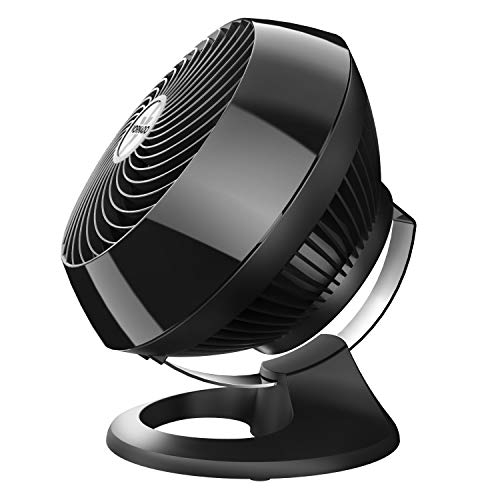
3. Vornado 560 Medium Air Circulator — Best Mid-Size
The 560 is the medium sibling of the 660 and the natural choice for a single bedroom, kitchen or home office. It uses the same vortex design — deep-pitched propeller, guide cone and spiral grille — and Vornado rates it to move air up to 75 feet, which is plenty to circulate a mid-size room. Four speeds give a genuinely low setting for sleeping hours as well as stronger settings for clearing cooking heat. The head adjusts on the chrome glide bar, and the grille comes off for wiping down the blades. It is smaller and lighter than the 660, so it is easier to move between rooms as the day changes. If your rooms are mid-size and you do not need smart controls or a DC motor, the 560 covers the brief without paying for the large model’s extra reach.

4. Vornado 460 Small Air Circulator — Best for Bedrooms and Desks
The 460 shrinks the circulator formula down to nightstand and desk size — about 9.7 inches wide, 11.25 inches tall and just over 4 pounds — while keeping the vortex airflow that defines the range. Vornado rates it to move air up to 70 feet, which is strong for its size and more than enough to keep a bedroom or small office circulating rather than just blowing on one spot. It has three speeds, an adjustable tilt on the chrome glide bar, and a removable grille for cleaning. There is no remote or timer, so it suits a set-and-forget spot where you can reach the switch easily. Choose the 460 when the bigger models physically do not fit your space, or when you want a second, smaller circulator for a bedroom while a larger model handles the living room.
View Vornado 460 Small Air Circulator on Amazon

5. Vornado 660 AE Air Circulator — Best Smart Controls
The 660 AE takes the large 660 platform — four speeds, vortex airflow rated to 100 feet, a 90-degree tilting head — and adds Alexa voice control. It is a Certified for Humans device, Amazon’s program for smart devices that set up without specialist skills, so you can switch it on, change speed or turn it off by voice or from the Alexa app when your hands are full. That makes it the pick for kitchens and workshops, and for anyone already running an Alexa household. Under the smart layer it is the same size and shape as the standard 660, with the same removable grille for cleaning. You do pay extra for the connected features, and if your home runs on a different voice assistant the AE version makes less sense. Otherwise it delivers the strongest airflow in this list with the most convenient controls.

What to Look For
| Factor | Why it matters | What to check |
|---|---|---|
| Airflow reach | Decides whether air actually crosses the room or fades halfway. | Maker’s stated throw distance and the size of your room. |
| Speed settings | More steps let you match the fan to the moment. | Number of speeds and whether the lowest one suits quiet hours. |
| Noise | A circulator often runs for hours in the background. | Maker’s decibel figure at low and high speeds, if listed. |
| Tilt and oscillation | Controls where the air goes and how evenly it spreads. | Tilt range, sweep angle, and whether oscillation can be switched off. |
| Footprint and weight | Affects where it fits and how easy it is to move. | Base size, carry handle, and cord length. |
| Controls | Remote or app control saves getting up. | Remote range, timer options, and display brightness. |
Setup and Care Tips
- Place the unit low and angle it toward a far corner so the airflow can travel the longest path.
- Keep furniture and tall plants out of the direct air stream so the flow is not broken up.
- Wipe the grille and blades with a barely damp cloth after unplugging the unit.
- Run it at a low speed first and raise it only if the room still feels stale.
- Store it with the cord loosely wrapped and the grille covered to limit dust build-up.
Mistakes to Avoid
- Choosing by blade size alone, since motor and housing shape drive how far air travels.
- Buying a model with a short cord, then relying on an extension that does not fit your outlet layout.
- Ignoring the lowest speed, which is the setting you will use most of the time.
- Pointing it straight at a seating area when the goal is to move air through the whole room.
- Skipping the maker’s cleaning notes, which differ between grille designs.
How Room Shape Changes Airflow
An air circulator works by sending a tight column of air across a room, letting it hit a surface, and drawing still air into the moving loop. Because the effect relies on a bounce, the shape of the room has a big influence. A long rectangular living room lets the stream travel a good distance before it meets a wall. A small square bedroom gives the air less run, and an open plan area with several doorways can let the stream drift away instead of curling back.
Furniture, shelving and doorways all interrupt the stream. A tall bookcase directly in the path can break up the flow, while an open stretch of wall gives the air a clean surface to follow. Before choosing a model or a position, walk through the room and picture where the air would travel.
Choosing a Size for the Space
Circulators come in small, medium and large sizes. A compact unit suits a desk, a nightstand or a small bedroom. A mid-size model handles a typical living room or a master bedroom. A large unit is aimed at big rooms, open plan spaces and areas with high ceilings. Makers usually provide suggested room sizes or reach distances in their listings, but treat those as guidance and compare them with the layout of your own space.
Going one size up gives you a reserve of power, so you can run the unit at a lower, quieter speed. Going too large in a tiny room can feel overpowering and noisy at the top setting.
Speed Settings and Noise Levels
Most circulators offer several speeds, and the practical question is how the lowest and highest settings feel. A quiet low speed is useful at night or while you work, whereas a strong high speed helps on warm afternoons. Listings often quote decibel figures, but conditions vary, so read the description for general notes on how loud the unit becomes and whether the speed steps are evenly spaced.
Sound also depends on where the unit sits. A fan on a hard floor can hum through the surface, while a mat or a small stand may reduce that transfer. Keeping the grille clean helps keep the sound steady.
Controls, Timers and Smart Features
| Feature | Useful for | Consider |
|---|---|---|
| Dial or knob | Simple, quick adjustments | Must be within reach |
| Remote control | Changing settings from the sofa or bed | Needs batteries and a safe place to keep it |
| Timer | Automatic shut-off | Check the time range offered |
| App or smart link | Scheduling and voice control | Requires a compatible network and account |
| Oscillation | Spreading the stream | Not every model includes it |
Think about how you will actually use the device. If you want to set it once and forget it, a simple dial is fine. If you like to adjust from bed, a remote adds convenience.
Using a Circulator Alongside Heating and Cooling
A circulator does not cool or heat air by itself. What it does is move the air that is already in the room, which can help even out the feel between corners. Many people use one with an air conditioner or a heater to help spread the conditioned air more evenly. Positioning matters here. In summer, you might aim the stream along the ceiling or across the room so cool air near the unit mixes with warmer air elsewhere. In cooler months, a gentle stream can help bring warm air down from higher levels.
Follow the maker’s advice for use with other appliances, and do not block the vents of heaters or air conditioners.
Tilt Angle and Placement Tricks
- Place the unit on the floor or a low surface so the stream travels at body height or just above.
- Aim it at a far wall or corner rather than directly at people.
- Tilt it up a little to push air along the ceiling in tall rooms.
- Try a position near a doorway to help move air from one room into the next.
- Leave several inches of clearance around the back and sides so the intake is not blocked.
Move the unit a short distance, wait a few minutes, and see how the room feels. Small shifts can make a big difference.
Moving Air in Kitchens, Bedrooms and Home Offices
Kitchens
Cooking leaves smells and heat in the air. A circulator on a counter or floor can help shift the air toward a vent or an open window. Keep it away from splashes, hot surfaces and the stove, and follow the maker’s guidance on where it may be placed.
Bedrooms
A small model on a dresser, angled toward a wall, offers a soft background breeze. Avoid pointing a strong stream at a bed if it feels uncomfortable.
Home Offices
Closed rooms with computers can feel stuffy. A low-speed circulator helps keep air moving without blowing papers about. Place it so cords stay clear of walkways.
Cleaning and Care
Dust collects on the grille and blades, and it can reduce airflow and make the unit louder. Switch off and unplug the device before cleaning. Many grilles can be removed by hand or with a simple tool as the manual describes. Wipe the parts with a damp cloth, let them dry, and refit them securely. Use a soft brush for the rear intake. Do not spray liquid inside the housing or immerse the unit in water.
Worked Examples for Common Rooms
A Long Living Room
Imagine a living room about twice as long as it is wide, with a sofa along one short wall. Place the circulator near the end opposite the sofa and aim it along the length of the room, a little above head height. The stream travels down the room, meets the far wall, and returns along the sides, mixing the air. Moving the unit toward the corner and angling it along the long wall can spread the effect to the dining side.
A Small Bedroom
In a compact bedroom, a small unit on the floor in a corner, aimed at the opposite wall, often gives a mild circulation without a direct draft on the bed. Use the lowest speed that still moves air, and check the effect over a few evenings before changing anything.
An Open Plan Space
Open areas lose airflow in every direction. Consider placing the unit near the boundary between zones and aiming it toward the area you use most, or use two smaller units in different spots instead of one that has to cover everything. Experiment with positions and give each a fair trial.
Troubleshooting
- Airflow feels weak: clean the grille and intake, then check the speed setting and whether furniture blocks the path.
- Unit vibrates: move it to a flat, firm surface and check that the base is assembled correctly.
- Clicking or rattling: inspect the grille clips and look for debris near the blades.
- Remote does not respond: replace the batteries and check for obstructions in front of the sensor.
- Unit will not run: test the outlet with another device, and contact the seller if the problem remains.
Energy and Running Costs
Circulators generally draw less power than many other household appliances, but the amount varies with the model and the setting. Look at the wattage in the specifications, and compare units with the same room size in mind. Models with efficient motors may use less electricity at the same airflow, yet the details differ, so read the maker’s information carefully.
Common Mistakes
- Pointing the unit straight at a seating area and expecting a whole-room effect.
- Placing it behind furniture where the intake is blocked.
- Choosing a size that is too small for an open plan space.
- Forgetting to clean the grille for months.
- Running a cord across a doorway.
Who Should Skip a Circulator
If you want a personal breeze that feels strong at close range, a standard fan might suit you better. Anyone who dislikes a constant airflow sound may prefer a quieter, simpler device. Those who need actual cooling in a hot space will still need an air conditioner or other cooling system.
Short Glossary
- Air circulator: a fan designed to move air across a whole space.
- CFM: cubic feet per minute, a measure of air movement.
- Grille: the guard around the blades.
- Oscillation: a side to side sweep of the airflow.
Quick Checklist
- Sketch the room and mark furniture and doors.
- Pick a size that suits the space.
- Decide on controls and timer needs.
- Plan a position with clear intake.
- Read the maker’s care steps.
Circulator, Fan or Purifier: Picking the Right Tool
These three products are often mixed up, and buying the wrong one is a common letdown. A circulator moves air around a room. A regular fan cools skin by blowing on it. An air purifier passes air through a filter. A circulator does not filter anything, so if filtering is your goal, look at a different product type.
| Product | Main job | Good match for |
|---|---|---|
| Circulator | Mix and move room air | Stuffy corners, uneven temperatures |
| Pedestal or box fan | Direct breeze on a person | Spot cooling |
| Purifier | Pass air through a filter | Dust and odor concerns |
A Short Plan for Your First Week
Once a unit is home, a little method helps you find the right spot. Change one thing at a time and give each setting a day before judging it.
- Place it on a flat, hard surface away from the wall by the distance the manual suggests.
- Begin on a low speed and note how far the air carries.
- Adjust the tilt a little at a time until the room feels evenly mixed.
- Try a higher speed only if the low one leaves areas still.
- Keep the cord out of walking paths.
Knowing When to Ask for Help
A circulator should not fix every comfort problem. If one room is always much warmer or colder than the rest, the cause may be insulation, ducts, windows or the heating and cooling system itself. A heating and cooling professional can look at those. If the unit makes grinding sounds, smells odd or trips a breaker, stop using it and follow the maker’s guidance on service or warranty. Do not open the housing yourself unless the manual says it is safe to do so.
Reading Specifications Without Being Misled
Listings often quote airflow and noise figures that are hard to compare. Airflow may be given in cubic feet per minute, while noise might be given in decibels at an unstated distance. When two makers use different test methods, their numbers cannot be lined up fairly.
Instead of chasing a single figure, look at the range of speed settings and the stated room size. Ask whether the controls suit you, and whether the cord is long enough for your layout. Check also whether the listing explains how to clean the grille and housing. The more clearly a maker describes these basics, the easier your comparison becomes. If a detail is missing, the product manual on the maker’s site is usually a good source before you buy.
Keep the manual and the packing slip together in one folder. If a question comes up later about parts, service or coverage, having both on hand saves a lot of time and avoids confusion with the seller.
A Practical Decision Workflow Before You Buy
Most disappointing purchases in this category do not happen because the product itself is poor. They happen because the buyer skipped a short round of honest homework and ordered on a single headline feature. A whole-room air circulator has to fit a specific space, a specific routine and a specific set of habits, and those three things differ far more between households than any specification sheet suggests. The workflow below takes about fifteen minutes, needs nothing more than a tape measure, a notebook and your phone, and it will narrow the picks in this guide down to one or two clear candidates.
Start with the space, not the product. Measure the area where the circulator will live or be used, and write down the fixed obstacles as well: doors that swing through the space, sockets that are already spoken for, furniture that cannot move, and anything that generates heat, moisture or dust nearby. Photograph the space from two angles. It sounds excessive, but a photograph taken now will answer questions later that memory will not, especially once you are comparing dimensions on a product page late in the evening.
Next, write down the job in one sentence. Not a wish list, just the main job: what should be different the week after this arrives? Keep that sentence visible while you shop. Every feature you consider after that has to earn its place by serving that sentence. Features that do not serve it are not bargains; they are future clutter, extra cleaning, or settings you will scroll past for years without touching.
Then list your constraints honestly. Budget is only one of them. Time is another: how many minutes a week will you genuinely give to cleaning, charging, adjusting or maintaining this purchase? Storage is a third: where does it, and everything that comes with it, go when it is not in use? Noise tolerance, the patience of other people in the household, and any physical limits such as lifting weight or reaching height all belong on the same short list.
Only now open the product pages, and read them in a fixed order. First the dimensions and requirements, because a mismatch there ends the discussion. Second the controls and the everyday operating steps, because those are what you will live with daily. Third the care requirements, because they decide whether the product still pleases you in month six. Marketing language comes last, if at all. When two picks look identical, the one whose everyday steps are simpler almost always wins in real life.
Finally, do a short reality check against the picks above. The option labelled as the best overall choice earns that label by balancing the most common needs, which makes it the sensible default if your written job sentence sounds ordinary. The more specialised picks earn their place when your constraints list contains something unusual: a very small space, a very heavy workload, a strict noise limit, or a user with specific physical needs. If none of your constraints are unusual, resist paying extra for specialisation you will never call on.
Use Cases in Detail: Matching the Pick to the Situation
Abstract advice only goes so far, so it helps to walk through the situations buyers describe most often and see how the decision changes in each one. Read the scenarios below and find the one closest to your own household; the right choice usually becomes obvious once the situation is stated plainly.
A living room where air feels still in the corners
In this situation the priority is reliability under daily repetition. The circulator will be used when people are tired, rushed or distracted, so controls need to be forgiving and the basic setup needs to stay put without constant adjustment. Choose the pick whose everyday operation is described most simply in the reviews above, set it up once with care, and then leave the settings alone for the first week so you learn its normal behaviour before you start fine-tuning anything.
A bedroom that runs warm at night
Here the deciding factor is usually comfort over long stretches rather than peak performance in short bursts. Think about posture, reach, noise and heat over hours, not minutes. A whole-room air circulator that feels fine in a five-minute test can become irritating by the third hour, so weight the comments in this guide about sustained use more heavily than the headline features. It is also worth planning the surrounding details: lighting, seating, cable routes or storage within arm’s reach make as much difference as the product itself.
A home office with a desk in one corner
When several people share the same circulator, the purchase has to survive handovers. Settings get changed, parts get moved, and nobody reads instructions twice. Favour the pick with the clearest controls and the fewest fragile accessories, agree one house rule for how it is left after use, and keep any small parts together in one labelled container. Shared use also raises the value of easy cleaning, because a product that is simple to wipe down or empty actually gets cleaned, while a fiddly one quietly gets worse.
A kitchen that holds cooking heat
This last situation rewards planning for the awkward moments rather than the average day. Think about the hottest, coldest, busiest or most tiring version of the routine, and choose the pick that still works then. Capacity, reach and durability matter more than refinements. It is also the situation where buying once, properly, beats buying cheaply twice: a circulator that struggles at the edges of its range tends to be replaced within a year, which costs more than starting with the stronger option would have done.
Comparing the Picks Head to Head
Comparison tables compress a lot of judgement into a few rows, which makes them useful starting points and poor finishing points. The paragraphs below slow the comparison down and look at each pick in this guide on its own terms, using only what the reviews above already establish. Work through them with your constraints list open, and cross picks off rather than ranking them: the right purchase is usually the last one standing, not the one with the longest feature list.
Vornado 660 Large Air Circulator. Its role in this guide — best overall — tells you the job it was picked for, so judge it against that job rather than against every other pick at once. Re-read its section above with your written job sentence beside you, and note the one honest limitation mentioned there. If that limitation touches something you do every day, move on to the next pick; if it touches something you rarely do, it is a fair trade for the strengths the review describes.
Vornado 633DC Energy Smart Air Circulator. Its role in this guide — best for energy savings — tells you the job it was picked for, so judge it against that job rather than against every other pick at once. Re-read its section above with your written job sentence beside you, and note the one honest limitation mentioned there. If that limitation touches something you do every day, move on to the next pick; if it touches something you rarely do, it is a fair trade for the strengths the review describes.
Vornado 560 Medium Air Circulator. Its role in this guide — best mid-size — tells you the job it was picked for, so judge it against that job rather than against every other pick at once. Re-read its section above with your written job sentence beside you, and note the one honest limitation mentioned there. If that limitation touches something you do every day, move on to the next pick; if it touches something you rarely do, it is a fair trade for the strengths the review describes.
Vornado 460 Small Air Circulator. Its role in this guide — best for bedrooms and desks — tells you the job it was picked for, so judge it against that job rather than against every other pick at once. Re-read its section above with your written job sentence beside you, and note the one honest limitation mentioned there. If that limitation touches something you do every day, move on to the next pick; if it touches something you rarely do, it is a fair trade for the strengths the review describes.
Vornado 660 AE Air Circulator. Its role in this guide — best smart controls — tells you the job it was picked for, so judge it against that job rather than against every other pick at once. Re-read its section above with your written job sentence beside you, and note the one honest limitation mentioned there. If that limitation touches something you do every day, move on to the next pick; if it touches something you rarely do, it is a fair trade for the strengths the review describes.
Two patterns are worth watching for as you compare. First, the gap between the best overall pick and the specialised picks is rarely about quality; it is about fit. A specialised pick is not a lesser product, it is a narrower one, brilliant inside its niche and merely adequate outside it. Second, accessories and extras sway decisions out of proportion to their value. Ask of every extra whether you would use it weekly. If the honest answer is monthly or never, let it go, and let the core performance, the controls and the care routine decide instead.
If you finish this comparison with two picks still standing, break the tie with ownership questions rather than performance questions. Which one will be easier to clean in your actual space? Which one’s controls will the other people in the household understand without asking you? Which one stores more neatly when it is not in use? Those unglamorous questions predict satisfaction six months from now far better than any single specification does.
Day-to-Day Use, Cleaning and a Simple Care Routine
The first week with a new circulator sets habits that tend to stick, so spend a little of that week deliberately. Run through the full operating cycle slowly once, from start to finish, while you are not in a hurry. Notice the order things have to happen in, where your hands naturally go, and which step feels awkward. Awkward steps are where mistakes and breakages concentrate later, so rearrange the surrounding space now, while changing it is still easy.
Build cleaning into the routine the product already has, rather than treating it as a separate chore. A quick wipe, shake, rinse or empty at the natural end of each use takes seconds and prevents the slow build-up that eventually needs a deep clean. Keep whatever you use for that quick job within arm’s reach of where the circulator lives; supplies stored in another room might as well be stored in another house, because the quick job simply stops happening.
A workable care schedule
After each use: return everything to its resting state, clear away residue, moisture or loose debris, and leave the circulator somewhere air can reach it if it needs to dry. Weekly: give the surfaces and contact points a proper clean with a soft cloth and mild cleaner suited to the material, check moving parts and connections for looseness, and deal with small issues while they are still small. Monthly: do the deeper job — the full wash, descaling, sharpening, re-tightening or inspection the manual describes — and look honestly at wear. Seasonally: review storage, replace anything consumable that has quietly expired or worn out, and reconsider placement if the household’s routine has changed.
Storage deserves the same thought as use. Keep the circulator dry, out of direct extremes of heat and cold, and away from the crush zone at the back of a cupboard or the bottom of a pile. Small parts belong in one container, labelled, stored with the main item rather than near it. If the original packaging includes shaped inserts that protect fragile parts, consider keeping it; flat-pack storage boxes look tidier but protect less.
When something goes wrong, troubleshoot in order of likelihood before assuming failure. Check power, connections and settings first, then positioning, then cleanliness, then wear. Most problems reported with products in this category trace back to one of those four, and most are fixed in minutes without tools or spare parts. Keep the manual, or a photo of its troubleshooting page, somewhere you can find it on a bad evening rather than at the bottom of a drawer.
More Mistakes That Shorten a Product’s Life
Beyond the mistakes covered earlier in this guide, a few quieter habits do most of the long-term damage. The first is running the circulator at its maximum setting as a default. Maximum settings exist for occasional peaks; used constantly, they raise noise, heat and wear while often delivering little extra benefit. Find the lowest setting that does the job properly and treat anything above it as a reserve.
The second is ignoring the environment. Dust, steam, direct sun, cramped airflow and unstable surfaces all age a whole-room air circulator faster than ordinary use does. You cannot always choose the environment, but you can usually improve it by a few centimetres: a small gap for air, a mat for stability, a move away from a heat source. Those tiny adjustments compound over years.
The third is postponing small maintenance until it becomes a repair. A loose fitting, a frayed edge, a filter or part that is past its best — each is cheap and quick to address when noticed, and expensive or impossible later. The weekly check in the care schedule above exists precisely to catch these while they are still trivial.
The fourth is buying replacement parts, refills or accessories on price alone without checking fit. Incompatible extras are a false economy: they perform poorly, can damage the main product, and usually cannot be returned once opened. Match the part to the model exactly as the manual specifies, and keep a note of the model details on your phone so the information is with you when you need it.
The last is letting the purchase drift away from its original job. Households change, and a circulator bought for one routine gets pressed into another it was never suited to. When that happens, the honest options are to adapt the routine back, accept the compromise knowingly, or replace the product with one designed for the new job. Blaming the product for a job it never claimed to do helps nobody, and recognising the mismatch early saves both money and frustration.
FAQ
How is a circulator different from a regular fan?
A regular fan spreads air wide and loses force quickly. A circulator concentrates the flow into a narrower column so it can carry farther, moving air around the whole room rather than cooling a single spot.
Where should I put one?
Many people set it on the floor or a low shelf aimed at an upper corner or a far wall. Try a few angles for a day each and keep the one that gives the most even movement in the room.
How long should a whole-room air circulator realistically last?
Longevity depends far more on routine care and a suitable environment than on the badge on the front. A circulator that is cleaned on the simple schedule described in this guide, stored dry and used within the job it was bought for will normally serve for years of regular household use. The earliest signs that replacement is approaching are usually a slow decline in performance, controls or fittings becoming loose or unreliable, and replacement parts getting hard to find. When two of those three appear together, start planning a replacement rather than spending on repairs.
Is it worth paying more for the top pick in this guide?
Only if the extra money buys something your own constraints list actually asks for. The top pick earns its place by balancing the needs most buyers share, which makes it the safest choice for an ordinary household. Paying more for a specialised model makes sense when your situation is genuinely specialised — an unusually large or small space, a much heavier workload than average, or a user with specific needs. If your written job sentence sounds like most people’s, the balanced pick will satisfy you, and the saving is better kept for the accessories or consumables you will genuinely use.
What should I check in the first week of ownership?
Check fit, controls and routine, in that order. Confirm the circulator sits, fits or operates in your space exactly as you measured it, and that doors, sockets and neighbouring items still work as they should. Run every control once so nothing is a surprise later. Then watch your own routine: note anything you keep working around, because small rearrangements made in week one are easy, while workarounds left for a month become permanent habits. Keep packaging until the end of that first week in case an exchange is needed.
How do I know whether to repair or replace?
Compare three things: the cost of the repair against the remaining life you would get from it, the availability of the correct parts, and whether the fault is isolated or part of a general decline. A single failed part on an otherwise sound circulator is usually worth repairing. Repeated faults, declining performance and worn fittings arriving together signal that the product is wearing out as a whole, and money spent on one repair tends to be followed by another. Safety always overrides the calculation: anything electrical, load-bearing or heat-related that behaves unpredictably should be taken out of use until it is checked.
Can I use a circulator for jobs beyond what it was bought for?
Sometimes, cautiously, and only within the limits the manual describes. Products in this category are designed and tested around a particular job, load and environment. Occasional light use outside that pattern is unlikely to cause harm, but making an unsuitable job part of the regular routine accelerates wear and can create safety risks the design never anticipated. If a new job has become a regular part of your household’s life, that is a sign to look at a product designed for it, rather than asking the current one to stretch further every week.
What is the single most useful habit for getting value from this purchase?
The end-of-use reset. Returning the circulator to a clean, dry, ready state every time you finish with it takes under a minute and does more for long-term satisfaction than any other habit. It prevents build-up, reveals small problems while they are still trivial, means the product is always ready when the next person reaches for it, and quietly extends its working life. Most products that disappoint early were not badly made; they were badly reset, day after day, until small neglects added up.
The Short Version
Match the reach to your room size, favor a quiet low setting, and look for a tilt range that lets you aim the air where you want it. Compare the maker’s numbers side by side, then pick the layout and controls you will enjoy using every day.
Related Guides
- How to Choose the Best Whole House Air Purifiers (2026 Guide)
- How to Cook a Whole Chicken in an Air Fryer: Full Guide
- How to Cook Sweet Potatoes in an Air Fryer: Whole, Cubes, Fries
- 6 Best Window Air Conditioners: BTU, Room Size, Noise (2026)
- Tower Fan vs Air Circulator: Match the Airflow to the Room