A coir doormat is woven or tufted from coconut husk fiber. The stiff fibers scrape grit from shoes before it reaches the floor. Mats differ in thickness, in whether they have a vinyl backing, and in size, so a mat for a covered porch is not always right for a tight door clearance.
The six mats below range from a 0.5 inch backed mat to a 1 inch unbacked scraper. Sizes, thickness and backing come from each product’s listing page. We have not used these mats ourselves. Durability claims are the makers’ own.
As an Amazon Associate we earn from qualifying purchases. Links below are affiliate links, and they do not change the product information we give.
What to Look For
| Feature | Why it matters |
|---|---|
| Thickness | Thicker mats scrape harder but need door clearance |
| Backing | Vinyl resists sliding; unbacked mats dry with more airflow |
| Size | Wider mats suit double doors and wide entries |
| Shedding | Some loose fiber is normal for coir |
In this guide
Specs at a Glance
| Mat | Size and thickness | Backing | Notes |
|---|---|---|---|
| KAF Home | 17 x 30 in; 0.6 in | Non-slip; the listing says both TPE and PVC | Low pile; plain blank mat; 4 lb |
| Kempf 1 inch | 22 x 36 in; 1 in | Coir; open weave | Braided; 3 kg; shake clean |
| Kempf Dragon Weave | 22 x 36 in; 1 in | Unbacked | Hand-twisted fibers; medium pile |
| Calloway Mills | 24 x 36 in; 0.6 in | Vinyl | Machine made; 3.2 lb |
| Kempf Black Border | 22 x 36 in; 0.5 in | Vinyl | Low pile; dyed border; 7 lb |
| PLUS Haven | 17.5 x 30 in; 0.6 in | PVC | Tufted; light brown |
The 6 Best Coir Doormats

Top pickBest for a standard-width door
1. KAF Home Coir Doormat, 17 x 30 Inch
A plain 17 by 30 inch mat with a 0.6 inch low pile and a non-slip backing, described as weather resistant for indoor or outdoor use. The listing names the backing as both recycled TPE and PVC, so check which you receive.
Suits: a standard-width door. Strengths: a low pile and a non-slip back. Weaknesses: the backing material is described two ways. Skip it if you want a wide mat.

View KAF Home Coir Doormat 17 x 30 Inch Non-Slip Backing on Amazon

Best for heavy scraping at a covered entry
2. Kempf 1 Inch Thick Natural Coir Doormat, 22 x 36 Inch
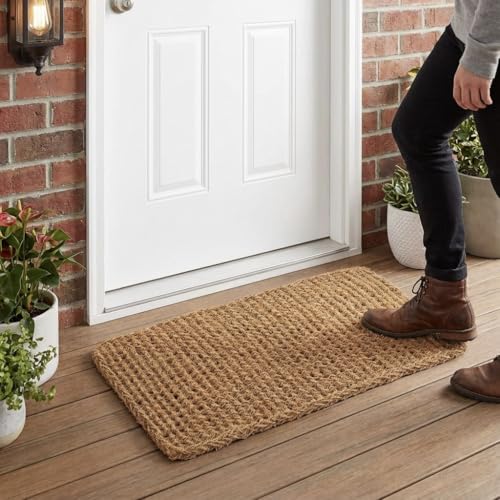
A braided, hand-woven 22 by 36 inch mat that is 1 inch thick with an open coir backing for airflow. The maker suggests covered porches, mudrooms and garage entries and says to shake or tap it clean.
Suits: heavy scraping at a covered entry. Strengths: a thick pile and no rubber backing. Weaknesses: may not clear a low door. Skip it if you want a non-slip back.

View Kempf 1 Inch Thick Natural Woven Coco Coir Doormat 22 x 36 Inch on Amazon
Best for wide front doors
3. Kempf Dragon Weave Coir Doormat, 22 x 36 Inch
A flat-woven 22 by 36 inch mat, 1 inch thick, with hand-twisted fibers in rope-like bundles and no PVC backing. The maker says to shake or vacuum it to clean.
Suits: wide front doors. Strengths: a rigid weave and a breathable back. Weaknesses: not anchored by a backing. Skip it if the mat will sit on a slick surface.

View Kempf Dragon Weave Coco Coir Doormat 22 x 36 Inch on Amazon

Best for a larger entry
4. Calloway Mills Natural Coir Doormat, 24 x 36 Inch
A machine-made 24 by 36 inch mat with a 0.6 inch pile and a vinyl backing that the maker says helps prevent movement. It is the widest mat in this group.
Suits: a larger entry. Strengths: the most coverage and a backing. Weaknesses: the spec table lists the material as natural fibers. Skip it if you want a hand-woven look.

View Calloway Mills Natural Coir Vinyl Backing Doormat 24 x 36 Inch on Amazon

Best for doors with little clearance
5. Kempf Black Border Coir Doormat, 22 x 36 Inch
A needle-punched 22 by 36 inch mat, 0.5 inch thick with a low pile, vinyl backing and a dyed border that the maker says will not fade. The listing title mentions low clearance.
Suits: doors with little clearance. Strengths: the thinnest mat and a bordered look. Weaknesses: a thinner scraping layer. Skip it if you want a thick scraper.

View Kempf Black Border Coco Coir Doormat 22 x 36 Inch Non-Slip Backing on Amazon

Best for a standard door
6. PLUS Haven Coco Coir Door Mat, 17.5 x 30 Inch
A tufted 17.5 by 30 inch light brown mat with a 0.6 inch pile and a PVC backing. The maker notes that sizing may vary slightly and that light shedding can occur.
Suits: a standard door. Strengths: a backed, tufted build. Weaknesses: some shedding. Skip it if you want a wider mat.

View PLUS Haven Coco Coir Door Mat 17.5 x 30 Inch Heavy Duty Backing on Amazon
Care and Setup
- Measure your door clearance before choosing a thick mat.
- Shake the mat out or brush it regularly.
- Place it where it stays under cover when you can.
- Let a wet mat dry in the open.
Mistakes to Avoid
- Choosing a 1 inch mat for a door with low clearance.
- Expecting no shedding from a natural fiber mat.
- Putting an unbacked mat on a slick floor.
- Buying a narrow mat for a wide entry.
Questions to Ask Before You Buy
- How wide is your door, and does the mat need to stay clear of the swing?
- Is the entrance covered by a porch or exposed to direct rain?
- Does the maker’s listing describe the thickness, so you can check clearance under the door?
- Do you want a plain natural look, a printed design or a bordered style?
- Will anyone in the household be bothered by loose fibers on a floor or on shoes?
- Does the listing mention cleaning instructions?
Storage and Care Notes
Natural fiber mats shed a little when new, so expect to sweep the area for the first few weeks. Shake the mat outdoors on a regular basis, or beat it against a railing, to knock loose grit out of the weave. A stiff broom or a vacuum with a brush head can lift what stays behind.
Moisture is the main enemy of plant fiber. If the mat gets soaked, lift it and let it dry in the open so the underside can breathe, and avoid leaving it on a wet surface for long. Sun fades the color over time, which many people consider part of the charm. Do not use harsh chemicals or a pressure washer unless the maker’s listing allows it.
When the mat is flattened and worn, you can rotate it to even out use or replace it. In cold seasons, consider rolling it up and storing it indoors if the maker suggests that.
Who Should Skip It
If someone in the home has trouble with loose debris, or if you want a mat that tolerates frequent machine washing, a synthetic option may fit better. Entrances with heavy rain and no cover may suit a drainage-style mat instead.
Measuring Your Entrance Before Ordering
A doormat that does not fit will frustrate you every day, so take a few minutes to measure before you choose. Start with the width of the door itself, and decide whether you want the mat to match the door or extend past it. A mat that is slightly wider than the door looks balanced and gives people more room to wipe their feet. A mat that is narrower than the door can look lost and leave gaps at the sides.
Next, look at the depth of the space in front of the door. The mat should sit flat within the area, with room to spare, so that you are not tripping over an edge. Allow for the swing of the door, because a mat that catches on the bottom of the door will tear, curl or stop the door closing properly.
- Measure the width of the door and the space available on the ground.
- Check how far the door swings inward or outward, and which way.
- Measure the gap beneath the door when it is closed.
- Compare each measurement with the size in the product listing.
Makers sometimes note that sizes can vary slightly, so allow a little tolerance. If your space is tight, a smaller or thinner mat is safer than one that barely fits. Take the measurements with the door fully open and closed, as the clearance can change across its swing.
Thick Versus Thin Mats and Door Clearance
Thickness is the feature that causes the most surprises. A thick mat scrapes harder and holds more grit, but it needs room under the door. A thin mat sits low and slides under most doors, but its scraping layer is shallower, so it may need more frequent shaking.
Check the clearance by measuring the gap between the floor and the bottom of the door at its lowest point. Remember that a mat sits on the floor and may be on top of an existing threshold, a rug or paving that raises it further. Test with a stack of books or a ruler to see how much space you really have.
- Thick mats: suit covered porches and entrances where the door opens outward or has a high gap.
- Thin mats: suit doors that open inward over carpet or have little clearance.
- Mid-thickness mats: a common middle ground for standard doors.
If the door opens outward, thickness matters less for the swing but still matters for catching on the threshold when you step. If the door opens inward over a floor covering, clearance is critical. When in doubt, choose the thinner option and plan to clean it more often. Look at the listing for the stated thickness, and compare it with your measured gap.
Where the Mat Will Live: Indoor, Outdoor and Covered Spots
The location changes which mat suits best. Coir is a natural fiber, so it responds to weather in a way that synthetic mats do not. Understanding this helps you pick the right place and the right care routine.
A covered porch is generally the kindest setting. The mat stays shaded from heavy rain and strong sun, so the fiber lasts longer. An uncovered doorstep exposes the mat to rain, frost and sun, which can speed up wear, darkening and fading. Many people accept that and replace the mat when it looks tired, while others bring it inside during harsh weather.
Indoors, coir works well in a hallway or entry, where it catches dirt before it spreads. Here, shedding is the main concern, since loose fibers can find their way onto the floor. A backed mat tends to stay put on smooth flooring.
- Put the mat on a flat, clean surface so water can drain beneath it.
- Avoid places where water pools, as constant damp can lead to mould.
- On wooden decking or painted surfaces, check whether a backing could mark the finish.
- In sunny spots, expect some colour change over time.
Read what the maker says about indoor or outdoor use and follow it. If rain exposure is unavoidable, consider keeping a second mat indoors for deep cleaning and swapping them.
How Long a Coir Mat Lasts and When to Replace It
There is no exact lifespan, because use, weather and care all play a part. A mat by a busy family door will wear faster than one by a seldom-used side entrance. Durability claims on listings are the maker’s own, so treat them as a guide rather than a promise.
Signs that a coir mat is nearing the end of its life are easy to spot. The fibers flatten and stop scraping effectively. Bald patches appear where feet land most often. The backing, if there is one, cracks or peels away. A damp smell that does not go away after drying suggests that moisture has soaked in.
- The pile is flattened and no longer scrapes shoes well.
- Large areas have shed so much fiber that the base shows.
- The backing is curling, peeling or cracking.
- Mould or a persistent musty smell remains after drying.
- The edges are fraying badly enough to catch feet.
You can extend life by rotating the mat so wear is spread out, shaking it regularly and letting it dry fully after rain. If it still looks worn after care, replacing it is simple and inexpensive compared with the floor it protects. When you replace it, use what you learned from the old one: whether it was the right size, thickness and backing for your door.
Budget Tiers and What Changes Between Them
Coir mats span a range of prices, and the difference usually shows up in construction rather than in the basic material. Understanding what you gain at each level helps you decide where to spend.
At the lower end, you tend to find lighter, thinner mats with a machine-made or tufted build and a backing. These do a decent job of catching surface dirt and suit sheltered or lightly used entrances. They may shed more and wear sooner under heavy use.
In the middle, mats are often thicker and denser, with firmer fibers or a more even weave. They scrape more thoroughly and tend to hold their shape for longer. Some come with decorative borders or printed designs.
At the higher end, hand-woven or hand-twisted mats with a thick pile are common. They look more textured and rugged, and they suit people who want a strong scraper at a main entrance. They may weigh more and lack a non-slip backing.
- Pay for thickness if you have a muddy approach and the clearance to allow it.
- Pay for a backing if the mat will sit on a smooth floor.
- Do not pay extra for size you cannot use.
- Check the listing for what the maker actually states about construction.
The right level depends on how hard the mat will work. A sheltered side door rarely needs the toughest option, while a busy main entrance may repay a sturdier build.
Where the Mat Will Live: Matching Thickness and Backing
The same coir mat does not suit every doorway. A porch with a covered roof asks different questions than an open step that sees rain and a garage entry that sees mud. Think about the spot first, then compare backing and thickness.
| Location | What to prioritize |
|---|---|
| Covered porch | Natural fiber depth for scraping, moderate backing |
| Open front step | Backing that drains and a mat you can lift to rinse |
| Inside entry | Slim profile, a backing that grips the floor, and a size that clears the door swing |
| Garage or mudroom | Thick fibers and a larger footprint for several pairs of boots |
Door clearance deserves a check. Measure the gap under the door and compare it with the stated thickness of the mat, so the door can still swing over it.
Shedding, Fading and Other Normal Behavior
Coir comes from coconut husk fibers, and the natural material behaves in ways that surprise first-time owners. Knowing what is normal keeps you from judging a mat too soon.
A new mat sheds loose bristles for a while. Shake it out outdoors, and a vacuum or a stiff broom will collect the rest. This shedding usually slows with use. Natural fibers also fade in sunlight and may turn a lighter shade over a season or two, particularly in a spot that gets direct sun. If that matters to you, a printed or dyed mat in a shaded location will hold its look longer.
Moisture is another point. Coir dries fairly quickly but can hold dampness against a concrete step, so lifting the mat now and then to let air reach the underside is a good habit. Hosing it down and leaving it propped up to dry works for most mats, while the maker’s care label tells you if anything is off limits.
Finally, remember that a doormat is a scraper, not a vacuum. Knock it against a wall, and expect to replace it when the fibers flatten or the backing wears through.
A Short Care Routine
- Shake or beat the mat outdoors every week or two.
- Vacuum the surface if it is used indoors.
- Rinse with a hose now and then, then prop it up to dry in the shade.
- Brush mud away only after it has dried.
- Rotate the mat to even out wear.
Sizing the Mat to the Door
A mat should be wide enough that a person can step on it with both feet before reaching the door. As a general guide, choose a width that is close to the width of the door frame, and a depth that allows at least one full stride. A mat that looks tiny against a large entry will not catch much, and a mat that is too large may bump the door. Measure the open area, then compare it with the figures on the listing. Rounded corners can help in tight spots.
Deciding on Coir doormats: A Slower, Smarter Way to Choose
Most disappointing purchases in this category happen in the first five minutes, when a single attractive feature crowds out the questions that actually decide whether the product will work in your home. A coir doormat is a working surface that scrapes, sheds and weathers in public view, so door clearance and exposure matter as much as the pattern on its face. A slower decision does not need to be a long one. It simply means working through the job, the space, the people and the upkeep in that order, and only then comparing the picks in this guide against the answers you have written down.
Start with the job in one plain sentence. Write down what the coir doormats has to do on an ordinary day, not on the best day or the worst day. Ordinary use is where products earn their keep, and a choice that fits the ordinary day usually stretches to cover the unusual one, while the reverse is rarely true. If two people will use it in different ways, write both jobs down and notice where they agree, because the overlap is the safest ground to buy for.
Then be honest about the feature you are most tempted by. Tempting features are not bad features, but they should have to justify themselves against the job sentence you just wrote. If the feature does not make the ordinary day easier, calmer, warmer, cooler, safer or tidier, it belongs in the nice to have column, and it should not be allowed to overrule size, fit or ease of use when those point the other way.
Measure First, Then Read the Picks Again
Before you compare any of the options above, measure the full length and width of the traffic path, the clearance under any doors that swing over it, and the furniture it needs to sit under or in front of, rather than ordering from the room name alone. Write the numbers where you can see them while you shop, and keep them in the same units the listing uses, converting carefully if you have to, because most sizing mistakes are really unit or rounding mistakes that felt too small to matter.
Leave yourself a margin. A product that only just fits the hallway, doorway or floor area it has to cover leaves no room for the way real homes behave: things get moved, other items share the space, and people reach, sit, walk or lean in ways no diagram predicts. A comfortable margin is not wasted space. It is the difference between a product that slots into your routine and one that has to be negotiated with every day.
Once you have your numbers, read the pick descriptions at the top of this guide a second time with a pen in hand, literally or mentally. Mark each pick as a clear fit, a possible fit or a poor fit on size alone, and let that shortlist, rather than the order the picks appear in, drive the rest of your reading. Reviews and comparisons get much more useful once half the field has been honestly eliminated.
Picture the Ordinary Week, Not Just the First Day
New purchases are usually judged on day one, when everything is novel and everyone is being careful. A better test is the ordinary week that follows. Picture the coir doormats on a tired weekday, when you are in a hurry, the room is not tidy and nobody is performing good habits for the benefit of a new purchase. If the product still makes sense in that picture, it is a product you will still be using in six months.
Now picture the busiest version of its job: guests in the house, children or pets underfoot, a trip being packed for, a deadline looming, or the season at its hottest, coldest or wettest, depending on what this product has to handle. Busy moments expose weak points that calm moments hide, such as awkward controls, slow setup, fragile parts or care routines that take longer than the use itself. You do not need the product to be perfect under pressure, but you do need to know in advance where it will struggle.
Finally, picture the quiet version of its job, the early morning or late evening when the house is still. Products used at the edges of the day are judged on different qualities: how much noise they make, how much light they give off, how they feel half asleep, and whether using them disturbs anyone else. Running these three pictures, the ordinary week, the busy peak and the quiet edge, takes two minutes and prevents most mismatches between a good product and the wrong home.
Comparing the Picks in This Guide, Head to Head
The picks above were chosen to cover different needs rather than to repeat the same product six times, so the most useful comparison is not a hunt for a single winner. It is a process of elimination driven by your job sentence, your measurements and your tolerance for upkeep. Work through the pairs below in that spirit, keeping the pick whose described strengths match your ordinary week and letting go of any pick whose described weakness lands on something you do every day.
Set the KAF Home Coir Doormat, 17 x 30 Inch beside the Kempf 1 Inch Thick Natural Coir Doormat, 22 x 36 Inch and ask what each one is really for. The notes above give each pick a clear suits, strengths and skip it if summary, and those three lines are the honest comparison: if the skip it if line describes your household, believe it, even if the strengths sound appealing. If neither skip line applies, decide on the strength you will actually use weekly rather than the strength that merely sounds impressive, and check the size and care details of your preferred one a final time before ordering.
Set the Kempf Dragon Weave Coir Doormat, 22 x 36 Inch beside the Calloway Mills Natural Coir Doormat, 24 x 36 Inch and ask what each one is really for. The notes above give each pick a clear suits, strengths and skip it if summary, and those three lines are the honest comparison: if the skip it if line describes your household, believe it, even if the strengths sound appealing. If neither skip line applies, decide on the strength you will actually use weekly rather than the strength that merely sounds impressive, and check the size and care details of your preferred one a final time before ordering.
Set the Kempf Black Border Coir Doormat, 22 x 36 Inch beside the PLUS Haven Coco Coir Door Mat, 17.5 x 30 Inch and ask what each one is really for. The notes above give each pick a clear suits, strengths and skip it if summary, and those three lines are the honest comparison: if the skip it if line describes your household, believe it, even if the strengths sound appealing. If neither skip line applies, decide on the strength you will actually use weekly rather than the strength that merely sounds impressive, and check the size and care details of your preferred one a final time before ordering.
If two picks are still tied after that, choose on the unglamorous details: which one is easier to clean, easier to move, easier to live with when it is not the centre of attention, and easier to replace or pass on if your needs change. Ties are usually broken better by daily friction than by features, because features are used occasionally while friction is felt constantly.
Care Habits That Keep It Working Longer
Give the item a firm shake or vacuum on a routine that matches the traffic it receives, and deal with grit early, because grit worked deep into fibres or backing is what wears a floor covering out from the inside.
Blot spills promptly from the outside of the mark inward, test any cleaning product on a hidden corner first, and let the item dry fully before walking it back into heavy use or putting furniture back on top of it.
Use a suitable pad or backing support where the design allows it. A pad improves grip, softens the feel underfoot, protects the floor beneath and usually extends the life of the covering itself.
Build the care into a rhythm you already keep rather than inventing a new one. A task attached to an existing habit, such as laundry day, the weekly clean or the change of a season, actually happens. A care routine that depends on remembering a separate schedule quietly stops happening, and the product pays for it months later in ways that look like poor quality but are really postponed maintenance.
When Something Feels Wrong: A Calm Troubleshooting Order
If edges curl or corners lift, flatten them patiently with weight and time, check the pad underneath, and make sure door clearance is not catching the edge every time the door moves.
If the item slides, clean the floor underneath first, because dust and polish residue defeat most grips, then reassess the pad or backing before blaming the covering itself.
Whatever the problem, change one thing at a time and give the change a fair trial before changing another. Swapping three things at once leaves you with no idea which one helped, and it often creates a new problem while solving the old one. Keep a short note of what you tried, even if it is only a line on your phone, because the pattern across a week is far more informative than any single frustrating evening.
Know the point at which troubleshooting should stop. If the item is damaged, unsafe, electrically suspect, structurally unsound or simply miserable to use after honest adjustments, replacing it is not a failure of effort. It is the correct conclusion of the process, and the notes you kept about what went wrong are exactly what makes the next choice a better one.
The Return Trip: Mistakes That Send Good Products Back
The most common reason products like these go back is not defects. It is a mismatch discovered too late: the size that was guessed instead of measured, the care routine nobody in the house was willing to keep, or the feature bought for a version of life the household does not actually live. Every one of those is visible before ordering if you use the job sentence, the measurements and the ordinary week picture described above, which is why this guide returns to them so often.
A second, quieter mistake is buying for a single person in a shared home. If other people will use, move, wash, sit on, walk over or sleep beside the coir doormats, their habits are part of the specification whether they were consulted or not. A five minute conversation before ordering, covering who uses it most, who maintains it and where it lives when not in use, prevents the slow resentment that builds around a purchase only one person wanted.
When the product arrives, keep the packaging until you have lived with it through at least a few ordinary days and one honest test of its main job. First impressions reward novelty, but returns windows are spent on real life, and the household that tests promptly, while keeping its options open, is the one that ends up keeping the right product instead of merely keeping the first product.
A Short Decision Worksheet You Can Actually Finish
Before you order, answer five prompts in writing, on paper or in a note: the job in one sentence; the three measurements that matter; the person who will use it most; the care task you are committing to and when it will happen; and the one weakness from the pick descriptions you are knowingly accepting. That last prompt matters most. Every pick in this guide has a stated weakness, and a purchase made with a weakness chosen in advance ages far better than one where the weakness arrives as a surprise.
If you cannot fill in one of the prompts, that is the research you still need to do, and it is almost always a five minute job: a measurement, a look at the care label information in the listing, or a question to the person who shares the space. Resist the urge to fill the gap with optimism. Optimism is not a measurement, and in this category the difference between a product that delights and one that gets returned is very often a single honest number or a single honest conversation.
Keep the worksheet after you buy. If the product works, it becomes the template for the next purchase in the category. If it does not, it tells you exactly which assumption was wrong, which turns a disappointing purchase into useful information rather than a lesson you have to pay to learn twice.
When the Household Changes Around It
A purchase that fits today has to survive the household changing around it: a new work schedule, a child growing into a new routine, a pet arriving, a room being rearranged, or a season turning and changing what you ask of the coir doormats every day. Before you buy, run one change scenario in your head and ask whether the pick you favour would still work, would work with a small adjustment, or would become the wrong product entirely. Picks that bend are usually better long term buys than picks that are perfect only for today.
Sharing deserves the same forward thinking. If the coir doormats will be used by people with different heights, habits, sensitivities or standards of tidiness, the right choice is rarely the one tuned perfectly to a single person. It is the one whose adjustments are quick, whose controls or setup make sense to a newcomer without a lecture, and whose care routine does not depend on one conscientious owner remembering everything. Write the shared rules down once, where the item lives, and the daily friction drops for everyone.
If the household is genuinely split, with two people wanting opposite things from the same purchase, name that split before ordering rather than after. Sometimes the honest answer is the more adjustable pick. Sometimes it is accepting the priority of the person who uses it most, with the other person’s need met in a smaller, separate way. What rarely works is a compromise chosen vaguely in the hope that both people will somehow be satisfied, because vague compromises tend to satisfy nobody every single day.
The First Month, the Sixth Month and the First Year
Ownership has a rhythm worth planning for. In the first month, everything is about adjustment: finding the right position, setting or arrangement, learning the quirks, and doing the first proper clean or check while the instructions are still fresh in your mind. Keep notes during this month, even rough ones, because the things that annoy you slightly in week one are the things that will decide in month six whether the product still gets used.
By the sixth month, novelty has gone and the product has either joined the furniture of your life or started to be worked around. Working around a product is the clearest signal that something in the original decision was off: the size, the care burden, the placement or the fit with the people using it. That is the moment for an honest adjustment, a relocation, a change of routine, or a frank admission that a different pick from this guide would have suited the house better, while the lesson is still cheap.
At the first year, do the review you wish listings included: what wore, what surprised you, what you would measure differently, and what you would never again buy without checking. A year of ordinary use teaches more about this category than any amount of pre purchase reading, and households that capture those lessons in a sentence or two make every later purchase in the category faster, cheaper and more accurate.
Reading the Listing One More Time, With Better Questions
Before ordering, reread the listing for your chosen pick with a sceptical eye and a short list of questions. Are the dimensions given for the whole product or only part of it? Is the care method described for the whole item or only a removable part? Which pieces are included, which are merely shown, and which must be bought or already owned? Listings are usually accurate about what they state and silent about what they do not, so the gaps you notice are the questions worth asking the seller before money changes hands.
Photographs deserve the same scepticism. Look at what the room in the photograph is doing to make the product look good: the scale of surrounding furniture, the light, the styling items that will not be in your home. Then look for the plain photographs, the ones showing backs, undersides, seams, fixings, controls or edges, because those unglamorous views are where quality and shortcuts both live. A listing with honest plain photographs is usually a better sign than one with only beautiful ones.
Finally, check the practical tail of the purchase: delivery size, assembly or setup demands, what you need on the day it arrives, and how a return would actually work if the ordinary week test fails. None of this is pessimism. It is the difference between a purchase planned as a whole, from doorstep to daily use, and a purchase that was only ever planned as far as the checkout button.
Knowing What Good Looks Like, So You Can Repeat It
When you find a version of this product that works, record why, in plain terms, while the reasons are still obvious: the measurements that turned out right, the feature that genuinely gets used, the weakness you accepted and barely notice, and the care routine that proved sustainable. Products in this category get replaced eventually, through wear, moving house or changing needs, and that short record turns the replacement purchase from a fresh research project into a ten minute confirmation.
It also protects you from the most common replacement mistake, which is drifting. When a good product wears out, the temptation is to buy something noticeably different for the sake of novelty, and to rediscover, one by one, the reasons the original worked. Different is only better when it answers a specific complaint you actually have. If you cannot name the complaint, replacing like with like, updated where the picks in this guide have improved on it, is usually the wiser and cheaper path.
That is the real purpose of a guide like this one: not just to name six respectable options, but to give you a way of thinking about the coir doormats that survives any single model coming and going. Jobs, measurements, ordinary weeks, honest weaknesses and sustainable care will still be the right questions when the next generation of picks arrives, and a household that asks them consistently buys well in this category almost by habit.
Coir Doormat FAQ
Backed or unbacked?
Backed mats stay put better. Unbacked mats let more air through.
Can they go outside?
Several makers describe them for indoor or outdoor use. Covered spots are usually kinder to natural fiber.
Will a coir mat damage my floor?
Rough fibers or a rubber backing can sometimes mark delicate finishes, especially when trapped moisture is involved. Check the maker's guidance and lift the mat occasionally to let the surface dry.
How do I stop a mat from sliding?
A backed mat grips better on smooth surfaces. For an unbacked mat, a separate non-slip pad made for outdoor rugs may help, if it suits your floor. Make sure the edges lie flat.
Can I wash a coir doormat with water?
Most makers advise against soaking. Shake or brush it, and spot-clean if needed, then let it dry fully in the open. Follow the cleaning notes in the listing.
Why does my new mat shed?
Natural coir fibers loosen when new, especially during the first weeks. Shaking the mat outdoors and sweeping the area usually reduces it over time.
Does coir attract insects?
Natural fiber that stays damp can attract mould or pests. Keeping the mat dry and shaking it out often helps. Check beneath it now and then.
Is coir a good choice if I have pets?
Many pet owners use it to catch dirt from paws. The fibers can shed or catch on claws, so watch how your pet reacts and check the mat for loose strands.
Can I cut a coir mat to fit?
Some people trim edges, but cutting may cause fraying and could damage a backing. Choose the right size instead where possible, and follow any maker guidance.
What is the difference between woven and tufted coir?
Woven mats are made by interlacing fibers, often giving a firmer, more textured surface. Tufted mats have fibers inserted into a base. Compare the construction details in the listing.
How long will it take to lie flat after unrolling or unfolding?
Give it time measured in days rather than minutes, helped by reverse rolling, weight on stubborn corners and normal foot traffic. Creases from packaging are a memory in the material, and patient flattening almost always wins where impatient heat or force can do damage.
Do I really need a pad or backing support underneath?
In most busy spots, yes. A suitable pad improves grip, comfort and floor protection at the same time, and it reduces the sliding and edge wear that shorten the life of the covering itself. It is the least glamorous part of the purchase and one of the most consequential.
What is the best everyday cleaning rhythm?
Frequent light attention beats occasional heroics: regular vacuuming or shaking matched to the traffic, spills blotted the day they happen, and a deeper clean on a seasonal rhythm or as the maker directs. Grit and stains are both far easier to manage early than late.
How do I stop it becoming a trip hazard?
Keep edges flat, grip secure and the covering out of the swing path problems described earlier in this guide, and check the spots where people turn, step down or push doors open. Most trips happen at transitions, so walk the route yourself at normal speed and fix what your own feet find.
When should a floor covering be replaced rather than cleaned?
When the backing crumbles or loses grip permanently, when edges will no longer lie flat, when odours survive a proper deep clean, or when the traffic lane is worn visibly thinner than the rest. Cleaning restores cleanliness; it cannot restore structure, and structure is what keeps a covering safe.
The Short Version
For a standard door, the KAF Home. For a thick scraper, the Kempf 1 inch. For a rigid weave, the Dragon Weave. For the widest mat, the Calloway Mills. For low clearance, the Black Border. For a tufted backed mat, the PLUS Haven.