A sparkling water maker adds carbon dioxide to plain water in a bottle so you can make fizzy water at home. Machines differ in how they connect to the gas cylinder, how you control the fizz level and what bottles they use. We have not used these products ourselves, so this guide focuses on how to read the specifications and what to compare.
Begin with how much sparkling water you drink and how much counter space you can spare. Then compare the cylinder system, bottle type, carbonation controls and power needs. The table below lists each factor and what to check. Claims about speed or fizz level come from the maker, so rely on the stated bottle sizes, materials and connection types. Look closely at how cylinders are refilled or swapped, because refill options shape the convenience of owning one more than almost any other detail.
As an Amazon Associate we earn from qualifying purchases. Links on this site are affiliate links, and they do not change the information we give.
In this guide
Quick Picks
| Pick | Product | Best For |
|---|---|---|
| Best Overall | SodaStream Terra Sparkling Water Maker (Black) | Everyday sparkling water with quick-connect CO2 |
| Best Electric | SodaStream E-DUO Sparkling Water Maker (Black) | One-touch fizz and a glass bottle option |
| Best for Any Drink | Drinkmate OmniFizz Sparkling Water and Soda Maker (Matte Black) | Carbonating juice, tea and wine, not just water |
| Best Premium Design | Aarke Carbonator 3 (Matte Black) | A stainless-steel machine that stays on display |
| Best Budget | SodaStream Fizzi Sparkling Water Maker (Black) | A slim starter machine with cylinder included |
Our Picks

1. SodaStream Terra Sparkling Water Maker (Black) — Best for most households
The Terra is the straightforward starting point for the checks in this guide. It uses SodaStream’s Quick Connect cylinder system, so the CO2 cylinder clicks into the back without screwing or tools, and the starter kit includes one 60L cylinder, a dishwasher-safe carbonating bottle and a bubly flavor drop, which covers the included-items check in one box. Fizz control is a simple push button on top: you press in short bursts and stop at the bubble level you like, so there are no presets to learn. The machine is fully manual and needs no outlet or batteries, which makes placement easy on a small counter, and the bottle locks in with a snap-lock design. Only SodaStream’s quick-connect bottles and pink-labeled Quick Connect cylinders fit, so check the cylinder label before you buy refills. If you want one machine that handles daily sparkling water with the least fuss, this is it.

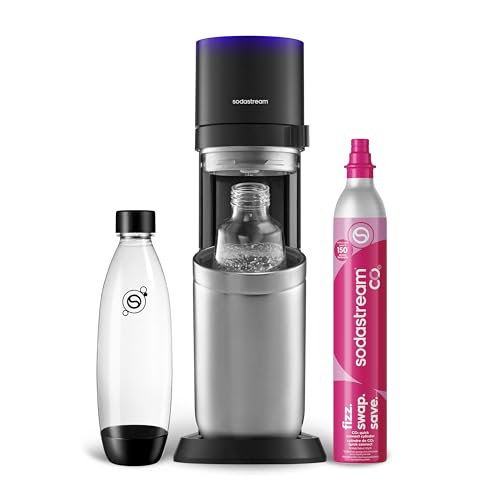
2. SodaStream E-DUO Sparkling Water Maker (Black) — Best for glass bottles and one-touch fizz
The E-DUO is the electric member of SodaStream’s current line, and it answers two checks from the guide at once: bottle material and fizz control. The box includes both a 1 liter glass bottle and a 1 liter BPA-free plastic carbonating bottle, so you can serve from glass at the table and keep plastic for everyday use. Carbonation is one-touch and electric, with the machine running the cycle instead of you counting button presses, which gives more repeatable results for households that make several bottles a day. It takes the same Quick Connect CO2 cylinder as the Terra, and a 60L cylinder is included. Because it is electric, it needs an outlet and a fixed spot on the counter, unlike the manual models here. The glass bottle is hand-wash per the manual. Choose it if you dislike plastic bottles or want push-and-walk-away carbonation.

3. Drinkmate OmniFizz Sparkling Water and Soda Maker (Matte Black) — Best for carbonating more than water
Every other machine in this list is meant for water only; the OmniFizz is built to carbonate almost any cold drink, including juice, iced tea, wine and cocktails, and even to re-fizz flat soda. The difference is its patented Fizz Infuser cap, which lets pressure release slowly so sugary or pulpy drinks do not foam over. This bundle includes the machine, a 60L CO2 cylinder, the Fizz Infuser and two BPA-free bottles, a 1 liter and a 0.5 liter. The OmniFizz uses standard screw-in 60L cylinders rather than SodaStream’s quick-connect type, so check the connection against the cylinder check in this guide before ordering refills. It needs no electricity or batteries, and at 8 by 5 by 16 inches it has one of the smallest footprints here. Pick it if sparkling juice, wine spritzers or cocktails are the real goal, not just water.


4. Aarke Carbonator 3 (Matte Black) — Best for design-led kitchens
The Carbonator 3 is the machine you buy when the maker will live on the counter in plain sight. The body is stainless steel rather than plastic, with a slim profile, a polished steel nozzle and a single lever you push down to carbonate; the lever also gives you direct control over how much gas goes in, which covers the fizz-control check in a manual way. It uses standard screw-in 60L CO2 cylinders, the widely available threaded type, and an 800 milliliter BPA-free PET bottle is included. Note the packaging detail from the included-items check: this listing is the machine and bottle, and the CO2 cylinder is sold separately, so budget for a first cylinder. There is no power cord and nothing electronic to set up. It costs more than the plastic machines here, and the return is materials and build rather than extra functions, so it suits buyers who value the object itself.

5. SodaStream Fizzi Sparkling Water Maker (Black) — Best budget starter
The Fizzi is SodaStream’s slim, lower-cost machine, and the kit includes the two things the included-items check cares about: a 60L CO2 cylinder and a 1 liter BPA-free reusable carbonating bottle, so it works out of the box. The bottle uses a snap-lock fitting that clicks into place instead of screwing in, and carbonation is a manual top button, so you control the fizz level by how many presses you give it. There is no cord or battery, and the narrow body is one of the easiest here to fit on a crowded counter or in a small kitchen. One compatibility point matters: the Fizzi takes the older screw-in style SodaStream cylinders, not the pink Quick Connect type used by the Terra and E-DUO, so match the cylinder to the machine when you reorder. For occasional sparkling water without paying for electric or premium models, it covers the essentials.
View SodaStream Fizzi Sparkling Water Maker on Amazon
What to Look For
| Factor | Why it matters | What to check |
|---|---|---|
| Cylinder connection | Decides which refills fit | Check the thread or quick-connect type and whether adapters are listed |
| Bottle material | Affects weight, look and cleaning | Look for glass or plastic and whether bottles can go in a dishwasher |
| Fizz control | Lets you adjust the bubble level | See whether it is a button, lever or preset levels |
| Power source | Affects placement | Check for manual models or electric ones that need an outlet |
| Size | Matters for small counters | Compare height, width and the clearance needed above the bottle |
| Included items | Affects what else you must buy | See whether a first cylinder and bottles come in the box |
Setup and Care Tips
- Use only the bottles the maker lists for your machine.
- Fill with cold plain water to the marked fill line.
- Rinse bottles after use and let them dry before storing.
- Do not add flavors to the bottle unless the manual allows it.
- Wipe the machine and the nozzle area with a damp cloth.
Mistakes to Avoid
- Buying before checking how cylinders are refilled.
- Filling above the marked line.
- Using bottles from a different brand without confirmation.
- Ignoring counter height and clearance.
- Putting bottles in the dishwasher when the maker says not to.
How do you choose the right sparkling water maker?
Choose a sparkling water maker by matching three things to your routine: how much you drink, how you want to control the fizz, and which cylinder system you are willing to live with. Everything else, from color to bottle shape, is secondary.
Start with volume. A household that drinks a bottle or two a week can be happy with a compact manual machine, while a family that fills several bottles a day will notice every extra step. In that case, a one-touch electric model or a machine with a simple, repeatable button can save patience.
Next, think about fizz level. Manual machines let you press in short bursts and stop when it tastes right, which gives you control but takes a little practice. Electric machines run a set cycle, which is more consistent from bottle to bottle.
Then look at what you want to carbonate:
- Plain water only: any standard sparkling water maker will do the job.
- Juice, tea or wine: look for a machine built for it, because sugary drinks can foam over in a standard bottle.
- Flavored water: check what the maker allows in the bottle, and add flavor after carbonating if the manual says so.
Finally, consider where the machine will live. A sparkling water maker kept on the counter gets used far more often than one stored in a cabinet. If the counter is crowded, a slim body matters more than extra features, and you should measure the height with a bottle fitted.
Keep your priorities in order: cylinder convenience first, then control, then looks. A machine you enjoy using is the one that actually replaces bottled water.
Which sparkling water maker should you buy?
The best sparkling water maker is the one that matches how you drink, and the five machines in this guide cover five different buyer types. Use the lines below to narrow your shortlist.
- If you want the simplest everyday machine: go for the SodaStream Terra. It is manual, needs no outlet and uses a click-in cylinder.
- If you dislike plastic bottles or want push-and-walk-away fizz: choose the SodaStream E-DUO. It is electric and comes with a glass bottle option, so it needs a spot near an outlet.
- If you want to carbonate juice, tea or wine: pick the Drinkmate OmniFizz. Its cap is designed for drinks beyond plain water.
- If the machine will sit on show in the kitchen: choose the Aarke Carbonator 3. You are paying for materials and design, and you will need to buy the first cylinder separately.
- If you are new to home carbonation and want a low-commitment start: look at the SodaStream Fizzi. It comes with a cylinder and bottle and has a slim body.
If two of these seem equally good, let the cylinder decide. The Terra and the E-DUO share the same quick-connect cylinder, while the Fizzi, the OmniFizz and the Carbonator 3 use screw-in types according to the descriptions above. Buying into one cylinder family means you can swap or refill without thinking about adapters.
Also be honest about effort. If you know you will not press a button repeatedly, the electric model is worth the outlet. If counter clutter bothers you, the manual slim models are easier to live with.
Quick-connect vs screw-in cylinders: what is the difference?
A quick-connect cylinder clicks into the machine without threading, while a screw-in cylinder is twisted into a threaded port. Both hold CO2, but they are not interchangeable between machines that use different fittings.
The picks in this guide show both styles. The Terra and the E-DUO use the click-in type, which is quicker to swap and needs no tools. The Fizzi, the OmniFizz and the Carbonator 3 use screw-in cylinders, which are a long-established format that many refill points handle.
Here is how the two compare in daily use:
- Swapping speed: click-in is faster, especially for people who find threading fiddly.
- Refill options: screw-in cylinders are widely handled by exchange and refill services, but availability depends on where you live, so check locally.
- Machine compatibility: the cylinder must match the machine. Read the label and the listing, and do not assume a cylinder from another brand will fit.
- Spare storage: a spare cylinder needs a safe, upright place away from heat. Follow the maker’s storage guidance.
Handle any cylinder with care. Use only the cylinders the manual lists, never force a fitting, and keep cylinders away from sources of heat. If a cylinder will not seat easily, stop and check that you have the right type rather than pushing harder.
Before ordering your first refill, find out who exchanges or refills your cylinder type nearby. That one check often matters more than the machine itself, because a machine you cannot refill conveniently stays in the cupboard.
What to check before you buy a sparkling water maker
Before you buy a sparkling water maker, confirm the cylinder type, the bottle, the size and what is actually in the box. A few minutes with the listing prevents most disappointments.
- Cylinder format: is it quick-connect or screw-in, and can you refill or exchange it where you live?
- First cylinder included: some listings include one and some do not. The Carbonator 3 listing, for example, is described above as machine and bottle only.
- Bottle count and material: check whether you get glass, plastic or both, and whether bottles go in the dishwasher.
- Spare bottle availability: make sure replacement bottles are sold for your model, since plastic bottles have a recommended replacement period in the manual.
- Power: manual machines need none, while electric ones need an outlet within reach.
- Dimensions with bottle fitted: measure the height under your cabinets, not just the body.
- Fridge fit: check that the bottle size suits your fridge shelf.
- What you can carbonate: read what the maker allows besides plain water.
- Warranty and returns: confirm the terms on the listing, since they vary by seller and region.
- Cleaning and care: note which parts are hand-wash only.
Keep this list open next to the listing and tick each line. If an item is not stated, treat it as unknown and look at the manual or ask the seller before ordering.
Is a sparkling water maker worth it, and who should skip it?
A sparkling water maker is worth it if you drink fizzy water often and are happy to handle the cylinder routine. It is a poor fit if you drink it rarely or dislike errands.
Here are the honest trade-offs:
- Cylinder routine: you will swap or refill cylinders from time to time, which means storing a spare and occasionally making a trip.
- Counter space: even a slim machine takes room, and an electric one needs to stay near an outlet.
- Fizz is yours to tune: manual machines take a little practice to get the bubble level you like.
- Plastic bottles wear out: follow the replacement guidance in the manual.
- Flavor limits: not every machine is meant for juice or wine, so check before trying.
Is it worth paying more? A higher-priced machine usually buys materials, looks or convenience, such as stainless steel or one-touch operation, rather than a different kind of fizz. If those matter to you, they justify the step up. If you just want bubbles in water, a simple manual model does the same core job.
You may want to skip a machine if you only drink sparkling water now and then, if you have nowhere safe to keep a spare cylinder, or if you prefer a no-maintenance routine.
If the trade-offs sound acceptable, compare the picks above, check the current listing for the cylinder type and what is included, then choose the machine that fits how you will use it.
Choosing With Confidence: A Deeper Look at What Separates the Picks
By the time most readers reach this point in the guide, they have a shortlist — and the real question is no longer which sparkling water makers exist, but which one will still feel like the right choice a year from now. That answer rarely comes from a single feature. It comes from how the whole product fits your space, your routine and your expectations. This section slows the decision down and walks through the judgment calls that experienced owners make, so you can apply the same thinking to the picks above.
Start with the job, stated plainly. A sparkling water maker bought for daily sparkling water at home lives a very different life from one bought for cutting back on canned drinks and serving guests. Write down your main scenario in one sentence before you compare anything. Every feature, material and design choice in this category should be judged against that sentence. Options that serve your main scenario well and everything else adequately are almost always better buys than options that are brilliant at a scenario you will rarely face and merely acceptable at the one you face every week.
Next, look at the fundamentals that this guide keeps returning to: carbonating bottle, carbon dioxide cylinder, fizz level, counter space and bottle storage. These are not marketing talking points; they are the parts you will interact with every single time you use the product. When you read the individual reviews above, pay closest attention to what each pick does with these fundamentals. A product that gets them right feels effortless in daily use. A product that cuts corners here will remind you of it constantly, no matter how appealing its extra features looked in a feature list.
Matching the pick to your space and routine
Measure and observe before you buy. Check the physical space the sparkling water maker has to live in or work in, including clearance to move around it, access for cleaning, and how it interacts with what is already there. Then walk through your actual routine: when do you reach for it, how much setup patience do you honestly have, and who else will use it? A pick that suits a careful single user can frustrate a busy household, and a pick designed for a busy household can feel like overkill for one person. The reviews above flag these differences; use them.
Also think about the unglamorous moments: putting it away, cleaning it after a messy job, moving it, or storing it during the season when it sees less use. Products earn their keep in those moments. If a design makes the routine easy, you will use it more and maintain it better. If every use ends with an awkward cleanup or a storage puzzle, even an excellent product slowly becomes a burden. When two picks look close on performance, choose the one with the easier routine.
Reading the trade-offs honestly
Every pick in this guide involves a trade-off, and the reviews name them rather than hiding them. One option trades convenience for durability, another trades a lower commitment for fewer refinements, another is specialized in a way that makes it superb for one scenario and ordinary for others. None of those trade-offs is automatically wrong. The mistake is choosing a trade-off without noticing it. As you compare, ask of each pick: what did the maker prioritize, what did they deprioritize, and does that priority order match mine? When the answer is yes, you have found your pick, even if another option scores better on a feature you care about less.
Budget deserves the same honesty. Set the amount you are comfortable spending before you fall in love with a flagship, and judge value inside that boundary. Within any tier in this guide there is a pick that represents the tier well. Overspending on capabilities you will not use does not buy satisfaction; it buys a quieter version of regret. Underspending has its own cost when the product sees heavy use: more friction, earlier replacement, and money spent twice. The middle path — the pick whose strengths match your main scenario at a tier you can justify by how often you will use it — is where most satisfied owners land.
Real-World Scenarios: Putting the Picks to Work
Specifications and feature lists only tell half the story. The scenarios below describe the situations readers most often describe when they write about sparkling water makers — daily sparkling water at home, mixing drinks, cutting back on canned drinks and serving guests. Thinking through which of them sounds most like your life is the fastest way to narrow the shortlist to one confident choice.
In the first scenario, the sparkling water maker is a daily workhorse. It gets used early, often and without ceremony, and it has to tolerate being handled by people who are in a hurry. For this life, prioritize the fundamentals — especially carbonating bottle and carbon dioxide cylinder — over refinement. Durability and an easy routine beat clever extras, because the product will be judged a hundred times a month on whether it simply works.
In the second scenario, the sparkling water maker is a specialist brought out for a particular job done properly. Here, the specialized pick in the lineup earns its place: the design choices that look narrow on paper turn out to be exactly what the job demands. If this is you, do not talk yourself into the generalist out of a vague feeling that versatility is safer. A specialist used for its specialty is satisfying every time; a generalist asked to do a specialist job is a compromise every time.
In the third scenario, space or storage is the binding constraint. The sparkling water maker has to fit a smaller footprint, share its home with other gear, or be set up and put away repeatedly. Judge the picks by their real occupied space and their setup routine, not by their capability list. Owners in this scenario consistently say the same thing afterwards: the best product was the one that fit their space gracefully, because a product that fights your space loses even when it wins on features.
In the fourth scenario, the sparkling water maker is shared — by a household, a team, a class or a crew. Shared use rewards intuitive design, forgiving construction and easy cleaning, and it punishes fiddly routines that only one person understands. If several people will use yours, weight the reviews accordingly: look for the picks described as straightforward and robust, and be skeptical of any option whose routine depends on one careful owner’s habits.
Getting the Most From Your Sparkling water maker: Use, Care and Long-Term Ownership
Ownership done well is a skill, and it is mostly a collection of small habits. The first habit is a proper first week. Unbox and inspect everything, confirm that all parts and accessories described in the guide and the product documentation are present, and run through the basic routine once at a calm moment rather than debuting the product under pressure. Note anything that feels loose, rough or not as described while the fix is still simple.
The second habit is cleaning as you go. Most wear on sparkling water makers is not dramatic damage; it is the slow accumulation of grit, moisture and residue in exactly the places nobody wipes. After use, give the surfaces and contact points a quick clean appropriate to the materials, let anything damp dry fully before storage, and keep an eye on counter space and bottle storage — the detail owners most often mention when a product ages early. The care guidance earlier in this guide covers the specifics; this is about rhythm. Small, frequent care beats occasional deep rescue almost every time.
The third habit is a short periodic inspection. Once in a while — monthly for daily-use items, seasonally for occasional ones — spend a few minutes checking fasteners, moving parts, wear surfaces and anything that flexes, seals or locks. Tighten what has loosened, clean what has built up, and address small issues while they are still small. This is also the moment to reconsider storage: a sparkling water maker stored dry, supported properly and out of punishing conditions will outlast a neglected one by years, whatever tier it came from.
Mistakes that shorten the life of sparkling water makers
Beyond the mistakes covered earlier in this guide, a few ownership errors show up again and again. The first is using the product outside the job it was chosen for — asking a light-duty pick to do heavy-duty work, or a specialist to be a generalist — and then blaming the product. The second is skipping the boring setup steps: proper fitting, leveling, anchoring, charging, sealing or breaking in, depending on the category, exists because it prevents the failures that follow. The third is storing the product in the worst available place — damp, crushing, sun-baked or buried under other gear — for months at a time. Avoid those three, and you have avoided most premature replacements.
Finally, know the difference between wear and failure. Cosmetic marks from honest use are not a verdict on your purchase; they are evidence the product is doing its job. What matters is function: does it still do the thing you bought it for, safely and without growing frustration? Judged that way, a well chosen sparkling water maker has a long useful life, and the decision framework in this guide — main scenario first, fundamentals second, trade-offs made knowingly — is what gets you there.
Head to Head: How the Picks in This Guide Differ in Practice
Readers often ask for a plain-language comparison of the shortlisted options, so here is how the picks above separate when you live with them rather than line them up on paper. None of these notes introduce new claims about the products; they simply draw out the positioning already described in the reviews, so you can match each pick to the scenario it was chosen for.
Consider the Aarke Carbonator 3 (Matte Black) — described in this guide as best for design-led kitchens — if its role in the lineup matches how you actually live with sparkling water makers. The strongest reason to choose it is fit for purpose rather than any single headline feature: check it against the carbonating bottle, the carbon dioxide cylinder, and the space or routine it has to fit into. If those line up with your priorities, it is a sensible pick; if you find yourself making excuses for a mismatch on the basics, one of the other options in this guide will almost certainly serve you better.
Consider the Drinkmate OmniFizz Sparkling Water and Soda Maker (Matte Black) — described in this guide as best for carbonating more than water — if its role in the lineup matches how you actually live with sparkling water makers. The strongest reason to choose it is fit for purpose rather than any single headline feature: check it against the carbonating bottle, the carbon dioxide cylinder, and the space or routine it has to fit into. If those line up with your priorities, it is a sensible pick; if you find yourself making excuses for a mismatch on the basics, one of the other options in this guide will almost certainly serve you better.
Consider the SodaStream Fizzi Sparkling Water Maker (Black) — described in this guide as best budget starter — if its role in the lineup matches how you actually live with sparkling water makers. The strongest reason to choose it is fit for purpose rather than any single headline feature: check it against the carbonating bottle, the carbon dioxide cylinder, and the space or routine it has to fit into. If those line up with your priorities, it is a sensible pick; if you find yourself making excuses for a mismatch on the basics, one of the other options in this guide will almost certainly serve you better.
Consider the SodaStream E-DUO Sparkling Water Maker (Black) — described in this guide as best for glass bottles and one-touch fizz — if its role in the lineup matches how you actually live with sparkling water makers. The strongest reason to choose it is fit for purpose rather than any single headline feature: check it against the carbonating bottle, the carbon dioxide cylinder, and the space or routine it has to fit into. If those line up with your priorities, it is a sensible pick; if you find yourself making excuses for a mismatch on the basics, one of the other options in this guide will almost certainly serve you better.
Consider the SodaStream Terra Sparkling Water Maker (Black) — described in this guide as best for most households — if its role in the lineup matches how you actually live with sparkling water makers. The strongest reason to choose it is fit for purpose rather than any single headline feature: check it against the carbonating bottle, the carbon dioxide cylinder, and the space or routine it has to fit into. If those line up with your priorities, it is a sensible pick; if you find yourself making excuses for a mismatch on the basics, one of the other options in this guide will almost certainly serve you better.
The pattern across all of them is the same one this guide has followed from the start: there is no single winner, only a best match. Identify your main scenario, weigh the fundamentals that you will touch every day, accept the trade-off that costs you least, and the right choice usually becomes obvious. If you are still torn between two, choose the one with the easier daily routine — it is the tiebreaker satisfied owners mention most.
FAQ
Why does cold water matter?
Makers commonly suggest using cold water, since gas dissolves more readily at lower temperatures. Follow the instructions for your machine.
Do all cylinders work with all machines?
No. Connections differ, so confirm compatibility in the listing and ask about adapters before you order.
How long does a sparkling water maker take to carbonate a bottle?
It depends on the machine and how fizzy you want the water. Manual models take a few short presses, and electric models run their own cycle. Check the manual for the maker's guidance rather than relying on a fixed time.
Can you carbonate flavored water or juice in any sparkling water maker?
Not always. Many makers advise carbonating plain water only and adding flavor afterward, because sugary liquids can foam and clog parts. A machine designed for other drinks, like the OmniFizz in this guide, is the safer choice for juice or wine.
Do sparkling water maker bottles expire?
Plastic bottles are usually given a recommended replacement period in the manual. Inspect them for cracks, cloudiness or damage, and replace them when the maker says to. Glass bottles need careful handling and should be checked for chips.
Can you use a sparkling water maker without electricity?
Yes, manual models need no power at all. Of the machines in this guide, the Terra, OmniFizz, Carbonator 3 and Fizzi work by hand, while the E-DUO is electric.
How do you store a spare CO2 cylinder safely?
Keep it upright in a cool place away from heat and direct sun, and follow the storage notes in the manual. Do not leave it in a hot car or near a stove.
Is sparkling water from a home machine the same as store-bought?
It is plain water with dissolved carbon dioxide, so it is similar in basic composition. Taste depends on your water, how cold it is and how long you carbonate it.
What water temperature works best in a sparkling water maker?
Cold water is commonly recommended because gas dissolves more readily at lower temperatures. Chill the water first and fill only to the marked line.
How do I get the most value from a sparkling water maker over its life?
Value comes from use and care in equal measure. Choose the pick that fits your main scenario, learn its routine properly in the first few weeks, keep up the simple cleaning and inspection habits covered in this guide, and avoid the common mistakes that shorten service life. Owners who do those four things consistently report the fewest regrets, whatever tier they bought at.
Can one sparkling water maker handle several different jobs well?
Often yes, within limits. Versatile options in this guide are designed to cover the common scenarios — daily sparkling water at home, mixing drinks, cutting back on canned drinks and serving guests — without major compromise. Where a single choice struggles is at the extremes: the heaviest duty task, the tightest space, or a very specific requirement. If one scenario matters far more than the rest, choose for that scenario and let the others be a bonus.
Is it worth paying more for a sparkling water maker, or is a basic one enough?
It depends on how often and how hard you will use it. If your sparkling water maker will see occasional, light use, a simpler option from this guide is often plenty. If it will be used daily, shared by several people, or relied on in demanding conditions, stepping up usually buys better materials, smoother operation and less frustration over time. The honest test is cost per use: frequent users feel the difference, occasional users rarely do.
Should I buy a sparkling water maker now or wait for a newer model?
For most buyers, waiting rarely changes the outcome. The fundamentals of a good sparkling water maker — sound construction around carbonating bottle, sensible design, and a good match for your use — change slowly. Buy when you have a real need and a pick in this guide matches it; a product that solves your problem today is worth more than a rumored improvement that may never matter to you.
What maintenance do most owners of sparkling water makers forget?
The unglamorous basics: wiping down surfaces before grit or moisture does quiet damage, checking fasteners and moving parts for looseness, and storing the sparkling water maker in the conditions the maker intends rather than wherever space happens to be free. Ten minutes of routine care after heavy use prevents most of the wear that owners later blame on build quality.
What should I check in the first week of owning a new sparkling water maker?
Use the first week to confirm fit and function while returning or exchanging is still easy. Check that it works with your existing setup, that nothing about carbonating bottle feels off in real use, and that the day to day routine — setting it up, using it, putting it away — is as easy as you expected. Small annoyances in week one tend to become big annoyances by month six, so take them seriously.
How do I know if a sparkling water maker is the wrong choice for me?
The clearest signs are friction and workarounds: you avoid using it, you have to adapt your routine around its weaknesses, or the mismatch is with something fundamental like size, placement or the way it handles carbon dioxide cylinder. Features can be learned, but a basic mismatch in fit or purpose rarely improves, which is why matching the pick to your main use case matters more than chasing the longest feature list.
How long should a good sparkling water maker last with regular use?
Longevity depends far more on care and conditions than on the badge. A well chosen sparkling water maker that is used as intended, cleaned on a sensible schedule, and stored or protected properly between uses should give years of service. The parts that usually age first are the wear points connected to carbonating bottle and counter space and bottle storage, so inspect those regularly and deal with small issues early rather than waiting for a failure.
Questions to Ask Before You Buy
- How much sparkling water does my household drink in a normal week?
- Do I want to carbonate in a bottle, a carafe, or both?
- Is there counter space, and does the machine fit under my cabinets?
- How easy is it to swap or refill the gas cylinder where I live?
- Does the machine need electricity, or does it work by hand?
- Can I add flavor drops or juice, and what does the maker say about doing so?
Matching It to Your Kitchen and Habits
Where the machine lives affects how often you use it. A unit kept on the counter gets used more than one hidden in a cabinet, but it needs a spot near a water source and an outlet if it is powered.
Small Kitchens
Measure the height with the bottle fitted, since many machines need extra room above for loading. Slim bodies are handy, yet a narrow base can feel less steady.
Busy Households
If several people use it daily, a quick, simple lever or button helps. Consider bottle capacity so you are not refilling constantly.
Occasional Use
A basic, compact machine may be enough for weekend drinks. Cylinder supply still matters, so check how refills work in your area.
Compatibility Checks
- Cylinder type and connector: match the machine with the cylinder format it uses.
- Bottle type: use only the bottles the maker lists for the machine.
- Exchange or refill options: check which services exist near you.
- Cleaning guidance: follow the manual for bottles and removable parts.
Who Should Skip It
If you drink sparkling water only now and then, buying bottled may suit you better. Kitchens with no room to store a spare cylinder, or households that dislike regular refill errands, may find the routine tiresome.
Feature Trade-offs
| Choice | Upside | Consideration |
|---|---|---|
| Manual operation | No outlet needed | Takes a little effort |
| Electric operation | One touch use | Needs a plug and space |
| Glass carafe | Looks good on a table | Needs careful handling |
| Plastic bottle | Light and portable | Follow the replacement guidance |
Weigh these trade-offs against how your household actually drinks. A tabletop crowd may enjoy a showpiece carafe, while a busy family might prefer something quick and forgiving. Always read the maker’s manual and instructions for filling levels, cylinder fitting and cleaning.
The Short Version
Check the cylinder connection and refill options first, then compare bottle material, fizz control and size. Treat speed and fizz claims as the maker’s own wording, and follow the manual for filling and cleaning to keep the machine working as described. Make a note of how many liters you drink in a typical week and compare that with the cylinder yield the maker lists. Check the cost of spare bottles and the places where you can swap or refill cylinders near you, and look for a bottle size that fits your fridge shelf.
Related Guides
- 6 Best Home Ice Makers With Water Lines: Built-In Picks
- How to Choose the Best Bread Makers: Buyer's Guide (2026)
- How to Choose the Best Electric Pasta Makers: A Buyer's Guide
- How to Choose the Best Nugget Ice Makers: Buyer's Guide (2026)
- How to Choose the Best Undercounter Ice Makers: A Buyer's Guide


