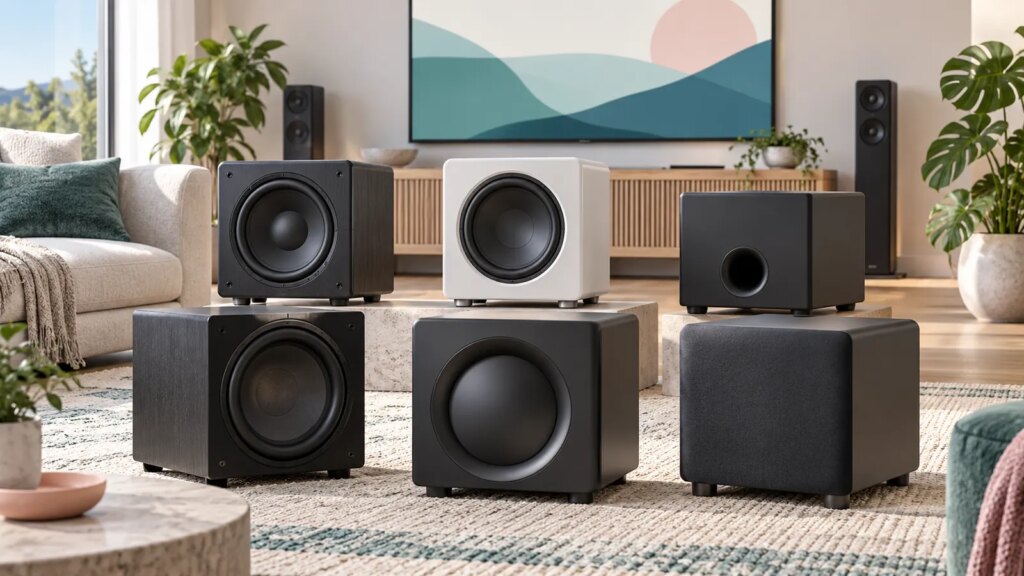
A powered subwoofer adds the low end that small speakers and soundbars cannot reproduce on their own. It has a built-in amplifier, so you only need a signal cable and a power outlet. We have not used these products ourselves, so this guide makes no claims about results. Instead, it shows how to read a product page and match a unit to your space.
The right choice depends on your room, your speakers and what you play most. A small apartment needs a different design than a large basement theater. Work through the factors below, compare listings with the same checklist, and you will avoid most of the common mismatches.
As an Amazon Associate we earn from qualifying purchases. Links on this site are affiliate links, and they do not change the information we give.
What to Look For
| Factor | Why it matters | What to check |
|---|---|---|
| Driver size | Larger drivers usually move more air, which helps with deep bass in bigger rooms. | Match the driver to your room size and how loud you listen. |
| Enclosure type | Sealed designs tend toward tight, controlled bass, while ported designs favor depth and output. | Decide whether music or movie effects matter more to you. |
| Inputs | The connection decides which receivers, soundbars and TVs will work. | Look for a line-level or low-frequency input that fits your gear. |
| Controls | Crossover and phase controls let you blend the sub with your main speakers. | Check for a dial or app that adjusts crossover, level and phase. |
| Wireless option | A wireless link reduces cable clutter across a living room. | Confirm the transmitter is included and works with your source. |
| Cabinet and footprint | Cabinet size and finish affect placement and how well it blends in. | Measure the space and compare to the listed dimensions. |
Setup and Care Tips
- Try a few spots in the room, because bass changes a lot with placement near walls and corners.
- Set the crossover so the sub handles only the lowest notes and your main speakers handle the rest.
- Adjust the level slowly by ear with familiar music until the bass blends in rather than stands out.
- Keep the cabinet away from curtains and clutter that can block a port or rattle.
- Dust the grille with a soft dry cloth and keep drinks away from the unit.
Mistakes to Avoid
- Choosing the largest driver for a small room, which can overwhelm the space.
- Ignoring the input type until the unit arrives and does not match your receiver.
- Pushing the level too high instead of fixing placement and crossover settings.
- Placing the sub on a hollow shelf that vibrates and adds buzzing.
- Assuming a wireless link removes the need for a power outlet nearby.
FAQ
Do I need a subwoofer if I already have a soundbar?
Not always. Many soundbars handle bass well enough for casual viewing. A separate sub helps if you want fuller effects and music, and some soundbars offer a dedicated output for one.
Is a sealed or ported cabinet better?
Neither is better for everyone. Sealed cabinets are often described as tighter and more compact, while ported ones are often described as louder at low frequencies. Pick based on your room and listening habits.
The Short Version
Match the driver and cabinet type to your room, confirm the inputs fit your gear, and look for useful controls. Careful placement matters as much as the unit itself, so plan to adjust and listen before settling on a spot.