The best pig cookers are built for one of the oldest and most social ways to cook: roasting a whole pig slowly over heat until the meat is tender and the skin is crisp. Whether the occasion is a family reunion, a holiday feast or a neighbourhood gathering, a whole-hog roast feeds a crowd from a single piece of meat, and the cooker is what makes it possible. This guide covers the strongest pig roasters available through the site catalogue right now, from enclosed Caja China style roasters to open rotisserie spit kits.
A pig cooker is not the same as a regular grill. It has to hold a whole animal, turn it evenly or cook it with steady radiant heat, and keep the temperature consistent for hours. The models below were chosen because they are genuine whole-pig roasters or heavy-duty rotisserie kits with the capacity and the build to handle the job, verified against the product catalogue with brand and model details matched before any link was added.
Before you buy, think about how you want to cook. An enclosed roaster cooks with trapped heat and is forgiving for a first whole-hog attempt. An open rotisserie gives you the classic turning spit and crisp skin, but it needs more attention during the cook. Capacity matters too: a roaster rated for 70 pounds will not hold a larger animal, and a spit kit needs a motor strong enough for the weight you plan to cook. The comparison below weighs capacity, heat source, build and ease of use, so you can choose the cooker that fits your gathering.
It also helps to be realistic about the occasion. A whole pig feeds a large group, so the cooker is really a purchase for someone who hosts gatherings, runs a barbecue team or cooks for a community event. If you roast a whole animal once a year, an enclosed roaster that stores neatly may suit you better than a large spit kit. If you roast several times a summer, the spit kit earns its place quickly. Either way, buy the cooker for the gatherings you actually host, not the ones you imagine.
It is worth saying plainly what a pig cooker is not. It is not a gadget for a weeknight dinner, and it is not a purchase to make on impulse. It is a large, single-purpose cooker for a cook who hosts big gatherings and wants the centrepiece to be memorable. If that describes you, the models below are worth a careful look. If it does not, a good grill or a smoker will serve you better for far less money and storage space.
In this guide
Quick picks: best pig cookers
| # | Product | Where to buy |
|---|---|---|
| 1 | BC Classics Bene Casa Caja Asadora Large Pit Barbecue Portable Pig Roaster | Check on Amazon |
| 2 | La Caja China Model #1-70 LB Pig Roaster, Original | Check on Amazon |
| 3 | VEVOR Rotisserie Grill, 46-Inch Electric Rotisserie Grill Kit | Check on Amazon |
| 4 | VEVOR Rotisserie Grill, N52-Inch Electric Rotisserie Grill Kit | Check on Amazon |
| 5 | DEWOSEN 50W Rotisserie Grill With Wind Screen, 51-Inch BBQ Outdoor Pig and Lamb Spit Roaster | Check on Amazon |
| 6 | Charotis 62-Inch Propane Spit Roaster, 50W Motor, Model SSG1 | Check on Amazon |
How the Picks Were Chosen
Each model in this guide was chosen because it is a genuine pig roaster or a heavy-duty rotisserie kit designed for whole animals, not a small grill, a replacement part or a generic spit with no stated capacity. Enclosed roasters had to be built for whole pigs, with a named model and a stated weight capacity. Rotisserie kits had to include a motor, a spit and a frame strong enough for a whole pig or lamb, with stainless steel construction that can stand up to hours of outdoor cooking.
Capacity was judged honestly. A roaster rated for 70 pounds suits a pig of that size, and we did not pretend a smaller kit could do the same job. Build quality mattered as much as capacity: stainless steel frames and spits resist rust and heat, while a motor rated for the load keeps the spit turning evenly all afternoon. Models with vague or missing capacity details were left out, even when the listing looked promising.
Finally, every pick had to be verifiable in the product catalogue with a full brand and model match. Where two listings were close variants of the same model, only genuinely distinct listings were used, and each product section is written about the specific model linked. No product was included on the strength of a headline claim alone.
We also looked at how each cooker is actually used on the day. A roaster that needs constant charcoal management is a different commitment from one that holds heat on its own, and a spit kit that needs mains power is a different commitment from a propane model. The models below were judged on the whole experience, including setup, cooking and cleaning, not just on the specification sheet.
The Picks at a Glance
| Product | Standout Feature | Best For |
|---|---|---|
| BC Classics Bene Casa Caja Asadora Large Pit Barbecue Portable Pig Roaster | Enclosed pit roaster for whole pigs | First-time whole-hog cooks |
| La Caja China Model #1-70 LB Pig Roaster, Original | Classic Caja China roaster for 70-pound pigs | Traditional Cuban-style roasting |
| VEVOR Rotisserie Grill, 46-Inch Electric Rotisserie Grill Kit | 46-inch stainless steel spit kit | Backyard rotisserie roasting |
| VEVOR Rotisserie Grill, N52-Inch Electric Rotisserie Grill Kit | 52-inch stainless steel spit kit | Larger animals on the spit |
| DEWOSEN 50W Rotisserie Grill With Wind Screen, 51 Inch | 51-inch spit kit with wind screen | Windy outdoor cooking spots |
| Charotis 62-Inch Propane Spit Roaster, Model SSG1 | Propane spit roaster for whole pig, lamb and goat | Propane cooking without mains power |
Best Pig Cookers in Detail in Detail

BC Classics Bene Casa Caja Asadora Large Pit Barbecue Portable Pig Roaster
The Caja Asadora is an enclosed pit barbecue roaster built for whole pigs, and its design is forgiving for a cook attempting a whole-hog roast for the first time. The pig sits inside the box while heat cooks it from above, which keeps the temperature even and the meat moist. Because the box traps heat, it is less affected by wind than an open spit, and the portable design means it can be moved to where the gathering is happening.
On the day, the Caja Asadora rewards a calm approach. Set the pig in the box, get the charcoal going on top, and resist the urge to open the box often, since every opening lets heat escape. The enclosed design does most of the work, so the cook can focus on the fire and the guests. For a first roast, it helps to have a meat thermometer and a clear plan for timing, and to start earlier than you think you need to, since a whole pig never hurries. The Caja Asadora is also a good choice for a cook who wants to roast without managing an open flame. The enclosed box keeps the heat in and the wind out, so the cook can focus on the charcoal and the timing rather than the fire. It is the most relaxed way to roast a whole pig.
Key specs: Large portable pit barbecue pig roaster; enclosed Caja Asadora design; built for whole-pig roasting.
Strengths:
- The enclosed design holds heat evenly, which gives a forgiving cook for a first whole-hog roast.
- Cooking with trapped heat keeps the meat moist while the skin crisps.
- The portable pit design can be moved to the gathering rather than the other way round.
Trade-offs:
- An enclosed roaster takes up more storage space than a spit kit when it is not in use.
- You cannot watch the meat as easily as on an open rotisserie.
- It is a single-purpose roaster, so it earns its keep only when you roast whole animals.
This is the right pick for a cook planning a first whole-hog roast who wants the forgiving, even heat of an enclosed roaster rather than managing an open spit all day.
Best for: First-time whole-hog roasts and cooks who want even, forgiving heat.
Not suited for: Cooks who want the theatre of an open turning spit, or who roast whole animals only rarely.
Check price on Amazon: BC Classics Bene Casa Caja Asadora Large Pit Barbecue Portable Pig Roaster
La Caja China Model #1-70 LB Pig Roaster, Original
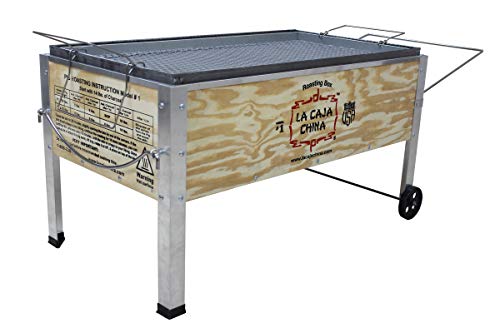
La Caja China is the original Caja China roaster, and Model #1 is sized for pigs up to 70 pounds. It is the classic Cuban-style roaster: the pig goes in the box, charcoal goes on top, and the trapped heat roasts the meat evenly while the skin turns crisp. It is a proven design that has been used for whole-hog roasts at family gatherings for years, and the 70-pound capacity covers a pig large enough to feed a crowd.
The La Caja China routine is simple once you have done it: charcoal on the lid, pig in the box, and patience. The heat radiates down through the lid, roasting the meat evenly while the skin crisps. Check the charcoal occasionally and add more when the heat drops, but otherwise leave the box closed. The 70-pound capacity means the roast can feed a large gathering, so plan the sides and the serving table for a crowd. The La Caja China roaster has a loyal following because the design is simple and proven. There are no motors, no electronics and no parts to fail: a box, a lid and charcoal. That simplicity is reassuring when the roast is the centrepiece of a large gathering and there is no room for a breakdown.
Key specs: La Caja China Model #1; 70-pound pig capacity; original Caja China roaster design; outdoor barbecue and rotisserie grill.
Strengths:
- The original Caja China design is proven over years of whole-hog roasting.
- The 70-pound capacity feeds a large gathering from a single pig.
- Charcoal heat on top gives even roasting and crisp skin.
Trade-offs:
- The roaster is large and needs dedicated storage space.
- It is a single-purpose appliance that only earns its place when you roast whole pigs.
- Charcoal must be managed during the cook to keep the heat steady.
This is the pick for a cook who wants the classic Caja China experience and has a gathering large enough to justify a 70-pound pig.
Best for: Traditional Cuban-style whole-hog roasts for large gatherings.
Not suited for: Small gatherings, or cooks with no storage space for a large roaster.
Check price on Amazon: La Caja China Model #1-70 LB Pig Roaster, Original
VEVOR Rotisserie Grill, 46-Inch Electric Rotisserie Grill Kit
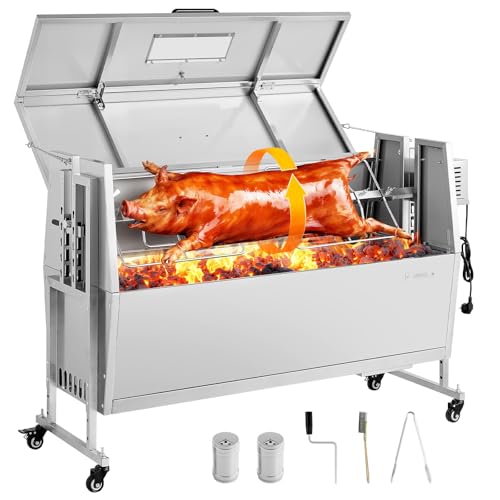
This VEVOR kit is a 46-inch electric rotisserie grill built for outdoor roasting of whole pigs and lambs. The stainless steel spit turns the meat automatically, so it bastes itself in its own juices while the outside crisps. The electric motor does the turning, which frees the cook to manage the fire and the guests instead of standing at the spit. At 46 inches it suits a whole pig or lamb for a medium to large gathering.
Setting up the 46-inch VEVOR kit takes a little time, so build it before the guests arrive. Balance the pig on the spit so the load is even, tighten the forks well, and test the motor before you light the fire. Once the spit is turning, the cook is mostly about managing the fire: steady heat, even coals and a watchful eye on the meat. The automatic turning is what makes the kit practical, since it frees you to tend the fire instead of the spit. The 46-inch VEVOR kit is the right size for a medium gathering. It holds a pig large enough to feed a crowd without the bulk of the larger kits, and it stores more easily when the season ends. For a cook who roasts once or twice a summer, it is the practical middle ground.
Key specs: 46-inch electric rotisserie grill kit; stainless steel barbecue outdoor pig and lamb roaster; automatic rotation; electric motor.
Strengths:
- Automatic rotation bastes the meat continuously and crisps the skin evenly.
- Stainless steel construction stands up to hours of outdoor cooking and is easy to clean.
- The electric motor frees the cook from turning the spit by hand.
Trade-offs:
- An open spit needs more attention to the fire than an enclosed roaster.
- It needs mains power for the motor, so it cannot run far from an outlet.
- The kit takes time to assemble and to set up before each cook.
This is the pick for a cook who wants the classic open-spit roast with automatic turning, and who has a power outlet within reach of the cooking spot.
Best for: Backyard rotisserie roasts of whole pig or lamb with automatic turning.
Not suited for: Cooks without mains power at the cooking spot, or who prefer the set-and-forget style of an enclosed roaster.
Check price on Amazon: VEVOR Rotisserie Grill, 46-Inch Electric Rotisserie Grill Kit
VEVOR Rotisserie Grill, N52-Inch Electric Rotisserie Grill Kit
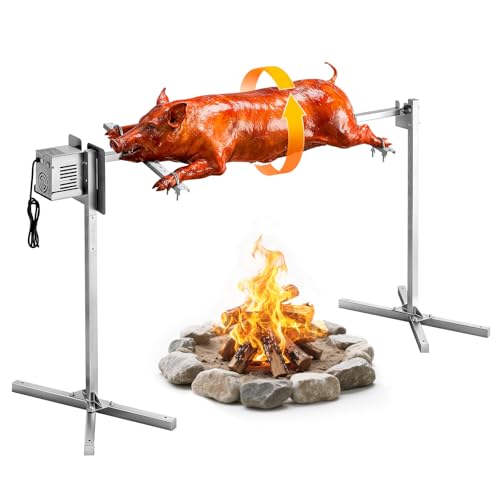
The 52-inch VEVOR kit is the larger sibling in the VEVOR rotisserie line, giving you six more inches of spit than the 46-inch model. That extra length matters when the animal is larger or when you want room to add vegetables or a second smaller cut alongside the main roast. Like the smaller kit it is stainless steel with an electric motor, so the meat turns automatically while the cook manages the fire.
The extra length of the 52-inch kit is most useful when the animal is large or when you want to add vegetables to the spit. A whole pig with a few skewers of vegetables alongside makes the most of the fire. Balancing matters more with a longer spit, so take time to centre the load and tighten everything before the motor starts. A well-balanced spit turns smoothly and quietly, while an unbalanced one jerks and strains the motor. The 52-inch kit is worth the extra length when the guest list is large. The longer spit holds a bigger animal, and the extra room means you can add vegetables or a second cut without crowding. The stainless steel build cleans up well after a long, greasy cook.
Key specs: 52-inch electric rotisserie grill kit; stainless steel barbecue outdoor pig and lamb roaster; automatic rotation; electric motor.
Strengths:
- The longer 52-inch spit handles larger animals and leaves room for extra items.
- Stainless steel construction resists heat and weather and cleans up well.
- Automatic rotation keeps the meat basting and the skin crisping evenly.
Trade-offs:
- The longer kit is heavier and takes more storage space than the 46-inch model.
- It still needs mains power for the motor.
- An open spit needs the cook to watch the fire through the cook.
This is the pick when the 46-inch kit feels tight for the size of animal you plan to roast, or when you want room on the spit for extras.
Best for: Larger whole animals and cooks who want extra spit length for side items.
Not suited for: Small gatherings where a shorter spit would do, or cooking spots without power.
Check price on Amazon: VEVOR Rotisserie Grill, N52-Inch Electric Rotisserie Grill Kit

DEWOSEN 50W Rotisserie Grill With Wind Screen, 51-Inch BBQ Outdoor Pig and Lamb Spit Roaster
The DEWOSEN kit adds a wind screen to the standard rotisserie formula, and that is a practical difference for anyone who cooks outdoors in an exposed spot. Wind is the enemy of an open fire: it steals heat from one side and leaves the meat cooking unevenly. The wind screen shields the fire, the 50-watt motor turns a 51-inch spit, and the stainless steel build handles the heat. The stated capacity covers pigs and lambs up to 132 pounds, which is generous for a backyard kit.
The wind screen is the detail that makes the DEWOSEN kit worth choosing for an exposed garden or a coastal spot. Set the screen on the windward side and the fire will hold its heat far better. The 50-watt motor and the generous capacity mean the kit can handle a large animal without strain, which is reassuring when the roast is the centrepiece of the day. In calm weather the screen simply comes off, so it costs nothing to have it. The DEWOSEN wind screen is a simple idea that makes a real difference. Wind is the most common cause of uneven cooking on an open spit, and a screen that blocks it keeps the heat where it belongs. In a sheltered garden it can be left off, so it costs nothing to have it ready.
Key specs: 51-inch rotisserie grill with wind screen; 50-watt motor; stainless steel barbecue outdoor pig and lamb spit roaster; 132-pound capacity.
Strengths:
- The wind screen protects the fire from gusts, which keeps the heat even.
- The 50-watt motor and 132-pound capacity handle large animals with ease.
- Stainless steel construction is durable outdoors and easy to clean.
Trade-offs:
- The wind screen adds parts to assemble and store.
- It needs mains power for the motor.
- An open spit still needs the cook to manage the fire during the roast.
This is the pick for an exposed cooking spot where wind is a real problem, or for a cook who wants the highest stated capacity in this guide.
Best for: Windy outdoor spots and the largest animals in this guide.
Not suited for: Sheltered cooking spots where a wind screen adds little, or cooks without power nearby.

Charotis 62-Inch Propane Spit Roaster, 50W Motor, Model SSG1
The Charotis SSG1 is the only propane-powered spit roaster in this guide, and that makes it the practical choice when there is no mains power at the cooking spot or when you prefer gas heat. The 62-inch stainless steel spit is the longest here, the 50-watt motor turns the meat automatically, and the propane burner gives steady, adjustable heat for whole pig, lamb or goat. For a cook who roasts away from the house, the propane design removes the need for an extension lead.
Cooking with the Charotis propane roaster is different from charcoal: the heat is steadier and easier to adjust, and there is no ash to manage. Connect the tank, check the hose and the connections for leaks with soapy water, and light the burner before the meat goes on. The propane flame holds a consistent temperature, which makes timing more predictable. Keep a spare tank nearby for a long roast, since running out of gas halfway through is the one problem that is hard to fix quickly. The Charotis propane roaster is the practical choice for a cook who roasts away from the house. A propane tank is easier to transport than a supply of charcoal, and the steady flame means the timing is more predictable. Keep a spare tank nearby for a long roast.
Key specs: 62-inch propane spit roaster; 50-watt motor; stainless steel barbecue rotisserie for whole pig, lamb and goat; model SSG1.
Strengths:
- Propane heat works anywhere, with no need for mains power.
- The 62-inch spit is the longest in this guide, so it handles the largest animals.
- Gas heat is steady and adjustable, which helps keep the temperature even.
Trade-offs:
- You need a propane tank, and the tank is an extra thing to carry and store.
- Gas roasting gives a different flavour from charcoal or wood fire.
- The long spit and burner assembly take time to set up and take space to store.
This is the pick for roasting away from mains power, or for a cook who prefers the steady, adjustable heat of propane for a long roast.
Best for: Off-grid roasting and cooks who prefer propane heat for whole animals.
Not suited for: Cooks who want charcoal flavour, or who roast only in a spot with easy mains power.
Check price on Amazon: Charotis 62-Inch Propane Spit Roaster, 50W Motor, Model SSG1
Buying Guide
Start with capacity, because it is the one specification you cannot work around. Check the weight of the pig you plan to cook and buy a roaster rated for at least that weight, with room to spare. A roaster rated for 70 pounds will not hold a larger animal, and an overloaded spit strains the motor and turns unevenly. If you are unsure, ask your butcher for the dressed weight before you order the cooker.
Next, choose between an enclosed roaster and an open spit. Enclosed roasters such as the Caja China models cook with trapped heat, which is forgiving and even, and they are less affected by wind. Open spits give you the classic turning roast and crisp skin, but they need the cook to manage the fire and watch the meat. First-time whole-hog cooks usually do better with an enclosed roaster, while experienced roasters often prefer the spit.
Consider the heat source. Charcoal gives traditional flavour and high heat, but it needs attention during a long cook. Propane gives steady, adjustable heat and works anywhere a tank can go. Electric rotisserie kits need mains power, so they suit a backyard near the house. Match the heat source to your cooking spot, not just to your preference.
Finally, check the build. Stainless steel frames and spits resist rust and clean up after a long, greasy cook. The motor should be rated for the weight you plan to turn, and the spit should be long enough to hold the animal with room at each end. A kit that looks cheap usually is, and a whole-hog roast is the wrong time to discover it.
Think about the fire as well as the cooker. Charcoal gives traditional flavour but needs attention and a supply of good charcoal. Propane is steady and convenient but gives a different flavour. Wood adds smoke flavour but is harder to control. The cooker you choose should match the fuel you are happy to manage for several hours, because the fire is half the job in whole-hog roasting.
Think about who will help on the day. A whole-hog roast is a team effort: someone manages the fire, someone watches the meat, and someone prepares the sides. The cooker you choose should match the number of helpers you have. An enclosed roaster needs less attention, while an open spit needs a cook who can stay with it. Plan the team as well as the cooker.
How to Use and Care for Your Cooker
After a whole-hog roast, clean the roaster while it is still warm but safe to touch. Grease and drippings set hard as they cool, and they are much harder to remove the next day. Scrape the interior of an enclosed roaster, wash the spit and forks with hot soapy water, and dry everything fully before storage. Stainless steel can be scrubbed, but avoid steel wool on polished surfaces if you want to keep the finish.
Store the roaster dry and covered. Moisture is the enemy of any outdoor cooker, and a damp roaster will rust even if it is stainless steel. Keep the motor and any electrical parts indoors, and check the power cord for damage before each use. For propane models, disconnect the tank after cooking and store the tank upright in a ventilated spot away from the house.
Before each roast, check the spit for straightness, the forks for tightness and the motor for smooth running. A bent spit wobbles and cooks unevenly, and a loose fork can let the meat slip. A quick check before the fire is lit saves a ruined roast later.
For spit kits, the motor deserves attention. Keep it dry, store it indoors, and check the gears and the power cord before each roast. A motor that has been left outside in the rain will not last. Oil any moving parts lightly if the manual suggests it, and keep the spit and forks clean and dry so they do not rust between roasts.
For enclosed roasters, check the hinges and the latches before each use. A lid that does not close tightly lets heat escape and cooks unevenly. Oil the hinges lightly if they stiffen, and replace a worn latch before it fails during a cook. A roaster that seals well cooks well.
Common Mistakes to Avoid
The most common mistake is underestimating the time a whole pig takes. A whole-hog roast is measured in hours, not minutes, and starting late means serving late. Plan the cook backwards from the serving time, allow extra time for the fire to settle, and remember that the meat needs resting time after it comes off the heat. A meat thermometer is the only reliable way to know when the roast is done.
A second mistake is overloading the spit or the roaster. An animal heavier than the rated capacity strains the motor, turns unevenly and cooks unevenly. Weigh the pig before the cook, or ask the butcher for the dressed weight, and do not guess. A related mistake is failing to balance the meat on the spit: an unbalanced load turns jerkily and can stall the motor.
A third mistake is ignoring the wind. An open fire in a windy spot cooks one side faster than the other, and the cook spends the day chasing the heat. Choose a sheltered spot, use a wind screen if your kit has one, and keep the fire even. Enclosed roasters are more forgiving here, which is one reason they suit first-time roasters.
A fourth mistake is carving the pig too soon. A whole roast needs resting time after it comes off the heat, just like a smaller roast, so the juices settle and the meat stays moist. Cover the pig loosely with foil and let it rest for at least twenty minutes before carving. Cutting into it straight away lets the juices run out and leaves the meat dry.
A fifth mistake is failing to plan the serving. A whole pig needs a large table, sharp carving knives, serving platters and a plan for who carves. The meat should be carved in a logical order, starting with the shoulders and the hams, and the crackling should be cut into portions while it is still crisp. A roast that is cooked perfectly but carved badly loses much of its impact.
Final Recommendation
If you are roasting a whole pig for the first time, choose the La Caja China Model #1, because the enclosed design is the most forgiving way to get an even roast and crisp skin. If you want the classic open-spit experience and you cook in a windy spot, choose the DEWOSEN kit with its wind screen and generous capacity. If you roast away from mains power, the propane Charotis SSG1 is the practical choice. For more on outdoor roasting, see our guides to the best rotisserie attachments for grills and the best rotisserie attachments for kettle grills. For the wider outdoor cooking category, our guides to the best pellet smokers under 500 and the best pellet smokers under 1000 cover slow outdoor cooking in more depth.
Whichever cooker you choose, plan the whole day around the roast. A whole pig is a celebration, and the cooker is only part of it: the fire, the timing, the resting and the carving all matter. Buy the cooker that fits your gathering, practise the timing once, and the second roast will be far easier than the first.
Frequently Asked Questions
How long does it take to roast a whole pig?
A whole pig takes several hours, and the exact time depends on the weight of the animal, the cooker and the heat. Plan backwards from your serving time, allow extra time for the fire to settle, and use a meat thermometer to check the thickest part of the meat rather than relying on time alone.
What size pig cooker do I need?
Match the cooker to the dressed weight of the pig. A roaster rated for 70 pounds suits a pig up to that weight, and a spit kit should be rated for at least the weight you plan to turn. Ask your butcher for the dressed weight before you buy the cooker.
Is an enclosed roaster or an open spit better for a first roast?
An enclosed roaster is more forgiving for a first roast because it holds heat evenly and is less affected by wind. An open spit gives the classic turning roast and crisp skin but needs more attention to the fire during the cook.
Do I need mains power for a rotisserie kit?
Electric rotisserie kits need mains power for the motor. If your cooking spot has no power nearby, choose a propane spit roaster such as the Charotis SSG1, or an enclosed charcoal roaster such as the Caja China models.
How do I get crisp skin on a whole pig?
Dry skin crisps best, so pat the skin dry before cooking and keep the heat steady. On a spit, even turning helps the skin crisp all round. On an enclosed roaster, the trapped heat does much of the work. Avoid opening the roaster often, since that lets heat escape.
What should I serve with a whole roast pig?
Classic accompaniments are simple: bread rolls, coleslaw, pickles, a sharp sauce and salads that cut through the rich meat. Keep the sides simple, since the pig is the centrepiece, and make sure there is enough for the number of guests the pig will feed.
Can I roast a whole pig in a regular grill?
A regular grill is usually too small and too uneven for a whole pig. A dedicated pig roaster or a heavy-duty spit kit is built for the weight, the size and the long cooking time. Trying to force a whole pig onto a small grill usually ends with uneven cooking and a strained grill.
How much meat does a whole pig yield?
A whole pig yields roughly half its dressed weight in edible meat, depending on the size and the cut. A 70-pound pig feeds around 35 to 50 people, depending on appetites and the amount of side dishes served. Plan for generous portions, since a roast pig is a celebration meal.
Do I need a special thermometer for roasting a whole pig?
A reliable meat thermometer is essential, since time alone cannot tell you when a whole pig is done. A probe thermometer that stays in the meat during the cook is the most useful, because it lets you watch the temperature without opening the roaster. Check the thickest part of the shoulder and the ham.
How do I store a pig roaster between uses?
Clean it thoroughly, dry it fully, and store it covered in a dry place. Keep the motor and any electrical parts indoors. A light coat of cooking oil on bare steel parts helps prevent rust during storage, and a cover keeps dust and moisture out.


