Most toaster oven guides sort by capacity, functions or finish, and treat weight as a line buried in the specification table. This guide inverts that order. Weight is the first filter here, applied before anything else is considered: every oven below has a manufacturer-documented weight of ten pounds or less, and any model whose maker could not put a number at or under that ceiling in writing was excluded, however good it looked otherwise. The reason for the strictness is the readership. An oven that lives permanently on a deep counter can weigh whatever it weighs. An oven that gets lifted into a cupboard after breakfast, carried out to an RV, hauled up dorm stairs each term or moved by someone whose grip is not what it was needs a number that can be trusted before it is bought, not discovered on the doorstep.
A disclosure before the picks. This site may earn an affiliate commission when readers buy through links on the page, at no extra cost to the reader. That commission is the business model, and it is stated plainly so the reasoning below can be judged on its merits. The selections and every figure in them come from research: the manufacturers’ own product pages, specification sheets and manuals, read closely enough to catch the places where a maker’s numbers disagree with each other. Nothing here is based on popularity, and no oven is credited with a capability its maker does not document.
The ceiling also shapes what this guide is not. It is not a ranking of the best small toaster ovens overall, because some excellent small ovens miss the cut by ounces and are named honestly in the buying guide below so readers can see exactly what the ceiling costs. It is not organised by heating technology either: one pick below cooks with infrared elements rather than conventional ones, and it is labelled as such wherever it matters, but the element question gets its own treatment elsewhere on this site. Here, the sequence is deliberate — weight first, then the trade-offs in capacity and power that a low weight forces, then everything else.
A note on method, since this guide stands or falls on its numbers. Each pick’s weight was traced to the manufacturer’s own material — a product page specification table, a printed specification sheet or a manual — and cross-checked against at least one other source. Where sources disagreed, the disagreement is reported in the pick’s entry and the manufacturer’s figure is the one carried into the text, because a maker’s published specification is the only number a buyer can hold anyone to. The same discipline was applied to wattage, temperature ranges, timers and capacities: if a figure appears below, it is because the maker prints it. Features that circulate in retail listings but appear in no manufacturer document were left out, even when they sounded plausible, and the maker’s documents record the basis for each pick so the checking can be repeated.
In this guide
Quick picks: best toaster ovens that weigh no more than 10 pounds
| # | Product | Where to buy |
|---|---|---|
| 1 | Panasonic FlashXpress NB-G110P | Check on Amazon |
| 2 | DASH Mini Toaster Oven | Check on Amazon |
| 3 | Elite Gourmet ETO236 | Check on Amazon |
| 4 | BLACK+DECKER TO1313SBD | Check on Amazon |
| 5 | Hamilton Beach Easy Reach 31344DA | Check on Amazon |
What to look for in a toaster oven that weighs no more than 10 pounds
Whose weight figure you are reading
The single most important skill in this corner of the market is knowing which weight you are looking at. Manufacturers publish a net weight for the appliance itself; retailers often list a packaged or shipping weight that includes the box, the tray, the rack and the packing foam, and the two figures can sit two pounds apart for the same oven. Panasonic’s own specification sheet for the FlashXpress below is the clearest example in this guide: it lists a net unit weight of 7.5 pounds and a gross carton weight of 9.7 pounds, side by side, for one product. A shopper comparing the carton figure of one oven against the net figure of another would draw entirely the wrong conclusion. Every weight in this guide is the maker’s figure for the appliance, taken from the maker’s own page or specification sheet, and where a maker’s sources disagree with each other, the discrepancy is flagged in the pick’s entry rather than smoothed over.
What the 10-pound ceiling actually excludes
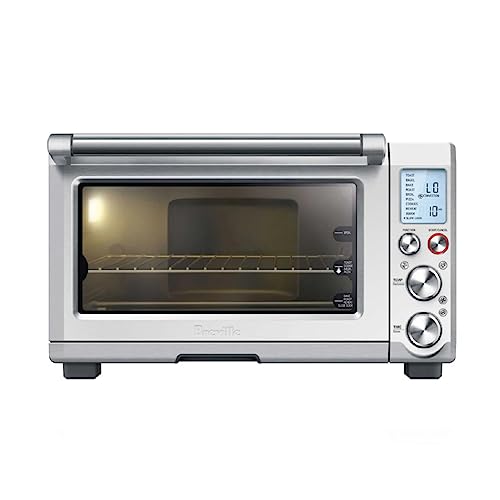
A hard ceiling only means something if its cost is visible. The clearest near-miss is the Breville Mini Smart Oven, a compact and well-regarded oven whose maker lists it at 10.7 pounds: seven-tenths of a pound over the line, and excluded. Below that line, the market thins quickly. The five picks here span 3.2 to 8.2 pounds, and there is a real gap between the heaviest pick and the ceiling, because the class between roughly eight and ten pounds is sparsely populated — ovens tend to jump from this featherweight group straight to the twelve-to-twenty-pound countertop mainstream once they add convection fans, double walls, steel construction and family-sized cavities. Readers who never actually lift their oven should know that relaxing the ceiling to fifteen pounds opens a much larger field; readers who lift theirs weekly will find the five below are close to the whole honest market.
Capacity shrinks in steps, not smoothly
Light ovens sort into three clear capacity steps. At the bottom is the single-slice class, represented here by the DASH Mini: one slice of bread, a mini pizza, a ramekin, a single portion of anything. The middle step holds two slices, which sounds like a small difference but changes the machine’s job from personal warmer to a genuine breakfast oven for one or two people. The top step in this weight class holds four slices or a nine-inch pizza, and it is the largest format that stays under the ceiling — six-slice and twelve-inch-pizza ovens exist in abundance, but not under ten pounds. Choosing between the steps is really choosing how the oven will be used on an ordinary morning: toast for one, toast for two, or toast and a small pizza for a household. Everything else about these machines matters less than getting that step right.
Wattage, and why low power can be a feature
The five picks draw between 550 and 1,300 watts, and the spread is not a simple quality ladder. In a house with a modern kitchen circuit, the Panasonic’s 1,300 watts buy speed and a genuine 500-degree top end. In a dorm room, an older apartment or an RV running on a shared or limited supply, the DASH Mini’s 550 watts and the Elite Gourmet’s 650 watts are not compromises but safeguards: they are far less likely to trip a breaker when a kettle, a microwave or a roommate’s hair dryer shares the circuit. The honest cost of low wattage is time and browning power on thicker foods, and the picks below say so individually. Match the draw to the wiring of the place the oven will actually live, not to the wiring of an ideal kitchen.
Heating technology at this size
Four of the five picks heat with conventional resistance elements above and below the cavity, the arrangement toaster ovens have used for decades. The sixth, the Panasonic FlashXpress, uses double infrared heating — near-infrared and far-infrared elements at the front and back of the cavity — which reaches cooking heat almost immediately and removes the preheating stage entirely. That difference is flagged wherever it affects how the oven is used, because an infrared oven’s timing habits do not transfer directly from element-oven recipes. Readers whose main interest is the element itself — how quartz tubes, conventional elements and infrared compare as technologies — will find that question treated on its own terms elsewhere on this site. For this guide’s purpose, technology is one attribute among several, weighed after the scale has had its say.
Doors decide how an oven is loaded
At these sizes the door is not a detail. Five picks use the familiar drop-down door, which opens toward the user and becomes a hot shelf in front of the cavity: fine on a clear counter, awkward in a galley kitchen or an RV where the space in front of the oven is also the walkway. The Hamilton Beach Easy Reach replaces it with a roll-top door that travels up and over the oven, leaving the counter in front free and keeping the hot glass out of the loading path entirely. Anyone who lifts an oven in and out of storage should also think about the door as a moving part: a drop-down door can swing during a carry if it is not held shut, while the roll-top stays closed by its own geometry. Neither design is better in the abstract; they suit different counters and different carrying habits.
Timers and the shape of a cooking session
Timer design quietly divides this group. The two smallest picks cap a session at fifteen minutes, which covers toast, reheating and small bakes but rules out anything slow. The rest offer thirty minutes, and two of them add a stay-on setting for longer, supervised cooking. A mechanical dial timer, which is what most of these ovens use, has one underappreciated virtue for a stored-away appliance: there is no clock to reset and no standby draw worth mentioning, and the oven is fully ready the moment it is plugged in. Readers who bake in longer stretches should treat the fifteen-minute models as warmers with ambitions, and choose from the thirty-minute group instead.
Cleaning an oven you move often
An oven that is lifted regularly gets cleaned differently from one that never moves: crumbs migrate, and a crumb tray that slides out from the front matters more than an interior coating. Most of these picks include a removable crumb tray and a baking pan sized to the cavity, and the Hamilton Beach goes further with a door that lifts off entirely. Nonstick claims in this class should be read narrowly — they apply to the included pan, not to the cavity walls. The practical routine is simple: empty the tray after anything crumbly, wipe the interior while the oven is unplugged and cool, and never immerse any part of an appliance this light in water. Portability does not reduce the cleaning; if anything, an oven stored in a cupboard should go away clean every time.
Carrying is a grip problem as much as a weight problem
Two ovens of identical weight can feel entirely different in the hand. A compact, roughly cubic body can be hugged against the torso and carried with the forearms doing the work; a wide, shallow body of the same weight must be held by its sides at arm’s length, which is where wrists and shoulders complain. Handles are rare in this class, so the realistic grips are under the base or around the body, and a warm oven should never be carried at all — the discipline is to let it cool, empty the crumb tray, and secure the door with one hand during the move. Cord length plays a quiet part as well: a stored oven that must reach a distant socket will be set down in awkward places, so measure the run from the intended shelf to the nearest outlet before choosing. The picks below note carrying character where it genuinely differs, because for this guide’s readers it is a primary specification, not a footnote.
When a maker publishes no weight at all
A surprising number of small ovens — particularly the cheapest unbranded ones — publish no weight anywhere in their documentation. This guide treats silence as disqualifying, and it is worth understanding why. A missing figure usually means the number was never controlled as a specification, so the unit that arrives may differ from any expectation set by a retail listing, and a listing’s figure may itself be a shipping weight, a guess, or a copy from a different model. For a purchase whose entire premise is a number, the number has to exist in the maker’s own material. Every pick below could produce one; several otherwise-plausible candidates could not, and they are not named here because an unverifiable oven cannot be recommended on a weight axis at all.
The five picks
The order below runs from the most full-featured oven in the class to the lowest-weight one, which is also roughly the order of descending capability. Every weight is the manufacturer’s published figure for the appliance itself.
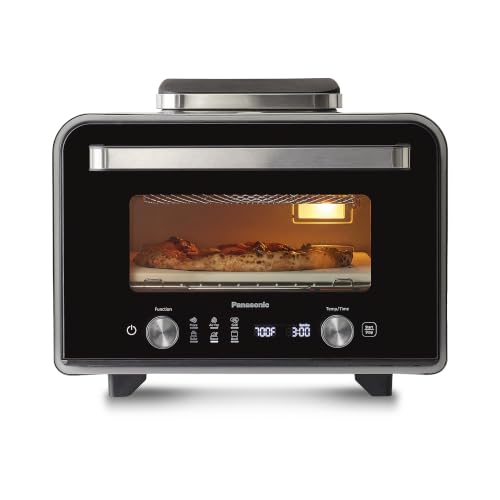
Panasonic FlashXpress NB-G110P: the infrared exception
The FlashXpress is the pick that proves this weight class is not a toy category. Panasonic lists the unit at 7.5 pounds net, in a body thirteen inches wide, twelve deep and a little over ten high, and inside that body sits the most ambitious heating system here: double infrared, with near-infrared and far-infrared elements positioned at the front and back of the cavity. Infrared elements reach working heat almost the instant they are switched on, so the FlashXpress has no preheating stage at all — food goes in, the door closes, and cooking starts. At 1,300 watts it is also the most powerful oven in this guide, with a temperature dial running from 250 to 500 degrees Fahrenheit, the widest range on offer.
Capacity is the full four-slice step: the included square tray takes four slices of toast or a nine-inch pizza, and the interior is a little over half a cubic foot. Six automatic cooking menus cover toast, waffles, rolls, pizza, quick reheating and hash browns, with a crust control offering light, medium and dark for toast, and the manual dial remains available for everything the menus do not name. A timer runs to twenty-five minutes, the rack is linked to the door so it slides forward as the door opens, and an automatic shut-off guards the end of every cycle. It is, by a wide margin, the most complete oven in this guide — the one a buyer chooses when the weight ceiling is a constraint to satisfy rather than the main attraction.
The controls deserve a word, because they are the least conventional part of the design. Rather than a function dial, the FlashXpress uses one-touch buttons for its six menus alongside the temperature dial, and the crust control is a simple three-position choice rather than a sliding scale. Owners of conventional ovens sometimes find the arrangement takes a weekend to learn; after that, the logic is arguably faster than a dial, because a known job — waffles, a reheat, hash browns — is a single press with the timing already decided. The interior light and the door-linked rack belong to the same philosophy: this is an oven designed to be watched and adjusted, not set and abandoned.
The infrared system changes habits as well as hardware. Timings from conventional toaster oven recipes assume a preheat and a slower element response, so they transfer imperfectly; the menus exist partly to absorb that learning curve. The exposed element tubes also ask for a gentler cleaning routine than a plain cavity, and the twenty-five-minute timer ceiling is five minutes shorter than the thirty offered by three rivals here. None of that diminishes the machine; it simply means the FlashXpress rewards a reader who cooks attentively over one who wants the most familiar possible oven.
Strengths
- Double infrared heating removes preheating entirely, so cooking starts the moment the door closes.
- The strongest specification in the class: 1,300 watts and a 250-to-500-degree range in a 7.5-pound body.
- Six automatic menus and a three-step crust control cover the everyday jobs without guesswork.
- Four-slice capacity and a nine-inch pizza fit, on the joint-smallest footprint among the four-slice picks.
Trade-offs
- Infrared timing differs from conventional ovens, so familiar recipes need adjustment rather than direct transfer.
- The timer stops at twenty-five minutes, the briefest ceiling among the four-slice picks.
- There is no convection fan, and the exposed elements need careful, gentle cleaning.
- A similar-looking stainless sibling model exists under a different model code, so the NB-G110P code is worth confirming on the box.
Who it suits: the small-kitchen cook who refuses to treat a light oven as a lesser oven. If the plan is real cooking — pizza, reheats, baked potatoes, toast in quantity — inside a body one person can lift onto a shelf without thinking twice, this is the strongest answer in the class, and it is worth a look to check price on Amazon.
Check price on Amazon: Panasonic FlashXpress NB-G110P


DASH Mini Toaster Oven DMTO100GBRD04: the lowest-weight by far
The DASH Mini is less a small toaster oven than a different species: 3.2 pounds by the maker’s listing, roughly seven and three-quarter inches in each direction, and built around a single dial. It toasts one slice of bread at a time, or a mini pizza of about five inches, a halved bagel, a ramekin or a few cookies. Power is 550 watts, the temperature is fixed at 400 degrees Fahrenheit, and a fifteen-minute timer with automatic shut-off is the entire control system. A removable baking tray, an oven rack and a crumb tray are included, which is more kit than the size suggests.
Judged as an oven, those numbers look like limitations; judged as an object that has to earn a place in a dorm room, a studio flat or an RV locker, they are the point. The Mini asks for almost no counter, almost no circuit capacity and almost no commitment. It can live in a cupboard, a drawer-adjacent shelf or a storage box and come out for a single slice of toast, which is the actual job most countertop ovens perform most days. The red finish of the DMTO100GBRD04 code is the version this guide names; other colours exist under different model codes, a detail worth knowing before ordering, since the code and the colour are tied together in DASH’s catalogue.
What fits inside defines the Mini’s real menu. A standard slice of bread sits flat; a halved bagel fits; a ramekin of baked eggs, a small dish of macaroni cheese, a few cookies on the tray and a personal pizza of around five inches all work. What does not fit is anything in a standard baking dish, a second slice, or a portion meant to be shared. The included tray is sized to the cavity, which matters more than it sounds: with an oven this small, the manufacturer’s own tray is effectively the only pan that fits, and having it in the box removes the hunt for miniature bakeware. The glass door, unusual at this size and price class, lets the single slice be watched without opening anything.
The fixed temperature is the honest centre of the trade-off. Four hundred degrees is a sensible universal setting for toast, reheating and small bakes, but there is no low end for gentle warming and no high end for aggressive browning, and no way to follow a recipe that specifies a temperature. The fifteen-minute timer likewise suits snacks rather than meals. Buyers who understand the Mini as a one-person warmer with a toasting habit will be delighted by it; buyers who expect a miniature version of a full oven will not.
Strengths
- At 3.2 pounds it weighs less than half of the next-lowest-weight pick, and stores almost anywhere.
- The 550-watt draw is gentle on dorm, older-apartment and RV circuits.
- One dial and an automatic shut-off make it the simplest oven here to operate.
- Baking tray, rack and crumb tray are all included despite the tiny format.
Trade-offs
- One slice at a time, with a cavity sized for single portions only.
- The temperature is fixed at 400 degrees, with no adjustment in either direction.
- The fifteen-minute timer rules out longer bakes entirely.
- Colour and model code are linked, so the exact code must match the colour wanted.
Who it suits: the dorm resident, the solo dweller in a genuinely tiny kitchen, or the RV traveller who wants toast and warm snacks from something that stores like a kettle. If one slice at a time is the household’s real rhythm and every ounce of storage matters, this is the pick to check price on Amazon.
Check price on Amazon: DASH Mini Toaster Oven

Elite Gourmet ETO236: two slices and a real temperature dial
The ETO236 is the smallest oven here that still behaves like a conventional toaster oven. Elite Gourmet lists it at 4.5 pounds, and its proportions are unusual: about thirteen and a quarter inches wide but only seven and a half deep and six and a half high, a wide, low, shallow box that slides into shelf spaces and under-cabinet gaps that defeat taller machines. Inside are two slices’ worth of room, a wire rack and a nonstick baking pan. Power is 650 watts, the temperature adjusts from 200 to 450 degrees Fahrenheit, and a fifteen-minute timer with automatic shut-off runs the session.
That temperature dial is what separates the ETO236 from the DASH Mini above it. A range starting at 200 degrees allows genuine warming and gentle reheating, and the 450-degree top end browns properly, so the oven can follow ordinary recipes at miniature scale: an open-faced sandwich, a small tray of vegetables, a personal pizza, two slices of toast. Bake, broil and toast functions are selected on the same simple knob layout, and a built-in thermostat holds the set temperature rather than simply running the elements flat out. For one person, or two people with modest appetites, this is the smallest format that does not require rethinking what a toaster oven is for.
The wide, low shape has one more consequence worth weighing: heat clearance. A six-and-a-half-inch height means the top of the oven sits closer to whatever is above it — a shelf, a cupboard base — than any other pick here, and the maker’s clearance guidance should be measured against the actual shelf, not assumed. In exchange, the shallow depth leaves the front of a worktop usable in a way the deeper four-slice bodies do not, and the oven can stay out permanently in kitchens where a taller machine would have to be stored. Several readers of this guide will be choosing between this oven and the DASH on exactly that point: stored away and feather-light, or left out and slightly more capable.
The limits are scale and stamina. Two slices is two slices: a household that toasts for three must run batches, and the shallow cavity will not take a tall dish. Fifteen minutes is the briefest timer in the guide alongside the DASH, so anything slow is out, and 650 watts means thicker items brown more slowly than they would in the stronger ovens here. The construction is plainly built to a budget, with a single rack position. None of this matters for the oven’s intended work, which is small, quick and frequent.
Strengths
- A full 200-to-450-degree temperature range in a 4.5-pound oven, unlike the fixed-setting Mini.
- The low, shallow body fits shelves and under-cabinet spaces that exclude taller ovens.
- Two-slice capacity doubles the single-slice class for couples and small households.
- The 650-watt draw stays friendly to limited circuits, and the timer shuts off automatically.
Trade-offs
- The fifteen-minute timer is the joint-briefest here and excludes slow cooking.
- Two slices and a shallow cavity cap the size of every meal.
- Modest wattage browns thick items slowly compared with the stronger picks.
- A single rack position leaves little room for fine height adjustment.
Who it suits: one or two people in a small flat, a dorm with a little more freedom, or an RV kitchen that needs a real oven in miniature rather than a warmer. If two slices, a proper temperature dial and a body that disappears onto a shelf match the household, this is a sensible place to check price on Amazon.
Check price on Amazon: Elite Gourmet ETO236
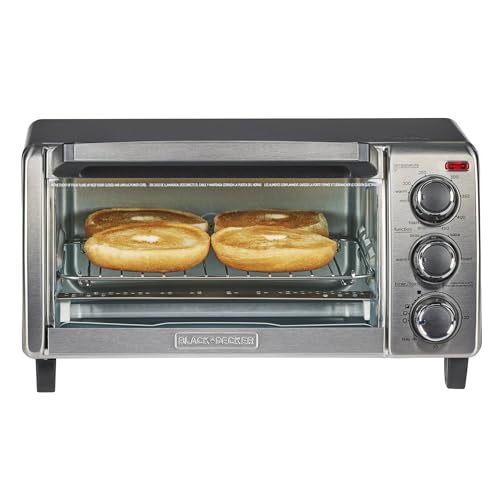
BLACK+DECKER TO1313SBD: the lowest-weight four-slice, with a stay-on timer
BLACK+DECKER’s long-running four-slice oven makes the most interesting weight claim in this guide. The manufacturer’s own product page lists the TO1313SBD at 5.0 pounds — the lowest-weight four-slice oven here by a clear margin — while a major retail listing shows a noticeably higher figure for the same model. Following this guide’s rule, the maker’s number is the one used, and the disagreement itself is instructive: it is exactly the net-versus-packaged confusion described in the buying guide. Either way the oven is comfortably inside the ceiling. The body measures about fifteen and a half inches wide, eleven deep and eight and a third high, with a curved interior that fits four slices or a nine-inch pizza.
Inside that light body sits a fuller feature set than the weight suggests. Power is 1,150 watts with natural convection airflow — the brand’s EvenToast approach, which circulates heated air without a fan — across bake, broil, toast and keep-warm functions. The thirty-minute timer adds the feature nobody else in this guide offers: a stay-on setting for longer cooking under supervision. A removable crumb tray and an included bake pan complete a specification that reads like a mid-sized oven’s, carried in a featherweight frame.
The natural convection claim is worth explaining, because it is easy to misread. There is no fan. Instead, the cavity’s shape and venting are arranged so heated air circulates on its own, evening out the hot spots that plain elements produce — the brand’s long-standing approach to more uniform toast. It will not match a fan oven’s aggression on frozen food, but it also adds no fan noise, no fan to fail, and no weight, which is precisely how this oven keeps a four-function, four-slice specification at a maker’s figure of five pounds. The keep-warm function pairs naturally with the stay-on timer: a finished dish can be held, then the oven switched off deliberately rather than by the clock, a small flexibility that suits households where people eat at staggered times.
The frame is where the compromises live. The footprint is the joint-widest in the guide despite the low weight, so counter depth, not lifting strength, is the constraint it imposes. Shade and temperature are dial-controlled and approximate, the keep-warm function shares the main dial rather than having a dedicated control, and the light construction that makes the oven easy to carry also makes it feel less planted on the counter when the door is pulled down. For the buyer whose priority is maximum cooking scope per pound, those are easy trades to accept.
Strengths
- The maker’s listed 5.0 pounds makes it the lowest-weight four-slice oven in the guide.
- A stay-on timer setting, unique here, allows longer supervised cooking sessions.
- Natural convection airflow and 1,150 watts give it the broadest conventional feature set per pound.
- Four functions including keep-warm, with a crumb tray and bake pan included.
Trade-offs
- The joint-widest footprint here, so counter space matters more than lifting strength.
- Maker and retail weight figures disagree, which buyers should understand before comparing.
- Dial controls are approximate rather than precise, including the toast shade.
- The light body feels less firmly planted when the drop-down door is opened.
Who it suits: the cook who wants a full four-slice feature set — stay-on timer, keep-warm, convection airflow — without giving up the ability to lift the oven away one-handed. If counter width is available and weight is the scarce resource, this is the pick to check price on Amazon.
Check price on Amazon: BLACK+DECKER TO1313SBD


Hamilton Beach Easy Reach 31344DA: the roll-top door
The heaviest pick in the guide is here for its door. Hamilton Beach lists the Easy Reach at 8.2 pounds — still nearly two pounds under the ceiling — and builds it around a roll-top door that moves up and over the oven instead of dropping down toward the user. The difference is practical in three ways: the counter in front stays usable while the oven is open, food is loaded from above rather than past a hot glass panel, and spills cannot land on the door because the door is never underneath the food. The door also lifts off entirely for cleaning, and a slide-out crumb tray handles the rest of the mess.
The oven behind the door is a solid four-slice specification: 1,200 watts, a 200-to-450-degree range, bake, broil and toast functions, two rack positions, an included bake pan, and a thirty-minute timer with a stay-on option, a ready bell and automatic shut-off. It fits four slices or a nine-inch pizza in a body about sixteen inches wide, twelve deep and nine high. The ready bell deserves a mention for this guide’s audience: in a kitchen where the oven is stored away and brought out for a task, an audible signal that travels to another room is worth more than another degree of temperature precision.
Two rack positions sound like a minor line in a specification, but in a four-slice cavity they are the difference between toast that browns and a tray that sits too close to the top element. The Easy Reach’s positions let flat foods ride low for even heat and taller items drop down for clearance, and the included bake pan is sized to the cavity so the positions are actually usable rather than theoretical. The contoured knobs belong to the same accessibility story as the door: they are shaped to be gripped and turned with a less-than-perfect hand, and the timer’s bell removes the need to hover. Specification sheets rarely connect these details; in daily use they are one connected argument about who the oven is designed for.
Weight and shape are the costs. At 8.2 pounds it is the pick most likely to be left out on the counter rather than stored, which partly defeats the purpose for the most demanding lifters, though it remains easy to move when needed. The curved roll-top profile means nothing can be set on top of the oven, the three-function list is the plainest among the four-slice picks, and the door mechanism is a moving assembly that asks to be treated gently during carries. Buyers who load and unload around a hot drop-down door every day will forgive all of it for the access alone.
Strengths
- The roll-top door keeps the counter in front clear and the hot glass out of the loading path.
- The door lifts off and the crumb tray slides out, making it the easiest four-slice pick to clean.
- A ready bell, stay-on option and automatic shut-off round out the timer better than any rival here.
- At 8.2 pounds it stays well under the ceiling while offering the full four-slice format.
Trade-offs
- The heaviest pick in the guide, and the most likely to end up living on the counter.
- The curved top cannot hold anything, and the footprint is the joint-widest here.
- Only three cooking functions, the plainest list among the four-slice picks.
- The roll-top mechanism is one more moving part to treat carefully when carrying.
Who it suits: anyone who loads an oven in a tight space, cooks with limited reach or grip, or is tired of reaching over a hot drop-down door. If easy access matters more than the last few pounds of lightness, the Easy Reach is the one to check price on Amazon.
Check price on Amazon: Hamilton Beach Easy Reach 31344DA
The five side by side
| Toaster oven | Maker-listed weight | Capacity | Heating and power | Standout trait |
|---|---|---|---|---|
| Panasonic FlashXpress NB-G110P | 7.5 lb | 4 slices, 9-inch pizza | Double infrared, 1,300 watts | No preheating, widest temperature range |
| DASH Mini Toaster Oven | 3.2 lb | 1 slice, mini pizza | Conventional element, 550 watts | Lowest-weight here by a wide margin |
| Elite Gourmet ETO236 | 4.5 lb | 2 slices | Conventional elements, 650 watts | Full temperature dial in a low, shallow body |
| BLACK+DECKER TO1313SBD | 5.0 lb | 4 slices, 9-inch pizza | Natural convection, 1,150 watts | Lowest-weight four-slice, stay-on timer |
| Hamilton Beach Easy Reach 31344DA | 8.2 lb | 4 slices, 9-inch pizza | Conventional elements, 1,200 watts | Roll-top door and ready bell |
Read the table by columns rather than rows. The weight column shows how unevenly the class is spread — nearly five pounds separate the lowest-weight and heaviest picks, which is the difference between storing an oven in a drawer-adjacent cupboard and sliding it along a counter. The capacity column shows the three steps described in the buying guide, and the heating column shows why wattage alone does not rank these machines: the infrared Panasonic and the convection-assisted BLACK+DECKER reach their results by different routes from the plain-element ovens between them.
If the table leaves a reader torn between two capacity steps, the tie-breaker is storage rather than appetite. An oven that is slightly too small gets used daily and its limits become routine — a second round of toast is a minor event. An oven that is slightly too large for its shelf gets left out, resented, and finally replaced, which is the expensive outcome. Measure the cupboard or the shelf first, in inches, and let that measurement veto any pick it cannot house; then choose the most capable oven that survives the veto. That sequence — space, weight, capacity, features — is the order this entire guide was built in, and it works just as well applied at the kitchen table.
The near-misses, named honestly
A ceiling is only credible if the reader can see what it turned away. The Breville Mini Smart Oven is the hardest exclusion: a compact oven with a strong following, quartz elements and a four-slice-plus cavity, listed by Breville at 10.7 pounds. It misses this guide by less than the weight of a mug of coffee, and readers who do not truly lift their oven should feel free to overrule the ceiling and consider it — this guide’s promise is simply that everything inside the line is verifiably under it. Breville’s larger Smart Oven models, and the mainstream countertop ovens from Cuisinart and similar makers, sit between twelve and twenty pounds and were never candidates. At the other extreme, a handful of ultra-cheap two-slice ovens advertise weights in this class but publish no manufacturer figure to verify, and were excluded on that ground alone, as the buying guide explains. The five picks are what remains when the rule is applied without exceptions: a small class, but a completely honest one.
Matching the oven to the space it will live in
For a dorm room, the decision is mostly electrical and social. The DASH Mini and the Elite Gourmet draw the least power, store in the least space and annoy nobody; between them, the choice is one slice with total simplicity or two slices with a temperature dial. For an RV or a boat galley, add the carrying question: an oven that travels should be light, mechanically simple and indifferent to being plugged into a different circuit every night, which favours the DASH and the Elite Gourmet over anything with electronic controls. For a small apartment where the oven is a genuine second oven, the four-slice picks earn their extra pounds, and the choice among them is about habits — infrared speed from the Panasonic, features per pound from the BLACK+DECKER, or access from the Hamilton Beach.
There is one more scenario this class serves quietly well: the household that already owns a full-size oven and wants a small second one for the jobs that do not justify heating it. Toast, a tray of roasted vegetables for two, reheating a portion without drying it — these are daily tasks that a range oven performs wastefully and slowly. A light countertop oven that can be lifted out for the holiday season, when every appliance earns its place, and stored again in January is a rational purchase rather than a gadget, and it is the scenario in which the four-slice picks make most sense: big enough to be genuinely useful at a family gathering, light enough to vanish afterwards.
For anyone whose hands are the real constraint — reduced grip, arthritis, a shoulder that objects — the analysis changes subtly. Total weight matters, but so does how the weight is carried: a compact body that can be held against the torso beats a wide, light body that must be held at arm’s length, and a door that never needs holding open while loading removes a second burden. On that reading the DASH Mini carries best, and the Hamilton Beach loads best once it is in place. It is also worth knowing the boundary of this guide: when the job stops being toast and small bakes and becomes air frying in quantity, a countertop oven of any weight is the wrong tool, and rack-based air fryers take over. Every pick here is a toaster oven first, and is happiest staying one.
Frequently asked questions
Why do shops list a different weight from the manufacturer?
Because they are weighing different things. The manufacturer’s figure is the appliance alone; a retail listing often shows the packaged weight, box and accessories included. Panasonic’s specification sheet for the FlashXpress states both openly — 7.5 pounds net for the unit, 9.7 pounds gross for the carton — which is why this guide uses maker figures throughout and flags the one pick, the BLACK+DECKER, where the maker’s page and a major listing disagree.
Is a toaster oven under 10 pounds big enough for a household?
For toast, reheating and small bakes, yes, provided the household is small. The four-slice picks handle breakfast for two to four people and a nine-inch pizza; none of them will roast a chicken or take a casserole dish, and none pretends to. Households that regularly cook oven meals for more than two should treat this class as a second oven rather than the only one.
Can a lightweight toaster oven go in a dorm room or an RV?
Generally yes, with two checks. First, the circuit: the picks here draw from 550 to 1,300 watts, and the lower half of that range is far kinder to shared and limited supplies. Second, the rules of the building or site, which sometimes restrict countertop ovens regardless of size. Light weight removes the storage problem; it does not remove the need for the ventilation clearance every maker specifies around a hot appliance. In practice the two smallest picks are the easiest to place legally in a dorm room, because a shelf or desk corner that would crowd a four-slice body gives a one- or two-slice oven the breathing room its manual asks for.
Does a lighter oven cook worse than a heavier one?
Not automatically. Weight in a toaster oven is mostly structure — thicker steel, insulation, a convection fan, a larger cavity — so a lighter oven usually gives up capacity and features rather than basic competence at its own scale. The Panasonic shows that a light body can hold the most advanced heating here, while the two-slice and one-slice picks cook their small loads perfectly well. What light ovens cannot do is cook large loads, and no specification changes that.
What is the lowest-weight pick here, and what does it give up?
The DASH Mini, at 3.2 pounds — less than half the weight of the next pick. In exchange it gives up capacity (one slice at a time), temperature choice (a fixed 400 degrees) and session length (fifteen minutes). For a single person whose oven work is toast and warm snacks, those are trades rather than losses; for anyone cooking for two or following recipes, the Elite Gourmet one step up is the better starting point.
Every oven in this guide earned its place by passing a scale before it passed any other judgement, and that ordering is the whole argument: a toaster oven that is easy to lift gets used, stored properly and kept for years, while a heavier one slowly becomes furniture. Choose the capacity step that matches the household, respect the wiring of the room it will live in, and the lowest-weight oven that does the job is very often the right one.