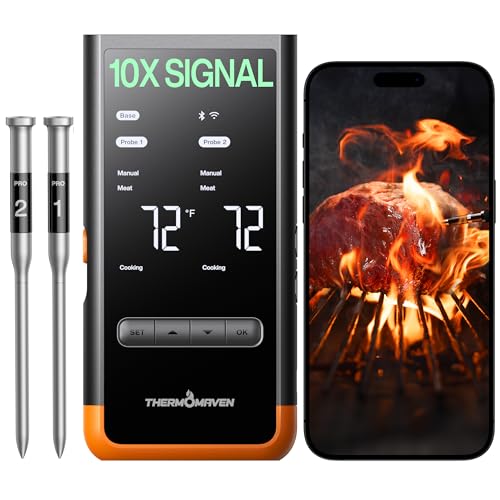
A brisket does not care that you have other things to do. Neither does a pork shoulder settling into hour nine of a low-and-slow cook, or a turkey that needs its breast and thigh tracked as two separate problems. A remote meat thermometer exists for exactly this tension: the food needs hours of attention, and you need to be somewhere else. The probe stays in the meat, the signal travels to a receiver or a phone, and the cook gets to leave the patio without guessing. This guide compares five remote systems that take genuinely different approaches to that job, from a radio-frequency set with its own handheld receiver to fully wireless probes that report through WiFi.
One disclosure before the picks. This site may earn an affiliate commission when readers buy through links on the page, at no extra cost to the reader. That commission structure is the whole business model, and it is worth stating plainly. The selections and the reasoning below come from research: manufacturer specifications, published documentation, stated temperature limits, probe counts, and the physics of how each connection type behaves around metal cookers and house walls. Nothing here rests on a price tag or a popularity score, and the order of the picks reflects how the systems differ, not a promise that one of them wins for every kitchen.
In this guide
Quick picks: best remote meat thermometers
| # | Product | Where to buy |
|---|---|---|
| 1 | Inkbird IBBQ-4T | Check on Amazon |
| 2 | Typhur Sync | Check on Amazon |
| 3 | CHEF iQ Sense | Check on Amazon |
| 4 | ThermoPro Twin TempSpike | Check on Amazon |
| 5 | MEATER 2 Plus | Check on Amazon |
What “remote” actually means, and what it does not
The word remote covers three different machines that happen to share a job. The oldest design is the radio-frequency set: wired probes plug into a transmitter that sits beside the cooker, and a dedicated receiver, carried in a pocket or clipped to a belt, shows the readings. The second design pairs wired probes with a base unit that talks to a phone app over Bluetooth or WiFi. The third and newest design removes the wire entirely: the probe itself is a sealed, battery-powered transmitter that lives inside the meat, and it reports to a charger dock, a base station, or a phone. All three are remote. They differ in range, in failure modes, in how many temperatures they can watch at once, and in how much they depend on a phone behaving itself.
Just as important is the boundary on the other side. A remote thermometer is a leave-in instrument: its probe goes into the meat before or during the cook and stays there, reporting continuously. An instant-read thermometer is a different tool that answers a different question, the spot check at the end of a cook or the quick verification of a thin cut. A remote probe cannot do the instant-read job well, because its sensor sits at one fixed point and its reading is only as honest as its placement. An instant-read cannot do the remote job at all, because it tells you nothing until you open the cooker and lose the heat you were protecting. Households that cook long and often usually end up owning both, and this guide only ranks the remote half of that pair.
There is a second boundary worth drawing. A general oven thermometer with a wired probe, the kind sold for checking roasts and oven accuracy, overlaps with this category but is not the same thing. The remote systems ranked here are built around distance and alerting: multiple probes, ambient temperature channels, high and low alarms, and a signal path designed to survive a closed metal lid and a brick wall. That alerting layer is the real product. A number you have to walk outside to read is just a thermometer with a long wire.
The five picks at a glance
| Pick | Connection | Probes | Tracks ambient heat | Needs a phone | Best suited to |
|---|---|---|---|---|---|
| Inkbird IBBQ-4T | WiFi to an app | 4 wired probes | Yes, via a probe channel | Yes | Cooks who want to check the pit from anywhere |
| Typhur Sync | WiFi and Bluetooth through a base station | 2 wireless probes | Yes, each probe reads its own tip surroundings | Optional | Two-probe wireless cooking with a screen at the cooker |
| CHEF iQ Sense | WiFi and Bluetooth through a hub | 3 wireless probes | Yes, built into each probe | Yes, for the guided features | App-led cooking with presets and predictions |
| ThermoPro Twin TempSpike | Bluetooth through a booster case | 2 wireless probes | Yes, built into each probe | Yes | A first wireless set for grills and ovens |
| MEATER 2 Plus | Bluetooth repeated by the charger dock | 1 wireless probe | Yes, built into the probe | Yes | Single-probe cooks who want the simplest kit |
The table compresses a lot, so treat it as a map rather than a verdict. Probe count, connection type, and ambient tracking are the three axes that decide most purchases, and the individual reviews below take each system on its own terms, including the trade-offs that a spec sheet tends to bury.
The picks in detail

Inkbird IBBQ-4T: four probes on WiFi, readable from anywhere
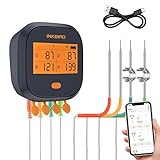
The IBBQ-4T keeps the four-probe wired layout but changes the destination of the signal. Its base unit joins the home WiFi network on the 2.4 GHz band and reports to the Inkbird app, which means the cook is no longer bounded by radio range at all. Anywhere the phone has a connection, the cook can see the pit: from the sofa, from the store during a mid-cook supply run, from the far end of the house where the receiver of an RF set would have given up several walls ago. For long cooks in real houses, that is a genuinely different capability rather than a spec-sheet flourish.
The base is rechargeable over USB, which removes the battery-swap chore from the transmitter side, and the app provides the layer that RF sets cannot: temperature graphs across the whole cook, preset targets by protein, and alarms that arrive as phone notifications. Four channels again allow the pattern that serious smoking demands, meat probes in the cuts and one channel reserved for ambient temperature at grate level. The stated probe range reaches from below freezing to roughly 572 degrees Fahrenheit, comfortably covering smoking and roasting, and the probes are rated for the wet environment of a cooker that produces steam as readily as smoke.
The dependencies are the mirror image of a dedicated receiver’s independence. WiFi-only remote access means the system leans on the router, on the 2.4 GHz band specifically, and on the app staying connected in the background. A cooker placed at the edge of the home network’s reach, behind a metal shed or a long garden, can leave the base struggling for signal precisely where the cook needs it. There is also no standalone receiver: step away from the phone and the readings step away with it. None of this disqualifies the IBBQ-4T; it simply defines its household. In a home with strong WiFi reaching the patio, it offers the most complete remote picture of any wired set here.
Strengths
- WiFi reporting removes range as a practical limit wherever the phone itself has service.
- Four channels with app graphing show the whole cook, including stalls and pit drift.
- Rechargeable base avoids disposable batteries on the transmitter side.
- App presets and notifications handle both target alarms and ambient high-low warnings.
Trade-offs
- Requires a 2.4 GHz WiFi signal that actually reaches the cooker, which not every yard offers.
- No independent receiver, so the phone is a single point of failure for alerts.
- Wired probes carry the same cable-routing and flame-avoidance duties as any wired set.
Who it suits: the cook whose smoker or grill sits comfortably inside home WiFi coverage and who wants to supervise a long cook from anywhere, not just from the yard. For connected households it is the most capable wired option in the group, so check price on Amazon.
Check price on Amazon: Inkbird IBBQ-4T

Typhur Sync: two wireless probes with a base station that has its own screen
The Typhur Sync removes the probe wires and then solves the problem that wire removal creates. Each of its two probes is a self-contained sensor with a transmitter in its handle end, and the probes report to a base station that sits near the cooker. That base station is the thoughtful part: it has its own display, so temperatures can be read at the cooker without a phone, and it relays the data onward over both Bluetooth and WiFi, so the same readings appear in the Typhur app across the house or beyond it. It is the only design in this roundup that offers a screen at the pit and a feed to the phone as equal citizens.
Each probe reads two temperatures at once. A sensor near the tip reports the internal temperature of the meat, and a sensor at the handle end reports the ambient temperature immediately surrounding the food, which is a more honest number than the temperature at the top of the lid. The manufacturer states a high accuracy figure for the internal reading and rates the probe’s handle end for the heat of a working grill environment, with the standing rule of all wireless probes applying here: the electronics live in the handle, so the handle’s stated limit, not the tip’s, is the ceiling that matters. The base station doubles as the charging dock, and the probes are stated to run for well over a day of continuous cooking on a charge, which covers the longest smokes without a mid-cook recharge.
Two probes is the ceiling, and for some cooks that is the whole objection. A household that routinely smokes two large cuts and wants a separate grate probe is asking for a third and fourth channel this system does not have, though the ambient reading built into each probe softens that loss. The Sync also sits in the newer, more electronic end of the category: firmware, an app, and a dock that must be kept together as a set. Cooks who lose small electronics should think honestly about that. As a two-probe wireless system, though, it is the most complete interpretation of the idea in this group.
Strengths
- Base station display shows readings at the cooker with no phone involved.
- Dual connection, Bluetooth locally and WiFi for distance, covers both yard and away-from-home checks.
- Every probe reports internal and ambient temperature together, so no channel is sacrificed to the pit.
- Stated probe battery life spans the longest cooks without a mid-session charge.
Trade-offs
- Two probes is the hard limit, which large multi-cut cooks will outgrow.
- The handle-end heat limit of a wireless probe is lower than the ceiling stated for a wired probe’s cable.
- A dock, two probes, and an app form a small ecosystem that has to be stored and kept together.
Who it suits: the cook who wants wireless freedom without surrendering the at-the-cooker screen, and whose cooks rarely need more than two pieces of meat watched at once. It balances both worlds more evenly than anything else here, so check price on Amazon.
Check price on Amazon: Typhur Sync

CHEF iQ Sense: three wireless probes built around guided cooking
The CHEF iQ Sense is the most software-forward system in this roundup. Three ultra-thin wireless probes report through a hub that connects by both Bluetooth and WiFi, and the CHEF iQ app wraps the hardware in a guided-cooking layer: choose the protein and the cut, set the desired finish, and the app estimates remaining cooking time, tracks the climb, and announces when to pull the food and how long to rest it. Each probe carries sensors for internal temperature and for the ambient heat around the food, so three probes can watch three cuts, or two cuts and a zone, without giving up ambient information on any of them.
The probes themselves deserve a word, because their thinness is a functional point rather than a cosmetic one. A slim probe displaces less of a chicken breast or a fish fillet, leaves a smaller puncture for juices to escape, and fits foods that a thick wireless probe would dominate. The hub acts as the range bridge, relaying the short-range probe signal onto the home network, and the manufacturer states effectively unlimited range once the WiFi link is established, bounded only by the phone’s own connection. Charging happens in the hub, and the stated probe endurance covers long sessions, with quick top-ups between cooks.
The trade is that the system’s best features live inside the app, and the app is therefore not optional decoration. Cooks who want a number and an alarm, nothing more, are carrying a guided platform they will never open, and the prediction features are only as good as the cut information entered at the start. The ecosystem is also the most closed here: probes, hub, and app are one vendor’s stack. For the cook who genuinely cooks by guidance, especially one still building confidence with expensive cuts, that stack is the point. The Sense sells coaching that happens to include excellent telemetry.
Strengths
- Three wireless probes is the highest wireless channel count in this roundup.
- Guided cooking with time estimates and rest prompts suits cooks building confidence.
- Thin probes handle delicate and small cuts that bulky probes overwhelm.
- WiFi through the hub removes practical range limits inside network coverage.
Trade-offs
- The defining features require the app; there is no meaningful screen-on-device experience.
- Predictions depend on entering the cut and target correctly at the start of the cook.
- A single-vendor stack of probes, hub, and software is the least mix-and-match kit here.
Who it suits: the app-comfortable cook who wants the thermometer to coach as well as report, and who cooks several pieces at once often enough to use three probes. If guidance is the feature you keep wishing for, this is the system built around it, so check price on Amazon.
Check price on Amazon: CHEF iQ Sense

ThermoPro Twin TempSpike: the straightforward two-probe wireless set
The Twin TempSpike is ThermoPro’s answer to the fully wireless format, and it keeps the brand’s plain-spoken character. Two probes, each with an internal sensor at the tip and an ambient sensor at the handle end, report over Bluetooth to the ThermoPro app. The charging case is more than storage: it acts as a signal booster that sits between the probes and the phone, and the manufacturer states a range of up to 500 feet in open conditions for the boosted link. That booster is an admission of the central fact about Bluetooth and cookers, which is that a phone alone, indoors, talking to a probe sealed inside a metal box is a weak arrangement; putting a relay near the cooker fixes most of it.
In use, the two-probe layout maps neatly onto the most common real cooks: a chicken with a probe in the breast and one in the thigh, two steaks finished to two different targets, or one cut plus its ambient surroundings from the same probe. The app supplies the expected instruments, preset temperatures by protein, custom alarms, and a graph of the cook. The probes are stated to withstand the ambient heat of ordinary grilling and roasting at the handle end, and the case keeps both probes charged and paired as a single grab-and-go unit, which quietly solves the storage problem that loose probes create in a utensil drawer.
The limits are the familiar wireless ones, stated plainly. Bluetooth, even boosted, is a through-walls negotiation rather than a guarantee, and there is no WiFi path for checking the cook from across town. The ambient sensor sits at the probe’s handle, close to the food, which reads the microclimate around the meat rather than the grate as a whole; that is useful information, but it is not identical to a clipped grate probe. And two probes is the ceiling. Within those boundaries, the Twin TempSpike is the least complicated route into wireless monitoring in this group, and for many households it will simply be enough.
Strengths
- Booster case meaningfully extends Bluetooth range and doubles as charging storage.
- Two dual-sensor probes cover the most common two-target cooks without spare channels wasted.
- App covers presets, custom alarms, and cook graphs without extra complexity.
- The whole kit lives in one case, which keeps probes charged, paired, and findable.
Trade-offs
- Bluetooth only, so there is no way to check the cook from beyond the boosted local range.
- Ambient readings come from the probe handle’s microclimate, not from a separate grate position.
- Two channels will not stretch to multi-cut cooks plus a dedicated pit watch.
Who it suits: the household moving from wired probes, or from no thermometer at all, into wireless monitoring for ordinary grills, roasts, and single smokes. It is the simplest full wireless set here to live with day to day, so check price on Amazon.
Check price on Amazon: ThermoPro Twin TempSpike

MEATER 2 Plus: the single-probe minimalist
The MEATER 2 Plus is the purest expression of the wireless idea: one probe, no wires, no base unit beyond its wooden charging block, and an app. The probe carries two sensors, one for the internal temperature of the meat and one at the handle end for ambient heat, and it talks by Bluetooth to its charger, which repeats the signal onward to the phone. MEATER quotes an open-air reach of as much as 250 feet for that repeated link. The 2 Plus generation raised the probe’s stated ambient heat tolerance at the handle end to roughly 932 degrees Fahrenheit, a figure aimed squarely at searing and at cooks over open flame where the first generation’s limits were a real constraint.
A single probe sounds like a limitation, and for multi-cut cooks it is one, but it is also a description of a great deal of actual cooking. One roast, one chicken, one thick steak, one pork tenderloin: the weeknight and Sunday repertoire is heavily single-item, and for that repertoire the MEATER kit is the smallest, quickest system here to deploy and to put away. The app adds a guided layer of its own, with an estimator that projects when the food will reach its target and factors in resting, so the probe coaches the finish as well as reporting the present. The probe charges in its block from a replaceable battery in the charger, and the whole object takes up less drawer space than a pepper mill.
The boundaries should be respected rather than argued with. One probe means one internal reading; a turkey’s breast and thigh cannot both be watched, and a second cut means a second probe purchased separately. Bluetooth range through the repeater is respectable but remains the shortest stated reach in this roundup, and thick walls tax it. That higher ceiling also does not repeal the general rule that the electronics end of any wireless probe is its weak point under direct flame. Judged as what it is, a single-probe instrument for single-item cooks, the MEATER 2 Plus is the most refined object in the category.
Strengths
- The smallest and simplest kit here: one probe, one charging block, nothing else to manage.
- Raised handle-end heat tolerance suits searing and higher-heat grills better than earlier wireless probes.
- App estimation projects finish and rest, which helps time the rest of the meal.
- Dual sensors give internal and ambient readings from a single insertion.
Trade-offs
- One probe watches one spot; two-zone or two-cut cooks need additional probes.
- Stated range is the shortest in this group, and the link is Bluetooth only.
- No screen anywhere in the system, so the phone is mandatory for every glance.
Who it suits: the cook whose repertoire is one centrepiece at a time and who values a kit that disappears into a drawer between cooks. For single-item households it is the cleanest solution in the roundup, so check price on Amazon.
Check price on Amazon: MEATER 2 Plus
What to look for in a remote meat thermometer
Connection type decides the real range. The three connection families behave like three different products. Radio frequency to a dedicated receiver is the long-distance and thick-wall specialist, because the receiver is a purpose-built radio rather than a phone splitting attention. WiFi removes distance from the question entirely, provided the cooker sits inside the home network’s footprint. Bluetooth is the shortest-legged of the three and leans on boosters, docks, and repeaters to stay honest. Every range figure in this category is measured in open air, and every wall, floor, and metal lid between probe and receiver spends some of that figure. Choose the connection for the geography of your house and yard, not for the biggest number on a box.
Probe count, and the ambient question. Count what a long cook actually needs watched. A single large cut can justify two probes by itself, one in the thickest section and one near a thinner end. Two cuts double the demand. Then there is the pit: knowing the cooker’s real temperature at grate level is what turns a stall from a mystery into a schedule, and it requires either a spare channel with a clip-on probe or a wireless probe whose handle-end sensor reports the air around the food. Systems that build ambient sensing into every probe quietly return a channel to the meat, and that design choice matters more over a year of cooks than any single specification.
Temperature limits are two numbers, not one. Every probe has a tip that lives in the meat and a part that lives in the cooker’s heat. On wired probes the vulnerable part is the cable and its joint to the probe, and the stated cable limit is the ceiling for the whole assembly. On wireless probes the vulnerable part is the handle, which contains the battery and transmitter, and its stated ambient limit governs even though the tip could survive far more. Read both numbers in the manufacturer’s documentation before a first high-heat cook, and treat flare-ups and direct flame as hazards to the electronics end regardless of what the tip is doing.
The app is part of the instrument. On phone-based systems the app carries the alarms, the presets, the graphs, and the predictions, so its quality is a hardware fact, not a bonus. Look for custom alarms rather than presets alone, because households cook to their own targets. Look for high and low ambient alarms, since a dying fire at hour six is a more common disaster than overshooting a steak. Consider what the app demands in return: accounts, permissions, and a phone that keeps the connection alive in the background. A dedicated receiver looks primitive beside an app until the night the phone updates itself mid-cook; both arrangements have honest arguments, and the picks above include each kind.
Accuracy claims and calibration. Manufacturers state accuracy as a band, commonly within about one degree Fahrenheit for the internal sensor on the systems here, and that band is tight enough that placement error will dwarf instrument error in nearly every cook. A probe tip resting against bone or sitting in a fat pocket can be wrong by far more than any sensor in this roundup. Some systems allow calibration against an ice bath, which is worth doing once, if only to learn the ritual: a properly made ice slurry sits at the freezing point, and a probe that reads it honestly can be trusted to report a brisket honestly too.
Power, charging, and the drawer problem. Wireless probes live or die by their charging routine. Docks and cases that charge the probe whenever it is stored turn readiness into a habit; probes that need deliberate charging before a cook will eventually be dead on the one afternoon they are needed. Stated probe endurance across these systems runs from a single long cook to well past a full day, and the practical question is not the maximum but the recovery: how fast a depleted probe becomes useful again between back-to-back cooks. Wired sets shift the burden to batteries in the transmitter and receiver, which is duller but predictable, and a spare set of batteries in the drawer settles it.
Washing and water. Probes meet marinade, rendered fat, and dishwater. Wireless probes are sealed units and are generally the easiest to rinse, though stated water resistance varies and submerging the electronics end beyond its stated limit is a quiet way to end a probe’s career. Wired probes should be washed with the cable joint kept dry, since moisture entering that joint is the classic cause of drifting, ghost readings. In both families the rule is the same: wash the part that touched the food, respect the part that thinks.
Range claims, walls, and the metal box problem
Every remote thermometer cooks inside a metal box and reports through a building, and both facts tax the signal. A closed steel lid is a partial shield around the probe’s transmitter, which is why wireless systems route their signals through a dock or booster placed outside the cooker rather than asking the probe to reach the phone directly. Houses add their own toll: each wall absorbs some of the signal, brick and foil-backed insulation absorb more, and a below-grade room can end a Bluetooth conversation that worked perfectly across an open yard. This is why the same system earns praise from a cook with a patio kitchen and complaints from a cook whose smoker sits behind a garage.
The practical defence is placement, and it is mostly free. Keep the relay, dock, or transmitter close to the cooker and, where possible, in line of sight of the room where the reading will be watched. Keep the phone’s path to a WiFi base short on walls by knowing where the router’s coverage honestly ends. On RF sets, carry the receiver rather than leaving it at the far end of the house. None of the systems here can repeal the physics, but all of them perform close to their stated behaviour when the signal path is treated as part of the setup rather than an afterthought.
Placement: where remote readings go wrong
The most sophisticated thermometer in this roundup reports the temperature of exactly one point, and the cook chooses that point. The rules are consistent across proteins. Aim for the thermal centre of the thickest section, because that is the last place to reach target and the place doneness is decided. Keep the sensing tip clear of bone, which conducts heat differently from muscle and reports a temperature the meat around it has not reached. Keep it out of fat seams and pockets, which lag and mislead in the other direction. On wireless probes, respect the minimum insertion depth marked or described by the manufacturer: the internal sensor needs to be fully in the meat, and the handle needs to be fully out of it, exposed to the cooker’s air so its ambient reading means something.
Ambient placement carries its own discipline. A clip-on grate probe should sit at the level of the food, a short distance from it, not touching the meat and not parked over a burner or a coal bed, where it would report the fire instead of the cooking environment. The handle-end sensor of a wireless probe reads the air immediately around the food, which is genuinely useful, though it will read slightly differently from a grate probe a few inches away, and neither is wrong; they are answering from different seats in the same theatre. What matters is consistency: watch the same channel, in the same position, cook after cook, and its trends become a language the household learns to read.
Beyond the smoker: ovens, grills, and the rest of the repertoire
Smoking dominates the marketing of this category, but the same instruments solve quieter problems elsewhere. In the oven, a remote probe turns a roast from a schedule of door openings into a single insertion: every opening of an oven door dumps the accumulated heat and restarts the climb, so a cook who can watch the roast from the counter simply cooks in a more stable oven. Holiday birds are the clearest case, since a large turkey occupies the oven for hours, punishes guesswork at both ends, and presents two targets, breast and thigh, that finish at different times and reward being watched as the separate problems they are.
On the grill, the case is about lid discipline and flare management. Grilled foods cook fast enough that continuous monitoring matters less for the meat itself, but the ambient channel still earns its place, revealing how unevenly a grill’s zones actually behave and how sharply its temperature dives when the lid lifts. Wireless probes add a specific advantage here, because grilled items get turned, moved between zones, and sometimes finished over direct heat, all of which a cable resents. The counterweight is heat: grills run hotter than smokers, the handle ceiling of a wireless probe is a real boundary rather than a footnote, and the manufacturer’s stated limit should be checked against the cooking style rather than assumed.
There are also jobs at the edge of the category that these systems handle gracefully. A probe watching a Dutch oven on a campfire extends the same logic outdoors, provided the connection type suits a setting with no network, which is the RF set’s home ground. A probe in a large cut resting in a cooler held for service reports whether the holding temperature is staying where food safety needs it, a use that depends on the ambient and internal channels being read as a log rather than as a race to a target. None of these uses requires a different instrument. They require the same one, chosen with its connection, its channels, and its limits understood, which is the argument this whole guide has been making in different words.
Matching a system to a cooking style
The overnight smoker cook is served by alarms and endurance above all: high and low ambient warnings, a link that survives the house, and enough channels for the meat and the pit together. That profile points toward the four-probe sets, wired RF for independence or WiFi for distance. The weeknight griller, cooking one or two items for under an hour, is served by speed of deployment, which points toward the wireless probes that live charged in a case and ask for nothing but insertion. The guidance-seeking cook, working through unfamiliar cuts, gets real value from the app-led systems whose estimates and rest prompts teach timing while they report. And the travelling cook, at a campsite, a tailgate, or a relative’s house with an unknown network, is best served by the system that brings its own receiver and asks the location for nothing. There is no configuration of household for which all five picks make equal sense, and that is the sign of a category with real choices in it.
Care habits that keep probes honest
Probes fail slowly and then suddenly, and most of the slow part is preventable. Wipe or wash probes promptly rather than letting cooked-on residue bake through another session. Coil wired cables loosely instead of wrapping them tight around the transmitter, since the cable’s conductors fatigue at sharp bends and at the joint. Store wireless probes in their charging dock as a rule, not as an occasion. Keep spare batteries where the RF receiver lives. Once in a while, run the ice-bath check described earlier and note the reading; a probe that drifts is not useless, but it should be known. These are small rituals, and they are the entire difference between a thermometer that is trusted for years and one that gets doubted at the exact moment a large, expensive cut depends on it.
One more habit belongs on the list, and it costs nothing: keep the parts of a system together. Probes in their dock, the dock near the cooker tools, spare batteries in the same drawer, and cables coiled with the transmitter they belong to. A thermometer that can be found, charged, and assembled in under a minute is a thermometer that gets used on ordinary Tuesdays, not only on the cooks that were planned a week ahead.
Anatomy of a long cook: what the remote set is doing at each stage
It helps to walk through a long cook and notice when the thermometer earns its place, because it is not earning it evenly across the hours. In the first stage, the setup stage, the remote set is a placement tool: probes go in before the lid closes, the ambient channel confirms the cooker has settled at its working temperature rather than the number the lid gauge claims, and the targets and alarms get set while hands are still clean. This is the cheapest moment to fix a badly seated probe, and the remote display is what reveals one, because a channel that reads oddly at minute ten is a placement problem announcing itself early.
The middle of the cook is where remote monitoring changes behaviour rather than merely reporting numbers. A pork shoulder or a brisket will stall, sometimes for hours, as evaporative cooling balances the heat arriving at the surface. Without continuous readings, the stall looks like failure and tempts the cook into raising the fire, wrapping too early, or opening the lid to investigate, and every one of those responses costs time or bark. With a graph or even a patient series of readings, the stall reads as what it is: a flat line with a healthy pit temperature beside it, which is information that says do nothing. The ambient channel carries equal weight in this stage, because the slow drift of a charcoal fire or a pellet hopper running low announces itself in the pit line long before it shows in the meat.
The final stage is the one the alarms exist for. Meat that has climbed slowly for hours can move quickly at the end, and the difference between pulling at the target and pulling twenty minutes late is the difference the whole cook was for. A target alarm converts that finish from a vigil into a notification, and a system that estimates remaining time, as the app-led picks here do, converts it further into a schedule the rest of the meal can be planned around. Resting belongs to this stage too: carryover heat keeps the internal temperature rising after the food leaves the cooker, and watching that rise and fall on the probe that is still in the meat is the most precise way to learn how a particular cooker and cut behave together, cook after cook.
Wired probes versus wireless probes, honestly
The wired and wireless families are often presented as old and new, with the implication that one is replacing the other. The reality is a set of trades that point in both directions. Wired probes tolerate more heat at the sensing end, cost less per channel, and scale to four channels without drama. Their transmitters are simple, their batteries are replaceable in seconds, and a wired channel that works at the start of a cook has very few ways to stop working during it, short of a cable meeting direct flame. For pure telemetry per channel, the wired design remains the benchmark, which is why the two four-probe systems in this roundup are wired.
Wireless probes trade that robustness for freedom from the cable’s whole list of small tyrannies. There is no wire for a lid to pinch, no cable to keep clear of a burner, no transmitter tethered to the side of the cooker, and nothing crossing the workspace when food is turned, wrapped, or moved. Rotisserie cooking, where a wired probe simply cannot follow the food, belongs to wireless by default. The costs are concentrated at the handle: a battery with finite endurance, electronics with a lower heat ceiling than a cable, a thicker probe body that small or delicate foods notice, and a signal that must escape a metal box with help from a dock or booster. Neither family is the future of the other. They are answers to different kitchens, and the roundup deliberately keeps strong examples of both.
Common buying mistakes in this category
The first mistake is buying range by the largest printed number. Open-air range figures describe a field, not a house, and the household that cooks behind two brick walls should weight connection type and relay design far above the headline distance. The second mistake is counting probes without counting the ambient channel: a two-probe wired set that must surrender one probe to the pit is, for smoking purposes, a one-probe set, and buyers discover that arithmetic during their first brisket rather than at the shelf. The third mistake is ignoring the handle limit on wireless probes and then cooking at searing temperatures as though the whole probe were made of the same steel as its tip.
The fourth mistake is subtler: choosing a deeply app-dependent system for a cook who dislikes cooking with a phone nearby, or a screen-only RF set for a cook who wants graphs and history. The interface is used at every cook, long after the specifications are forgotten, and a mismatch there quietly retires more thermometers than any hardware failure. The fifth mistake is treating the first cook as a debut. Any new system deserves a low-stakes rehearsal, a chicken rather than a holiday brisket, so that its alarms, its app behaviour, its range in the actual house, and its probe placement lessons are all learned when the cost of a lesson is small.
Frequently asked questions
Can a remote thermometer replace an instant-read thermometer?
No, and the two tools are not rivals. A remote probe watches one fixed point continuously during the cook, which is what long cooking needs. An instant-read takes a fast spot measurement wherever it is inserted, which is what final checks, thin cuts, and verification need. A household that grills and smokes regularly will use the remote set for the long watch and still reach for an instant-read at the end.
Why does the range drop so much indoors compared with the stated figure?
Stated ranges are measured in open air with nothing between the transmitter and the receiver. A closed metal cooker lid shields part of the signal at the source, and every wall, floor, and appliance between the cooker and the reader absorbs more of it. Boosters, docks, and WiFi relays exist precisely to shorten the hard part of that path. Placing the relay near the cooker, with as clear a line as possible toward the house, recovers most of what the building takes.
How many probes does a home cook actually need?
Two covers the majority of cooks: two zones of one large cut, or one cut plus an ambient watch on systems without built-in ambient sensing. Four earns its keep when two large cuts cook together, or when a dedicated grate-level ambient channel is wanted alongside multiple meat probes. Wireless systems with ambient sensing in every probe stretch their count further, since no channel has to be given up to the pit.
Is the ambient reading from a wireless probe’s handle the same as a grate probe?
Not identical, though both are useful. The handle sensor samples the pocket of air hugging the food itself, which is the environment the food is genuinely cooking in. A clipped grate probe reads the air at its own position on the grate, which may sit closer to or farther from the heat source. Expect a modest difference between the two positions, and trust trends within one position more than comparisons across positions.
What temperature limits matter most for wireless probes?
The handle end is the limit that governs. It houses the battery and the radio, and the maximum air temperature the maker states for that end is far lower than what the metal tip can survive inside the meat. Keep the handle out of direct flame, respect the manufacturer’s stated ceiling for the air around it, and observe the minimum insertion depth so the sensor sits where the documentation assumes it sits.
Five systems, three architectures, and one shared promise run through this whole category: the cook should be free to leave the fire without abandoning it. Choose the connection that fits the geography of the house, the probe count that fits the size of the cooks, and the interface that fits the cook, and the brisket will send word when it is ready, wherever in the house the evening has taken you.