This site is reader-supported, and when you buy through links in this guide we may earn an affiliate commission. That support keeps our kitchen research independent, and it never changes which thermometers make the list or what we say about them.
An oven-safe digital meat thermometer solves a problem that an instant-read thermometer cannot. An instant-read gives you one number at one moment, which means opening the oven door, letting heat escape, and guessing what happens during the forty minutes between checks. A leave-in thermometer watches the roast the whole time. Its probe stays buried in the thickest part of the meat from the moment the pan goes in, and its display or app tells you exactly when the center crosses the line between juicy and dry. For a holiday turkey, a slow Sunday brisket, or a weeknight chicken in the air fryer, that continuous reading is the difference between cooking by feel and cooking with certainty.
The category splits into two families. Wired models run a thin, heat-rated cable from the probe, out through the oven door seal, to a base unit that sits on the counter. Wireless models put the electronics inside a thick probe and talk to your phone over Bluetooth or Wi-Fi. Both approaches work, and both have real failure modes worth understanding before you choose. Wired cables eventually fray or get pinched in the door. Wireless probes have a maximum ambient temperature at the handle end, and thick metal oven walls can shorten their range. This guide explains those trade-offs honestly, then walks through five thermometers that cover every budget tier and cooking style, from a simple budget wired probe to a premium dual-sensor wireless system.
Every pick below was chosen for probe accuracy, cable or handle heat tolerance, alarm usefulness, and how the unit behaves during a long cook rather than a five-minute demo. Prices in this category move constantly with sales and seasons, so instead of printing numbers that would be stale within a week, each pick is positioned by tier in plain words — budget, mid-range, or premium — and ends with a prompt to check the current price on Amazon.
In this guide
Quick picks: best oven digital meat thermometers
| # | Product | Where to buy |
|---|---|---|
| 1 | MEATER 2 Plus | Check on Amazon |
| 2 | MEATER Plus | Check on Amazon |
| 3 | ThermoWorks ChefAlarm | Check on Amazon |
| 4 | ThermoWorks DOT | Check on Amazon |
| 5 | Taylor Pro Leave-In Probe | Check on Amazon |
What to look for in an oven-safe digital meat thermometer
Probe and cable heat ratings
The single most important specification is how much heat the parts inside the oven can survive. On a wired thermometer, the probe itself is stainless steel and tolerates far more heat than the cable behind it. Quality cables use a stainless steel mesh braid over a heat-resistant core and are typically rated for sustained exposure well above normal roasting temperatures, but the rating that matters is the cable’s, not the probe’s. A cable rated only for moderate heat will work for a chicken at everyday roasting temperatures and then fail during a high-heat pizza session or a broiler finish. Check the cable rating before you buy, and treat the printed maximum as a ceiling you stay comfortably below, not a target.
Wireless probes flip the problem. There is no cable, but the fat end of the probe contains a battery and transmitter, and that end has a strict ambient limit. Manufacturers handle this by requiring the probe to be inserted up to a marked safety line, so the electronics stay inside the meat’s cooler zone or just at its surface. Ignore the insertion line and you cook the battery. This is the most common way wireless probes die, and it is entirely preventable.
Accuracy and sensor placement
A good meat thermometer reads within about a degree or two of the true temperature across the cooking range. That level of accuracy matters because the window between a perfect medium-rare and an overcooked roast is only a few degrees. On dual-sensor wireless probes, one sensor sits near the tip and measures the internal temperature of the meat, while a second sensor at the handle measures the ambient temperature of your oven, smoker, or air fryer. That ambient reading is quietly one of the most useful features in modern cooking: oven dials are notoriously optimistic or pessimistic, and knowing your smoker is actually running thirty degrees hot explains a lot of mysteriously fast cooks.
Sensor position inside the probe also affects what you measure. The internal sensor is rarely at the very tip; it is usually set back a short distance. Insert the probe so that this sensing zone sits in the thermal center of the meat — the last place to heat up — rather than near a bone, a fat seam, or the surface. A thermometer can only report the temperature where its sensor actually is, and most “inaccurate thermometer” complaints are really placement mistakes.
Alarms you can set and actually hear
The whole point of a leave-in thermometer is the alarm. Look for a target-temperature alarm you can set to the exact degree, and ideally a range alarm on multi-probe units that warns you if the smoker temperature drifts too low or spikes too high. Volume matters more than people expect. A base unit beeping politely in the kitchen will not wake you during an overnight brisket cook, which is why app-connected models with phone notifications have become popular for smoking. Think about where you will be when the alarm fires — on the couch, in the garden, or asleep — and choose the alerting style that reaches you there.
Display, app, and range
Wired base units should have a large, backlit display you can read across the room, plus a magnetic back or kickstand so it lives on the oven door or fridge rather than sliding around the counter. App-based models live or die by their software: the best apps show a live temperature graph, estimate remaining cook time, let you pick doneness presets or set custom targets, and keep a history of past cooks. Bluetooth range is measured in open air by manufacturers; a closed oven, a brick smoker, and two interior walls will cut it dramatically. If you plan to monitor a cook from the far end of the house, a Wi-Fi model or a Bluetooth model with a separate repeater or charger relay is worth the step up.
Probe count and versatility
One probe is enough for a single roast. Two probes let you watch a brisket flat and point at the same time, or track the meat and the pit temperature independently on a smoker that has no built-in gauge you trust. Some base units accept additional probes later, which makes them a better long-term buy than a sealed single-probe unit. Also consider probe length and shape: long, thin probes suit big cuts, while shorter probes work better in an air fryer basket where vertical clearance is tight and a tall probe can foul the heating element or fan housing.
Cleaning and durability
Probes are not dishwasher items in most cases, and wireless probes in particular should be hand-washed and dried promptly; water ingress at the charging contacts is a known killer. Wired probes should never have their cable submerged, because moisture wicks into the braid and later boils out as erratic readings. Wipe probes down, coil cables loosely rather than wrapping them tight around the base unit, and store wireless probes in their charging dock so they are topped up and ready. A thermometer that is dead or lost in a drawer when the roast goes in is no thermometer at all.
Quick comparison: five oven-safe thermometers at a glance
| Thermometer | Style | Best for | Tier | Standout trait |
|---|---|---|---|---|
| MEATER 2 Plus | Wireless, dual sensor | Rotisserie, grilling, smoking | Premium | Highest ambient tolerance and long relay range |
| MEATER Plus | Wireless, dual sensor | Everyday roasting without cables | Mid-range to premium | Simple single-probe freedom with a smart app |
| ThermoWorks ChefAlarm | Wired, single probe | Serious roasting and candy work | Mid-range | Pro-grade accuracy, high and low alarms |
| ThermoWorks DOT | Wired, single probe | Set-and-forget simplicity | Budget to mid-range | One dial, one alarm, almost nothing to learn |
| Taylor Pro Leave-In Probe | Wired, single probe | First leave-in thermometer | Budget | Straightforward timer and temperature alarm |
Read the table as a map, not a ranking. The right choice depends on whether you value freedom from cables, a second probe for the smoker, or the lowest possible complexity. The detailed reviews below explain who each model genuinely suits — and who should skip it. If you are torn between two rows, decide by the cooker you use most often and the alarm style that will actually reach you when it fires.
The five best oven-safe digital meat thermometers

1. MEATER 2 Plus — the premium wireless pick for high heat and long range
The MEATER 2 Plus is the thermometer to buy when you want one wireless probe that handles everything from a Tuesday chicken breast to a rotisserie spinning over open flame. It builds on the original MEATER formula — a single thick probe with sensors at both ends and no wires anywhere — and hardens it for serious heat. The probe’s ambient end tolerates the kind of direct, searing temperatures that would destroy lesser wireless probes, which makes it a natural fit for grilling and rotisserie work where the handle end of the probe sits close to the fire. Inside the meat, the tip sensor tracks internal temperature with the responsiveness you need for carryover cooking decisions.
The charging dock doubles as a Bluetooth repeater, and that detail transforms the ownership experience. The probe talks to the dock, and the dock relays the signal much farther than a probe alone could reach, so monitoring a smoker from inside the house stops being a gamble. The app estimates remaining cook time based on how fast the temperature is climbing, graphs the whole cook, and lets you set layered alerts so you are warned before the target rather than only at it. For a brisket that needs wrapping at a particular stall point, those early warnings are genuinely useful rather than decorative.
Strengths: The dual-sensor design gives you internal and ambient readings from one probe, which means your oven or smoker gets audited every time you cook. Build quality feels a clear step above the first generation, the probe is waterproof enough to survive a proper wash and even a dishwasher cycle according to the maker, and the guided-cook system in the app is the friendliest in the category for nervous cooks. It is also one of the few wireless probes that behaves well in an air fryer, where its compact length clears most baskets.
Trade-offs: This is a premium-priced single probe, and households that routinely cook two different cuts at once will feel the limit. The ambient sensor lives at the handle end, so its oven reading reflects conditions right at the meat’s surface, which can differ from the far corner of a smoker. Like every wireless probe, it must be inserted to the safety line every single time; cooks who eyeball placement will eventually damage it. Battery life per charge is measured in days of cooking rather than weeks, so the dock needs to live somewhere it stays plugged in or charged.
Who it suits: Grillers, rotisserie fans, and smokers who want the most capable single wireless probe and will use the app. If your cooking regularly involves high ambient heat, this is the safest wireless bet. To see today’s deal, check price on Amazon.
Check price on Amazon: MEATER 2 Plus


2. MEATER Plus — cable-free roasting for everyday cooks
The original MEATER Plus remains the easiest recommendation for people who simply want to stop opening the oven door. It pairs one dual-sensor wireless probe with a handsome wooden charging block that also works as a signal repeater, extending the practical range well beyond what the probe manages alone. Setup takes minutes: charge the probe, open the app, insert the probe to the line, and choose a guided cook or set your own target. From there the app watches the roast while you get on with everything else a meal demands.
In daily use, the ambient sensor is the quiet star. Most home ovens cycle above and below their set point by a surprising margin, and watching the real temperature trace explains why the same recipe behaves differently in different kitchens. The app’s time estimates are not magic — they wobble early in a cook and settle as the curve develops — but they are good enough to time side dishes by, which is what most cooks actually need. The probe handles roasting, baking, and air frying duties happily, and its waterproof build shrugs off a rinse under the tap.
Strengths: True wire-free cooking with no cable crossing the oven seal, a mature and stable app, dual internal and ambient sensing, and a repeater dock that makes whole-house monitoring realistic in many homes. The guided cooks, with doneness levels for common proteins, help beginners land their first perfect roast without a lecture on carryover heat. It is also compact enough to live permanently on the counter rather than in a drawer.
Trade-offs: The ambient ceiling is lower than the second-generation model’s, so this is a roasting and smoking tool rather than a searing tool; keep the handle end away from direct flame and broiler elements. Range still depends on your home’s layout, and a probe sealed inside a heavy kamado or a foil-wrapped brisket will lose signal sooner than the headline numbers suggest. It is one probe only, with no path to add a second to the same dock.
Who it suits: Home roasters and air fryer owners who want dependable, cable-free monitoring without paying for the flagship. It is the wireless thermometer most people should start with. For the current offer, check price on Amazon.
Check price on Amazon: MEATER Plus
3. ThermoWorks ChefAlarm — the wired workhorse for serious cooks
The ChefAlarm comes from ThermoWorks, the company behind the Thermapen, and it shows the same professional priorities: accuracy first, sensible alarms, and no gimmicks. It is a wired unit with a single included probe on a stainless-braided cable, a big backlit display, and a control layout built around two alarms — a high alarm for your target temperature and a low alarm that most competitors forget. The low alarm sounds like a small thing until you use the ChefAlarm for yogurt, proofing, or candy, or until you use it to warn you that a smoker is dying and the temperature is falling instead of rising.
Accuracy is the headline. The ChefAlarm reads with the tight tolerance ThermoWorks is known for, and it accepts the company’s range of interchangeable probes, including needle probes for small cuts and heavy-duty probes for smokers. The unit tracks minimum and maximum temperatures reached during the cook, which turns it into a quiet food-safety log for long sessions. A proper timer runs alongside the temperature functions, the case is splash-resistant, and the whole thing folds flat with a magnetic back for storage on the fridge door.
Strengths: Best-in-class accuracy at this tier, genuinely useful high and low alarms, min/max memory, a loud adjustable alarm, and compatibility with a deep bench of professional probes. The display is large and legible, the buttons work with greasy fingers, and there is no app, account, or Bluetooth pairing to fail at the critical moment. For candy, jam, and deep-frying — where the same unit watches oil temperature — it doubles as a kitchen thermometer far beyond meat.
Trade-offs: It is wired, so the cable crosses the oven door seal and needs sensible routing away from burners. Only one probe is included, and while the unit is single-channel, smokers who want meat-plus-pit readings from one box should look at a dual-probe model instead. There is no phone connectivity at all, which means the alarm only helps if you are within earshot — fine for roasting, limiting for overnight cooks in another room.
Who it suits: Precision-minded roasters, bakers, and candy makers who value accuracy and reliability over connectivity. If your kitchen already trusts a Thermapen, this is its leave-in partner. See the latest pricing when you check price on Amazon.
Check price on Amazon: ThermoWorks ChefAlarm

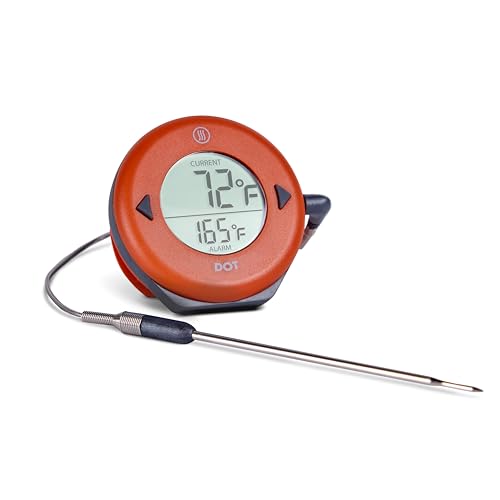
4. ThermoWorks DOT — the simplest good thermometer you can buy
The DOT strips the leave-in thermometer down to its essence: a probe, a cable, a round display, and one dial. You turn the dial to your target temperature, put the probe in the meat, and wait for the beep. That is the entire learning curve, and for a large share of home cooks it is exactly enough. There is no app to update, no Bluetooth to pair, and no menu tree to get lost in while your hands are covered in chicken. ThermoWorks sells it in cheerful colors, and its magnetic back means it lives on the oven door, always in sight.
Do not mistake simplicity for weakness. The DOT reads with the same professional accuracy culture as its bigger sibling, updates quickly, and its included probe handles roasting temperatures on a braided cable. The alarm is assertive enough to hear from the next room. Because it accepts the same family of ThermoWorks probes, owners can add a longer smoker probe or a needle probe later and turn the humble DOT into a more versatile tool without replacing the base unit.
Strengths: Near-zero complexity, trustworthy accuracy, a loud alarm, and a price that sits at the friendly end of the quality market. It is the thermometer least likely to be abandoned in a drawer, because there is nothing about it to dread using. Battery life stretches for months of regular cooking, and the single-button design makes it the one to hand to a helper or a teenager with total confidence.
Trade-offs: One probe, one alarm, no low-temperature alarm, no timer, no min/max memory, and no remote monitoring of any kind. The display shows the current temperature and your set point, and that is all it will ever show. Smokers running overnight cooks will outgrow it; so will anyone who wants a graph of the cook. The cable, like all cables, is a consumable over years of door closings.
Who it suits: Beginners, minimalists, and anyone buying a first leave-in thermometer for roasts and poultry. It is also a superb second thermometer for the holiday when two ovens run at once. To confirm the current deal, check price on Amazon.
Check price on Amazon: ThermoWorks DOT

6. Taylor Pro Leave-In Probe Thermometer — the straightforward budget starter
Taylor has made kitchen measurement tools for generations, and its Pro leave-in probe thermometer is the honest, inexpensive way into this category. A single wired probe on a heat-resistant cable feeds a compact base with a clear digital readout, a programmable temperature alarm, and a built-in timer. It does the core job — it watches your roast and beeps when the roast is done — without asking you to learn an app or manage a charging dock.
The details are sensibly chosen for the tier. The probe is long enough for a turkey or a pork shoulder, the base stands on the counter or sticks to the oven by magnet, and the display angle is easy to read while you work. Taylor’s temperature presets give new cooks a starting point, and the alarm can be set to a custom target once you know your preferences. For apartment cooks and air fryer owners, the small footprint is a real advantage over bulkier stations.
Strengths: The lowest-cost route to genuine leave-in cooking from a long-established measurement brand. It is light, simple, and quick to deploy for a weeknight chicken, and the combined timer-plus-thermometer layout suits cooks who run one dish at a time. It also makes a thoughtful, inexpensive gift for someone setting up a first kitchen.
Trade-offs: A single probe and a basic feature set: no remote receiver, no app, no low alarm, and accuracy that is perfectly serviceable rather than exacting. The cable and probe are built to the price, so heavy daily use will wear them sooner than the professional units above. The alarm is modest in volume; light sleepers monitoring an overnight cook should choose a phone-connected model instead.
Who it suits: Budget shoppers, first-kitchen cooks, and anyone who wants to test whether leave-in cooking fits their habits before investing more. It covers the fundamentals honestly. See today’s price when you check price on Amazon.
Check price on Amazon: Taylor Pro Leave-In Probe
Wired vs wireless: which style fits your cooking?
The wired-versus-wireless decision shapes daily life with the thermometer more than any brand choice. Wired probes are cheaper, effectively unlimited in run time, and immune to signal problems; a cable does not care about brick smokers or foil. Their weaknesses are physical. The cable crosses the oven door gasket, which can let a whisper of heat escape and, over years, the repeated pinch of the door fatigues the braid until readings turn erratic. Route the cable through the hinge side where the seal is most forgiving, never let it touch a heating element or burner grate, and a good cable lasts for years.
Wireless probes trade those physical worries for electronic ones. They are unmatched for rotisserie cooking, where a cable is simply impossible, and they keep the oven seal intact. In exchange, you manage charging, you respect a strict insertion depth, you accept a hard ceiling on ambient temperature at the handle, and you live with radio range that shrinks inside metal boxes. In an air fryer, a wireless probe is often the only practical leave-in option at all, because the basket slides in and out and a cable would foul the drawer. In a smoker, a wired probe with a remote receiver or a dual-probe station often proves the more reliable tool. Match the style to the cooker you actually use most, not the one you admire.
Using a leave-in thermometer in the oven, air fryer, and smoker
In the oven
Insert the probe before the meat goes in, aiming for the thermal center: the middle of the thickest muscle, away from bone and large fat deposits, which conduct heat differently and lie to the sensor. For poultry, that is the deepest part of the thigh or the center of the breast, checked so the tip is not touching the cavity. Set the alarm a few degrees below your final target to account for carryover cooking — a large roast can climb five to ten degrees while it rests, and even a chicken breast gains a couple. Resting is part of the cook, and the thermometer’s job is to get you to the right finished temperature, not the right oven-exit number.
In the air fryer
Air fryers cook fast and hot in a small cavity, which changes the technique. Use a short probe or a wireless probe that clears the basket and the element above it, and confirm the probe does not block the drawer from closing. Because air fryer cooks are short, an alarm matters more than an app graph; by the time a steak has overcooked, it has really overcooked. Thin cuts are hard to probe accurately — the sensor zone may span the whole thickness — so for very thin items, a leave-in probe guides timing while a quick instant-read check at the end confirms the result.
In the smoker
Smoking is where leave-in thermometers earn their keep. A second probe clipped at grate level tells you the temperature your meat actually experiences, which routinely differs from the smoker’s built-in gauge by a wide margin. Set a low alarm on the pit probe to catch a dying fire and a high alarm to catch a flare, and let the meat probe’s target alarm tell you when to wrap, spritz decisions aside, and when to start probing for tenderness. Remember that in barbecue, temperature is a guide and tenderness is the verdict: brisket and pork shoulder finish when they probe tender, which happens across a range rather than at one magic number.
Safe temperatures, in plain language
The temperatures below reflect widely published USDA guidance for home cooks and are offered as general reference, not as a substitute for the guidance that comes with your thermometer or your own judgment. Whole cuts of beef, pork, lamb, and veal are considered safe at 145°F with a rest of at least three minutes, though many cooks serve beef and lamb below that by personal choice. Ground meats call for 160°F, with ground poultry at 165°F. All poultry — whole birds, parts, and ground — is guided to 165°F. Fish is guided to 145°F or until the flesh is opaque and flakes. Leftovers and casseroles are reheated to 165°F. When in doubt, cook to the guideline, rest the meat properly, and remember that a thermometer placed in the wrong spot can certify a temperature the coldest part of the food never reached.
Care habits that make probes last
Most thermometer failures are slow acts of neglect rather than defects. Never submerge a wired probe’s cable, and never close the cable in a hot door at the same pinched point every time — move the pinch point around. Do not yank a wireless probe out of meat by its hot handle end with bare fingers; use a towel. Clean probes promptly, because baked-on residue insulates the sensor and slows its response. Store wireless probes in their dock so they greet the next cook charged, and keep spare batteries for wired bases in the same drawer. Finally, test any thermometer occasionally in ice water, which should read right around freezing, and in boiling water, which reads at the boiling point for your altitude. A thermometer you have verified is a thermometer you can trust with a holiday dinner.
Storage deserves one last thought, because more probes are ruined in drawers than in ovens. A probe tossed loose among utensils gets its tip bent, its cable kinked, and its sensing element knocked around a dozen times a week. Keep wired probes coiled loosely with the base unit, keep wireless probes seated in their dock, and give the whole kit one consistent home near the oven rather than wherever it happened to land after the last wash. The thermometer you can find in five seconds, charged and intact, is the one that actually gets used on an ordinary Tuesday — and ordinary Tuesdays are where good tools quietly pay for themselves.
Reading the spec sheet like a pro
Thermometer listings throw numbers at you, and a few of them matter far more than the rest. Accuracy is usually expressed as a plus-or-minus figure across a stated range; a tighter figure across the food range — roughly the span between refrigerator temperature and a hot grill — is what you are paying for, and accuracy claims measured only at room temperature tell you little. Response time matters less for leave-in probes than for instant-read models, because the probe sits in the meat for hours; what matters instead is stability, meaning the reading settles and stays put rather than wandering as the oven cycles.
Temperature range deserves a second look. The top of the range determines whether the same unit can watch frying oil or a sugar syrup, and the ambient rating — for a cable, a probe handle, or a wireless probe’s electronics end — determines whether it survives your hottest cooking. Battery claims deserve similar skepticism: a wireless probe’s cooking time per charge and its standby time are different numbers, and a wired base unit’s battery life assumes the backlight is used sparingly. None of these figures are reasons to reject a thermometer on their own. They are reasons to compare like with like and to be suspicious of any listing that shouts about the one impressive number while staying silent about the rest.
Matching the thermometer to your cooker
Different cookers reward different designs, and the best thermometer for a gas oven is not automatically the best for a pellet smoker. In a conventional oven, almost everything in this guide works; choose on accuracy, alarms, and whether you want a phone in the loop. In an air fryer, clearance rules: short or wireless probes win, and a base unit with a loud, simple alarm beats an elaborate app because the cooks are short. On a grill, ambient heat near the handle end is the enemy of wireless probes, so either choose a model built for high ambient temperatures or go wired and route the cable away from the fire.
Smokers reward redundancy. Two probes are close to a necessity, the pit probe matters as much as the meat probe, and remote monitoring — by receiver or by phone — changes an overnight cook from a vigil into a nap. Pellet grill owners should check whether their grill’s built-in probes can be trusted against a known thermometer at least once; many built-in systems read grate temperature from a single wall sensor and drift with age. Kamado and offset owners, cooking inside thick ceramic or steel, should expect Bluetooth range to shrink and should favor systems with a repeater dock or a separate receiver placed near the cooker. The pattern across all of these is the same: the cooker sets the constraints, and the thermometer that respects them wins.
A note on presets and doneness charts
Nearly every thermometer above the budget tier ships with preset temperatures for beef, pork, poultry, and fish at several doneness levels. Treat those presets as a starting draft, not scripture. Manufacturers write them cautiously, often aiming above current USDA guidance for whole cuts and sometimes below it for ground meat, and they cannot know your carryover, your rest, or your family’s taste. The cooks who get the most from these tools use presets for the first cook, taste the result, and then save a custom target of their own. Within a few cooks the thermometer stops being a chart with a beep and becomes a record of what your household actually likes — which is, in the end, the only doneness standard that gets dinner eaten happily.
Doneness is a range, not a single number
Safety minimums are only half the story. The other half is preference, and preference lives in ranges. A beef steak or roast pulled at the rare end of the range arrives red and cool in the center; medium-rare, the level most steak lovers aim for, is warm and red; medium is warm and pink; and by well-done the meat has surrendered most of its moisture along with its color. Each step up the scale costs juiciness, which is why the alarm on your thermometer should be set with both the target and the rest in mind. A thick roast continues to climb after it leaves the oven — carryover of five degrees is normal, and a large standing rib roast can climb closer to ten — so the number you set is always lower than the number you serve.
Pork has been transformed by modern guidance. Where older cookbooks demanded pork cooked to a dry, gray endpoint, current USDA guidance treats whole pork cuts like other whole meats: cook to the safe minimum and rest, and the result is blushing, juicy pork that surprises anyone raised on the old rules. Lamb follows a similar pattern, with most cooks serving chops and legs somewhere between the safe minimum and a rosy medium. Ground meats are the exception to every preference argument: because grinding distributes surface bacteria through the mixture, ground beef, pork, and poultry should be cooked to their full guided temperatures with no blushing exceptions.
Fish rewards a lighter touch and a thermometer used with finesse. The guided temperature produces flesh that is opaque and flakes, but many cooks pull salmon and tuna earlier for a translucent center, accepting the trade-off knowingly. The honest approach is to know the guideline, know your preference, and use the thermometer to hit your chosen point repeatably instead of drifting past it while you set the table. Repeatability is the real product a good thermometer sells: the same result, on purpose, every time.
Your first cook with a leave-in thermometer, step by step
Start with a forgiving protein: a whole chicken or a pork loin, not the holiday turkey. Pat the meat dry, season it, and decide your target before anything gets hot — final serving temperature first, then subtract the expected carryover to get your alarm setting. Insert the probe while the meat is still on the counter, where you can see what you are doing: in from the side, tip toward the center of the thickest muscle, no bone contact. Route a wired cable out of the oven on the hinge side, leaving a gentle loop rather than a taut line, or confirm a wireless probe is seated to its safety line and connected to the app before the door closes.
During the cook, resist the urge to fiddle. Watch the ambient reading if your thermometer offers one and note how your oven actually behaves; most cooks discover their oven runs hot or cold within the first hour, and that knowledge improves every recipe they make afterward. When the alarm sounds, do not yank the meat out in a panic. Check the reading is stable, pull the roast, and tent it loosely with foil. Watch the temperature climb during the rest — that climb is carryover doing exactly what you planned for. Slice only after the rest, and make a note of the alarm setting and the result. Two or three cooks of notes will teach you your oven, your thermometer, and your family’s preferences better than any chart.
Common mistakes that make good thermometers look bad
The most common mistake is bone contact. A probe tip resting against bone reads the bone’s temperature, which climbs faster than the surrounding meat, and the cook pulls the roast early into a raw center. The second is shallow placement, where the sensing zone sits near the surface and reports the temperature of the outer inch rather than the core. The third is trusting a single reading in a large, uneven cut: a brisket flat and point finish at different times, and a turkey breast and thigh live in different worlds. Move the probe, or use two, and let the coldest reading govern your decisions.
Equipment mistakes matter too. A wireless probe inserted short of its line cooks its own electronics a little more each time, and the damage is cumulative and invisible until the probe dies mid-cook. A wired cable draped over a burner or trapped against a heating element fails the same slow way. Finally, there is the alarm mistake: setting the alarm to the final serving temperature and forgetting carryover, then blaming the thermometer for an overcooked roast that it reported with perfect honesty. The thermometer measures; the cook decides. Most disappointments in this category are decision errors wearing a thermometer costume.
Accessories and ownership costs worth knowing
Budget a little beyond the box. A probe clip that holds a second probe at grate level turns any dual-channel unit into a proper smoker station. A heat-resistant glove or a good towel makes repositioning probes in a hot oven safer. Replacement probes are the main running cost of wired systems, and their price and availability differ sharply by brand; professional brands treat probes as stocked spare parts, while the cheapest sealed units treat a dead cable as the end of the product. Wireless owners should know that the probe itself is the consumable — drop it on concrete, cook its battery past the line often enough, and replacement is the only fix. None of this should scare anyone off. It simply means the true cost of a thermometer is the box price plus a probe or two across years of service, and the picks in this guide were chosen partly because their makers support them like tools rather than gadgets.
Frequently asked questions
Can I leave a meat thermometer in the oven the whole time?
Yes — that is exactly what the models in this guide are designed for, provided the probe (and cable, on wired models) is rated for oven use. Ordinary instant-read thermometers are different: their plastic housings and electronics cannot stay in the oven, and they must only be inserted for a quick reading. Always confirm that a thermometer is sold as oven-safe or leave-in before giving it a permanent spot in a roast, and on wireless models, always insert the probe to its marked safety line so the electronics stay protected.
Why does my thermometer read differently from my oven dial?
Because the oven dial is usually wrong, or at least approximate. Home ovens cycle around their set point, swinging above and below it, and the built-in sensor sits in one fixed spot that may not reflect conditions at the rack. An ambient probe near the food gives you the temperature your dinner actually experiences. A gap of twenty degrees or more between the dial and a trusted probe is common, and it is one of the strongest arguments for owning a thermometer with an ambient sensor or a second grate-level probe.
Where exactly should the probe go in a chicken or roast?
Aim for the center of the thickest part of the largest muscle. In a whole chicken, slide the probe into the thickest part of the thigh without touching bone, or into the center of the breast. In a beef roast, come in from the side so the sensing zone sits in the middle of the cut rather than near the top or bottom surface. Avoid fat seams, gristle, and the pan itself. If the reading seems to jump to doneness suspiciously fast, the sensor is probably near the surface or touching bone — reposition and let it settle.
Is a wireless probe safe to use in an air fryer?
Generally yes, and it is often the most practical option, because a wired cable interferes with the sliding basket. Check two things first: the probe must be short enough to clear the heating element and fan housing with the drawer closed, and it must be inserted to its safety line so the electronics end stays within its temperature limit. Air fryers run hot in a tight space, so respect the ambient rating and avoid the highest settings for extended cooks if your probe’s ceiling is modest.
How long do the cables on wired thermometers last?
A quality braided cable lasts for years of regular roasting if it is routed sensibly and not pinched at the same point or dragged across burners. Cables are the wear item of the category, though, and erratic readings, wild jumps, or a display that changes when you wiggle the cable are the classic signs of a dying one. Brands like ThermoWorks and ThermoPro sell replacement probes inexpensively, which is worth weighing when you buy: a thermometer with replaceable probes has a much longer useful life than a sealed unit.
Why not just use an instant-read thermometer?
It is a fair question, because a good instant-read is one of the best tools a cook can own, and nothing in this guide replaces it. The two tools answer different questions. An instant-read answers “what is the temperature right here, right now?” in a few seconds, at as many spots as you care to check. That makes it the final authority at the end of a cook and the only sensible tool for thin foods — burgers, chops, fish fillets, chicken cutlets — where a leave-in probe cannot sit accurately. If you own neither, an instant-read is arguably the first thermometer to buy.
What an instant-read cannot do is watch. Every check costs a door opening, a rush of escaped heat, and a small extension of the cook, and between checks you are guessing. For a twenty-minute chicken breast that barely matters. For a three-hour roast, an overnight brisket, or a turkey that anchors a holiday, it matters enormously. The leave-in thermometer also catches the problems that happen when nobody is looking: the oven that drifts, the smoker fire that fades at 3 a.m., the roast that races through its stall while you are setting the table. Serious home kitchens end up with both tools because the jobs are genuinely different — one monitors, the other verifies — and the cooks in those kitchens would not give up either. Buy the leave-in that fits your cooker and your habits from the five above, keep an instant-read beside it for the final check, and temperature stops being a source of suspense at exactly the meals where suspense is least welcome.
The last word
Pick the thermometer that matches the way your kitchen actually cooks, set its alarm a few degrees early, and let the roast — not the clock — tell you when dinner is ready.