As an Amazon Associate, this site may earn an affiliate commission from qualifying purchases made through links on this page, at no extra cost to you. Every pick below was chosen from manufacturer documentation and published specifications, and the comparisons in this guide rest on that research alone.
Most blenders cannot be taken apart where it matters. On the majority of machines sold today the blade is sealed into the jar at the factory, and the inside of that jar can be rinsed, soaked and spun with soapy water, but the blade itself can never be lifted out, scrubbed on both sides, dried fully or replaced. This guide is about the minority built the other way: blenders whose blade assembly separates from the jar or cup as its own part, in a removal step the manufacturer’s own manual describes in words. That last clause is the entry gate, and it is strict. A pick qualifies only when the maker’s documentation names the blade assembly as removable — not when a listing photograph suggests it, and not when the jar merely unscrews from the base motor.
The six qualifying machines use three distinct architectures, and the architecture is this guide’s first axis. Architecture A is the lift-out tower: a stacked blade column that stands in the pitcher and is lifted straight out by the top of its shaft, found here on one large Ninja. Architecture B is the screw-off bottom assembly: the blade unit threads into the base of the jar over a sealing gasket and unscrews for washing, the classic arrangement, found here on three mid-size machines from Oster, Hamilton Beach and Cuisinart. Architecture C is the screw-on extractor: on personal blenders the blade unit threads onto the mouth of the cup itself, blends, and unscrews to be replaced by a drinking lid, found here on a Ninja and a Magic Bullet. Each architecture carries its own cleaning dividend and its own discipline, and the reviews keep those consequences attached to each pick rather than smoothing them into a general claim.
The second axis is capacity, and it follows the architectures closely. The tower machine is the big-batch pick, a 72 ounce pitcher. The screw-off trio occupy the middle — 40 to 56 ounces of glass or Tritan, the family smoothie and soup sizes. The screw-on pair are personal machines of 22 to 24 ounces, built for one drink made in the cup it is drunk from. Power is the third axis and the least comparable, because the makers label it inconsistently — peak watts here, a rated figure there, a horsepower claim somewhere else — and this guide prints each maker’s number with its label attached rather than converting them into a false common scale. Readers should choose by architecture and batch size first, and let power settle arguments only between machines of the same kind.
The usual honesty notes apply. This guide prints no prices, because blender pricing moves with bundles and seasons; each pick is placed in words instead — budget, mid-range or premium — and closes with a prompt to look up the current figure at the retailer. It prints no scores, because the distance between a lift-out tower and a screw-off base is a question about how you want to wash a machine, not a verdict. And one absence is announced now and explained fully in the buying guidance below: the two most famous names in blending, Vitamix and Blendtec, appear nowhere in the picks, because both seal their blades into their jars by design. That is a philosophy, not a defect, and this guide explains it rather than pretending those machines fell short of a standard they never claimed to meet.
In this guide
Quick picks: best blenders with removable blades
| # | Product | Where to buy |
|---|---|---|
| 1 | Ninja Professional Plus BN701 | Check on Amazon |
| 2 | Oster Pro 1200 | Check on Amazon |
| 3 | Hamilton Beach Power Elite 58148 | Check on Amazon |
| 4 | Cuisinart Velocity Ultra SPB-650 | Check on Amazon |
| 5 | Ninja Nutri-Blender Pro BN401 | Check on Amazon |
| 6 | Magic Bullet MBR-1101 | Check on Amazon |
Quick comparison: the six picks at a glance
The short version runs by architecture. The Ninja BN701 is the lift-out tower and the big pitcher: 72 ounces, a stacked blade column removed by its shaft before pouring, and the strongest documented power story of the six. The Oster Pro 1200 is the classic screw-off in glass, with a dual-direction blade and an all-metal drive. The Hamilton Beach Power Elite 58148 is the budget screw-off, the maker itself printing removable blades on the box. The Cuisinart SPB-650 is the screw-off in Tritan, the only plastic-jar machine of the trio, with a one-horsepower motor. The Ninja BN401 is the personal screw-on at full power, two 24 ounce cups and extractor blades. And the Magic Bullet MBR-1101 is the original personal screw-on in its 11-piece set, the budget pick of the whole guide.
What to look for in a blender with removable blades
The architecture decides the cleaning, so learn the three shapes first. In architecture A, the blade is a tower: a central shaft carrying stacked cutting edges, standing loose in the pitcher and driven from below. Removal is a lift — grasp the top of the shaft and raise the whole column out — and the pitcher that remains is a smooth, empty vessel with no hardware in its base, the easiest large jar in this guide to wash and dry. In architecture B, the blade unit is the jar’s floor: it threads into the jar’s base over a gasket, and removal is an unscrewing that separates jar, gasket and blade unit into three washable parts. In architecture C, the blade unit is a cap: it threads onto the cup’s mouth, the cup inverts onto the base to blend, and the unit unscrews afterwards so a spout or flat lid can take its place. Every other difference in this guide — leaks, washing rules, spare parts — is a consequence of one of these three shapes.
Architecture B runs on gasket discipline, and the guide will not pretend otherwise. A screw-off base seals because a gasket sits between the blade unit and the jar, and it leaks when that gasket is seated twisted, trapped off-centre, or left in the sink. The makers’ manuals describe the same ritual in their own words: place the gasket on the blade assembly, set the assembly into the jar’s base, thread it firm. Done in that order, the seal is complete and the machine is as tight as any sealed jar. Done carelessly, the first smoothie finds the counter. This is the honest trade at the centre of the category — a jar that comes fully apart asks for ten seconds of attention at reassembly — and readers who know they will resent those ten seconds should choose the tower or a sealed machine instead, with this guide’s blessing and its explanation of the sealed philosophy below.
Architecture A runs on one safety habit. The tower is not locked into the pitcher; it stands in place, held by its fit and by the lid. The Ninja owner’s guide for the BN700 series states the consequence plainly in its own way: the stacked blade assembly is removable for cleaning and replacement, and it is to be lifted out by the top of its shaft before the pitcher is poured from, so the column never rides out with the pour. The edges along the shaft are the working edges and are handled as such — by the shaft’s top, never by the blades. Built into a habit, this is a two-second step that also happens to be the cleaning step: tower out, pitcher rinsed as a plain vessel, tower washed and dried as its own part.
Washing rules belong to the blade unit, and they differ by maker. Ninja documents the BN701’s stacked blade assembly and the BN401’s extractor assembly as dishwasher safe in its guides for those models. Hamilton Beach lists its removable blades among the dishwasher-safe parts of the 58148. Oster’s manual lists the blade assembly and gasket of the Pro 1200 among the parts that can go through the dishwasher. Magic Bullet’s manual directs the opposite for its cross blade: hand washing for the blade unit, with the cups and lids assigned to the top rack. The pattern is not architecture alone — it is each maker’s instruction for its own seals and edges — so the reviews state the rule pick by pick, and no claim made for one machine is carried across to another anywhere in this guide.
Why Vitamix and Blendtec are not here. The two most decorated names in blending are absent from this guide, and the reason is design philosophy, not quality. Vitamix builds its blades into the container as a sealed unit and answers the cleaning question with a self-cleaning cycle: warm water, a drop of soap, a minute at high speed. Blendtec likewise fixes its blade in the jar and relies on the same rinse-and-spin routine. For many households that answer is sufficient, and those machines are covered elsewhere on this site on their own terms. But a sealed jar can never be scrubbed beneath the blade, never fully dried at its base, and never fitted with a fresh blade when the original dulls — and a guide whose entire subject is the removable blade would betray its subject by admitting machines that define themselves against it. Their absence here is the entry gate working as designed.
Power figures must keep their labels. This category’s numbers arrive in three dialects. Peak watts describe the motor’s maximum draw and headline most listings: 1,400 peak watts on the BN701’s marketing, 1,100 on the BN401, 700 on the Hamilton Beach. Rated figures describe sustained output and live deeper in the documents: Ninja’s owner’s guide for the BN701 specifies 1,200 watts at 120 volts beneath the peak figure on the box. Cuisinart speaks a third dialect, rating the SPB-650’s motor at one horsepower with a maximum rated draw of 750 watts in its booklet. None of these numbers converts cleanly into another, and a guide that ranked these six by a single watt column would be ranking labels, not motors. Read power within an architecture: among personal machines the BN401’s figure dwarfs the Magic Bullet’s 250 watts, and that comparison is fair; across architectures, batch size and blade design move the result more than the number does.
Jar material is the quiet axis. The screw-off trio splits by vessel: Boroclass glass on the Oster, ordinary glass on the Hamilton Beach, and Tritan on the Cuisinart — a BPA-free copolyester that trades the weight and chill of glass for resistance to drops and a lighter lift to the sink. The tower machine’s pitcher is plastic in the large-format way of its class, and the personal pair blend in their own BPA-free cups. Glass suits readers who blend hot soups and dislike any plastic at the food surface; Tritan and the personal cups suit readers who lift, carry and wash the vessel constantly and value the lighter hand. Neither preference is a compromise — both are served by a pick in this guide — but the choice should be made deliberately, because the jar is the part of a blender its owner touches most.
Replacement parts are a specification, and they are printed in the manual. Because the blade assembly is a part, it has a part’s paper trail: the manuals and parts lists for these six name the assemblies, gaskets, jars, collars and lids as orderable components, which converts the two common deaths of a blender — a dulled blade and a tired seal — from replacements of the whole machine into orders of a single item. The Oster’s ten-year limited warranty on its all-metal drive is the same philosophy expressed as a promise. When comparing two otherwise equal picks in this guide, the depth and ordinariness of the parts list is a legitimate tiebreaker, and it favours the long-running designs whose components have been catalogued for years over any newer machine whose parts story is still a promise.
A tamper is a different axis, and it is not this one. Readers arriving from this site’s guide to blenders sold with plungers should note the clean division: that guide ranks machines by an accessory for pushing thick mixtures down, and its picks are sealed-blade machines almost by definition, since a tamper works through the lid of a fixed jar. This guide ranks by blade architecture, and the overlap between the two pick sets is zero — not as a criticism of either, but because the two questions, how a mixture is pushed and how a blade comes out, are answered by different machines. Decide which question is yours before choosing which guide to shop from.
Removable is an ownership philosophy
There is a longer argument beneath the cleaning one, and it is about years rather than washes. A blender whose blade assembly is a part is a blender whose wear items can be renewed: blade units dull, gaskets flatten, and on the machines in this guide both are replaceable parts in the makers’ own parts lists, orderable by the part names the manuals print. The Oster’s drive is warranted for a decade in its maker’s limited terms because the drive is a component, and the same thinking runs through the category — assemblies, gaskets, jars and lids as separable, replaceable things. A sealed machine concentrates all of that mortality into the jar: when its blade dulls or its base seal tires, the container is the part, at container prices.
The counter-argument deserves its sentence too. Every joint that opens is a joint that can be misassembled, and the sealed philosophy buys its cleanliness-by-cycle with a genuine simplicity: nothing to seat, nothing to lose down the drain, nothing to leave in the dishwasher when the jar is needed. This guide’s position is only that the choice should be made knowingly. A reader who washes a blender daily and cooks with staining, fibrous, oily mixtures — turmeric, nut butters, pesto, berry seeds — meets the limits of rinse-and-spin within a month, and for that reader the removable blade is not a preference but the difference between a machine that is clean and a machine that is clean enough. The six picks that follow are for that reader.
The best blenders with removable blades, reviewed
Six machines follow, ordered by architecture: the lift-out tower first, then the three screw-off jar bases in descending placement, then the two screw-on personal machines. Every removal step, washing rule and figure traces to the maker’s documentation for the exact model code in the heading, and the variant cautions are part of the reviews rather than footnotes, because in this category the neighbouring code is usually a different architecture wearing a familiar name.

Top pick
1. Ninja Professional Plus Blender with Auto-iQ BN701: the lift-out tower
The BN701 is the sole representative of architecture A in this guide, and it is the flagship pick: Ninja’s Professional Plus with Auto-iQ, built around a 72 ounce Total Crushing pitcher with a maximum liquid line of 64 ounces and a stacked blade assembly that stands in the pitcher as a separate column. SharkNinja’s owner’s guide for the BN700 series describes that assembly as designed to be removed for cleaning and replacement, lifted out by the top of its shaft — and, in the guide’s own caution, removed before the pitcher is poured from, because the column is not locked in place. Three Auto-iQ programmes handle the machine’s automated work. On power, the guide prints both of the maker’s numbers with their labels, because Ninja publishes two: 1,400 peak watts in the product’s marketing, and a rated specification of 1,200 watts at 120 volts in the owner’s guide’s own technical lines. They are the same motor described two ways, and this review declines to merge them into one figure.
The tower architecture pays its dividend at the sink. With the column lifted out, the pitcher is a smooth, open vessel — no blade fixed at its base, no hardware shadow where smoothie dries — and it washes and dries like a jug. The column itself, washed as its own part and documented by Ninja as dishwasher safe, can be scrubbed along its full length and dried completely, which is the whole promise of this guide delivered in its largest format. The batch size is the other half of the case: 64 ounces of liquid capacity is the family-and-guests tier, the pitcher for a round of frozen drinks or a double batch of soup base, and no other pick in this guide works at that scale.
The disciplines are the two already named, and they are not optional. The tower comes out by the top of the shaft, before pouring, every time — a habit that takes a week to build and protects both the pour and the pourer. And the variant traps around the code are real: the BN700 without the Plus specification is a lesser-featured sibling, and Ninja’s kitchen systems built on similar bases, the BN750 and BN801 families, add food-processor bowls and belong to a different product class that this pick must not be confused with at purchase. In placement the BN701 sits at the premium end of this guide, which its capacity and programme set explain.
Strengths: The only lift-out tower in the guide and the largest capacity — a pitcher that washes as a plain vessel and a blade column that scrubs and dries as its own part. Auto-iQ programmes, a dishwasher-safe blade assembly per the maker’s guide, and more documented motor than any other pick carries.
Trade-offs: The unlocked tower demands the lift-before-pouring habit without exception, and its stacked edges are the most serious handling caution in the guide. It is a large, tall machine that wants a permanent counter station.
Who it suits: The BN701 suits the household that blends at family scale — frozen drinks for a table, soup bases, big smoothie rounds — and wants the easiest large jar in the category to wash. It suits buyers who will build the shaft-lift habit gladly in exchange for a pitcher with nothing fixed inside it. Small households should start with the personal picks below. Match the listing to the BN701 code and the Auto-iQ description before you check price on Amazon.
Check price on Amazon: Ninja Professional Plus BN701
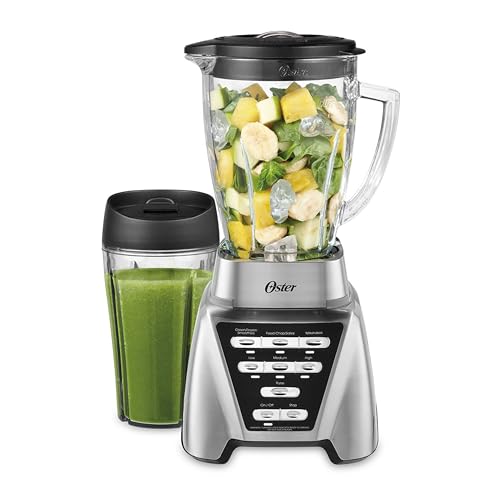
2. Oster Pro 1200 BLSTMB-CBG-000: the classic screw-off, in glass
The Oster Pro 1200 is architecture B in its canonical form, from the maker that has built blenders this way for generations. The manual’s assembly sequence is the architecture in one sentence: the gasket is placed on the blade assembly, the assembly is set into the mouth at the jar’s base, and the base is threaded firm — and the cleaning pages list the blade assembly and gasket among the removable parts that can go through the dishwasher. The jar is six-cup Boroclass glass. The blade is the maker’s Crush Pro design, six stainless points driven by Dual Direction Blade Technology, which reverses the blade’s rotation to pull ingredients through rather than letting them ride above the cut. Seven speeds with Smart Settings programmes run the machine, and the drive is the maker’s All-Metal Drive, covered by a ten-year limited warranty — the longest component promise in this guide.
What the Oster argues is that the oldest architecture, executed with the best drivetrain, is still the centre of the category. The dual-direction blade addresses the screw-off class’s traditional weakness — tall ingredients bridging above a one-way blade — by reversing against the bridge. The glass jar suits the soup-and-sauce cook who blends hot and dislikes plastic at the food surface. The parts list is deep and ordinary: gaskets, blade assemblies, jars and lids as orderable components, which is the ownership philosophy of this guide in its most established form. The specific bundle to match is the BLSTMB-CBG-000, the version the brief verified with the 24 ounce smoothie cup in the box, which quietly gives this mid-size machine a personal-blending second life.
The cautions are the architecture’s own. The gasket ritual governs every reassembly — gasket on the assembly, assembly seated, base threaded — and a gasket left twisted is a leak with a countdown. The variant field needs care: a sibling code, BLSTMB-GTF, describes a different bundle of the same family and is not the verified pick, and Oster’s Pro Series kitchen systems with tampers are a different line answering the other guide’s question. Glass, finally, is glass — heavier to the sink, and mortal when dropped — which is the deliberate price of the material’s virtues.
Strengths: The reference screw-off design with the category’s best drivetrain story — dual-direction blade, all-metal drive under a ten-year limited warranty, Boroclass glass, and a parts list deep enough to renew the machine for years. The bundled smoothie cup adds a personal mode.
Trade-offs: Gasket discipline at every reassembly, with leaks as the tuition for carelessness. The glass jar is the heaviest vessel among the mid-size picks, and the bundle code must be matched exactly against near-identical siblings.
Who it suits: The Pro 1200 suits the cook who blends hot soups and sauces in glass, values a drivetrain built as a component, and is content with the ten-second gasket ritual as the price of a jar that comes fully apart. It suits households replacing a blender for the long term. Match the listing to BLSTMB-CBG-000, gasket and smoothie cup included, before you check price on Amazon.
Check price on Amazon: Oster Pro 1200

3. Hamilton Beach Power Elite Wave Action 58148: the budget screw-off
Hamilton Beach makes this guide’s entry argument on its own product page, in its own words: the glass jar, the lid, the jar collar and the removable blades of the Power Elite 58148 are all dishwasher safe, and the product’s box lists removable blades among the included features. This is architecture B at its most accessible — a 40 ounce glass jar over a screw-off blade unit, with Ice Sabre stainless blades and the maker’s Wave-Action system, a jar geometry designed to pull the mixture continuously down into the blades so the blend finishes without the shake-and-stop routine. The documented power is 700 peak watts, the control is five buttons carrying twelve blending functions, and the maker’s limited warranty runs three years. In this guide’s placements it is the budget pick of the full-size machines, named in words as plainly as the guide can name it.
The case for the 58148 is that it surrenders nothing structural to its price. The blade comes out, the jar is glass, the parts wash in the dishwasher, and the Wave-Action jar does the one piece of fluid engineering that matters in a mid-power machine — keeping the load circulating through the cut instead of stacking above it. Twelve functions across five buttons is the honest interface of its tier: no screen, no programme theatre, a button per job. For the household whose blending is smoothies, salsas, shakes and the occasional soup, the specification is not a compromise list; it is the whole list, at the placement where this guide’s other full-size picks begin to charge for drivetrain and capacity.
The limits are equally plain. Seven hundred peak watts is the gentlest figure among the jar machines, and dense work — nut butters, heavy frozen loads — will take longer and ask more patience than the Oster or the tower above it. The 40 ounce jar is the smallest of the trio, sized for one to three servings rather than a family round. And the variant cautions matter at this end of the market, where codes multiply: the pick is the 58148, also sold as the 58148A, and not the Wave Crusher 54221, which is this guide’s designated backup for the pick rather than the pick itself; a red variant, 58148R, exists in the family and is the same machine in colour, to be matched knowingly rather than by accident.
Strengths: The complete removable-blade architecture at a budget placement — glass jar, dishwasher-safe removable blades by the maker’s own description, Wave-Action circulation and a three-year limited warranty. The simplest interface in the guide.
Trade-offs: The least power and the smallest jar of the full-size trio, so dense and large work is slow work. The gasket discipline of architecture B applies in full, as it does to every screw-off pick.
Who it suits: The 58148 suits the smoothie-and-salsa household, the first removable-blade purchase, and the buyer who wants the architecture’s cleaning dividend without paying for drivetrain they will never tax. It suits smaller households precisely because its jar is modest. Confirm the listing is the 58148 or 58148A and not the Wave Crusher sibling before you check price on Amazon.
Check price on Amazon: Hamilton Beach Power Elite 58148

4. Cuisinart Velocity Ultra 1 HP SPB-650: the screw-off in Tritan
Cuisinart’s booklet for the Velocity Ultra uses this guide’s key phrase as a matter of routine: the machine is built around a removable blade assembly, named as such in the assembly warnings — the assembly is twisted firmly to the jar — and in the cleaning pages, where it is removed by turning it counter-clockwise and washed as its own part. The booklet rates the motor at one horsepower and puts its maximum rated draw at 750 watts, and the jar is 56 ounces of BPA-free Tritan — the only Tritan vessel among the screw-off trio, and the largest. The controls pair Low, High and Pulse with two presets, Smoothie and Ice Crush, and the maker’s limited warranty runs three years. The architecture is B; the personality is the lightweight, high-capacity one.
The Tritan jar is the argument. Fifty-six ounces is the family size the glass pair splits the difference around, and Tritan carries that volume at a fraction of the glass jar’s weight, survives the drop that ends a glass jar’s life, and goes to the sink one-handed when full. For households blending daily at volume — the protein-shake rotation, the big smoothie batch divided among children — the vessel’s weight is not a detail but the daily experience of the machine. The one-horsepower rating with its honest booklet figure beneath it is the other half of the case: Cuisinart publishes its sustained number where rivals headline peaks, and the presets map onto the two jobs this size of machine is actually bought for.
The cautions come in two kinds. The first is the architecture’s standard one, sharpened by the booklet’s own firmness: the blade assembly must be twisted firmly to the jar, and the gasket seating that firmness implies is the seal — the manual’s warning exists because the leak it prevents is the known failure of the type. The second is about the model’s family: the SPB-650 is the blender alone, while the BFP-650 Velocity Ultra Trio adds a food-processor bowl and travel cups to the same base concept; a Trio listing is a different bundle and must not be matched to this pick unless the purchase intends the Trio and the article’s description is adjusted to say so. The pick also carries the guide’s most careful availability note in its source file, which the buyer will feel only as the advice to confirm the exact code on a current United States listing.
Strengths: The largest jar of the screw-off trio in the material that weighs least, a motor whose maker publishes a rated figure under its horsepower claim, and presets aimed at the two jobs the size is bought for. The removable blade assembly is named and instructed in the maker’s own booklet.
Trade-offs: Tritan gives up glass’s heat confidence and surface feel, and the assembly’s firm-twist seal punishes a casual hand. The Trio sibling’s listings intermingle with the blender-only code.
Who it suits: The SPB-650 suits the high-volume daily blender — big batches, carried jars, a machine lifted full several times a day — and the reader who prefers a published rated wattage to a headline peak. It suits households that found glass too heavy rather than too fragile. Match the listing to SPB-650 exactly, distinct from the BFP-650 Trio, before you check price on Amazon.
Check price on Amazon: Cuisinart Velocity Ultra SPB-650
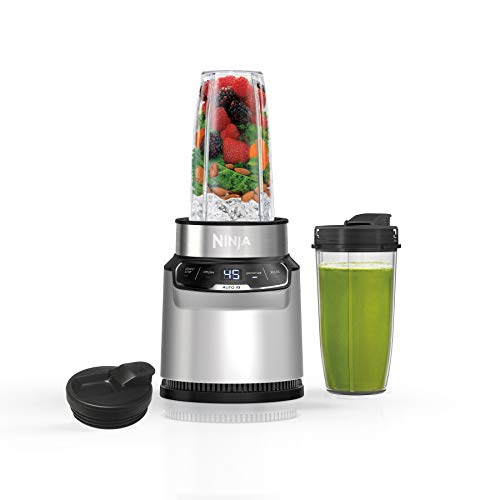
5. Ninja Nutri-Blender Pro BN401: the personal screw-on at full power
Architecture C inverts the jar: there is no jar. On the BN401, Ninja’s Pro Extractor Blades assembly threads onto the mouth of a 24 ounce cup until tight; the cup inverts onto the base and blends; the assembly then unscrews and a spout lid takes its place, so the vessel blended in is the vessel drunk from. The maker documents 1,100 peak watts — a figure worth pausing on, because it belongs to a personal machine and exceeds the headline numbers of the full-size budget picks — two Auto-iQ programmes, and a box containing two 24 ounce cups with two spout lids, so a second drink can be assembled while the first is being drunk. Ninja’s documentation for the model lists the blade assembly among its dishwasher-safe parts, a rule this guide states for this pick only, under the washing discipline set out in the guidance above.
The personal format’s virtue is the disappearance of the transfer. Nothing is poured, nothing is scraped from a pitcher, and the part count at the sink is a cup, a blade unit and a lid. The extractor architecture is also the most forgiving of the three to live with: the seal is the cup’s own rim against the assembly, threaded hand-tight, with no separate gasket to seat or lose — the leak discipline of architecture B is designed out, at the price of a one-drink batch. At 1,100 peak watts the BN401 is the performance end of the personal class, built for frozen fruit and ice in single servings, and its two-cup box recognises the actual rhythm of its use: a drink for the commute and a drink for after the gym, or two drinkers in sequence without a wash between.
The cautions are about codes and about the number. The code to match is BN401: the BN400 is a different base generation, and the BN401A describes a different cup bundle built around a 32 ounce cup, neither of which is this pick. The number requires the note this guide keeps for it: Ninja publishes 1,100 peak watts for the model, while some retail data fields for the same machine carry a lower peak figure; the article prints the maker’s number and records the discrepancy in its source file rather than silently choosing, and the buyer comparing listings should expect to meet both figures and trust the code over either. In placement the BN401 is the premium personal pick, priced by its power.
Strengths: Full-power personal blending with the simplest seal in the guide — no gasket, no transfer, blend and drink in one cup. Two cups and two spout lids in the box, Auto-iQ programmes, and a dishwasher-safe blade assembly per the maker’s documentation.
Trade-offs: One drink per batch by design, and the premium placement of the personal class. The extractor blades are handled at every drink, so the unscrew-and-rinse step is a daily habit rather than an occasional one.
Who it suits: The BN401 suits the daily single-serving blender — smoothies, shakes and frozen drinks for one or two people in sequence — who wants personal format without personal-format power limits. It suits commuters and gym households. Match the listing to BN401 with the two 24 ounce cups, not the BN400 base or the BN401A bundle, before you check price on Amazon.
Check price on Amazon: Ninja Nutri-Blender Pro BN401

6. Magic Bullet MBR-1101: the original personal screw-on
The Magic Bullet is the machine that taught the market architecture C, and the MBR-1101 is its standard 11-piece set: a 250 watt power base, a stainless Cross Blade that threads onto the cup’s mouth, a Tall Cup with a maximum fill of 22 fluid ounces, a Short Cup, a Party Mug, two lip rings, stay-fresh resealable lids and a to-go lid. The manual’s choreography is the one the category copied — blade on, cup inverted onto the base, blend, blade off, ring or lid on — and its care pages draw the washing line this guide has been careful with throughout: the cups and lids go to the top rack of the dishwasher, while the blade assembly is washed by hand. It is the budget pick of the entire guide, in words and in fact, and the smallest machine here by a wide margin.
What the Magic Bullet argues is that for a certain kind of blending, the architecture is the appliance. Salsa for two, a single smoothie, a small batch of dressing, baby food in the Short Cup, a milkshake in the Party Mug — these are jobs whose natural vessel is a cup, and a machine that lives in a cupboard corner, assembles in seconds and washes in fewer has a claim on them that no pitcher machine can answer. The lip rings are the detail that explains the design’s longevity: they thread onto the cup where the blade was, turning a blending vessel with a threaded rim into a comfortable drinking cup, which is the whole idea of the format executed in one small part. The 250 watts are honestly matched to the format — this is a machine for soft and medium work in small volumes, and it has never claimed otherwise.
The limits follow from the same honesty. Hard frozen loads, ice in quantity and fibrous mixtures at volume belong to the BN401 above or to the jar machines; the Magic Bullet’s motor and cup size draw their line well short of them, and a buyer whose morning is a frozen-fruit smoothie with ice should read this pick as the budget alternative for gentler drinks, not as a cheaper BN401. The hand-wash rule for its blade is the firmest in the guide and is stated in its manual without exception. And the bundle code matters: the pick is the 11-piece MBR-1101 set, also listed under the MBR-1101AK code, and not the smaller four-piece MBR-0401 set sold through another retailer, nor the separate Magic Bullet Mini line.
Strengths: The defining personal format at the guide’s budget placement — an 11-piece set whose cups, rings and lids make blend-and-drink a single motion, in the smallest footprint here. The architecture’s simplest possible parts list.
Trade-offs: The least power in the guide by design, small cups, and a blade assembly that is hand-wash only by the maker’s instruction. Frozen and fibrous work at volume is beyond its brief.
Who it suits: The MBR-1101 suits the small-batch, soft-work blender — dressings, salsas, single smoothies, baby food — in a small kitchen, a dorm, an office or a second home, and the gift buyer at a budget placement. It suits households adding a personal machine beside a full-size one. Match the listing to the 11-piece MBR-1101 set before you check price on Amazon.
Check price on Amazon: Magic Bullet MBR-1101
How the six compare
The table below is deliberately qualitative apart from the figures the makers themselves publish, because the differences that decide this guide — architecture, seal, washing rule — are structural. Read it by deciding how you want to wash a blender, and only then which row.
| Pick | Architecture | Capacity | Maker’s power figure | Blade washing rule | Main trade-off |
|---|---|---|---|---|---|
| Ninja BN701 | A — lift-out tower | 72 oz pitcher (64 oz liquid) | 1,400 peak watts; 1,200W rated in guide | Dishwasher safe per maker | Tower must be lifted before pouring |
| Oster Pro 1200 | B — screw-off base | 6-cup glass jar | See maker’s documentation | Dishwasher safe per manual | Gasket seating at every assembly |
| Hamilton Beach 58148 | B — screw-off base | 40 oz glass jar | 700 peak watts | Dishwasher safe per maker | Gentlest power of the jar trio |
| Cuisinart SPB-650 | B — screw-off base | 56 oz Tritan jar | 1 HP; 750W max rated in booklet | Removed and washed per booklet | Firm-twist seal; Trio sibling |
| Ninja BN401 | C — screw-on extractor | 2 × 24 oz cups | 1,100 peak watts | Dishwasher safe per maker | One drink per batch |
| Magic Bullet MBR-1101 | C — screw-on cross blade | 22 oz tall cup | 250W | Hand wash the blade unit | Soft and medium work only |
Two patterns deserve drawing out. The first is that the seal tells the story of each architecture: the tower has no seal at the blade at all, the screw-off trio live and leak by a gasket, and the screw-on pair seal on the cup’s own rim — so a reader’s tolerance for the gasket ritual alone eliminates or elects a third of the table. The second is that washing rules are issued per model, not per architecture: two of the three architectures contain a dishwasher-safe blade and the third pair splits its verdict between its two picks, which is why this guide states the rule inside every review instead of once for the category.
A third pattern is quieter: capacity follows architecture so faithfully that the table can be read in either direction. Towers live in big pitchers, screw-off bases under family jars, and screw-on blades on single cups — so a reader who knows their batch size already knows their architecture, and the remaining choice is only which maker’s execution of that shape to bring home.
Living with one: gaskets, edges and neighbouring guides
Ownership of a removable-blade blender runs on three small stocks: a spare gasket for any architecture B machine, kept in the drawer the manual’s part name identifies; a narrow brush for the underside of blade units, where fibrous residue gathers in every architecture; and the habit of drying blade assemblies fully before reassembly, because a part that can come out can also be put away dry, which is half the point of owning it. Edges are handled by their shafts, threads and housings, never by the cutting faces, and blade units live in a drawer tray rather than loose among utensils. None of this exceeds five minutes a week, and all of it is the maintenance the sealed machines spend instead on soaking and spinning.
Storage is the other half of living with parts. A blade assembly put away assembled keeps its gasket seated and its edges sheathed by the jar; a blade assembly stored loose wants a tray, a cloth or its own corner of a drawer, never a tumble among utensils where edges dull and fingers learn caution the expensive way. The personal machines solve their own version of this — the blade unit threads back onto an empty cup and the whole thing stands as one piece. Towers dry standing on a cloth by the sink. These are the small logistics of a category built from separable things, and they take a week to become invisible.
Two neighbouring guides on this site frame this one, and readers may want them in the right order. The first ranks blenders by ease of cleaning in the broad sense — dishwasher-safe parts, self-cleaning cycles and smooth interiors, sealed machines included — and readers whose real question is general washing effort, rather than blade architecture specifically, should start there and return here only if the blade itself is the point. The second ranks by the tamper accessory for thick mixtures, with a pick set that overlaps this one not at all, because its machines keep their blades sealed and push the mixture instead; readers torn between the two questions should decide whether their thick mixtures or their washing water matters more. Between the three guides, every blender-cleaning question on this site has exactly one home.
Frequently asked questions
Why are Vitamix and Blendtec not in this guide?
Because both makers fix the blade permanently inside the jar and handle cleaning by spinning warm soapy water in the sealed container, never by taking anything apart. It is a deliberate philosophy with its own full-length coverage on this site, but it fails this guide’s one entry condition: a removal step, described in the maker’s own manual, by which the blade assembly comes out as a separate part. A blade that cannot come out cannot be scrubbed on its underside, dried at the base or renewed when dull — so the gate excludes them by definition, not by quality.
Do screw-off blenders leak?
They leak when the gasket is seated badly, and not when it is seated as the manual directs. The seal on an architecture B machine is a gasket placed on the blade assembly, set into the jar’s base and threaded firm; a gasket trapped twisted or off-centre is the known cause of the type’s leaks, which is why the makers print the sequence and why this guide repeats it in every screw-off review. Readers who know they will rush reassembly have two honest alternatives in this guide — the tower, which has no blade seal, and the screw-on personal machines, which seal on the cup’s rim.
Can the blade assemblies go in the dishwasher?
It depends on the model, and this guide states the rule per pick because the makers do. Ninja documents the blade assemblies of both the BN701 and the BN401 as dishwasher safe in its guides; Hamilton Beach lists the 58148’s removable blades among its dishwasher-safe parts; Oster’s manual lists its blade assembly and gasket likewise. Magic Bullet’s manual sends its cross blade to the sink to be washed by hand, while the set’s cups and lids are assigned to the top rack. No rule in this list transfers to a machine it was not written for, and the manual of the exact model in hand outranks any general claim, including this one.
Can I replace just the blade or the gasket when they wear out?
Yes — that is the ownership argument for the whole category. Because the blade assembly is a part, it appears in the maker’s parts list under its own name, and gaskets for the screw-off machines are inexpensive consumables rather than repair events. A tower column, a screw-off assembly or an extractor unit can be renewed without replacing the jar or the base, and the Oster’s all-metal drive carries a ten-year limited warranty on the same component logic. On a sealed machine, by contrast, a dull blade means a new container, which is the long-term cost the sealed philosophy accepts.
Which architecture is best for thick mixtures like nut butter?
Among these six, the large and powerful jar machines — the BN701’s tower in its 72 ounce pitcher and the Oster’s dual-direction screw-off — are the picks whose capacity and drive suit sustained thick work, with the Cuisinart behind them. The personal pair are built for drinks and soft batches, and thick mixtures in small cups stall against their format rather than their motors. Readers whose primary subject is thick mixtures specifically should also read this site’s plungers guide, since a tamper is the tool designed for exactly that load — on machines whose blades, by design, stay where the factory put them.
The bottom line
Decide the architecture and the guide narrows itself. For the big pitcher that washes like a jug, the Ninja BN701 and its lift-out tower. For the classic screw-off, the Oster Pro 1200 in glass for the long term, the Hamilton Beach 58148 for the budget, and the Cuisinart SPB-650 when the jar must be large and light. For one drink at a time, the Ninja BN401 at full power or the Magic Bullet where the work is gentle and the placement is the point. Three architectures, six machines, one shared property: the blade comes out, because the manual says it does.
A removable blade asks one small discipline of its owner — seat the gasket, lift by the shaft, mind the edges — and returns the one thing no sealed jar can offer: a blender that comes completely, verifiably clean.


