This article contains affiliate links. If you buy through a link on this page, we may earn an affiliate commission at no extra cost to you.
In this guide
Quick picks: best consumer report for pressure cookers
| # | Product | Where to buy |
|---|---|---|
| 1 | Instant Pot Duo | Check on Amazon |
| 2 | Ninja Foodi SmartLid | Check on Amazon |
| 3 | Breville Fast Slow Pro | Check on Amazon |
| 4 | Presto Electric Pressure Cooker | Check on Amazon |
| 5 | Fissler Vitaquick | Check on Amazon |
Why a Pressure Cooker Still Earns Its Counter Space
A pressure cooker does one thing no other pot in your kitchen can do: it makes time behave differently. A beef stew that wants three slow hours on the stove finishes in about forty minutes. Dried beans go from a bag in the pantry to a finished pot without an overnight soak. Tough cuts that normally demand a whole Sunday afternoon become weeknight food. That is the entire promise, and when a pressure cooker is good, it delivers on it week after week without drama.
The reason it works is simple physics. A sealed pot traps steam, the pressure inside climbs, and the boiling point of water climbs with it. Instead of simmering at the usual temperature, your food cooks in liquid and steam that are significantly hotter, so connective tissue breaks down faster, starches gelatinize sooner, and flavors move into the food instead of just sitting on top of it. Everything else about choosing a cooker — electric or stovetop, size, release method, safety systems — is about how conveniently and how controllably you want to use that physics.
The modern market splits into two families. Electric multi-cookers plug in, regulate themselves, and bundle a pressure cooker together with a slow cooker, rice cooker, yogurt maker, and steamer in one appliance. Stovetop pressure cookers are simply excellent pots with locking lids and pressure valves; they depend on your burner and your attention, and in exchange they reach higher pressure, respond instantly to heat changes, and can last for decades. Neither family is objectively better. They suit different cooks, different kitchens, and different levels of patience, and this guide treats both seriously.
We picked six models that cover the realistic range of what home cooks actually buy: the default electric choice most people start with, a more refined electric step-up, a multi-cooker that also air fries under the same lid, a premium electric model with the best controls in its class, a straightforward budget-leaning electric pot, and a German stovetop classic built like cookware rather than like an appliance. Each pick below explains what it does well, where it frustrates, and exactly who should buy it.
One honest note before the details: a pressure cooker is not magic, and it is not instant. Every model needs time to come up to pressure before the countdown starts, and time to release pressure afterward. A “35-minute” recipe usually means about an hour door to door. That is still a transformation compared with conventional cooking, but going in with realistic expectations is the difference between a cooker you love and one that migrates to the back of a cupboard.
What to Look for in a Pressure Cooker
Electric Multi-Cooker or Stovetop Pot?
This is the first and most consequential decision. An electric multi-cooker is a self-contained appliance: you add food, close the lid, choose a program, and walk away. The machine builds pressure, holds it, beeps when the cooking time ends, and keeps the food warm afterward. For busy households this set-and-forget behavior is the whole appeal. The trade-offs are counter space, a thicket of preset buttons you may never use, more electronics that can eventually fail, and — on most models — a maximum pressure slightly lower than a stovetop pot achieves, which means recipes written for stovetop cookers sometimes need a few extra minutes.
A stovetop pressure cooker is a pot first and a pressure vessel second. You can sear in it with real burner power, reduce sauces with the lid off, and use it as a stockpot or pasta pot on days when pressure is not needed. Because it runs at the traditional full pressure used by most classic recipes, timings translate directly. It also has no electronics to die; a gasket and a valve are the only wear parts. The cost of all this is attention: you regulate the burner to hold pressure, you time the cooking yourself, and you manage the release. Cooks who enjoy the process often prefer it. Cooks who want dinner to handle itself usually do not.
Think about your kitchen honestly. If counter space is scarce and your stove is always busy, an electric model that lives in a cupboard and cooks anywhere there is an outlet solves a real problem. If you have a good burner, cook large batches, and dislike single-purpose appliances, the stovetop route gives you more control and a longer-lived tool. Many experienced pressure cooks own one of each and use them for different jobs.
Pressure Release: Natural, Quick, and Everything Between
How pressure comes down matters as much as how it goes up, and it is the part beginners most often get wrong. There are two basic methods. Natural release means you turn off the heat (or the machine does) and simply wait; the pressure falls gradually as the pot cools, which can take anywhere from ten minutes to half an hour for a full pot. Quick release means you open the valve and vent the steam deliberately, dropping the pressure in a few minutes while the pot is still hot.
The choice is not about speed preference — it changes the food. Meats cooked in liquid, like pot roast, stew beef, and pork shoulder, benefit from natural release because a sudden pressure drop makes the liquid inside the meat boil violently, squeezing out juices and leaving the texture tight and dry at the edges. Beans, grains, and soups also behave better with at least a partial natural release, because quick-venting a starchy pot can sputter foamy liquid through the valve. Vegetables, seafood, eggs, and delicate items that overcook in minutes want the opposite: quick release stops the cooking on time, and waiting would turn them to mush.
Most real recipes use a hybrid: ten or fifteen minutes of natural release to let the worst of the pressure subside, then a quick release of whatever remains. Good cookers make this easy. On electric models, look for a release button or a valve positioned away from the steam path so your hand is never over the vent, and a clear indicator — a float pin that drops — showing when the lid is safe to open. On stovetop models, running the pot under a cold tap is the traditional fast-release method, and a well-designed valve you can open with a spoon handle keeps fingers out of the steam. However a cooker handles release, you should be able to do it calmly, from the side, every time.
Capacity: Buy for Your Household, Not Your Imagination
Pressure cookers are sized by total volume, but you can never fill one to the brim. For safety, the pot should be no more than two-thirds full for most foods, and only half full for foods that foam or expand — beans, grains, pasta, and porridge. That arithmetic surprises people: a 6-quart cooker, the most popular size, really holds about 4 quarts of stew or 3 quarts of dried-bean chili. It suits households of two to four people and handles a whole chicken, a generous batch of soup, or a pork shoulder cut into chunks.
An 8-quart model earns its keep for families of five or more, for batch cooks who freeze portions, and for anyone who regularly cooks large items like a big rack of ribs or a double batch of stock. The cost is storage space and longer pressurizing times for small meals. A 3-quart mini is genuinely useful for singles, couples cooking sides and grains, and dorm or RV kitchens, but it is a specialist: many recipes are written assuming a 6-quart pot, and small cookers can struggle with foaming foods.
Stovetop cookers follow the same logic with one advantage: because they are pots, a large stovetop model still works fine for small quantities as long as there is enough liquid to build steam, and many brands sell sets with two pot bodies sharing one lid. If you cook for a crowd only at holidays, a mid-size electric plus a big stovetop pot you already own may cover everything without a second appliance.
Safety: Why the Old Horror Stories No Longer Apply
Many people carry a inherited fear of pressure cookers from a grandparent’s jiggling stovetop pot that hissed, rattled, and in rare old stories, blew a gasket across the kitchen. Modern cookers — electric and stovetop alike — are engineered so that scenario cannot happen. Understanding the layers of protection helps you cook with confidence instead of anxiety.
Every reputable modern cooker has multiple independent safety systems. The lid locks mechanically and cannot be opened while the pot is pressurized; on electric models, sensors refuse to start pressure if the lid is not sealed correctly, and cut power if temperatures run away. A primary pressure regulator vents excess steam continuously to hold the set pressure. Behind it sits a backup release, and behind that, a fail-safe such as a gasket that deforms to vent steam sideways at pressures far above anything cooking generates. Electric models add thermal fuses and anti-block shields over the valve so food particles cannot clog the only exit.
The realistic risks today are mundane, not explosive: steam burns from careless quick release, a clogged valve from overfilling with foamy food, and scalding from opening toward your face. All three are prevented by habits, not luck — fill within the lines, keep the valve and gasket clean, vent from the side with a utensil, and always turn the lid away from you as you lift it. A cooker treated that way is one of the safest tools in the kitchen, and arguably safer than a deep fryer or a broiler.
Inner Pot Materials and Why They Matter
On electric models, the cooking pot is removable, and what it is made of shapes daily life with the machine. Stainless steel pots are durable, dishwasher-safe, indifferent to metal utensils, and let you sear properly before pressure cooking. Their weakness is sticking: rice, eggs, and oatmeal cling more readily, and a scorched layer on the base is the most common trigger of the dreaded burn warning. Nonstick-coated pots release food effortlessly and clean in seconds, which is why many people prefer them for grains and porridge — but the coating is a consumable. It will wear, it dislikes metal tools and abrasive pads, and when it goes, the pot needs replacing rather than the whole machine only if the manufacturer still sells spares.
Stovetop cookers sidestep this debate: they are typically stainless steel with an encapsulated aluminum or copper base for even heating, or occasionally hard-anodized aluminum in older designs. Stainless with a thick base sears beautifully, deglazes cleanly, and will outlive its gasket many times over. Whatever material you choose, check before buying that replacement gaskets, float valves, and inner pots are readily available for that exact model. A cooker whose maker has orphaned its spare parts becomes disposable, whatever its build quality.
Controls, Presets, and the Truth About Buttons
Electric cookers compete on button counts, and most of those buttons are theater. Soup, beans, poultry, and porridge presets are all the same high-pressure cooking with different factory default times; anything you can do with a preset you can do with a manual pressure setting and a kitchen timer mindset. The controls that genuinely matter are fewer and more practical: a manual high/low pressure adjustment, an easy way to set time in one-minute steps without scrolling forever, a sauté function with at least two heat levels, a delay-start timer if your schedule needs it, and a display you can read across the kitchen.
Sous vide, air fry, bake, and dehydrate functions on multi-cookers range from genuinely useful to box-ticking. Air frying under a second lid or a combined smart lid works well for small batches — wings, fries, a few chicken thighs — but the basket is small compared with a dedicated air fryer, and big families will cook in relays. Judge a multi-cooker first as a pressure cooker; treat the extras as bonuses, and you will rarely be disappointed.
Two smaller features deserve a mention because they shape real schedules. Keep-warm holds food at a safe serving temperature after cooking ends, which is genuinely useful for an hour or two and quietly destructive beyond that — grains dry out, vegetables surrender, and sauces reduce in ways you did not plan. Treat it as a bridge to the table, not a storage mode, and refrigerate leftovers as you would from any pot. Delay start, meanwhile, sounds ideal for waking to oatmeal or arriving home to stew, but food safety draws a hard line: perishable ingredients should not sit at room temperature in the pot for hours waiting for the timer. Use delay start for sturdy, shelf-stable loads like steel-cut oats in water, and skip it for anything containing meat or dairy.
Common Problems: Burn Notices and Gasket Odors
Two complaints dominate pressure cooker ownership, and both are manageable once you understand them. The first is the burn warning on electric models — the machine detects the pot base running too hot and pauses to protect the food. It is rarely a defect. The usual causes are too little thin liquid (pressure cooking needs roughly a cup of watery liquid in a 6-quart pot to generate steam), thick sauces like tomato paste or cream soups sitting on the bottom, or starch and sugars from a sauté scorching before the lid went on. The fixes are habits: deglaze the pot after searing by scraping up the browned bits with liquid, layer thick ingredients on top of thin ones without stirring, and add dairy and thickeners after pressure cooking, not before.
The second complaint is the silicone sealing ring, which absorbs odors enthusiastically. One batch of garlicky beans perfumes the gasket, and the next batch of rice or cheesecake inherits a whisper of it. The standard solution is owning two rings — one for savory, one for sweet and mild foods — and swapping them takes seconds. Washing the ring and storing the lid upside down, so the gasket airs out instead of sitting sealed in a damp pot, keeps smells from building up. A spare ring is also cheap insurance: gaskets stretch and lose their seal after a year or two of heavy use, and a cooker that will not come to pressure almost always needs a fresh one, not a repair.
Stovetop cookers skip the burn sensor entirely — you are the sensor — but they share the gasket reality and add one small chore of their own: keeping the pressure valve and vent pipe clear, which a rinse and an occasional pipe-cleaner pass handles. Neither family’s problems are reasons to avoid pressure cooking. They are the ordinary learning curve of the method, and every pick below was chosen partly for how gracefully it handles them.
Quick Comparison
| Model | Type | Best for | Standout trait | Main compromise |
|---|---|---|---|---|
| Instant Pot Duo | Electric multi-cooker | First-time buyers | Enormous recipe community | Basic display and controls |
| Instant Pot Pro | Electric multi-cooker | Enthusiast home cooks | Stovetop-friendly inner pot with handles | More than beginners need |
| Ninja Foodi SmartLid | Electric multi-cooker with air fry | Small kitchens, one-pot households | Pressure cooks and crisps under one lid | Tall, heavy, small crisping capacity |
| Breville Fast Slow Pro | Electric multi-cooker | Precision-focused cooks | Automatic, hands-free steam release | Premium positioning |
| Presto 6-Quart Electric | Electric pressure cooker | Simple, no-fuss cooking | Straightforward controls, easy cleaning | Fewer extras and refinements |
| Fissler Vitaquick | Stovetop pressure cooker | Buy-it-for-life cooks | Full traditional pressure, heirloom build | Requires attention at the stove |
Every model in this guide can turn out an excellent pot of beans or a fall-apart roast. The differences are in how you interact with the machine day to day — and in which frustrations you would rather live with. The detailed reviews below dig into exactly that.
The Best Pressure Cookers, Reviewed


Instant Pot Duo
The Duo is the pressure cooker that taught a generation of home cooks the method, and it remains the easiest recommendation for anyone buying their first one. It is a mid-range electric multi-cooker that pressure cooks, slow cooks, cooks rice, steams, sautés, makes yogurt, and keeps food warm, all in a footprint no bigger than a large stockpot. Nothing about it is exotic, and that is precisely its strength: whatever recipe you find, in whatever cookbook or corner of the internet, it was almost certainly tested in this machine or one of its close siblings.
In daily use, the Duo’s virtues are predictability and support. The stainless steel inner pot sears competently, the lid seals with a reassuring automatic chime, and the control panel — a row of program buttons around a simple display — takes one evening to learn. Because so many people own one, every question you will ever have has been asked and answered somewhere: how long for frozen chicken thighs, why the pin has not dropped, whether a cheesecake needs a trivet. That community knowledge is a real feature, and no rival matches it.
The trade-offs are the compromises of a design built to a mainstream brief. The display shows time but not a live pressure indicator beyond the float pin, the sauté function offers limited heat adjustment, and the preset buttons will mostly gather dust once you learn manual mode. The stainless pot’s sticking tendency means rice and oatmeal need a little technique — a rinse of the grains, a light oiling, or the pot-in-pot method. None of this is disqualifying; it is the normal texture of cooking with the category’s default appliance.
Strengths
- The largest recipe ecosystem of any cooker — nearly every pressure recipe assumes this machine
- Stainless steel inner pot that sears well and tolerates metal utensils
- Straightforward controls that beginners master quickly
- Replacement gaskets, pots, and lids are available everywhere
Trade-offs
- Basic display with no detailed pressure or progress feedback
- Stainless pot sticks with rice, eggs, and porridge until you learn the workarounds
- Preset buttons add clutter without adding capability
The Duo suits first-time pressure cooks, busy families who want one appliance to handle weeknight staples, and anyone who values a deep bench of recipes and spare parts over refined controls. If you expect to cook beans, soups, stews, and shredded meats several times a week and want the machine to simply work, start here — check price on Amazon.
Check price on Amazon: Instant Pot Duo
Instant Pot Pro
The Pro is what happens when the Duo’s formula gets a thoughtful redesign aimed at people who actually cook. Its defining upgrade is the inner pot: still stainless steel, but with a flat, induction-style base and — crucially — stay-cool silicone handles. You can lift the pot out with your hands instead of mitts, move it to the stovetop for a harder sear or a faster reduction, and carry a full pot of soup to the table without a juggling act. It sounds like a small thing. After a month of use it feels like the feature every electric cooker should have had from the start.
The controls also grow up. A larger, clearer display shows a progress bar for preheating, cooking, and release, so you always know where dinner stands. There are more customizable programs, including settings you can save as favorites, a gentler and more capable sauté range, and a quieter steam release with a diffusing cover that softens the hiss that makes new users jump. Little refinements accumulate: the lid rests in a holder on the base, the sealing ring is easier to seat correctly, and the whole machine feels less like an appliance fighting you and more like a tool cooperating.
What the Pro does not change is the fundamental cooking. Pressure levels, capacity, and results are in the same family as the Duo, so your recipes transfer one-to-one. You are paying — in positioning terms, this is the step-up model in the line — for ergonomics and information, not for better stew. Cooks who make one pot of chili a month will not feel the difference enough to care. Cooks who pressure cook four nights a week will feel it every single time.
Strengths
- Handled inner pot that moves between cooker, stove, and table with ease
- Clear display with a cooking progress bar and better feedback
- Quieter, diffused steam release that startles nobody
- More granular sauté control and savable favorite programs
Trade-offs
- Positioned a tier above the Duo for refinements rather than raw capability
- Still a stainless pot, so the same sticking behavior with grains applies
- Slightly more menu depth for beginners to learn
The Pro suits enthusiastic home cooks who pressure cook constantly, anyone upgrading from a first machine and frustrated by mitt-and-towel pot handling, and cooks who sear seriously before sealing the lid. If the Duo is the sensible default, the Pro is the one you buy when you already know you love the method — check price on Amazon.

Ninja Foodi SmartLid Multi-Cooker
The Foodi line built its reputation on a trick no one else had: pressure cook a whole chicken until it is tender, then crisp the skin golden without moving the food to another appliance. Early models did this with a second, separate crisping lid you stored in a cupboard. The SmartLid generation folds everything into one hinged lid with a mode slider — pressure, steam-crisp, and air fry all live under the same cover. For small kitchens, that consolidation is the entire argument, and it is a strong one.
As a pressure cooker, the Foodi is genuinely good: it comes to pressure quickly, the nonstick inner pot releases food beautifully, and the steam-crisp mode produces results — juicy meat with a rendered, browned exterior — that a plain pressure cooker simply cannot match without a trip under the broiler. Frozen wings, a small roast chicken, and salmon fillets with crisped skin are where this machine shines brightest. The slider interface is intuitive, and the included crisping basket nests inside the pot for storage.
The compromises are physical. This is a tall, heavy appliance; the lid opens upward and demands serious clearance under cabinets, and the whole unit is a commitment to move and store. The crisping capacity is modest — you are air frying for two to four people, not a crowd — and the nonstick pot, while easy to clean, will eventually need replacing and dislikes metal tools. The control scheme also has a learning curve: choosing the wrong slider position means the lid will not seal, and the machine will tell you so with varying degrees of clarity.
Strengths
- Pressure cooking and genuine crisping under a single lid — no lid swapping
- Steam-crisp mode delivers tender interiors with browned, rendered exteriors
- Fast to pressure, with a nonstick pot that cleans easily
- Replaces a separate air fryer for small households
Trade-offs
- Large, tall, and heavy — needs counter space and cabinet clearance
- Air-fry capacity suits small batches only
- Nonstick pot requires gentle utensils and eventual replacement
The Foodi SmartLid suits small households and apartment kitchens where one appliance must do the work of three, and anyone whose favorite pressure-cooked foods are the ones that beg for a crispy finish. If you mostly cook soups, beans, and braises, its talents are wasted; if you dream in roast chicken and wings, it has no real rival — check price on Amazon.
Check price on Amazon: Ninja Foodi SmartLid
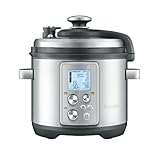

Breville Fast Slow Pro
Breville’s Fast Slow Pro is the electric pressure cooker for people who read manuals and enjoy them. Where other machines give you high and low pressure and a row of presets, the Pro offers a wide, finely graded range of pressure settings, sensors that monitor temperature at two points in the pot, and an altitude adjustment that compensates for thinner air — a detail that matters enormously if you cook in the mountains and one no mainstream rival bothers with. It feels engineered by people who pressure cook seriously.
Its signature convenience is the steam release. A hands-free automatic release can be set to natural, pulse, or quick, and the machine manages it when the cooking ends — no hovering, no towel over the valve, no startling jet of steam while you are plating salads across the kitchen. The pulse setting, which vents in short bursts, is particularly kind to frothy foods like beans and porridge that punish an abrupt full release. The large LCD changes color as the machine moves through preheating, cooking, and releasing, so a glance from the doorway tells you exactly where dinner is.
The ceramic-coated nonstick pot divides opinion: it releases food wonderfully and wipes clean, but it is not the pot for aggressive searing purists, and like all coatings it has a lifespan. The machine is also unapologetically the premium option in this guide — you are choosing it for control and polish, not value. And while its slow cook and sear functions are strong, its preset library is less recipe-ecosystem-driven than the Instant Pot world’s; you will adapt timings yourself, which, if you are the cook this machine is aimed at, you will consider a feature.
Strengths
- Automatic hands-free steam release with natural, pulse, and quick options
- Fine-grained pressure range and dual sensors for precise control
- Altitude adjustment for accurate cooking in high elevations
- Excellent color display showing each cooking stage at a glance
Trade-offs
- Premium positioning in the category
- Nonstick ceramic pot instead of stainless steel
- Smaller built-in recipe community than the biggest-selling rival
The Fast Slow Pro suits detail-oriented cooks who want pressure cooking to be precise and repeatable, high-altitude households, and anyone who finds manual steam release annoying enough to pay to eliminate it. It is the connoisseur’s electric cooker — check price on Amazon.
Check price on Amazon: Breville Fast Slow Pro

Presto 6-Quart Electric Pressure Cooker
Presto has made pressure cookers since the era of the jiggling stovetop weight, and its electric model carries that heritage in the best way: it is a pressure cooker first, with no ambition to be twelve appliances in a trench coat. The controls are a short, honest list — pressure cooking presets for the staples, browning, slow cooking, and keep-warm — presented on a simple panel that a guest in your kitchen could operate without instruction. For a meaningful slice of buyers, that restraint is not a limitation. It is the product.
Two practical choices stand out. The inner pot is nonstick, which makes this the friendliest machine in the guide for rice, oatmeal, and sticky grains that scorch stainless pots into burn-warning territory. Cleanup is correspondingly easy: pot and lid components come apart sensibly, and the whole machine has the wipe-down simplicity of older, well-thought-out appliances. Presto’s long history also means parts and support follow the old appliance model — this is a company that still sells gaskets for cookers older than their owners.
What you give up is the modern multi-cooker flourish. There is no yogurt program, no sous vide, no app, no crisping lid, and the display and feedback are basic — you get less of the progress information the fancier machines provide. Searing power is adequate rather than assertive. None of that matters if your actual cooking is stews, soups, beans, pot roasts, and rice, which — be honest — is ninety percent of what any pressure cooker ever does. This machine does that ninety percent without fuss, at the straightforward end of the range.
Strengths
- Simple, legible controls with no preset overload
- Nonstick inner pot that excels at grains and cleans in moments
- From a heritage pressure-cooker maker with strong parts support
- A focused tool for the core jobs: stews, beans, roasts, rice
Trade-offs
- Few extras — no yogurt, sous vide, or air fry functions
- Basic display with minimal cooking feedback
- Searing is serviceable rather than powerful
The Presto suits cooks who want pressure cooking without a learning curve, older users who value legible controls over features, and anyone burned by overcomplicated appliances. It is the pick for people who read a 40-button panel as a warning sign — check price on Amazon.
Check price on Amazon: Presto Electric Pressure Cooker
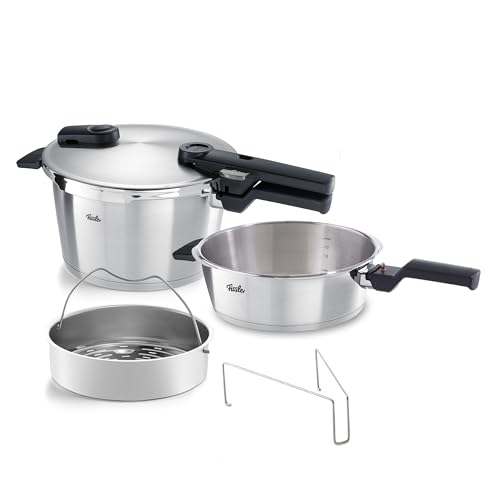
Fissler Vitaquick
The Vitaquick is the argument for the stovetop, made by a German cookware company that treats a pressure cooker as a piece of serious cookware rather than a gadget. The body is heavy 18/10 stainless steel with a thick, energy-efficient base that works on every hob including induction, sears like a proper sauté pan, and — this matters over years — has no electronics, no display, and no firmware between you and dinner. With gaskets replaced as they age, there is no reason this pot will not cook for decades.
Fissler’s details reward attention. The lid locks with an audible click and a color indicator in the handle confirms a correct seal before you apply heat; the pressure indicator rises in clear stages so you can see the pot approach and hold its settings — a gentle level for vegetables, fish, and delicate foods, and the full traditional pressure for meats and beans. Because it reaches the classic pressure that most European and older American recipes assume, cookbook timings land exactly as written. The removable handle and the valve assembly come apart for real cleaning, and the pot doubles as a first-rate stockpot and steamer with the lid’s pressure function unused.
The stovetop bargain applies in full: you are the control system. You bring the pot to pressure, adjust the burner to hold it there without waste, time the cooking, and manage the release — by lifting the valve, or by the fast cold-water method under the tap. None of this is difficult, but all of it is presence; this is not a pot you start and leave for the school run. It is also positioned as premium cookware, and the buy-in reflects that. For the right cook, that is money spent once, correctly.
Strengths
- Heirloom stainless build with no electronics to fail
- Reaches full traditional pressure, so classic recipe timings are exact
- Two pressure settings with a clear visual indicator and locking confirmation
- Doubles as a superb everyday stockpot; works on induction
Trade-offs
- Requires your attention at the stove from start to finish
- Premium cookware positioning
- No timer, no keep-warm, no presets — you provide all three
The Vitaquick suits experienced cooks who value control and longevity over automation, households tired of replacing appliances, and anyone whose recipe library leans on traditional pressure timings. It is the cooker you buy when you want to stop buying cookers — check price on Amazon.
Check price on Amazon: Fissler Vitaquick
Getting the Most From Your Cooker
Match the Release to the Food
If you remember one skill, make it this one, because release method decides texture more than any preset. Use natural release — full or at least ten to fifteen minutes — for large cuts of meat, dried beans, broths, and anything foamy or starchy. Use quick release for green vegetables, seafood, soft eggs, and pasta, where five extra minutes under pressure is the difference between bright and ruined. Use the hybrid for grains and most weeknight stews: a short natural rest takes the violence out of the venting, then a quick release gets dinner moving. When in doubt, split the difference; under-releasing costs you a few minutes, while over-venting a pot of bean soup costs you a cleanup.
Habits That Prevent the Common Failures
Nearly every bad pressure-cooker experience traces back to four habits. First, liquid: keep at least a cup of thin, watery liquid in a family-size pot, and remember that tomatoes, barbecue sauce, and cream soups do not count until they are thinned — they scorch instead of steaming. Second, layering: after searing, scrape the pot base completely clean while deglazing, then add thick ingredients last, on top, unstirred. Third, fill lines: two-thirds full for ordinary foods, half for beans, grains, and anything that foams, no exceptions for optimism. Fourth, the gasket: rinse it after every use, keep a spare, and store the lid upside down so the ring dries and airs. Follow those four and the burn notices, sputtering valves, and perfumed rice that plague beginners simply stop happening.
Sizing Recipes Up and Down
Pressure cooking scales gracefully within limits. Doubling a stew in the same pot usually needs no time change — the food cooks at pressure for the same duration, though the fuller pot takes longer to pressurize and release, so total time grows. Halving is trickier in a big pot: keep the minimum liquid the same rather than halving it, or the cooker cannot build steam properly. Pot-in-pot cooking — a covered smaller dish on a trivet above water — is the elegant solution for small quantities, delicate desserts, and reheating, and it also lets you cook two components, like rice above a curry, in one cycle.
Your First Week With the Cooker
New owners succeed fastest with a deliberate first week rather than a random recipe spree. Start with the water test — a cup of water, a few minutes at pressure, one quick release — which teaches you the sounds, the pin, and the venting with nothing at stake. Follow with hard-cooked eggs, which are nearly impossible to ruin and demonstrate quick release. Midweek, cook dried beans with a full natural release and notice how the texture rewards patience. By the weekend, attempt a stew with a sear, a deglaze, and a hybrid release — every core skill in one pot. After that week, the machine’s logic is in your hands: you will read any recipe and instinctively know its pressurize time, its release method, and its likely pitfalls. Keep notes in the margins as you go; a month of your own annotations becomes the most trustworthy pressure-cooking reference in your kitchen, tuned to your pot, your stove, and your altitude.
Realistic Timing: What “Fast” Actually Means
The Three Clocks of Every Recipe
Every pressure recipe runs on three clocks, and only one of them appears in the headline time. The first is pressurizing: the pot must boil its liquid and build steam before cooking begins, which takes five minutes for a half-full pot of soup and can take twenty for a full, cold pot straight from the fridge. The second is the cooking time at pressure — the number recipes advertise. The third is the release, from a two-minute quick vent to a half-hour natural cool-down. Add them honestly and a “30-minute” stew is really a 55-minute project. That is still less than half the stovetop or oven equivalent, but planning around the real total is what keeps pressure cooking relaxing instead of disappointing.
A few benchmarks calibrate expectations. Dried black beans, unsoaked, cook at pressure in roughly half an hour and reach the table in about an hour all-in. A whole chicken takes under half an hour at pressure plus a natural rest. Steel-cut oats need only a few minutes at pressure but a patient natural release. Beef stew meat wants twenty to twenty-five minutes at pressure to turn silky rather than merely cooked. Once you have cooked a food twice, write your total time — all three clocks — in the margin of the recipe. Your own annotated numbers will be worth more than any chart.
Altitude and Other Quiet Variables
Pressure cooking is one of the few methods where geography changes the recipe. At altitude, thinner air means a pressure cooker reaches a lower absolute pressure and water boils cooler, so foods take measurably longer — a rule of thumb is to add a small percentage of cooking time for every thousand feet above sea level, and to be generous with natural release, which does part of the work gently. This is where the Breville’s altitude compensation and the Fissler’s full traditional pressure stop being trivia and start being dinner. Frozen starting points, very full pots, and dense foods like large roasts also stretch timings; when a result disappoints, adjust one variable at a time and note it, the way you would with an oven that runs hot.
Accessories Worth Owning (and a Few That Are Not)
The essential accessory list is short and unglamorous. A spare sealing ring, for the odor reasons covered earlier, is the one purchase every owner should make in the first month. A stainless trivet or steamer basket — often included — unlocks pot-in-pot cooking, eggs, and vegetables held above the liquid. Heat-safe glass or stainless containers sized to fit your pot turn it into a bain-marie for custards, cheesecakes, and reheating leftovers without drying them out. Long-handled tongs and a ladle you trust round out the kit; everything else is optional.
The optional tier has a few genuine wins. An extra inner pot lets you cook rice while a curry rests, or swap a scorched pot mid-recipe without washing under pressure of a different kind. A glass lid converts the pot into a slow cooker and serving vessel. A second, nonstick pot — for owners of stainless machines — is a targeted fix for households that cook grains daily. What you can safely skip: most bundled accessory kits, whose dozen pieces typically include three you will use and nine that will migrate to the back of a drawer, and any gadget that duplicates a function your cooker already performs. Buy accessories in response to a recipe you actually cook, not in anticipation of a lifestyle, and your pressure cooker stays the space-saving tool it was meant to be.
Cleaning and Storage, Briefly
Daily care takes two minutes: wash the pot, wipe the lid’s underside, rinse the gasket, and check that the steam valve and anti-block shield are clear of food. Weekly or after any foamy cook, remove the valve cover and float pin on electric models and rinse them properly — most mysterious pressure failures are just a gummed valve. Never immerse an electric base; a damp cloth is its bath. Store the cooker with the lid upside down or ajar so the gasket airs and the pot never develops the closed-cupboard smell that makes new owners think something has spoiled. None of this is burdensome, but all of it is the difference between a cooker that performs identically in year five and one that slowly becomes unreliable.
What Pressure Cookers Do Best — and What to Cook Another Way
Knowing a tool’s limits is part of choosing it well, so here is the honest map. Pressure cookers are unmatched for dried beans and lentils, tough braising cuts, stocks and broths, soups and stews, grains like brown rice and farro, one-pot pastas and curries, and anything that starts frozen. These foods share a trait: they cook in liquid, improve with sustained moist heat, and forgive small timing errors. If your weeknight rotation leans on these dishes, a pressure cooker will feel less like an appliance and more like a schedule expansion.
Other foods fight the method. Anything whose appeal is crispness — skin-on chicken by itself, roasted vegetables, a good crust — needs dry heat, and pressure produces the opposite environment; that is why crisping-lid machines and a finishing pass under the broiler exist. Delicate fish and quick vegetables cook so fast conventionally that the pressurize-and-release overhead makes the cooker slower in practice, not faster. Dairy-rich sauces can split under pressure and are better stirred in at the end. And bread, obviously, belongs to the oven. None of this diminishes the cooker; it defines the job. Buy it for the first list and it will earn its space every week.
A Word on Longevity and Warranty
Electric multi-cookers are appliances, and their realistic lifespan is measured in years of heavy use rather than decades — heating elements, sensors, and control boards eventually age, and model lines turn over, which is why choosing a brand with a deep spare-parts catalog matters more than any single feature. Stovetop cookers invert the equation: the pot itself is nearly immortal, and the maintenance budget is a gasket every year or two and a valve check now and then. When you compare a mid-range electric against a premium stovetop pot, you are not really comparing two prices; you are comparing a shorter, more convenient ownership with a longer, more manual one. Decide which kind of owner you are, and the shortlist in this guide mostly chooses itself.
Frequently Asked Questions
Are modern pressure cookers actually safe?
Yes — today’s electric and stovetop models carry several independent safety systems: locking lids that cannot open under pressure, primary and backup pressure releases, and fail-safes that vent steam long before anything dangerous could build. The realistic hazards are steam burns and scalds, and both are avoided by venting from the side, keeping hands out of the steam path, and opening the lid away from your face. Treat it with the same respect you give a hot oven and it is among the safest appliances you own.
Why did my electric cooker show a burn warning?
The burn message means the pot’s base overheated, and the cause is almost always the food, not the machine: too little thin liquid, a thick sauce touching the bottom, or browned bits left unscraped after searing. Let the pot cool, add a splash of water, scrape the base clean, layer thick ingredients on top rather than stirring them down, and restart — the meal is usually salvageable, and the habit changes prevent a repeat.
Can I cook frozen meat in a pressure cooker?
Yes, and it is one of the method’s best party tricks. Frozen chicken pieces, ground meat, and even a small frozen roast cook safely and well under pressure; simply add roughly half again as much pressure time as the thawed recipe calls for, make sure liquid can circulate around the food rather than the pieces being fused into one solid block, and use a thermometer to confirm the center is fully cooked. Large, thick frozen roasts benefit from a brief thaw so the middle keeps pace with the outside.
Why does my rice taste faintly like last week’s chili?
Your sealing ring is the culprit — silicone absorbs strong odors and shares them with the next dish. Keep two gaskets, one reserved for savory cooking and one for grains, desserts, and mild foods, and swap them as needed. Washing the ring promptly and storing the lid upside down so the gasket airs out will keep both rings fresher for longer.
Electric or stovetop — which should a beginner choose?
Most beginners are happier starting electric: the machine manages pressure, timing, and keep-warm automatically, which removes the only real learning curve the method has. Choose stovetop first if you already cook confidently, want maximum control and a pot that will last for decades, or follow traditional recipes written for full stovetop pressure. There is no wrong answer — only the answer that matches how you actually cook.
Whichever cooker you bring home, the first pot of beans — cheap, forgiving, and ready in under an hour from dry — will teach you more about pressure cooking than any manual, so start there and let the pot earn its place one weeknight at a time.


