Some blender recipes fail for a reason that has nothing to do with motor power. A jar of roasted nuts, a hummus with very little added liquid, or a frozen dessert built from solid banana and berries does not flow, and a mixture that does not flow cannot circulate past the blades. The blades carve out a cavity, spin inside it, and the food above the cavity simply sits there while the motor note climbs. The tool designed for exactly this failure is the plunger (tamper): a sturdy rod that passes through the opening in the lid and pushes the mixture down into the blades while the machine runs, its collar stopping it short of the cutting edges. Manufacturers call it a tamper; many shoppers search for it as a plunger. This guide uses both terms, and it compares six countertop blenders that include a plunger (tamper) in the box as standard, according to each manufacturer’s own published box contents.
One disclosure before the picks. This site may earn an affiliate commission when readers buy through links on the page, at no extra cost to the reader. That commission is the business model, and it is stated plainly so the reasoning below can be judged on its merits. The selections come from research: manufacturer specifications, published box-contents lists, stated capacities and motor figures, and parts documentation. Nothing here rests on a popularity score, and the order of the picks reflects how the machines differ rather than a claim that one of them wins for every kitchen.
The entry rule for this roundup is strict, and it is worth stating before any brand names appear. A pick qualifies only when the plunger is part of the manufacturer’s package for that exact model or bundle, not an accessory sold separately and not a third-party stick of roughly the right length. A tamper is a fitted part: its length and collar are matched to one container, and a tamper from another jar can be too short to help or long enough to reach the blades. Every pick below clears that bar on its maker’s own documentation, and the buying guide further down explains how to check the same evidence on any listing before ordering.
In this guide
Quick picks: best blenders with plungers
| # | Product | Where to buy |
|---|---|---|
| 1 | Vitamix 5200 | Check on Amazon |
| 2 | Cleanblend Commercial | Check on Amazon |
| 3 | KitchenAid K400 with Tamper | Check on Amazon |
| 4 | NutriBullet Blender Combo | Check on Amazon |
| 5 | Oster Versa Pro | Check on Amazon |
Why thick blends stall, and what the plunger actually does
A blender works by circulation. The blades throw the mixture outward and upward, the jar walls fold it back down, and a vortex forms that keeps feeding material into the cutting zone. Thin and medium mixtures circulate on their own. Thick mixtures break the loop in a specific way: the blades clear a pocket around themselves, the pocket fills with air, and the dense food bridges over the top of it. Roasted nuts do this within seconds. Frozen fruit with no added liquid does it. Chickpea mixtures with the aquafaba held back do it. The result is a machine running at full speed and a blend that is not moving, which is why adding liquid is the usual rescue and also the usual compromise, because a nut butter thinned into a sauce is no longer the recipe.
The plunger answers the problem mechanically instead of culinarily. Working through the lid opening while the motor runs, it lets the cook press the mixture down into the blades and push it toward the corners of the jar, collapsing the air pocket and restarting circulation without stopping the machine, removing the lid, or diluting the recipe. The collar near the top of the rod is the safety engineering: it meets the lid and physically prevents the rod from reaching the blades when the lid is in place. That is also why the technique has one non-negotiable rule, which every manufacturer of these machines prints in its manual: the plunger is used only through the lid opening, with the lid seated, never in an open jar, and never replaced by a spoon, spatula, or any other utensil that lacks the stop.
Used well, the plunger changes the technique of a thick blend. The cook starts at a low speed so the load settles, ramps upward as the mixture begins to move, and works the plunger against the corners of the jar where dense food hides. Short pauses matter too, because a thick load is the hardest work a blender motor does, and several of the machines below carry thermal protection that will stop the motor to save it if a dense batch is driven without rest. None of this requires strength. It requires the right fitted tool, which is precisely what the in-box requirement guarantees.
Loading and running a thick blend, step by step
Technique decides as much as hardware does, and the manuals of the machines below agree on the broad sequence. Loading order comes first. Even in a recipe with almost no liquid, what little liquid exists goes in first, followed by soft ingredients, then heavy and frozen items last, so the first seconds of blending have something that can move. Dry goods that will become butter go in as a single load rather than in additions, because a half-processed nut load folds new nuts in poorly. The lid goes on, the centre cap comes out, and the plunger takes the cap’s place before the motor starts, not after the mixture has already bridged.
The run itself has three phases. It begins low: a slow speed for the first seconds lets the load settle onto the blades without throwing dry ingredients up the jar walls where they stick. It rises steadily as the mixture starts to move, because a thick blend that is babied at low speed will churn a pocket and stall, while one driven to full speed in a single jolt can overload the motor before circulation begins. Then it settles into the working phase, where the plunger’s rhythm matters: press down, work toward one corner, ease off, work toward another, keeping the mixture folding rather than simply pinned. The cook is listening throughout. A motor whose note rises and strains is asking for a pause or a touch more liquid; a motor running free and high is usually spinning in an air pocket and asking for the plunger.
Rest is part of the recipe, not a failure of it. Dense loads generate heat in the motor and friction in the mixture, and several of these machines carry thermal protection that stops the motor outright when the limit is reached, after which the manufacturer’s instruction is to let the machine cool before resuming. Building short pauses into a long nut-butter run, and splitting a very large batch into two jars’ worth, keeps the process inside the machine’s design instead of against its safeguards. Scraping the jar down belongs to those pauses, with the motor off and the jar, on some models, removed from the base. The plunger exists precisely so that scraping is the exception rather than the method: while the machine runs, the fitted rod does the work that a spatula must never attempt.
Why Blendtec and Ninja are not on this list
Two of the largest names in blending are absent from the picks, and the absence is a design decision by those manufacturers, not an oversight in the research. Blendtec builds its machines around a thick, blunt safety blade and square jar geometry, most visibly the five-sided WildSide jar, engineered so the mixture folds back into the blade path without assistance. Ninja builds around a stacked blade assembly, a tower of blades at several heights inside the pitcher, so the cutting zone reaches up through the mixture instead of waiting for the mixture to come down. Both approaches aim to make the tamper unnecessary, and neither manufacturer includes one in the box for its full-size countertop models.
That engineering choice is legitimate, and for smoothies, frozen drinks, and most medium mixtures it works as advertised. The boundary appears at the thickest end of the repertoire. A jar of nothing but roasted nuts and their own oil, or a frozen dessert with no liquid at all, asks any circulation system to move a mixture that behaves more like a solid than a fluid, and the cook’s options narrow to stopping and scraping, adding liquid, or owning a machine whose manufacturer fitted a plunger for the job. Readers whose blending life is mostly drinks will lose nothing by choosing the tamperless designs. Readers whose signature recipes are nut butters, dense hummus, and frozen desserts are the audience this roundup serves, and for them the in-box plunger is not an accessory preference but the deciding feature.
What to look for in a blender with a plunger
Start with the evidence, because the word tamper travels loosely in retail listings. The reliable check is the manufacturer’s own box-contents list for the exact model or bundle: if the plunger appears there, the pick is genuine; if it appears only in a retailer’s bullet points, or only as a compatible accessory, treat the claim as unproven. Bundle discipline matters most with mainstream brands, where the same blender name is sold in a base package and in a package with the tamper included, at different prices, under model numbers that differ by a few digits. The KitchenAid pick below exists in exactly that split, and its section names the correct bundle code. A buyer who orders the base version of such a model and finds no plunger in the carton has not been cheated; the distinction was in the model number all along.
Power figures need translating before they mean anything, because this category speaks two currencies. Some manufacturers state watts, some state peak horsepower, and the two are measured on different bases that do not convert into a clean ranking across brands. Treat each figure as a statement within its own brand’s language: a useful tier marker, not a cross-brand score. What actually decides thick-blend behaviour is the combination of motor strength, blade design, jar geometry, and the plunger’s help, and a mid-powered machine with a well-shaped jar and a fitted tamper will finish a nut butter that a stronger tamperless machine leaves bridged over its blades. The honest use of the numbers below is to place each pick in its maker’s range, from the entry model to the flagship, and no further.
Jar capacity should be matched to the batch, not to ambition. Thick mixtures need enough volume in the jar to fold and circulate, and a small batch in a very large jar can ride so low and wide that even a plunger struggles to gather it. A sixty-four-ounce jar suits family-scale nut butter and frozen dessert batches; a forty-eight or fifty-six-ounce jar suits one to four servings and stores under standard cabinets more easily; and households that blend thick recipes in small amounts should read each pick’s minimum-batch behaviour as carefully as its maximum capacity. Jar height is the companion figure: tall classic containers are part of why the oldest design below works as it does, and they are also the first thing to measure against low wall cabinets.
Controls decide how a thick blend feels to run. A variable-speed dial is the traditional tool for dense work because it lets the cook start slowly, listen to the load, and ramp up in step with the mixture’s movement, and four of the six picks below are dial machines. Preset programs take the opposite approach, running a timed pattern chosen by the manufacturer; they are convenient for drinks and soups, and some include a useful self-cleaning cycle, but a program cannot feel an air pocket forming, so dense recipes on a preset machine still come back to manual speeds and the plunger. Pulse is the third control that matters: short bursts settle a load and chop coarsely before the sustained blending begins. For a thick-recipe household, the ranking is dial first, pulse second, programs as a bonus.
The plunger itself deserves a look before purchase. It should be the manufacturer’s part for that container, with a collar that stops it at the lid, a length that reaches the mixture without nearing the blades, and a grip that stays manageable with wet hands. Replacement plungers are sold by the manufacturers below, which matters because the rod is the part most likely to be left in a sink or lost in a move. Storage is a small daily detail: a plunger lives somewhere between uses, and a kitchen that cannot stand loose rods on the counter should picture where this one will go. Cleaning is simple for all six picks, since the rod is a single smooth piece that rinses or goes in the dishwasher per each maker’s instructions.
Finally, weigh the support tail. Thick blending is the hardest duty cycle a countertop blender faces, so warranty terms carry more weight here than in a smoothie roundup: the picks below range from five to seven years of manufacturer cover, with the strongest terms attached to the two oldest designs in the list. Parts availability follows the same pattern. Containers, lids, blade assemblies, and replacement plungers for long-running model lines stay orderable for years, and a machine bought to make nut butter weekly should be judged partly on whether its wear parts will still exist when they are needed.
The other end of the dial: long runs, hot soup, and friction
Thick blending is not the only duty that separates these machines, and a complete buying guide should place the plunger in the context of everything else the same motor will be asked to do. At the opposite extreme sits hot soup made from raw ingredients by blade friction, a technique the high-performance brands in this list are known for: a sustained run at full speed converts the blades’ energy into heat until a soup steams. The plunger plays almost no part there, because a soup is liquid from the first minute and circulates freely; what the soup run tests instead is the motor’s cooling and the jar’s venting, since the lid must release steam through the same opening the tamper uses elsewhere. A household choosing between these six for both jobs should note that the machines with the strongest thick-blend credentials, the two Vitamix picks and the Cleanblend, are also the ones whose makers built their reputations on exactly those long, hot runs, while the preset machines answer with programmed soup settings that trade the cook’s control for convenience.
The plunger as a fitted part, not a generic stick
It is worth pausing on how model-specific this simple rod is, because the differences explain several of the cautions attached to the picks. A tamper is dimensioned for one container: its working length is set so the tip can reach the mixture sitting on the blades, and its collar is positioned so the rod stops, against the lid, before the tip can reach the cutting edges. Change the container and both dimensions change. Within the Vitamix range alone, the tamper for the tall classic sixty-four-ounce container is a longer part than the mini tamper supplied with the E310’s lower, wider forty-eight-ounce container, and the two are not interchangeable even though both carry the same brand. A household that later adds a second container to a Vitamix should expect to add its matched tamper as well.
The same logic governs the bundle discipline in the middle of the list. KitchenAid’s tamper is made for the K400’s fifty-six-ounce jar, and it is placed in the carton only for the KSB4028 bundle; the base K400 leaves the jar’s lid opening ready but the rod unpurchased. NutriBullet’s tamper belongs to the sixty-four-ounce pitcher alone and plays no part in the cup system, where the sealed extractor design neither needs nor accepts one. Oster’s rod is matched to the Versa jar in either of its profiles. In each case the part is inexpensive and orderable from the manufacturer, which cuts both ways for the buyer: a lost tamper is a minor problem, but a blender bought without one, on the assumption that any rod will do, starts its life missing the component this entire roundup is about. Checking the box-contents list for the exact model number remains the only reliable way to know the part is inside.
The six plunger blenders, compared by role
The six machines below are arranged by role rather than by price: the reference design of the category, its smaller sibling, the value-and-power challenger, the mainstream bundle with the metal base, the combination system for households that also blend single servings, and the programmed all-rounder from a long-running appliance line. Every one of them includes its plunger in the manufacturer’s package, and every motor figure is stated in the basis its own manufacturer uses.
| Pick | Motor, as the maker states it | Jar | Controls | Plunger evidence |
|---|---|---|---|---|
| Vitamix 5200 | 2.0 peak horsepower | 64 oz classic tall container | Variable dial 1 to 10, plus High | Tamper listed in the manufacturer’s package |
| Vitamix E310 | 2.0 peak horsepower | 48 oz low-profile container | Variable dial 1 to 10, plus Pulse | Mini tamper listed in the manufacturer’s package |
| Cleanblend Commercial | 1,800 watts | 64 oz container | Variable dial, plus Pulse | Tamper listed in the manufacturer’s included components |
| KitchenAid K400 with Tamper | 1.5 peak horsepower | 56 oz jar | 5-speed dial, 3 presets, Self-Clean | Tamper included in the KSB4028 bundle only |
| NutriBullet Blender Combo | 1,200 watts | 64 oz pitcher, plus 32 oz and 24 oz cups | 3 speeds, Pulse, Extract program | Tamper listed in the manufacturer’s includes list |
| Oster Versa Pro | 1,400 watts | 64 oz jar | Variable dial, 3 programmed settings, Pulse | Tamper included in the manufacturer’s package |

Vitamix 5200: the reference design for thick blending
The Vitamix 5200 is the machine this category is measured against, and its specification explains why. A motor rated by Vitamix at 2.0 peak horsepower drives laser-cut stainless blades inside the classic tall sixty-four-ounce container, and the control set is deliberately plain: a variable-speed dial running from 1 to 10 and a separate High switch. The tamper is part of the standard package, as it has been across this model’s long production run, and the tall, relatively narrow container is shaped to work with it, funnelling the mixture down toward the blades so the plunger’s pushes land where they matter. A radial cooling fan and thermal protection guard the motor during the long, dense runs that nut butter demands.
For thick work the technique this machine rewards is patience at the dial. A nut butter starts as a loud, dry tumble, passes through a stage where the mixture climbs the jar walls and bridges, and only becomes a flowing butter after sustained blending with the plunger working the corners. The 5200’s manual controls suit that arc exactly, because the cook governs every step of it rather than supervising a program. Frozen desserts with no added liquid, hummus kept deliberately stiff, and batters all run on the same pattern. The seven-year full warranty is the other half of the argument: it is the longest cover in this roundup alongside the Oster, and it reflects a model line whose containers, lids, and tampers remain stocked as parts.
The container ecosystem around the 5200 is the deepest in this roundup, and it matters to thick-recipe households in a specific way: smaller and specialised containers mount on the same base, including a thirty-two-ounce container that suits small nut-butter batches better than the tall jar does, and a dry-grains container whose blade is shaped for milling flour and kneading dough. Each container takes its own matched tamper, for the fit reasons set out above, so an expanding collection is also a small collection of rods. Owners who expect their blending to grow over the years are buying into that system as much as into the single machine.
Strengths
- The benchmark thick-blend technique: tall container, fitted tamper, and full manual control.
- Seven-year full warranty, the joint longest in this roundup.
- Deep parts and container ecosystem built over a long production run.
- Thermal protection and a cooling fan specified for sustained dense loads.
Trade-offs
- The tall container on the base is the highest profile here and may not slide under low wall cabinets.
- Small single servings ride low in the sixty-four-ounce jar; a smaller extra container is the usual answer.
- No preset programs at all, which drink-focused households may miss.
- It sits at the premium end of this list on price tier.
Who it suits: the committed thick-recipe household, the weekly nut-butter maker, and any buyer who wants the design the rest of the category imitates, backed by the longest track record in the group, so check price on Amazon.
Check price on Amazon: Vitamix 5200
Vitamix E310: the same technique in a smaller jar
The E310 is the entry model of the Vitamix Explorian line, and it keeps the essentials of the reference design while cutting the jar and the price tier. The motor carries the same 2.0 peak horsepower rating as the 5200, the controls are a variable-speed dial from 1 to 10 with a pulse switch in place of the 5200’s High switch, and a mini tamper sized for its container is listed in the manufacturer’s package. The container is the real difference: forty-eight ounces in a lower, wider profile that brings the assembled machine down to a height that fits under standard kitchen cabinets, which is where most countertop blenders actually live.
For one to four servings of thick food, the smaller jar is not a compromise but a match. Nut butter in household quantities, hummus for a few days, frozen dessert for a family evening: all sit in the forty-eight-ounce container at a depth the plunger can work properly, where the same amount in a sixty-four-ounce jar spreads thinner and gathers less willingly. The pulse switch earns its place here too, settling a dry load in bursts before the sustained run. What the E310 gives up is headroom and time: batch cooks who fill a jar to the brim will hit its ceiling, and its full warranty runs five years rather than the 5200’s seven.
The cabinet question deserves its numbers stated plainly, because it decides real purchases. With its container seated, the E310 stands about eighteen inches tall, a height that clears the underside of standard wall cabinets where the 5200’s tall container does not, and that difference determines whether the machine lives on the counter, ready for daily use, or in a cupboard, from which thick recipes get made less often. The lower, wider container also pours more easily for smaller hands and rinses faster. None of this makes the E310 a lesser machine; it makes it the same technique re-proportioned for the kitchens most people actually have, which is why it is the pick most likely to be recommended first in conversation.
Strengths
- Same maker-stated motor rating as the 5200, in a shorter machine that fits under cabinets.
- Mini tamper included in the manufacturer’s package, sized to the forty-eight-ounce container.
- Pulse switch added to the classic dial layout, useful for settling dry loads.
- Five-year full warranty, matching the strongest terms outside the two seven-year picks.
Trade-offs
- Forty-eight ounces caps batch size for large households and batch cooks.
- Warranty is two years shorter than the 5200’s cover.
- No preset programs, in keeping with the manual philosophy of the line.
- Very small amounts still need enough depth to circulate, as with any full-size jar.
Who it suits: smaller households that want genuine Vitamix thick-blend technique without the tall jar or the flagship price tier, and anyone whose cabinet clearance rules the 5200 out, so check price on Amazon.
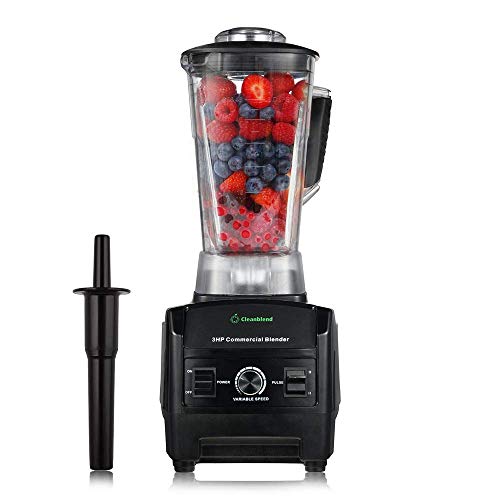
Cleanblend Commercial: the power-per-price challenger
The Cleanblend Commercial Blender approaches the category from the opposite direction to Vitamix: a single model, sold on specification, at a noticeably lower price tier. Cleanblend states the motor at 1,800 watts, with a three-horsepower peak figure in its own materials, turning a six-pronged stainless blade inside a sixty-four-ounce BPA-free container. The controls are a variable-speed knob with pulse and power levers, and the tamper appears in the manufacturer’s included-components list for the package, alongside the container, lid, and warranty booklet. A five-year warranty backs the machine.
On paper this is the strongest motor statement in the roundup, and the honest reading of it follows the rule set out in the buying guide: watts and peak horsepower are different currencies, so the figure places the Cleanblend at the top of its own brand’s range rather than proving a cross-brand victory. What is not in doubt is the intent of the design. The tall container profile, the fitted tamper, and the manual dial are the classic thick-blend toolkit, aimed at the same nut butters, frozen desserts, and dense purées as the reference pick, and the brand’s commercial naming reflects the duty it is built for. The compromises are those of a smaller company: a thinner parts and accessory ecosystem, no smaller container in the range to match the big jar, and a support network that cannot match the oldest names here.
One option in Cleanblend’s own catalogue deserves a mention for small-batch cooks: the company sells a thirty-two-ounce container, with its own matched tamper and lid, as an accessory for the same base. That answers the big jar’s one structural weakness for this category, since a modest quantity of nuts in a sixty-four-ounce container spreads wide and shallow, and it does so inside the manufacturer’s system rather than through any improvised substitute. Buyers comparing the Cleanblend against the Vitamix pair should count that accessory’s existence in its favour and its extra cost against the headline value.
Strengths
- The largest maker-stated power figure in the roundup, at a mid price tier.
- Tamper confirmed in the manufacturer’s included-components list.
- Classic thick-blend layout: tall sixty-four-ounce container and a manual variable dial.
- Five-year warranty, equal to the KitchenAid and the E310.
Trade-offs
- The assembled machine is tall, the recurring cost of the classic container shape.
- No preset programs and no smaller container option in the maker’s range.
- Parts and accessory depth cannot match the Vitamix ecosystem.
- The brand’s stated peak figure uses a different basis from the horsepower-rated picks, so cross-brand comparisons need care.
Who it suits: the value-driven buyer who wants the classic tamper-and-tall-jar toolkit and the biggest specification sheet in the group without paying the flagship tier, so check price on Amazon.
Check price on Amazon: Cleanblend Commercial

KitchenAid K400 with Tamper: the bundle to buy by number
The KitchenAid K400 is the pick where this roundup’s entry rule matters most, because KitchenAid sells the K400 both ways. The base K400 package does not include a tamper; the K400 Variable Speed Blender with Tamper, model KSB4028, does, and that bundle code is the one this pick refers to. Inside it sits a fifty-six-ounce BPA-free jar on a die-cast metal base, a motor rated by KitchenAid at 1.5 peak horsepower, a five-speed variable dial, three preset programs for ice crush, icy drinks, and smoothies, and a self-cleaning cycle. KitchenAid’s Intelli-Speed control senses the load and holds the chosen speed against it, and its Soft Start feature brings the blades up gradually instead of jolting a dense load.
The engineering story here is the three-part blending system: a ribbed jar that folds contents toward the blades, an asymmetric blade that cuts at several angles, and the sensing motor control. For thick recipes the tamper completes that system, giving the cook the manual answer when a nut butter bridges despite the jar’s help, and the preset programs handle the drink end of the repertoire without supervision. The die-cast base gives the machine a planted feel that plastic bases lack, and the five-year warranty matches the E310 and the Cleanblend. The disciplines are two: order by the bundle code, not the blender name, and accept that the fifty-six-ounce jar and the maker’s horsepower figure place this machine a step below the two Vitamix picks for the very largest, densest batches.
Two of the K400’s details repay attention under thick loads. Soft Start brings the blades up gently, which keeps a dry nut load in the jar instead of plastered up its walls in the first second, and Intelli-Speed then holds the selected speed as the mixture’s resistance changes, doing electronically what a dial cook does by ear. The die-cast base contributes the third detail: mass. A blender working a dense load wants to walk and twist on its feet, and the metal base’s weight is a functional answer, paid for in lifting weight when the machine is moved for cleaning. None of these features appears in a headline specification, and together they are the substance of this pick.
Strengths
- Tamper included in the KSB4028 bundle, with the model code stated plainly for ordering.
- Die-cast metal base and a load-sensing motor control that holds speed under dense loads.
- The broadest control set here: variable dial, three presets, pulse, and a self-cleaning cycle.
- Five-year warranty from a manufacturer with a deep parts network.
Trade-offs
- The base K400 package excludes the tamper, so the wrong bundle defeats the purpose of the pick.
- Fifty-six ounces is mid-sized: smaller than the sixty-four-ounce jars around it.
- The maker’s 1.5 peak horsepower figure is the lowest of the full-size picks here.
- The ribbed jar’s folds need a brush at cleaning time after sticky nut butters.
Who it suits: the household that wants presets for drinks and a tamper for thick work in one mainstream machine, and is willing to order carefully by bundle code to get both, so check price on Amazon.
Check price on Amazon: KitchenAid K400 with Tamper

NutriBullet Blender Combo: the tamper plus single-serve system
The NutriBullet Blender Combo is the system pick of the roundup: one 1,200-watt motor base that drives a sixty-four-ounce pitcher for batches and, through an extractor blade, a thirty-two-ounce cup and a twenty-four-ounce handled cup for single servings. The manufacturer’s includes list for the combo names the tamper among the pitcher’s equipment, and the manual directs it to be used through the vented lid cap of the pitcher when ingredients stall. Controls are push-button: three speeds, a pulse function, and an Extract program that runs a timed cycle for the cups.
The division of labour is the appeal. Smoothies for one happen in the cups, where a tamper has no role; the pitcher is where this pick meets the roundup’s subject, and with the tamper in hand it handles the hummus, thick dips, and frozen-fruit desserts that a drinks system would otherwise leave unblended or diluted. Buyers should understand the shape of the compromise, though. Button speeds offer less fine control over a dense load than the dials on the Vitamix, Cleanblend, and Oster picks, the tamper belongs to the pitcher alone, and the brand’s warranty terms are shorter than the five-to-seven-year cover found elsewhere in this list. As a household system that covers both ends of the counter, it earns its place; as a dedicated nut-butter machine, it is outranked here.
The cups deserve their own honest paragraph, because they are why many households will choose this system. A twenty-four or thirty-two-ounce cup with the extractor blade serves the weekday pattern of blend, seal with a to-go lid, and leave, and no tamper is involved at that scale because a cup’s narrow column keeps its contents in the blade path. The Combo’s proposition is that one motor base covers that pattern and the weekend batch pattern, pitcher and tamper included, for less counter space and less money than two separate machines. Households that recognise both patterns in their own week are the ones this pick was designed for; households with only the batch pattern should compare it against the dedicated jar machines above it in this list.
Strengths
- Tamper listed in the manufacturer’s includes list for the pitcher.
- One base covers batch blending and single-serve cups, the widest role in the roundup.
- Sixty-four-ounce pitcher matches the largest jars here.
- Extract program automates the cup work the brand is known for.
Trade-offs
- Push-button speeds give less granular control over thick loads than a dial.
- The tamper works only with the pitcher, not the personal cups.
- Warranty cover is shorter than the five-to-seven-year terms on most of this list.
- More parts to store and wash than any single-jar pick here.
Who it suits: the mixed household that blends single smoothies on weekdays and batch recipes at weekends, and wants one system with a tamper ready for the thick end of both, so check price on Amazon.
Check price on Amazon: NutriBullet Blender Combo

Oster Versa Pro: programmed settings and a seven-year promise
The Oster Versa Pro Series is the veteran appliance line’s entry in this class, built around a 1,400-watt motor, a sixty-four-ounce BPA-free Tritan jar, and an all-metal drive system. Oster includes the tamper in the package, and the control panel combines a variable-speed dial with three programmed settings for smoothies, dips and spreads, and soup, plus pulse. The line has been sold in two jar profiles, a low-profile version and a taller classic version, under closely related model codes, so the jar shape in the carton is worth a glance when ordering; the specification that defines the pick, motor, jar capacity, and the included tamper, is common to the series.
The programmed settings are the Versa’s distinguishing habit. For dips and spreads, the very category where a plunger earns its keep, a programmed cycle runs a pattern of speeds intended to pull the mixture down, and the cook supervises with the tamper for the densest loads rather than managing every second at the dial. Soup work benefits from the sustained high-speed running the series is known for. Against that, the platform is an older one: its programs are blunt instruments beside a skilled hand on a dial, its availability comes and goes in a way the continuously stocked lines here do not, and its jar and tamper are proprietary to the series. The seven-year limited warranty, matching the longest cover in this roundup, is Oster’s counterweight and a genuine one for a machine bought to work thick loads weekly.
Strengths
- Tamper included, with a programmed dips-and-spreads setting aimed at thick mixtures.
- Seven-year limited warranty, the joint longest cover in the roundup.
- All-metal drive system, the durability feature Oster has built its name on.
- 1,400 watts as the maker states it, with a variable dial behind the programs.
Trade-offs
- Two jar profiles exist under near-identical naming, so the carton needs checking.
- Programs cannot sense an air pocket; dense loads still need manual speeds and the plunger.
- An older platform whose retail availability is less steady than the current lines here.
- Jar, lid, and tamper are proprietary to the Versa series.
Who it suits: the buyer who likes programmed convenience, trusts Oster’s metal-drive tradition, and wants the longest warranty in the group standing behind a thick-recipe routine, so check price on Amazon.
Check price on Amazon: Oster Versa Pro
Ownership: cleaning, storage, and the day the plunger goes missing
Thick recipes are the messiest work in blending, and the ownership experience of these machines is shaped by it. Nut butters coat a jar in a film that cold water alone will not shift; the standard rescue, which several of these manufacturers build into their controls as a self-cleaning cycle, is warm water with a drop of washing-up liquid run at speed immediately after emptying the jar, before the residue sets. The plunger itself is the easiest part in the category to clean, a single smooth rod with no seams, rinsed in seconds or placed in the dishwasher where the maker allows it. Lids and their centre caps trap more residue than the rod does and reward a brush. Blade assemblies on most of these jars are fixed in the container, which keeps seals simple and means the jar’s interior corners, where dense mixtures pack hardest, are the places to check after washing.
Storage sounds trivial until a long rod meets a shallow drawer. The tall-container tampers are the longest parts in the roundup, and kitchens that store utensils in drawers should measure once; the alternatives are a countertop crock or the jar itself, which is where many owners keep the rod between uses, seated in the container it serves. That habit has a quiet benefit: the tamper stays matched to its container, which matters in the two-Vitamix households and anywhere a second jar joins the first. A tamper stored with the wrong jar invites exactly the fit mistake the collar system exists to prevent.
Loss and damage are minor events with these machines, provided the response is the manufacturer’s parts list rather than a marketplace substitute. Every brand in this roundup sells its tamper as a replacement part, identified by the container it fits, and ordering by that container, not by the blender’s name alone, is the detail that gets the right rod delivered. A cracked collar or a rod chewed by contact it should never have made with a blade is a reason to replace the part, not to keep working with it, because the collar is the safety device. Judged over years, this is the category’s understated advantage: the component most central to the machine’s purpose is also the cheapest and simplest to renew.
A related caution belongs to the second-hand and open-box market, where these models circulate actively. The tamper is the part most often missing from a used package, separated from the machine somewhere in its first home, and a listing that photographs the base and jar may say nothing about the rod. A used purchase of any pick in this roundup should be priced on the assumption that the manufacturer’s replacement tamper may need ordering on day one, matched to the container as described above; with that small cost allowed for, the long warranties and parts support of the older designs here make them more sensible used buys than most small appliances.
Choosing by the thick recipe you make most
The fastest way to choose among these six is to name the thick recipe that will run most often, because each pick’s strengths line up with a different one. Nut butter is the sternest assignment: it runs long, heats the motor, and bridges more stubbornly than any other common mixture. The 5200 is the natural first choice for it, the E310 its smaller-batch equal, and the Cleanblend the value route to the same technique. Hummus and thick bean dips are shorter, friendlier loads; the K400’s presets and sensing motor suit a household that makes them alongside daily drinks, and the Versa’s dips-and-spreads program was designed with exactly this category in mind. Frozen desserts reward jar depth and plunger reach, which favours the sixty-four-ounce machines, while the NutriBullet Combo covers the household whose frozen desserts share the counter with weekday single-serve smoothies.
Frequency is the second filter. A machine that runs a dense batch twice a month can be chosen on fit and features; a machine that runs one daily should be chosen on warranty and parts, which is where the two seven-year picks and the long Vitamix parts trail press their advantage. Counter reality is the third filter, and it is unglamorous: measure the space under the wall cabinets before falling for a tall jar, and picture where the plunger will live, because a tool stored in a distant drawer is a tool that stops being used.
Readers comparing across this site’s other blender guides will notice that those sort the market differently, by motor size and by jar capacity, and both cuts are useful after the tamper question is settled. The wattage-first view of the category is covered in the guide to , and the capacity-first view in the guide to . Neither axis replaces this one. A blender can clear a wattage threshold or a capacity threshold and still leave a nut butter stranded above its blades; the plunger in the box is the specification that decides the thick recipes, and the other two decide how the chosen machine fits the rest of the kitchen’s work.
Frequently asked questions
Is a plunger the same thing as a tamper?
Yes, in this category the two words name the same tool. Tamper is the term the manufacturers print in their manuals and box-contents lists, while plunger is the word many shoppers use when searching, borrowed from the pushing action the tool performs. It has nothing to do with a sink plunger or a coffee tamper, which are different objects for different jobs. When checking a listing, search the box contents for either word, and confirm the part is the manufacturer’s own for that container.
Which foods actually need a plunger?
The foods that need one share a trait: too little free liquid to circulate. Nut and seed butters made from roasted nuts alone, hummus mixed stiff, frozen desserts built from solid frozen fruit with no added liquid, thick dips and spreads, and dense purées such as concentrated baby food all bridge over the blades without help. Smoothies, soups, batters, and sauces carry enough liquid to form a vortex on their own, and for those the plunger simply stays in its drawer.
Can a tamper be bought later for a blender that does not include one?
Sometimes, and only from the same manufacturer. Brands that build tamper-ready containers sell the matched rod as an accessory, and that is a safe purchase because the length and collar are made for the jar. What is not safe is improvisation: a third-party rod of uncertain length, or any kitchen utensil, can reach the blades of a running blender, which is why every manual in this category restricts the tool to the manufacturer’s part used through the lid. Readers who already own a tamperless design from Blendtec or Ninja own machines engineered to work without one; adding a foreign rod to those jars is not the answer, and the answer for the thickest recipes is a machine designed around the tool.
Why do the power figures in this roundup not line up?
Because the manufacturers state them on different bases. Vitamix and KitchenAid quote peak horsepower, a laboratory measure of the motor’s maximum output, while Cleanblend, NutriBullet, and Oster quote watts, an electrical figure. Neither basis is dishonest, but they are not interchangeable, and converting one into the other produces a ranking the underlying measurements do not support. The useful comparisons are within each brand’s own range, and across brands the deciding evidence is the combination of jar design, blade, controls, and the fitted plunger.
How should the plunger be used during a thick blend?
Seat the lid, remove its centre cap, and work the plunger through the opening while the machine runs, pressing the mixture down and toward the corners of the jar where dense food collects. Start at a low speed so the load settles, then raise the speed as circulation establishes, and let the plunger’s collar do its job of stopping the rod short of the blades. Never blend thick food with the lid off and a utensil in hand, and give long, dense runs the pauses the manufacturer’s manual describes, since several of these motors carry thermal protection that will stop the machine to protect it.
Every machine in this roundup was chosen by a single test of evidence: the plunger is in the box, named by the manufacturer, fitted to the jar it serves. Match that certainty to the thick recipe at the centre of your kitchen, and the choice among the six mostly makes itself. A plunger in the box is a small plastic promise that the densest recipe in your rotation was part of the design brief, not an afterthought.


