A 0.7 cubic foot microwave is the smallest full-featured size most households ever buy, and it earns that spot honestly. It is the microwave of dorm rooms, first apartments, office break rooms, RV galleys, and kitchen counters where every inch is already spoken for. This guide compares six real compact models from Toshiba, BLACK+DECKER, Hamilton Beach, COMFEE’, Farberware, and Mainstays, and it is upfront about what this size class can and cannot do. Links in this article may earn an affiliate commission, which is how the research behind guides like this one gets paid for, at no extra cost to you.
Before the picks, one clarification matters more than any single model below. Almost every microwave in this class runs at about 700 watts, and that number shapes your daily experience far more than the brand badge on the door. A 700-watt oven reheats a plate of leftovers perfectly well, but it cooks noticeably slower than the 900 to 1,100 watt machines most packaged-food instructions are written for. Frozen meals take longer, popcorn needs a careful ear, and a mug of soup will not race to a boil. None of that makes these machines bad. It makes them honest appliances for small spaces, as long as you walk in knowing the deal.
The second reality is the turntable. A 0.7 cubic foot cavity usually carries a glass plate around ten inches across, which means a standard eleven or twelve inch dinner plate often will not fit, or fits only if you tilt it through the door at an angle and accept that it cannot rotate. If your household reheats food on big ceramic plates, measure before you buy anything in this guide. If you mostly warm mugs, bowls, small plates, and single-serve containers, the size stops being a limitation within a week and simply becomes the shape of your routine.
In this guide
Quick picks: best 7 cubic foot microwaves
| # | Product | Where to buy |
|---|---|---|
| 1 | Toshiba EM925A5A | Check on Amazon |
| 2 | BLACK+DECKER EM720CB7 | Check on Amazon |
| 3 | COMFEE’ EM720CPL | Check on Amazon |
| 4 | Farberware Countertop 700W | Check on Amazon |
| 5 | Mainstays 0.7 cu ft | Check on Amazon |
What to look for in a 0.7 cubic foot microwave
Power, and what 700 watts really means at dinner time
Cooking power in this class clusters tightly around 700 watts, with a few models edging slightly above it. That is enough for reheating, defrosting small portions, melting butter, softening ice cream, and cooking single servings of oatmeal, eggs, or mug cakes. Where you will feel the gap is with dense frozen food: a frozen burrito or a thick lasagna square needs meaningfully more time than the box suggests, because most box directions assume roughly double the wattage. The practical fix is simple. Add time in modest increments, let food stand for a minute so heat equalizes, and stir or flip dense items halfway through. People who treat a compact microwave like a smaller version of a big one, rather than a slower one, are the people who end up disappointed by it.
Turntable size and the dinner plate test
The glass turntable in this class is typically just under ten inches in diameter, sometimes a touch over. That handles cereal bowls, soup mugs, side plates, and most microwave-safe containers without drama. It does not handle a full-size dinner plate with room to spin, and it definitely does not handle a rectangular casserole dish. If reheating plated dinners is your main use, bring the plate you actually use and test the fit mentally against the stated turntable diameter before ordering. A plate that enters but cannot rotate heats unevenly, leaving a hot rim and a cold center, which is the single most common complaint about compact microwaves and the easiest one to avoid.
Footprint, door swing, and the space above the oven
A typical 0.7 cubic foot model is roughly seventeen to eighteen inches wide, ten to eleven inches tall, and thirteen to fourteen inches deep, with the door swinging open toward you and to the left. Measure your counter depth including the space the open door and your hands need, not just the closed box. These ovens also vent heat, usually from the sides or rear, and they need a few inches of breathing room around them. Tucking one into a closed cubby with no airflow is a reliable way to shorten its life. In a dorm, remember that the shelf or desk corner you have in mind also has to hold the weight, which is usually around twenty to twenty-three pounds, without wobbling every time the door shuts.
Controls you will actually use
Compact microwaves split into two control styles: membrane touchpads with number keys and express-cook buttons, and simpler dials on the most basic models. For most people the touchpad wins, because one-touch thirty-second additions and a proper add-a-minute function get used dozens of times a week. Weight and time defrost modes matter if you thaw frozen chicken or ground meat regularly. A kitchen timer that runs independently of cooking is a quiet luxury in shared spaces. What you can safely ignore is a long list of sensor features and specialty presets, because in this wattage class the auto menus are approximations at best, and your own eyes and a thermometer will beat them every time.
Sound, light, and living with other people
In a studio apartment or dorm, the microwave is in the same room as the bed, so noise and beeping stop being trivial details. Some models in this class offer a mute or sound-off setting for the keypad and end-of-cycle beeps, and that feature alone can decide which machine a night-shift worker or a parent of a sleeping baby should buy. Interior light brightness varies more than you would expect, and a dim cavity is annoying when you are watching popcorn or checking whether cheese has melted. The turntable motor and cooling fan also contribute a background hum; none of these ovens are silent, but the better ones keep the sound low and even rather than rattly.
Cleaning and the realities of a small cavity
A compact cavity gets dirty faster per meal than a big one, because splatters have less distance to travel before they hit a wall. Smooth interior finishes wipe down more easily than textured ones, and a removable turntable that can go in the sink makes weekly cleaning a two-minute job instead of a chore you postpone. Steam is your friend here: heating a bowl of water with a slice of lemon for a few minutes loosens dried sauce so it wipes away without scrubbing. Whatever model you choose, plan on that small ritual, because a neglected compact microwave starts to smell stale quickly in a small room.
Door style: handle versus push button
Compact microwaves open one of two ways, and the difference shows up daily. A pull handle gives you a positive grip, works when your hands are wet or floury, and tends to age gracefully because there is no latch mechanism to wear. A push-button release keeps the front flat and clean-looking, wipes down in one pass, and is easier for children and for anyone with limited grip strength, but the release mechanism is one more moving part in a machine built to a price. Neither is better in the abstract. In a busy family kitchen the handle usually wins on durability, while in a tidy office or a minimalist studio the flat push-button front earns its keep every time someone cleans it.
While you are looking at the door, check the window mesh and the viewing angle too. A larger, clearer window makes the stand-and-watch method of compact cooking much easier, and at 700 watts you will be watching often. The door should also open past a right angle so a bowl can come out toward you without scraping the frame, a small geometric detail that matters every single day in a cavity this size.
The six picks, compared honestly
The six models below were chosen because they are genuinely sold in this size, genuinely different from one another, and representative of what your money buys across the class: a polished all-rounder, a dependable mainstream name, a plain value workhorse, a retro-styled compact with a loyal following, a feature-led Farberware, and the store-brand budget option that fills dorm rooms every August. Each review follows the same structure so you can compare them fairly, and each one names the trade-offs plainly rather than burying them.

Toshiba EM925A5A: the polished all-rounder
The Toshiba EM925A5A is what happens when a manufacturer treats a small microwave as a real appliance instead of a stripped-down afterthought. It offers the standard 700 watts of cooking power for this class, a turntable of roughly ten inches, and a control panel that feels a step more deliberate than its rivals, with a clean layout, an easy-read display, and one-touch starts for the times you cook most often. The black stainless finish on the common version also hides fingerprints better than glossy black plastic, which matters in a small kitchen where the microwave sits at eye level and gets touched constantly.
In daily use, the Toshiba’s best quality is consistency. Reheated rice comes out evenly warm rather than scorched at the edges, defrost cycles treat a frozen chicken breast gently instead of cooking its corners, and the ten power levels give you genuine control when you are melting chocolate or proofing a small batch of dough at the lowest setting. The sound-off function deserves special mention: you can silence the beeps entirely, which makes this the easiest compact microwave to live with in a studio apartment or a shared dorm where someone is always asleep at an odd hour.
Strengths: The mute function is a genuine quality-of-life feature that most rivals skip. The control panel is intuitive without reading the manual. Power delivery feels even for the class, so reheats need less stirring and standing time. The finish resists smudges, and the interior light is bright enough to actually monitor food through the door window.
Trade-offs: It usually sits toward the upper end of this class on price, though you should compare on the day rather than assume. The cavity is still a 0.7 cubic foot cavity, so the dinner plate problem applies in full. The door latch has a firm, slightly stiff feel that some users love and others find heavy. And like every 700-watt oven, it will not make frozen meals fast, no matter how nice the panel looks.
Who it suits: This is the pick for someone buying one compact microwave and keeping it for years: studio dwellers, office managers stocking a break room, and anyone who reheats food at midnight and wants silence while doing it. If your budget stretches a little within the class, the Toshiba is where the extra money is most visibly spent.
In the kitchen, the Toshiba handles the two hardest compact jobs with the most grace. Defrosting a frozen portion of ground meat comes out pliable rather than grey at the edges when you use the weight setting and turn the packet once, and reheating a bowl of soup for one reaches an even temperature with a single stir at the halfway beep. Its lowest power levels are genuinely low, which makes it the best of the six for melting butter without explosions and for softening a pint of ice cream to scoopable in under a minute. If your cooking leans on those gentle jobs, this is the machine that treats them as first-class work rather than afterthoughts.
For the quietest beeps and the most sorted control panel in this size, the Toshiba is the one to shortlist first and check price on Amazon.
Check price on Amazon: Toshiba EM925A5A
BLACK+DECKER EM720CB7: the dependable mainstream name
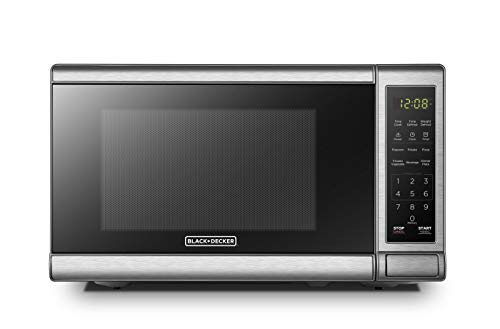
The BLACK+DECKER EM720CB7 is the compact microwave many people picture when they picture one at all, and there is a reason it shows up in so many dorm rooms and rental kitchens. It delivers the class-standard 700 watts, a turntable just under ten inches, and a push-button door that is easy to open with an elbow when your hands are full of dishes. The styling is plain in a good way: black, unpretentious, and happy to disappear into the background of a busy counter.
What you get here is predictability. The express cook buttons run from one to six minutes with a single press, the add-thirty-seconds key sits where your thumb expects it, and the auto menus for popcorn, potato, pizza, and frozen vegetables behave about as well as auto menus at 700 watts can behave, which is to say they get you close and your judgment finishes the job. The kitchen timer and clock are straightforward, the child lock is there if toddlers visit, and the whole machine asks almost nothing of you in return for years of reheats.
Strengths: The brand’s service network and replacement-part availability are as good as this class gets, which matters for a machine you may keep through several moves. Controls are genuinely simple, the push-button door is convenient, and the footprint is among the more compact in the group, which helps on shallow counters. It also tends to be easy to find in stock, in more than one finish.
Trade-offs: There is no way to mute the beeps, and the end-of-cycle signal is not shy, so light sleepers in the same room will hear about your midnight noodles. The interior light is on the dim side. The turntable is fractionally smaller than the Toshiba’s, which tightens the plate-fit problem a little further. Fit and finish are workmanlike rather than premium, with more visible seams than the Toshiba.
Who it suits: Renters, first-apartment buyers, and office buyers who want a known name, simple controls, and an easy replacement path if anything ever fails. It is also a sensible pick for a guest room, a workshop, or a break room where the users change constantly and nobody will ever read a manual.
Day to day, the BLACK+DECKER is the machine guests and coworkers use correctly without instructions, and that is a real cooking note rather than a design compliment. The express keys cover the way people actually reheat in an office: one press for a minute, a second press to extend, no menus to escape from when a line forms behind you. Popcorn lands reliably if you listen rather than trust the preset, and a standard mug of water for tea reaches a proper heat in a time you can set your watch by. It asks for no technique, and in shared spaces that is the highest praise available.
If a familiar badge and dead-simple buttons matter more to you than silence settings, this BLACK+DECKER is the safe pair of hands to check price on Amazon.
Check price on Amazon: BLACK+DECKER EM720CB7
Hamilton Beach 0.7 cu ft: the plain value workhorse
Hamilton Beach builds this compact microwave for the buyer who reads the specification sheet, nods, and moves on. You get the familiar 700 watts, a ten-inch class turntable, ten power levels, and the core auto functions, presented on a straightforward touchpad with no attempt at theatre. The cabinet is light, the door is simple, and the whole machine communicates one idea clearly: it is here to heat food, not to decorate your counter.
That honesty is its charm. In practice the Hamilton Beach reheats soup, oatmeal, and leftovers exactly as well as machines costing noticeably more, because at 700 watts the heating element physics are the same for everyone and the differences live in controls and finish. The weight-defrost mode is easy to set, the express buttons behave sensibly, and the unit is light enough that a student can carry it up three flights of dorm stairs without recruiting help, which is a real specification even if no box prints it.
Strengths: Value is the headline: this is frequently among the least expensive ways to get a full-featured 0.7 cubic foot oven from an established brand. It is light and easy to move, the controls cover everything a typical user touches in a week, and the simple design means there is very little to go wrong or to learn. For a second microwave, in a garage, a she-shed, or a rental unit, that simplicity is exactly right.
Trade-offs: The cabinet feels thinner than the Toshiba’s, and the door closes with a lighter, tinnier sound. The display is basic and can be hard to read at an angle in bright light. There is no mute option, and the beeps are assertive. The styling will not win any countertop beauty contests, and the interior finish needs prompt wiping because it shows dried splatter readily.
Who it suits: Students, landlords furnishing a unit, and anyone who needs a second microwave for a specific job, like a basement bar or a workshop lunch corner. It is also the rational choice when the machine will be replaced in a few years anyway, such as a college career, because you are not paying for longevity you will not use.
The Hamilton Beach cooks with a directness that suits simple food done often. Oatmeal, canned soup, reheated pasta, and steamed frozen vegetables all come out as expected when you add the usual extra time for the wattage, and the defrost setting handles a single frozen burger patty without drama. Its light weight shows up in the kitchen too: it is the easiest of the six to slide aside for wiping the counter beneath, which in a small kitchen is a weekly event rather than a rare one. Nothing about its cooking surprises you, in either direction, and for a second oven that predictability is precisely the requirement.
When the brief is simply a full-featured compact oven for the least money from a real brand, the Hamilton Beach is the workhorse to check price on Amazon.


COMFEE’ EM720CPL: the retro-styled dorm favorite
The COMFEE’ EM720CPL takes a different route into the dorm room: it looks like a small appliance from a friendlier decade. Rounded corners, soft color options alongside the usual black and white, and a compact body make it the one machine in this group that people buy partly as decor. Under the styling it is a conventional 700-watt, 0.7 cubic foot oven with a turntable in the ten-inch class, a mute function, and an eco mode that trims standby power draw, which is a thoughtful touch for a machine that sits plugged in all day doing nothing.
The surprise is that the cute one is also reasonably thoughtful to use. The mute setting silences the keypad for late-night reheats, the one-touch express options cover the common jobs, and the door handle, a proper pull handle rather than a push button, feels natural and stays clean because you grip it in one defined place. Owners tend to keep these longer than expected, partly because a machine with a personality is harder to treat as disposable.
Strengths: The styling is the obvious one: in a small living space where the microwave is always visible, looks are a legitimate feature. The mute function matches the Toshiba’s best trick. Eco mode reduces the trickle of standby electricity. The handle design is practical, and the color choices let the machine match a kettle or a mini fridge instead of clashing with everything.
Trade-offs: You are paying something for the design, so on pure specification per dollar the plainer machines edge it out. The cavity and turntable are at the snug end of the class, so the dinner plate problem bites hardest here. Color finishes can complicate a warranty replacement if a shade is discontinued. And the retro knobs-and-buttons aesthetic, while charming, gives you a slightly less precise feel when setting odd times than a full number pad layout.
Who it suits: Dorm residents and studio dwellers who will look at this machine every day and would rather look at something cheerful. It also suits gift buyers, because it is the one compact microwave that feels like a present rather than a purchase order, and small-space owners coordinating a color scheme.
Cooking with the COMFEE’ is a slightly slower, slightly calmer ritual, and its owners tend to like it that way. The cavity rewards smaller vessels: a cereal bowl of soup, a single portion of noodles, a mug of hot chocolate all fit and heat with room to spare, while anything family-sized was never the point. The eco mode means the clock display is not glowing at full insistence all night, a detail dorm residents mention more than any preset. Treat it as a personal appliance for one person’s meals and snacks, and it performs that role with more charm than anything else in this class.
If your microwave has to earn its place visually as well as functionally, the COMFEE’ is the charming one to check price on Amazon.
Check price on Amazon: COMFEE’ EM720CPL

Farberware Countertop 700W: the feature-led alternative
Farberware’s 0.7 cubic foot countertop model tries to win on the checklist. Alongside the expected 700 watts and ten power levels, it leans on its programmed settings: a row of one-touch options for the foods people actually microwave in small spaces, weight and time defrost, and in some versions a multi-stage cooking function that lets you program a defrost followed by a cook in one sequence. For a machine aimed at busy small households, that last feature is more useful than it sounds, because it removes the standing-around-and-waiting step between thawing the chicken and cooking it.
The Farberware also tends to present a slightly more finished face than the budget tier: a cleaner door line, a reasonably bright display, and buttons with a positive, definite press. It reheats evenly for the class, handles the popcorn-and-judgment ritual as well as anything at 700 watts, and its interior wipes clean without a fight. It is the machine in this group most likely to be chosen by someone who compared feature lists side by side, and there is nothing wrong with that, because its list is genuinely competitive.
Strengths: The programmed settings and multi-stage cooking give it the deepest feature set in the group. One-touch options are sensibly chosen rather than padded with novelties. The presentation is a step above the pure budget machines, and defrost performance on small portions of meat is among the better efforts here.
Trade-offs: More features mean a slightly busier panel, and a first-time user will take a day or two longer to feel at home than with the BLACK+DECKER. The brand’s small-appliance support is adequate rather than outstanding. Availability and exact feature mixes vary between versions sold under the same broad name, so it is worth confirming the specific model’s panel before you commit. The cavity remains firmly 0.7 cubic feet, with the usual plate limits.
Who it suits: Small households that actually cook in the microwave rather than only reheating: people defrosting ingredients several times a week, batch-cooking single portions, and using timed sequences. If you are the kind of cook who reads what every button does and then uses half of them regularly, this is your machine in the class.
The Farberware justifies its busier panel in one specific routine: the defrost-then-cook sequence. Program it in the morning with frozen chicken portions and it moves from thawing to cooking without you standing over it, which is the closest a 700-watt compact gets to set-and-forget cooking. Its presets for the common small-space foods are tuned optimistically, so knock a little time off the potato and popcorn settings until you learn your unit, but the underlying heating is even and the turntable keeps pace. For a single cook who meal-preps in small batches, those programmed sequences save real minutes every day.
For the deepest button-for-button feature list at this size, the Farberware is the spec-sheet winner to check price on Amazon.
Check price on Amazon: Farberware Countertop 700W


Mainstays 0.7 cu ft: the budget dorm staple
Mainstays is Walmart’s house brand, and its 0.7 cubic foot microwave is the machine that fills dorm rooms every August by the thousands. The formula is radical simplicity at the lowest workable cost: 700 watts, a turntable in the ten-inch class, ten power levels, express cooking, and a plain cabinet that comes in basic colors. Nothing about it pretends to be premium, and that honesty, at its price tier, is the entire point.
Judged on heating alone, it does the job. Noodles cook, soup heats, leftovers warm through, and frozen meals get there with the usual extra minutes that 700 watts demands. The controls are big and obvious, which makes it a surprisingly good choice for a grandparent’s counter or a break room where nobody wants a learning curve. What you give up is refinement: the door sounds hollow, the beeps are cheerful and unmutable, and the finish shows every fingerprint and splatter as if it were keeping score.
Strengths: It is typically the least expensive machine in this comparison, sometimes by a wide margin, and it is available on a shelf today if you live near a large store, which solves the broken-microwave emergency in one trip. The controls could not be simpler. Replacement, if it ever comes to that, is equally painless at this tier.
Trade-offs: Build quality is the thinnest here, and long-term durability is the open question you accept in exchange for the price. There is no mute, no eco mode, and no design ambition. The interior light is dim, the turntable is at the smaller end, and the warranty support path is the retailer’s rather than a manufacturer’s. Treat it as a consumable with a long life rather than an heirloom and you will judge it fairly.
Who it suits: Students on a strict budget, anyone equipping a dorm or a first room away from home, landlords who need a working unit today, and buyers who would rather replace cheaply in a few years than pay more now. It is also a rational spare for a garage or office where the microwave’s life will be hard and its users many.
Set expectations correctly and the Mainstays cooks a student’s whole menu without complaint: instant noodles in their cup or a bowl, macaroni cups, reheated takeout, frozen burritos given their extra minutes and a flip, and endless mugs of water for tea and coffee. It is not the machine for careful defrosting or delicate melting, where its simpler power control shows, but the daily cycle of dorm food runs on jobs it does perfectly well. Buy it with the plan that it owes you a few school years rather than a decade, keep the vents clear, and it will almost certainly pay that debt in full.
When the budget is the brief and the food still has to get hot tonight, the Mainstays is the no-drama staple to check price on Amazon.
Check price on Amazon: Mainstays 0.7 cu ft
Side-by-side: how the six compare
| Model | Character | Door style | Quiet option | Best at | Watch out for |
|---|---|---|---|---|---|
| Toshiba EM925A5A | Polished all-rounder | Handle | Yes, full mute | Even reheating, late-night use | Upper end of class pricing |
| BLACK+DECKER EM720CB7 | Mainstream dependable | Push button | No | Simple daily use, easy support | Unmutable beeps, dim light |
| Hamilton Beach 0.7 cu ft | Value workhorse | Handle | No | Full features for little money | Thin cabinet feel |
| COMFEE’ EM720CPL | Retro-styled compact | Handle | Yes, mute plus eco mode | Looks, small-space charm | Snug cavity, style premium |
| Farberware Countertop 700W | Feature-led | Handle | Varies by version | Programmed and multi-stage cooking | Busier panel to learn |
| Mainstays 0.7 cu ft | Budget staple | Handle | No | Lowest cost, same-day availability | Basic build and finish |
Read the table as personalities rather than rankings. Every machine here heats with roughly the same power, so the right choice is the one whose controls, noise, looks, and build match the room it will live in and the people who will share it. The six also share the same plate limits and the same cleaning needs, which means the decision really comes down to those daily details rather than to any dramatic difference in how hot your soup gets.
Living with 700 watts: honest cooking notes
The adjustment period with a compact microwave lasts about a week, and it goes faster if you learn three habits. First, translate times: a useful rule is to add roughly half again to the time a package suggests for a high-wattage oven, then check and add more in short bursts. Second, use standing time deliberately, because a minute under a loose cover lets heat migrate from the hot edges to the cold center and fixes most unevenness complaints without extra cooking. Third, choose containers that fit the machine: round bowls heat more evenly than square ones, shallow food heats faster than a deep mound, and anything you can stir halfway through will reward you for it.
Popcorn deserves its own warning. At 700 watts, the gap between almost-ready and scorched is narrow, and the bag’s printed time, written for stronger ovens, will mislead you in both directions. Use the popcorn setting as a starting suggestion, stand there, and stop the machine when the popping slows to a couple of seconds between pops. Frozen dinners behave the opposite way: they need patience, a mid-cycle stir wherever the design of the meal allows it, and a rest before eating so the center finishes gently instead of staying icy under a steaming surface.
For dorm cooking specifically, the compact microwave quietly becomes a real kitchen. It steams vegetables in a covered bowl with a spoonful of water, cooks scrambled eggs in a mug in short bursts with stirring, softens tortillas, reheats rice with a sprinkled tablespoon of water to restore its texture, and handles mug cakes and instant everything without complaint. None of these jobs need more than 700 watts. They need a cook who works in short intervals and checks often, which is good practice in any kitchen at any size.
A week of real meals in a 0.7 cubic foot microwave
Abstract specifications only go so far, so consider what a week actually looks like when this small box is your main heating appliance. Monday starts with oatmeal, which cooks in a deep bowl in a few short bursts and never boils over if you give it headroom and one stir. Lunch is leftover rice and curry from the weekend, reheated under a loose cover with a sprinkle of water over the rice, and it comes back close to fresh. Dinner is steamed broccoli and a baked potato; the potato is the slow job at 700 watts, and the honest technique is to start it early, turn it once, and let it rest wrapped while everything else happens.
Midweek, the machine earns its keep in smaller ways. It defrosts a single chicken breast gently for a stir-fry made on a hot plate. It melts butter and chocolate without a double boiler. It warms tortillas so they fold instead of cracking, reheats pizza slices for the person who prefers them soft rather than crisp, and produces a mug cake at eleven at night that tastes better than it has any right to. None of these jobs are glamorous, and together they are most of what home heating actually is.
The weekend exposes the limits, and it is better to meet them in this guide than at your counter. A family-size frozen lasagna does not fit and would cook unevenly if it did. A whole chicken is out of the question. Two mugs of soup heat one at a time, which means cooking for a crowd becomes a queue. The compact microwave is a one-person, one-dish appliance, and a household that accepts that rhythm finds it sufficient far more often than the specification sheet suggests.
Placement, power, and safety in tight quarters
Small spaces punish careless placement, so give the machine a proper home. It needs a level, sturdy surface, a few inches of clearance around the vents, and a counter deep enough that the open door does not hang over the edge. Keep it away from the stove, because rising heat and grease shorten its life, and away from the sink, because splashed water and electrical appliances should keep a polite distance. In an RV or a boat, add one more consideration: secure the unit so travel does not walk it across the counter, and confirm your power system is comfortable with the draw before you rely on it off-grid.
On power, a cooking output of 700 watts does not mean the machine draws only 700 watts from the wall; the input draw is higher, and on a shared dorm or older apartment circuit, running the microwave at the same moment as a kettle, a hair dryer, or a space heater can trip a breaker. That is not a defect, it is arithmetic. Stagger the big loads and the compact microwave will behave perfectly. Extension cords deserve a firm no: plug the oven directly into a wall outlet, keep the cord off hot surfaces, and never operate the machine with a damaged cord or a door that does not latch cleanly.
Two habits protect both the food and the machine. Never run the oven empty, because the energy has nowhere to go and the cavity absorbs the punishment instead. And use containers that are genuinely microwave-safe, with no metal trim, no foil seals left on tubs, and no recycled takeout plastic that was never meant to be heated twice. A ten-inch turntable forgives many things, but a warped container that tips soup across it is not one of them.
Accessories that make a small microwave work harder
The right accessories matter more in a compact oven than in a big one, because space is the whole problem. A vented splatter cover sized to the turntable keeps the cavity clean and lets you stack a bowl under it without drama. A microwave steamer basket turns the machine into a respectable vegetable cooker. Deep, wide bowls with handles are the unsung heroes: they prevent oatmeal boil-overs, give soups room to bubble, and come out of the oven without a wrestling match against a hot rim. A simple microwave-safe plate one size down from your dinner plates quietly solves the fit problem for most reheating.
Two cautions belong with the shopping list. Skip the novelty crisping pans and browning trays unless the manufacturer of your exact model endorses them, because at 700 watts their results are inconsistent and they crowd a cavity that has no room to spare. And measure any accessory against the turntable before buying, since a steamer that cannot rotate steams unevenly and a cover that brushes the cavity walls will remind you of the mistake at every meal.
When 0.7 cubic feet is the wrong size
Honesty about fit matters more than any single recommendation in this guide. Choose a larger oven if you regularly reheat food on full-size dinner plates, cook for three or more people at once, rely on family-size frozen meals, or want to fit a rectangular casserole dish. Choose a larger oven, too, if your household cooks raw proteins in the microwave often, because the extra wattage in the next size class is a genuine cooking difference rather than a luxury. The cost of stepping up is counter space and a bigger box to move, and for a family kitchen that trade is usually worth it.
Stay with this class, confidently, if the machine serves one or two people, lives in a dorm, an office, an RV, or a small apartment, and spends its life on mugs, bowls, plates of leftovers, and single servings. In that life, a bigger oven is not better; it is just bigger, taking counter you do not have to heat food you could have heated in something half its footprint. The buyers who regret a compact microwave are almost always the ones who needed the larger size and talked themselves down. The buyers who love theirs knew their plates, their portions, and their room before they ordered.
Care routine: ten minutes a month
A compact microwave stays pleasant with a small, regular routine. Wipe the cavity after any spill that splatters, because sauce reheated ten times becomes part of the machine’s smell. Once a week, wash the turntable and its ring in the sink and dry them properly before they go back. Once a month, steam-clean the interior with a bowl of water and lemon, wipe the door seal and the latch area where crumbs collect, and check that the vents are free of dust and grease. Clean the exterior with a damp cloth rather than sprays directed at the control panel, and the touchpad will stay responsive for years.
If the machine ever sparks, smells of burning electronics, or runs with the door visibly ajar, stop using it and treat it as done. Those are not quirks to live with at any size, and at this class’s replacement cost, repair is rarely the sensible path. Everything short of that, a clean cavity and clear vents will prevent.
Read the exact model number before you order
One last piece of buying discipline applies to every pick in this guide. Manufacturers sell near-identical compact microwaves under slightly different model numbers, with small differences in finish, panel layout, and occasionally the mute or eco features that decided your choice. Before ordering, match the full model number on the listing to the model named in the review, confirm the wattage and the turntable size on the specification tab, and glance at the dimensions against your measured space one final time. Two minutes of that care prevents the most common disappointment in this category, which is not a bad microwave arriving, but a slightly different one.
Shared spaces: offices, break rooms, and small-oven etiquette
Half the machines in this class will live where several people share them, and shared use changes what matters. Controls that a stranger can operate without instructions beat clever features, which is why the plainest panels in this group make such good break-room ovens. Durability becomes a collective issue too: a door that tolerates being shut firmly by a hundred different hands, and a touchpad that survives being wiped by whoever cleans the office kitchen, will outlast a fussier machine regardless of brand.
Etiquette keeps a shared compact microwave pleasant, and the rules scale down from any office kitchen. Add time in short bursts instead of abandoning food to overcook while a meeting runs long, because a small cavity fills the whole room with the smell of scorched popcorn in a way a big kitchen absorbs. Cover your food, wipe your splatter while it is still warm and easy, and take your leftovers out when the cycle ends rather than using the oven as storage. If the machine will live in a workplace, the person buying it should also decide the cleaning rota on day one; a compact oven that nobody owns is a compact oven that everybody resents by spring.
Noise carries further in shared spaces as well. An office microwave that beeps loudly at the end of every cycle announces each employee’s lunch to the floor, and a model with a mute setting, or at least a single short end signal, is a genuinely kinder colleague. The same logic applies to a nursery-adjacent kitchen or a home office: the quietest machine in this group earns its place in any room where someone is sleeping, meeting, or concentrating within earshot.
Buying used, refurbished, or open-box in this class
Because compact microwaves are inexpensive and constantly resold by students and movers, the used market for this size is enormous, and it can be a smart way to buy. It also carries specific risks that a quick check eliminates. Inspect the door and its latch first: the door must close squarely, latch with a positive action, and show no cracks in the frame or the screen, because the door is the safety system, not a cosmetic panel. Look inside for rust spots, bubbled paint, or a damaged waveguide cover, all of which are reasons to walk away at any price.
Test before money changes hands whenever you can. A cup of water should come out steaming after a couple of minutes, the turntable should rotate smoothly without grinding, and every button on the pad should respond, especially the start and stop keys that wear first. Ask about smells; a machine that reeks of burned food or cigarettes will share that aroma with your meals for months. Refurbished units from a retailer with a return window are the safer version of the same bargain, because the return right substitutes for the test you cannot do in a parking lot.
Finally, weigh the arithmetic honestly. At the budget end of this class, a brand-new machine with a warranty can cost little more than a used one of unknown history, and the gap narrows further during the back-to-school and holiday selling seasons. Buying used makes the most sense for the better-built models in this group, where the original quality justifies inheriting someone else’s first years of use.
Frequently asked questions
Will a standard dinner plate fit in a 0.7 cubic foot microwave?
Usually not with room to spare. The turntables in this class are around ten inches across, so a typical eleven or twelve inch dinner plate either will not pass through the door or will sit still instead of rotating. A plate that cannot rotate heats unevenly. If plated dinners are your main use, either switch to smaller plates and bowls for reheating, or step up a size class and give up some counter space.
Why does my food take longer than the package says?
Because the package almost certainly assumes a microwave of 900 to 1,100 watts, and this class delivers about 700. The food is not undercooked by a faulty machine; it is cooked by a slower one. Add time in modest increments, stir or turn dense food halfway, and let it stand for a minute before eating. Within a week, the adjusted times become second nature.
Is a 0.7 cubic foot microwave allowed in a dorm room?
Often yes, but the rules belong to your school and your building, not to the microwave. Many dorms allow compact microwaves, sometimes only in specific wattage ranges or only as rented combination units with a mini fridge, and some prohibit them in individual rooms while providing shared kitchenettes. Check the housing policy before you buy, and check the circuit too, because an older dorm circuit shared with a mini fridge and a kettle has opinions of its own.
Can a compact microwave replace cooking for one person?
For reheating, steaming, defrosting, and simple one-person dishes, largely yes, especially paired with an electric kettle. It will not brown or crisp food, and it struggles with large or dense items, so most single cooks still want at least a hot plate or an air fryer beside it. Within those limits, a 0.7 cubic foot oven covers a surprising share of a small household’s daily heating work.
How long should a microwave this size last?
With ordinary care, several years of daily use is a fair expectation, and the better-built models in this group commonly outlast that. Longevity habits are boring and effective: keep the vents clear, wipe splatters before they bake on, do not run the oven empty, and avoid slamming the door. At the budget end, judge the machine by cost per year rather than expecting a decade, and it will rarely disappoint you.
Choose the compact microwave whose noise, controls, and looks fit the room it will live in, and a 0.7 cubic foot oven will quietly handle your daily heating for years without ever asking for more counter than it deserves.


