Owning a Nespresso machine is the easy part. The machine heats up in half a minute, the pump does its work at the press of a button, and the result is in your cup before you have fully woken up. The hard part — the part that decides whether that cup tastes like a small Italian bar or like an airport lounge — is the capsule you fed it. A capsule is a sealed decision made months earlier in a roastery: which beans, roasted how dark, ground how fine, packed how fresh. Your machine cannot undo any of those choices. It can only extract them faithfully. That is why choosing capsules matters more than choosing between most OriginalLine machines, and why this guide spends its length on what is inside the little aluminium cups rather than on the hardware around them.
Six capsules are compared below, drawn from Nespresso’s own range and from the third-party roasters whose capsules genuinely earn their place in the drawer. Prices in this category shift with subscriptions, seasonal bundles and multipack promotions, so rather than print figures that would go stale, each pick ends with a pointer to check the current price where it is sold. One disclosure before we begin: this site may earn an affiliate commission when readers buy through links on the page, and that is how guides like this one stay free to read. It does not influence which capsules made the list or what we say about their weaknesses — and every pick below has at least one weakness worth knowing about.
The short version, for readers in a hurry: if you drink your espresso straight and like it dark, start with Arpeggio. If your household runs on lattes and cappuccinos, Roma and the Starbucks Espresso Roast will cover nearly every morning between them. If you want a gentler, sweeter cup from a roaster with a century of blending behind it, illy Classico is the one. The longer version — why those are the answers, what the intensity numbers actually mean, and which capsules to walk past — is everything that follows.
One idea runs through the whole guide and is worth stating early: experienced capsule drinkers rarely rely on a single favourite. They keep a small system in the drawer — a daily capsule for the first cup of the day, a stronger one for milk drinks and for guests who like their coffee assertive, something gentler for the afternoon, perhaps a decaf for the evening. Four sleeves, each with a job. That is how the picks below are best used: not as a league table with one winner, but as a cast of characters, each castable for a role in your own kitchen. Read their strengths and trade-offs as job descriptions, and the right combination for your household will assemble itself as you go.
In this guide
Quick picks: best expresso capsules for nespresso machines
| # | Product | Where to buy |
|---|---|---|
| 1 | Nespresso Arpeggio | Check on Amazon |
| 2 | Nespresso Roma | Check on Amazon |
| 3 | Starbucks by Nespresso Espresso Roast | Check on Amazon |
| 4 | Peet's Coffee Nerissimo | Check on Amazon |
| 5 | L'OR Espresso Ristretto | Check on Amazon |
First, the boundary: this guide covers OriginalLine capsules only
Nespresso sells two capsule systems, and they do not mix. OriginalLine — the original system, sold since the late nineteen-eighties and now made by a long list of manufacturers besides Nespresso itself — uses the small, truncated-cone capsule that most people picture when they hear the word Nespresso. Vertuo, the newer system, uses a much larger, dome-shaped capsule with a barcode printed around its rim, which the machine reads to set the brew parameters, and it brews everything from a single espresso to a full carafe-sized coffee. The two capsules are different shapes, different sizes, and entirely incompatible. An OriginalLine capsule will not fit a Vertuo machine, a Vertuo capsule will not fit an OriginalLine machine, and no adapter changes that in any way worth trusting with hot water under pressure.
Everything in this guide is about OriginalLine. That choice is deliberate, for three reasons. First, OriginalLine is the system with a genuine open market: because the original patents expired years ago, any roaster may make and sell compatible capsules, which is why this guide can compare Nespresso’s own capsules against illy, Peet’s, L’OR, Starbucks and dozens of others on equal footing. Vertuo capsules, by contrast, are made only by Nespresso, so a Vertuo buying guide would be a tour of one company’s catalogue. Second, OriginalLine machines — the Essenza Mini, Pixie, CitiZ, Inissia, Lattissima and Creatista lines, and the many compatible machines from other brands — are the ones most often found in kitchens, offices and hotel rooms. Third, OriginalLine is an espresso system at heart: its capsules are dosed for espresso and lungo extractions, which is the drink this guide cares about.
So if your machine’s capsule looks like a small thimble with a foil lid, you are in the right place. If it looks like a small flying saucer with printing around the edge, you own a Vertuo machine, and nothing below will fit it — check your machine’s manual before ordering anything in this guide, because returns on opened coffee are nobody’s idea of a good morning.
One more boundary worth knowing: OriginalLine is not a Nespresso-only hardware club either. Because the system is open, the machines themselves come from several manufacturers — Nespresso’s own designs are built and sold with partners such as De’Longhi and Breville (under the Sage name in some markets), and other brands sell compatible machines of their own. The capsule does not care whose badge is on the machine. If the machine takes OriginalLine capsules, every capsule in this guide will brew in it, and differences between machines — a degree or two of temperature, a slightly different flow — are far smaller than the differences between the capsules themselves. That is the system’s real strength: the competition happens in the coffee, where it belongs.
What to look for in an OriginalLine capsule
The intensity scale: useful, but not what you think it is
Nearly every OriginalLine capsule carries an intensity number, and Nespresso’s own scale currently runs from the mildest blends at the bottom up to thirteen at the top. Third-party roasters print their own numbers, roughly aligned with the same idea. The number is widely misunderstood. Intensity is not a caffeine measurement — a fierce-tasting dark capsule does not necessarily contain more caffeine than a mild one, and in practice the species of bean matters more, with robusta-heavy blends carrying more caffeine than pure arabica ones regardless of the printed number. Intensity is not a strength measurement in the brewing sense either, because your machine brews every capsule with the same water and pressure. What the number describes is the character of the coffee in the cup: how dark the roast is, how concentrated and assertive the flavour feels, how much bitterness and roasted depth you should expect. A low number promises a lighter roast, brighter acidity and a more delicate cup. A high number promises dark-roast flavours — cocoa, spice, toasted notes — and a heavier, more lingering finish.
Used that way, the scale is genuinely helpful: it lets you predict whether a capsule will taste like toasted hazelnut or like the crust of a good sourdough. Used as a macho score — always buying the highest number on the shelf — it misleads, because some of the most interesting capsules in this guide sit in the middle of the scale, and because milk flattens intensity differences considerably. A capsule that tastes overwhelming straight may be perfect under steamed milk, while a delicate mid-intensity capsule can vanish in a latte entirely. Read the number as a roast-and-character guide, match it to how you actually drink your coffee, and treat any brand’s numbers as comparable only within that brand’s own range.
Roast level and bean origin shape the cup more than branding
Underneath the intensity number sits the real story: what beans, from where, roasted how far. Arabica beans bring acidity, sweetness and aromatic complexity — the floral, fruity and nutty notes that make a straight espresso interesting. Robusta brings body, bitterness and a thicker crema, along with more caffeine, and a proportion of it in a blend is a traditional Italian choice rather than a cheap shortcut. Roast level then pushes those raw materials in a direction. Light roasts keep origin character and brightness but can taste sharp or thin through a capsule system, which extracts quickly. Medium roasts are the balancing point most of these picks occupy: enough development for sweetness and body, not so much that the beans’ identity is roasted away. Dark roasts trade nuance for force — chocolate, spice, smoke and a bitter edge that cuts through milk — and they are forgiving of the capsule format’s short extraction. When a capsule’s description lists origins, read it as a flavour hint rather than a guarantee; when it lists none, expect a blend built for consistency, which is its own legitimate goal.
Blends versus single origins: two different promises
Most capsules in this guide are blends, and that is a deliberate choice by their makers rather than a failure of ambition. A blend lets a roaster balance acidity from one origin against body from another and — crucially for a product sold by the million — hold the flavour steady as harvests change, swapping components behind the scenes so the cup you buy in spring matches the one from autumn. Nespresso also sells single-origin capsules, and third parties increasingly do too: one farm region, one harvest character, nothing to hide behind. These can be the most interesting capsules in the system, with distinctive floral, fruity or cocoa profiles that no blend would dare. The trade is consistency and sometimes comfort — a single origin may taste brighter, sharper or stranger than a house blend, and it may change subtly between production runs. A sensible drawer holds both: a blend for the weekday autopilot cup, a single origin for the mornings when you are actually paying attention.
Compatibility: what “OriginalLine compatible” really promises
Because the OriginalLine system is open, the market is crowded with capsules claiming compatibility, and most of them do work — the capsule geometry is standardised, the machine pierces the foil, water is forced through, coffee comes out. But compatible covers a range of manufacturing quality. The differences show up in the details: how cleanly the foil pierces, whether the capsule body deforms under pressure and slows the flow, whether the seal holds so that water goes through the coffee rather than around it. A poorly made capsule can produce a watery, under-extracted shot, drip after the brew finishes, or in the worst cases jam in the mechanism. The six picks in this guide come from manufacturers with long track records in this format, and that is not an accident. With capsules, you are buying a tiny piece of engineering as much as a portion of coffee, and the roasters who have made billions of them have the tolerances figured out. One more compatibility note: a handful of very old or very specific machines have quirks — some early models grip capsules tighter than others — so if a new brand’s capsules feel stiff to insert, do not force the lever; try a single sleeve before stocking up.
Aluminium, plastic and the recycling question
OriginalLine capsules are made from one of two materials, and the choice has consequences beyond the cup. Nespresso’s own capsules and many premium third-party ones are aluminium. Aluminium protects coffee superbly — it is a complete barrier against oxygen and light — and it is infinitely recyclable, though only through the right stream: the capsules are too small for most kerbside sorting systems, which is why Nespresso runs its own collection scheme with recycling bags and drop-off points, and why some third-party aluminium brands join similar programmes. Plastic capsules, used by some budget brands, are cheaper and lighter but are rarely accepted in household recycling and generally end up in landfill, and their oxygen barrier is weaker, which matters for freshness. A third category — compostable capsules — has grown quickly; some are genuinely certified for home or industrial composting, but the certification details matter, and a capsule that needs an industrial facility you do not have access to is, in practice, rubbish. The honest summary: aluminium capsules returned through a collection scheme are currently the most defensible option, plastic the least, and compostables a promising middle path whose real-world value depends entirely on your local facilities. If the waste question weighs on you, factor the recycling route into your buying decision alongside taste — a capsule you love but bin guiltily is only half a good purchase.
Freshness and shelf life: sealed does not mean immortal
The great advantage of the capsule format is preservation. Each capsule is hermetically sealed, usually flushed to keep oxygen away from the grounds, so the coffee inside degrades far more slowly than beans in an opened bag. Unopened capsules typically carry a best-before date many months out, and they remain perfectly drinkable beyond it — what fades is not safety but liveliness, the aromatic top notes going first. That said, sealed is not the same as immortal, and how you treat capsules still matters. Buy from sellers with brisk turnover rather than dusty old stock. Store capsules somewhere cool and dry, away from the heat above the machine itself, which is the one place many people keep them and the one place they age fastest. Respect the order you bought them in — first in, first out — rather than letting a forgotten sleeve sit at the back of the cupboard for a year. And be sceptical of enormous bulk purchases of a capsule you have not tasted: the per-capsule saving is real, but it is no saving at all if two hundred capsules of a roast you dislike are waiting for you every morning. Variety packs exist precisely because capsule drinkers’ tastes differ, and they are the cheapest research you will ever do in coffee.
How much coffee is actually in the capsule
Here is a specification almost nobody prints in large type: an OriginalLine capsule contains roughly five to seven grams of ground coffee. Compare that with the eighteen or so grams a café grinds for a double shot and you understand the format’s physics. A capsule cannot produce a café-strength double; it produces a concentrated single, and everything about the system’s flavour — the intensity of the good capsules, the thinness of the bad ones — follows from roasters trying to extract maximum character from a small dose. It also explains two practical rules. First, if you want a stronger drink, use two capsules in two separate extractions rather than running one capsule long, which only adds bitterness and hot water. Second, judge capsules as singles: a capsule that tastes complete and balanced at its intended length is doing its job properly, and asking it to fill a travel mug is asking the wrong question of the wrong product. The best roasters treat that small, fixed dose as the design brief itself, blending and grinding specifically to shine inside it rather than despite it.
The six capsules, reviewed
A note on method before the picks themselves. Each capsule below is profiled the same way: by the drink it makes as a straight espresso first — because that is where a capsule has nowhere to hide — and then by how it behaves in milk, since that is how most of it will actually be drunk. Flavour descriptions are necessarily approximate; palates differ, water differs, and machines differ slightly in temperature and flow. What does not differ is the structure of each capsule’s character: its roast level, its balance of acidity and bitterness, its body. Those are the things this guide reports, and they are the things you can rely on when your box arrives.

Nespresso Arpeggio: the dark-roast benchmark
Arpeggio is the capsule against which every other dark OriginalLine capsule is quietly measured, and after decades on sale it still holds the position. It is a blend of Latin American arabicas roasted dark and ground fine, and the cup it makes is the definition of the intense Italian style: dense, cocoa-heavy, with woody and roasted notes and a bitterness that reads as structure rather than harshness. The crema is thick and persistent, the body is the fullest in Nespresso’s standard range, and the finish is long — you will still taste it, pleasantly, several minutes later. As a short ristretto it is almost chewy; as a standard espresso it is the closest a capsule gets to the shot a good Italian bar pulls from its house blend.
Strengths. Arpeggio’s greatest strength is authority: it tastes unmistakably like espresso, with no thinness, no sourness and no apology. It is also one of the most consistent capsules made — box after box, year after year, the cup barely moves, which matters more than novelty when this is the coffee you drink half-asleep. In milk it is superb, holding its roasted character through a cappuccino and even a latte without turning sweet or washed out, because the dark roast and fine grind give it flavour mass to spare.
Trade-offs. Subtlety is not on the menu. The dark roast that gives Arpeggio its power also covers the finer aromatic notes of its beans, so drinkers who love bright, fruity, light-roast coffee will find it blunt, and its bitterness, while controlled, is always present. It is also intense enough that a lungo extraction can push it toward harshness; it is happiest at espresso length or shorter.
Who it suits. Straight-espresso drinkers who like the traditional dark Italian profile, and milk-drink households that want one capsule to do everything. If you only ever stock one capsule, this is the safest single choice in the entire system, so before you commit to a full sleeve, check price on Amazon.
Check price on Amazon: Nespresso Arpeggio

Nespresso Roma: the balanced all-rounder
Roma is Arpeggio’s civilised sibling: a blend built around Central and South American arabicas with a lighter touch in the roaster, giving a cup that leads with roasted cereal and woody notes but keeps a thread of acidity and delicacy running through it. Where Arpeggio fills the mouth, Roma moves through it — the body is medium, the bitterness moderate, the finish shorter and cleaner. It is the capsule Nespresso itself positions as the elegant one, and for once the marketing word is accurate. Drunk straight, it shows more of its beans than any of the darker house blends; it rewards attention instead of demanding it.
Strengths. Balance is the headline. Roma works at every length — a ristretto with genuine sweetness, an espresso with poise, a lungo that stays pleasant rather than collapsing into bitterness, which is where most capsules fail. That versatility makes it the best household compromise capsule in this guide: the person who drinks it black and the person who foams milk are both reasonably served by the same sleeve. It is also the most forgiving Nespresso capsule for drinkers who find the dark blends too aggressive.
Trade-offs. The same lightness that makes Roma elegant makes it fragile in milk. In a large latte it can disappear, leaving warm milk with a coffee rumour, so milk drinkers should keep drinks small or reach for a darker pick. And drinkers chasing maximum intensity will find it polite to a fault — it sits in the middle of the intensity scale and is content there.
Who it suits. Mixed households, lungo drinkers, and anyone whose taste runs to balance over brute force. It is also the capsule to hand a Nespresso newcomer, because it shows what the system does well without overwhelming them — and since it is widely sold in multipacks, compare bundle sizes when you check price on Amazon.
Check price on Amazon: Nespresso Roma

Starbucks by Nespresso Espresso Roast: the milk-drink heavyweight
This is Starbucks’ signature espresso — the same dark, caramel-heavy profile the cafés build their drinks on — made under licence in OriginalLine format. It is a Latin American blend roasted darker than anything in Nespresso’s own core range, and the cup is unapologetic: molasses and caramelised sugar up front, a deep roasted core, and a sweet-but-bitter finish that is engineered, quite openly, to be tasted through milk, syrup and everything else a modern coffee menu piles on. Drunk straight it divides opinion sharply; in a cappuccino it tastes like the high street, which for millions of people is exactly the point.
Strengths. Nothing in this guide cuts through milk like it. If your morning drink is a latte and other capsules keep vanishing on you, this is the fix — the dark roast keeps its identity in a full mug. It is also exceptionally easy to find, sold in supermarkets as well as online, and the capsules themselves are well made, piercing cleanly and extracting evenly. For recreating café-chain drinks at home — including the sweetened ones — it is not merely an option, it is the actual ingredient.
Trade-offs. As a straight espresso it is the least nuanced cup here: the roast is dark enough that origin character is mostly a memory, and a bitter, almost smoky edge appears if the extraction runs long. Drinkers who take their espresso black and their coffee lightly roasted should look elsewhere in this list. It also tends to be positioned as a premium capsule despite being a mass-market blend, so value depends heavily on where and in what quantity you buy it.
Who it suits. Latte and cappuccino households, fans of the Starbucks flavour profile, and anyone building sweetened or flavoured drinks at home. For that crowd it is close to unbeatable, and the larger multipacks usually change the maths considerably when you check price on Amazon.
Check price on Amazon: Starbucks by Nespresso Espresso Roast
illy Classico: the smooth traditionalist
illy has built its name on a single blend — nine arabicas, selected and balanced to taste the same in Trieste and everywhere else — and Classico is that blend in OriginalLine form, a medium roast aimed squarely at smoothness. The cup is the gentlest in this guide: soft caramel and toasted bread, a whisper of floral and fruity notes, low bitterness and a rounded, almost silky texture. Where the dark picks shout, Classico converses. It is also the pick that tastes most like the espresso served in old-school Italian cafés that favour balance over bravado, and for drinkers who find modern dark roasts punishing, it can feel like coming home.
Strengths. Refinement and consistency. illy’s blending discipline means the capsule tastes the same month after month, and its medium roast preserves actual coffee flavour — sweetness, grain, a little fruit — instead of replacing it with roast flavour. It is the easiest-drinking straight espresso here, the one most likely to please a table of guests with different tastes, and it makes a genuinely lovely macchiato, where a splash of milk softens it without swamping it.
Trade-offs. Gentleness is a ceiling as well as a virtue. In a full latte Classico fades badly, and drinkers who love intensity will call it thin — the body is lighter and the finish shorter than the dark picks. It also tends to sit at the premium end of third-party pricing, which stings more in a capsule you may find too mild. And because the blend never changes, there is no seasonal novelty to chase; what you taste in January is what you get in December.
Who it suits. Drinkers who take espresso straight or with just a touch of milk, who value smoothness over strength, and who want one dependable blend rather than a rotating cast. If bitterness is the thing that usually ruins espresso for you, start here — and since illy’s multipack pricing varies more than most between sellers, check price on Amazon.
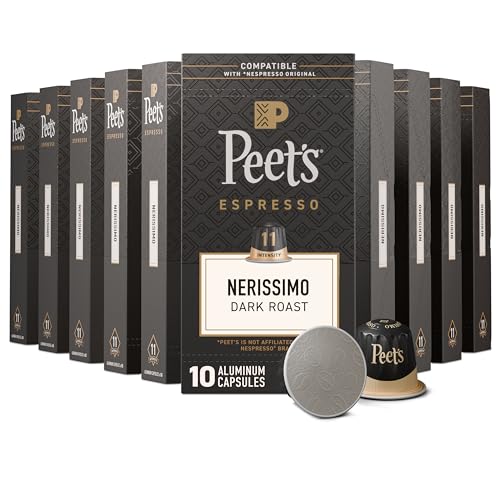
Peet’s Coffee Nerissimo: the darkest of the dark
Peet’s built its reputation in Berkeley on roasting darker than anyone else dared, and Nerissimo is that philosophy in a capsule: the darkest pick in Peet’s OriginalLine range and the darkest in this guide. The name promises blackness and the cup delivers — bittersweet chocolate, toasted sugar and a deep, almost smoky roast character, with a heavy body and a finish that lingers like the end of a dark chocolate bar. There is very little acidity here and no interest in any. It is a capsule with a point of view, aimed at drinkers who find even Arpeggio a touch restrained.
Strengths. Impact. Nerissimo produces the boldest straight shot in this roundup and a milk drink with real backbone — flat whites and cortados made with it taste concentrated rather than milky. The capsules are aluminium and well manufactured, with clean, even extractions, and Peet’s roasting consistency is excellent. It also makes a superb base for iced drinks, where dilution from melting ice defeats lesser capsules; Nerissimo is still standing when the glass is empty.
Trade-offs. This is the least forgiving capsule here. Over-extract it as a lungo and the bitterness turns ashy; serve it to a light-roast drinker and you will watch them quietly set the cup down. Delicacy, brightness and origin nuance are entirely absent by design. Availability can also be patchier than the Nespresso and Starbucks picks depending on your region, and the range’s naming — several dark Peet’s capsules with similar descriptions — rewards careful reading so you order the one you meant to.
Who it suits. Committed dark-roast drinkers, flat-white and cortado makers, and anyone whose complaint about capsules is that they taste weak. If that has ever been your complaint, this is your capsule — and because Nerissimo inspires loyalty and rejection in roughly equal measure, consider starting with a single sleeve when you check price on Amazon.
Check price on Amazon: Peet's Coffee Nerissimo

L’OR Espresso Ristretto: the value-minded connoisseur
L’OR is the capsule brand of JDE, one of the world’s largest coffee companies, and its Ristretto is the pick that most often embarrasses more expensive rivals. It is a dark, intense blend built for the short extraction its name describes: spicy, full-bodied, with notes of dark chocolate and a peppery, almost liquorice edge that gives it more personality than most supermarket capsules. Pulled short, it is dense and expressive; the gold-foil branding promises luxury, and unusually for this end of the market, the cup mostly backs it up.
Strengths. Flavour per penny. L’OR capsules are aluminium, widely distributed in supermarkets, and frequently the most affordable respectable capsule on the shelf — yet the Ristretto’s cup quality sits comfortably beside the premium picks in this guide. It has genuine character beyond generic darkness: that spicy, complex edge makes it the most interesting budget shot here, and it performs in milk well above its price class. The range around it is broad, so once you trust the brand you can explore lighter blends without changing supplier.
Trade-offs. Pulled long, Ristretto’s intensity curdles into harshness faster than Arpeggio’s does — it is a short-drink specialist and should be treated as one. The blend’s spiciness, its best feature in a ristretto, can read as roughness to drinkers who prefer smooth, sweet profiles. And while availability is excellent in much of Europe, it is less universal elsewhere, so some readers will be ordering online rather than grabbing it with the groceries.
Who it suits. Ristretto and espresso drinkers who buy capsules often and feel the cost, and anyone who wants a supermarket capsule that does not taste like a compromise. It is the pick that proves the format’s open market works — and because this is the capsule where the gap between the two is often widest, compare it against your local supermarket when you check price on Amazon.
Check price on Amazon: L'OR Espresso Ristretto
Side by side: the six capsules compared
Numbers and adjectives only go so far, so here is the whole field on one table. Read it qualitatively — these are characters, not scores — and note how the right answer changes with the drink in your hand.
| Capsule | Roast character | Best as | In milk | One-line verdict |
|---|---|---|---|---|
| Nespresso Arpeggio | Dark, cocoa and wood | Espresso or ristretto | Excellent — holds its own | The benchmark dark capsule |
| Nespresso Roma | Medium, balanced, roasted cereal | Espresso or lungo | Fair — keep drinks small | The household all-rounder |
| Starbucks Espresso Roast | Very dark, caramel and molasses | Milk drinks | Outstanding — built for it | The high-street latte at home |
| illy Classico | Medium, smooth, caramel and grain | Straight espresso | Light — best as macchiato | The gentle traditionalist |
| Peet’s Nerissimo | Darkest, bittersweet chocolate | Espresso, cortado, iced | Excellent — concentrated | Maximum impact, no apologies |
| L’OR Ristretto | Dark, spicy, liquorice edge | Ristretto | Good — above its class | The connoisseur’s bargain |
To use the table well, start from the drink, not the brand. Find the column that describes your actual morning — straight shots, small milk drinks, big milky mugs — and let it eliminate most of the field; what remains is a shortlist of two, and at that point the honest answer is to buy a sleeve of each and let your own palate arbitrate, because the difference between two well-matched finalists is preference, not quality. Notice, too, what the table does not contain: no scores, no rankings, no winner. Capsule taste is a landscape, not a ladder, and the most useful thing a guide can hand you is a map of where each capsule lives on it.
Ristretto, espresso, lungo: one capsule, three lengths
Your machine offers buttons, and behind those buttons sits the most underused variable in capsule coffee: length. A ristretto pulls roughly half the water of an espresso through the same capsule, producing a shorter, denser, sweeter drink in which the coffee’s first and best fraction is concentrated. An espresso is the standard the capsules are designed around. A lungo doubles the water, stretching the same five or six grams of coffee into a longer, thinner, more bitter cup — and that last word is the catch. Water keeps extracting as long as it flows, and what it extracts late in the process is the bitter, woody material you least want. This is why some brands sell dedicated lungo capsules with a coarser grind and a blend built to be stretched, and why using them matters: a lungo capsule is engineered for the long pull in a way an espresso capsule is not.
The practical guidance is simple. Drink ristretto capsules short, as their makers intend — L’OR’s pick in this guide is the clearest example. Drink espresso capsules at espresso length, and if you want more volume, add hot water afterwards rather than more extraction. Reserve the lungo button for capsules actually labelled for it, Roma being the most adaptable of this guide’s picks at longer lengths. And never re-run a spent capsule for a second cup: the good material leaves in the first extraction, and the second cup is a hot, bitter echo that gives the format an undeserved reputation. Capsules are single servings by design, and respecting that design is the cheapest upgrade in this entire article.
Getting the best from any capsule
Technique matters less with capsules than with any other brewing method — that is rather the point of them — but it does not matter zero, and a few habits will lift every capsule in this guide. First, warm the cup. Espresso is a small drink, and a cold porcelain cup steals a shocking share of its heat before the first sip; run the machine’s hot water into the cup first, or rest the cup on the machine’s warmer if it has one. Second, run a blank shot — water only, no capsule — before the first drink of the day. It heats the brew group, rinses away yesterday’s residue, and means your capsule meets a machine at working temperature rather than one still waking up. Third, respect the lengths the capsules were designed for. A capsule dosed for espresso pulled out to a long lungo does not become a bigger coffee; it becomes an over-extracted one, as the water drags bitter compounds out of grounds that have already given what they had. If you want a longer drink, pull an espresso and add hot water to taste — an Americano-style drink that keeps the capsule’s character intact.
Milk deserves a paragraph of its own. Capsule machines with integrated milk systems make life easy, but the milk itself is your variable: fresh, cold, whole milk foams best and tastes sweetest, and warming it beyond the point where the jug feels hot to the hand scalds the sugars and flattens the drink — the most common home-latte fault, ahead of capsule choice entirely. Match the capsule to the size of the drink, too. A single capsule under a large mug of milk is a rumour of coffee; that is what the darker picks in this guide exist for, and it is why honest guides keep repeating that milk drinks want intensity. Finally, keep the machine clean. Capsule systems are low-maintenance, not no-maintenance: empty the used-capsule container before it becomes archaeology, rinse the drip tray, and descale on the schedule your water hardness demands, because scale slows the flow, drops the temperature and quietly makes every capsule taste worse than it should.
Water itself is the ingredient nobody lists. A capsule is five or six grams of coffee; the rest of your cup is water, and its mineral content steers the flavour. Very hard water mutes acidity, dulls the aromatics and lays down scale in the machine at the same time. Very soft or distilled water swings the other way, extracting sharply and tasting thin, because a little mineral content is genuinely needed to carry flavour out of the grounds. Most households land in the happy middle with ordinary tap water, but if your kettle furs up within weeks, a simple filter jug will improve your capsules and slow your descaling schedule in one move — and if your tap water tastes strongly of chlorine, filtering improves the cup more than upgrading the capsule does. The machine cannot fix the water; it can only heat it.
Decaf capsules deserve better than their reputation
No decaf capsule appears among the six picks, because this guide ranks by flavour first, but the category deserves an honest defence. Decaffeinated coffee’s poor reputation was earned in an era of harsh chemical processes and stale beans; modern decaf starts from the same quality beans as regular coffee, with caffeine removed before roasting by water-based or carbon-dioxide methods that leave most flavour compounds intact. In capsule form, decaf has a further advantage: the hermetic seal protects a coffee that is slightly more fragile after processing, so a decaf capsule often tastes fresher relative to its regular counterpart than decaf beans do from a bag. Nespresso’s own decaffeinated versions of its blends and illy’s decaf both follow the house profiles above closely enough that most guests will not identify them in a cappuccino. If your household drinks coffee after dinner, a sleeve of good decaf is not a compromise purchase — it is the difference between espresso at nine in the evening and no espresso at all, and it frees you from doing caffeine arithmetic before accepting a second cup.
Decaf also solves the guest problem nobody plans for: the visitor who loves the ritual of an after-dinner espresso but not the night awake that follows it, the family member cutting back for a while, the teenager angling for a first taste of the grown-up drink. A capsule machine makes serving them effortless — the decaf lives in the same drawer, brews in the same thirty seconds, and asks for no separate equipment and no apology. Buy it from the same roasters you trust for regular coffee, store it in rotation like everything else, and treat it as a full member of the drawer system rather than an emergency ration. Coffee hospitality is measured by whether everyone at the table gets a cup they enjoy, and decaf is how a capsule household passes that test after dark.
Five capsule mistakes that quietly ruin good coffee
Most disappointing capsule coffee is not the capsule’s fault. It is one of five habits. The first is storing capsules in the prettiest place rather than the right one — the rack on top of the machine, bathed in heat and steam, ageing the coffee it displays. The second is buying by intensity number alone, filling the drawer with the darkest capsules in the shop and then wondering why every morning tastes the same kind of bitter. The third is the long pull: stretching espresso capsules to mug length and blaming the brand for the bitterness that physics guarantees. The fourth is neglecting the machine — a scaled-up machine runs cool and slow, and no capsule, however good, can express itself through a brew group that is fighting limestone. The fifth is brand loyalty by default: never tasting outside one maker’s range in a system whose entire point is an open shelf. Avoid those five, and the capsules in this guide will taste the way their roasters intended.
Buying and storing capsules without wasting money
Capsule economics reward a little strategy. The per-capsule cost of the same coffee can vary dramatically between a single supermarket sleeve, a manufacturer’s subscription and a large online multipack, so the first rule is to compare like with like — per capsule, not per box, since sleeve sizes differ between brands. Subscriptions suit households with one settled favourite: they smooth supply and usually carry the maker’s best terms, but they are a poor way to explore. For exploration, variety packs and single sleeves are the honest route, and the tasting cost of a sleeve you dislike is small compared with the years-long cost of drinking a capsule you merely tolerate because it was cheap in bulk.
It is also worth doing the unfashionable arithmetic of cost per drink rather than cost per box. A two-capsule household drink — one for the shot, one because the mug is large — doubles the running cost of the habit, and over a year that difference outweighs anything you saved on the machine. This is not an argument for drinking less coffee; it is an argument for matching the capsule to the cup. Households that serve big milky drinks from intense capsules often find one capsule genuinely suffices, because intensity is doing the work that a second capsule was doing before. Conversely, a mild capsule that always needs a partner to be tasted is not the bargain its sleeve price suggests. The cheapest capsule is the one that satisfies you singly, at the length it was made for.
Storage is simpler than bean storage but not thoughtless. Keep capsules in their sleeves until you need them if you can — the sleeve is a second barrier — and keep the drawer or box away from heat and steam, which means not directly above the kettle and not on top of the warm machine. A cool cupboard is ideal. Rotate stock so older capsules are drunk first, and if you buy in bulk during a promotion, write the month on the sleeve with a pen; future you, staring at four identical boxes, will be grateful. One more practical note: if your household drinks both OriginalLine capsules and something else — a partner with a Vertuo machine, say — store them in clearly separate places. They look similar at seven in the morning, and the wrong capsule in the wrong machine is a small mess that every dual-system household makes exactly once.
Frequently asked questions
Will third-party capsules damage my Nespresso machine?
Capsules from established manufacturers — the illy, Peet’s, L’OR and Starbucks picks in this guide among them — are engineered to the OriginalLine specification and will not harm a machine in normal use; Nespresso’s own warranty position has been tested in several markets and using compatible capsules does not void coverage for unrelated faults. The realistic risks come from no-name capsules with poor tolerances, which can pierce badly, leak or jam. Buy capsules from roasters with reputations, and if a capsule resists the lever, stop and remove it rather than forcing the mechanism.
Do higher-intensity capsules contain more caffeine?
Not reliably. Intensity describes roast character and flavour assertiveness, not caffeine content. Caffeine in a capsule depends mainly on the blend — robusta carries roughly twice the caffeine of arabica — and on the dose of coffee in the capsule, and neither is printed on the box in a way that maps to the intensity number. Most OriginalLine espresso capsules land in a broadly similar caffeine range per shot. If caffeine is your concern, the honest levers are how many shots you drink and whether you choose a decaffeinated capsule, not which intensity you buy.
Can I use OriginalLine capsules in a Vertuo machine, or the reverse?
No, in either direction. The two systems use capsules of different shapes and sizes, and the machines’ brewing mechanisms are built around those shapes — Vertuo machines even read a barcode on the capsule rim to set their parameters. There is no official adapter, and unofficial workarounds risk leaks, jams and scalding. If you are shopping for a machine as well as capsules, choose the system first: OriginalLine for the open capsule market and classic espresso, Vertuo for Nespresso-only capsules and larger coffee sizes.
How long do capsules stay fresh, and how should I store them?
Unopened capsules are hermetically sealed and keep well for many months — check the best-before date on the sleeve, and know that coffee past that date is a quality question, not a safety one: it will taste duller, not dangerous. Once a sleeve is open, the individual capsules are still sealed, so there is no rush, but aim to use them within a few weeks for the best aromatics. Store everything cool, dry and away from heat sources, and drink older stock first. Freezing capsules is unnecessary and can introduce condensation when they return to room temperature.
What should a beginner buy first?
A variety of small quantities rather than a mountain of one capsule. If your machine is new, a sensible starter set from this guide is one sleeve each of Roma for balanced everyday drinking, Arpeggio for dark straight shots and milk drinks, and illy Classico for a smoother contrast — three reference points that between them teach you where your taste sits on the roast scale. From there, branch toward Nerissimo if you wanted more darkness, or toward L’OR if you wanted Arpeggio’s character at a friendlier cost. Taste is the only specification that matters in the end, and it cannot be read off a box.
The bottom line
The OriginalLine system earns its popularity honestly: a small, sealed, consistent dose of coffee, an open market of roasters competing to fill it, and a machine that asks almost nothing of you. Within that market, the six capsules above cover the ground that matters — Arpeggio’s dark authority, Roma’s balance, the Starbucks roast’s milk-drink muscle, illy’s smoothness, Peet’s uncompromising darkness and L’OR’s spicy value. Choose by the drink you actually make at seven in the morning, not the one you imagine making on a slow Sunday, keep the machine warm and the cups warmer, and rotate your stock like you mean it. Do that, and the smallest kitchen gadget you own will quietly become the one you judge all other coffee by — starting tomorrow, one honest little cup at a time.


