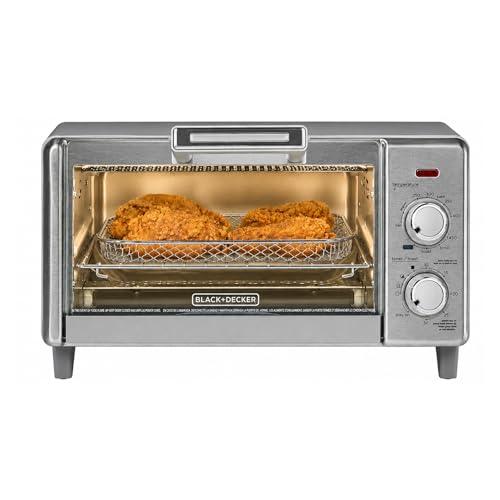
Most toaster ovens make heat the slow way: a metal rod warms up, glows dull orange, and radiates warmth into the cavity until the thermostat decides enough is enough. A quartz toaster oven takes a different route. Its heating elements are resistance wires sealed inside quartz glass tubes, and quartz passes radiant energy quickly, so the elements reach working temperature within seconds of the cycle starting and cool almost as fast when the power cuts. That speed is not a party trick. An oven that can switch its heat on and off in short, precise bursts can steer power between the top and bottom elements moment by moment, browning a bagel’s cut side while merely warming its crust, or pushing heat underneath a pizza base while the cheese on top only simmers. Nearly every meaningful advantage claimed for this class of oven — faster preheats, tighter temperature control, more even toast — traces back to that one physical property of the quartz tube.
One disclosure before the picks. This site may earn an affiliate commission when readers buy through links on the page, at no extra cost to the reader. That commission is the business model, and it is stated plainly so the reasoning below can be judged on its merits. The selections and every specification in this guide come from research: manufacturer product pages, published element counts, stated capacities, and the feature lists the makers themselves print. No claim here goes beyond what a maker documents about its own machine, and where documentation conflicts between sources, the guide follows the maker’s own page and says so.
A second honesty note belongs up front, because it shapes the whole list. The quartz toaster oven class is dominated by one manufacturer to a degree that would look like bias in any other category. Breville builds its entire Smart Oven line around quartz elements and its Element IQ power-steering system, and five of the six picks below carry that badge. That is not favouritism; it is the shape of the market. Most rival brands heat their countertop ovens with metal tubular elements, and the best-known non-Breville fast-heating oven, Panasonic’s FlashXpress, is not a quartz oven at all — Panasonic describes its technology as double infrared heating, a different system that gets its own discussion in the buying guide below. The sixth pick, from Ninja, earns its place because its top cavity is built around a named quartz heating system inside a genuinely different two-cavity design. Readers who want a quartz oven are, in practice, choosing among Breville sizes first and asking whether the Ninja’s split cavity suits them better second. This guide is organised to make exactly that decision well.
Quartz, metal and infrared: three ways a small oven makes heat
A metal tubular element — the calrod rod found in most budget toaster ovens — is a resistance wire packed inside a steel sheath. The sheath has to heat through before the cavity does, and it keeps radiating after the power stops, so the oven’s temperature control always lags behind its own heat source. Control systems compensate by cycling the element on and off in long, coarse swings, and the food experiences those swings as alternating blasts and lulls. Metal elements are tough, cheap, and forgiving of splashes and knocks, which is why they dominate the lower end of the market, but fine control is not their strength.
A quartz element inverts those trade-offs. The wire sits inside a thin quartz glass tube, and because the tube is largely transparent to the radiant energy the wire produces, heat leaves the element almost as soon as current flows. Response is measured in seconds rather than minutes. The practical consequences stack up quickly. Preheats shorten because the elements are not spending their first minutes warming their own housing. Temperature holds steadier because the controller can trim output in short pulses instead of long cycles — Breville’s manuals describe the elements visibly pulsing during cooking, and note that this is normal behaviour rather than a fault. And zoning becomes possible: with several independently driven quartz elements above and below the rack, an oven can weight its output toward the top for broiling, toward the bottom for pizza bases, or balance the two for baking, all within a single cooking cycle. The costs of the technology are real too. Quartz tubes are glass, and glass resents being struck by a heavy roasting pan or splashed with cold liquid while hot. Quartz ovens also tend to sit in higher price bands than metal-element machines of similar size, because the elements and the electronics that steer them are the product.
Infrared ovens are the third family, and the one most often confused with quartz. Panasonic’s FlashXpress is the reference point: Panasonic describes it as double infrared heating, pairing far-infrared elements inside the cavity with near-infrared emitters, and it preheats essentially instantly and toasts with unusual speed for its size. Infrared done this way is a legitimate, effective technology — but it is not quartz, and an oven does not become a quartz oven because it heats quickly or glows brightly. The distinction matters for this guide’s scope: readers searching for quartz models specifically usually want the multi-element, power-steered layout that quartz tubes make practical, with several elements sharing the work. The FlashXpress earns its infrared results with a compact two-element arrangement in a small cavity, which is a different design philosophy aimed at toast and reheating more than at full oven duties. It is a fine alternative for the right counter, and the buying guide below returns to it, but it is deliberately not one of the six picks, because including it would blur the very category line this article exists to draw.
In this guide
What to look for in a quartz toaster oven
Element count and placement
The headline number in this class is how many quartz elements the oven carries and where they sit. Four elements — typically two above the rack and two below — is the working minimum for the power-steering idea to mean anything, and it is the layout inside the two compact Breville picks below. Five elements, as in the Smart Oven Pro, adds an extra element to refine the top-bottom balance in a larger cavity. Six elements, found in the two Air Fryer Pro models, supports the biggest cavities in the class and the widest spread of rack positions. More elements in a bigger box is not automatically better cooking; it is better distribution of the same total wattage across a larger space. Match the count to the cavity: a six-element oven bought to toast two slices is mostly unused hardware, while a four-element oven asked to roast for six people will spend its life working at its limits. Ninja’s entry works differently — its quartz system serves the top cavity of a two-cavity machine — so its element story is about the division of labour between two ovens rather than a single count.
Power steering: what Element IQ actually does
Five of the six picks share Breville’s Element IQ system, so it deserves a plain explanation. Element IQ is the control layer that decides, for each cooking function, how the oven’s total power is divided among its quartz elements and how that division changes through the cycle. Toasting weights the top elements differently from baking; pizza shifts output downward to drive the base; broiling concentrates power overhead. Because quartz elements respond in seconds, these adjustments can happen as short pulses rather than slow swings, which is the entire technical premise of the line. The practical question for a buyer is not whether the system exists — it does, across the whole Breville range — but whether the cooking functions offered match the household’s actual habits. The smaller ovens carry eight functions, the mid-size Pro adds slow cooking, and the two flagship models expand to thirteen functions including air frying, dehydrating and proofing. A household that will never proof dough or dehydrate fruit gains nothing from the longer list except a longer control-panel scroll.
Preheat speed and recovery
Quartz’s fast response shows up twice in daily cooking. The first is the preheat: an 1800-watt quartz oven reaches baking temperature in a fraction of the time a full-size range oven needs, which changes whether cooking a small meal in the countertop oven feels like a shortcut or a ceremony. The second, less discussed, is recovery — how quickly the cavity regains temperature after the door opens to turn food or check a crust. Every door opening dumps hot air; an oven whose elements respond in seconds rebuilds its heat quickly, while a slow element leaves food sitting in a cooling box. Published wattage is the honest comparison figure here: every pick in this guide runs at or near 1800 watts, the practical ceiling for a standard North American kitchen circuit, so the class competes on how intelligently that wattage is steered rather than on raw power.
Cavity size, rack positions and what actually fits
Capacity claims in this category are usually expressed in toast slices and pizza diameters, and those are the figures worth trusting because they describe the rack, not the marketing. The picks below span from four slices and an 11-inch pizza in the Mini Smart Oven to nine slices, a 13-inch pizza and, in the largest Breville, a whole turkey of the size the maker specifies. Rack positions matter as much as volume: broiling wants food close under the top elements, baking wants it centred, and roasting wants clearance above the food so the top elements brown rather than scorch. Ovens with three rack positions and clear markings on the door glass remove the guesswork. Households replacing a second oven for holiday cooking should size by the largest single dish they genuinely cook — a casserole dish with handles is the usual failure case, since handle width, not the dish body, decides whether the door closes.
Convection and air frying
A convection fan changes what a quartz oven is for. Without one — the case for the two compact Breville picks — the oven is a precise radiant baker and toaster. With one, moving air speeds roasting and enables air frying, and the two flagship Breville models add a higher fan speed the maker calls super convection for their air fry and dehydrate functions. The Ninja takes yet another path, dedicating its entire bottom cavity to convection air frying while the quartz top cavity handles the radiant work. Buyers whose main goal is air frying a family’s worth of food in a separate appliance may find this site’s dedicated air fryer coverage more relevant than any countertop oven; readers weighing rack arrangements for that job can start with best air fryers with racks and return here if the oven format still wins. Inside this guide, the convection question is simpler: households that roast and air fry weekly should shortlist the fan-equipped picks, and households that mostly toast, bake and reheat should not pay for fan hardware they will rarely switch on.
Controls, connectivity and the app question
Every pick here uses some combination of dials, buttons and an LCD that reports the function’s suggested time and temperature, and the differences are in the extras. The Joule Oven Air Fryer Pro is the connectivity outlier: it links to the Joule app for guided recipes, remote monitoring and voice control through common assistants, and it can receive new cooking functions through updates. That is genuinely useful for cooks who like guided, repeatable programs, and genuinely irrelevant for cooks who set a temperature and walk away. At the other end, the Mini and Compact models keep the interface deliberately plain — a function dial, a time-and-temperature dial, and a screen — which suits shared kitchens and holiday homes where the next user has never seen the machine. None of the controls in this class requires an account or a phone to cook dinner, including the Joule, whose app layer is an addition rather than a gate.
Low-temperature range: proofing, dehydrating and slow work
The bottom of the temperature dial separates the generations of this class as clearly as the top. Basic quartz ovens start around 120 degrees Fahrenheit, which is warm enough for keeping food hot and little else. The flagship models reach down to around 80 degrees, and that low band unlocks two jobs the smaller ovens cannot do: proofing bread dough at a gentle, stable warmth, and dehydrating fruit, herbs and jerky over long, low runs. The Smart Oven Pro takes a third route with its dedicated slow cook function, trading the very low dial settings for a timed, set-and-leave braise. None of these is a reason to buy an oven by itself, but households that bake bread weekly or preserve a garden’s output should treat the low end of the range as a headline specification, not a footnote, and should notice that it lives only in the larger picks in this guide.
Footprint, clearance and heat on the counter
A quartz oven is a radiant appliance, and its surroundings feel it. Makers specify clearance on the sides and above the body — commonly several inches — because the case itself grows hot and the vents need room to breathe, and a large model parked tight under low cabinets can discolour the cabinet underside over months of broiling. The honest measurement is not the oven’s width but the width plus its clearances, and on a crowded counter that total often decides between the flagship and the Compact more decisively than any cooking feature. Depth matters too: doors on these ovens open downward and need their swing, and the biggest models project far enough that a standard counter leaves little working room in front. Readers in small kitchens should measure the actual patch of counter, including the space above it, before falling for the largest cavity — an oven that fits its shelf with clearance to spare will be used daily, and one that has to be dragged out and plugged in will not.
Accessories and cleaning
Quartz tubes reward gentle treatment, and the accessory kit shapes daily cleaning more than most buyers expect. All the Breville picks ship with some combination of a wire rack, a baking or roasting pan and, on the air fry models, a mesh air fry basket; the Ninja ships two sheet pans, two racks, a basket and a crumb tray to serve its two cavities. Non-stick cavity coatings, which most of these ovens carry, wipe down easily but dislike abrasive pads, and the elements themselves should never be scrubbed or struck — a soft cloth once the oven is cold is the whole maintenance routine. Crumb trays that slide out from the front, rather than requiring the oven to be tipped, are worth real money in a kitchen that toasts daily. Before buying, check the pan sizes against dishes already owned: an oven whose included pan matches a household’s standard casserole saves a shelf of duplicate bakeware.
The six picks at a glance
The table below compares the six ovens on the qualities this guide treats as decisive: the heating layout, the cavity class, the cooking system wrapped around the elements, and the household each design serves best. It is deliberately qualitative — the sections after it carry the per-model detail.
| Oven | Heating layout | Cavity class | Standout quality | Best suited to |
|---|---|---|---|---|
| Breville Smart Oven Air Fryer Pro BOV900 | 6 quartz elements, Element IQ | Largest single cavity in the group | Thirteen functions including air fry and dehydrate | Households replacing a second oven |
| Breville Joule Oven Air Fryer Pro BOV950 | 6 quartz elements, Element IQ | Largest single cavity in the group | App guidance and voice control | Connected kitchens and guided cooks |
| Breville Smart Oven Pro BOV845 | 5 quartz elements, Element IQ | Mid-large single cavity | Slow cook function and interior light | Bakers and slow-cooking households |
| Breville Compact Smart Oven BOV650 | 4 quartz elements, Element IQ | Compact single cavity | Full power steering in a smaller body | Couples and small counters |
| Breville Mini Smart Oven BOV450 | 4 quartz elements, Element IQ | Smallest cavity in the group | The lightest, simplest Breville layout | Singles, dorms and first kitchens |
| Ninja DCT801 Double Oven Pro | QuartzHeat top cavity, convection bottom cavity | Two independent cavities | Two dishes finished at the same time | Families cooking a main and a side together |
How the core jobs play out on quartz
Toast and bagels
Toasting is the job quartz was born for, because it is a pure radiant task with a visible finish line. A steered oven browns the upward face of bread with the top elements while the bottom elements warm the base, and the bagel function refines that split further, adding heat to the cut side while merely crisping the crust. Speed matters here in a way it does not for roasting: a quartz oven that reaches working heat in seconds turns breakfast into a two-minute routine, and the pulsing control keeps pale bread from tipping into scorched while the cook is pouring coffee. Shade consistency across a full rack of four to nine slices is where element distribution shows itself — edges and centre receive deliberately different power rather than whatever a single rod happens to throw at them.
Pizza
Pizza exposes the opposite demand: the base needs aggressive heat from below while the toppings need only enough from above to melt and spot. Quartz systems handle the split natively, weighting the lower elements for the crust while the upper elements idle at a gentler output, which is why pizza is a named function on every pick in this guide rather than a bake setting with a hopeful note. The deciding figures are the pizza diameter each cavity accepts — 11 inches at the small end, 12 in the Compact, 13 in the three larger Breville models — and the rack position that centres the pie between the element sets. Frozen pizza is the weekly reality for many households, and an oven whose pizza function was designed around it, with a preheat prompt before the pie goes in, produces a crisper base than one that treats pizza as generic baking.
Baking and roasting
Baking is where temperature stability, quartz’s second gift, does the work. Cakes, muffins and casseroles punish an oven that swings: a long overshoot dries edges while the centre sets, and a sag leaves batters dense. The short-pulse control that quartz elements allow holds a cavity closer to its set point, and the larger picks add convection to even out the remaining gradients between rack positions. Roasting adds the recovery question — a cold joint of meat drops cavity temperature sharply, and elements that answer in seconds rebuild the roasting environment while slower elements are still warming their own sheaths. None of this makes a countertop oven magic; it makes it consistent, which is what baking actually rewards.
Reheating and leftovers
Reheating is the quiet daily job that decides whether an oven earns its counter space, because it is the task most likely to happen twice a day. Radiant quartz heat revives the foods microwaves ruin — pizza slices, fried chicken, pastry, roasted vegetables — by re-crisping surfaces instead of steaming them, and the fast preheat means the oven is ready before impatience wins and the microwave gets used anyway. The reheat functions on these ovens run gentler cycles than full baking, warming food through without pushing it into a second cooking. Households that cook once and eat twice will feel the quartz difference here more than in any showcase recipe.
The best quartz toaster ovens in detail
The six picks are ordered by their place in the category rather than by a single score: the two flagship single-cavity models first, the mid-size Pro next, then the two compact ovens, and finally the Ninja, whose two-cavity design answers a different question altogether. Each entry states the element layout its maker documents, because in this category the heating system is the specification everything else hangs from.
Breville Smart Oven Air Fryer Pro BOV900
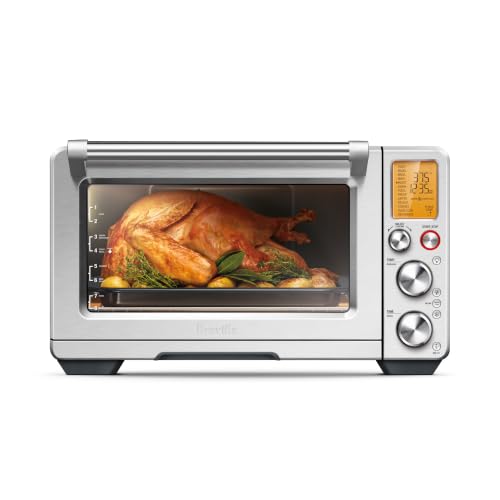
The BOV900 is the fullest expression of the quartz idea in a single cavity. Six quartz elements — the most in this guide — work under Element IQ control across a one-cubic-foot interior that Breville sizes for nine slices of toast, a 13-inch pizza, or a turkey of the weight the maker specifies. Thirteen functions run from the everyday (toast, bagel, bake, roast, broil, pizza, cookies) through the specialist (air fry, proof, dehydrate, slow cook), and a two-speed convection fan, including the maker’s super convection setting, moves air for the frying and dehydrating work. The temperature span is the widest here, reaching low enough for proofing dough and high enough for aggressive broiling. For a household that wants one countertop oven to stand in for a second wall oven, this is the reference design against which the rest of the list is measured.
Two of its functions deserve specific mention because they explain the flagship tier. Proofing holds the cavity at the low, steady warmth dough wants, turning the oven into the proofing box most kitchens lack, and dehydrating runs the elements and fan gently for the long hours fruit and herbs require — both jobs exist only because quartz elements can be driven at very low, stable outputs without the coarse cycling that would cook the contents instead. The air fry function, meanwhile, is where the super convection fan speed earns its name, moving enough air across the mesh basket to crisp with the intensity the category promises. A household will not use all thirteen functions weekly, but the flagship argument is that the four or five it does use are each properly engineered rather than approximated.
Strengths
- Six independently steered quartz elements give the finest top-to-bottom heat control in the group.
- The largest cavity here swallows family roasts and full-size bakeware that smaller ovens refuse.
- Thirteen functions, including air fry, dehydrate and proof, cover nearly every countertop cooking task.
- Two-speed convection, with a higher super convection setting, supports crisp air frying.
- The accessory set — racks, roasting pan, pizza pan and air fry basket — matches the cavity’s ambitions.
Trade-offs
- It is the biggest footprint in this guide and demands generous counter clearance on every side.
- Households that only toast and reheat will pay for dehydrating and proofing hardware that sits idle.
- Six glass elements mean six tubes to treat gently when sliding heavy pans in and out.
Who it suits
This is the pick for households that cook seriously in a countertop oven several times a week and want the quartz system’s full range in one machine. Shoppers who want a single quartz oven to cover nearly every job, from weekday toast to a holiday bird, should check price on Amazon.


Breville Joule Oven Air Fryer Pro BOV950
The Joule Oven Air Fryer Pro starts from the same hardware foundation as the BOV900 — six quartz elements under Element IQ control, a one-cubic-foot cavity, thirteen cooking functions and 1800 watts — and then adds a layer none of the other picks offers: connectivity. Through the Joule app, the oven accepts guided recipes that set function, temperature and time in sequence, sends progress notifications to a phone, and responds to voice control through common smart assistants. Breville also positions the connected platform as a way to deliver new cooking functions to the oven over time. Underneath the software, the cooking proposition is identical to its sibling’s: fast quartz response, steered power, and a cavity sized for family cooking.
Strengths
- The same six-element quartz hardware and thirteen functions as the flagship single-cavity design.
- Guided app recipes run multi-stage programs that would be tedious to set by hand.
- Remote monitoring suits cooks who leave the kitchen while a roast runs.
- Voice control through common assistants adds hands-free adjustment mid-recipe.
- The large cavity keeps the family-size capacity of the BOV900.
Trade-offs
- The connectivity is the reason to buy it; cooks who ignore apps pay for a layer they never open.
- Guided features depend on a phone, a network connection and the maker’s app continuing to be supported.
- It shares the flagship footprint, so the counter-space cost is identical to the BOV900’s.
Who it suits
The Joule suits cooks who already run a connected kitchen and like the discipline of guided, repeatable programs, but who still want quartz hardware doing the actual cooking. Readers who like the idea of the oven joining the rest of a connected kitchen can check price on Amazon.
Breville Smart Oven Pro BOV845
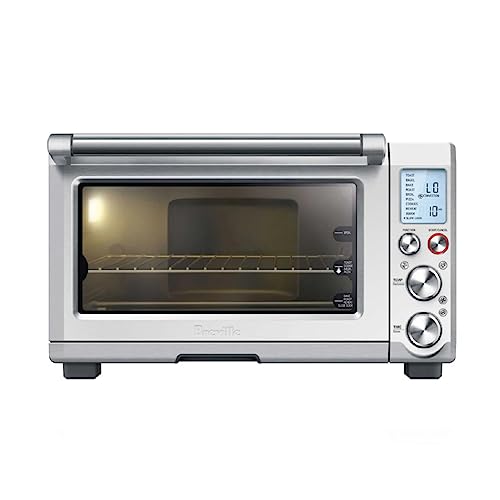
The Smart Oven Pro BOV845 is the thoughtful middle of the Breville range. Five quartz elements serve a cavity Breville sizes for six slices of toast or a 13-inch pizza, and the ten-function list makes one distinctive choice: instead of air frying, it offers a slow cook function that can run for up to ten hours before switching itself to keep warm. An interior light — a small feature that is oddly rare in this class — lets the cook check browning without opening the door and dumping the heat the quartz elements then have to rebuild. Element IQ steers the five elements exactly as it does in the larger models, so toast, pizza and baking behaviour will feel familiar to anyone stepping up from the compact ovens. For households whose cooking leans toward baking, roasting and slow braises rather than air frying, this is arguably the best-judged specification on the list.
Strengths
- Five quartz elements with full Element IQ steering in a mid-large cavity.
- The slow cook function, with automatic keep warm, replaces a separate slow cooker for many households.
- An interior light allows browning checks without opening the door.
- Six-slice, 13-inch-pizza capacity covers most family baking and roasting.
- No air fry hardware keeps the function list focused on oven work.
Trade-offs
- There is no air fry function, so crisp-frying households should look at the two Pro models above.
- Five elements in a slightly smaller cavity is a step down from the flagships’ distribution.
- The slow cook ceiling of ten hours will not suit every recipe’s schedule.
Who it suits
The BOV845 suits bakers and slow-cooking households that want quartz control and a generous cavity without paying for an air fry system they will not use. Cooks who want Element IQ and a slow-cook setting instead of air fry hardware should check price on Amazon.
Breville Compact Smart Oven BOV650
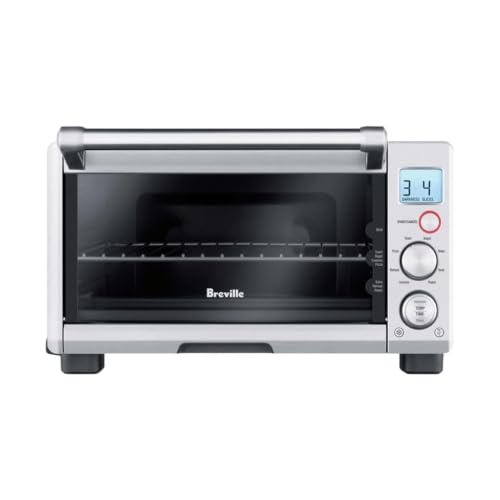
The Compact Smart Oven is where the quartz range becomes sensible for smaller kitchens without surrendering the technology that defines it. Breville’s own page and manual list four quartz elements — two above and two below the rack — driven by the same Element IQ steering as the flagships, at the same 1800 watts. That detail is worth stating carefully because secondary sources disagree about this model, variously crediting it with five elements; the maker’s documentation says four, and four is what this guide records. The cavity takes four slices of toast or a 12-inch pizza, eight functions cover the daily round of toast, bagel, bake, roast, broil, pizza, cookies and reheat, and three rack positions handle the height adjustments. There is no convection fan, which keeps the design honest: this is a radiant oven for households whose cooking is toasting, baking and reheating rather than roasting at speed.
Strengths
- Full Element IQ power steering across four quartz elements, verified against the maker’s own documentation.
- A 12-inch pizza fits, which keeps Friday-night cooking inside the compact class.
- The 1800-watt output matches the flagships, so preheat and recovery stay brisk.
- Three rack positions give real control over distance from the top elements.
- The smaller body leaves counter room for the rest of a working kitchen.
Trade-offs
- No convection fan means slower roasting and no air frying of any kind.
- Four slices is a hard ceiling for family breakfast shifts.
- The function list stops at the essentials — no slow cook, proof or dehydrate.
Who it suits
The Compact suits couples and small households that want genuine quartz control for daily cooking without giving a flagship-sized patch of counter to the oven. Small households that still want proper power steering across four quartz elements can check price on Amazon.

Breville Mini Smart Oven BOV450
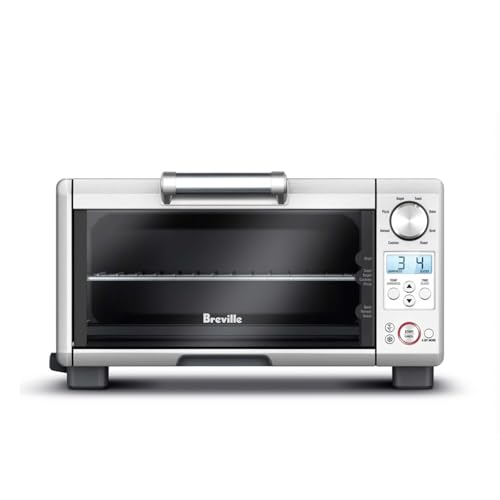
The Mini Smart Oven is the smallest expression of the quartz idea Breville sells. Four quartz elements and Element IQ steering sit inside a cavity sized for four slices of toast or an 11-inch pizza, with the same eight everyday functions as the Compact and the same 1800 watts behind them. What the Mini removes is everything else: no convection fan, no interior light, no specialist functions — just a function dial, a time-and-temperature dial, and a footprint that fits counters the rest of this list cannot. One clarification matters for readers comparing across this site’s guides: at the weight Breville publishes for it, the Mini sits just above the ten-pound line, so it is not one of the ultralight ovens in the companion guide discussed later in this article. It is the small end of the quartz range, not a featherweight travel oven, and its build reflects that.
Strengths
- The smallest footprint in the Breville quartz range, for counters nothing else here fits.
- Four quartz elements with Element IQ still deliver steered, even toasting.
- The two-dial interface is the simplest in the group to learn and to teach.
- Eight functions cover the realistic needs of one or two people.
- Full 1800-watt output keeps a small cavity fast rather than feeble.
Trade-offs
- An 11-inch pizza ceiling excludes the standard 12-inch frozen pizza.
- No convection, no light, and no functions beyond the everyday eight.
- The cavity height limits taller bakeware and small roasts.
Who it suits
The Mini suits singles, couples in small flats, and anyone equipping a first kitchen who wants quartz behaviour in the least possible space. Anyone furnishing a compact counter who wants the smallest Breville footprint in the range should check price on Amazon.
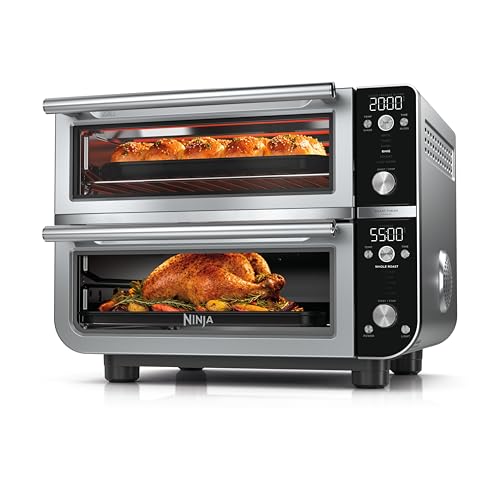
Ninja DCT801 Double Oven Pro
The Ninja is the structural dissenter in this guide, and its quartz claim needs precise wording. SharkNinja’s own product page states that the top oven uses its QuartzHeat technology for fast, even heating, while the bottom oven is built around the maker’s convection air frying. So the DCT801 is not a six-element single cavity in the Breville pattern; it is two independent ovens stacked in one body, only the upper of which is quartz-heated. What that buys is parallelism. The two cavities run different functions at different temperatures and times, and the maker’s Smart Finish system can synchronise them so a main and a side complete together, while DualZone control lets each run entirely on its own. Twelve functions are shared across the machine, total capacity is in the thirty-quart class across both cavities, and the maker sizes it for family loads such as a whole chicken in the larger space. The included kit — two sheet pans, two wire racks, an air fry basket and a crumb tray — reflects the two-cavity brief.
A weeknight example shows the design at its best. The top, quartz-heated cavity roasts vegetables or bakes a small casserole at a steady oven temperature while the bottom cavity air fries chicken pieces at a higher effective intensity, and Smart Finish is set so the vegetables’ longer, gentler program and the chicken’s shorter, fiercer one end together. In a single-cavity oven that menu is a sequence — one dish waits, cooling, while the other cooks, or both compromise at one temperature. The Ninja’s compromise is different: neither cavity is as tall or as refined as a flagship single cavity, and the top oven’s quartz system does not steer power with Element IQ’s granularity. The trade is parallelism for finesse, and for families cooking two-part dinners four nights a week, parallelism usually wins.
Strengths
- Two independent cavities cook a main and a side at different settings simultaneously.
- The quartz-heated top oven handles toast, bake and roast work with fast radiant response.
- Smart Finish synchronises the cavities so both dishes land at the same moment.
- The bottom cavity is a dedicated convection air fryer rather than an afterthought mode.
- Family-scale total capacity across the two cavities suits batch cooking.
Trade-offs
- Only the top cavity is quartz; buyers wanting quartz heat throughout should choose a Breville.
- Each individual cavity is shallower than a comparable single-cavity oven, limiting tall dishes.
- The stacked body is tall and heavy, and it is the most complex control layout here.
- There is no Element IQ-style steering; the quartz system is simpler than Breville’s.
Who it suits
The DCT801 suits families whose bottleneck is timing — two dishes, two settings, one finish line — more than ultimate single-cavity refinement. Families who would rather run two smaller meals side by side than queue them through one large cavity should check price on Amazon.
Matching the six to real kitchens
The honest way to choose among these ovens is to start from the constraint that bites hardest. If the constraint is counter space, the decision is already made at the small end: the Mini for one or two people, the Compact when a 12-inch pizza is non-negotiable. If the constraint is the weekly cooking pattern, work through the function lists rather than the element counts. Air frying and dehydrating point to the BOV900 or the Joule; slow cooking points to the BOV845, the only pick that offers it; two-dish weeknight dinners point to the Ninja, whose second cavity solves a scheduling problem no single oven can. If the constraint is the largest dish cooked all year — the holiday casserole, the big roast — the two flagship Breville cavities are the only ones here sized for it, and the choice between them is purely whether app guidance earns its keep in that kitchen.
One comparison this guide deliberately does not make is against the ultralight end of the toaster oven market. None of these six is a sub-ten-pound machine; even the Mini, the lightest pick here, sits just over that line at the weight its maker publishes, and the rest are substantially heavier. Readers whose first requirement is an oven light enough to lift into a cupboard after every use, or to carry to a dorm room or a recreational vehicle, are shopping a different axis entirely, and this site covers it separately in best vacuums under 10 pounds. The two guides share no picks, by design: the quartz list is organised by heating technology, the weight list by portability, and an oven that tops one ranking has no claim on the other.
Budget framing, finally, is best done by tier rather than by number. The Mini and Compact form the entry tier, the Smart Oven Pro the middle, and the two Air Fryer Pro models plus the Ninja the top tier. Within each tier the extra money buys identifiable hardware — a fan, a fifth or sixth element, a bigger cavity, a second cavity — rather than vague quality, so the useful question is always whether that specific hardware maps to a weekly habit. Quartz technology itself is present and correct in every tier, which is the real reassurance this category offers: stepping down in size or price does not mean stepping out of the quartz class.
Quartz and the second-oven question: energy and workflow
The economic case for a quartz countertop oven rests on a simple asymmetry: most home cooking is small. Heating a full-size range oven’s large cavity to bake six muffins, roast two chicken breasts or reheat a casserole for one wastes both time and electricity on empty air, and in summer it heats the kitchen the air conditioning then has to cool again. A countertop quartz oven heats a cavity sized to the food, reaches temperature in a few minutes, and — because its elements respond instantly — spends its energy in short, purposeful pulses rather than long recoveries. Over a year of daily small meals, that difference is the appliance’s real running-cost argument, and it is why so many households find the countertop oven becoming the default and the range becoming the special-occasion tool. The workflow effect compounds the saving: a fast preheat removes the planning step from small meals, so the oven gets used for the jobs it is best at instead of being skipped for the microwave.
The limits of the arrangement are equally plain, and this guide states them so the category is not oversold. A countertop oven cannot cook a holiday meal for twelve, cannot run three trays at once, and cannot take the tallest stockpot or the widest roasting pan a range swallows without thinking. Households that regularly cook at that scale will treat any pick here as a complement to the range, not a successor, and should size their purchase accordingly — the mid-size Pro rather than a flagship bought to imitate an oven it cannot be. Quartz technology improves everything a small oven does; it does not change what a small oven is.
Reading a quartz oven spec sheet without being misled
Three habits protect a buyer in this category. The first is to source element counts from the maker, not the marketplace. This guide’s own research found secondary sources crediting the Compact Smart Oven with five elements while Breville’s page and manual say four — an error that flatters the product and propagates because it is copied from listing to listing. Model codes deserve the same discipline: Breville’s BOV numbers differ by a single digit between ovens of different sizes and element counts, and Ninja’s DCT line contains several double ovens whose heating systems are not interchangeable, so the exact code in a listing title should be checked character by character against the maker’s page before money moves. The second habit is to translate capacity claims into the two honest units — toast slices and pizza diameter — and to treat cubic-foot figures as secondary, since cavity shape decides what fits more than volume does. The third is to read wattage as a ceiling, not a ranking: every serious pick here runs at 1800 watts because that is what a standard circuit offers, and the differences that matter live in how the control system spends those watts. A spec sheet read this way — maker’s figures, honest units, wattage as context — will steer a buyer to the right oven more reliably than any single score.
Living with quartz elements
Quartz ovens ask for slightly different habits from metal-element machines, and the habits are cheap. The tubes are glass, so pans go in and out with a moment’s care rather than a slide and a clatter, and cold liquid never meets a hot tube — a splash of water on a working element is the classic way to crack one. Cleaning follows from the same fact: the elements are wiped, never scrubbed, and only once the oven is fully cold; the cavity walls and crumb tray take the actual cleaning work, and both are designed for it. Splatter is the slow enemy, because baked-on grease near an element smokes at broiling temperatures, so a quick wipe after fatty cooking saves a smoky kitchen later. Element failure, when it eventually comes, announces itself plainly as a tube that no longer glows or a function that heats unevenly, and it is a service question rather than a home repair — the tubes are not user-swappable parts in the way a range element can be. The door deserves the same steadiness as the tubes: its glass is the cook’s window onto browning, and a wipe while warm with a soft cloth keeps it readable, while slamming it shut sends exactly the kind of shock through the frame that glass tubes dislike. Accessory storage matters more than it sounds, because the heavy roasting pan stored loose on top of the oven eventually gets dragged across the case or dropped against the door; a drawer or a shelf beside the oven is the safer home. These are small disciplines, measured in seconds a week, and they are the difference between an oven that still steers its heat precisely in year five and one that faded early through knocks rather than wear. None of this is burdensome, but it is the honest price of the responsiveness that makes the category worth buying, and households that treat countertop appliances roughly should weigh it before choosing quartz over a metal-element oven built like a toolbox.
Frequently asked questions
Is quartz really better than a metal heating element?
Quartz is better at responsiveness and control: the elements reach temperature in seconds, accept fine pulsing from the control system, and can be steered independently above and below the food. Metal elements are tougher, cheaper, and slower to respond. For toasting, baking and pizza — jobs where heat placement decides the result — quartz’s control is a genuine advantage. For rough treatment and the lowest prices, metal keeps its place.
Why is the Panasonic FlashXpress not in the picks?
Because Panasonic does not describe it as a quartz oven. The maker calls its system double infrared heating, using far-infrared and near-infrared emitters, which is a different technology that happens to share quartz’s speed. It is a respected compact oven and a sensible alternative for toast-focused buyers, but this guide’s scope is ovens whose makers build and describe them around quartz elements, and the FlashXpress falls outside that line.
Does the number of quartz elements decide cooking quality?
Not on its own. Element count has to be read against cavity size: four elements steer a compact cavity well, while the largest cavities need six to distribute the same total wattage evenly. What decides results is the pairing of count, cavity and the control system dividing power among the elements. A six-element oven used for two slices of toast is wasted hardware, and a four-element oven asked to roast for six is undersized — match the pairing to the household.
Can a quartz toaster oven replace a full-size oven?
For many households, most of the time, yes — the flagship picks here bake, roast, broil, air fry and slow cook in cavities that take family dishes, at a fraction of a range oven’s preheat time and energy draw. The limits are absolute size and batch cooking: a very large turkey, multiple trays at once, or a tall stacked bake will still belong to the big oven. Most owners end up using the countertop oven daily and the range on occasions, which is the realistic version of replacement.
Are quartz elements fragile or expensive to live with?
They are glass, so they deserve the modest care described in the maintenance section above: no knocks from heavy pans, no cold splashes on hot tubes, no scrubbing. Treated that way they are ordinary appliance parts with ordinary lifespans, and daily ownership costs no more than any other countertop oven. The fragility concern is real but narrow — it rules out rough handling, not normal cooking.
Quartz earned its place in the countertop oven by making heat behave like a dial instead of a bonfire: instant to arrive, precise to aim, and gone the moment it is not wanted. Choose the cavity that matches the household, the function list that matches the week, and the elements will do the rest — quietly, quickly, and exactly where the food needs them.