A handheld milk frother is the smallest appliance in the coffee corner: a slim wand with a spring whisk on the end, a small motor in the handle, and a job that takes about twenty seconds. Lower the whisk into warm milk, switch it on, and the spinning coil drags air down into the liquid until the volume doubles and the surface turns glossy. There is no steam wand, no jug of scalded milk to wash, and no counter space surrendered. What there is, instead, is technique. The same wand that produces silky microfoam in one kitchen produces a glass of coarse bubbles in another, and the difference is rarely the price of the tool. It is the speed of the motor, the shape of the whisk, the freshness of the batteries, and how the person holding it moves the wand through the milk.
That is why this guide ranks handheld frothers on the things that actually separate them: motor speed and how that speed holds up as batteries fade, single versus double whisk heads, battery cells you replace versus a built-in cell you recharge, how the shaft and whisk are built, and how easily the whole thing rinses clean before the milk dries on it. Every pick here is a battery-powered wand. Automatic countertop frothers, the kind with a jug and a heating element, are a different category with a different budget, and this guide covers them only in one short section that explains when they are the better buy. If your goal is a cappuccino-style foam for a home latte, foam for a matcha, or a whipped top for hot chocolate, a wand is usually enough, provided you choose one whose motor and whisk suit the drinks you make most.
Some links in this guide are affiliate links, which means this site may earn an affiliate commission when readers buy through them, at no extra cost to the reader. That commission is how the research behind guides like this one gets paid for. The rankings below are built from manufacturer specifications, product documentation and the practical physics of whisking milk, and the order reflects the balance of speed, build and battery management that matters most in daily use.
What to look for in a handheld milk frother
Motor speed, and what speed actually does to foam
Manufacturers quote motor speeds for wand frothers in revolutions per minute, and the numbers on this list span a wide range, from gentler motors suited to stirring and light foam up to high-speed motors that can pull a vortex in a mug of cold milk. Speed matters because foam quality is about bubble size. A whisk moving fast enough shears the air it drags in into smaller bubbles, and small bubbles are what make microfoam: the dense, glossy, pourable foam that sits on a flat white like wet paint. A slow or weakening motor makes big bubbles instead, which look impressive for a minute and then collapse into a frothy scum on top of hot milk. When you read a speed figure, treat it as a ceiling rather than a promise. The speed that matters is the speed under load, whisk deep in milk, on batteries that are a month old, and that is where designs differ. Models with speed settings let you start slow to avoid sloshing, then climb; single-speed models bet everything on one well-chosen gear.
Battery cells you swap versus a cell you recharge
The biggest practical divide in this category is power. Replaceable-cell models run on AA or AAA batteries. They are cheap to buy, they work the moment fresh cells go in, and a fading whisk is fixed in ten seconds with new batteries. Their weakness is the slow fade: a wand rarely dies outright, it just gets lazier week by week, and the foam quietly gets worse while the owner blames the milk. Rechargeable models carry a built-in lithium cell topped up over USB, usually USB-C on newer designs. They hold a steadier output across the charge, they remove the battery drawer from your kitchen, and several offer two or three speed settings that replaceable-cell models rarely have. Their weakness is the dead-wand morning: if the cell is flat and you want a latte now, you wait, or you keep a cheap backup wand. Neither system is simply better. Heavy daily users who froth twice a day often prefer rechargeable models for the steady output; occasional users are better served by replaceable cells that sit in a drawer for a month without self-discharging into uselessness.
Whisk head design: single spring, double spring, and extras
The business end of every wand is a coil of wire wound into a small spring loop. A single whisk is the classic design: light, easy to rinse, and perfectly capable of good foam in a small cup. A double whisk stacks two coils, moves more milk per revolution, and generally builds volume faster in larger glasses, at the cost of a head that is slightly harder to clean and a little more prone to splashing in shallow mugs. Some rechargeable models add interchangeable heads, a balloon whisk for eggs and dressings or a hook for mixing powders, which turns the wand into a small general-purpose mixer. Those extras are worth having if you whisk matcha, protein powder or salad dressing more often than you froth milk; if milk is the whole job, a single well-made spring, firmly mounted, beats a drawer of attachments.
Shaft, whisk material, and mounting strength
The shaft should be stainless steel, long enough to reach the bottom of a tall latte glass without the handle dipping into the milk, and rigid enough not to flex when the whisk meets resistance. The joint between shaft and handle is the failure point on cheap wands: a press-fit shaft can work loose and start to wobble, and a wobbling whisk sprays milk and foams unevenly. Better designs thread or firmly crimp the shaft, and the difference shows up after months rather than days. The spring itself should be tightly wound with no gaps that trap dried milk, and it should sit centred on the shaft; an off-centre whisk vibrates, and vibration is both noise and lost energy.
Water resistance and the ten-second clean
A handheld frother lives or dies by how it is cleaned, because the correct method is to rinse the whisk under the tap immediately, ideally with a two-second spin in clean water, before the milk film dries. Most wands are splash-resistant at the whisk end and emphatically not waterproof at the handle, where the battery compartment or charging port sits. The practical questions are whether the whisk and shaft tolerate a full rinse without water creeping into the body, whether the battery cap seals with a proper thread or a flimsy clip, and whether a rechargeable model’s port has a cover. None of this appears in headline specifications, and all of it decides whether the wand is still in service next year.
Grip, vibration, and noise
You hold a frother for twenty to sixty seconds at a time, so ergonomics are about small things: a handle thick enough to grip with wet fingers, a button that can be held down without cramping or, better, a switch that stays on, and balance that does not make the wand nose-heavy. Cheap motors vibrate through the handle and whine at a pitch that carries through a quiet morning kitchen. None of these flaws stop a wand from frothing, but they decide whether frothing feels like a pleasure or a chore, and chores get skipped.
Stands, cases, and storage in a small kitchen
A wand with wet whisk cannot simply go back in the cutlery drawer. Several models include a counter stand, which keeps the whisk upright, draining and out of the drawer tangle, and a stand is worth more than it looks if the wand is used daily. Others ship with a slim case or nothing at all. In a small kitchen, the stand-versus-drawer question is real: a drawer wand needs its whisk dried first, every time, or it will pick up odours and eventually rust spots at the coil ends if the steel is poor.
Motor life and the signs of a wand wearing out
These are small brushed or brushless motors built to a price, and their realistic lifespan is measured in years of daily use for the better designs. The early warnings are a falling pitch under load, foam that takes noticeably longer to build on fresh batteries or a full charge, and a whisk that spins true when dry but shudders in milk. Warranties in this category are modest, often a year, sometimes longer on the motor, and the honest expectation is that a wand is a consumable tool with a long life rather than a lifetime purchase. Buying the model whose power system you will actually maintain, fresh cells or regular charging, does more for longevity than any specification.
Speed settings, splash control, and why one speed can be enough
A single-speed wand makes one bet: that its chosen speed suits most milk in most cups. For classic hot drinks that bet is usually right, and the simplicity means one button and nothing to learn. Multiple speeds earn their complexity in three situations. Powders come first, because matcha, cocoa and protein powder all need a gentle start that folds powder into liquid instead of launching it up the sides of the vessel. Cold foam comes second, because cold milk wants more pace, not less, and the top setting on a multi-speed wand is typically stronger than a single-speed model’s compromise gear. Small vessels come third, because an espresso cup or a small bowl punishes full power. If your use is one drink, one way, every day, one speed is a feature. If your wand is a general kitchen tool, speeds pay for themselves.
Noise, pitch, and the early-morning test
Every wand makes noise, but the character of the noise differs enough to matter in a sleeping household. High-speed motors on a full charge sing at a high pitch that carries through thin walls, while a motor under load in deep milk drops to a lower, duller note that stays in the kitchen. Replaceable-cell models get quieter as their batteries fade, which sounds like a benefit and is actually the warning sign discussed above. Rechargeable models hold their pitch, and therefore their noise, steady across the charge. Handle design plays a part too: a solid, slightly heavier body absorbs vibration that a hollow budget shell turns into a rattle against the rim of a glass. If the wand will mostly work before dawn, favour the calmer designs, the Aerolatte and the Schiuma in this list, and froth in a jug with a cloth under it, which damps the contact noise that no motor choice can remove. None of these tools is loud in absolute terms; all of them are loud enough at six in the morning that the difference between a whine and a hum is a genuine quality-of-life specification.
What the price tiers actually buy, in words
At the budget tier you are buying a motor, a spring and a battery compartment, and the good news is that this is most of what frothing requires; the compromises live in switch feel, whisk centring and how gracefully the tool ages. The mid-range tier buys refinement: better balance, quieter motors, stands and cases included rather than improvised, spare whisks available, and brands that answer email. The premium end of this small category buys design and longevity, bodies that feel like objects rather than appliances, and support measured in years. What no tier buys is a different physical result in the cup when technique is equal, which is why this guide ranks a budget rechargeable wand and a heritage battery wand side by side without embarrassment. Spend where your daily irritation lives: if battery fade annoys you, buy rechargeable; if a wobbly whisk annoys you, buy build quality; if both annoy you, the mid-range is your home.
In this guide
Why foam works: milk, air, and bubble size
Foam is a structure, not a substance. When a whisk spins in milk it folds air into the liquid, and the milk’s proteins rush to coat each new bubble before it can pop. Casein and whey proteins act like a skin: the finer the bubbles, the more total skin the milk can form, and the more stable and glossy the result. This is why two wands with similar headline speeds can produce different foam. The whisk that introduces air gradually, in small doses at the surface, gives the proteins time to coat fine bubbles. The whisk that churns violently traps large pockets of air faster than the proteins can stabilise them, and large bubbles merge, rise and burst, leaving the thin, soapy foam that collapses before the drink is finished.
Temperature changes the chemistry. Cold milk holds its proteins in a state that foams slowly but builds stiff, stable peaks, which is why cold foam for iced drinks works so well with a wand. As milk warms toward steaming point, the proteins unfold and coat bubbles more readily, and foam builds faster and finer. Push past that point toward boiling and the proteins denature in the wrong way, the fat melts out of the structure, and the foam turns coarse and starts to taste cooked. The practical window is wide but real: warm the milk until it steams and the vessel feels hot to a held hand, and stop there. A wand cannot rescue milk that has been boiled, and no motor upgrade compensates for it.
Fat plays a quieter role. Whole milk’s fat gives foam its rich mouthfeel but slightly limits volume, because fat globules compete with proteins at the bubble walls. Skimmed milk, with almost no fat, builds the largest volume of foam and the least flavour. Neither is wrong; they are different drinks. The wand’s contribution to all of this is mechanical honesty: a centred whisk, a speed that holds under load, and enough torque to keep the vortex going in a full jug. Everything in the rankings below follows from those three mechanical facts.
Handheld wand or countertop frother: the honest boundary
An automatic countertop frother heats and foams the milk for you, in a jug, at the press of a button, and for households making four lattes every morning that convenience is worth its counter space and its considerably higher price. It also heats the milk, which a wand does not do at all: with a handheld frother you warm the milk first, in a pan or the microwave, and foam it second. A wand wins on price, on storage, on speed of cleaning, on cold drinks, since it foams cold milk, iced lattes and matcha without any heating step, and on travel, since it fits in a suitcase for hotel-room coffee. A countertop unit wins on hands-free repeatability and on heating. If your drinks are mostly iced, mostly single, or mostly outside the morning rush, the wand is the rational tool. If your household runs a small café at breakfast, buy the jug.
There is a middle path worth knowing about: the manual pump frother and the French press trick, where hot milk is pumped or plunged until it foams. Both make surprisingly good foam with no batteries at all, and both ask for a washing-up commitment a wand never does. They suit the battery-sceptical and the off-grid, and they lose to a wand on speed, on cold drinks, and on the simple fact that a wand rinses in ten seconds while a pump jug is a small washing project. The wand’s real competition is not other foam gadgets; it is the decision to skip foam entirely, and it wins that argument every time it is clean, charged and within reach.
Technique: the part no specification sheet can sell you
Start with cold milk in a vessel a third full at most, because foam doubles or triples the volume and a full mug will overflow the moment the whisk bites. Warm the milk first if the drink is hot; foam built on cold milk and then microwaved collapses, while milk warmed to roughly drinking-hot, steaming but not boiling, foams readily and keeps its structure. Hold the whisk just under the surface at first, slightly off centre, so it draws air down in a steady vortex, and listen: a gentle tearing sound means air is entering in small doses, which is what you want. Once the volume has grown, sink the whisk deeper to roll the foam through the milk and break the largest bubbles. Keep the wand moving slowly around the vessel rather than parked in one spot. When the foam looks glossy and moves like thick paint, stop; over-whisked foam turns stiff and dry. Tap the vessel once on the counter and swirl it, and pour promptly. Every pick below performs noticeably better with this technique than a stronger motor does without it.
Cold foam has its own technique. Use milk straight from the fridge, in a tall narrow glass if you have one, and keep the whisk deeper than you would for hot foam, because cold foam builds volume quickly and a shallow whisk will climb the foam and splash. Shorter bursts work better than one long run: build the foam, let it settle for a moment, then give it a few seconds more to firm up. For matcha, whisk in a wide bowl with a small amount of warm water first until the powder is a smooth paste, then add the rest of the liquid; a wand on its lowest setting, or a single-speed wand used in brief pulses, does this without wearing the matcha. And for whipped coffee, patience is the technique: the mixture looks hopeless for the first half minute and then turns, all at once, into peaks.
Milk choice matters as much as the tool. Fresh whole milk foams most forgivingly because its fat and protein balance stabilises small bubbles. Skimmed milk makes abundant, stiff foam that tastes thin. Barista-style oat milks are formulated to foam and generally outperform standard plant milks, which can separate under a fast whisk. Very fresh milk foams better than milk near its date, and milk that has been frozen and thawed often refuses to foam properly at all. If a wand suddenly seems to have lost its touch, change the milk before you change the wand.
best espresso machines for home use
The six best handheld milk frothers

Zulay Kitchen Milk Boss: the popular all-rounder
The Milk Boss is the wand that turned handheld frothers into a mainstream kitchen gadget, and its formula is simple: a fast single-speed motor, a stainless spring whisk, two AA batteries, and a stand included in the box. The motor spins the whisk hard enough to pull a proper vortex in a mug and to build glossy foam on warm milk in well under half a minute, and it is equally happy whipping cold milk for an iced drink or blending a matcha. The handle is a comfortable matte cylinder with a single top button that needs holding down, and the whole tool is light enough that the hold-to-run button is a minor rather than serious complaint.
Look closer at the daily experience and the details hold up. The whisk shaft is long enough for a tall latte glass, the spring is tightly wound and sits centred, so the spin stays smooth rather than buzzy, and the stand’s footprint is small enough for the strip of counter beside a coffee machine. The button is a simple press-and-hold on top of the handle, which sounds basic until a rival puts a fiddly slider on the side. Cold work deserves a mention too: the motor has enough pace to whip a dalgona-style coffee and to turn cold milk into a respectable cold foam, jobs where weaker wands merely stir. It is not the quietest tool here and it will not froth a litre of milk for a brunch crowd in one vessel, but within the one- or two-drink rhythm it was designed for, it rarely puts a foot wrong.
Its trade-offs are the classic replaceable-cell ones. Performance is excellent on fresh batteries and drifts as they fade, and because there is no speed control, the full-power start can splash in a shallow or overfilled cup until your technique adjusts. The whisk is a single coil, so in a very large glass it takes longer to move all the milk than a double whisk would. Against that, the stand keeps it upright and ready on the counter, the brand’s after-sales reputation in this category is strong, and the price tier is firmly at the budget end, so a second wand for a desk or a suitcase is an easy decision. For most people making one or two drinks a day, this is the sensible default: simple, quick, and easy to live with.
Strengths: strong motor for the class; stand included; simple one-button operation; good foam on hot and cold milk. Trade-offs: replaceable batteries fade gradually; single speed can splash in shallow cups; single whisk is slower in large glasses. Who it suits: daily latte and cappuccino drinkers who want the proven, no-fuss option and do not mind swapping AA cells a few times a year, so keep a spare pair in the drawer when you check price on Amazon.

PowerLix Milk Pro: the double-whisk volume builder
The Milk Pro takes the same basic formula, two AA batteries and a stainless shaft, and doubles the whisk: two stacked spring coils that move noticeably more milk per second. In a tall glass or a small jug, that second coil shows. Foam builds faster, and the foam it builds is a little finer at the same technique level, because the milk circulates through the whisk more often in the same time. It ships with a stand as well, and the handle carries the same simple hold-down button arrangement, in a slightly slimmer body.
In practice the double coil also changes how forgiving the wand feels. A single whisk rewards precise positioning, held just under the surface at a slight angle; wander too deep and the air stops flowing in. The Milk Pro’s wider head keeps drawing air across a broader range of depths, so a less practiced hand still gets a decent foam, and the margin for error on a rushed weekday morning is genuinely larger. It also handles thicker starting points well, hot chocolate made from powder and milk, for instance, where the first job is dissolving and the second is foaming. The stand matches the Zulay’s for convenience, and the whole package stays in the same budget tier, which makes the choice between them mostly about vessel size and how much foam you build at once.
The double whisk is not free. It needs a touch more clearance, so very small espresso cups are awkward, and it holds more milk film after use, which makes the immediate rinse more important, not less. Battery fade behaves exactly as it does on any replaceable-cell wand, and the slim handle, while elegant, is a little less secure in wet hands than chunkier rivals. Where this pick earns its place is in households that froth larger volumes, a big latte mug, foam for two drinks in one jug, hot chocolate for children, where the extra throughput saves real time every single day. If your drinks are large or shared, the double coil is the upgrade that matters.
Strengths: double whisk builds volume quickly; finer foam in larger vessels; stand included; slim, tidy design. Trade-offs: head needs more clearance in small cups; more whisk surface to rinse; replaceable-cell fade applies. Who it suits: people frothing for two, or working in tall glasses and small jugs, who value speed of volume over minimal size, so choose this over a single whisk when you check price on Amazon.
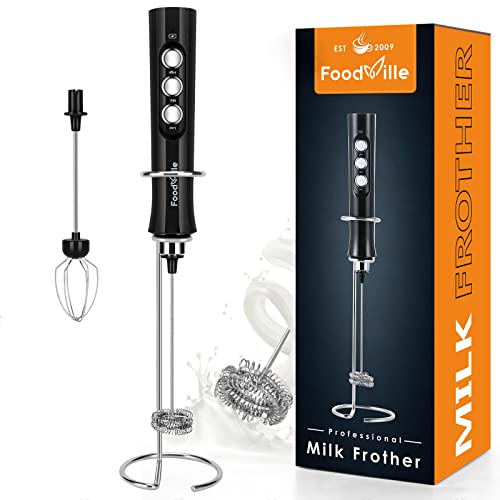
FoodVille MF02: the rechargeable with speeds and spare heads
The MF02 is the modern answer to the battery drawer: a built-in rechargeable cell topped up over USB, three speed settings, and a set of interchangeable heads that usually includes two spring whisks and a small balloon whisk. The speed control is the real feature. The lowest setting stirs powders and blends protein shakes without painting the counter, the middle setting is the milk setting for most cups, and the top setting is there for cold foam and for rescuing a slow morning. Output stays consistent as the charge falls in a way replaceable cells cannot match, and when the cell finally runs down, a cable rather than a shopping trip fixes it.
The details reward a closer look. The lowest speed is slow enough to stir a matcha in a bowl without sloshing it over the rim, a job most single-speed wands do badly, and the whisk heads swap with a positive click that inspires more confidence than a friction fit. Charging is via a standard USB cable, so the kitchen drawer cable that charges a phone or a torch also revives the wand, and a charge indicator removes the guesswork that plagues cheaper rechargeable models. The body seals its port against splashes, and the shaft is a proper stainless rod rather than a coated wire. It is, in short, the wand for someone who has already owned a basic one and knows exactly which limitations they want to buy their way out of.
The costs are the ones built into any rechargeable tool. A flat wand on a weekday morning is a small domestic tragedy, and the only defences are routine charging or a backup. The interchangeable heads click on and off, which is convenient and also one more joint to rinse and one more small part to lose down the back of a drawer. The body is a little longer than the battery wands, and the button arrangement, a press to cycle speeds, takes a day to learn. None of that outweighs the package for the right user: someone who froths daily, hates buying batteries, and will genuinely use the extra heads for eggs, dressings and matcha. For that user this is the most complete wand on the list.
Strengths: USB recharging with steady output; three speeds for control; interchangeable whisk heads; no battery costs. Trade-offs: useless when the charge is flat until recharged; spare heads are small parts to keep track of; slightly larger body. Who it suits: daily users who also whisk matcha, eggs and dressings, and who prefer charging a device to stocking batteries, so set a weekly charging habit when you check price on Amazon.

Aerolatte Original: the one that started it
The Aerolatte is the original handheld frother, the design that proved a spring whisk on a stick could make café-style foam at home, and it remains a study in doing one thing neatly. It runs on two AA batteries, spins a single spring whisk at a well-judged speed, and comes in a slim body that has barely changed in years because it did not need to. Its foam is reliably fine for its class, its balance in the hand is excellent, and its restrained motor is noticeably quieter and calmer than the high-speed budget wands, which makes it a pleasant tool at six in the morning.
There is also a heritage argument that should not be dismissed as nostalgia. A design that survives for years in a category flooded with novelty usually survives because its failure rate is low and its foam is consistent, and consistency is what a morning routine actually needs. The Aerolatte’s whisk geometry, a compact spring of a particular diameter, was settled early and copied widely, which tells its own story. Owners tend to keep these for a long time, replacing batteries and nothing else, and the brand still sells replacement whisks, a small thing that signals a product intended to be maintained rather than discarded. In a list full of feature lists, that quiet durability is a feature too.
Restraint is also its limitation. There is no stand in most packages, no speed choice, and no double whisk, and in a large jug it takes its time. The battery fade pattern is the familiar one. What you are buying here is refinement rather than features: a wand that feels considered, from the switch action to the way the whisk is mounted dead centre so it spins without a wobble. It suits a smaller household making classic milk drinks in classic cups, where the theatre of foam in twenty seconds matters more than throughput. As the connoisseur’s simple choice, it holds its own on this list.
Strengths: balanced, quiet, wobble-free spin; proven long-running design; fine foam in small and medium cups. Trade-offs: no stand typically included; single speed and single whisk; slower in large volumes. Who it suits: one- or two-person households making traditional lattes and cappuccinos who value feel and quiet over features, so pair it with a small jug when you check price on Amazon.

Bodum Schiuma: the slim minimalist
The Schiuma comes from a coffee brand that cares about how things look on the counter, and it shows: a very slim, light wand with a soft-touch handle, a single spring whisk, and a push-button that sits where your thumb naturally rests. It runs on AA batteries and is aimed squarely at the single daily drink. Its motor is tuned for control rather than drama, so it is good at the careful surface work that turns foam glossy, and its light weight makes it the least tiring wand here for anyone who finds heavier tools awkward.
Its finesse shows in the drinks where control matters most. A cappuccino for one, in a small cup, with foam that needs to be glossy rather than mountainous, is exactly the Schiuma’s home ground, and its gentle top speed means it is nearly impossible to blow milk out of a small vessel, a real consideration for anyone frothing in a favourite mug rather than a jug. The soft-touch coating also stays grippy when hands are wet from rinsing, and the wand’s light weight makes it a kind choice for older hands or anyone with reduced grip strength. It will not impress a spec-sheet shopper, and it is not trying to; it is a well-mannered tool for a well-mannered drink.
The slim body cuts both ways. There is less room for batteries and motor, so this is not the pick for big volumes, and the light build asks to be treated gently: it is a drawer-and-care tool rather than one to toss in a bag. It also shares the replaceable-cell fade, and with no stand it lives in the drawer, which means drying the whisk before it goes away. Within its brief, though, it is a genuinely likeable object, and for the solo coffee drinker in a small kitchen, where every stored item must earn its place, its tiny footprint and calm manner make a strong case.
Strengths: very slim and light; comfortable soft-touch grip; controlled, tidy frothing for single drinks. Trade-offs: not built for large volumes; no stand; delicate feel compared with chunkier rivals. Who it suits: solo drinkers in small kitchens who make one careful drink at a time and store the wand in a drawer, so keep it with the coffee things when you check price on Amazon.
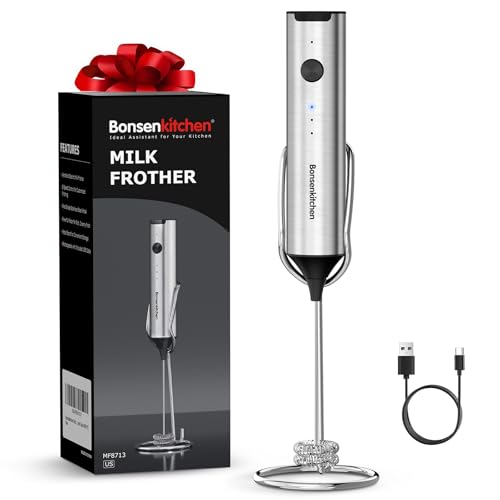
Bonsenkitchen Milk Frother: the high-speed budget charger
Bonsenkitchen’s rechargeable wand aims at buyers who want the modern feature list, USB charging, multiple speeds, a high maximum motor speed, without leaving the budget tier. In its common configuration it offers three speeds, two whisk heads, and enough top-end pace to build cold foam quickly and to power through thicker jobs like whipped coffee and hot chocolate. The handle is a straightforward cylinder with a single cycling button, and the package usually includes the charging cable and a spare whisk, which is the right kind of generosity in a tool whose whisk is its wear part.
Where it earns genuine respect is cold work. Whipped coffee, cold foam for iced lattes, and powdered drinks that need violence rather than finesse all play to its top speed, and the three settings mean the same wand can drop to a stir for a dressing without redecorating the worktop. The two heads cover the realistic range of kitchen jobs, the charging is the now-universal USB kind, and the wand’s honest cheapness reframes its flaws: a slightly hollow handle feel matters less when the whole tool costs what a round of café drinks does. Treat it as a capable appliance with a finite life rather than an heirloom, keep the spare whisk somewhere findable, and it will do everything most kitchens ask of it.
Budget rechargeable tools share a pattern, and this one follows it: the plastics and switch feel workmanlike rather than premium, the quoted top speed is achieved on a full charge and softens as the cell drains, and long-term support depends on the brand’s marketplace presence rather than a service network. Read in its own terms, though, the value is real. It froths well, it charges from the same cable as everything else in a modern kitchen, and it costs little enough that replacing it in a few years is a shrug rather than a grievance. For a first rechargeable wand, or a second wand for work or travel, it is the pragmatic pick.
Strengths: USB charging and three speeds at a budget tier; strong top-end pace for cold foam; spare whisk typically included. Trade-offs: workmanlike build feel; top speed depends on charge level; basic long-term support. Who it suits: buyers who want rechargeable convenience and speed choice without paying premium prices, including as a travel or office wand, so charge it alongside your phone when you check price on Amazon.
Side by side: the six wands at a glance
| Model | Power | Whisk | Speeds | Best at |
|---|---|---|---|---|
| Zulay Kitchen Milk Boss | 2 × AA, replaceable | Single spring | One | Everyday all-round use |
| PowerLix Milk Pro | 2 × AA, replaceable | Double spring | One | Larger volumes, faster foam |
| FoodVille MF02 | Built-in cell, USB | Interchangeable heads | Three | Versatility beyond milk |
| Aerolatte Original | 2 × AA, replaceable | Single spring | One | Quiet, balanced classic drinks |
| Bodum Schiuma | AA, replaceable | Single spring | One | Slim storage, single drinks |
| Bonsenkitchen Milk Frother | Built-in cell, USB | Two heads included | Three | Budget rechargeable speed |
Read the table by power system first, because that is the decision you live with daily, and by whisk second, because that is the decision that shapes your foam. Everything else on a wand is refinement.
What a wand cannot do: honest limits
A wand cannot steam. Steaming does two things at once, heating the milk and texturing it with pressurised vapour, and the texture it produces, especially the way steamed milk turns sweet and silky through its whole volume, is something a whisk approximates rather than reproduces. Wand foam sits on top of the milk as a distinct layer more than steam foam does, and in a large drink that layering is noticeable. A wand also cannot texture a full litre for a table of guests without the first cup’s foam ageing while the last is made, and it cannot make the dense, hot, sweet milk of a café flat white at café speed. Naming these limits is not a criticism of the category; it is the reason the category exists alongside espresso machines rather than instead of them. For one or two drinks, made unhurriedly, in a home kitchen, the approximation is close enough that most people stop noticing the difference within a week, and the money and counter space saved are real every single day.
Choosing by the drinks you actually make
Classic lattes and cappuccinos, one or two at a time. Almost any wand here will serve you, so choose on power system and feel. The Zulay and the Aerolatte are the natural shortlist: one modern and vigorous, one calm and refined. Work in a small jug rather than the cup, warm the milk first, and either tool will give you foam that pours.
Drinks for a household, or big mugs. Throughput becomes the deciding factor. The PowerLix’s double whisk earns its keep when the vessel is a jug for two drinks or a large mug, and the rechargeable models with a strong top speed are close behind. A gentle single-whisk wand in a big jug is a recipe for lukewarm milk and thin foam.
Iced drinks and cold foam. Cold milk foams stiffly and well, and a wand is the best tool for the job because there is no heating element in the way. Speed matters here, since cold milk resists the whisk more than warm milk does; the FoodVille and the Bonsenkitchen, run at their higher settings, are the natural picks, and the Zulay handles cold work creditably too.
Matcha, powders and everything else. If the wand will spend half its life outside milk, the interchangeable heads and speed control of the FoodVille stop being luxuries and become the point of the purchase. A single-speed, full-power wand is a blunt instrument for whisking matcha in a bowl or blending a small dressing, and the splash pattern will teach you that exactly once.
Hot chocolate and children’s drinks. The job here is dissolving powder evenly and adding a light foam, in volumes larger than a coffee cup. A double whisk or a higher-speed rechargeable handles the volume, and the immediate rinse matters double, because sweetened milk dries into the stickiest film of all.
Keeping a wand alive: spares, storage and travel
A spring whisk is a wear part. It bends when it meets the side of a vessel at speed, it kinks when it is dropped into a cutlery drawer under a pile of spoons, and a bent spring foams unevenly forever after. Brands that sell replacement whisks, or include a spare in the box, are quietly telling you they expect the wand to outlast its first whisk, and that is the right expectation to buy into. Straighten a mildly bent spring gently between finger and thumb rather than replacing it at the first wobble, and store the wand where the whisk hangs free: in its stand, in a tall jar with the coffee things, or in a case, never loose at the bottom of a drawer.
Travel deserves a word, because a wand is one of the few coffee tools that genuinely travels. A battery model with the cells removed, or a rechargeable model topped up before the trip, turns a hotel kettle and a small carton of milk into a passable morning latte, and takes less space than a change of shoes. Wrap the whisk in a cloth so it does not bend in the bag, and rinse it in the bathroom sink the moment you finish; hotel rooms are where the ten-second rinse habit goes to die, and a wand that comes home with dried milk in its spring rarely forgives it.
Common mistakes that ruin good foam
The first mistake is the full cup. Foam needs headroom, and a vessel filled past halfway will redecorate the counter. The second is frothing milk that is already too hot: milk taken close to boiling foams coarsely and tastes cooked, so warm it gently and stop at steaming. The third is parking the whisk at the bottom from the start, which stirs without drawing air; the air enters at the surface, so begin shallow and sink later. The fourth is neglecting the ten-second rinse, after which dried milk glues itself into the coil and every later foam tastes faintly of it. The fifth is blaming the wand for tired batteries or a flat charge; a fading power source is the most common cause of foam that used to be better. Fix those five habits and the least expensive wand on this page will outperform an neglected premium one.
best coffee makers for home use
Frequently asked questions
Can a handheld frother make real microfoam for latte art?
It can make foam fine enough for simple latte art, with two honest caveats. The texture depends on technique, starting the whisk just under the surface to dose the air in slowly, then sinking it to roll the foam smooth, and on milk that is warm rather than scalded. The result is usually a touch airier than steam-wand microfoam, so hearts and tulips are achievable while intricate competition patterns are not a realistic promise from a spring whisk.
Does a handheld frother heat the milk?
No. A wand only moves the milk; it adds no heat. For hot drinks, warm the milk first in a small pan or the microwave until it steams gently, then froth it. For iced drinks, matcha and cold foam, that limitation disappears, because the wand works in cold milk just as well, which is one reason many owners end up using it more in summer than in winter.
How long do the batteries or the charge actually last?
It depends on use, but the pattern is consistent: replaceable AA cells in a daily-use wand typically give weeks of drinks before the fade becomes noticeable, and the fade, not a sudden stop, is your signal to swap them. A rechargeable wand typically handles many drinks per charge and asks for a cable every week or two of daily use. In both systems, foam quality is the fuel gauge: when foam takes longer to build, the power source is asking for attention. One habit helps both systems: mark the change. A small note of the date on a battery packet, or a fixed weekly charging slot for a rechargeable wand, turns a vague sense that the foam used to be better into a schedule you can actually follow, and it protects the milk, the drink and the wand’s reputation in your kitchen from an unfair trial.
What else can I use a handheld frother for besides milk?
Plenty, which is why these wands earn their drawer space. They whisk matcha without lumps, blend protein powder and powdered drinks, whip small amounts of cream, beat a couple of eggs, emulsify a vinaigrette, and make the whipped coffee that periodically takes over social media. Models with interchangeable heads widen that list further. The rule is to respect the motor: thin liquids and small volumes only, never dough, never a full mixing bowl of anything thick.
How do I clean the whisk properly?
Immediately after use, rinse the whisk and shaft under the tap, then spin the whisk for a few seconds in a glass of clean warm water with the tiniest drop of washing-up liquid if the milk was sweetened or flavoured, and rinse once more. Shake off the water and let the wand stand or hang to dry. Never submerge the handle, never put the wand in a dishwasher, and never leave the whisk sitting in milk or water, which is how springs acquire odours and, on poorer steel, rust spots.
A twenty-second tool earns its place by being reached for without thinking, so choose the wand whose power system and whisk match the drinks you actually make, keep its batteries fresh or its charge topped up, and the foam will take care of itself.

