As an Amazon Associate, this site may earn an affiliate commission from qualifying purchases made through links on this page, at no extra cost to you.
Why soup is the hardest job a hand blender will ever do
Most kitchen tools get to choose their conditions. A hand blender does not. Soup asks it to work in a pot of near-boiling liquid, against vegetables that go from rock-hard to mush in the space of a minute, with fibres that wrap, skins that resist, and steam rising straight into the motor housing. It is the one job where every weakness of a cheap immersion blender shows up at once: a weak motor stalls in a pot of carrots, a short shaft forces your hand over a steaming surface, a badly shaped blending head sucks itself to the bottom of the pot or flings hot tomato soup up your arm, and a plastic shaft warps the first time it meets a rolling boil.
That is why a hand blender bought for soup deserves a different evaluation than one bought for smoothies or whipped cream. A smoothie blender works in a cold glass for thirty seconds. A soup blender works in a deep, hot pot for several minutes, moving through dense, fibrous, uneven material, and it has to keep its composure the whole time. The best hand blenders for soup share a particular set of traits: a stainless steel shaft that does not care about heat, enough sustained power to break down fibrous vegetables without the motor bogging down, a blending head designed to keep liquid moving downward instead of spraying it upward, and a grip that stays comfortable and secure when your hand is warm and slightly damp from steam.
This guide looks at six real hand blenders through that soup-first lens. Each one was judged on how it handles hot liquid directly in the pot, how smoothly it purees the awkward ingredients that show up in soup — carrot coins, celery strings, potato chunks, roasted squash skin, lentil skins, herb stems — and how it behaves in the everyday realities of a soup kitchen: deep stockpots, narrow saucepans, and tall containers. Corded models are judged on their own merits here, because soup blending is a sustained, high-load job where a mains-powered motor has real advantages, and because a blender tethered to an outlet is not a problem when the pot sits on the stove.
None of the six picks below is a perfect tool. Each one trades something away — power against noise, versatility against simplicity, price against build quality — and the honest differences between them are what this guide is built on. What follows is a ranking of the best blenders for the specific, demanding job of turning a pot of cooked vegetables into soup you would actually serve to guests.
In this guide
Quick comparison: the six picks at a glance
Before the detailed reviews, here is the shape of the field. The Braun MultiQuick 7 leads on pure soup performance, with the most convincing anti-splash head and the most useful range of speeds for moving from chunky to silky. The Vitamix immersion blender is the power pick, the one to reach for when your soup starts with hard root vegetables and ends with a texture that has to be restaurant-smooth. The Breville Control Grip is the control freak of the group, built around a bell-shaped head that manages suction and splash better than any other design here, and it is the easiest to hold steady in a deep pot. The KitchenAid variable-speed model is the steady all-rounder, the one most kitchens already know how to use, with a shaft length and grip that suit ordinary saucepans. The Cuisinart Smart Stick is the straightforward two-speed workhorse, simple to the point of being almost impossible to use wrong. And the Mueller Austria Ultra-Stick is the budget pick, genuinely capable at a fraction of the price of the others, with a few rough edges that matter less if soup is a weekly job rather than a daily one.
If you only have time for one line of advice: buy the Braun if you want the best all-round soup tool, the Vitamix if you want the smoothest possible texture, and the Mueller if you want to spend the least and still get good soup. The rest of this guide explains why, pick by pick, and helps you match the tool to the way you actually cook.
What to look for in a hand blender for soup
Soup blending has its own checklist, and it is shorter and more specific than the generic advice you will find on most blender pages. The four things that matter most are the shaft material, the motor’s sustained power, the shape of the blending head, and the length of the shaft relative to your pots. Get those four right and almost everything else is a bonus. Get any one of them wrong and you will feel it every time you make soup.
Stainless steel shaft: the non-negotiable for hot soup
A hand blender’s shaft is the part that lives in the soup. Plastic shafts are fine for cold smoothies and mayonnaise, but a pot of soup at a simmer is a different environment. Plastic can warp, stain, and absorb odours over time, and some plastic shafts are explicitly not rated for use in boiling liquid, which means the manufacturer is telling you, in the fine print, that this is not the tool for this job. Stainless steel does not have these problems. It tolerates heat, it does not stain from tomato or turmeric, it does not hold the smell of last week’s garlic soup, and it can be plunged into a pot that is still on the heat without a second thought.
Every pick in this guide has a stainless steel shaft, and that is deliberate. If you are comparing models outside this list, treat a plastic shaft as a disqualifier for soup work, no matter how good the rest of the specification looks. The shaft is also where you should check the blending head’s attachment: a head that twists off easily is easier to clean after a tomato soup, and a head that locks firmly is one that will not work loose halfway through a pot of lentils.
Sustained power and speed control: smoothness is a process, not a switch
Soup does not go from chunky to silky in one burst. It goes through stages: first the big pieces break down, then the fibres separate, then the texture evens out, and finally the last stubborn bits — a piece of carrot skin, a string of celery — get caught and ground down. A blender with a single speed forces you to do all of that at full power, which is noisy, splashy, and hard on the motor. A blender with useful speed control lets you start slow, when the pot is full of large pieces that would spray, and build up as the soup thins out and the risk of splashing drops.
Wattage matters, but not in the way marketing suggests. A higher wattage number does not automatically mean smoother soup, because the blade design, the shape of the head, and the way the motor delivers torque under load matter just as much. What matters in practice is whether the motor keeps its speed when the blade meets resistance — a pot of dense sweet potato, a handful of raw kale stems — or whether it slows, strains, and heats up. The picks below were chosen partly on this quality: the motors that hold their nerve under load are the ones that produce genuinely smooth soup, while the ones that bog down leave you with a texture that is smooth in the middle and gritty at the edges.
Variable speed is worth paying for in a soup blender, and a turbo or boost button is worth having for the last thirty seconds of a blend, when you want to chase down the final fibres. What is not worth paying for is a dozen speeds you will never use. Three to five genuinely distinct speeds, or a smooth dial you can adjust with one thumb, is the sweet spot.
Anti-splash design: the difference between soup and a mess
Splashing is the most underrated problem in soup blending, and it is entirely a design problem. A blending head that is too open lets liquid escape upward; a head that is too closed creates suction that pins the blender to the bottom of the pot and starves the blade of new material. The best designs use a bell or dome shape with carefully placed vents, so liquid is drawn in from below, circulated past the blade, and pushed back down, rather than being flung up the shaft and out of the pot.
You can feel the difference within seconds of using a well-designed head: the blender sits calmly in the liquid, the surface of the soup dimples rather than erupts, and you can move the blender slowly around the pot without hot droplets finding your forearm. With a poorly designed head, the same soup becomes a hazard. This is the single most important reason to buy a blender designed with soup in mind rather than a general-purpose stick, and it is the quality that separates the top picks in this guide from the budget end of the market.
Technique matters too, and it is worth learning: keep the head fully submerged before you switch on, tilt it slightly rather than holding it dead vertical, and move it in slow circles rather than pumping it up and down. But technique cannot fix a bad head design, and a good head design forgives mediocre technique, which is exactly what you want when you are blending soup with one hand while holding a lid with the other.
Shaft length and grip: reach the bottom without reaching into the steam
A soup pot is deep, and a hand blender that cannot reach the bottom of your stockpot without your hand hovering over boiling liquid is a tool you will use less and less. Measure your tallest pot, then check the shaft length: you want the blade to reach the bottom with at least a few centimetres of clearance between your hand and the rim of the pot. Most of the picks here suit a standard stockpot, but if you regularly cook in a tall, narrow pot, the longer-shafted models in this guide earn their keep.
The grip matters as much as the length. A soup blender is held for minutes at a time, often with a hand that is warm from steam, and a grip that is too slim, too smooth, or too hard will tire your hand and make the blender harder to control. Look for a soft-touch grip with a shape that fills the palm and a power button that is easy to hold down without cramping. A blender that is too light can feel skittish in a thick soup; one that is too heavy becomes a chore by the third minute.
What else matters, and what does not
Attachments are a mixed blessing for soup cooks. A whisk attachment is genuinely useful if you also make whipped cream, and a chopping bowl can earn its place if you like to prep soup vegetables with the same tool. But a hand blender bought for soup does not need a dozen attachments, and a box full of accessories you never use is not a bargain.
Noise is worth a mention, because soup blending happens at the stove, often while other things are cooking, and a screaming motor is unpleasant. The quieter models in this guide are not silent, but they are noticeably less aggressive at full power, and that matters if you blend soup while a child naps or a partner takes a call in the next room.
Cleaning is the last practical consideration. A detachable shaft that rinses under the tap, a head with no hidden crevices where soup can lodge, and a blade guard that does not trap food will save you more time over a year than any attachment. Every pick here detaches for rinsing, and the reviews note where cleaning is genuinely easy.
The six best hand blenders for soup, reviewed
Each review below follows the same structure: what the blender does in a pot of soup, where it is strong, where it compromises, and who it suits. The picks are ordered by how well they handle the soup job overall, starting with the strongest all-rounder.


Top pick
1. Braun MultiQuick 7 MQ7035X: the best all-round soup blender
The Braun MultiQuick 7 is the blender this guide would hand to someone who makes soup three times a week and wants one tool that handles the whole job without drama. Its defining feature is the PowerBell Plus blending head, a bell-shaped dome with a stainless steel blade that is shaped to pull liquid down and around rather than up and out, and in a pot of hot soup the difference is immediate. Where cheaper heads erupt, the Braun dimples. Where other blenders need you to keep the head buried and still, the Braun lets you move it in slow, confident circles, and the soup follows it rather than fighting it.
The speed control is the other reason this blender tops the list. A large dial on the top of the handle gives you a genuine range of speeds, from a slow churn that breaks down big pieces of potato without spraying, up to a fast finish that chases down fibres, and a separate turbo button for the final push. That range matters more in soup than in any other job, because soup changes as you blend it: it starts thick and full of chunks, and it ends thin and nearly smooth, and the blender that can match its speed to each stage produces a better result with less mess. The motor holds its speed under load, too. A pot of roasted carrots and parsnips, the kind of dense, fibrous mixture that makes lesser motors slow and whine, does not slow this one down in any way you can hear or feel.
The shaft is stainless steel, long enough for a standard stockpot, and the grip is one of the most comfortable in this group: a soft-touch handle that fills the palm, with the speed dial falling naturally under the thumb. The blending head twists off for rinsing, and the bell shape has no awkward crevices where tomato soup can hide. At a simmer, with the pot still on the heat, the Braun is calm and predictable, which is the highest praise a soup tool can earn.
Strengths: the most convincing anti-splash head in this group, with a bell design that keeps hot liquid moving downward; a genuinely useful range of speeds plus a turbo button, so you can start slow on chunky soup and finish fast for a silky texture; a motor that holds its speed under load in dense, fibrous vegetables; a comfortable soft-touch grip and a stainless steel shaft long enough for a standard stockpot; easy to rinse clean, with a head that detaches and no crevices that trap soup.
Trade-offs: it sits in the mid-range to premium tier, so it costs noticeably more than a basic stick blender; the motor is powerful but not the quietest here at full speed; the accessory set is generous but adds bulk to the box if you only ever want the blending shaft; and the dial, while excellent, takes a little getting used to if you are coming from a simple two-button blender.
Who it suits: the regular soup maker who wants one blender that does the whole job well — chunky vegetable soups, silky bisques, and everything in between — without needing to learn tricks or tolerate splashing. If soup is a weekly habit and you want the tool to disappear into the job, this is the pick.
It is the blender to reach for when the pot is full, the soup is hot, and you want the job done properly the first time — check price on Amazon.


2. Vitamix immersion blender: the smoothest texture, period
If the Braun is the best all-rounder, the Vitamix is the specialist in smoothness. This is the blender for the cook who has eaten a truly silky soup in a restaurant and wants to know why theirs never quite gets there. The answer, most of the time, is that the last fibres never get broken down, and the Vitamix is built to break them down. Its motor is the strongest in this group, and more importantly it delivers its power smoothly and steadily, without the pulsing or bogging that leaves a soup smooth in the middle and gritty around the edges.
The five-speed control is simple and honest: a dial you turn with your thumb, with speeds that are genuinely distinct from one another, and the difference between the lowest and highest setting is large enough to matter. At the lowest speed, you can break down a pot of chunky potato and leek without spraying; at the highest, you can take a roasted squash soup to a texture that pours like cream. The blade design helps here too — the Vitamix uses a four-prong blade that catches and cuts fibres rather than just pushing them around, and on a pot of soup with celery strings and carrot skin, that difference shows up in the final texture.
The shaft is stainless steel and the bell-shaped head is designed to reduce suction, so the blender does not pin itself to the bottom of the pot the way some powerful sticks do. That matters with a motor this strong, because suction plus power is how you end up with a blender that will not move and a patch of soup that never gets blended. The Vitamix moves freely, and the soup circulates well. The grip is slim and straightforward, and the whole tool feels solid and well balanced in the hand, with the weight sitting low, near the pot, rather than high near your wrist.
Strengths: the strongest, most consistent motor in this group, and the smoothest final texture on fibrous soups; a four-prong blade that genuinely catches and cuts strings and skins; five distinct speeds that cover the whole journey from chunky to silky; a stainless steel shaft and a bell head that manages suction well despite the power; solid, well-balanced build that feels like a tool made to last.
Trade-offs: it is a premium-priced blender, and the price is hard to justify if you only make soup occasionally; it is heavier than the mid-range picks, which you feel by the third minute of blending; the speed dial is on the small side and can be fiddly with wet hands; and it comes with fewer accessories than some rivals at a similar price, because the money went into the motor and the blade rather than the box.
Who it suits: the cook who cares most about texture — the one who makes roasted vegetable soups, bisques, and pureed lentil soups and wants them genuinely silky, with no grit and no stray fibres. If you have ever been disappointed by a soup that was almost smooth, this is the blender that fixes that.
For the silkiest soup this group can produce, from the toughest starting vegetables, this is the one to buy — check price on Amazon.
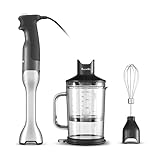

3. Breville Control Grip BSB510XL: the most controlled blender in a deep pot
The Breville Control Grip is the blender for the cook who has been splashed one too many times. Its entire design is built around control: a bell-shaped blending head with a ribbed interior that manages the flow of liquid, an ergonomic trigger-style grip that gives you precise command over the power, and a shaft long enough to reach the bottom of a deep stockpot while your hand stays comfortably above the rim. In use, it feels less like a power tool and more like an extension of your hand, and that is a rare quality in a hand blender.
The anti-suction design is the standout feature. Many powerful blenders create a vacuum at the bottom of the pot, pinning the head to the surface and starving the blade of new material, which forces you to lift and reposition constantly. The Breville’s head is shaped to break that suction, so the blender glides across the bottom of the pot in slow arcs and the soup circulates evenly. On a pot of split pea soup, where the mixture is dense and reluctant to move, that freedom of movement is the difference between a soup that blends evenly and a soup that has a smooth patch in the middle and lumps around the edges.
Speed control is handled by a trigger grip rather than a dial, which takes a little getting used to but rewards you with fine control: squeeze gently for a slow churn, squeeze harder for more power. It is intuitive once you have used it twice, and it is particularly good for the delicate early stage of blending, when the pot is full of large pieces and a sudden burst of full power would spray hot soup. The motor is strong enough for root vegetables and fibrous greens, though it does not quite match the Vitamix for the very final polish on the toughest fibres. The stainless steel shaft and the detachable head rinse clean easily, and the whole tool has the solid, considered feel that Breville is known for.
Strengths: the best anti-suction head design in this group, letting the blender glide freely across the bottom of a deep pot; a trigger grip that gives unusually fine control over speed, ideal for the splashy early stage of blending; a long stainless steel shaft that suits tall stockpots; a calm, controlled feel in hot liquid, with very little spraying even when the pot is full; well built, with a detachable head that rinses clean.
Trade-offs: the trigger grip is an acquired taste, and cooks used to a simple push-button may find it unfamiliar for the first few uses; the motor is strong but not the strongest here, so the very toughest fibrous soups take a little longer to reach perfect smoothness; it sits in the premium tier, so it is not a casual purchase; and it is slightly heavier than the simplest sticks, which matters on a long blending session.
Who it suits: the cook who blends in deep stockpots and hates being splashed — the one who makes big batches of soup, works with pots that are tall rather than wide, and values control and calm over raw power. If your pots are deep and your patience for hot droplets is low, this is your blender.
When control in a deep, hot pot matters more than anything else, this is the tool that earns its place on the stove — check price on Amazon.

4. KitchenAid variable speed corded hand blender: the steady all-rounder
The KitchenAid variable-speed hand blender is the least dramatic pick in this guide, and that is precisely its appeal. It does not have the most powerful motor, the most clever head design, or the most speeds. What it has is a combination of competence and familiarity that makes it the easiest blender here to live with: a comfortable grip, a straightforward variable-speed dial, a stainless steel shaft, and a blending head that does a solid, unspectacular job on every kind of soup you are likely to make.
In a pot of soup, the KitchenAid behaves like a reliable colleague. It starts smoothly, it does not spray, it moves through a pot of cooked vegetables at a steady pace, and it finishes with a texture that is smooth enough for everyday eating, even if it does not quite reach the restaurant-grade silk of the Vitamix. On a tomato soup, a potato and leek soup, or a simple carrot soup, you would struggle to tell the difference between this blender and one costing twice as much. Where the difference shows up is at the extremes: a pot of very fibrous greens, or a soup built on tough root vegetables, takes a little longer and a little more patience here, and the final texture may have a trace more body to it.
The variable-speed dial is genuinely useful, with a range that covers the slow start and the fast finish, and the blender has a pan guard — a small attachment that fits over the blending head to protect non-stick cookware from scratches. That is a thoughtful touch for a soup cook, because so many soups are made in non-stick or enamelled pots, and a scratched pot is a real cost. The grip is comfortable and the tool is well balanced, and the whole thing feels like it belongs in a kitchen that is used every day rather than a showroom.
Strengths: a reliable, unflashy performer on everyday soups, with a smooth start and very little spraying; a useful variable-speed dial and a pan guard that protects non-stick and enamelled pots; a comfortable grip and good balance for longer blending sessions; a stainless steel shaft and a detachable head that is easy to rinse; widely available, with a brand and a support network most cooks already know.
Trade-offs: the motor is not the strongest here, so very fibrous or very dense soups take longer and may finish slightly less silky; the anti-splash design is good but not exceptional, and a very full pot of thin soup can still spit a little at full speed; it is a mid-range price without a single standout feature to justify it; and the accessory set is modest compared with some rivals.
Who it suits: the everyday cook who wants a dependable hand blender for regular soups and does not want to overthink the purchase. If you make soup once or twice a week, in ordinary saucepans and stockpots, and you want a tool that simply works, this is the safe and sensible pick.
For a dependable everyday soup blender that never makes a fuss, this is the one most kitchens will be happiest with — check price on Amazon.

5. Cuisinart Smart Stick CSB-175: the simple two-speed workhorse
The Cuisinart Smart Stick is the simplest blender in this guide, and simplicity is a genuine virtue when your hands are wet, the pot is hot, and you have been cooking for an hour. Two speeds, one button each, a stainless steel shaft, and nothing else to learn. There is no dial to fumble, no trigger to master, no mode to remember. You press low to start, you press high to finish, and the soup gets blended. For a cook who finds multi-speed dials fiddly, or for a household where several people share the same blender, that simplicity is worth more than any feature list.
Do not mistake simple for weak. The motor is a respectable mid-range unit, and in a pot of ordinary soup — potato, carrot, tomato, squash — it does the job without complaint. It starts gently on low, which is the speed you will use for most of the blending, and the high speed has enough authority to finish the job. Where it shows its limits is on the hardest material: a pot full of raw fibrous stems, or a soup built on very dense root vegetables, will take longer here than on the Braun or the Vitamix, and you may need to move the blender more slowly and deliberately to give the blade time to work. That is a fair trade for the price and the simplicity, and for most soup cooks it will never matter.
The blending head is a straightforward bell design with reasonable splash control. It is not as refined as the Braun or the Breville, and a very full pot of thin soup can spit a little if you switch it on at high speed with the head near the surface. Used properly — head submerged, start on low — it is well behaved. The shaft is stainless steel, the head detaches for rinsing, and the grip is slim and light, which makes it easy to hold for a long blending session, though it can feel a little insubstantial in a very thick soup compared with the heavier models here.
Strengths: genuinely simple to use, with two clearly distinct speeds and no learning curve; a capable motor for everyday soups at a friendly price; light and easy to hold for long sessions; a stainless steel shaft and a detachable head that rinses clean; a proven, widely owned design that has been in kitchens for years.
Trade-offs: only two speeds, so you have less fine control over the journey from chunky to silky; the motor works harder on very fibrous or dense soups and takes longer to reach a perfectly smooth texture; splash control is decent rather than excellent, so technique matters more; and the light build can feel less planted in a thick, heavy soup.
Who it suits: the cook who wants soup blending to be as simple as possible — a first hand blender, a shared household tool, or a second blender kept for soup duty. If you value a tool you can hand to anyone in the house without explanation, this is the pick.
For soup blending without complications, at a price that makes the decision easy, this straightforward stick does the job well — check price on Amazon.

6. Mueller Austria Ultra-Stick 500W: the budget pick that actually works
Budget hand blenders have a reputation problem, and most of it is deserved: weak motors, plastic shafts, heads that spray, and a lifespan measured in months. The Mueller Austria Ultra-Stick is the exception that makes the rule worth stating. It is a genuinely inexpensive blender, and it has a stainless steel shaft, a motor with enough power for real soup, and a head design that is far better behaved than its price suggests. It is not as refined as the picks above it, but it is a real soup tool rather than a toy, and that distinction matters.
In a pot of soup, the Mueller does the honest work. On a potato and leek soup, or a roasted tomato soup, it produces a smooth result in a reasonable time, with a little more noise and a little more vibration than the premium models. The motor is rated at a power level that sounds modest on paper, but it holds up well under the sustained load of a pot of cooked vegetables, and it does not stall or overheat on an ordinary batch. Where you feel the price is in the edges: the speed control is a simple two-speed setup with less finesse than a dial, the splash control is good rather than great, and the grip is functional rather than comfortable, with a harder plastic feel that you notice by the third minute.
None of those are deal-breakers for a weekly soup maker. The shaft is stainless steel and long enough for a standard pot, the head detaches and rinses clean, and the blender comes with a whisk attachment and a beaker in the box, which is generous at this price. The most sensible way to think about the Mueller is as a tool that does eighty percent of what the premium picks do at a fraction of the price — and for a cook who makes soup once a week rather than every day, that eighty percent is all they will ever need.
Strengths: the lowest price in this group by a clear margin, with performance that is genuinely usable for real soup; a stainless steel shaft and a motor that handles ordinary soups without stalling; a light, easy-to-hold body; a detachable head that rinses clean; useful extras in the box, including a whisk attachment and a beaker, at no extra cost.
Trade-offs: the motor and head are less refined than the premium picks, so very fibrous or very dense soups take longer and may finish slightly less smooth; splash control is good but not great, and a full pot needs a careful start on low speed; the grip is harder and less comfortable over a long session; and the overall build feels lighter and less durable than the top picks, which matters if soup is a daily job.
Who it suits: the budget-conscious cook, the occasional soup maker, or anyone buying a first hand blender to see how much they will use it. If soup is a weekly pleasure rather than a daily routine, this blender gives you almost everything you need for very little money.
If you want a real soup blender for the smallest outlay this guide can recommend with a clear conscience, this is the one — check price on Amazon.
Qualitative comparison: how the six picks differ
| Blender | Soup smoothness | Splash control | Ease of use | Best for |
|---|---|---|---|---|
| Braun MultiQuick 7 | Excellent | Excellent | Easy, dial control | Best all-round soup blender |
| Vitamix immersion blender | Outstanding | Very good | Easy, five speeds | Silkiest texture on fibrous soups |
| Breville Control Grip | Very good | Outstanding | Trigger grip, takes a little learning | Deep pots and splash-free blending |
| KitchenAid variable speed | Good | Good | Very easy, familiar dial | Reliable everyday soup making |
| Cuisinart Smart Stick | Good | Fair to good | Simplest of all | Shared households and first-time buyers |
| Mueller Austria Ultra-Stick | Good on ordinary soups | Fair to good | Easy, two speeds | Budget soup making |
Read the table as a guide to trade-offs, not as a league table. The Braun wins on balance, the Vitamix on texture, the Breville on control, and the Mueller on value. The right choice is the one whose strengths match the soup you actually make and whose weaknesses you will never notice.
Soup by soup: which pick for which recipe
Not every soup asks the same thing of a blender, and the pick that is perfect for one recipe can be merely adequate for another. A silky roasted squash soup is a different job from a chunky potato soup that you only want half-blended, and a lentil soup full of skins is a different job again. Matching the blender to the recipe you make most often is the fastest way to a good purchase, so here is how the six picks line up against the soups people actually cook.
For silky pureed soups — roasted butternut squash, carrot and ginger, sweet potato, or a classic cream of tomato — the Vitamix is the natural choice, with the Braun a close second. These soups live or die on texture, and the difference between a soup that is smooth and a soup that is silky is exactly the territory where a strong motor and a good blade earn their money. The Vitamix takes a squash soup to a pourable, velvety finish with no trace of skin or fibre, and the Braun gets very close with less noise and a friendlier price. If silky purees are your main soup, choose between those two and do not look back.
For chunky soups that you only want partly blended — a potato and leek soup where you want some body left, a bean soup where you want the beans to stay mostly whole, a minestrone where you blend a ladleful to thicken the broth and leave the rest — the Breville and the KitchenAid are the best tools. Their speed control is fine enough to blend briefly and stop before the texture goes too far, and the Breville’s trigger grip is particularly good for short, controlled bursts. The trick with these soups is restraint: blend for ten seconds, stir, look, and decide whether you need ten more. A blender with a coarse low speed makes that easy, and a blender that only knows full power makes it hard.
For lentil and split pea soups, which are dense, starchy, and full of skins, the Braun and the Vitamix lead again, for a different reason: these soups are heavy, and they resist circulation. A blender that creates suction and pins itself to the bottom of the pot will leave a ring of unblended lentils around the edges, while a blender with a well-designed head keeps the thick mixture moving.
For soups with fibrous greens — a kale and white bean soup, a spinach soup, a soup built on chard stems — the Vitamix is the clear leader, because its four-prong blade catches fibres that other blades push aside. The Braun is second. If you cook with a lot of leafy greens, this is the distinction that matters most, and it is worth choosing the blender around it. The practical tip that no blender can replace is to cut fibrous stems short before cooking, because a two-centimetre stem blends far more easily than a ten-centimetre one, whatever the motor.
For small batches — a single serving of soup, a small saucepan of sauce, a quick puree — the Cuisinart and the Mueller are the most convenient, because they are light and easy to handle in a small pot, and their simple two-speed control is all you need when the job is short.
Finally, for big batches — a stockpot of soup for a crowd, a freezer stash made in one long session — the Breville and the Braun are the picks, because they are the most comfortable to hold for a long time and the least likely to splash when the pot is full.
How to blend soup safely, and how to get the smoothest result
Technique is half the job, and a few habits will improve the result from any blender in this guide. First, blend in stages rather than trying to do the whole pot at once: work the head slowly around the bottom of the pot, letting the soup circulate, rather than pumping it up and down. Second, always start on the lowest speed with the head fully submerged, and only increase the speed as the soup thins out. Third, leave a little liquid in the pot — a soup that is too thick will not circulate, and a splash of stock or water will help the blender move the mixture past the blade. Fourth, if the soup contains fibrous stems or skins, blend for longer than you think you need to; the last thirty seconds of blending, at a higher speed, is where the texture goes from good to silky.
There is also a question of order that catches out new soup cooks: blend the soup before you add the cream, the butter, or the fresh herbs, not after. Cream and butter emulsify best when stirred in at the end, and fresh herbs lose their brightness if they are blended for minutes at full speed; add them in the last thirty seconds, or stir them in after blending.
One more habit is worth building: taste the soup before you decide it is finished blending, not after. A soup that looks smooth in the pot can still have a gritty patch near the bottom, and the only way to know is to take a spoonful from a different part of the pot each time.
Safety deserves a line of its own. Hot soup and a spinning blade are a combination that demands respect. Never lift the head out of the liquid while the motor is running, never blend a pot that is more than about two-thirds full, and keep your free hand away from the rim of the pot. If you are blending in a pot that is still on the stove, turn the heat down first, and give the soup a minute off the boil before you start. These are small habits, but they are the difference between a calm kitchen and a trip to the sink to wash hot tomato soup off your arm.
best 2 hand blenders
cyber monday kitchen gadget deals 2026
Frequently asked questions
Can you blend soup while it is still hot in the pot?
Yes, with a hand blender that has a stainless steel shaft — that is exactly what these tools are made for. A plastic shaft is not suitable for hot liquid, and a hand blender with a plastic shaft should not be used in a pot that is still on the heat. With a stainless steel shaft, you can blend directly in the pot at a simmer, though it is wise to turn the heat down first and to keep the blending head fully submerged before you switch the motor on.
Why does my hand blender splash hot soup everywhere?
Splashing usually comes from one of three causes: the blending head is not fully submerged when you switch the motor on, the speed is too high for the stage the soup is at, or the head design lets liquid escape upward instead of circulating it downward. The fix is to keep the head buried, start on the lowest speed, and increase the speed only as the soup thins out. If the problem persists with good technique, the head design is the cause, and a blender with a bell-shaped anti-splash head — like the Braun or the Breville in this guide — will make a noticeable difference.
Do I need a corded hand blender for soup, or is cordless fine?
Soup is a sustained, high-load job, and a corded blender has a real advantage: its motor delivers full power for as long as you need it, without fading as a battery drains. A good cordless blender can handle a small pot of soup, but on a large batch of dense, fibrous soup, a corded model will finish faster and with a smoother result. Since soup is blended at the stove, where an outlet is usually nearby, the cord is rarely a practical problem.
How do I get soup really smooth, with no fibres or grit?
Three things matter: power, time, and patience. Use a blender with enough sustained power to keep its speed under load, blend for longer than feels necessary — the last thirty seconds at a higher speed is where the final fibres break down — and move the head slowly around the pot so that every part of the soup passes the blade. If the soup still has fibres after a long blend, the culprit is usually celery strings or herb stems that were left too long; cutting them shorter before cooking helps more than any blender can.
How do I clean a hand blender after blending soup?
Detach the shaft and rinse it under hot running water immediately after use, before the soup dries on the blade and the head. For tomato or turmeric soup, which stains, a quick rinse with a drop of washing-up liquid and a soft brush around the blade guard is enough. Do not immerse the motor housing in water, and do not put the shaft in the dishwasher unless the manufacturer explicitly says it is safe — hand rinsing is faster and kinder to the tool.
The bottom line
Soup is the job that reveals what a hand blender is really made of, and the six picks in this guide were chosen because they meet that test in different ways: the Braun for all-round excellence, the Vitamix for the smoothest texture, the Breville for control in a deep pot, the KitchenAid for reliable everyday work, the Cuisinart for simplicity, and the Mueller for honest value. Whichever one you choose, the habits matter as much as the hardware — start slow, keep the head submerged, and give the soup time to become silky. Do that, and the pot on your stove will turn into the kind of soup that makes people ask for the recipe, which is, in the end, the only test that matters.


