Disclosure: As an Amazon Associate, airfryerkitchensupply.com earns from qualifying purchases. Links on this page are affiliate links; they cost you nothing extra. Prices and availability change often, so check the current Amazon listing before you buy.
So, is a garlic press worth it in a real kitchen, with real washing-up and a knife already in the drawer? The short answer to is a garlic press worth it is: worth it if garlic is a weekly habit and you rinse tools without thinking; not worth it if garlic is occasional, or if every dish you love depends on minced texture. The rest of this guide prices both sides honestly, in time, effort and drawer space rather than in money.
Key Takeaways
Key Takeaways: A press sells speed, uniformity and clean hands, and charges cleaning, texture change and a little waste. The knife and board alternative is genuinely free and genuinely good, which sets a high bar. Frequent cooks clear that bar easily; occasional cooks rarely do. Best for: garlic several nights a week, batch cooking, households that hate garlic fingers. Not suited for: minimalists, texture purists, and anyone whose washing-up waits until morning.
In this guide
Is a Garlic Press Worth It: What You Actually Get
Leverage is the whole physics of a garlic press. The clove resists, the sieve resists, and the only thing standing between you and a clean press is how efficiently the handles multiply the force in your hand. Long handles with the pivot set well forward feel dramatically easier than short handles with the pivot near the chamber, even when the chambers look identical on a shelf. When you test a press in a shop, mime the squeeze: if your fingers are already fully closed before the imaginary clove would give way, the geometry is working against you, and every clove after the third will feel like hard work.
Chamber size decides how a press fits your cooking rhythm. A chamber that swallows one very large clove or two ordinary ones suits weeknight cooking, where garlic goes in by the spoonful rather than the head. An oversized chamber sounds better but can spread a single small clove thinly across the sieve, so half of it smears rather than extrudes. Match the chamber to the cloves you actually buy: the tight, small cloves of hardneck garlic behave very differently from the fat, mild cloves sold loose in most supermarkets.
Pressing unpeeled cloves is the feature that sells presses, and it mostly works: the skin stays in the chamber while the flesh extrudes through the holes. Mostly is the honest word. A dry, papery skin separates cleanly, while a fresh, tight skin can tear and send fragments through with the garlic, and very small cloves can slip sideways and jam half-pressed. Treat unpeeled pressing as a convenience for robust cloves, not a promise, and keep a quick peel in your routine for the small or stubborn ones.
Pressed garlic is not minced garlic with less effort; it is a different ingredient. Pressing ruptures far more cells, so the flavour arrives sharper, hotter and more immediate, and it disperses through a sauce until no single bite announces itself. Minced garlic keeps small pieces intact, giving gentler pockets of flavour and a little texture. Neither is better in the abstract. Pressed garlic disappears beautifully into dressings, marinades and pan sauces; minced garlic behaves better where garlic should stay distinct, and it browns more predictably because the pieces are larger.
Pressed garlic browns faster than minced garlic, and burns faster too, because the fine, moist paste presents enormous surface area to a hot pan. The practical adjustment is timing: where minced garlic can go into hot oil at the start of a dish, pressed garlic often does better added a minute later, or bloomed briefly and then joined by liquid or vegetables that drop the pan temperature. Cooks who complain that pressed garlic tastes bitter are usually describing scorching, not the press itself, and the fix is sequence rather than equipment.
Every press leaves something behind. A film of garlic stays on the sieve face, fibres lodge in the holes, and a portion of the clove never extrudes at all. Good designs accept this and make the residue easy to remove: sieves that swing out, surfaces that open flat, and cleaning tools shaped to the hole pattern. Poor designs hide the residue in a fixed basket you can only reach with a fingertip and hope. Judge any press by its worst moment, which is not the first squeeze but the washing-up afterwards.
The Real Costs Beyond Money
The purchase is the smallest cost. The standing costs are drawer space, a cleaning routine that cannot be skipped without consequences, a small yield loss on every clove, and a modest learning curve in the pan, where pressed garlic needs later timing than the minced garlic most recipes assume. None of these is large. All of them recur exactly as often as the benefits do, which is why frequency of use is the master variable in this entire decision.
The hinge is the press’s quiet weak point. Every squeeze loads it, every wash wets it, and on cheaper designs it is a simple pin through cast lugs that slowly develops play. A press with hinge play wastes force sideways, so the handles travel further for the same pressure and the chamber misaligns with the sieve. When you handle a press, squeeze it empty and feel for lateral wobble. None when new is the standard to demand, because wobble never improves with age; it only announces itself earlier each year.
Handle comfort is not a luxury detail on a tool whose entire job is being squeezed hard. Wide, slightly soft handles spread the load across your palm and fingers, while thin metal handles concentrate it into lines that ache by the fourth clove. This matters most for cooks who batch-prep, and it matters in a different way for anyone whose grip is not what it was: a press that needs a two-handed squeeze for a big clove is a press that will quietly stop being used, whatever its other virtues.
Dishwasher-safe on the box and dishwasher-happy in practice are different claims. Stainless presses genuinely tolerate the dishwasher for years. Coated alloy presses often survive it too, but detergents are hard on coatings and on the polished finish of handles, and garlic residue baked on by a hot wash is harder to remove than residue rinsed first. The sensible routine, whatever the label says, is rinse immediately, then choose: hand-wash in seconds, or rack it knowing the rinse already did the real work.
A garlic press lives in a drawer, and drawer life is unkind to fussy mechanisms. Ejector buttons get pressed by neighbouring tools, cleaning tools unclip and migrate to the drawer’s dark corners, and rocking tools slide under everything. None of this is a reason to avoid a design you like; it is a reason to give the press a consistent home, ideally in a utensil crock or the same drawer section every time, so the small parts and your habits stay together.
The honest benchmark for every press is a knife and a board, which together cost nothing extra because you already own them. A practiced cook can mince a clove in well under a minute, and the flat of the blade plus a pinch of salt will produce a paste when a paste is truly wanted. What the press sells is not capability but consistency and speed at volume: identical results on clove one and clove twelve, with no knife skills assumed and no board to scrub afterwards. Judge it on that basis and the decision gets much clearer.
Who It Pays Off For
First, the garlic-heavy household: cuisines built on garlic reward uniformity and volume, and the press returns its cost in ease within weeks. Second, the batch cook, for whom twenty cloves by knife is a project and by press is a pause. Third, the cook who dislikes knife work or finds a well-leveraged squeeze the more comfortable motion, in plain qualitative terms. For all three, the press is not a gadget; it is infrastructure.
Pressed garlic is not minced garlic with less effort; it is a different ingredient. Pressing ruptures far more cells, so the flavour arrives sharper, hotter and more immediate, and it disperses through a sauce until no single bite announces itself. Minced garlic keeps small pieces intact, giving gentler pockets of flavour and a little texture. Neither is better in the abstract. Pressed garlic disappears beautifully into dressings, marinades and pan sauces; minced garlic behaves better where garlic should stay distinct, and it browns more predictably because the pieces are larger.
Pressed garlic browns faster than minced garlic, and burns faster too, because the fine, moist paste presents enormous surface area to a hot pan. The practical adjustment is timing: where minced garlic can go into hot oil at the start of a dish, pressed garlic often does better added a minute later, or bloomed briefly and then joined by liquid or vegetables that drop the pan temperature. Cooks who complain that pressed garlic tastes bitter are usually describing scorching, not the press itself, and the fix is sequence rather than equipment.
Every press leaves something behind. A film of garlic stays on the sieve face, fibres lodge in the holes, and a portion of the clove never extrudes at all. Good designs accept this and make the residue easy to remove: sieves that swing out, surfaces that open flat, and cleaning tools shaped to the hole pattern. Poor designs hide the residue in a fixed basket you can only reach with a fingertip and hope. Judge any press by its worst moment, which is not the first squeeze but the washing-up afterwards.
The single most valuable habit in this entire subject costs nothing: rinse the press immediately. Garlic residue that is rinsed within a minute lifts away under the tap with almost no effort, while the same residue left through dinner dries into a cement that glues itself into every hole. If you cannot wash straight away, drop the press into a mug of water beside the sink. Soaking is the difference between a ten-second rinse and a ten-minute excavation, and it matters more than any cleaning tool bundled in the box.
Who Should Skip It
Skip it if you mince a clove twice a month and enjoy the ritual; the knife you own is free, excellent and already washed. Skip it if your favourite dishes need garlic in distinct, gently browned pieces. Skip it, honestly, if your washing-up reliably waits, because a press left to dry out becomes the rare tool that punishes its owner, and skipped cleaning is the number one reason presses end up abandoned at the back of drawers.
Volume is where the press earns its drawer space. One clove for a dressing is a knife job by any sensible measure. Six cloves for a soup, a whole head for a marinade, or a double batch of garlic butter is where pressing pulls away: each clove takes seconds, the output is uniform, and your hands stay clean enough to move straight to the next task. Households that cook garlic-heavy food several nights a week feel this arithmetic weekly; occasional garlic users may never feel it at all.
Garlic hands are the press’s smallest and most persuasive argument. Mincing leaves your fingers carrying the smell through the evening, and it transfers to everything you touch. A press keeps fingers mostly clear of the cut surfaces, especially with unpeeled cloves, and a stainless press has a side benefit many cooks swear by: rubbing your hands on stainless under water afterwards noticeably reduces the lingering smell. It is a modest gain, but it is the one owners mention first when asked why the press stayed.
What happens to the skin tells you a lot about a press. In a well-shaped chamber the skin flattens into a neat disc that lifts out in one piece, sometimes with the help of the ejector or a fingertip. In a poorly shaped one the skin shreds, mixes with unpressed flesh and turns emptying into picking. When you read product descriptions, look for language about the chamber shape and the peel’s exit, not just pressing power; the peel’s journey is the part you repeat most often.
Hole size is a texture dial. Small holes produce a fine, wet paste that melts into sauces and dressings and all but vanishes. Larger holes give a coarser crush closer to a rough mince, which holds up better in a hot pan and reads as garlic rather than garlic essence. There is no universal right answer, only a match to your cooking: sauce-led cooks should favour fine holes, while cooks who start everything in a frying pan often prefer the coarser output and the slower browning that comes with it.
Strengths and Trade-Offs of Owning One
Strengths:
- Minutes saved in the busiest part of cooking, several times a week.
- Identical garlic, clove after clove, batch after batch.
- Hands that do not announce dinner to everyone you meet afterwards.
Trade-offs:
- A cleaning routine that tolerates no postponement.
- A sharper, wetter garlic character that not every dish wants.
- A single-task tool competing for drawer space with multitaskers.
Hole size is a texture dial. Small holes produce a fine, wet paste that melts into sauces and dressings and all but vanishes. Larger holes give a coarser crush closer to a rough mince, which holds up better in a hot pan and reads as garlic rather than garlic essence. There is no universal right answer, only a match to your cooking: sauce-led cooks should favour fine holes, while cooks who start everything in a frying pan often prefer the coarser output and the slower browning that comes with it.
Dried residue deserves its own warning because it defeats good presses and bad ones equally. Once garlic paste dries inside the holes, water alone struggles: the fibres swell, grip, and resist. The rescue routine is a soak in warm water, then working from the back of the sieve with a brush or the press’s own cleaning tool, pushing residue out the way it came in. A wooden skewer handles individual blocked holes. What never helps is forcing the handles together on a clogged press, which loads the hinge for no benefit.
Batch prep changes the ranking of almost every design. A press that is delightful for two cloves can become tedious at twenty if the chamber needs picking clean between cloves, while a design with a scraper or ejector keeps its rhythm: press, open, flick, reload. If you regularly make big pots, sauces for the freezer or infused oils for gifts, weigh the emptying action as heavily as the pressing action. Throughput is a system, and the slowest step in the system is the one you will feel.
Alternatives to Consider
The first alternative is the one already in your kitchen: a knife, a board, and, for paste, the flat of the blade with a pinch of salt. It is free, precise and texture-perfect, and some chefs prefer mincing for exactly those reasons; their position is respectable, not stubborn. The second is a garlic rocker, which keeps most of the speed with simpler cleaning. The third is a grater, excellent for a clove or two. The designs below show what the money buys when you do decide the press route is yours.
Each design is with its tier in words, so the comparison stays about fit rather than shelf tickets.
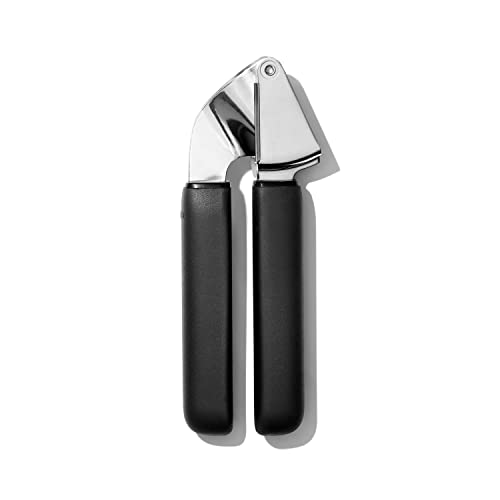
OXO Good Grips Garlic Press
The OXO Good Grips Garlic Press is the familiar mid-tier all-rounder, positioned in the mid-tier of the market, and its defining idea is wide soft handles, a generous chamber and a built-in cleaning tool stored in the handle. In daily use that idea matters more than any single specification: you feel it in how the chamber loads, how the handles travel, and how the tool behaves at the sink afterwards. It presses standard supermarket cloves without drama, handles two small cloves together when a recipe is generous, and produces the fine, wet paste that sauces and dressings want. Check price on Amazon if you are buying with a link later; in prose terms, judge it against the tier described here rather than against the cheapest press on the shelf.
Strengths in real use are consistency and predictability. The output from the first clove matches the output from the sixth, the skin behaves itself more often than not, and the cleaning routine is learnable in one wash: rinse at once, clear the sieve face, open it fully where the design allows, and let it dry before the drawer. Its honest limitation is the one every press shares and this design only softens: some garlic always stays behind, dried residue always fights back, and a knife still wins for a single clove when the board is already out. Choose this one if easy everyday pressing matters more than squeezing out the last premium refinement.
Best for: cooks whose habits match the design idea described above. Not suited for: anyone expecting any press to make cleaning disappear entirely, or cooks who mince once a month and already enjoy doing it by hand.
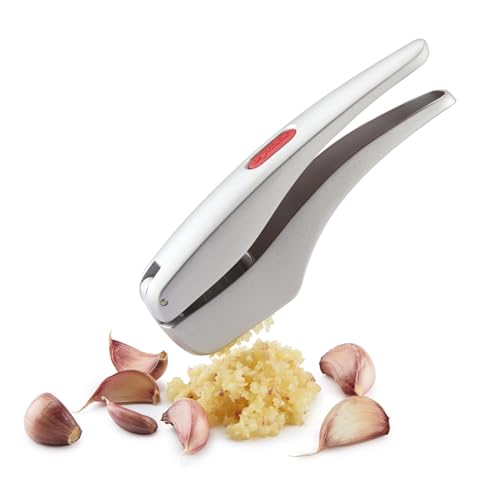
Zyliss Susi 3 Garlic Press
The Zyliss Susi 3 Garlic Press is the lightweight integrated-cleaner design, positioned in the mid-tier of the market, and its defining idea is a lighter body, an integrated cleaning tool that clips in place, and a chamber shaped to take a large clove without peeling first. In daily use that idea matters more than any single specification: you feel it in how the chamber loads, how the handles travel, and how the tool behaves at the sink afterwards. It presses standard supermarket cloves without drama, handles two small cloves together when a recipe is generous, and produces the fine, wet paste that sauces and dressings want. Check price on Amazon if you are buying with a link later; in prose terms, judge it against the tier described here rather than against the cheapest press on the shelf.
Strengths in real use are consistency and predictability. The output from the first clove matches the output from the sixth, the skin behaves itself more often than not, and the cleaning routine is learnable in one wash: rinse at once, clear the sieve face, open it fully where the design allows, and let it dry before the drawer. Its honest limitation is the one every press shares and this design only softens: some garlic always stays behind, dried residue always fights back, and a knife still wins for a single clove when the board is already out. Choose this one if low weight and a stored cleaning tool solve the two annoyances you actually have.
Best for: cooks whose habits match the design idea described above. Not suited for: anyone expecting any press to make cleaning disappear entirely, or cooks who mince once a month and already enjoy doing it by hand.

Kuhn Rikon Epicurean Garlic Press
The Kuhn Rikon Epicurean Garlic Press is the premium stainless lever design, positioned in the premium of the market, and its defining idea is an all-stainless build, a swing-out sieve that opens fully for rinsing, and long handles that convert grip into pressure efficiently. In daily use that idea matters more than any single specification: you feel it in how the chamber loads, how the handles travel, and how the tool behaves at the sink afterwards. It presses standard supermarket cloves without drama, handles two small cloves together when a recipe is generous, and produces the fine, wet paste that sauces and dressings want. Check price on Amazon if you are buying with a link later; in prose terms, judge it against the tier described here rather than against the cheapest press on the shelf.
Strengths in real use are consistency and predictability. The output from the first clove matches the output from the sixth, the skin behaves itself more often than not, and the cleaning routine is learnable in one wash: rinse at once, clear the sieve face, open it fully where the design allows, and let it dry before the drawer. Its honest limitation is the one every press shares and this design only softens: some garlic always stays behind, dried residue always fights back, and a knife still wins for a single clove when the board is already out. Choose this one if you press often, wash seriously, and want the tool to feel unchanged after years of service.
Best for: cooks whose habits match the design idea described above. Not suited for: anyone expecting any press to make cleaning disappear entirely, or cooks who mince once a month and already enjoy doing it by hand.
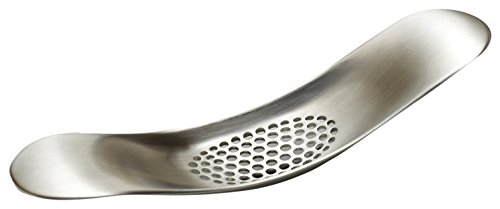
Joseph Joseph Garlic Rocker
The Joseph Joseph Garlic Rocker is the press-free rocking alternative, positioned in the entry-to-mid tier of the market, and its defining idea is a curved rocking body with no moving hinge at all: you rock it over a peeled clove and scrape the crushed garlic from its surface. In daily use that idea matters more than any single specification: you feel it in how the chamber loads, how the handles travel, and how the tool behaves at the sink afterwards. It presses standard supermarket cloves without drama, handles two small cloves together when a recipe is generous, and produces the fine, wet paste that sauces and dressings want. Check price on Amazon if you are buying with a link later; in prose terms, judge it against the tier described here rather than against the cheapest press on the shelf.
Strengths in real use are consistency and predictability. The output from the first clove matches the output from the sixth, the skin behaves itself more often than not, and the cleaning routine is learnable in one wash: rinse at once, clear the sieve face, open it fully where the design allows, and let it dry before the drawer. Its honest limitation is the one every press shares and this design only softens: some garlic always stays behind, dried residue always fights back, and a knife still wins for a single clove when the board is already out. Choose this one if you dislike hinges and baskets and want the simplest possible thing to rinse.
Best for: cooks whose habits match the design idea described above. Not suited for: anyone expecting any press to make cleaning disappear entirely, or cooks who mince once a month and already enjoy doing it by hand.

Dreamfarm Garject
The Dreamfarm Garject is the self-cleaning ejector design, positioned in the premium of the market, and its defining idea is a press with a built-in scraper that sweeps the sieve as you open it and an ejector button that flicks the spent peel away. In daily use that idea matters more than any single specification: you feel it in how the chamber loads, how the handles travel, and how the tool behaves at the sink afterwards. It presses standard supermarket cloves without drama, handles two small cloves together when a recipe is generous, and produces the fine, wet paste that sauces and dressings want. Check price on Amazon if you are buying with a link later; in prose terms, judge it against the tier described here rather than against the cheapest press on the shelf.
Strengths in real use are consistency and predictability. The output from the first clove matches the output from the sixth, the skin behaves itself more often than not, and the cleaning routine is learnable in one wash: rinse at once, clear the sieve face, open it fully where the design allows, and let it dry before the drawer. Its honest limitation is the one every press shares and this design only softens: some garlic always stays behind, dried residue always fights back, and a knife still wins for a single clove when the board is already out. Choose this one if the scrape-and-eject routine matches how you cook: fast, repetitive, and intolerant of picking at sieves.
Best for: cooks whose habits match the design idea described above. Not suited for: anyone expecting any press to make cleaning disappear entirely, or cooks who mince once a month and already enjoy doing it by hand.
How to Get the Most Value If You Buy
Every press leaves something behind. A film of garlic stays on the sieve face, fibres lodge in the holes, and a portion of the clove never extrudes at all. Good designs accept this and make the residue easy to remove: sieves that swing out, surfaces that open flat, and cleaning tools shaped to the hole pattern. Poor designs hide the residue in a fixed basket you can only reach with a fingertip and hope. Judge any press by its worst moment, which is not the first squeeze but the washing-up afterwards.
The single most valuable habit in this entire subject costs nothing: rinse the press immediately. Garlic residue that is rinsed within a minute lifts away under the tap with almost no effort, while the same residue left through dinner dries into a cement that glues itself into every hole. If you cannot wash straight away, drop the press into a mug of water beside the sink. Soaking is the difference between a ten-second rinse and a ten-minute excavation, and it matters more than any cleaning tool bundled in the box.
Stainless steel is the reference material for presses because it resists garlic’s sulphur compounds, shrugs off the dishwasher and does not flex under load. Die-cast aluminium and zinc alloy presses can be excellent and lighter, but their coatings deserve respect: once a coating chips at the sieve edge, the metal beneath can discolour and cleaning gets harder. Plastic-bodied presses keep weight and cost down and suit occasional use, yet the hinge is where they eventually confess their limits, usually mid-recipe and always at the worst moment.
The hinge is the press’s quiet weak point. Every squeeze loads it, every wash wets it, and on cheaper designs it is a simple pin through cast lugs that slowly develops play. A press with hinge play wastes force sideways, so the handles travel further for the same pressure and the chamber misaligns with the sieve. When you handle a press, squeeze it empty and feel for lateral wobble. None when new is the standard to demand, because wobble never improves with age; it only announces itself earlier each year.
Handle comfort is not a luxury detail on a tool whose entire job is being squeezed hard. Wide, slightly soft handles spread the load across your palm and fingers, while thin metal handles concentrate it into lines that ache by the fourth clove. This matters most for cooks who batch-prep, and it matters in a different way for anyone whose grip is not what it was: a press that needs a two-handed squeeze for a big clove is a press that will quietly stop being used, whatever its other virtues.
The Decision Checklist
Answer honestly: Do you cook with garlic at least three nights most weeks? Do you ever press or mince more than four cloves at once? Do you rinse tools immediately as a matter of routine? Would uniform garlic improve your sauces and dressings? Is drawer space genuinely available? Do you dislike garlic smell on your hands? Four or more yes answers: buy a good mid-tier press without further deliberation. Two or fewer: keep the knife, and spend nothing with a clear conscience.
Worth It for Whom? A Garlic Press Break-Even Test Based on Your Actual Routine
Most advice about a garlic press focuses on the day you buy it, yet satisfaction is decided later, at the prep area beside the board, mid-recipe, during crushing cloves quickly while a pan is already heating. So work backwards from daily life: fix the routine, the space and the people in your mind first, and only then weigh the features that looked persuasive on a product page. Start with whether unpeeled cloves, cleaning pins or a removable basket suit how you cook. If that check fails, stop there, since the remaining virtues of any garlic press are built on a foundation your home has already rejected. Every household has an unusual week, and for yours it may be that recipes needing one small clove, where a knife may honestly be faster; buy for that week as well as the ordinary one.
Ask which part of the garlic press will look tired first and whether that tiredness is cosmetic, cleanable, repairable or terminal, because the answer sets the realistic lifespan. Keep the paperwork, digital or printed, in one known place: instructions, guarantee details and the measurements you took. Future you, troubleshooting at an inconvenient hour, will be grateful. Flexibility is worth paying for only if you will use it. A garlic press that folds, moves or converts impresses in the listing and matters only if your routine actually asks it to. Check for duplicated function in your own home first, because the item you already own that does part of this job changes what the new garlic press actually needs to be.
- Set the minimum usage that justifies keeping it.
- Calendar a one-month check against your prediction.
- Add storage, cleaning and replacement-part costs to the reckoning.
- Count honest uses in a typical month before deciding.
- Name the simpler alternative and what it cannot do for you.
If the honest answer is that a borrowed, shared or simpler alternative covers your real need, believe it, because a garlic press that sits idle is not a bargain at any specification. When a shortlist refuses to separate, stop comparing headline features and compare failure modes instead, since you will meet the weaknesses weekly and the strengths only occasionally. Anything heavy, hot, sharp, load-bearing or electrically powered deserves a respectful pause in the decision, and the maker’s own guidance, read before purchase, is part of the specification. Include the hidden costs in your reckoning: storage space, cleaning time, replacement parts, accessories and the attention the item demands when something small goes wrong.
Think about handing the task over: if someone else had to use, clean or reset the garlic press from your brief description alone, the design and your setup would pass or fail together. For something used every day, durability and fit deserve the larger share of your attention, because the purchase happens once and the using happens hundreds of times. For items that suffer from constant use without rest, a planned spare is not extravagance; it is how the routine survives the day the main one is wet, dirty, broken or missing. Read the included-parts list as carefully as the feature list. Many disappointing first days with a garlic press are simply the discovery that an essential accessory was never in the box.
Imagine the routine at its most demanding rather than its most pleasant, and notice which weaknesses in a garlic press would stop being theoretical and start being daily. Ask the least enthusiastic person in the home what would annoy them about it. Their answer usually identifies the storage, cleaning or noise issue that the buyer was too optimistic to see. The failure pattern to plan against is residue drying in the holes, turning a quick tool into a slow cleaning job, and it seldom arrives suddenly; it builds through small, ordinary habits that nobody notices during the first few weeks. Uncertainty about your own routine cannot be fixed by research about products. Settle how, where and how often the garlic press will be used, and the shortlist usually shortens itself.
Try this decision exercise: write down three non-negotiable jobs, one acceptable compromise and one walk-away flaw. If a candidate survives that list, it deserves its place on the shortlist. Consider what the garlic press gives off while it works and what it leaves behind afterwards, because living with the by-products is part of living with the product. Attention is a budget too. A garlic press that needs remembering, scheduling, monitoring or special handling spends it, so count that cost alongside the physical ones. Beware of solving a problem you do not have, because the largest or most elaborate version of a garlic press adds cleaning, storage and cost in effort to a routine a simpler version would have served perfectly.
Frequently Asked Questions
Is a garlic press worth it for a small household?
It can be, if that small household cooks with garlic often. Household size matters less than frequency: a couple making garlic-rich food four nights a week gets more from a press than a large family using garlic twice a month. Judge by cloves per week, not by people per table, and the answer usually becomes obvious.
Why do some chefs dislike garlic presses?
Mainly for texture and control. Mincing keeps garlic in pieces that brown gently and stay distinct in a dish, while pressing produces a sharp, wet paste that disperses completely and burns sooner. Some chefs also dislike the cleaning and the small waste. Those are coherent preferences, not snobbery, and home cooks who share them should mince with pride.
Does a garlic press save time overall, including cleaning?
Yes, when rinsed immediately and used at volume. Pressing several cloves takes seconds, and a rinsed press washes in seconds too. The arithmetic fails only in the two edge cases: a single clove, where the knife was faster all along, and a press left unrinsed, where cleaning eats the savings. Both edge cases are about habits, not hardware.
What is the free alternative to a garlic press?
A knife and a cutting board you already own. Mincing takes under a minute per clove with practice, and crushing the mince with the flat of the blade and a pinch of salt produces a true paste when a recipe needs one. The alternative is genuinely free and genuinely good, which is exactly why a press must earn its place on frequency rather than novelty.
How long does a good garlic press last?
A stainless press with a sound hinge can serve for many years of weekly use. Coated alloy models last well while their coating stays intact. The usual endings are hinge play, chipped coatings and lost cleaning tools, all postponed by rinsing promptly, drying before storage and never forcing a clogged chamber. Buy the tier your frequency justifies and longevity follows.
Should I buy a press if I have limited hand strength?
Consider leverage first, in qualitative terms: long handles, wide soft grips and an efficient pivot make pressing feel substantially easier, and a rocker replaces the squeeze with a downward rocking motion using body weight. Avoid short, compact presses. The right design can make garlic prep more comfortable; the wrong one will simply gather dust.
Related Guides
Keep exploring the same corner of the kitchen: our companion guide: garlic press review our companion guide: garlic press reviews our companion guide: garlic press buying guide best cutting boards for home cooks best chef knife sets for cooks who still mince by hand best dishwasher-safe cutting board picks.
Extra Field Notes
Field note, in the test kitchen: the hinge is the press’s quiet weak point. Every squeeze loads it, every wash wets it, and on cheaper designs it is a simple pin through cast lugs that slowly develops play. A press with hinge play wastes force sideways, so the handles travel further for the same pressure and the chamber misaligns with the sieve. When you handle a press, squeeze it empty and feel for lateral wobble. None when new is the standard to demand, because wobble never improves with age; it only announces itself earlier each year.
Field note, in the test kitchen: handle comfort is not a luxury detail on a tool whose entire job is being squeezed hard. Wide, slightly soft handles spread the load across your palm and fingers, while thin metal handles concentrate it into lines that ache by the fourth clove. This matters most for cooks who batch-prep, and it matters in a different way for anyone whose grip is not what it was: a press that needs a two-handed squeeze for a big clove is a press that will quietly stop being used, whatever its other virtues.
Field note, in the test kitchen: dishwasher-safe on the box and dishwasher-happy in practice are different claims. Stainless presses genuinely tolerate the dishwasher for years. Coated alloy presses often survive it too, but detergents are hard on coatings and on the polished finish of handles, and garlic residue baked on by a hot wash is harder to remove than residue rinsed first. The sensible routine, whatever the label says, is rinse immediately, then choose: hand-wash in seconds, or rack it knowing the rinse already did the real work.
Field note, in the test kitchen: a garlic press lives in a drawer, and drawer life is unkind to fussy mechanisms. Ejector buttons get pressed by neighbouring tools, cleaning tools unclip and migrate to the drawer’s dark corners, and rocking tools slide under everything. None of this is a reason to avoid a design you like; it is a reason to give the press a consistent home, ideally in a utensil crock or the same drawer section every time, so the small parts and your habits stay together.
Field note, in the test kitchen: the honest benchmark for every press is a knife and a board, which together cost nothing extra because you already own them. A practiced cook can mince a clove in well under a minute, and the flat of the blade plus a pinch of salt will produce a paste when a paste is truly wanted. What the press sells is not capability but consistency and speed at volume: identical results on clove one and clove twelve, with no knife skills assumed and no board to scrub afterwards. Judge it on that basis and the decision gets much clearer.
Field note, in the test kitchen: volume is where the press earns its drawer space. One clove for a dressing is a knife job by any sensible measure. Six cloves for a soup, a whole head for a marinade, or a double batch of garlic butter is where pressing pulls away: each clove takes seconds, the output is uniform, and your hands stay clean enough to move straight to the next task. Households that cook garlic-heavy food several nights a week feel this arithmetic weekly; occasional garlic users may never feel it at all.
Field note, in the test kitchen: garlic hands are the press’s smallest and most persuasive argument. Mincing leaves your fingers carrying the smell through the evening, and it transfers to everything you touch. A press keeps fingers mostly clear of the cut surfaces, especially with unpeeled cloves, and a stainless press has a side benefit many cooks swear by: rubbing your hands on stainless under water afterwards noticeably reduces the lingering smell. It is a modest gain, but it is the one owners mention first when asked why the press stayed.
Field note, in the test kitchen: what happens to the skin tells you a lot about a press. In a well-shaped chamber the skin flattens into a neat disc that lifts out in one piece, sometimes with the help of the ejector or a fingertip. In a poorly shaped one the skin shreds, mixes with unpressed flesh and turns emptying into picking. When you read product descriptions, look for language about the chamber shape and the peel’s exit, not just pressing power; the peel’s journey is the part you repeat most often.
Field note, in the test kitchen: hole size is a texture dial. Small holes produce a fine, wet paste that melts into sauces and dressings and all but vanishes. Larger holes give a coarser crush closer to a rough mince, which holds up better in a hot pan and reads as garlic rather than garlic essence. There is no universal right answer, only a match to your cooking: sauce-led cooks should favour fine holes, while cooks who start everything in a frying pan often prefer the coarser output and the slower browning that comes with it.
Field note, in the test kitchen: dried residue deserves its own warning because it defeats good presses and bad ones equally. Once garlic paste dries inside the holes, water alone struggles: the fibres swell, grip, and resist. The rescue routine is a soak in warm water, then working from the back of the sieve with a brush or the press’s own cleaning tool, pushing residue out the way it came in. A wooden skewer handles individual blocked holes. What never helps is forcing the handles together on a clogged press, which loads the hinge for no benefit.
Field note, in the test kitchen: batch prep changes the ranking of almost every design. A press that is delightful for two cloves can become tedious at twenty if the chamber needs picking clean between cloves, while a design with a scraper or ejector keeps its rhythm: press, open, flick, reload. If you regularly make big pots, sauces for the freezer or infused oils for gifts, weigh the emptying action as heavily as the pressing action. Throughput is a system, and the slowest step in the system is the one you will feel.
Field note, in the test kitchen: a garlic press makes a quietly excellent gift for a new household precisely because it is useful weekly and rarely bought well for oneself. The gifting rules are simple: choose stainless or a respected mid-tier design, favour easy cleaning over novelty mechanisms, and avoid anything so specialised that the recipient needs instructions. Paired with a board and a head of good garlic, it reads as thoughtful rather than gadgety, and it will be used long after more theatrical kitchen gifts have been rehomed.
Field note, in the test kitchen: leverage is the whole physics of a garlic press. The clove resists, the sieve resists, and the only thing standing between you and a clean press is how efficiently the handles multiply the force in your hand. Long handles with the pivot set well forward feel dramatically easier than short handles with the pivot near the chamber, even when the chambers look identical on a shelf. When you test a press in a shop, mime the squeeze: if your fingers are already fully closed before the imaginary clove would give way, the geometry is working against you, and every clove after the third will feel like hard work.


