A shop fan moves large volumes of air through garages, workshops, barns and job sites. Models come as drum fans, pedestal fans, wall-mount units and floor blowers, and they differ in motor build, blade size and how they handle a long day of use. The right match depends on the room and the task.
We have not used these products ourselves, so this page is a buying guide and not a verdict on any item. It lays out the features worth comparing, a table to use on product pages, and notes on setup, upkeep and common mistakes. Follow the maker’s instructions for the exact fan you buy.
As an Amazon Associate we earn from qualifying purchases. Links on this site are affiliate links, and they do not change the information we give.
In this guide
Quick Picks
| Pick | Product | Best For |
|---|---|---|
| 1 | Maxx Air 24-Inch High Velocity Drum Fan BF24TF | Best all-round drum fan for garages and shops |
| 2 | Tornado 24-Inch High Velocity Pedestal Fan | Best for airflow over benches and equipment |
| 3 | Tornado 24-Inch Oscillating Wall Mount Fan | Best for permanent mounting and free floor space |
| 4 | Lasko QuickMount 2264QM High Velocity Fan | Best convertible floor-or-wall fan |
| 5 | XPOWER P-230AT Mini Mighty Air Mover, Blue | Best blower for drying floors and tight spots |
Our Picks
1. Maxx Air 24-Inch High Velocity Drum Fan BF24TF — Best all-round drum fan for garages and shops
The BF24TF is the classic shop drum fan the guide describes: a 24-inch blade inside a steel barrel housing that focuses the air into a strong stream. Maxx Air rates it at up to 4,000 CFM from a two-speed, thermally protected motor, which covers the airflow and motor-protection points in the buying table. The fan head tilts up to 180 degrees with tool-free knobs, so you can aim it at a workbench, across a garage floor or up toward a ceiling to stir the whole room. Four handles and built-in wheels on this style of drum make it easier to reposition than fixed units, and the powder-coated steel grille guards the blades while still removing for cleaning. Two speeds keep the control simple: high for hot afternoons and drying, low for steady circulation with less noise. It takes floor space like every drum fan, but the footprint is compact for its output. Choose it if you want one movable fan that handles cooling, ventilation and drying duty in a garage, barn or workshop.
View Maxx Air 24-Inch High Velocity Drum Fan BF24TF on Amazon

2. Tornado 24-Inch High Velocity Pedestal Fan — Best for airflow over benches and equipment
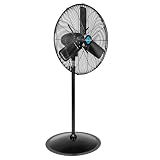
A pedestal layout solves the problem the guide raises with floor fans: air that has to travel over machinery, benches and stored material instead of into it. This Tornado stands its 24-inch metal blade on an adjustable pole, so the airstream can ride above obstacles and reach the person working behind them. Three speed settings let you trade airflow against noise, running it hard during heavy work and dropping it down for steady background circulation. The metal construction suits dusty shop conditions better than light plastic housings, and the wide, weighted base design is the stability point the guide tells you to check on any tall fan. Height adjustment also helps when the room layout changes, since the same fan can clear a low bench one week and a vehicle the next. It does need a reasonably level floor and more vertical clearance than a drum fan. Choose the Tornado pedestal if your shop is crowded and you need airflow delivered at standing height across a wide area.

3. Tornado 24-Inch Oscillating Wall Mount Fan — Best for permanent mounting and free floor space
Wall mounting is the guide’s answer when floor space is too valuable to give up, and this Tornado is built for that fixed role. The 24-inch metal fan hangs from a wall bracket, and its oscillation sweeps the airstream across a wide arc instead of blasting one spot, which suits barns, greenhouses and workshops where people move around. Three speeds cover the usual range from gentle circulation to full ventilation, and the head also tilts so the sweep can be aimed higher or lower once the bracket height is set. Metal blades and housing fit the dusty, long-day conditions the guide associates with industrial use. Installation needs a sturdy mounting point and a nearby outlet, and you should plan cleaning access, since a mounted fan collects the same dust as any other. In return, nothing sits on the floor to trip over or block a doorway. Choose it if you have one room that always needs air movement and a wall that can carry the bracket.

4. Lasko QuickMount 2264QM High Velocity Fan — Best convertible floor-or-wall fan
The QuickMount is the flexible option in this list: Lasko’s bracket system lets the same 20-inch fan sit on the floor or hang on a wall, so it can change roles as the shop changes. That convertibility answers the guide’s mounting-style question better than a single-purpose unit. The head pivots to direct the stream up, down or straight ahead, and three speeds give a workable spread between quiet circulation and maximum cooling. At 20 inches it moves less air than the 24-inch models above, which makes it a better match for single workstations, small garages and home workshops than for large barns. The metal grille and housing keep it in the industrial category rather than the household one, and the compact body stores easily when it is not mounted. Controls are simple dials on the unit, with no remote to lose. Choose the QuickMount if you want one fan that can cool a bench from the floor today and mount permanently above it later.
View Lasko QuickMount 2264QM High Velocity Fan on Amazon
5. XPOWER P-230AT Mini Mighty Air Mover, Blue — Best blower for drying floors and tight spots
The P-230AT covers the blower style the guide compares: instead of a wide fan wash, its centrifugal housing throws a focused stream along the floor, which is what drying paint, concrete, carpet and wet work areas actually needs. This blue 1/4 HP version is rated at 925 CFM, remarkable output for a unit that weighs about ten pounds, and it offers four operating positions, from flat on the floor to angled upward, plus three speeds and a three-hour timer. The housing is injection-moulded polypropylene, so it shrugs off the knocks of job sites, and units stack for storage or for running several in a row. Built-in power outlets let you daisy-chain additional movers from one socket, a practical detail when a whole room has to dry. It will not cool a person across a room like the drum and pedestal fans above. Choose the P-230AT if your shop work involves drying surfaces, clearing dust or ventilating a confined corner.
View XPOWER P-230AT Mini Mighty Air Mover, Blue on Amazon
What to Look For
| Factor | Why it matters | What to check |
|---|---|---|
| Airflow | Shows how much air the fan can move across the space. | The maker’s CFM figure, blade diameter and the room size it is meant for. |
| Motor and build | Affects how well the fan handles dust and long run times. | Motor type, housing material, bearing style and cord length. |
| Mounting style | Sets where you can place the fan and how much floor it uses. | Pedestal, wall bracket, floor stand or drum; tilt range and base stability. |
| Speed settings | Lets you balance airflow and noise for the job. | Number of speeds, switch type and any remote or thermostat option. |
| Guard design | Protects fingers and stray materials from the blades. | Grille spacing, finish and whether the guard comes off for cleaning. |
| Noise | A loud unit can wear on you in a small workshop. | The maker’s stated sound level and how it is measured. |
Setup and Care Tips
- Place the fan on a level surface or mount it firmly using the hardware the maker supplies.
- Disconnect power before cleaning the grille and blades, and use a soft brush for dust.
- Keep cords out of walkways and away from sharp edges or standing water.
- Aim airflow to move air across the whole room, such as drawing fresh air in at one door.
- Store the fan in a dry spot with a cover when it is out of season.
Mistakes to Avoid
- Buying on blade size alone without comparing the airflow figure.
- Ignoring where the cord reaches before choosing a mounting spot.
- Using a fan in conditions the maker does not describe, such as wet areas.
- Letting dust build up on the guard and motor housing.
- Choosing the highest speed setting when a quieter unit would cover the space.
Understanding Airflow Figures and Coverage
Airflow is the headline number for a shop fan, usually given as cubic feet per minute. It describes how much air the fan moves under the maker’s test conditions, which differ between brands, so comparisons work best when the numbers are presented in the same way. Blade diameter and motor speed are related to airflow, but a bigger fan is not automatically a stronger one. Blade pitch, guard design and motor power all play a part.
To use these figures, start with your space. Estimate the volume of the room by multiplying length, width and height. Then think about how often you want the air to turn over. A small workshop that needs a bit of circulation has very different needs from a large barn where you want strong air movement for hours. Makers may suggest room sizes for each model, and those suggestions are only guidance.
Distance matters. Air spreads and slows as it leaves the fan, so a fan used to cool a worker at a bench should be aimed from a short distance, while a fan for room circulation can sit farther back. Obstacles like machinery, shelves and vehicles block airflow, so you may need two smaller fans in different spots instead of one large unit.
Remember that moving air feels cooler but does not lower the room temperature. A fan cools people by evaporating sweat, so it may be most useful where someone is working. For ventilation, such as clearing dust or fumes, a fan must work with an open door or window to move air out.
Drum, Pedestal, Wall-Mount and Blower Styles Compared
Drum fans are a common choice for garages and job sites. They have a cylindrical housing around the blade, which focuses the air and protects the blade. They sit on the floor and often tilt, so you can aim them up or down. They are generally stable and compact, but they take up floor space.
Pedestal fans stand on an adjustable pole, which lets you raise the fan above equipment or people. Many oscillate, covering a wide area. Because they are taller, they can be less stable on uneven floors, so check the base width and weight. They suit larger rooms and workshops where airflow should be directed from above.
Wall-mount fans free the floor and are good for permanent installations, such as in a barn or a workshop. They require a sturdy mounting point, hardware and, usually, a nearby outlet. Check whether the fan oscillates and whether the bracket is included. Consider access for cleaning.
Blower or air mover styles focus air in a stream and are used to dry floors, carpets and work surfaces, or to move air through ducts. They can be loud and are often stackable or tiltable. Look at how many angles they offer and how they fit in tight places. Choose the style to match your task. Cooling a person, ventilating a room, drying a surface and circulating air in a large space are different jobs.
Motor Construction, Speeds and Noise
The motor is the heart of an industrial fan. Many shop fans have an enclosed or totally enclosed motor design, which is meant to keep dust out and extend the life. Read the maker’s description of the motor housing. Look for wording about continuous duty or thermal protection, which may automatically shut the motor off if it overheats. If a listing does not mention these details, check the manual.
Speed settings add flexibility. Two or three speeds are common, and some fans offer variable control. A low setting is quieter and good for steady circulation, and a high setting is useful in hot weather or for drying. Check how the speed is controlled, by a switch, knob or remote, and whether the control is easy to reach.
Noise can be a challenge in a garage or a shop where you also use tools. Makers sometimes list sound levels, but testing methods vary. Larger blades running at lower speed tend to move air with less noise than small blades at high speed, though this is a general tendency, not a rule. Rubber feet or a stable base can reduce vibration.
The blade material is typically metal or plastic. Metal blades are often described as more durable, and plastic blades as lighter and quieter. Guards should have openings small enough to prevent fingers from reaching the blades, as required by safety standards in your area. Check the guard and how it attaches.
Power Cords, Switches and Electrical Safety
An industrial fan is only as safe as its electrical setup. Look at the cord length and thickness, and check whether the plug is grounded. A short cord may tempt you to use an extension cord, but many makers advise against it, or require one rated for the fan’s load. If you must use one, choose a heavy-duty cord of the right length and rating, and keep it away from water, heat and foot traffic.
Check the on and off switch. A well-placed switch with a clear marking is useful, especially in a dusty shop. Some fans have a pull-chain or a rotary control. A power switch that lights up shows that the fan is on.
Check the circuit capacity. A large fan may draw significant current, and sharing a circuit with power tools, a compressor or a heater can trip the breaker. Know what else is on the circuit and avoid overloading it.
Protect the fan from moisture unless the maker specifies it as suitable for damp or wet areas. Do not place a fan where water can splash it, and unplug it before moving or cleaning. Keep the guard in place at all times. Do not insert objects through the grille. Keep children and pets away. If you notice a burning smell, sparks or unusual noise, unplug it and have it inspected.
Placement, Maintenance and Seasonal Storage
Where you put a fan affects results. For cooling, point the fan at the work area and let the air move across the person. For ventilation, put a fan in a window or doorway pushing air out, with another opening letting fresh air in. For drying, aim the stream across wet surfaces at a low angle. Keep the fan on a stable surface, away from walkways, and keep the cord tidy.
Regular cleaning keeps the fan efficient. Unplug it, and use a soft brush or vacuum to remove dust from the grille, blades and motor housing. Dust and grease reduce airflow and can unbalance the blades. Wipe with a damp cloth and let it dry. Do not spray liquid into the motor. Check the mounting hardware and tighten loose screws.
Check for wobble or noise. A bent blade or loose guard can cause vibration, and a worn motor bearing can squeal. Some fans need occasional lubrication, but only if the manual says so. Do not oil a sealed motor.
At the end of the season, clean the fan and store it in a dry place, covered to keep dust out. Coil the cord loosely. Before using it again, inspect the cord and plug for damage. Replace the fan if the motor smells hot, the blades are damaged or the housing is cracked. Keep the manual and receipt for warranty claims.
Going Deeper: Matching Industrial shop fans to Real Life
The shortlist above gives you the headline differences between these industrial shop fans, but the right choice usually becomes obvious only when you picture an ordinary week with the product in your home. Think about where it will live, who will use it most often, and what will make you stop using it if you get that part wrong. A product that looks ideal on a listing page can still be the wrong fit if it fights your space, your routine or the other people and things around it. The sections below walk through that thinking in the order experienced buyers tend to use, so you can test each pick on this page against your own situation before you commit.
Start with the job you actually need done
Write down, in one plain sentence, the main job you want these industrial shop fans to do, and then a second sentence for the job you hope they will also handle occasionally. Most disappointment comes from buying for the occasional job and living every day with the compromise that creates. If the main job is daily and demanding, favour the pick that handles that job with the least fuss, even if another option looks more versatile on paper. If the main job is light and occasional, ease of storage, simple setup and low-maintenance care usually matter more than maximum capability. Keep those two sentences beside you as you re-read the picks above, and score each one honestly against them rather than against an idealised version of your routine.
Next, think about the conditions around the job. Will these industrial shop fans be used indoors, outdoors, or moved between the two? Will they be used by one person or shared, by beginners or by people who already know what they are doing? Will they be used in short bursts or for long stretches at a time? Each answer quietly rules some designs in and others out: shared and frequent use rewards sturdiness and simple controls, while occasional solo use rewards compact size and quick setup. None of this appears in a headline feature list, yet it decides how satisfied you will feel a few months from now, when the novelty has worn off and only the everyday experience remains.
Measure the space, then measure it again
Space is the most common reason purchases like these get returned or quietly abandoned, so measure before you fall for any particular model. Note the full footprint the product needs in use, not just at rest: allow room to walk around it, to open anything that opens, to plug in, load, adjust or get on and off safely, and to store the accessories that come with it. Check doorways, hallways and storage spots it must pass through or live in, and compare those numbers with the dimensions the maker lists, in the same units, before ordering. If two people will use the space at once, allow for both of them. A few minutes with a tape measure now is far cheaper than repacking a bulky box later.
It also helps to think about what the product displaces. Few homes have genuinely empty space waiting, so these industrial shop fans will usually push something else aside, share a corner, or need a small reorganisation to work well. Decide in advance where the displaced things go, and whether the new arrangement still leaves the room comfortable to move through. Consider light, airflow and noise as well: a spot that is technically big enough can still be a poor home if it is gloomy, cramped to reach, or likely to disturb people in the next room. Choosing the location first, and the model second, reverses the order most people use, and it prevents the classic mistake of a good product exiled to a bad corner.
Match the design to the user, not the brochure
Every design in this category involves a trade-off between capability, convenience and care. Simpler designs tend to be lighter, cheaper to maintain and easier to learn, but they may ask more of the user in patience or technique. More elaborate designs can take work off your hands or add comfort and control, yet they usually bring more parts to clean, more settings to understand and more that can wear or fail over time. Neither direction is better in the abstract. The better question is which trade-offs you personally mind least. If you know you abandon fiddly routines, choose the option you will actually use on a tired weekday, not the one that impresses on the first weekend.
If the product will be shared, involve the other users before you buy rather than after. People differ in height, strength, confidence and patience, and a design that suits the person who did the research can quietly exclude everyone else. Where the maker lists sizes, capacities or user limits, check them against the real people involved, including whoever is likely to grow, join in or help with setup and cleaning. Where adjustability is offered, value it properly: a little flexibility in fit or configuration often matters more over years of use than a small difference in headline features, because it lets one purchase keep working as people and habits change around it.
How the Picks Above Compare in Everyday Use
With that groundwork done, the picks in this guide sort themselves more clearly. Each one below earned its place for a different kind of buyer, so instead of asking which is best overall, ask which description sounds most like your household. The notes that follow use only what this guide has already said about each product, reframed around daily use, so you can compare them on the things that will actually decide your experience.
Maxx Air 24-Inch High Velocity Drum Fan BF24TF is this guide’s choice for best all-round drum fan for garages and shops. Read its description above with your two job sentences in mind: if that best-for use is your main job, this is the benchmark the others have to beat. Pay attention to how it is meant to be set up and stored, because that routine is the one you would repeat most often, and to any sizing or user guidance the maker gives, since a good match there matters more than small feature differences. If its best-for use sounds like your occasional job rather than your main one, keep it on the list by all means, but let a pick aimed squarely at your everyday need lead, and treat this one as the alternative to choose only if its particular strengths genuinely outweigh that focus.
Tornado 24-Inch High Velocity Pedestal Fan is this guide’s choice for best for airflow over benches and equipment. Read its description above with your two job sentences in mind: if that best-for use is your main job, this is the benchmark the others have to beat. Pay attention to how it is meant to be set up and stored, because that routine is the one you would repeat most often, and to any sizing or user guidance the maker gives, since a good match there matters more than small feature differences. If its best-for use sounds like your occasional job rather than your main one, keep it on the list by all means, but let a pick aimed squarely at your everyday need lead, and treat this one as the alternative to choose only if its particular strengths genuinely outweigh that focus.
Tornado 24-Inch Oscillating Wall Mount Fan is this guide’s choice for best for permanent mounting and free floor space. Read its description above with your two job sentences in mind: if that best-for use is your main job, this is the benchmark the others have to beat. Pay attention to how it is meant to be set up and stored, because that routine is the one you would repeat most often, and to any sizing or user guidance the maker gives, since a good match there matters more than small feature differences. If its best-for use sounds like your occasional job rather than your main one, keep it on the list by all means, but let a pick aimed squarely at your everyday need lead, and treat this one as the alternative to choose only if its particular strengths genuinely outweigh that focus.
Lasko QuickMount 2264QM High Velocity Fan is this guide’s choice for best convertible floor-or-wall fan. Read its description above with your two job sentences in mind: if that best-for use is your main job, this is the benchmark the others have to beat. Pay attention to how it is meant to be set up and stored, because that routine is the one you would repeat most often, and to any sizing or user guidance the maker gives, since a good match there matters more than small feature differences. If its best-for use sounds like your occasional job rather than your main one, keep it on the list by all means, but let a pick aimed squarely at your everyday need lead, and treat this one as the alternative to choose only if its particular strengths genuinely outweigh that focus.
XPOWER P-230AT Mini Mighty Air Mover, Blue is this guide’s choice for best blower for drying floors and tight spots. Read its description above with your two job sentences in mind: if that best-for use is your main job, this is the benchmark the others have to beat. Pay attention to how it is meant to be set up and stored, because that routine is the one you would repeat most often, and to any sizing or user guidance the maker gives, since a good match there matters more than small feature differences. If its best-for use sounds like your occasional job rather than your main one, keep it on the list by all means, but let a pick aimed squarely at your everyday need lead, and treat this one as the alternative to choose only if its particular strengths genuinely outweigh that focus.
A useful final comparison is to imagine the worst ordinary moment with each pick: the rushed morning, the crowded room, the day something needs cleaning or putting away quickly. The right choice is usually the one whose worst ordinary moment you can live with easily. Also weigh how forgiving each design is of mistakes. Beginners, guests and children rarely use things exactly as intended, so a design that tolerates imperfect setup, rough handling or skipped steps gracefully will feel better in a real home than a more delicate design that demands everything be done just so. When two picks still seem equal after all this, choose the one that is simpler to care for and easier to store, because those are the qualities you will still be benefiting from long after the first impressions fade.
Setup, First Use and Settling In
When your choice arrives, resist the urge to rush it into full use. Unpack it somewhere with room to work, lay the parts out, and check everything against the maker’s list before you throw any packaging away; keep the box and paperwork until you are sure the product suits you, in case it needs to go back. Read the instructions all the way through once before starting, because the order of steps often matters and a step skipped early can be awkward to undo later. Assemble or set up on a clean, level surface with the tools the maker specifies, tighten and adjust things gradually rather than forcing them, and stop to re-read whenever something does not feel right. A careful first setup is the cheapest quality control there is.
Then give the product an honest breaking-in period. First uses are for learning, not judging: work out the settings, positions or techniques that suit you, expect a little awkwardness, and make small adjustments rather than large ones so you can tell what helped. Show anyone else who will use it how it works and agree the basic ground rules while enthusiasm is high, including where it lives, what it should never be used for, and who deals with cleaning and putting it away. If something seems wrong rather than merely unfamiliar, check the troubleshooting section of the manual before assuming a fault, since most early problems trace back to a setup step. Within a short time the routine should feel natural, and that, more than any first impression, tells you the purchase was right.
Safety checks worth making a habit
Whatever model you choose, build a few simple checks into your routine. Before use, glance over the parts that bear weight, move, heat up, plug in or fasten, and deal with anything loose, worn or damaged rather than working around it. Keep the area around the product clear while it is in use, follow the maker’s guidance on who should and should not use it, and never modify fixings, guards or safety features to make a setup fit; if the setup does not fit safely, change the setup, not the product. Store small parts, cords and accessories where they cannot trip, tangle or be reached by anyone too young to use them safely. These habits take seconds, they cost nothing, and they are the difference between a product that serves your home for years and one that causes an avoidable scare.
Care, Cleaning and Storage
Long life in this category is mostly about small, regular care rather than occasional heroic effort. After use, a quick wipe, shake-out, airing or tidy, following the maker’s guidance for the materials involved, stops dirt and moisture becoming the ingrained kind that is hard to shift later. Set a simple rhythm: a light clean as part of putting the product away, a slightly deeper clean on a regular cycle that suits how often you use it, and a periodic check of fastenings, surfaces and moving parts while you clean, so wear is spotted early when it is usually cheapest and easiest to address. Use only the cleaning methods and products the maker allows, because the wrong solvent, temperature or abrasive can damage finishes and fabrics in ways that are not covered by any warranty.
Storage deserves the same thought as use. Keep these industrial shop fans somewhere dry, out of harsh sunlight and away from heat sources, in the position the maker recommends rather than balanced, squashed or loaded with other things. If the product folds, breaks down or comes apart for storage, practise the routine once while you are not in a hurry, and keep any tools, caps or small fittings together in one labelled place so they are not lost. Before a long break from use, clean everything thoroughly, let it dry fully, and check it over; before using it again, repeat the safety glance rather than assuming it is exactly as you left it. Treated this way, most products in this category repay their cost over a long period, and staying tidy also means the product is ready the moment you want it, which is half of why you bought it.
When something goes wrong
If performance drops or something breaks, work through the simple causes first: correct setup, correct settings, cleanliness, and whether anything has loosened, filled up, worn smooth or been stored badly. Consult the manual’s troubleshooting guidance and the maker’s support channels before paying for repairs or deciding the product is finished, and keep your proof of purchase and any warranty paperwork together from the start so that conversation is easy. If a part is replaceable, replacing it promptly usually protects the rest of the product from knock-on damage. And if the honest conclusion is that the product no longer suits your needs, that is useful information rather than failure: the notes you have made about what worked and what did not are exactly what will make your next choice in this category a better one.
A Calm Decision Checklist Before You Order
- I can state the main job I need these industrial shop fans to do, in one sentence.
- I have measured the space in use and in storage, including access and clearance.
- I have checked the maker’s sizing, capacity and user guidance against the real people involved.
- I know how the product is set up, cleaned and put away, and I am willing to do that routine.
- I have compared the picks above by their best-for use, not by headline features alone.
- I have read the full description of my chosen pick on this page, including its limitations.
- I will check the current details, options and availability on the product page before ordering, since listings change.
- I will keep the packaging and paperwork until I am sure the product suits my home.
If you can tick every line, order with confidence. If one line stops you, that line is your real research task, and it is almost always quicker to resolve it now, with measurements, the maker’s information and the descriptions above, than after a large box has arrived. Buyers in this category rarely regret being careful for an extra evening; they regret the opposite.
FAQ
What size shop fan suits a two-car garage?
Larger floor or drum fans with stronger airflow figures are often used in bigger spaces. Compare the maker’s suggested coverage with your room dimensions.
Can a shop fan run all day?
Some are made for extended use, while others are meant for shorter periods. Check the maker’s guidance on duty cycle and the motor description for the model you like.
Is a bigger fan always better for a large garage?
Not necessarily. Airflow, placement and the number of fans matter as much as size. Two fans in different locations can work better than one large fan in a corner.
Do shop fans cool the air?
No, they move air, which helps people feel cooler through evaporation. They do not lower the room temperature.
Can I leave a shop fan on overnight?
Only if the maker states the fan is suited to extended use, and you should never leave it unattended in unsafe conditions. Check the manual and follow safety advice.
What is oscillation and do I need it?
Oscillation sweeps the airflow from side to side to cover a wider area. It suits general circulation. If you want a steady stream at one spot, a fixed fan is better.
How do I reduce vibration?
Place the fan on a level surface, check that the blades and guard are secure and use rubber pads if the manual allows. Clean dust from the blades since uneven buildup can cause wobble.
Can I use a shop fan outdoors?
Only if the maker says it is suitable. Many are designed for indoor or covered use, and rain or splashing can be dangerous. Check the rating and the manual.
How can I use a fan to clear fumes or dust?
Use the fan to push air out through a window or door while another opening lets fresh air in. For hazardous fumes or heavy dust, follow professional guidance on proper ventilation and protective equipment.
How do I choose the right size or capacity?
Start from the people and the space, not from the biggest option available. Use the maker’s sizing and capacity guidance, compare it honestly with who will use the product and how much room you measured, and remember that a slightly generous fit usually feels better than one that only just works on paper. If you fall between two options, favour the one that leaves comfortable clearance in use and in storage, because a product that is awkward to live around gets used less, however capable it is.
What should I check first when the product arrives?
Check the contents against the maker’s list, look everything over for damage, and read the instructions fully before setting anything up. Confirm that fixings, accessories and any tools you need are present, keep the packaging until you have used the product a few times, and register or file the warranty paperwork somewhere you will find it later. A slow first half hour prevents most of the problems people blame on the product itself.
How often does this kind of product need cleaning?
Little and often works best. A quick clean as part of putting the product away, plus a deeper clean on a regular cycle matched to how heavily you use it, keeps dirt and wear from building up. Always follow the maker’s guidance for the materials involved, and use the cleaning time to glance over fastenings and surfaces, so small issues are caught while they are still small.
Can I use it in a smaller home or a rented property?
Often, yes, but let the space lead the decision. Measure carefully, favour designs that store compactly or set up without permanent changes where that matters to you, and check any rules that apply to your home before choosing a model that fixes, hangs or installs in a lasting way. The descriptions above note which picks suit tighter or less permanent setups, and those are the ones to shortlist first if space or renting is your main constraint.
What is the most common mistake buyers make in this category?
Buying for features instead of fit. Shoppers compare headline specifications, choose the most capable option, and then discover it is too big for the room, too involved for their routine, or wrong for the people actually using it. Measuring first, being honest about how often and how carefully the product will be used, and choosing by best-for use rather than by specification lists avoids nearly all of it.
How long should a product like this last?
That depends far more on use and care than on the badge. Set up correctly, used within the maker’s guidance, cleaned little and often and stored dry and unstressed, a well-chosen product in this category should give long, uneventful service. Neglect, overloading and poor storage shorten life quickly, which is why the care and storage sections above are worth following even when everything seems fine.
What if the product turns out not to suit us?
First, check whether the problem is setup or fit rather than the product: re-read the instructions, try the maker’s troubleshooting steps, and make the small adjustments suggested in the guide above. If it genuinely does not suit, keeping the packaging, paperwork and proof of purchase makes returning or exchanging far easier, and the notes you made about why it did not work will point you straight to the pick that will.
The Short Version
Match airflow and mounting style to your room, then compare motor build, guard design and noise. A fan sized to the space and installed as directed will do the job best.
Related Guides
- How to Choose the Best Heavy Duty Shop Fans: A Buyer's Guide
- How to Choose the Best Attic Fans: Buyer's Guide (2026)
- 6 Best Industrial Coffee Tables: Metal Frame and Wood Top (2026)
- How to Choose the Best High Velocity Floor Fans: A Buyer's Guide
- How to Choose the Best Outdoor Ceiling Fans: A Buyer's Guide