Disclosure: airfryerkitchensupply.com is reader-supported. When you buy through links on our site, we may earn an affiliate commission at no extra cost to you.
Where to buy
The best slippers for very cold feet are bought on Amazon, where every pick below was verified against its own listing before a link was added. Warmth is easy to claim and hard to check, so this guide’s rule is material honesty: a pick earns its place through insulation you can identify in its listing — shearling, sheepskin, wool, fleece lining, a boot or bootie shape that covers the ankle — and each review names the exact material or design its listing states. Where a listing is vague about what makes it warm, the slipper was excluded, however thick it looked in photographs. Use the links to check price on Amazon, and note that warmth and sizing interact: a slipper that compresses its lining against your foot insulates less, so the size guidance in this guide matters as much as the materials.
- Fireside by Dearfoams Women’s Sydney Shearling Slippers (Chestnut) — Best Overall: Check the current price on Amazon
- WaySoft Australian Sheepskin Women’s Slippers — 100% Shearling Wool — Best Pure Sheepskin: Check the current price on Amazon
- Glerups Natural Wool Boot Slippers (Charcoal) — Best Ankle Coverage: Check the current price on Amazon
- EverFoams Women’s Bootie Slippers — Warm Collar (Purple) — Best Bootie Collar: Check the current price on Amazon
- LongBay Women’s Slipper Boots — Warm Winter (Black) — Best Budget Bootie: Check the current price on Amazon
- HomeTop Women’s Slippers — Closed Back, Shearling Lining (Chestnut) — Best Closed Back: Check the current price on Amazon
Very cold feet are rarely a mystery of circulation so much as a conspiracy of floors. Tile, stone, laminate over a cold slab, the draught that lives at skirting-board height — your feet spend the day at the coldest altitude in the house, losing heat to every surface they touch. Ordinary slippers fail here in a specific way: a thin sole conducts the floor’s cold straight through, a low scuff leaves the ankle — where blood runs close to the skin — exposed, and a lining that was plush in the shop has compressed to a membrane by midwinter. The best slippers for very cold feet attack all three leaks: insulation in the lining, coverage up the ankle, and a sole that acts as a thermal break.
This guide ranks six verified slippers built on those principles, and their insulation is stated, not implied. Genuine shearling and sheepskin lead the list, because a natural fleece traps air in a deep pile that synthetic linings imitate with varying success. Wool boot slippers cover the ankle completely. Fleece-lined booties bring the same shape at gentler tiers. Every material claim in every review traces to the pick’s own listing; if a listing did not say it, this guide does not either.
One honest boundary, stated once and meant: slippers manage comfort, not health. Feet that are cold because a room is cold are a footwear problem, and the six pairs below solve it well. Feet that are persistently, unusually cold — one foot much colder than the other, colour changes, numbness that does not pass — deserve a clinician’s attention, and no purchase in this guide should stand in for that. For the ordinary, miserable, floor-chilled majority, read on: warmth is a solvable engineering problem.
A last piece of framing before the picks: this guide treats winter as a season to dress for indoors as deliberately as outdoors. Nobody expects a summer shoe to survive January outside, yet households routinely ask a thin summer slipper to survive January inside, on stone, at ankle altitude. The six pairs below are winter equipment in slipper form — chosen for the coldest room and the coldest hour of your house, because a pair that wins there will never lose anywhere else in it.
In this guide
Quick Picks
Six slippers whose insulation is stated in their listings — genuine shearling, sheepskin, natural wool and fleece-lined bootie shapes. The badges run from maximum natural insulation to the budget bootie, and every review separates the insulation you can verify from the warmth you merely have to trust, so you can spend on the former with complete and fully justified confidence.
- Fireside by Dearfoams Women’s Sydney Shearling Slippers (Chestnut) — Best Overall: the listing states genuine shearling with a suede upper and memory foam — the classic cold-feet construction, from a dedicated slipper maker. Check the current price on Amazon
- WaySoft Australian Sheepskin Women’s Slippers — 100% Shearling Wool — Best Pure Sheepskin: the listing states 100% shearling wool with a hard sole — the maximum natural insulation claim in this guide, in the maker’s own words. Check the current price on Amazon
- Glerups Natural Wool Boot Slippers (Charcoal) — Best Ankle Coverage: the listing states natural wool in a boot shape with a rubber sole — insulation that continues up the ankle, where ordinary slippers stop. Check the current price on Amazon
- EverFoams Women’s Bootie Slippers — Warm Collar (Purple) — Best Bootie Collar: the listing states a warm collar, fleece lining and faux fur in a bootie shape — ankle coverage at a friendlier tier than the natural-fibre picks. Check the current price on Amazon
- LongBay Women’s Slipper Boots — Warm Winter (Black) — Best Budget Bootie: the listing states a warm winter bootie with a fuzzy fleece interior and a non-slip outsole — full ankle coverage at the guide’s budget tier. Check the current price on Amazon
- HomeTop Women’s Slippers — Closed Back, Shearling Lining (Chestnut) — Best Closed Back: the listing states a warm shearling lining and ankle-wrap wool in a closed-back slipper — no heel gap for draughts to enter. Check the current price on Amazon
How These Picks Were Chosen
Every candidate was checked against the catalog listing held for this site, and eligibility required identifiable insulation: a stated lining material known for warmth — shearling, sheepskin, wool, fleece, sherpa-style pile — or a boot or bootie construction that covers the ankle, or both. Fashion slippers with thin unlined uppers, heated gadgets with no slipper substance, and listings whose warmth existed only in adjectives were excluded. Duplicate colour and size variants of the same slipper were merged into a single pick.
Sizing presentation was checked as carefully as materials, because warmth claims die in a bad fit. Picks are described with the sizes their listings state — a single size here, a combined range there — and the reviews flag where a range limits precision. No pick’s warmth was extrapolated to sizes or variants its listing does not cover; a slipper verified in one listing is recommended as that listing, not as a promise about its whole extended family.
Ranking weighed the insulation material first — genuine shearling and sheepskin sit at the top of this category for a reason — then coverage, then the sole as a thermal break between foot and floor, then the practicalities: memory foam comfort, indoor or outdoor soles, and care. Prices and ratings were not consulted. One category was deliberately left out of the linked picks: battery-heated slippers exist in the wider market, but none was verified for this guide’s list, and this guide does not link what it has not verified — the passive insulation below needs no charging and never runs flat.
The 6 Best Slippers for Very Cold Feet

Fireside by Dearfoams Women’s Sydney Shearling Slippers (Chestnut) — Best Overall
The Sydney takes the top badge because it is the archetype done properly: a shearling slipper — real sheepskin fleece, stated in its listing — with a suede upper, memory foam underfoot and a durable indoor/outdoor outsole. Shearling insulates the way few synthetics manage, because the fleece is a deep forest of fibres that traps still air against the foot, and it keeps doing so for years rather than flattening in a season. For feet that are cold in every ordinary slipper, this is the reference standard.
Strengths
- Genuine shearling insulation stated in the listing
- Suede upper described as naturally water resistant — doorstep-proof
- Memory foam comfort over a durable indoor/outdoor outsole
Trade-offs
- A scuff shape leaves the ankle exposed — the boot picks below cover more
- Shearling is a premium material at a premium tier
- Real sheepskin needs the airing care described in this guide, not neglect
| Listing name | Fireside by Dearfoams Women’s Sydney Shearling Slippers, Chestnut, 8 | Naturally Water Resistant, Memory Foam, Suede, Indoor Outdoor, Slip-On, Durable Outsoles |
| Insulation (listing) | Shearling |
| Upper (listing) | Suede; naturally water resistant |
| Footbed/sole (listing) | Memory foam; durable indoor/outdoor outsoles |
Choose the Sydney if your cold-feet problem lives in the foot itself — cold toes, cold soles — in a normally heated home. The shearling does the heavy work: it insulates, it breathes enough to avoid the clammy trap that sealed synthetics create, and its pile recovers night after night. The suede and the outsole make it a real shoe for the doorstep and the wood run, which matters because cold feet often get coldest exactly there. If your ankles and lower legs chill too, the answer is coverage, and that is the Glerups boot’s department; for the foot alone, nothing in this guide insulates better per inch.
Best for: women with genuinely cold feet in heated homes who want the reference shearling scuff / Not suited for: anyone whose ankles chill too, or who wants a budget tier
Check the current price on Amazon

WaySoft Australian Sheepskin Women’s Slippers — 100% Shearling Wool — Best Pure Sheepskin
The WaySoft is the purist’s pick: its listing states 100% shearling wool — sheepskin with the fleece left on the hide — over a hard sole, presented as a warm indoor/outdoor slipper. Where blended and synthetic linings compromise, a full shearling lining insulates with the complete natural pile, and the hard sole adds the thermal break between your foot and a stone floor that soft-soled luxury slippers forget.
Strengths
- Full shearling wool lining, stated as 100% in the listing
- Hard sole insulates against cold floors and wears outdoors
- Natural fleece manages warmth without the sealed, clammy feel
Trade-offs
- Hard sole is less silent and less flexible than soft soles — stairs and sleeping households take note
- Premium natural material at a premium tier
- Sheepskin sizing can run snug while the fleece is new — it beds in with wear
| Listing name | WaySoft Australian Sheepskin Women’s Slippers, 100% Shearling Wool, Hard Sole, Warm Fuzzy Indoor Outdoor |
| Insulation (listing) | 100% shearling wool (listing’s own figure) |
| Sole (listing) | Hard sole; indoor/outdoor positioning |
| Origin claim (listing) | Australian sheepskin, as stated by the listing |
Buy the WaySoft if you have tried fleece-lined synthetics and found them warm for a month and tired by spring. Natural shearling’s advantage is endurance: the pile is skin, not stuffing, and it does not pack down the way loose fill does. The hard sole is a deliberate trade — you give up the silent, slipper-sock glide and gain a floor barrier and outdoor ability, which for the coldest homes is the right exchange. Fit it with a little patience: new shearling feels close, then moulds. Judge it at the end of week one, on the coldest floor in your house, at the coldest hour.
Best for: women who want maximum natural insulation and a sole that floors cannot chill through / Not suited for: anyone who prizes a silent, flexible soft sole
Check the current price on Amazon

Glerups Natural Wool Boot Slippers (Charcoal) — Best Ankle Coverage
Cold does not stop at the ankle, but most slippers do. The Glerups boot answers with coverage: natural wool, stated in its listing, formed into a foot-shaped bootie that wraps the ankle, on a rubber sole. The listing also describes the wool’s breathable temperature control — wool warms without sealing, releasing excess heat and moisture instead of storing them against the skin. It is a unisex design, labelled as such here, and it is the coverage specialist of this guide.
Strengths
- Boot height insulates the ankle — the gap every scuff leaves open
- Natural wool stated in the listing, with temperature-regulating character
- Rubber sole gives grip and a cold-floor barrier
Trade-offs
- Unisex design and sizing — check the listing’s size guidance carefully
- Boot shape is warmer than some heated homes need by spring
- Wool felt needs airing care, not machine washing — follow the listing’s guidance
| Listing name | Glerups Natural Wool Boot Slippers, Unisex Design, Rubber Sole, Charcoal | Soft, Comfortable, and Itching-Free, Foot-Shaped Slipper Booties with Closed Toe Coverage, Breathable Temperature Control |
| Insulation (listing) | Natural wool, boot height |
| Sole (listing) | Rubber sole |
| Design (listing) | Unisex; closed toe; foot-shaped bootie |
Choose the Glerups if your mental image of cold feet includes cold ankles above them — draughty rooms, high ceilings, floors that radiate winter. The boot cut closes the draught path that runs down a trouser leg and into a low slipper, and the wool handles the resulting warmth intelligently rather than by brute thickness. Its foot-shaped last is a quiet virtue for all-day wear: room where toes spread, no pinch at the forefoot. In a merely cool home it may be more slipper than you need; in a genuinely cold one, it is the pair the others are compared against.
Best for: anyone in a cold, draughty house whose ankles chill along with their feet / Not suited for: warm homes, or anyone who wants a quick slip-on scuff
Check the current price on Amazon

EverFoams Women’s Bootie Slippers — Warm Collar (Purple) — Best Bootie Collar
The EverFoams bootie brings the coverage principle down the price ladder: a bootie shape with a warm collar, a fleece lining and fuzzy faux fur, all stated in its listing, over memory foam with a non-slip sole. The collar is the feature — a cuff of insulation around the ankle that seals the gap between slipper and sock — and it makes this the natural pick for women who like the Glerups idea in a softer, plusher, more affordable form.
Strengths
- Warm collar and bootie shape cover the ankle
- Fleece lining and faux fur give deep plush warmth
- Memory foam comfort with a non-slip sole
Trade-offs
- Synthetic fleece will not match shearling’s years-long pile endurance
- Plush warmth is a winter design — too much for mild homes
- Faux fur trim is decorative and will show wear first
| Listing name | EverFoams Women’s Bootie Slippers Warm Collar House Shoes Purple,8 M US | Comfy, Memory Foam, Non-slip, Indoor, Outdoor, Cozy, Fuzzy Faux Fur, Foot Support Cushion, Durable, Fleece Lining, Fall |
| Insulation (listing) | Fleece lining; fuzzy faux fur; warm collar |
| Footbed (listing) | Memory foam |
| Sole (listing) | Non-slip; indoor/outdoor positioning |
This is the crowd-pleasing winter slipper: it looks warm, feels warm the first evening, and its collar genuinely addresses the ankle gap rather than merely photographing cosily. Its honest limit is time — synthetic fleece compresses faster than natural fleece, so expect its best warmth in its first winters and treat it as a seasonal purchase rather than a decade piece. Within that expectation it is excellent value in warmth per tier, and its non-slip sole keeps it practical on the kitchen runs where cold feet do their suffering.
Best for: women who want bootie coverage and plush warmth at an accessible tier / Not suited for: buyers shopping for a many-year natural-fibre investment
Check the current price on Amazon
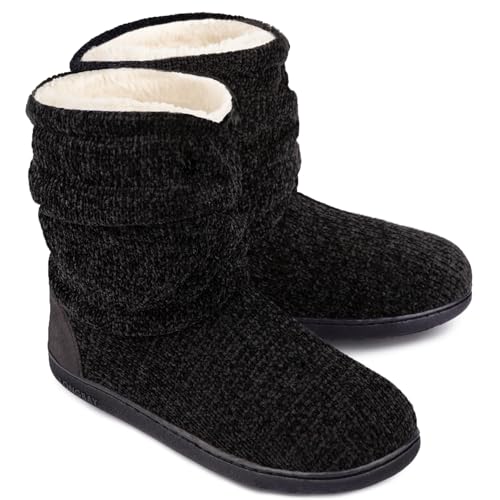
LongBay Women’s Slipper Boots — Warm Winter (Black) — Best Budget Bootie
The LongBay slipper boots are the budget proof that coverage matters more than cost: a bootie shape that wraps the ankle, a fuzzy fleece interior and chenille velvet upper, and a non-slip outsole for indoor and outdoor use — every element stated in its listing, at the accessible end of this guide’s tiers. For a cold house on a careful budget, this shape-first formula delivers most of the warmth that matters.
Strengths
- Bootie coverage at a budget tier
- Fleece interior stated in the listing for real insulation
- Non-slip outsole suits kitchen and doorstep alike
Trade-offs
- Budget materials will compress and tire sooner than the natural-fibre picks
- Combined size range (7-8 here) limits fit precision
- Chenille velvet is a home fabric — it will show a hard life
| Listing name | LongBay Women’s Slipper Boots Warm Winter Gift House Shoes Black 7-8 | Cute Bootie Design,Indoor Outdoor Use,Non-slip Outsole,Cozy Chenille Velvet,Fuzzy Fleece Interior,Cloud-like Comfort |
| Insulation (listing) | Fuzzy fleece interior; chenille velvet upper |
| Shape (listing) | Bootie design — ankle coverage |
| Sole (listing) | Non-slip outsole; indoor/outdoor use |
Buy the LongBay for a cold spare room, a draughty rental, a student house — anywhere the heating is inadequate and the budget is honest. Its warmth strategy is sound: cover the ankle, line with fleece, break the floor’s cold with a real outsole. What the tier concedes is endurance; this is a pair to enjoy for its winters and replace without resentment, not a pair to hand down. Judged on warmth delivered per tier in a genuinely cold room, it may be the smartest purchase in this guide.
Best for: cold houses and careful budgets that need ankle coverage now / Not suited for: buyers wanting natural fibres or many-year durability
Check the current price on Amazon

HomeTop Women’s Slippers — Closed Back, Shearling Lining (Chestnut) — Best Closed Back
The HomeTop closes the list with the third coverage strategy: not a boot, but a closed back with ankle-wrap wool and a warm shearling lining, both stated in its listing. An open-back scuff leaks heat at the heel with every step; this design seals that leak while keeping a slipper’s easy shape, and adds a dense foam cushion over a textured TPR sole for grip. For women who dislike boots but hate the heel draught, it is the precise answer.
Strengths
- Closed back seals the heel — no draught gap
- Shearling lining and ankle-wrap wool stated in the listing
- Textured TPR sole for grip on hard floors
Trade-offs
- The listing says ‘shearling lining’ without the full-sheepskin construction of the top picks — expect warmth, not heirloom pile
- Closed back means a slightly slower slip-on than a scuff
- Combined size range in this listing
| Listing name | HomeTop Women’s Slippers Closed-back Fuzzy Indoor Chestnut, 7-8 US | Fine Stitching Craft, Ankle Wrap Wool, Warm Shearling Lining, Dense Foam Cushion, Textured TPR Sole, Multi Shades |
| Insulation (listing) | Warm shearling lining; ankle wrap wool |
| Shape (listing) | Closed back |
| Footbed/sole (listing) | Dense foam cushion; textured TPR sole |
This pick rewards the reader who has diagnosed her own cold path: if your feet warm up in socks but chill in scuffs, the heel gap is your leak, and a closed back is the fix. The ankle-wrap wool extends the seal upward without a boot’s commitment, and the dense foam keeps the footbed supportive rather than pillowy. Its listing’s shearling claim is a lining claim, and this guide presents it as exactly that — a warm lining in a well-sealed shoe, at a mid tier, which for many cold-footed women is the correct amount of everything.
Best for: women whose heels and ankles leak heat in open-back slippers / Not suited for: anyone wanting the full sheepskin construction of the top two picks
Check the current price on Amazon
Comparison Table
| Pick | Badge | Key spec | Best for |
|---|---|---|---|
| Fireside by Dearfoams Women’s Sydney Shearling Slippers (Chestnut) | Best Overall | Listing states shearling, suede, memory foam; naturally water resistant; indoor/outdoor | women with genuinely cold feet in heated homes who want the reference shearling scuff |
| WaySoft Australian Sheepskin Women’s Slippers — 100% Shearling Wool | Best Pure Sheepskin | Listing states 100% shearling wool, hard sole, warm fuzzy build | women who want maximum natural insulation and a sole that floors cannot chill through |
| Glerups Natural Wool Boot Slippers (Charcoal) | Best Ankle Coverage | Listing states natural wool boot slippers with rubber sole; closed toe; temperature control | anyone in a cold, draughty house whose ankles chill along with their feet |
| EverFoams Women’s Bootie Slippers — Warm Collar (Purple) | Best Bootie Collar | Listing states warm collar, fleece lining, fuzzy faux fur, memory foam | women who want bootie coverage and plush warmth at an accessible tier |
| LongBay Women’s Slipper Boots — Warm Winter (Black) | Best Budget Bootie | Listing states warm winter bootie, chenille velvet, fuzzy fleece interior, non-slip outsole | cold houses and careful budgets that need ankle coverage now |
| HomeTop Women’s Slippers — Closed Back, Shearling Lining (Chestnut) | Best Closed Back | Listing states warm shearling lining, ankle wrap wool, dense foam cushion, TPR sole | women whose heels and ankles leak heat in open-back slippers |
Read the table by insulation and coverage together: shearling scuffs (Fireside, WaySoft) maximise foot insulation; the wool boot (Glerups) and booties (EverFoams, LongBay) add the ankle; the HomeTop seals the heel. Material claims are quoted from each listing’s own words, and no row of this table promises warmth that its listing cannot describe in its own plain, checkable, printed words.
How to Choose the Best Slippers for Very Cold Feet
Think in leaks, not in thickness. A cold foot loses heat three ways: through the sole to the floor, through the upper to the room air, and through every gap — the ankle, the heel, the toe box’s edge. A great cold-feet slipper plugs all three: a sole with substance, an insulating lining, and coverage that closes the gaps. A merely thick slipper often plugs only the second, which is why so many ‘warm’ slippers disappoint by January.
Materials rank by how they trap air and for how long. Genuine shearling and sheepskin — the Fireside and WaySoft listings state them — hold a deep, resilient pile of still air and keep holding it for years. Natural wool, as in the Glerups boot, insulates with the same fibre logic and adds temperature regulation. Synthetic fleeces and faux furs, as in the EverFoams and LongBay, start warm and compress sooner; they are honest seasonal purchases at honest tiers. Buy the material whose lifespan matches your intention.
Coverage is the second decision, and it follows your own cold map. Cold toes and soles only: a shearling scuff suffices. Cold ankles in a draughty house: a boot or bootie — Glerups, EverFoams, LongBay. A heel that chills in open backs: the HomeTop’s closed back. Diagnose where your cold actually lives before choosing the shape, because the warmest lining in the wrong shape still leaks.
Fit for warmth is looser than fit for fashion. Insulation works by loft — trapped air — and a slipper that compresses its lining against your foot squeezes the warmth out of it. You want room for the lining to stand and for a sock beneath it on the coldest nights. In combined size ranges, the larger size is usually the warmer one for this search; a thumb’s width of toe room is a feature here, not a flaw.
Finally, respect the sole as insulation. A hard or substantial sole — the WaySoft’s hard sole, the Glerups’ rubber — is a thermal break between your foot and a stone floor, and on the coldest floors it can matter as much as the lining. Soft, thin soles belong to warm houses. Match the sole to your coldest floor, not your average one.
Why Feet Get So Cold Indoors: Floors, Draughts and Altitude
Your feet live in the coldest layer of your home. Warm air rises; the air at ankle height in a still room can be strikingly cooler than the air at the thermostat, and floors — especially tile, stone and laminate over concrete — sit colder still and conduct heat away from anything resting on them. Add the draught that travels along skirting boards and under doors, and a slippered foot spends its day in a private winter that the room’s official temperature denies.
This is why cold feet are so often a footwear problem rather than a body problem: the same person is comfortable in boots at noon outdoors and chilled in thin slippers at home, because the slipper was the weakest insulation in the system. It is also why the fixes in this guide are architectural — sole as barrier, lining as insulation, coverage as draught-proofing — rather than medicinal. Build the barrier correctly and the private winter ends.
The exception deserves its sentence here rather than in a footnote: feet that are cold out of proportion to the room, asymmetrical between left and right, or accompanied by colour change or persistent numbness are not a slipper problem. That pattern deserves a clinician, promptly, and no guide about footwear should be allowed to delay it.
Shearling and Sheepskin: Why Natural Fleece Endures
Shearling is sheepskin with its fleece still attached to the hide, and that construction explains its reputation. Each fibre stands in a dense pile that traps air — the actual insulator — while the hide beneath gives the pile a foundation that loose fill never has. The result insulates deeply, breathes enough to release moisture vapour rather than storing it against the skin, and recovers its loft night after night for years.
Synthetic fleeces imitate the first of those properties and struggle with the third: their fibres are not rooted, so the pile mats under load and warmth fades with the loft. That is not a reason to scorn them — the booties in this guide deliver real warmth at kind tiers — but it is the reason the natural picks lead a guide for very cold feet, where the margin between warm and cold is the whole purchase.
Care is the natural material’s price: air shearling after wear, keep it dry, and follow the listing’s guidance rather than improvising washes. Treated so, the top two picks here are the longest-lived warmth in the category; treated carelessly, even the best fleece will sulk. The care section below gives the routine.
Boots, Booties, Collars and Closed Backs: The Coverage Family
Coverage design is a quiet taxonomy. The full boot, like the Glerups, wraps the ankle completely and suits draughty, cold houses where the chill climbs. The bootie, like the EverFoams and LongBay, covers slightly less with a softer, easier shape — the household favourite. The warm collar is the bootie’s clever cousin: a cuff that seals the ankle gap without a boot’s height, light enough for merely cold homes.
The closed back, as on the HomeTop, solves a different leak: the heel gap of the open scuff, which pumps cold air in with every step as the heel lifts and lands. Sealing it keeps the foot’s warm air pocket intact while walking, which is why a closed-back slipper can feel warmer than a thicker open one. Match the closure to the leak you actually have.
All coverage trades against convenience: boots and closed backs take a second longer to put on and run warmer in spring. In a genuinely cold house that trade is trivial. In a mild one, the shearling scuffs at the top of this guide give the insulation without the architecture — which is why this list is a family, not a single answer.
Socks, Layering and the Warm-Foot System
The warmest slipper system includes a sock. A wool or wool-blend sock inside a shearling slipper is the cold-house equivalent of double glazing: two trapped-air layers, each insulating, and the sock can be changed daily so the system starts dry every morning. Readers who find even good slippers insufficient usually find that the missing layer was the sock, not a better slipper.
Layering has one rule: do not compress. A sock so thick that it crushes the slipper’s lining flat destroys the loft that insulates — if the combination feels tight, the slipper size, not the sock, should change. This is the practical reason the sizing advice in this guide leans generous for this search: room is warmth.
Beyond the feet, two household habits multiply any slipper’s work: a rug on the coldest floor run — the kitchen triangle, the bathroom path — removes the worst conductive surface from the system, and slippers kept by the bed rather than in a cold hallway start the day at room temperature instead of floor temperature. Small logistics, large comfort.
Caring for Shearling, Wool and Fleece So They Stay Warm
Insulation dies by compression and moisture, and care is mostly the management of those two. Air every pair after wear — stood somewhere air moves, never sealed in a cupboard while damp — because a lining that dries fully each night keeps its loft and its freshness together. Rotate two pairs if you can; natural fleece especially repays the rest day.
Shearling and wool want gentle handling: brush the pile when it mats, spot-clean per the listing’s guidance, and keep them away from direct heat sources, which dry the hide and crack it — the radiator that tempts every cold-footed owner is the enemy of the slipper drying beside it. Synthetic fleeces are hardier and often washable where the listing says so; wash cold, air-dry, and expect loft to return with the drying.
Judge end-of-life honestly: a lining compressed to a film insulates like one, whatever the upper looks like. When the pile no longer stands after airing and brushing, the slipper has given its warmth and become a shoe-shaped souvenir. Replace it before the coldest month, not during it.
How to Warm Up Cold Feet at Home: A Slipper-First Routine
For the ordinary, floor-chilled case — not a medical routine, and no substitute for one where symptoms warrant it — this sequence stacks every small advantage in your favour.
- Start warm: put slippers on before your feet chill, not after. Insulation preserves heat far better than it creates it, so the pair goes on with the morning socks, not at the first shiver.
- Layer correctly: a wool-blend sock inside the slipper, with room for both linings to keep their loft. If the combination feels tight, size the slipper up rather than crushing the insulation flat.
- Break the floor’s contact: stand on a rug or mat for long stationary tasks — cooking, washing up, ironing — so the sole is not conducting slab-cold for an hour at a time.
- Move blood, gently: a short walk around the house every hour or so, and flexing your feet while seated, keeps warm blood arriving at the altitude where the cold lives.
- End the day dry: air the pair overnight somewhere ventilated, and rotate to the second pair tomorrow. A dry lining tomorrow morning is worth more than any feature printed on a box.
If feet remain stubbornly, unusually cold despite warm rooms, warm socks and good slippers — or if one foot differs from the other, or colour or sensation changes — treat that as the exception this guide keeps naming: a reason to see a clinician, not to buy a thicker slipper.
Common Buying Mistakes
Buying thickness instead of insulation. A fat synthetic lining that compresses in a month loses to a thinner natural pile that stands for years. Buy the material, not the silhouette.
Ignoring the ankle. The classic error of this search. If your ankles chill, a scuff — however luxurious — leaves the leak open. Buy coverage.
Sizing snug. Compressed lining is lost insulation. For cold feet, room for loft and a sock is the correct fit, even if it feels generous in the shop.
Drying shearling on the radiator. Direct heat cracks hide and kills pile. Air-dry at room temperature, away from the heat source, every time.
Expecting a slipper to answer a symptom. Persistently, unusually cold feet — especially one-sided, discoloured or numb — need a clinician. Slippers are for cold floors, and this guide keeps that boundary bright.
Final Recommendation
If you buy one pair from this guide, buy the insulation your cold actually needs, in the shape your cold actually lives in, at the size your lining needs in order to breathe and to work properly all winter. Start with the Fireside by Dearfoams Women’s Sydney Shearling Slippers (Chestnut) (check price on Amazon); the strongest alternative is the WaySoft Australian Sheepskin Women’s Slippers — 100% Shearling Wool (check price on Amazon); and the specialist choice is the Glerups Natural Wool Boot Slippers (Charcoal) (check price on Amazon).
The rest divide by cold map. The WaySoft is the maximum natural pile with a hard floor-breaking sole; the Glerups boot covers the ankle for draughty houses; the EverFoams bootie brings the collar and plush at a kinder tier; the LongBay proves coverage beats cost at the budget end; and the HomeTop seals the heel for the scuff-leak household. Pair any of them with a wool-blend sock and a dry start each morning, and the coldest room in the house loses its power over your feet — which is, in the end, the entire point of the purchase, and of this whole guide, from start to finish.
Reading further across this category? Compare Best Comfortable Warm Slippers Best Fleece Slippers Best Bootie Slippers Womens Best Sheep Skin Slippers For Women Best Mens Winter Slippers.
Frequently Asked Questions
What is the warmest slipper material?
Genuine shearling — sheepskin with its fleece attached — is the benchmark the other materials chase, because its rooted pile traps a deep layer of still air and keeps its loft for years. The top two picks in this guide state shearling in their listings. Natural wool, as in the Glerups boot, follows closely and adds temperature regulation; synthetic fleeces start warm and compress sooner, which is why they sit at the guide’s gentler tiers.
Are boot slippers warmer than scuffs?
Where ankles are involved, yes. A scuff insulates the foot and leaves the ankle — where blood runs near the surface — in the room’s coldest air layer. Boots and booties close that gap, and a warm collar seals it. If only your toes and soles chill, a shearling scuff is enough; if the cold climbs, buy coverage, as the middle picks in this guide provide.
Should I size up for very cold feet?
Slightly, yes — insulation needs loft, and a lining compressed against your foot insulates less. You also want room for a wool-blend sock on the coldest nights. In combined size ranges, take the larger size for this search; about a thumb’s width of toe room is a warmth feature here. Just do not overshoot into a sloppy fit that trips — roomy is the goal, not loose.
Do I need heated slippers instead?
For ordinary cold-floor misery, no — passive insulation has no battery to charge, nothing to run flat at the coldest moment, and it works all day. Heated designs exist in the wider market, but none was verified for this guide’s linked list, and this guide does not recommend what it has not verified. Start with shearling, coverage and a sock; that system solves the great majority of cold-feet winters, and it does so every hour of the day without a charger, a battery indicator or a single moving part to fail in February.
Why do my feet stay cold even in thick slippers?
Usually one of three leaks: a thin sole conducting the floor’s cold straight through, an open ankle or heel letting the warm air pocket escape, or a lining compressed flat — by tight sizing or by age — so its trapped air is gone. Diagnose which leak you have using the guide section above; each has a named pick in this list, and the fix is shape and material, not simply more thickness.
When are cold feet a reason to see a doctor instead of buying slippers?
When the pattern is unusual rather than environmental: one foot markedly colder than the other, colour changes, persistent numbness, or cold that ignores warm rooms and warm footwear. Those are not slipper problems, and this guide says so plainly. For the common case — cold floors, draughty rooms, feet that warm happily once insulated — the six pairs here are the answer, and a very comfortable one.


