Disclosure: airfryerkitchensupply.com is reader-supported. When you buy through links on our site, we may earn an affiliate commission at no extra cost to you.
Where to Buy
All six picks are on Amazon:
- SAFAVIEH Monaco Rug 8×10
- SAFAVIEH Rag Rug 5×8
- JONATHAN Y Moroccan Rug 8×10
- JONATHAN Y Malta Flatweave Rug
- SAFAVIEH Seagrass Rug 8×10
- SAFAVIEH Madison Rug 8×10
Asking for the best types of rugs for a high traffic family room is smarter than asking for the best rug, because in a room that hosts kids, dogs, guests and daily life, the type of rug — its fibre, construction and pile height — decides how it looks in three years, while the pattern only decides how it looks on day one. This guide is organised by type: power-loomed polypropylene, cotton rag rugs, durable low-pile weaves, flatweaves, natural seagrass fibre and low-pile transitional designs, each represented by a verified example you can actually buy.
The patterns that survive family rooms share a few traits you will see repeated below: low or flat pile that does not trap crumbs and toy parts, fibres that release dirt instead of absorbing it, and constructions described in their own listings as non-shedding, easy care or made for high traffic areas. Where a listing title states durability or easy-care wording, the review says so; where it does not, no claim is made. Check the current price on Amazon for the type that fits your household — and measure your room before falling for any of them.
Key Takeaways
- Type beats pattern: fibre, construction and pile height decide lifespan.
- Durable picks cluster low — flatweave, 1/4 in and 3/8 in piles.
- Polypropylene resists spills; cotton absorbs them; seagrass hates soaking.
- A rug pad is not optional in a family room — grip, cushion and longer life.
In this guide
Quick Picks
Best All-Round Type — SAFAVIEH Monaco MNC222F Area Rug 8×10 (Power-Loomed Polypropylene): Most family rooms — the default type to start from before specialising. Check price on Amazon
Best Natural Cotton Type — SAFAVIEH Rag Rug RAR121A 5×8 (Cotton Rag Rug): Families who want natural fibre and handmade character without giving up a high-traffic rating. Check price on Amazon
Best Durable Statement Type — JONATHAN Y Moroccan Boho Vintage Diamond Area Rug 8×10: Style-led family rooms that still need a rug built for daily traffic. Check price on Amazon
Best Flatweave Type — JONATHAN Y Malta Flatweave Rug 3×5: Entry-adjacent family room zones, under play tables, and households that hose-and-go clean. Check price on Amazon
Best Natural Fibre Type — SAFAVIEH Natural Fiber Seagrass Rug NF114A 8×10: Busy family rooms wanting a natural, textured foundation that hides daily dirt. Check price on Amazon
Best Low-Pile Traditional Type — SAFAVIEH Madison MAD604H Area Rug 8×10 (Low-Pile Polypropylene): Families who want a classic, warm look with a sensibly low, easy-care pile. Check price on Amazon
How These Picks Were Chosen
Examples were verified through Amazon listing held for this site, and each type is represented by a rug whose own title supports the claims made about it — ‘Ideal for High Traffic Areas’ in the SAFAVIEH titles, ‘High-Traffic, Easy-Cleaning, Durable’ in the JONATHAN Y Moroccan listing, ‘Durable’ and ‘Easy Care’ in the seagrass listing, and pile heights quoted in inches where the title states them. Types that fail family rooms in practice — deep shag, delicate silk-look viscose, high-pile wool — were left out on purpose, and the guide explains the reasoning rather than pretending they are contenders.
Sizes in the spec boxes are the verified sizes from the titles; most of these rugs come in other sizes on their listings, but only the title-verified size is printed here. Treat the example as the type made concrete: if the type suits your room, the listing’s size run is where you find your fit.
One exclusion deserves a sentence of its own: washable rugs are a genuinely useful modern category, but no pick in this guide is described as machine washable in its verified title, so the guide does not claim washability for any of them. If a fully washable rug is your priority, that is a different shortlist — and the internal links at the end of this guide point to our washable rug coverage. Here, the durability case rests on fibre, pile height and construction, which is the evidence these listings actually provide.
The 6 Best Types of Rugs for a High Traffic Family Room

SAFAVIEH Monaco MNC222F Area Rug 8×10 (Power-Loomed Polypropylene) — Best All-Round Type
The Monaco represents the family-room default: power-loomed polypropylene, non-shedding and easy care by its own title, and explicitly pitched at high traffic areas.
Strengths
- Title says it plainly: non-shedding and easy care, ideal for high traffic areas
- Polypropylene releases spills and dirt instead of drinking them in
- Distressed boho pattern hides the evidence of family life between cleans
Trade-offs
- Synthetic feel underfoot — less plush than wool or cotton
- An 8×10 anchors a seating area but will not wall-to-wall a large room
- Power-loomed consistency means less handmade character than the rag rug below
| Specification | Detail (from verified listing title) |
|---|---|
| Type | Power-loomed polypropylene |
| Size verified | 8′ x 10′ |
| Pile | Not stated in title |
| Title claims | Non-shedding & easy care; ideal for high traffic areas |
There is a reason polypropylene dominates family rooms: the fibre itself does not absorb moisture, so spills sit on the surface long enough to be blotted instead of soaking into the backing, and everyday dirt vacuums out rather than embedding. Power-looming adds consistency — an even, low, tight surface with no loose fibres to shed across your floors or clog a vacuum. SAFAVIEH’s Monaco leans into the brief with a distressed tribal pattern, and distressing is a genuine functional feature in a family room: a pattern that already looks artfully worn does not show the first juice stain or muddy paw print as a catastrophe. The honest compromises are feel and character. Polypropylene will never have the soft, natural hand of wool or cotton, and a machine-made rug looks machine-made. If your priority is a rug that forgives daily life and still looks intentional in photos, this type is the benchmark the others are measured against.
Best for: Most family rooms — the default type to start from before specialising / Not suited for: Buyers who want natural fibres only, or a thick plush pile to sit on
Check the current price on Amazon

SAFAVIEH Rag Rug RAR121A 5×8 (Cotton Rag Rug) — Best Natural Cotton Type
The rag rug is the natural-fibre answer: handmade cotton, boho-striped, and — per its title — made for high traffic areas in living rooms and bedrooms.
Strengths
- Handmade cotton construction with a boho stripe that suits relaxed family rooms
- Title rates it for high traffic areas despite the natural fibre
- Cotton rag weave hides wear in its texture — no single thread tells the story
Trade-offs
- Cotton absorbs spills more readily than polypropylene — blot fast, every time
- Handmade means slight variations in size and weave are part of the product
- Heavier and less slide-resistant than backed synthetic rugs; a rug pad helps
| Specification | Detail (from verified listing title) |
|---|---|
| Type | Handmade cotton rag rug |
| Size verified | 5′ x 8′ |
| Pile | Not stated in title |
| Title claims | Ideal for high traffic areas |
Rag rugs are woven from strips of cotton, and that construction is their durability trick: there is no pile to crush, no single surface thread to wear through, and the variegated stripe pattern is essentially camouflage for the marks of daily life. SAFAVIEH’s version is handmade, which brings the charm and the caveats of handmade goods — expect small irregularities in the weave and edges that are characterful rather than laser-straight. In a family room it works best as the warm, relaxed centre of a casual seating area, layered over a good rug pad to stop it travelling on hard floors. The real trade-off against synthetics is spill behaviour. Cotton drinks liquid where polypropylene resists it, so a rag rug household needs a blot-first habit and a tolerance for the occasional professional clean. Choose it for feel, natural fibre and looks; maintain it with a little more attention than the synthetic types ask for.
Best for: Families who want natural fibre and handmade character without giving up a high-traffic rating / Not suited for: Households with frequent liquid spills, or anyone who wants a wipe-and-forget rug
Check the current price on Amazon
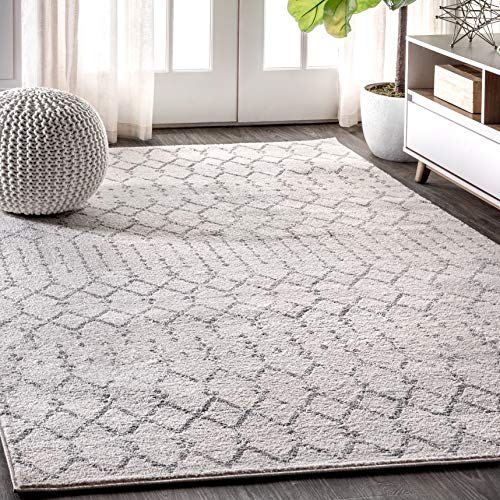
JONATHAN Y Moroccan Boho Vintage Diamond Area Rug 8×10 — Best Durable Statement Type
JONATHAN Y’s Moroccan diamond rug is the design-forward durable type: power-loomed, 0.31 inches thick, and titled high-traffic, easy-cleaning and durable.
Strengths
- Title stacks the three words a family room needs: high-traffic, easy-cleaning, durable
- 0.31 in profile is low enough for doors, toy cars and robot vacuums
- Vintage diamond pattern disguises wear while still anchoring the room’s style
Trade-offs
- Low profile means minimal cushion — pair with a pad if kids play on the floor for hours
- Power-loomed synthetic character, not a hand-knotted heirloom
- Cream and gray palette shows dark pet hair more than mid-tone patterns
| Specification | Detail (from verified listing title) |
|---|---|
| Type | Power-loomed, low textured weave |
| Size verified | 8×10 |
| Thickness (per title) | 0.31 in |
| Title claims | High-traffic, easy-cleaning, durable |
Some family rooms have to perform for guests as well as survive children, and this is the type for that double life. The vintage Moroccan diamond design gives a room a deliberate, styled centre, while the construction underneath is pure practicality — power-loomed for an even, hard-wearing surface and kept to a 0.31-inch profile that doors swing over, wheels roll across and vacuums traverse without drama. The cream and gray palette deserves an honest note: it is beautiful with light furniture and bright rooms, and it will show dark pet hair and tracked-in grit sooner than a mid-tone distressed pattern, so expect to vacuum a little more often to keep it looking its best. Add a cushioned rug pad and the low profile stops being a comfort compromise for floor-sitting families. As a type, it proves you do not have to choose between a rug that photographs well and one that survives the household — you just have to choose low, dense and patterned.
Best for: Style-led family rooms that still need a rug built for daily traffic / Not suited for: Families wanting maximum underfoot softness for floor play
Check the current price on Amazon

JONATHAN Y Malta Flatweave Rug 3×5 — Best Flatweave Type
The flatweave is the extremist of the family: no pile whatsoever, easy-cleaning and water-resistant per its title, and built for indoor and outdoor use.
Strengths
- Flatweave has no pile at all — nothing to trap crumbs, craft glitter or pet hair
- Title rates it easy-cleaning, high-traffic and water-resistant (note: resistant, not waterproof)
- Indoor/outdoor build shrugs off the muddy end of family life
Trade-offs
- Verified size here is a 3×5 accent — a family-room anchor needs a larger size from the listing
- Flatweave offers almost no cushion; a pad is effectively mandatory on hard floors
- Textured weave feels firmer under bare feet than any piled type
| Specification | Detail (from verified listing title) |
|---|---|
| Type | Flatweave, low-pile |
| Size verified | 3×5 |
| Use (per title) | Indoor/outdoor |
| Title claims | Easy-cleaning, high-traffic, water-resistant |
Every problem a pile rug has in a family room — trapped crumbs, ground-in play dough, pet hair woven into fibres — is a pile problem. A flatweave deletes the pile and with it most of the maintenance: spills sit on a tight textured surface, dirt shakes or vacuums straight off, and the rug can move between the family room and the patio without ceremony. The Malta’s title claims water resistance, and this guide repeats that wording exactly — resistant means it tolerates splashes and damp shoes, not that it is a waterproof mat, and standing liquid should still be lifted promptly. The costs are comfort and scale. Flatweave is firm, so on hard floors a quality pad is not optional if anyone sits or plays on it, and the verified size in this guide is a 3×5 accent piece — treat it as the type specimen, and take a larger size from the same listing for a main seating area. For the highest-traffic square metres of a family home, no type is easier to live with.
Best for: Entry-adjacent family room zones, under play tables, and households that hose-and-go clean / Not suited for: Anyone wanting a soft, sink-in main rug for lounging on the floor
Check the current price on Amazon

SAFAVIEH Natural Fiber Seagrass Rug NF114A 8×10 — Best Natural Fibre Type
Seagrass is the natural-fibre heavyweight: a durable, easy-care weave at a low 1/4 inch pile, titled kid and pet friendly by SAFAVIEH.
Strengths
- Seagrass is a naturally hard-wearing fibre — title rates it durable and easy care
- Kid and pet friendly per the title, with a texture that hides tracked-in dirt
- 1/4 inch pile keeps it low, stable and easy to vacuum
Trade-offs
- Seagrass texture is firm and slightly coarse — not a bare-feet luxury rug
- Natural fibre and standing liquid are enemies; spills need lifting, not soaking
- Natural colour variation is part of the product, not a defect to exchange over
| Specification | Detail (from verified listing title) |
|---|---|
| Type | Seagrass natural fibre |
| Size verified | 8×10 |
| Pile (per title) | 1/4 in |
| Title claims | Durable, kid & pet friendly, easy care |
Natural fibres have a reputation for delicacy that seagrass does not deserve. It grows in water, dries hard and smooth, and woven tightly it produces a rug surface that resists crushing and releases dirt instead of holding it — which is why the listing can honestly call it durable, easy care and suitable around kids and pets. The low 1/4-inch profile keeps furniture stable and vacuuming effortless, and the natural textured tone is perhaps the best dirt camouflage in this entire guide: the colour of seagrass is approximately the colour of the outdoors your family tracks in. The compromises are tactile and chemical. Seagrass feels firm and a little rustic underfoot — more beach house than boudoir — and like all natural fibres it dislikes being soaked, so the cleaning method is prompt blotting and surface care, never a drenching. Families who want nature’s materials with a workhorse attitude will find this type hard to beat.
Best for: Busy family rooms wanting a natural, textured foundation that hides daily dirt / Not suited for: Softness-first households, or rooms where drinks regularly end up on the floor
Check the current price on Amazon

SAFAVIEH Madison MAD604H Area Rug 8×10 (Low-Pile Polypropylene) — Best Low-Pile Traditional Type
The Madison represents the traditional low-pile type: power-loomed polypropylene at a title-stated 3/8 inch pile, in a warm transitional ogee design.
Strengths
- 3/8 inch low pile stated in the title — low enough for traffic, thick enough to feel like a rug
- Traditional ogee pattern in cream and orange warms up a family room’s look
- Power-loomed polypropylene brings the easy-care fibre at a classic design
Trade-offs
- Traditional styling will not suit every decor — it commits the room to a direction
- Slightly higher pile than the flatweave and seagrass picks, so slightly more vacuuming effort
- Title does not repeat the high-traffic wording of the Monaco — durability here rests on fibre and pile, stated plainly
| Specification | Detail (from verified listing title) |
|---|---|
| Type | Power-loomed polypropylene |
| Size verified | 8′ x 10′ |
| Pile (per title) | 3/8 in low pile |
| Origin (per title) | Made in Turkey |
Not every family room wants boho or beach-house texture; some want the classic medallion-and-ogee look of a traditional living room, engineered for real life. The Madison’s formula is fibre plus pile height: polypropylene for spill resistance and easy vacuuming, kept to a 3/8-inch low pile so the surface stays dense, doors clear it and furniture feet do not sink and wander. This guide is careful about one point: unlike the Monaco above, this listing’s title does not carry explicit high-traffic wording, so its case rests on the construction — the same fibre family and low-pile logic as the rated picks — rather than on a claim the manufacturer did not print here. That distinction is exactly how you should shop beyond this list too. As a type, the low-pile traditional is the choice for families whose room has a formal streak but a realistic attitude about children, pets and Friday-night takeaway on the rug.
Best for: Families who want a classic, warm look with a sensibly low, easy-care pile / Not suited for: Minimalist or contemporary rooms, or anyone who wants a title-rated high-traffic claim
Check the current price on Amazon
Comparison Table
| Pick | Badge | Key spec | Best for | Amazon |
|---|---|---|---|---|
| SAFAVIEH Monaco MNC222F Area Rug 8×10 (Power-Loomed Polypropylene) | Best All-Round Type | Type: Power-loomed polypropylene | Most family rooms — the default type to start from before specialising | Check price |
| SAFAVIEH Rag Rug RAR121A 5×8 (Cotton Rag Rug) | Best Natural Cotton Type | Type: Handmade cotton rag rug | Families who want natural fibre and handmade character without giving up a high-traffic rating | Check price |
| JONATHAN Y Moroccan Boho Vintage Diamond Area Rug 8×10 | Best Durable Statement Type | Type: Power-loomed, low textured weave | Style-led family rooms that still need a rug built for daily traffic | Check price |
| JONATHAN Y Malta Flatweave Rug 3×5 | Best Flatweave Type | Type: Flatweave, low-pile | Entry-adjacent family room zones, under play tables, and households that hose-and-go clean | Check price |
| SAFAVIEH Natural Fiber Seagrass Rug NF114A 8×10 | Best Natural Fibre Type | Type: Seagrass natural fibre | Busy family rooms wanting a natural, textured foundation that hides daily dirt | Check price |
| SAFAVIEH Madison MAD604H Area Rug 8×10 (Low-Pile Polypropylene) | Best Low-Pile Traditional Type | Type: Power-loomed polypropylene | Families who want a classic, warm look with a sensibly low, easy-care pile | Check price |
How to Choose a Rug Type for a Busy Family Room
Rank your household’s actual hazards before looking at a single pattern. If the main enemy is liquid — juice, coffee, pet accidents — fibre decides everything: polypropylene and other synthetics resist absorption, cotton drinks spills in, and natural fibres like seagrass tolerate dirt beautifully but hate being soaked. If the main enemy is abrasion — feet, wheels, claws, toy traffic — construction decides: low pile, flatweave and tight power-loomed surfaces outlast anything tall and plush, because there is less fibre standing up to be bent, broken and ground down.
Pile height is the easiest number to shop by, and the titles in this guide show why: the durable picks cluster at a flat weave, 1/4 inch and 3/8 inch. Anything much taller starts trading lifespan for softness, and deep shag in a family room is a crumb archive with a fringe. Pattern is the third decision, and it is a practical one: distressed, variegated and mid-tone designs hide the interval between cleans, while flat pale colours announce every mark. Finally, size the rug to the furniture, not the room — front legs of sofas and chairs on the rug at minimum — and budget for a pad, which stops sliding, adds the cushion low-pile rugs lack, and extends the rug’s life by absorbing friction from below.
Matching Rug Types to Family Room Zones
A family room is not one traffic zone but several. The path from door to sofa is a highway; the square under the coffee table is a spill zone; the corner with the toy box is an abrasion zone. Flatweave and seagrass earn their keep on the highway and under play areas, where cleaning speed matters more than softness. The seating centre can afford the slightly softer types — low-pile polypropylene or a rag rug over a good pad — because it sees feet rather than through-traffic, and it is where the family actually sits on the floor.
Households with dogs should weight fibre and pattern most heavily: synthetic low pile releases hair on vacuuming instead of harbouring it, and a variegated pattern hides what the vacuum missed until the weekend. Households with toddlers should weight the pad and the cleanability: a low rug that can be spot-cleaned in minutes, over a pad that can be replaced cheaply, beats a luxurious rug that needs professional care after its first encounter with yoghurt. The types in this guide are tools — match the tool to the zone and the whole room gets easier to live in.
Colour, Pattern and Light: Choosing a Rug That Forgives
Colour choice in a family room is a maintenance decision wearing a style costume. The practical sweet spot is mid-tone and variegated: dark enough to hide the interval between vacuums, light enough not to display every pale crumb and hair, and patterned enough that no single mark owns the surface. Distressed designs — like the Monaco and Moroccan picks in this guide — build that forgiveness into the pattern itself, because a rug that already looks artfully worn cannot be visibly worn by Tuesday. Flat, pale, single-colour rugs are the opposite bargain: beautiful on day one, a diary of family life by day thirty.
Light matters as much as colour. A family room’s rug is seen in daylight, lamplight and the unforgiving glare of a television at midnight, and fibres respond differently to each — natural seagrass warms in sunlight, synthetics hold their colour evenly, and cream palettes that look serene at noon can look stark at night. If you can, view a rug sample or the delivered rug in the room’s own evening light before committing the whole floor plan to it; most returns in this category are light-and-colour returns, not quality returns.
Pattern scale should match room scale and furniture load. Large rooms with plain sofas carry bold, large-scale designs well; small rooms or rooms with patterned upholstery do better with the quieter textures — the rag rug’s stripe, seagrass’s natural weave — that add interest without arguing with the furniture. And remember the pad’s effect on appearance: a good pad lets a rug sit flat and full, while a cheap or absent pad lets the same rug ripple, creep and look tired years before its time. In a family room, presentation and practicality are not opponents; they are the same decisions made carefully.
Rug Pads, Explained Properly
The pad is the least glamorous purchase in this guide and the one professionals insist on most, so it deserves its own section. A pad does four jobs at once: it grips the floor so the rug cannot slide or bunch under a running child or a braking dog; it adds the cushion that low-pile and flatweave rugs deliberately sacrifice for durability; it absorbs the friction between rug and floor that otherwise wears the rug’s backing and the floor’s finish simultaneously; and it slightly lifts the rug, improving airflow and making vacuuming more effective. Skipping the pad to save money is the classic false economy of rug buying.
Pad types split by floor. On hard floors, a felt-and-rubber pad is the standard recommendation: felt for cushion, a rubber face for grip, and no adhesives anywhere near your floor finish. On carpet, a thinner pad designed to grip carpet pile is the right tool — a hard-floor pad on carpet can creep and bunch. Thickness should complement the rug: a thin flatweave can take a plusher pad, while an already-substantial low-pile rug wants a thinner one, so doors still clear and the whole assembly does not become a trip edge at the threshold.
Sizing and care are simple but often skipped. Cut the pad roughly an inch smaller than the rug on every side so it stays invisible and the rug’s edges lie flat. Vacuum the pad when you deep-clean, replace it when its grip fades — pads are consumables with a lifespan of years, not decades — and never use a pad that has started to stick to or discolour the floor beneath. Bought right and maintained lightly, the pad is what turns a good rug type into a great family-room surface.
What ‘High Traffic’ Really Does to a Rug
Traffic wears a rug by bending fibres thousands of times in the same lanes. In a tall pile, each fibre bends at its base, weakens, and eventually lies flat or breaks — that is the grey path that appears across a well-used rug. Low, dense constructions survive because the fibres are short, mutually supported and barely bend at all; flatweaves remove the mechanism entirely. This is why the honest durability claims in this guide cluster around low pile heights and tight weaves, and why a plush rug marketed with soft-focus photography should be read sceptically for a family room, whatever its product name suggests.
Dirt accelerates everything. Grit that settles into a pile acts like sandpaper at the fibre base with every footstep, which is why frequent vacuuming is a durability practice, not just a cosmetic one — and why fibres that release dirt easily genuinely last longer in real homes. Choose the type that sheds your household’s dirt, vacuum the lanes more often than the corners, and rotate the rug twice a year so the wear — and the sunlight — are shared evenly.
Rugs and Family Health: Dust, Allergens and Honest Limits
A rug in a family room is a filter the household walks on. It traps dust, pollen and pet dander that would otherwise stay airborne — which is a genuine benefit while the rug is vacuumed regularly, and a genuine liability when it is not, because a neglected rug re-releases what it holds with every footstep. The practical conclusion is not to fear rugs but to vacuum them on the schedule this guide recommends: traffic lanes weekly, the whole surface regularly, and the underside monthly. Low-pile and flatweave types make that schedule easier to keep, which is a health argument for the same constructions that win on durability.
Households with asthma or allergies should weight fibre behaviour carefully. Tight synthetic weaves release dust to the vacuum instead of harbouring it deep in a pile, and they tolerate the frequent cleaning that allergy management demands. Natural fibres vary — seagrass’s hard, smooth surface is comparatively inhospitable to dust build-up, while softer natural piles hold more and release less. None of this makes any rug a medical intervention, and this guide makes no such claim; it simply notes that the easy-clean types recommended here are also the types that cooperate best with a cleanliness routine.
Children change the equation in one more way: family-room rugs are play surfaces, and babies and toddlers experience them at face height. That argues for the same shortlist logic — fibres that clean thoroughly, constructions without loose loops for small fingers to pull, and a pad that keeps the rug planted when a toddler hauls themselves up on its edge. Choose the type that survives the household, clean it like you mean it, and the rug becomes what it should be: the soft, safe centre of the room’s daily life.
When a Family Room Rug Should Be Replaced
Rugs rarely die dramatically; they fade, flatten and fray at the edges of acceptability until one day the room looks tired and nobody can say why. The honest replacement signals are functional. Traffic lanes that stay grey after a proper clean mean the fibres themselves are damaged, not dirty. A backing that crackles, sheds flakes or has lost its grip means the rug’s structure is done, whatever the surface looks like. Edges that curl despite pads and patience, and smells that survive cleaning, complete the list — each is the rug announcing that its service is over.
There is a middle path worth knowing: rotation, professional cleaning and re-edging can return a good rug to service for years, and a quality low-pile or natural-fibre rug deserves that investment before replacement is considered. The types in this guide were chosen partly for that maintainability — constructions a professional can clean and a household can live with for a long time. When replacement does come, let the old rug’s failure teach the new purchase: if the lanes died first, go lower and denser; if spills killed it, go more synthetic; if it slid and bunched, buy the better pad. A family room rug is a long relationship — choose the type as if you intend to keep it, because you will.
A Word on Rugs, Renting and Deposits
Renters live with family-room rugs differently: the rug is also floor insurance, protecting a landlord’s flooring from the household’s daily life. That dual role rewards the types in this guide twice over — low, stable constructions that do not creep and mark, over a pad that is certified safe for the floor beneath, because a pad that discolours or sticks to a rented floor can cost more than the rug. Photograph the floor before the rug goes down and after it comes up; in deposit disputes, the household with photographs is the household that wins.
Renting also changes the size and budget logic. A rug you may have to move in a year should be a size that fits many rooms — the 8×10 format of several picks here is the most portable of the generous sizes — and its budget should assume a second home rather than a forever one. The durable, forgiving types recommended throughout this guide are exactly the rugs that survive a move, a new room’s different light and a new household configuration. Buy the type well once, and it will follow the family through several addresses, which is the highest compliment a family-room rug can earn.
How to Set Up and Care for a Family Room Rug
A few habits in the first week and a simple routine afterwards will double the useful life of any rug type in this guide.
- Unroll and relax it: lay the rug flat and let the edges settle for a day or two; reverse-roll stubborn corners or weight them with books overnight rather than forcing them.
- Fit a rug pad: cut the pad an inch smaller than the rug on each side. The pad stops sliding, adds cushion under low-pile types and protects both rug and floor from friction wear.
- Position by furniture: front legs of sofas and chairs on the rug, back legs off is the classic family-room layout — it anchors the seating and keeps the rug from drifting.
- Vacuum the lanes weekly: the door-to-sofa path gets twice the passes of the corners. For braided and delicate weaves, use suction carefully as described in our vacuum guide — and keep beater bars gentle on natural fibres.
- Blot spills immediately: lift liquid with a clean cloth from the outside of the spill inward. Never scrub a natural fibre or rag weave; blot, rinse lightly if the fibre allows, and dry flat.
- Rotate twice a year: turn the rug 180 degrees to share traffic lanes and sunlight across the whole surface — the cheapest life-extension a rug can get.
Keep the care instructions that came with your rug. Fibre-specific guidance from the manufacturer beats generic advice, especially for natural fibres and handmade pieces.
Common Buying Mistakes
Choosing shag or high pile for a family room
Tall pile feels luxurious in the shop and becomes a crumb-and-grit archive at home, with traffic lanes matting flat within a year. Low, dense and flat constructions are the types that survive; get your softness from the pad underneath instead.
Buying pale and plain for a busy room
A flat cream rug in a family room is a diary of everything your household eats and tracks in. Distressed, patterned and mid-tone designs exist precisely to hide the interval between cleans — use them.
Skipping the rug pad
Without a pad, a rug slides, bunches, wears from beneath and feels thin. With one, the same rug is safer, softer and longer-lived. It is the highest-value accessory in this entire category.
Sizing to the room instead of the furniture
A rug floating in the middle of the floor, touching no furniture, looks lost and drifts. Size so at least the front legs of the seating sit on it, and measure before ordering — returns on 8×10 rugs are nobody’s idea of fun.
Soaking natural fibre rugs to clean them
Seagrass and jute constructions tolerate dirt, not drenching. Saturating them invites shrinkage, staining and mildew. Blot, surface-clean, and let professionals handle deep cleans on natural fibres.
Final Recommendation
Start from the type, and most families should start from the Monaco’s type — low, power-loomed polypropylene with an honest high-traffic title claim; check price on Amazon for the verified 8×10. If your room leans natural, choose between the cotton rag rug for softness and handmade character or the seagrass for the toughest natural surface. Style-led rooms should take the JONATHAN Y Moroccan, traditional rooms the low-pile Madison, and the hardest-working zones of any home deserve the Malta flatweave — in a larger size from its listing for main areas.
Whichever type you land on, buy the pad, vacuum the lanes, blot the spills and rotate twice a year. Family rooms are for living in; the right rug type is simply the one that lets you do that without thinking about the floor.
One last piece of sequencing advice for buyers furnishing a room from scratch: choose the rug before the small furniture, not after. The rug sets the room’s footprint, its colour temperature and its tolerance for daily life, and side tables, toy storage and floor lamps are all easier to choose into a settled scheme than a rug is to choose around them. If the room already exists and only the rug is changing, take the old rug’s measurements as your starting bid — most households discover they want the same size with a better type, which is the simplest upgrade path in this whole category. Measure, choose the type by fibre and pile, match the pattern to your household’s honesty about cleaning, and the family room gets the foundation it has been asking for.
Shortlist: SAFAVIEH Monaco MNC222F Area Rug 8×10 (Power-Loomed Polypropylene), SAFAVIEH Rag Rug RAR121A 5×8 (Cotton Rag Rug), JONATHAN Y Moroccan Boho Vintage Diamond Area Rug 8×10 — check price on Amazon for each before you decide.
Related guides on this site: Best Area Rugs For Family Rooms Best Area Rugs For Homes With Dogs Best Area Rugs For Kids And Pets Best Washable Rugs For Living Room Best Braided Wool Rugs
Frequently Asked Questions
What is the most durable rug type for a family room?
Low, dense constructions in fibres that release dirt: power-loomed polypropylene and flatweaves lead on pure durability, with seagrass the strongest natural option. The picks in this guide state their pile heights in their titles — a flat weave, 1/4 inch and 3/8 inch — and that low cluster is exactly the point.
Are wool rugs a good choice for high traffic family rooms?
Wool is resilient and naturally stain-resistant, but family-room wool needs a low, tight weave to survive, and it costs more to buy and to clean. None of the verified examples in this guide is a high-pile wool rug, because that construction mats in traffic lanes. A low-pile wool can work; a plush one will not stay plush.
How do I stop a family room rug from sliding?
With a rug pad cut slightly smaller than the rug. It grips the floor, adds cushion under low-pile types, and reduces the friction wear that shortens a rug’s life. Tape and corner grippers are partial fixes; a full pad is the real one.
Can I put a flatweave in the main seating area?
Yes — with a cushioned pad beneath it, a flatweave is comfortable, stable and the easiest type to keep clean. The verified Malta example here is a 3×5 accent size, so take a larger size from the same listing for a seating area and budget for the pad.
How often should a high traffic family room rug be vacuumed?
The traffic lanes at least weekly, the whole rug weekly to fortnightly depending on pets and children. Grit left in a rug abrades fibres with every step, so vacuuming is a durability habit, not just a cosmetic one. Rotate the rug twice a year as well.
What rug size works for a typical family room?
Size to the furniture: an 8×10 — the verified size of several picks here — suits most seating groups with front legs on the rug. Measure your sofa layout first; a rug that reaches under the front legs of every seat anchors the room and stops drift.


