Disclosure: airfryerkitchensupply.com is reader-supported. When you buy through links on our site, we may earn an affiliate commission at no extra cost to you.
Where to buy
The fastest way to buy any pick in this guide is through Amazon, where each listing shows its current configuration, size and colour options before you commit. Start with the shortlist below, then read the full reviews to match a pick to your space and habits. For a home about to be photographed and shown, order early enough to let a washable rug relax flat for a day or two before listing photos — creases from shipping are the one flaw a new rug reliably arrives with.
- OLANLY 5×7 Washable Area Rug — Beige Distressed Abstract (Best Overall for Staging) — check price on Amazon
- Lahome Dark Olive Green Washable Area Rug — 8×10, Rubber Backed (Best for Large Rooms) — check price on Amazon
- RUGSURE Washable Area Rug — Vintage Tribal, Green, 5×7 (Best Pattern Interest) — check price on Amazon
- Moynesa Ultra-Thin Washable Vintage Area Rug — 5×7 (Best Ultra-Thin) — check price on Amazon
- AMADA 8×10 Washable Area Rug — Vintage Blue (Best Soft-Feel Large Rug) — check price on Amazon
- GarveeHome Vintage Blue Area Rug — 8×10, Cottage Style (Best Cottage Look) — check price on Amazon
The best rugs for selling home with bad wood floors solve a presentation problem, not a flooring problem. When the wood is scratched, faded, water-marked or patched with mismatched boards, a well-chosen area rug covers the worst of it, pulls the room’s colours together for listing photos, and lets buyers look at the space instead of mentally pricing a refinish. Every rug in this guide was verified against a live Amazon listing, and each one shares the three traits staging actually needs: a large washable format, a low pile that doors and camera tripods tolerate, and a non-slip backing stated in its verified title.
One honesty note before the picks. A rug hides floor damage from view; it does not repair it, and in many places sellers still have disclosure obligations about known defects. Use these rugs the way professional stagers do — to present rooms at their best, define seating areas and soften echo in empty spaces — not to deceive a buyer about a floor that needs work. Your agent and local rules govern what must be disclosed; the rug’s job is presentation, and this guide keeps its claims to what the listings state.
You will also notice what is not claimed. No rug here is described as scratch-proof or floor-healing, because no verified title says that. Where a title states a rubber backing or non-slip construction, we say so; where you need extra protection between rug and boards, the guide recommends a separate rug pad and says why. There are no prices and no fixed scores printed — sizes, pile height language and backing types are the facts that decide a staging purchase, and those are what the spec boxes record.
In this guide
Quick Picks
Best Overall for Staging: OLANLY 5×7 Washable Area Rug — Beige Distressed Abstract — a soft non-slip 5×7 in a beige distressed abstract design, low pile, with spill and stain resistance stated in the title. — check price on Amazon
Best for Large Rooms: Lahome Dark Olive Green Washable Area Rug — 8×10, Rubber Backed — an 8×10 washable rug with a rubber backed non-slip, non-shedding construction in dark olive green for living and dining rooms. — check price on Amazon
Best Pattern Interest: RUGSURE Washable Area Rug — Vintage Tribal, Green, 5×7 — a 5×7 washable rug with a vintage tribal design, described as stain and water resistant and non-slip, and as pet and child friendly. — check price on Amazon
Best Ultra-Thin: Moynesa Ultra-Thin Washable Vintage Area Rug — 5×7 — an ultra-thin 5×7 washable rug in a vintage oriental medallion style, non-slip and non-shedding, made for doors that barely clear the floor. — check price on Amazon
Best Soft-Feel Large Rug: AMADA 8×10 Washable Area Rug — Vintage Blue — an 8×10 washable rug in blue with a non-slip, low-profile build and soft texture, described as pet friendly and easy to clean. — check price on Amazon
Best Cottage Look: GarveeHome Vintage Blue Area Rug — 8×10, Cottage Style — an 8×10 washable low-pile rug in a vintage blue cottage and retro farmhouse style for living rooms. — check price on Amazon
How These Picks Were Chosen
Candidates were searched and filtered for the staging brief: area-rug sizes that cover a meaningful share of a room (5×7 and 8×10 formats dominate), machine washable construction so a rug can be freshened between showings, low pile so doors swing and furniture sits level, and a stated non-slip or rubber backing so the rug stays where the photographer put it.
Pattern choice was judged by listing-photo logic. Distressed vintage and abstract designs in neutral families photograph as texture rather than statement, hide minor marks between showings, and do not fight with the furniture a stager places on top. Loud novelty patterns, bath mats, runners and chair mats were excluded even when their specifications were good, because they answer different searches. Six rugs survived: three in 5×7 for bedrooms and smaller living rooms, three in 8×10 for open living spaces.
- Verified Amazon title states size, washable construction and non-slip or rubber backing — all three, not a subset.
- Low pile or low profile stated or clearly implied by the washable format; no shag or high-pile staging hazards.
- Neutral, distressed or vintage pattern families that photograph calmly and suit multiple furniture styles.
- One rug per model — different sizes of the same design were treated as one pick, not two.
- Coverage claims kept to presentation: no rug is claimed to repair, protect against scratches beyond its stated backing, or substitute for seller disclosure.
Key Takeaways
- For staging, size is coverage: an 8×10 hides a living room’s worst boards; a 5×7 anchors a bedroom or small lounge.
- Distressed vintage patterns are the stager’s friend — they read as texture in photos and forgive scuffs between showings.
- Washable matters because a staged home may show for weeks; the rug must survive freshening, not just one photo day.
- Non-slip backing is stated on every pick here, but a thin rug pad underneath adds cushion and an extra barrier for fragile finishes.
- A rug presents a room; it does not repair a floor or replace disclosure. Keep the two jobs separate.
The 6 picks for best rugs for selling home with bad wood floors

OLANLY 5×7 Washable Area Rug — Beige Distressed Abstract — Best Overall for Staging
The OLANLY 5×7 is the default recommendation for a bedroom, a compact living room or a den where the boards are tired. Its verified title describes a soft, non-slip washable rug in a beige distressed abstract modern farmhouse design, low pile, with spill and stain resistance. Beige distressed is close to a universal staging language: it lightens dark worn floors, photographs neutrally under both warm and cool listing-photo lighting, and lets a buyer’s eye travel to the room’s size instead of its floor.
Strengths
- Beige distressed abstract pattern hides wear visually and matches almost any staging furniture
- Low pile keeps doors swinging and furniture feet level
- Spill and stain resistance stated — useful across weeks of showings
Trade-offs
- 5×7 covers a seating zone, not a whole large room — measure your worst boards before choosing the size
- Distressed styling is a look; if your home is sharply modern, the abstract design still works but read the photos carefully
- Washable rugs arrive folded; allow time for creases to relax before photography
| Specification | Detail |
|---|---|
| Size | 5×7 (as stated) |
| Pile | Low pile (as stated) |
| Backing | Non-slip (type Not stated) |
| Care | Washable (as stated) |
| Design | Beige distressed abstract, modern farmhouse |
| Stain resistance | Spill & stain resistant (as stated) |
Staging rugs earn their place in the first photograph, and this one’s colour story is doing quiet work: a beige field lifts a room whose wood has darkened unevenly, while the distressed abstract pattern breaks up the eye’s ability to track individual scratches at the rug’s edge — the exact place where covered floor meets visible floor and comparisons happen. The low pile is practical in two directions: doors clear it, and high heels at an open house do not sink into it. Between showings, the washable build and stated stain resistance mean a coffee ring from a viewing is a laundry cycle, not a ruined centrepiece. It will not make a bad floor good; it makes a room photograph as calm and cared-for, which is the achievable goal.
Best for: bedrooms and smaller living rooms with worn boards that need calm, neutral coverage / Not suited for: large open-plan rooms where a 5×7 leaves the worst damage outside the rug
Check the current price on Amazon

Lahome Dark Olive Green Washable Area Rug — 8×10, Rubber Backed — Best for Large Rooms
When the damaged floor is a big living room or dining room, coverage area beats everything, and this Lahome’s verified title leads with the right facts: 8×10, washable, rubber backed, non-slip and non-shedding, in a dark olive green described for bedrooms, living rooms and dining rooms. The rubber backing is the specification to note — of the picks here, it is the one whose title names its backing material outright.
Strengths
- 8×10 footprint covers the centre of a large room where traffic wear concentrates
- Rubber backing stated in the title — the clearest backing claim in this guide
- Non-shedding construction keeps a staged room looking clean without daily lint work
Trade-offs
- Dark olive is a stronger colour commitment than beige; it suits some furniture palettes and fights others
- A rubber-backed 8×10 is heavier to move and wash than the thin picks
- Deep colour shows light dust and pet hair more readily between showings
| Specification | Detail |
|---|---|
| Size | 8×10 (as stated) |
| Backing | Rubber backed, non-slip (as stated) |
| Care | Washable (as stated) |
| Shedding | Non-shedding (as stated) |
| Colour | Dark olive green |
| Pile | Not stated |
There is a staging argument for a deeper colour that beige cannot make: on a floor with light, bleached-out damage patches, a dark olive field creates a deliberate contrast that reads as design rather than concealment, and it grounds pale staging furniture beautifully in photographs. The rubber backing matters beyond grip — it gives the rug a settled, planted feel underfoot at viewings, with none of the corner-curl theatre of thin rugs on smooth boards. The honest costs are weight and housekeeping: an 8×10 rubber-backed rug is a two-person laundry job, and dark fibres advertise dust. Sellers with a long listing window and a big room will find both costs worth paying; sellers staging a small flat should take the 5×7 picks instead.
Best for: large living and dining rooms needing maximum coverage with a stated rubber backing / Not suited for: small rooms, or sellers who cannot manage washing a heavy 8×10 rug
Check the current price on Amazon
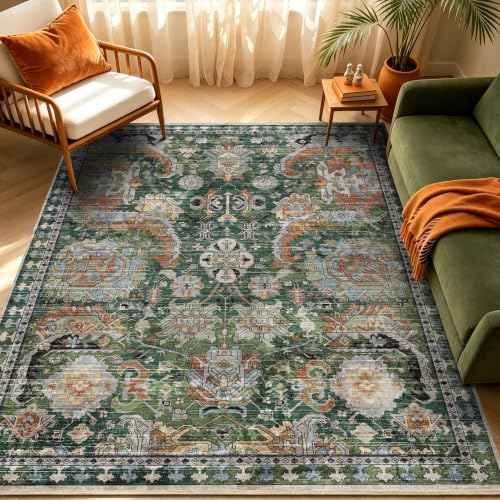
RUGSURE Washable Area Rug — Vintage Tribal, Green, 5×7 — Best Pattern Interest
Some rooms need the rug to do a little more than disappear. The RUGSURE’s verified title offers a vintage tribal design in green at 5×7, washable, non-slip, and described as stain and water resistant and friendly to pets and children. In a listing set, a patterned rug gives the photograph a focal point that is not the floor — particularly useful in an otherwise empty room, where a bare damaged floor would dominate every frame.
Strengths
- Vintage tribal pattern gives empty rooms a styled focal point for photos
- Stain and water resistance are stated in the title — note: water resistant, not waterproof
- Non-slip washable build suits family homes that must keep living during the sale
Trade-offs
- A defined pattern dates and styles a room more than a neutral distressed design
- Green colourway needs checking against your wall and furniture colours
- Water resistant means spills bead briefly; it does not make the rug a waterproof barrier for the floor beneath
| Specification | Detail |
|---|---|
| Size | 5′ x 7′ (as stated) |
| Design | Vintage tribal, green |
| Backing | Non-slip (type Not stated) |
| Care | Washable (as stated) |
| Resistance | Stain & water resistant (as stated) |
| Pile | Not stated |
The staging logic here is misdirection, used honestly: a handsome patterned rug in the centre of the room is what a buyer’s eye lands on, and the boards at the room’s edges — where the rug cannot reach — are read as background. Vintage tribal patterns are especially forgiving because their motifs are busy at exactly the scale of scuffs and marks, so the rug itself keeps looking fresh across a campaign of viewings. The title’s water resistant wording deserves the precise reading this guide gives it: resistance buys you time to blot a spill at an open house; it is not a promise that liquid cannot pass through, so coasters and quick blotting still matter over a floor you are protecting.
Best for: empty or sparsely furnished rooms that need a photo focal point, and lived-in family homes mid-sale / Not suited for: sellers wanting the most neutral possible backdrop for their own bold furniture
Check the current price on Amazon

Moynesa Ultra-Thin Washable Vintage Area Rug — 5×7 — Best Ultra-Thin
Old houses with bad floors often also have old doors with almost no clearance, and a standard rug can jam every swing. The Moynesa’s verified title answers with an ultra-thin washable 5×7 in a vintage boho oriental medallion design, described as non-slip and non-shedding. It lies nearly flush — the closest thing to re-skinning the visible floor for photographs while remaining a rug you can lift, wash and take with you.
Strengths
- Ultra-thin profile clears low doors and sits flat for tripod-level listing photos
- Medallion vintage design photographs as classic rather than trendy
- Non-shedding surface keeps the staged look tidy with minimal upkeep
Trade-offs
- Thin means minimal cushion — buyers will feel the hard floor through it at viewings
- Less physical separation between shoe soles and boards than a padded rug plus pad
- Oriental medallion styling suits traditional rooms better than stark contemporary ones
| Specification | Detail |
|---|---|
| Size | 5×7 (as stated) |
| Profile | Ultra-thin (as stated) |
| Design | Vintage oriental medallion, boho |
| Backing | Non-slip (type Not stated) |
| Care | Washable (as stated) |
| Shedding | Non-shedding (as stated) |
Think of this pick as photographic flooring. Its job is to change what the camera sees — colour, pattern, condition — while changing almost nothing about the room’s physical clearances. That makes it the right answer for hall-adjacent living rooms, bedrooms whose doors sweep the floor, and rental-grade flips where the seller wants a styled look with zero installation. The trade-off is underfoot honesty: at an open house, a thin rug feels thin, and on a floor with raised splinters or a proud nail head you should fix the hazard itself rather than cover it — a rug is presentation, not a safety repair. Pair it with the thinnest non-slip pad only if door clearance still allows; otherwise its own non-slip backing, as stated, does the holding.
Best for: rooms with low door clearance and sellers who want a near-flush photographic cover / Not suited for: anyone wanting cushion underfoot or to mask a floor with physical hazards
Check the current price on Amazon

AMADA 8×10 Washable Area Rug — Vintage Blue — Best Soft-Feel Large Rug
The AMADA is the comfort-forward large rug: its verified title states 8×10, washable, non-slip and low-profile, with a soft texture, a vintage look in blue, and pet friendly, easy to clean positioning for living rooms, bedrooms and dining rooms. For sellers still living in the home during the sale — most sellers — a rug that feels pleasant barefoot every day while presenting well on photo day earns its place twice.
Strengths
- Soft texture makes daily life on it pleasant while the home is on the market
- Low-profile non-slip build keeps the staging silhouette tidy
- Blue vintage colourway pairs well with the grey-and-white palette of most staged interiors
Trade-offs
- Blue is a colour decision; it can cool a room that already photographs cold
- 8×10 washable rugs need a large-capacity machine or a laundry service
- Pet friendly positioning invites the pets back onto it — keep a lint roller by the door on showing days
| Specification | Detail |
|---|---|
| Size | 8×10 (as stated) |
| Profile | Low-profile (as stated) |
| Texture | Soft (as stated) |
| Backing | Non-slip (type Not stated) |
| Care | Washable, easy to clean (as stated) |
| Colour | Blue, vintage decor |
Lived-in staging is a marathon: the rug must survive your family’s ordinary evenings and still be the calm centre of a Saturday open house. The AMADA’s specification leans into that reality — soft texture for the evenings, washable and easy to clean for the Saturdays, low profile so the room reads sleek in photographs. The blue vintage palette deserves a word of staging caution: blue-grey families dominate current interior photography, so this rug will blend with most staged looks, but in a home with warm honey wood tones elsewhere, test it against the room in daylight before committing the whole listing shoot to it. As with every pick here, its non-slip claim is the maker’s, stated in the title; on very smooth boards, add a slim pad if the rug walks during your own first week with it.
Best for: families living in the home during the sale who want daily comfort plus staging looks / Not suited for: sellers of very warm-toned interiors, or anyone without access to large-load laundry
Check the current price on Amazon

GarveeHome Vintage Blue Area Rug — 8×10, Cottage Style — Best Cottage Look
The GarveeHome pick is for the house whose charm is the product: cottages, farmhouses and older homes where buyers are purchasing character and the worn floors are part of a story the staging should soften, not sterilise. Its verified title describes an 8×10 washable low-pile rug in vintage blue with a cottage core, retro farmhouse character. Against old boards, that styling reads as intentional — the rug looks like it belongs to the house rather than arrived last Tuesday to hide something.
Strengths
- Cottage farmhouse styling integrates with older homes instead of looking like a cover-up
- 8×10 low-pile format covers generously while keeping doors and furniture happy
- Washable build suits a sale campaign with pets, kids and muddy viewings
Trade-offs
- A themed style is a commitment — it will not neutralise a minimalist condo
- Backing type is not stated beyond the washable format, so a separate pad is a wise addition
- Vintage blue varies by screen; judge it in the room’s own light
| Specification | Detail |
|---|---|
| Size | 8×10 (as stated) |
| Pile | Low-pile (as stated) |
| Design | Vintage blue, cottage / retro farmhouse |
| Care | Washable (as stated) |
| Backing | Not stated |
| Room fit | Living room (as stated) |
There are two staging philosophies for a character home: neutralise everything, or lean into the story and make every element look chosen. This rug serves the second philosophy. A vintage blue farmhouse design over old boards tells a buyer the house is loved and coherent, and in photographs it produces the warm, editorial look that lifestyle listings aim for. The specification honesty matters here: the title states size, pile and washability, but does not state a backing type, so this review marks the backing Not stated and recommends a non-slip rug pad underneath — which on an old, possibly uneven floor also smooths the rug’s lie and adds a protective layer between rug and boards. That combination — styled top, sensible pad — is exactly how a professional would stage it.
Best for: cottages, farmhouses and character homes where the rug should look like it belongs / Not suited for: minimalist interiors, or buyers unwilling to add a rug pad for grip
Check the current price on Amazon
Comparison Table
| Pick | Badge | Key spec | Best for |
|---|---|---|---|
| OLANLY 5×7 Washable Area Rug — Beige Distressed Abstract | Best Overall for Staging | 5×7 washable, non-slip, low pile | bedrooms and smaller living rooms with worn boards that need calm, neutral coverage |
| Lahome Dark Olive Green Washable Area Rug — 8×10, Rubber Backed | Best for Large Rooms | 8×10, rubber backed, non-slip | large living and dining rooms needing maximum coverage with a stated rubber backing |
| RUGSURE Washable Area Rug — Vintage Tribal, Green, 5×7 | Best Pattern Interest | 5×7 vintage tribal, water resistant | empty or sparsely furnished rooms that need a photo focal point, and lived-in family homes mid-sale |
| Moynesa Ultra-Thin Washable Vintage Area Rug — 5×7 | Best Ultra-Thin | Ultra-thin 5×7, non-slip | rooms with low door clearance and sellers who want a near-flush photographic cover |
| AMADA 8×10 Washable Area Rug — Vintage Blue | Best Soft-Feel Large Rug | 8×10 soft texture, low-profile | families living in the home during the sale who want daily comfort plus staging looks |
| GarveeHome Vintage Blue Area Rug — 8×10, Cottage Style | Best Cottage Look | 8×10 cottage vintage, low-pile | cottages, farmhouses and character homes where the rug should look like it belongs |
How to Choose Rug Size and Placement When the Floor Is the Problem
Measure the damage before the room. Sketch the floor, mark where the worst boards sit — usually the traffic path from door to window, the ring around a former rug, the water marks near a kitchen or bathroom threshold — and then choose the smallest standard rug that covers those marks with margin. A 5×7 covers a seating island; an 8×10 covers a room’s working centre. If the worst damage sits at the room’s edge, no area rug reaches it honestly, and that patch needs a repair conversation with your agent rather than a bigger rug.
Placement follows furniture, not walls. In a living room, the front legs of sofas and chairs should land on the rug; that anchors the arrangement in photographs and keeps the rug’s edges — where eyes compare covered and uncovered floor — under furniture shadow lines. In a bedroom, the rug belongs under the lower two-thirds of the bed, extending on both sides where feet land and where floor wear concentrates. Centre the pattern, straighten it against the room’s dominant wall, and photograph from the doorway: that is the frame buyers will judge, and the frame your rug placement should be designed for.
Colour choice is a lighting decision. Beige and light distressed designs lift dark, tired boards and make small rooms read larger. Deeper colours — the olive and blues in this guide — ground big rooms and create deliberate contrast. In both directions, distressed and vintage patterns outperform flat solids for this job, because a solid field shows every crumb and scuff at an open house while a broken pattern absorbs them visually. Order in time to live with the rug for a few days before photos; if the colour fights the room in real daylight, you want to know then.
Backings, Pads and Protecting the Floor Under the Rug
A staging rug sits on a floor you are trying to present, so what touches the boards matters. The picks in this guide state non-slip constructions, and one — the Lahome — states a rubber backing outright. Non-slip backing keeps the rug planted for photographs and prevents the slow creep that makes rooms look untidy by the third viewing. Where a title does not state a backing type, as with the GarveeHome pick, treat a separate non-slip rug pad as part of the purchase.
A pad does three jobs beyond grip. It adds a thin cushion that makes the rug feel more substantial underfoot at viewings; it smooths minor unevenness in old boards so the rug lies photographically flat; and it forms a barrier layer between rug backing and floor finish. That barrier matters on fragile or freshly finished floors, because some rubber backings can interact with certain finishes over long contact. For a sale campaign of weeks, the risk is low, but the pad removes the question entirely and costs little. Never use adhesive tapes or rug grippers that bond to the floor — residue on the boards creates a new defect worse than the one you covered.
Finally, lift and check. Once a week during the listing, lift a corner and look: moisture trapped under a rug on a ground-floor room can mark boards, and grit that migrates underneath acts like sandpaper when the rug shifts. A quick vacuum under the rug during your weekly showing-prep keeps both the presentation and the floor itself in better shape than you found them.
Staging With Rugs: The Photography and Viewing Playbook
Listing photographs are taken wider and lower than human vision, which exaggerates both floor damage and rug placement errors. Before the shoot, vacuum the rug in one direction to even the pile’s light reflection, pull it drum-tight and square, and check the doorway shot on your phone: the rug should read as a calm rectangle of texture with furniture legs planted on it, not as a bright island floating in damaged floor. If the contrast between covered and uncovered floor is jarring at the rug’s edge, a slightly larger size usually fixes what no amount of straightening can.
During viewings, the rug’s work is acoustic and psychological as much as visual. A large rug softens footfall echo in emptied rooms, making them feel furnished and calm, and it gives buyers a defined zone to stand in and imagine their own furniture. Keep it clean with a simple rhythm: shake or vacuum before every showing, wash it when it stops looking fresh rather than on a schedule, and keep shoes-off signage consistent — a rug that buyers are afraid to walk on has overshot its brief. The goal is a room that feels cared for, because buyers extrapolate from surfaces: a home that looks maintained is assumed to be maintained where they cannot see.
Working With Your Agent: Where the Rug Fits in the Sale Plan
A staging rug works hardest when it is part of a plan rather than a panic purchase, so talk to your agent before you order. Agents know which rooms photograph first, which flaws buyers in your price band forgive, and — critically — what your local disclosure rules require you to state about the floors regardless of what covers them. Bring the room measurements and a phone photo of the worst boards to that conversation. The usual professional answer is a version of this guide’s shortlist: one large neutral rug for the main living space, a 5×7 for the primary bedroom, and nothing at all in rooms where the floor is actually fine, because over-rugging a home reads as its own kind of concealment and buyers notice the pattern even when they cannot name it.
Timing is the second half of the plan. The rug should arrive at least a week before photography: time to unroll, relax, live with the colour in real light, and exchange if the palette fights the room. Photographers will thank you for a rug that lies flat and a room whose furniture legs already stand on it, because both read as permanence in the frame. During the campaign, treat the rug as a maintained surface, not a fixture — vacuumed before viewings, washed when it dulls, and lifted weekly to check the boards beneath, which protects both the presentation and your position if questions are asked later. And when the sale closes, document the floor’s condition honestly in the handover, with the rug either removed or explicitly included in the sale terms. Sellers who stage boldly and disclose plainly get the best of both: a beautiful first impression and a clean conscience at completion.
What to Do With the Rooms a Rug Cannot Save
Honesty about limits improves a sale plan, so name them: a rug cannot cover damage at a room’s edges, under fixed cabinetry, or on stairs, and some floors are worn in ways that presentation cannot soften. For edges and thresholds, the professional options are repair conversations — a refinisher’s quote for the worst room, a carpenter’s patch for the broken board by the door — obtained before listing so that buyers meet prices instead of surprises. Even when you choose not to do the work, holding a written quote transforms the negotiation: the floor becomes a known number rather than an imagined catastrophe, and imagined catastrophes are always priced higher by buyers than real ones.
Stairs and hallways deserve their own sentence, because sellers often ask whether a runner can do for a staircase what an area rug does for a room. A properly fitted runner is a legitimate presentation tool for a worn hall, but stair treads are a safety surface before they are a visual one, and any covering there must be professionally secured or not used at all — a loose runner on stairs is a hazard no photograph justifies. This guide’s picks are area rugs for rooms, chosen and specified for that job. Keep the categories separate, spend the rug money where cameras linger, and let quotes and disclosure carry the rest of the floor’s story with the same plainness this guide has tried to model.
How to Lay a Staging Rug So It Photographs Flat and Stays Put
A new washable rug arrives folded and determined to remember it. This sequence, done two days before photography, is how stagers get a rug to lie like it grew there.
- Unpack and unroll the rug in the room where it will live, pattern side up, roughly in position. Vacuum it once to lift packing dust and raise the pile evenly.
- Reverse-roll stubborn corners: roll a curled edge tightly in the opposite direction, hold for a minute, and release. Repeat rather than forcing.
- Slide the rug pad underneath if you are using one, trimmed an inch smaller than the rug on all sides so it never peeks out in photos.
- Position the rug against the room: align its long edge with the dominant wall or fireplace line, then walk the furniture onto it — front legs on for sofas and chairs.
- Weight the corners overnight with stacks of books or the furniture itself. Washable rugs relax significantly in the first 24 to 48 hours of warmth and weight.
- On photo morning, vacuum in a single direction, check the doorway view on your phone, and nudge — never drag a loaded rug — until the rectangle sits square in frame.
Between showings, resist moving the rug to vacuum underneath daily; weekly is enough, and every move is a chance for corners to re-curl. Keep the packaging until the sale closes if storage is tight — but store the rug rolled, not folded, so it can go straight into your next home without a second round of crease training.
After the sale, the same rug logic travels with you: the washable, low-pile, non-slip specification that staged a house is exactly the specification that survives a new home’s first muddy winter. Buy the staging rug you would happily keep, and the purchase stops being a selling cost and becomes furniture you already own.
Common Buying Mistakes
Buying a rug that is too small to cover the damage. A small rug in a big worn room reads as a spotlight on everything outside it. Measure the damaged zone first and size up; the difference between a 5×7 and an 8×10 is the difference between decorating and covering.
Using a rug to conceal a defect you must disclose. Presentation is legitimate; concealment of known material defects is a legal problem in many jurisdictions and a deal-killer when a buyer’s inspector lifts the rug. Talk to your agent about disclosure and let the rug do the honest job of presentation.
Choosing a solid pale rug for a long campaign. Solids show every mark a viewing leaves behind. Distressed and vintage patterns were invented, visually, for exactly this forgiving work — that is why this guide is full of them.
Taping or gluing a rug to a wood floor. Adhesives can strip finish and leave residue that becomes the worst mark on the floor. Non-slip backings and pads hold rugs without chemistry.
Ordering the rug the week of the photo shoot. Fold creases need days to relax, and colour surprises need time to exchange. A staging rug is a two-weeks-early purchase, not a last-minute one.
Final Recommendation
For most sellers, the OLANLY 5×7 in beige distressed is the safe first buy: neutral, low pile, washable and non-slip, it calms a bedroom or small living room without arguing with any furniture. For a big room, choose between the Lahome’s stated rubber backing in dark olive and the AMADA’s soft blue comfort if you are living in the home during the sale. Low doors point to the ultra-thin Moynesa; an empty room that needs a focal point points to the patterned RUGSURE; and a character cottage should take the GarveeHome vintage blue with a pad beneath it. Measure the damage, order early, lay it flat two days before photos — and let the floor’s story be told by your disclosure documents, while the rug tells the room’s.
Related guides in this programme: Best Area Rugs For Family Rooms, Best Area Rugs For Grey Floors, Best Artsy Rugs, Best Affordable Moroccan Rugs, Best Non Skid Rugs For Wood Floor.
Related guides
Frequently Asked Questions
Will a rug really help sell a home with bad wood floors?
It helps the presentation, which is what buyers respond to first: rooms photograph larger and calmer, seating areas read as defined, and the eye lands on the space rather than on refinishing estimates. It does not change the floor’s condition or your disclosure duties — it changes the first impression, which is the part of selling a rug can honestly influence.
What size rug covers the most floor damage?
Of the standard sizes here, an 8×10 covers the working centre of a living or dining room where traffic wear concentrates. A 5×7 suits bedrooms and small lounges. Measure your damaged zones and buy the size that covers them with margin; edge damage near walls may need a repair conversation instead of a rug.
Is a non-slip backing safe on wood floors?
Non-slip backings are designed to grip without adhesive, and the picks here state them in their titles. For fragile finishes or long campaigns, add a thin rug pad as a barrier layer, lift a corner weekly to check for trapped moisture or grit, and never use adhesive rug tapes on boards you care about.
Should I choose a light or dark rug over damaged wood?
Light distressed rugs lift dark, tired floors and enlarge small rooms in photos. Darker rugs ground large rooms and create deliberate contrast on pale, bleached damage. In both cases a distressed or vintage pattern outperforms a solid, because it hides the scuffs a campaign of viewings inevitably adds.
Can I just leave the rug for the buyer?
Sellers sometimes do, but treat it as a negotiated item, not an assumption — and remember the rug is your property covering a floor whose condition should be documented before it goes down. Photograph the floor before staging if your agent advises it, so the record is clear either way.
How do I keep a staging rug fresh through weeks of showings?
Choose washable — every pick here is — vacuum before each showing, blot spills immediately rather than scrubbing, and wash the rug when it stops looking fresh. Water resistant, as stated on the RUGSURE pick, buys blotting time; it does not make any rug waterproof, so coasters and quick action still matter.
Should I rug every room with a worn floor?
No. Rug the rooms that carry the listing — the living room and primary bedroom first — and let minor wear in secondary rooms read as ordinary lived-in character. A home where every floor is covered invites buyers to wonder what is underneath all of it, while a home with one or two calm, well-placed rugs reads as styled. Your agent’s eye on the photographs is the tie-breaker.


