Disclosure: airfryerkitchensupply.com is reader-supported. When you buy through links on our site, we may earn an affiliate commission at no extra cost to you.
Where to buy
Shopping for the best rugs for living room on top of carpet? All six rugs below are sold on Amazon, and each pick links to its listing so you can check the current price on Amazon, confirm available sizes, and read the backing and care details before ordering. Rug-on-carpet success depends on your existing carpet’s pile, which no listing can know — so measure your carpet first (the buying guide shows how), then match it against the pile descriptions quoted from each listing here. Where a listing states ‘ultra-thin’ or ‘low pile,’ those are the manufacturer’s own words, and they are the words that matter for this use.
- Moynesa Ultra-Thin Washable Vintage Area Rug (5×7) — Best Overall for Rug-on-Carpet: Check the current price on Amazon
- Lahome Moroccan Washable Round Rug (6ft) — Best Round Layering Rug: Check the current price on Amazon
- DMOYEST Low Pile Round Rug (6×6) — Best Modern Round Option: Check the current price on Amazon
- Vintage Washable Medallion Rug (5×7) — Best Classic Medallion Layer: Check the current price on Amazon
- Boho Washable Low Pile Rug (6×9) — Best Mid-Large Layer: Check the current price on Amazon
- Modern Abstract Washable Rug (8×10) — Best Room-Defining Layer: Check the current price on Amazon
Layering a rug over carpet sounds simple until the first week teaches you otherwise: the beautiful rug you unrolled on Monday is, by Friday, a bunched, rippled, migrating island that has crept halfway across the room and developed waves tall enough to trip on. The best rugs for living room on top of carpet are the ones engineered against that failure — thin, low-pile, and heavy or grippy enough to lie still on a surface that itself moves. A carpet is not a floor; it is a soft, shifting foundation, and a rug that behaves beautifully on hardwood can fail completely on top of it.
So this guide applies a stricter filter than a normal living-room rug roundup. Every pick is a low-pile or ultra-thin design whose listing says so, because pile-on-pile is the root of the rippling problem: two soft surfaces flex against each other with every footstep, and the top rug walks, buckles, and wrinkles. Thin, dense rugs flex less, grip better, and settle flatter. We also tell you plainly what the listings do not claim: none of these products is sold with a specific ‘carpet-safe’ or ‘for use on carpet’ promise in its title, so the selections rest on the physical criteria — thinness, low pile, non-slip backing where stated, and weight — and on the setup method in this guide, which includes the anchoring step that makes layering work.
The six picks are all washable living-room rugs in vintage, boho, and modern styles, in sizes from a 5×7 layering accent to an 8×10 room-definer, including two round options for under-coffee-table layouts. The buying guide after the reviews explains the physics in plain terms — why rugs creep, why your carpet’s pile height decides which rug you can use, and when the honest answer is a rug pad made for carpet-to-carpet use instead of a different rug.
In this guide
Quick Picks
Short version: for rug-over-carpet, thin wins. All six picks are ultra-thin or low-pile washable rugs whose listings say so; they differ in size, shape, and style. Pick your size first, then read the setup section — the anchoring method matters as much as the rug.
Moynesa Ultra-Thin Washable Vintage Area Rug (5×7) — Best Overall for Rug-on-Carpet. A 5×7 rug whose listing leads with ‘ultra-thin’ and adds washable, non-slip, and non-shedding, in a vintage oriental medallion style — the thinnest profile here, and thin is the whole game on carpet. Check the current price on Amazon
Lahome Moroccan Washable Round Rug (6ft) — Best Round Layering Rug. A 6-foot round rug described by its listing as ultra-thin, soft, and non-slip, in a vintage distressed Moroccan style — the layering answer for round coffee tables and curved layouts. Check the current price on Amazon
DMOYEST Low Pile Round Rug (6×6) — Best Modern Round Option. A 6×6 round rug whose listing states washable, low pile construction in a modern abstract design — a contemporary alternative to the vintage round pick, for living rooms, bedrooms, and dining areas. Check the current price on Amazon
Vintage Washable Medallion Rug (5×7) — Best Classic Medallion Layer. A 5×7 washable rug whose listing states a low pile and a distressed vintage medallion design in beige — the traditional-pattern layering option in the most versatile size. Check the current price on Amazon
Boho Washable Low Pile Rug (6×9) — Best Mid-Large Layer. A 6×9 washable rug whose listing states low pile, non-slip backing, and stain resistance, in a black boho farmhouse style — the bigger rectangle for rooms between 5×7 and 8×10. Check the current price on Amazon
Modern Abstract Washable Rug (8×10) — Best Room-Defining Layer. An 8×10 washable rug whose listing states a non-slip build and a soft low pile, in a neutral modern abstract design — full-room layering for large living rooms on suitable carpet. Check the current price on Amazon
How These Picks Were Chosen
We filtered the living-room rug field by one mechanical criterion before any aesthetic one: the listing had to describe the rug as ultra-thin or low pile. That is the property that decides whether a rug can lie on carpet without rippling, because a thin rug has less internal flex to fight the soft surface beneath it. Non-slip backing, where a listing states it, was the second criterion — grip against carpet fibers is what resists the slow creep that foot traffic causes. Washability, stated by all six listings here, was third: a rug layered on carpet cannot be sent out for cleaning as easily, and a washable rug keeps the layered look practical.
Every candidate was verified against its live Amazon listing, and we recorded the pile and backing claims exactly as stated. We want to be transparent about the limit of that verification: these listings describe rugs for floors generally, and none claims a specific carpet-on-carpet certification. Our recommendations are therefore criteria-based — thin, low, grippy, and washable — paired with a setup method that includes anchoring. If your carpet is deep plush or shag, read the buying guide’s honest section first: on very deep pile, no area rug layers well, and a different approach entirely may serve your room better.
The 6 Best Rugs for Living Room on Top of Carpet

Moynesa Ultra-Thin Washable Vintage Area Rug (5×7) — Best Overall for Rug-on-Carpet
The Moynesa takes the top spot because its listing uses the two words this entire category turns on: ultra-thin. A rug with minimal internal loft has almost nothing to flex against the carpet beneath it, so it lies flatter, ripples less, and resists the walking-and-bunching cycle that defeats thicker rugs. The listing adds the supporting cast a layered rug needs — non-slip backing to grip the carpet fibers, non-shedding construction so the top surface stays tidy, and washability for practical care — in a 5×7 vintage medallion design that gives a plain rental-grade carpet an instant point of view.
The 5×7 size is also the sweet spot for layering: large enough to define a seating zone and anchor furniture fronts, small enough that its own weight stays manageable and any minor shifting is a ten-second correction rather than a furniture-moving event. As with every pick here, the listing does not claim a specific carpet-safe certification, so success still depends on your carpet being low-to-medium pile and on the anchoring setup in this guide. On a suitable carpet, though, this is the formula in its purest form: the thinnest washable rug, with grip, in the most layerable size.
Strengths
- Ultra-thin profile stated in the listing — the key property for layering
- Non-slip backing grips the carpet beneath
- Non-shedding, washable construction keeps upkeep simple
Trade-offs
- Thin means minimal cushion — this is a visual layer, not padding
- 5×7 only in this listing; big rooms should size up to the 8×10 pick
- No explicit carpet-on-carpet claim in the listing — setup method matters
Key specs (from the manufacturer listing)
- Size: 5 x 7 ft, stated
- Profile: Ultra-thin, stated
- Backing: Non-slip, stated
- Washable: Yes, stated
- Shedding: Non-shedding, stated
Start here if your living-room carpet is the standard low-to-medium pile found in most rentals and newer homes, and your goal is pattern and definition over it. Anchor it with furniture weight on at least two edges — sofa front feet and a coffee table are the classic pair — and you have the layered look that interior photos promise, without the weekly re-flattening ritual that thicker rugs impose.
Best for: Low-to-medium pile carpets needing a defined, patterned seating zone / Not suited for: Deep plush carpets, or anyone wanting cushion from the top rug

Lahome Moroccan Washable Round Rug (6ft) — Best Round Layering Rug
Round rugs solve a layering problem rectangles cannot: in a room where the seating curves — a round coffee table, a swivel-chair conversation group, a bay-window reading corner — a rectangular layer fights the layout, while a round one completes it. The Lahome’s listing describes a soft, ultra-thin, non-slip round rug of 6 feet in a vintage distressed Moroccan pattern, and ultra-thin is again the operative phrase: a round rug has no corners to anchor under furniture legs as easily, so its flatness and grip carry even more of the anti-ripple load than a rectangle’s do.
The distressed Moroccan styling suits the layering purpose particularly well, because a deliberately aged pattern forgives the visual busyness of pattern-over-carpet — especially over a patterned existing carpet, where a crisp modern design would clash and a softened vintage one blends. Softness in an ultra-thin rug is relative — expect a smooth, low surface rather than plushness — and the 6-foot diameter defines a zone rather than covering a room. For the classic setup of round rug centered under a round coffee table on a wall-to-wall carpet, this is the pick that understands the assignment.
Strengths
- Ultra-thin and non-slip per the listing — flat and grippy on carpet
- Round format suits curved layouts and round tables
- Distressed pattern blends gracefully over existing carpet patterns
Trade-offs
- 6-foot diameter defines a zone; it will not cover a large room
- Round rugs anchor less easily under furniture than rectangles
- Soft in this class means smooth, not plush
Key specs (from the manufacturer listing)
- Shape: Round, 6 ft diameter, stated
- Profile: Ultra-thin, stated
- Backing: Non-slip, stated
- Washable: Yes, stated
- Style: Moroccan vintage distressed
Choose the Lahome when your living room’s geometry is round — or when a rectangular layer has already failed you and the room’s real problem is that the seating group is a circle pretending to be a grid. Center it under the table, let the chairs’ front legs kiss its edge, and the layer reads as intentional design rather than as a rug that escaped. On deep-pile carpet even this thin profile will struggle, so check your carpet against the guide below before ordering.
Best for: Round coffee tables, curved seating groups, bay-window corners / Not suited for: Large rectangular seating zones or deep plush carpets

DMOYEST Low Pile Round Rug (6×6) — Best Modern Round Option
The DMOYEST gives the round-rug shopper a modern accent instead of a vintage one: its listing describes a 6×6 washable rug with a low pile and a modern abstract design, for living rooms, bedrooms, and dining rooms. Low pile is the layering credential here — the rug’s surface sits close to its backing, so the whole construction flexes minimally on the carpet beneath, which is the mechanical behavior that keeps a layered rug lying flat through a week of foot traffic. The abstract pattern earns its place over carpet for the same reason distressed patterns do: visual complexity hides the slight texture differences between the rug’s edge and the carpet around it, so the layer looks deliberate.
Compared with the Lahome, the trade is backing information: the DMOYEST’s listing title does not call out a non-slip backing, so plan on the anchoring method in this guide doing that work — furniture weight, placement in a lower-traffic zone, or a carpet-to-carpet grip layer beneath. That is a manageable condition, not a disqualification, and it is exactly the kind of listing gap this guide exists to flag rather than paper over. If your room is modern, your carpet is low pile, and your layout is round, the DMOYEST is your design match.
Strengths
- Low pile stated in the listing — flexes minimally on carpet
- Modern abstract pattern suits contemporary rooms
- Washable construction keeps the layered look practical
Trade-offs
- Non-slip backing is not stated in the listing title — anchoring is on you
- Round format covers a zone, not a whole room
- Abstract styling is a stronger statement than neutral vintage
Key specs (from the manufacturer listing)
- Shape: Round, 6 x 6 ft, stated
- Pile: Low pile, stated
- Washable: Yes, stated
- Backing: Not stated in listing title
- Style: Modern abstract
Buy the DMOYEST for a modern living room where the vintage picks would look like someone else’s taste, and set it up properly: center it in the seating zone, anchor with the coffee table’s weight, and let the guide’s creep-prevention steps handle the rest. It is also the natural dining-area layer of this list — low pile under a dining set means chairs slide without dragging the rug into folds, on carpet or off it.
Best for: Modern living rooms and dining areas with round layouts / Not suited for: High-traffic paths unless anchored carefully
Vintage Washable Medallion Rug (5×7) — Best Classic Medallion Layer
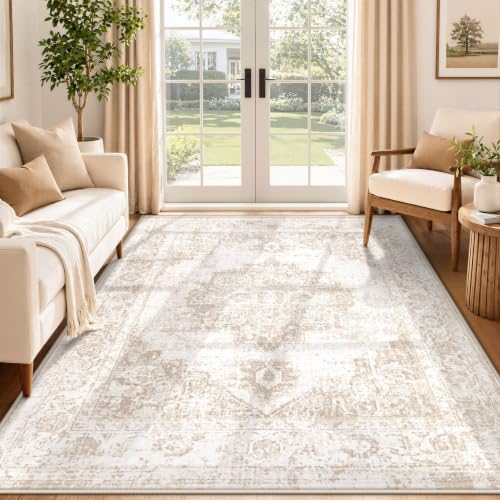
This 5×7 medallion rug is the classicist’s version of the layering formula: the listing states a washable construction with a low pile and a distressed finish, in a beige vintage medallion pattern aimed at living rooms, bedrooms, and dining areas. Low pile does the mechanical work on carpet — limited flex, flatter lay, less bunching — while the beige medallion does the diplomatic work, sitting comfortably over the beige and gray wall-to-wall carpets that fill most homes without demanding the room redecorate around it. If your goal is ‘my living room, but finished,’ rather than a style statement, this is the rug that disappears into the role.
The listing’s title does not specify the backing type, so treat anchoring as part of the installation: the 5×7 rectangle is the easiest shape to anchor well, with sofa feet on the long edge and a coffee table at the center, and the setup section of this guide covers the method in full. Washability keeps the arrangement honest over time — a layered rug collects the same dust and spills as any other, and a rug you can launder beats a rug you must spot-clean forever while it sits on top of carpet you are trying to protect.
Strengths
- Low pile stated in the listing for a flatter lay on carpet
- Beige medallion blends with the most common carpet colors
- Washable 5×7 is the easiest size to install, anchor, and launder
Trade-offs
- Backing type is not stated in the listing title — plan to anchor it
- Traditional medallion will not excite modern minimalists
- Beige shows dark soil more than busier patterns do
Key specs (from the manufacturer listing)
- Size: 5 x 7 ft, stated
- Pile: Low pile, stated
- Washable: Yes, stated
- Backing: Not stated in listing title
- Style: Vintage medallion, beige, distressed
Choose this rug when the carpet underneath is fine but forgettable and the room needs pattern, softness of line, and a defined center — the most common layering brief there is. It is also the safest gift-to-yourself for a rental, where the carpet cannot be changed and the deposit depends on leaving it as found: a washable low-pile layer takes the wear that the landlord’s carpet would otherwise take.
Best for: Rentals and traditional living rooms needing a calm, classic layer / Not suited for: Buyers wanting a stated non-slip backing out of the box

Boho Washable Low Pile Rug (6×9) — Best Mid-Large Layer
The 6×9 is the forgotten size that fits many real living rooms better than either standard neighbor, and this boho rug’s listing states the full layering toolkit: low pile, non-slip backing, stain resistance, and washability. Low pile plus a stated non-slip backing is the strongest anti-creep combination among the rectangular picks — the construction flexes little, and the backing grips the carpet fibers to resist what flex remains. Stain resistance, usually a dining-room feature, earns its place in a layered living room too, because a spill on a layered rug threatens two textiles at once, and a resistant surface buys cleanup time before anything reaches the carpet you are protecting.
The black-based boho farmhouse pattern is the boldest look here, and over pale wall-to-wall carpet it creates the strongest version of the layered effect — a defined dark island that organizes the whole room. Boldness cuts both ways: it will dominate a small room and it will show pale pet hair and lint more than mid-tone patterns do. The 6×9 footprint anchors properly under a standard sofa-and-chairs arrangement, with enough border to read as a designed layer rather than a mat. For a mid-to-large living room on low carpet, this is the most completely specified pick in the guide.
Strengths
- Low pile plus stated non-slip backing — the strongest anti-creep spec here
- Stain resistance protects the carpet underneath as well as the rug
- 6×9 size anchors a full seating arrangement
Trade-offs
- Black pattern dominates small rooms and shows pale debris
- Boho farmhouse style is a definite aesthetic commitment
- Larger size means a heavier wash load than the 5×7 picks
Key specs (from the manufacturer listing)
- Size: 6 x 9 ft, stated
- Pile: Low pile, stated
- Backing: Non-slip, stated
- Stain resistance: Stated in listing
- Washable: Yes, stated
Buy the boho 6×9 when your room is big enough that a 5×7 floats and your carpet is low enough that layering is viable — and when you want the layer to be the room’s main visual event. Its combination of stated specs makes it the lowest-risk large layer here; the remaining risk is purely stylistic, and the listing’s photos will settle that faster than any review can.
Best for: Mid-to-large living rooms wanting a bold, well-anchored layer / Not suited for: Small rooms or pale-debris households (light pet hair shows on black)

Modern Abstract Washable Rug (8×10) — Best Room-Defining Layer
At 8×10, a layered rug stops being an accent and becomes the room’s floor-within-the-floor, and this modern abstract rug’s listing supports the role with the right stated properties: washable, non-slip, and a soft low pile, in neutral tones that layer calmly over common carpet colors. Low pile remains the enabling spec — at this size, a thick rug’s tendency to ripple multiplies across every square foot, while a low-pile construction lies comparatively calm — and the non-slip backing works over a large contact area, which is itself a form of anchoring: more grip, more weight, more furniture standing on the layer to hold it in place.
Scale brings the honest warnings, and they are the same ones this guide gives every big rug: an 8×10 wash needs large-capacity laundry access; installation is a two-person job, especially when furniture must be lifted rather than slid; and on anything deeper than medium carpet pile, a layer this large will telegraph every wrinkle. But for the big, plain, carpeted living room — the room that feels like a beige field with furniture parked on it — a neutral 8×10 layer is transformative in a way no 5×7 can be, because it gives the seating arrangement a territory of its own. If your carpet passes the pile test in the guide below, this is the maximum-effect option.
Strengths
- Full 8×10 layering scale for large living rooms
- Low pile and stated non-slip backing suit the carpet-layering brief
- Neutral abstract design layers calmly over most carpet colors
Trade-offs
- Two-person installation; furniture must be placed onto it
- 8×10 washing requires large-capacity laundry access
- Unsuitable for deep-pile carpet — wrinkles will show at this scale
Key specs (from the manufacturer listing)
- Size: 8 x 10 ft, stated
- Pile: Low pile, stated
- Backing: Non-slip, stated
- Washable: Yes, stated
- Style: Modern abstract, neutral
Choose the 8×10 when the room’s problem is scale — a large carpeted expanse that swallows smaller rugs — and when your carpet is firmly in the low-to-medium pile camp. Install it with help, anchor it with the full furniture arrangement rather than a token chair leg, and give it a week of living before judging the lay; large thin rugs settle as their fibers relax into the carpet beneath, and most improve over the first days.
Best for: Large living rooms on low-to-medium pile carpet / Not suited for: Deep-pile carpets, solo installers, or small laundry setups
Comparison Table
Two columns decide your purchase here: profile (ultra-thin beats low pile beats everything else, for this job) and backing (stated non-slip versus not stated — the latter simply means anchoring is your responsibility). Everything else — pattern, size, shape — is ordinary rug shopping. If your carpet is deep plush, no row in this table will save you; read the guide’s pile section before ordering anything.
| Pick | Badge | Key spec | Best for |
|---|---|---|---|
| Moynesa Ultra-Thin Washable Vintage Area Rug (5×7) | Best Overall for Rug-on-Carpet | Ultra-thin washable 5×7, non-slip, non-shedding | Low-to-medium pile carpets needing a defined, patterned seating zone |
| Lahome Moroccan Washable Round Rug (6ft) | Best Round Layering Rug | Ultra-thin round 6ft, non-slip, washable | Round coffee tables, curved seating groups, bay-window corners |
| DMOYEST Low Pile Round Rug (6×6) | Best Modern Round Option | Low-pile round 6×6, washable, modern abstract | Modern living rooms and dining areas with round layouts |
| Vintage Washable Medallion Rug (5×7) | Best Classic Medallion Layer | Low-pile washable 5×7, vintage medallion | Rentals and traditional living rooms needing a calm, classic layer |
| Boho Washable Low Pile Rug (6×9) | Best Mid-Large Layer | Low-pile 6×9, non-slip, stain resistant, washable | Mid-to-large living rooms wanting a bold, well-anchored layer |
| Modern Abstract Washable Rug (8×10) | Best Room-Defining Layer | Low-pile washable 8×10, non-slip, neutral abstract | Large living rooms on low-to-medium pile carpet |
How to Choose a Rug to Put on Top of Carpet
Start by grading your carpet, because it — not the rug — sets the difficulty. Run your hand across it and press your fingers in: if the pile is short and dense (most rental, berber, and low-loop carpets), layering is straightforward and every pick here is in play. If the pile is medium, layering works with thin rugs and proper anchoring. If your carpet is deep plush or shag — the kind that shows footprints — be honest: rugs layered on it will ripple and wander no matter what their listings promise, because the foundation itself moves. On deep pile, the better projects are a large low rug pad alternative, a different room treatment, or accepting the carpet and spending the budget elsewhere in the room.
With a suitable carpet, choose the top rug by the three properties this guide filtered on. Thin first: ultra-thin constructions (Moynesa, Lahome) flex least and lie flattest; low-pile rugs are the next tier and include the rest of the picks. Grip second: a stated non-slip backing (Moynesa, Lahome, the boho 6×9, the 8×10) resists creep directly; where a listing does not state the backing, anchoring with furniture and placement becomes the grip strategy. Weight and size third: larger, heavier rugs with furniture standing on them move least — a small rug floating mid-room on carpet is the configuration most likely to travel, whatever it is made of.
A note on honesty in this category: you will find third-party advice claiming certain rugs are ‘carpet-safe’ as if it were a certification. It is not one, and none of the listings verified for this guide claims it. What protects the carpet under your layer is mundane: a clean rug, a clean carpet beneath it, no rubber compounds left to bake in direct sun for years, and periodic lifting to vacuum underneath so grit does not grind between the layers. Choose by physical properties, install by the method below, and maintain both textiles — that is the whole secret, and it works.
Why Rugs Ripple and Creep on Carpet — and How to Stop It
The physics is simple once you see it: carpet pile bends underfoot, and it bends directionally — pile has a lean, like grass. Every step on a layered rug pushes the rug a fraction in the pile’s lean direction and flexes it against the soft surface; thousands of steps later, the rug has migrated and the flex has organized itself into ripples, usually radiating from the highest-traffic edge. Thick rugs make it worse because their own loft flexes too, adding a second moving layer. This is why thinness is not an aesthetic preference in this guide but a mechanical requirement: a thin rug has almost no flex of its own, so the system has only one moving part instead of two.
The countermeasures follow from the cause. Anchor with weight: furniture legs and bases standing on the rug pin it against the traffic forces, which is why the classic arrangement — sofa front feet and coffee table on the layer — is classic. Orient with the pile: if your rug creeps consistently one way, rotating it 180 degrees sometimes balances the forces. Keep traffic lanes off the edges: a rug edge in the main walking path gets kicked and flexed constantly, while an edge under the sofa line rests. And give a new layer a settling week — fibers relax, the rug conforms to the carpet’s surface, and minor waves often flatten as the system beds in.
If creep persists despite a thin rug and good anchoring, the remaining tool is a grip layer between rug and carpet — pads and tapes made specifically for rug-on-carpet use exist for exactly this sandwich. Choose products sold for that purpose, test any adhesive product in a corner first, and avoid improvising with general-purpose tapes that can leave residue in carpet pile. With a suitable carpet, a thin rug, furniture anchoring, and if needed a purpose-made grip layer, the layered look is stable enough to forget about — which is the point of it.
Sizing and Styling a Layered Rug in the Living Room
Sizing rules for layers differ from sizing on hard floors. On carpet, the layered rug reads as an island, so its relationship to the furniture matters more than its relationship to the walls: the front legs of sofas and chairs should stand on the rug, with a visible border of the underlying carpet framing the island on all sides. In practice that means a 5×7 under a loveseat-and-chairs grouping, a 6×9 under a standard three-seat sofa arrangement, and an 8×10 when the room and the furniture group are genuinely large. Round rugs break the grid deliberately — a 6-foot round under a round coffee table, or centered in a conversation circle, is a designed gesture rather than coverage.
Styling over carpet is an exercise in contrast management. Over a plain carpet, almost any pattern works, and the vintage and medallion picks give a traditional room its missing center. Over a patterned carpet — the true test — choose a top rug whose pattern is larger in scale and softer in definition than the carpet’s: distressed and abstract designs (Lahome, DMOYEST, the 8×10) layer gracefully, while two busy small-scale patterns at war will make the room vibrate. Color-wise, the layer should differ from the carpet by enough to read as intentional — a beige rug on a beige carpet of the same value disappears into a slightly-off rectangle, while a clear step lighter, darker, or warmer reads as design.
Finally, remember what the layer is for. Most people layer for one of three reasons: to define a zone in a big carpeted room, to add pattern or color a landlord’s carpet lacks, or to take the wear in a high-traffic area so the carpet underneath survives. Name your reason before you shop and the size, pattern, and budget mostly choose themselves — and if your reason is wear protection in a rental, the washable picks here are doubly right, because the layer can be laundered back to presentable whenever inspection day approaches.
How to Install a Rug Over Carpet So It Stays Flat
Installation is where rug-on-carpet succeeds or fails. Budget half an hour, recruit a second pair of hands for anything 6×9 or larger, and work through these steps in order.
- Vacuum the carpet thoroughly first — including a slow pass against the pile direction. Grit left under a layered rug grinds between the two textiles with every step, wearing both; the five minutes now saves both rugs’ lives.
- Unroll the new rug elsewhere if you can and let it relax; if corners curl, weigh them down overnight. A rug that starts curled on carpet will never be persuaded flat by optimism.
- Position the rug with help, lifting rather than dragging it into place — dragging across carpet pile pre-loads the creep in one direction. Align it to the furniture plan, not just the walls: the seating arrangement is what will anchor it.
- Anchor with furniture weight: place the sofa’s front feet and the coffee table on the rug, and chairs’ front legs where the layout allows. The goal is at least two, preferably three, pinned zones spread across the rug’s area.
- Walk the whole surface firmly, center outward, to seat the backing into the carpet pile. Check edges and corners by hand; a corner that lifts now will be caught by a foot later, so weigh or adjust it until it rests.
- Live with it for a week before final judgment. Minor waves often settle as the rug conforms; persistent creep in one direction means rotate the rug 180 degrees, add anchoring weight on the traveling edge, or step up to a purpose-made rug-on-carpet grip layer underneath.
Maintenance for a layered rug is a rhythm, not an event: vacuum the top rug as normal, and every month or two, fold back or lift sections to vacuum the carpet beneath and check for trapped grit or moisture. That periodic check is also your carpet’s protection audit — the layer should be preserving the carpet, and a two-minute look confirms it is.
Common Buying Mistakes
Layering a thick or plush rug on carpet. Pile on pile is the original sin of this category: two flexing surfaces guarantee ripples and migration. Every pick in this guide is ultra-thin or low pile for mechanical reasons, not fashion ones. If the rug you love is plush, love it on a hard floor instead.
Trying to layer over deep plush or shag carpet. A moving foundation defeats every top rug. Grade your carpet honestly first — if it shows footprints, it will not hold a layer flat, and the money is better spent on other changes to the room. This guide’s picks assume low-to-medium pile, and they say so rather than selling you a struggle.
Floating a small rug mid-room with nothing on it. An unanchored rug on carpet is a rug in transit. At minimum, get furniture weight on two edges; place the rug so its edges sit out of the main walking lanes; and treat any small, light layer as a deliberate, occasionally-adjusted accent rather than a set-and-forget installation.
Skipping the vacuum underneath. Grit migrates through and under a layered rug and then grinds between the layers underfoot, abrading both textiles. The monthly lift-and-vacuum in the setup section is what makes layering protective rather than destructive for the carpet you are trying to preserve.
Believing ‘carpet-safe’ marketing without a stated basis. There is no standard certification behind the phrase, and none of the verified listings in this guide claims it. Judge by stated physical properties — thinness, pile, backing — and by your own carpet’s pile, and be skeptical of any product whose carpet claim is a badge rather than a specification.
Matching the rug too closely to the carpet color. A near-match reads as a mistake — a slightly wrong rectangle — rather than a layer. Step the color clearly lighter, darker, or warmer than the carpet, or use pattern to create the separation. The layered look depends on the eye seeing two deliberate surfaces, not one uncertain one.
Key Takeaways
- Thin is mechanical, not aesthetic: ultra-thin and low-pile rugs flex least on carpet, so they ripple and creep least.
- Grade your carpet first — low-to-medium pile layers well; deep plush defeats every top rug.
- Stated non-slip backings (Moynesa, Lahome, boho 6×9, 8×10) grip directly; unstated backings mean anchoring is your job.
- Furniture weight is the anchor: front feet and coffee table on the layer, edges out of traffic lanes.
- No listing here claims a carpet-safe certification — judge by stated physical properties and maintain both layers.
Final Recommendation
For the typical living room — low-to-medium pile carpet, a sofa group to define, patience for a proper install — start with the Moynesa: its stated ultra-thin profile and non-slip backing are the purest form of the layering formula, in the most manageable size. Round layouts should go to the Lahome for vintage rooms or the DMOYEST for modern ones; traditionalists to the beige medallion 5×7; and larger rooms to the boho 6×9 or the neutral 8×10, whose stated specs scale up without changing the rules.
Whatever you choose, install it by the method in this guide — clean carpet beneath, furniture anchoring, a settling week — and keep the monthly vacuum-underneath habit. Done that way, a layered rug is one of the highest-impact changes a carpeted living room can get: pattern, definition, and wear protection, all without touching the floor itself. Done casually, it is a wavy trip hazard with good intentions. The difference is entirely in the setup, and now you have it.
Start with the shortlist: Moynesa Ultra-Thin Washable Vintage Area Rug (5×7) (Best Overall for Rug-on-Carpet), Boho Washable Low Pile Rug (6×9) (Best Mid-Large Layer), Modern Abstract Washable Rug (8×10) (Best Room-Defining Layer).
Related guides on this site: Best Rugs For A Black Living Room Best Rugs For A Family Room Best Area Rugs For Family Rooms Best Rugs For A Bedroom Best Rugs For Labrador
Frequently Asked Questions
Can you put a rug on top of carpet without it bunching?
Yes, on the right carpet with the right rug and setup. The recipe is: low-to-medium pile carpet, an ultra-thin or low-pile rug (every pick here qualifies by its listing), furniture weight anchoring at least two edges, and edges kept out of the main traffic lanes. Bunching is caused by flex and migration; thinness removes most of the flex, and anchoring handles the migration. On deep plush carpet, honestly, no — the foundation moves too much for any top rug to stay flat.
What kind of rug works best on top of carpet?
A thin one with grip. Ultra-thin washable rugs like the Moynesa and Lahome, and low-pile rugs like the rest of these picks, flex minimally against the carpet. A stated non-slip backing helps resist creep; where a listing does not state the backing, anchoring with furniture does the job instead. Avoid thick, plush, and heavy-pile rugs for this use — they are the ones that ripple — and avoid very light, small rugs that have no weight to hold themselves in place.
Will a rug on top of carpet damage the carpet underneath?
Not if it is maintained: vacuum beneath the layer every month or two so grit cannot grind between the textiles, keep both layers clean and dry, and lift the rug periodically to check. The realistic risks are trapped grit abrasion, moisture held against the carpet, and — over years in strong sun — differential fading between covered and uncovered carpet. A washable top rug, lifted and laundered regularly, is generally protective: it takes the traffic wear the carpet would otherwise take alone.
Do I need a rug pad between the rug and the carpet?
Not always. With a thin rug, a stated non-slip backing, and good furniture anchoring, many layered setups are stable without one. If creep persists, a grip product made specifically for rug-on-carpet use is the right next step — choose one sold for that sandwich, test any adhesive type in an inconspicuous corner first, and avoid general-purpose tapes that can leave residue in carpet pile. A thick felt pad under a layered rug is usually counterproductive: it adds a third flexing layer.
Why does my rug keep creeping in one direction?
Carpet pile leans in one direction, and foot traffic pushes the top rug fractionally along that lean with every step. First responses: rotate the rug 180 degrees to balance the forces, add furniture weight on the edge it creeps toward, and move its edges out of the main walking lane. If it still travels, the rug is likely too thick or too light for your carpet’s pile — step down to an ultra-thin pick, or add a rug-on-carpet grip layer.
What size rug should I layer over living room carpet?
Size to the furniture group, not the room: front legs of sofas and chairs on the rug, with a border of carpet visible around the island. That is a 5×7 for a loveseat grouping, a 6×9 for a standard three-seat sofa arrangement, and an 8×10 for genuinely large groups. Round rugs — the 6-foot Lahome and DMOYEST here — suit round tables and curved layouts. Bigger layers move less once installed, but they are heavier to wash and install, so let your laundry and your helpers vote too.


