Disclosure: airfryerkitchensupply.com is reader-supported. When you buy through links on our site, we may earn an affiliate commission at no extra cost to you.
Where to buy
These are the verified options for best robot vacuum rugs dog hair: Every robot below was verified against its Amazon listing before earning a link, and every performance figure printed here — suction, runtime, self-empty capacity — comes from that verified listing title. Where a title does not state a figure, the spec box says “Not stated” rather than borrowing a number from a review elsewhere.
Roborock Q7 L5: check price on Amazon · Shark AV2501S AI Ultra: check price on Amazon · eufy C10: check price on Amazon · Tikom G8000 Max: check price on Amazon · ILIFE V5s Max: check price on Amazon · iRobot Roomba 105 Vac: check price on Amazon
The best robot vacuum rugs dog hair shoppers can buy has to win two fights at once, and most robots only win one. Dog hair on hard floors is easy — almost any robot sweeps it up. Dog hair in rugs is the real test: hair works itself down between fibres, wraps around brush rollers, and reappears on the surface a day after cleaning because the rug was only ever skimmed. A robot that is good for this exact job needs suction that holds up on carpet, a brush design that resists tangling with long hair, and navigation smart enough to cover the rug completely instead of bouncing off it — because the rugs are exactly where your dog spends its day, and exactly where the hair is thickest.
That combination explains the shape of this list. Every pick below has a listing that explicitly names pet hair, carpet or rugs among its strengths — we excluded well-known robots whose verified titles say nothing about pet hair at all, because a general-purpose robot is not what this search asks for. Within the six, the differences are about your home: self-emptying bases for people who do not want to touch a dustbin of dog hair every day, anti-tangle brushes for long-haired breeds, slim bodies for low rugs and furniture, and one budget-friendly design for smaller homes.
Set expectations honestly before you spend. A robot vacuum maintains rugs; it does not deep-clean them. It will keep surface hair, tracked-in grit and the daily shed under control so your rugs look and feel clean between proper cleans, and it will dramatically cut how often you haul out a full-size vacuum. It will not extract the deep-down dirt a heavy upright pulls from pile once a month, and no listing here claims otherwise. Buy it as a tireless daily housekeeper, run it often, and your rugs and your dog can coexist without the hair winning.
In this guide
Quick Picks
Six robots whose verified listings explicitly cover pet hair and carpet — ordered from the most complete rug-and-hair package to the simplest budget runabout.
Roborock Q7 L5 Robot Vacuum and Mop Combo (8,000Pa) — Best Overall
The most complete answer to this exact search: 8,000Pa suction as stated in the listing, a dual anti-tangle system aimed squarely at hair, LiDAR navigation with multi-level mapping, and a mop for the hard floors between your rugs. — Check the current price on Amazon
Shark AV2501S AI Ultra Robot Vacuum with Self-Empty Base — Best Self-Emptying for Pet Hair
A pet-hair robot whose listing says the quiet part out loud — “Perfect for Pet Hair” — backed by home mapping, Matrix Clean passes and a bagless self-empty base with a stated 30-day capacity and HEPA filtration. For dog owners, the base is the product: a month of hair handled without opening a bin. — Check the current price on Amazon
eufy C10 Robot Vacuum with Self Emptying (Slim, LiDAR) — Best Slim Self-Empty Design
A 2.85-inch slim self-emptying robot with a stated 8 weeks of hands-free capacity, LiDAR mapping, carpet detection, and an edge expansion brush the listing specifically ties to pet hair. Slim matters in dog homes: hair drifts under sofas, and that is exactly where a tall robot cannot go. — Check the current price on Amazon
Tikom G8000 Max Robot Vacuum and Mop Combo (5000Pa) — Best Value Combo
A vacuum-and-mop combo whose listing names hard floor, carpet and pet hair in one breath, with a stated 5000Pa suction, up to 150 minutes of runtime, and both app and remote control. The remote matters more than it sounds: not everyone in a household wants an app between them and a clean floor. — Check the current price on Amazon
ILIFE V5s Max Robot Vacuum (4000Pa, Gyro Navigation) — Best Simple Navigation Pick
A gyro-navigation robot with a stated 4000Pa suction whose listing names hard floors, carpets and pet hair together, controllable by app, Alexa or remote. Gyro navigation is the middle path: more orderly than random bounce, simpler than full LiDAR mapping. — Check the current price on Amazon
iRobot Roomba 105 Vac Robot Vacuum (7,000 Pa, LiDAR) — Best Brand-Name Vacuum-Only
The vacuum-only purist’s pick from the brand that started the category: a stated 7,000 Pa of power-lifting suction, LiDAR navigation, multi-surface cleaning and neat-row coverage, on a simple charging base. One honest note: this listing’s title emphasises multi-surface cleaning rather than naming pet hair, and it earns its place on suction and rug coverage — heavy-shedding homes should weigh the anti-tangle and pet-hair-labelled picks above it. — Check the current price on Amazon
How These Picks Were Chosen
We verified candidates and applied a hard filter first: the listing title had to name pet hair, carpet or rug capability. Robots whose titles were silent on pet hair — however famous the brand — were excluded, because this guide refuses to promise hair performance a manufacturer does not claim. Self-emptying robots had to state their hands-free capacity in the title to have it printed here; suction figures are printed only where the title states them.
The six survivors were then spread deliberately across ownership styles: two self-emptying LiDAR robots for larger dog-owning homes, a big-brand self-empty option, a vacuum-and-mop combo for homes mixing rugs with hard floors, a gyro-navigation value pick, and a straightforward branded vacuum-only model for people who distrust combo machines. Brush design got special attention throughout, because with dog hair the brush — tangle-prone bristle or anti-tangle design — decides how much time you spend cutting hair off the robot instead of the robot spending time cleaning your rugs.
One more filter mattered: rug behaviour. Robots that climb onto rugs and boost across them treat rugs as territory; robots that avoid carpet while mopping treat rugs as obstacles. Both approaches appear below, labelled honestly, because a home with wall-to-wall rugs and a home with two rugs on wooden floors need opposite answers.
The 6 Best Robot Vacuum Rugs Dog Hair Homes Need

Roborock Q7 L5 Robot Vacuum and Mop Combo (8,000Pa) — Best Overall
Start here if your home mixes rugs and hard floors across more than one level. LiDAR navigation maps rooms properly, so the robot cleans rugs in deliberate rows instead of random bounces, and multi-level mapping means it remembers the upstairs landing rug as well as the living room one. The dual anti-tangle system is the dog-specific headline: long hair is guided away from wrapping the brush, which is the maintenance chore that makes owners abandon lesser robots.
Strengths
- Dual anti-tangle system, named in the listing, targets hair wrap directly
- 8,000Pa suction as stated in the title — strong on rug pile
- LiDAR navigation with multi-level mapping covers whole homes methodically
Trade-offs
- No self-empty base in this configuration — you empty the bin yourself
- Mopping and rugs need managing: set the mop routine for hard-floor zones
- Combo machines have more parts to rinse and maintain than vacuum-only robots
| At a glance | |
|---|---|
| Suction | 8,000Pa (per listing) |
| Navigation | LiDAR, multi-level mapping |
| Brush | Dual anti-tangle system |
| Functions | Vacuum and mop combo |
| Self-empty | No — self-charging only |
| Colour | Black |
Suction numbers are easy to print and hard to interpret, so here is the useful version: on hard floors almost any suction lifts hair; on rugs, sustained suction is what pulls hair up out of the pile instead of combing the surface. The figure in this listing puts the Q7 L5 at the strong end of the mainstream, and paired with methodical LiDAR coverage — every strip of rug visited, none visited five times while another is skipped — it produces the even result dog owners actually notice: rugs that stay the same colour as the day they were cleaned.
The anti-tangle design deserves its headline status. With a shedding dog, a conventional bristle brush becomes a hair roller within a week, and suction falls as the brush clogs — the robot still runs, still makes noise, and quietly stops cleaning. A system designed to resist tangling stretches the interval between brush cleanings from days to weeks. You will still clean the brush; dog ownership guarantees it. You will just do it on your schedule instead of the robot’s.
Best for: Multi-room, multi-level homes mixing rugs with hard floors and a shedding dog / Not suited for: Anyone who refuses to empty a dustbin manually — choose a self-empty pick below
Check the current price on Amazon

Shark AV2501S AI Ultra Robot Vacuum with Self-Empty Base — Best Self-Emptying for Pet Hair
Choose this Shark if the dustbin is where robot ownership usually dies in your house. Every self-empty cycle moves the hair from robot to base, and the base is bagless, so there are no proprietary bags to keep buying — you empty the base itself roughly monthly per the stated capacity, on your schedule. The HEPA element in the base matters in dog homes, where emptying a bin of hair and dander into the kitchen air undoes half the point of vacuuming.
Strengths
- Self-empty base with stated 30-day capacity — bagless, so no bag refills to buy
- Listing explicitly positions it for pet hair, with home mapping for planned coverage
- HEPA filtration in the base suits homes managing dander as well as hair
Trade-offs
- The base is a sizeable piece of furniture that needs a permanent spot
- Suction is not stated in the title, so we do not print a figure for it
- Vacuum-only: hard floors get swept, not mopped
| At a glance | |
|---|---|
| Self-empty | Yes — bagless base, 30-day capacity (per listing) |
| Filtration | HEPA (base) |
| Navigation | Home mapping, Matrix Clean |
| Pet hair | Explicitly stated in listing |
| Suction | Not stated |
| Functions | Vacuum only |
Matrix Clean is Shark’s name for making multiple passes over an area in a grid pattern, and on rugs that behaviour is worth more than raw specifications suggest. Dog hair does not distribute evenly — it concentrates where the dog sleeps, shakes and scratches — and a robot that revisits a patch from several angles lifts hair that a single straight pass leaves lying flat in the pile. Combined with home mapping, you can send it to the rug zones daily and the whole floor plan on weekends, which is how dog homes actually need to run.
The ownership maths are the other half of the appeal. A bagless base trades the small recurring cost of bags for a slightly messier monthly emptying — tip it into an outside bin and the job is done. Over years of dog ownership that trade suits most households, and it removes the classic failure where the robot stops self-emptying because nobody ordered more bags.
Best for: Dog owners who want a month of hands-off hair collection with no bag costs / Not suited for: Homes wanting a mop function, or with nowhere to park a self-empty base
Check the current price on Amazon

eufy C10 Robot Vacuum with Self Emptying (Slim, LiDAR) — Best Slim Self-Empty Design
The eufy C10 is the pick for furnished rooms. At 2.85 inches tall it slides under sofa and bed frames where shed hair accumulates undisturbed for months, and carpet detection tells it when it has climbed onto a rug — the moment suction and behaviour should change. Eight weeks of stated hands-free capacity is the longest interval in this roundup, which suits owners who want the robot to be genuinely invisible labour.
Strengths
- 2.85-inch slim body reaches under furniture where dog hair collects
- Stated 8 weeks hands-free self-emptying — the longest interval here
- Carpet detection plus an edge brush the listing names for pet hair
Trade-offs
- Slim robots carry smaller onboard bins between base visits
- Suction is described as powerful but not given a figure in the title
- Edge brushes are consumables — budget for periodic replacement
| At a glance | |
|---|---|
| Height | 2.85 inches (slim) |
| Self-empty | Yes — 8 weeks hands free (per listing) |
| Navigation | LiDAR smart mapping |
| Carpet detection | Yes (per listing) |
| Suction figure | Not stated |
| Functions | Vacuum (self-emptying) |
Carpet detection is a small phrase with large consequences on rugs. A robot that knows it is on carpet can raise its effort for pile and, just as importantly, behaves predictably at rug edges — the fringe-and-threshold zone where lesser robots hesitate, spin and leave a border of hair as a souvenir. In a dog home those edges are high-traffic: paws wipe on rug borders every time the dog comes in, and the border is where grit concentrates.
The edge expansion brush addresses the other classic miss: the last two inches along skirting boards and furniture feet, where hair drifts and settles. A brush that reaches outward as the robot passes pulls that line of hair into the suction path. It will not perform miracles on deep pile — nothing at this size does — but for the low and medium rugs most homes own, the combination of slim access, rug awareness and edge reach is a well-aimed package.
Best for: Furnished homes with low furniture, several rugs and a shedding dog / Not suited for: Deep-pile or shag rugs, where slim mainstream robots struggle regardless of brand
Check the current price on Amazon

Tikom G8000 Max Robot Vacuum and Mop Combo (5000Pa) — Best Value Combo
Choose the Tikom if you want one machine to maintain a mixed-floor flat or small house and you prefer straightforward controls. The 150-minute stated runtime covers smaller homes in a single run, and the combo format means the hard floors your dog tracks mud across get mopped as well as vacuumed. It is the honest value pick: fewer mapping luxuries than the LiDAR robots above, at the simpler end of the market.
Strengths
- Listing explicitly covers carpet and pet hair
- Stated 150-minute maximum runtime suits small and medium homes in one run
- App plus physical remote control — accessible for every household member
Trade-offs
- No self-empty base; the bin is yours to empty
- Navigation is not LiDAR per the title — expect less precise mapping
- Mop water and rugs must be managed so rugs are not dragged over wet
| At a glance | |
|---|---|
| Suction | 5000Pa (per listing) |
| Runtime | Up to 150 minutes (per listing) |
| Functions | Vacuum and mop combo |
| Controls | App and remote |
| Self-empty | No |
| Navigation | Not stated |
Runtime is the specification that decides whether a value robot actually finishes your home. A robot that dies mid-clean and recharges for hours creates a patchwork floor — half done daily, never wholly done. At a stated 150 minutes maximum, this Tikom is sized for flats and smaller houses to complete in one outing, which is precisely the segment it serves best. Measure your expectations by floor area, not by hope.
The combo question deserves a straight answer for rug owners: the mop is for your hard floors, and the vacuum is for everything. In practice you will run vacuum everywhere most days and mop the kitchen and hallway zones on a schedule, keeping rug areas as vacuum territory. Owners who accept that division get two appliances’ worth of maintenance from one purchase; owners who expect the machine to make every decision for them should step up to a mapping model with room-level control.
Best for: Flats and smaller houses mixing carpet, hard floors and a pet / Not suited for: Large homes needing LiDAR mapping or hands-free emptying
Check the current price on Amazon
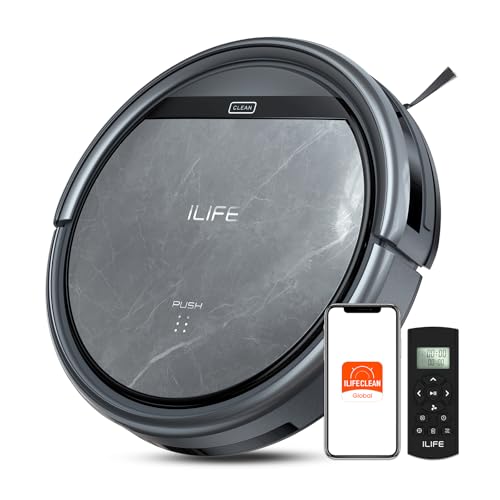
ILIFE V5s Max Robot Vacuum (4000Pa, Gyro Navigation) — Best Simple Navigation Pick
The ILIFE suits buyers who want orderly cleaning without paying for a mapping flagship or maintaining a self-empty tower. Gyro navigation keeps the robot’s paths roughly systematic, voice control through Alexa plus app and remote options cover every preference in the house, and self-charging means it puts itself back to bed after each run. For a one or two-rug home with a dog, this is the proportionate tool.
Strengths
- Listing covers carpets and pet hair explicitly
- Gyro navigation is more systematic than random-bounce designs
- App, Alexa and remote control options included per the listing
Trade-offs
- No self-emptying and no mop in this model
- Gyro navigation does not build the room maps LiDAR models offer
- 2.4G WiFi only, per the listing — check your router setup
| At a glance | |
|---|---|
| Suction | 4000Pa (per listing) |
| Navigation | Gyro navigation |
| Controls | WiFi app / Alexa / remote |
| Self-charging | Yes |
| Self-empty | No |
| Functions | Vacuum only |
There is a real virtue in the middle of this market. Flagship mapping robots are wonderful until their app updates, their dock needs a permanent square metre, or their price makes a second dog-related purchase impossible. A gyro robot like this one covers a normal flat in sensible lines, handles the rug-and-hair brief its listing promises, and asks almost nothing of you beyond bin emptying and brush checks. For many dog owners that is not a compromise; it is the correct amount of robot.
Keep two habits and this class of machine performs above its price: run it little and often, because frequent passes stop hair knitting itself into rug pile, and keep the rug’s surroundings decluttered — gyro robots are less talented at escaping cable nests and toy traps than mapping models. Five minutes of floor tidying buys a complete clean instead of a robot rescued from under the sofa.
Best for: Smaller homes wanting orderly, simple robot cleaning for rugs and pet hair / Not suited for: Anyone wanting room mapping, self-emptying or mopping
Check the current price on Amazon

iRobot Roomba 105 Vac Robot Vacuum (7,000 Pa, LiDAR) — Best Brand-Name Vacuum-Only
Choose the Roomba 105 Vac if you want a single-job machine from the category’s founding brand: no mop to rinse, no base tower, just strong stated suction and LiDAR rows across your rugs and floors. “Cleans in neat rows” is the behaviour rug owners want — overlapping, systematic passes that leave the pile looking groomed rather than randomly tracked.
Strengths
- Stated 7,000 Pa power-lifting suction — strong for rug pile
- LiDAR navigation with neat-row, multi-surface cleaning
- Vacuum-only simplicity: fewer parts, no mop maintenance
Trade-offs
- Charging base only — no self-emptying in this configuration
- The listing title does not specifically claim pet hair or anti-tangle features
- Combo functions are absent for buyers who wanted mopping too
| At a glance | |
|---|---|
| Suction | 7,000 Pa (per listing) |
| Navigation | LiDAR |
| Functions | Vacuum only |
| Base | Charging base |
| Cleaning pattern | Neat rows, multi-surface |
| Pet hair claim | Not stated in title |
Transparency matters in a roundup, so let us be precise about why this robot is sixth rather than first. On stated suction and navigation it out-specs several picks above it. But this search is specifically about dog hair, and hair performance lives in the brush system and the maker’s own claims — and this listing’s title makes neither a pet-hair nor an anti-tangle claim. We include it because its suction and row-based rug coverage are genuinely relevant, and we rank it last because honesty about the brief outranks brand fame.
For the right home it is still an excellent buy: a short-haired dog, low-pile rugs, and an owner who empties a bin without resentment. In that home, strong suction and disciplined rows beat features aimed at problems you do not have. For a long-haired double-coated shedder, take the warning seriously and choose the anti-tangle Roborock or a pet-hair-labelled self-empty model instead.
Best for: Short-haired dogs, low-pile rugs and buyers wanting simple, strong vacuuming / Not suited for: Heavy or long-haired shedding, where anti-tangle design matters more
Check the current price on Amazon
Comparison Table
| Pick | Badge | Key spec | Best for |
|---|---|---|---|
| Roborock Q7 L5 Robot Vacuum and Mop Combo (8,000Pa) | Best Overall | 8,000Pa; dual anti-tangle; LiDAR mapping | Multi-room, multi-level homes mixing rugs with hard floors and a shedding dog |
| Shark AV2501S AI Ultra Robot Vacuum with Self-Empty Base | Best Self-Emptying for Pet Hair | Self-empty 30-day bagless base; HEPA; pet hair | Dog owners who want a month of hands-off hair collection with no bag costs |
| eufy C10 Robot Vacuum with Self Emptying (Slim, LiDAR) | Best Slim Self-Empty Design | 2.85in slim; 8-week self-empty; carpet detection | Furnished homes with low furniture, several rugs and a shedding dog |
| Tikom G8000 Max Robot Vacuum and Mop Combo (5000Pa) | Best Value Combo | 5000Pa; 150 min; vacuum + mop; remote included | Flats and smaller houses mixing carpet, hard floors and a pet |
| ILIFE V5s Max Robot Vacuum (4000Pa, Gyro Navigation) | Best Simple Navigation Pick | 4000Pa; gyro navigation; Alexa/app/remote | Smaller homes wanting orderly, simple robot cleaning for rugs and pet hair |
| iRobot Roomba 105 Vac Robot Vacuum (7,000 Pa, LiDAR) | Best Brand-Name Vacuum-Only | 7,000 Pa; LiDAR; neat rows; vacuum only | Short-haired dogs, low-pile rugs and buyers wanting simple, strong vacuuming |
Two questions sort this table fast. First, emptying: the Shark and eufy empty themselves into a base for weeks; the other four ask you to empty a small bin after runs. Second, hair hardware: the Roborock’s anti-tangle system and the pet-hair-labelled Shark and eufy are built for shedding; the Roomba is a strong general rug vacuum whose listing makes no hair-specific claim, and it is ranked accordingly.
How to Choose a Robot Vacuum for Rugs and Dog Hair
Start with the brush, not the suction figure. Dog hair defeats robots by wrapping: a bristle brush in a shedding home becomes a felted roller within days, suction collapses, and the robot performs an impression of cleaning. Anti-tangle and anti-hair-wrap designs — named in the listings of our top picks — exist precisely for this failure mode. If a listing for a robot you are considering says nothing about its brush and nothing about pet hair, assume it was designed for dust and crumbs, not for a retriever in moulting season.
Next, match navigation to your floor plan. LiDAR robots map rooms and clean rugs in complete, overlapping rows — the right tool for multiple rugs across multiple rooms. Gyro robots keep orderly lines without a true map and suit smaller, simpler homes. Random-bounce robots still exist at the bottom of the market; on rugs, where coverage completeness is the whole game, they are the false economy of this category.
Then decide the emptying question with your eyes open. Self-empty bases transform ownership in dog homes — the bin fills with hair fast, and every manual emptying is a small cloud of dander. The cost is money, floor space and, in bagged systems, consumables. Manual-bin robots are cheaper and smaller. Neither is wrong; but be honest about whether future-you will empty a small bin every second day for three years, because a robot that is not emptied stops cleaning no matter how good its brush is.
Rug Types: Pile, Fringe and Thresholds
Low-pile and flatweave rugs are robot country: every pick here will climb on, clean across and step off without drama, and these are the rugs where daily robot maintenance makes the biggest visible difference. Medium pile is still comfortable territory for the stronger-suction picks. Deep shag is where honesty is required — long pile swallows suction, traps brushes and can stall lighter robots, and no mainstream robot in this roundup should be bought primarily for a deep shag rug.
Fringe and tassels are the classic rug-robot conflict. Robots can chew fringe, drag it and occasionally wedge themselves on it. The practical fixes are unglamorous: tuck fringe under the rug where the design allows, use the app’s no-go lines where your model supports them, or lift the fringed heirloom out of the robot’s territory and vacuum it by hand. Thresholds between rooms matter too — a robot that climbs rug edges confidently usually handles standard room thresholds, but very high strips can fence it into one room, which no app setting can cure.
Finally, remember the dog’s contribution to the map: water bowls, feeding mats and toy stashes are obstacle fields. Robots clean best in homes that give them a tidy stage — bowls on a washable mat in one spot, toys in a basket — and five minutes of staging beats any navigation upgrade.
Budget Tiers for Dog-Hair Robot Vacuums
Frame the money in three tiers rather than chasing exact prices, which move constantly. The value tier buys gyro or basic navigation, manual emptying and honest pet-hair claims — the ILIFE and Tikom end of this list — and it genuinely suffices for flats and small houses. The mid tier buys LiDAR mapping and either a self-empty base or anti-tangle hardware. The premium tier combines everything: mapping, self-emptying, anti-tangle brushes and mop systems with their own docks.
Spend in the order the failures occur. In a shedding home the failures are, in sequence: tangled brushes, a full bin, missed rug areas. That means anti-tangle hardware first, self-emptying second, mapping third, and mopping last — mopping is a bonus for hard floors and does nothing for the hair in your rugs. A mid-tier robot bought in that order will out-clean a premium robot bought for its mop.
How Often Should a Robot Run in a Dog Home?
More often than you think, and less dramatically than you fear. Hair lands on rugs continuously, and it is vastly easier to lift in the first day than after a week of being walked into the pile. Most dog homes settle on a daily run for the main living areas — the rooms with the rugs and the dog — and a full-home run two or three times a week. Robots make this painless precisely because the labour is theirs; the schedule costs you nothing but a little electricity and an occasional bin check.
Seasonal shedding changes the maths. During the spring and autumn coat blows, step the main rooms up to twice daily if your robot and your patience allow, and check brushes and filters weekly instead of monthly. The rest of the year, weekly brush checks suffice for anti-tangle models; conventional brushes in a shedding home want attention every few runs regardless of season. Filters are the forgotten consumable — a clogged filter strangles suction exactly like a tangled brush, and rinsing or replacing it on the maker’s schedule keeps an older robot cleaning like a newer one.
Robot Vacuum Plus Upright: The Two-Machine Truth
Every honest guide in this category should say it plainly: the robot does not retire your upright vacuum. What it does is change its job. The robot owns the daily surface — the shed, the tracked grit, the paw-print dust on the rug pile — and the upright becomes a monthly deep-clean tool instead of a twice-weekly emergency response. Rugs genuinely stay cleaner in that system than under either machine alone, because dirt never gets the week it needs to work deep into the pile.
If budget forces a choice, sequence it: robot first for a dog home with rugs, because frequency beats intensity against a problem that renews itself daily. Add the deep cleans with a borrowed or budget upright until you can own both. Households that reverse the order usually own an excellent upright that comes out less and less often, in a home that looks progressively more like the dog owns it.
Living with the Robot: Noise, Dogs and Daily Reality
Noise is the unlisted specification that shapes daily life with a robot. These machines are far quieter than an upright, but they are not silent, and a daily run during a baby’s nap or a work call will teach you scheduling faster than any manual. Use the app schedules properly: run the rug rooms while the house is out or busy, and let the robot’s regularity become part of the household rhythm rather than an interruption to it. Self-empty bases deserve a special note — the emptying blast is loud for a few seconds, and most owners learn to schedule it away from sleeping hours.
Dogs, for their part, sort into three camps: the indifferent majority, the curious followers, and the small minority who regard the robot as prey or threat. Followers are harmless entertainment. For the third camp, run the robot when the dog is out of the room until familiarity does its work, and never leave a determined robot-attacker alone with a machine whose brush housing costs real money. Puppies deserve supervision for a different reason — an accident on the rug followed by a scheduled run is the one dog-and-robot story nobody wants to live, and it is prevented by the simple habit of a floor check before the daily run.
Finally, keep the relationship honest in both directions. The robot will not love your rugs the way a careful human with an upright does, and you will occasionally rescue it from a chair-leg maze or a swallowed sock. In exchange it cleans on days when no human would have bothered — which, across a year of dog ownership, is most of the days that matter.
One last daily-reality note: keep a small brush-cleaning habit attached to something you already do — Sunday coffee, the weekly shop, bin night. Robots do not fail dramatically; they fade, a little suction at a time, as hair and dust accumulate in the parts nobody checks. A two-minute weekly ritual is the entire difference between a three-year robot and a one-year disappointment.
How to Set Up a Robot Vacuum for a Home with Rugs and a Dog
Thirty minutes of setup decides whether the robot becomes invisible labour or a rescue hobby.
- Stage the home first: cables lifted, small toys basketed, dog bowls consolidated onto one washable mat, and rug fringe tucked or planned around.
- Place the dock or base against a straight wall with clear space in front, on hard floor where possible — a robot that cannot find home cannot keep a schedule.
- Let the robot complete one full mapping or familiarisation run without interruption, and keep the dog calmly in another room for this first outing if machinery makes them nervous.
- In the app, name rooms honestly, set no-go zones for feeding areas and any fringe you could not tuck, and schedule the main rug rooms daily.
- Run the first week supervised at a distance: watch where the robot hesitates — rug edges, thresholds, chair-leg forests — and fix the room, not the robot, wherever you can.
- Set your maintenance rhythm from day one: brush check, bin or base check, filter check, on the cadence the shedding in your home actually demands.
Most dogs accept a robot within days once they learn it is boring, predictable and never chases them. Run early sessions when you are home, let the dog observe from a distance, and never use the robot as a toy or a herding joke — a dog that attacks the robot teaches you the price of a replacement brush housing.
Common Buying Mistakes
Buying on suction numbers alone. Suction matters on rugs, but a tangled brush nullifies it within a week in a shedding home. Brush design and hair claims come first; figures second.
Expecting the robot to deep-clean rugs. Robots maintain; uprights extract. A robot keeps rugs presentable daily — plan a periodic deep clean and the combination works beautifully.
Leaving fringe, cables and toys as an obstacle course. Robots fail on staged messes, not on clean floors. Five minutes of tidying buys a complete clean; skipping it buys a rescue mission.
Forgetting the bin because the robot “just runs”. A full bin or base silently ends cleaning while the robot keeps touring. Dog hair fills bins fast — check on the schedule your dog’s coat dictates.
Running the mop across the rugs. Combo robots mop hard floors; rugs are vacuum territory. Manage zones so rugs are never dragged over wet, or they will hold onto dirt and smells.
Key Takeaways
- Brush design beats suction figures in a shedding home — anti-tangle first.
- Self-emptying bases are the quality-of-life feature dog owners actually feel.
- Robots maintain rugs daily; an upright still owns the monthly deep clean.
- Run rug rooms daily, check brushes weekly during shedding season.
Final Recommendation
For most dog-owning, rug-owning homes, the Roborock Q7 L5 is the complete answer: anti-tangle hardware, strong stated suction and LiDAR coverage of every rug, every day. If touching a dustbin of hair is your personal line, the Shark AV2501S and its bagless self-empty base — or the slim, long-interval eufy C10 for furnished rooms — remove that chore for weeks at a time. Smaller homes should save money confidently with the Tikom or the ILIFE, and Roomba loyalists with short-haired dogs will be well served by the 105 Vac, with the honest caveat recorded in its review.
Whichever you pick, check the current price on Amazon, stage your floors once, and let daily running do what daily running does — rugs that stay clean because the hair never gets a chance to settle in.
Quick re-check links: Roborock Q7 L5 · Shark AV2501S · eufy C10 · Tikom G8000 Max · ILIFE V5s Max · Roomba 105 Vac
Best Robot Vacuums For Dog Hair Best Vacuum For Dog Hair On Rugs Best Vacuums For Heavy Dog Hair Best Area Rugs For Homes With Dogs Best Area Rugs For Kids And Pets
Frequently Asked Questions
Can a robot vacuum really get dog hair out of rugs?
It can keep rug surfaces genuinely clean day to day: hair lying in and on the pile is exactly what strong suction, anti-tangle brushes and repeated passes are good at. What it cannot do is the deep extraction an upright performs on compacted dirt. Used daily, a robot stops hair building up to the point where deep cleans become excavations.
How important is anti-tangle design for dog hair?
It is the difference between a robot that cleans for weeks unattended and one that quietly stops cleaning within days. Long hair wraps conventional brushes, suction falls, and the robot tours without lifting anything. In a shedding home, anti-tangle or anti-wrap hardware is the first feature to pay for.
Is a self-empty base worth it with a dog?
For most dog owners, yes — dog hair fills a robot’s small bin quickly, and the base stretches emptying from every couple of days to weeks at a time, with the stated capacities printed in the reviews above. Bagless bases avoid refill costs; bagged bases are tidier to empty. Either beats the daily bin.
Will a robot vacuum damage my rugs or their fringe?
The rugs themselves are safe — robot suction and brushes are far gentler than an upright’s beater bar. Fringe is the exception: it can be chewed, dragged or caught. Tuck it, zone it out in the app, or keep fringed heirloom rugs outside the robot’s territory.
Should I choose a vacuum-only robot or a vacuum-mop combo for rugs?
For the rugs themselves it makes no difference — both vacuum them the same way. The combo earns its money on your hard floors. If your home is mostly rugs, vacuum-only is simpler and cheaper to maintain; if you have large hard-floor areas the dog tracks across, the combo’s mop is genuinely useful there.
How often should I run the robot with a shedding dog?
Daily in the main rooms is the rhythm that works, stepping up during the heavy shedding seasons. Frequent light passes keep hair from being walked deep into rug pile, which is when it becomes hard for any robot to lift.


