Disclosure: airfryerkitchensupply.com is reader-supported. When you buy through links on our site, we may earn an affiliate commission at no extra cost to you.
Where to buy
The verified picks in this guide are sold on Amazon. Use the links below to check price on Amazon for each model; listings, sizes and colour options change over time, so confirm the exact configuration on the product page before ordering.
- DONAMA Cervical Pillow for Neck and Shoulder Pain Relief — check price on Amazon
- Mkicesky Orthopedic Memory Foam Pillow for Neck and Shoulder Pain Reli — check price on Amazon
- Royal Therapy Memory Foam Pillow — check price on Amazon
- Anvo Memory Foam Pillow — check price on Amazon
- Polovo Neck Pillow Memory Foam Pillows for Sleeping — check price on Amazon
- Cool Gel Cooling Pillow for Side Sleepers — check price on Amazon
Introduction: Finding the memory foam shoulder pillows
Side sleepers searching for the best memory foam shoulder pillows are usually chasing one specific fix: a pillow that fills the gap between the ear and the mattress so the shoulder below is not crushed and the neck above is not bent. That gap is the whole design problem. A flat pillow that is thick enough to fill it will push the head too high in the centre; a pillow that is comfortable under the head leaves the shoulder to take the body’s weight. The contour and cervical shapes in this guide exist to solve exactly that geometry — a raised edge under the neck, a hollow or lower zone for the head, and enough firm memory foam to hold the shape until morning.
Every pick below is a genuine memory foam pillow whose verified listing title speaks directly to neck and shoulder support for side, back or stomach sleeping. We excluded body pillows, latex pillows and massager devices that surface in shoulder searches but solve a different problem. One framing note matters for honesty: these are comfort products.
Expect a shortlist built around shape rather than brand. Two heights matter more than any feature list: the height of the neck edge, and the height where your head rests. Get those right for your shoulder width and mattress firmness, and memory foam’s slow, moulding response does the rest.
In this guide
Quick Picks
Short on time? These are the six selections that survived verification, grouped by the job each one does best. Every linked model below was confirmed against the Amazon catalogue data available to this site; any slot that could not be verified is marked honestly instead of being filled with a guessed product.
DONAMA Cervical Pillow for Neck and Shoulder Pain Relief — Best Overall — check price on Amazon
DONAMA’s cervical contour pillow pairs a dual-height ergonomic shape with a cooling angle — the most flexible starting point for side sleepers with shoulder pressure.
Mkicesky Orthopedic Memory Foam Pillow for Neck and Shoulder Pain Reli — Best Ergonomic Shape — check price on Amazon
Mkicesky’s orthopaedic memory foam pillow leans into sculpted ergonomic shaping for side, back and stomach sleepers who want pronounced neck support.
Royal Therapy Memory Foam Pillow — Best Queen Size — check price on Amazon
Royal Therapy’s queen contour cervical pillow states its 24-inch queen sizing in the listing — useful certainty for buyers matching pillowcases and bed width.
Anvo Memory Foam Pillow — Best Classic Contour — check price on Amazon
Anvo’s neck contour cervical pillow is the classic orthopaedic wave shape in memory foam — the reference design most contour pillows are variations of.
Polovo Neck Pillow Memory Foam Pillows for Sleeping — Best for Combination Sleepers — check price on Amazon
Polovo’s ergonomic cervical pillow is shaped to keep neck support in place as you move between side and back positions through the night.
Cool Gel Cooling Pillow for Side Sleepers — Best Cooling Gel — check price on Amazon
A cool-gel memory foam contour in standard size for side sleepers who love foam’s moulding feel but sleep hot.
Key Takeaways
- Shoulder comfort for side sleepers is a geometry problem: fill the ear-to-mattress gap without lifting the head too high.
- Contour and cervical shapes put a raised edge under the neck and a lower zone under the head — that is the design to look for.
- Dual-height pillows let you choose the taller or lower edge, which is the easiest way to match shoulder width.
- Memory foam softens with body heat, so judge a pillow after twenty minutes in position, not after twenty seconds.
- These are comfort products that support neutral posture; they are not medical devices and this guide makes no medical claims.
How These Picks Were Chosen
Selection began with catalogue searches for memory foam pillows aimed at neck and shoulder support. Three kinds of impostors were removed: body pillows, which support the whole torso rather than the shoulder gap; latex pillows, which are excellent but are not memory foam and belong in a different guide; and powered massager pillows, which are devices, not sleep pillows. What remained were contour and cervical memory foam pillows whose own listing titles confirm the foam type and the sleeping positions they target.
The six survivors were chosen to span the real decision space: a dual-height cooling contour design, an orthopaedic ergonomic shape, two established cervical contour models at different characters, a cooling contour pillow for side sleepers, and a firmer standard-shape memory foam option for sleepers who dislike deep contouring. Where a listing states a size — such as a queen dimension — the spec box prints it, because that figure comes from the verified title. Where a title is silent on loft or firmness numbers, we describe the feel in relative terms instead of inventing measurements.
As across this site, no static prices and no fixed ratings appear anywhere in the guide. Use the links to check the current price on Amazon, and treat the first nights with any new pillow as an adjustment period — neck muscles notice a new sleeping geometry, and a fair judgement takes most of a week.
The 6 Best Memory Foam Shoulder Pillows Reviewed

1. DONAMA Cervical Pillow for Neck and Shoulder Pain Relief — Best Overall
Check the current price on Amazon
The DONAMA cervical pillow is built around the two decisions a side sleeper actually faces: which edge height suits their shoulder width, and whether the pillow sleeps warm. Its dual-height contour gives a taller and a lower neck edge in one pillow, and the listing positions it as a cooling contour design for neck and shoulder support across side, back and stomach positions.
Strengths
- Dual-height edges let you match support to your shoulder width without buying twice
- Contour shape cradles the neck while the head rests in a lower central zone
- Cooling positioning suits sleepers who find plain memory foam warm
Trade-offs
- Contour shape feels unfamiliar for the first several nights
- Side-specific geometry is less ideal for dedicated stomach sleepers
- Foam firmness is fixed — there is no adjustability beyond choosing an edge
| Specification (from the verified listing title) | Detail |
|---|---|
| Type | Cervical contour memory foam |
| Shape | Dual-height ergonomic |
| Positions | Side, back and stomach (per listing) |
The dual-height design is the practical headline. Broad-shouldered side sleepers generally need the taller edge to keep the spine level; narrower frames and back sleepers usually prefer the lower edge. Because both edges live in the same pillow, you can test across a week instead of guessing from a size chart. Memory foam’s heat response matters here too: the foam softens where your neck warms it, deepening the cradle slightly through the night, which is why the first twenty minutes feel firmer than hour three. Pair it with a mattress that does not sag at the shoulder — no pillow can correct a hammock-shaped mattress. If you wake with ear pressure, the edge is likely too high; rotate to the lower edge before concluding the pillow is wrong.
Best for: side sleepers who want to test two heights in one pillow / Not suited for: sleepers who strongly prefer a flat, traditional pillow shape

2. Mkicesky Orthopedic Memory Foam Pillow for Neck and Shoulder Pain Reli — Best Ergonomic Shape
Check the current price on Amazon
The Mkicesky pillow takes the ergonomic brief seriously: a sculpted orthopaedic memory foam form intended to support the neck and shoulders across side, back and stomach sleeping. It suits sleepers who have tried gently contoured pillows and found the shaping too subtle to notice.
Strengths
- Pronounced ergonomic shaping gives clear neck-edge support
- One design addresses side, back and stomach positions
- Memory foam moulds to individual neck curvature
Trade-offs
- Strong shaping is divisive — some sleepers never adapt to it
- Less suitable if you move between many positions all night
- Listing title does not state dimensions, so check the product page size carefully
| Specification (from the verified listing title) | Detail |
|---|---|
| Type | Orthopaedic memory foam |
| Shape | Ergonomic sculpted |
| Positions | Side, back and stomach (per listing) |
Sculpted pillows live or die on match: when the curve meets your neck where support is wanted, the effect is immediate; when it does not, the pillow feels like an obstacle. Give this shape a genuine trial of several nights, sleeping in your dominant position, before judging. Side sleepers should check that the raised edge sits under the neck rather than under the shoulder itself — a common positioning error that makes any contour pillow feel too high. Back sleepers should confirm the head settles into the central zone without the chin being pushed toward the chest. The listing title does not state a size, and we do not guess one; verify dimensions on the product page against your pillowcase and bed size before ordering.
Best for: sleepers who want pronounced, sculpted neck support / Not suited for: restless sleepers who change position constantly

3. Royal Therapy Memory Foam Pillow — Best Queen Size
Check the current price on Amazon
Royal Therapy’s memory foam pillow is a queen-size contour cervical design aimed at neck and shoulder comfort for side, back and stomach sleepers. The listing states a 24-inch dimension, which removes the guesswork that surrounds many contour pillows and makes it easy to match with queen pillowcases.
Strengths
- Stated queen sizing in the listing simplifies case and bed matching
- Contour cervical shape supports the neck edge for side sleeping
- Established model with a clear, specific listing
Trade-offs
- Queen footprint is wide for twin beds or crowded doubles
- Contour shape still requires an adjustment period
- One firmness character — no dual-height choice
| Specification (from the verified listing title) | Detail |
|---|---|
| Type | Contour cervical memory foam |
| Size | Queen, 24 in (from listing title) |
| Positions | Side, back and stomach (per listing) |
Size certainty is an underrated virtue in this category, and this is the pick for buyers who have been burned by pillows that arrived smaller than imagined. The contour follows the classic pattern — raised neck edge, lower head zone — executed at queen width, which also gives side sleepers more room to shift position without falling off the pillow’s shaped area. As with all memory foam, expect a faint new-foam smell on opening that airs out in a day or two, and expect the foam to feel firmest on cold nights and softest in warm rooms. If your mattress is very soft, your shoulder sinks deeper and the effective pillow height drops; on soft mattresses this standard-height contour is often a better match than extra-tall designs.
Best for: queen-bed owners who want stated dimensions / Not suited for: twin beds or sleepers wanting adjustable height
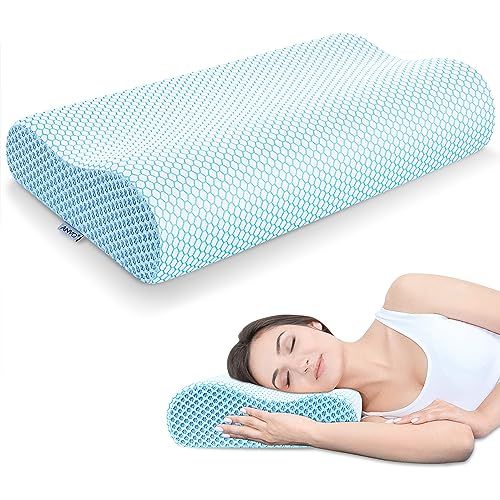
4. Anvo Memory Foam Pillow — Best Classic Contour
Check the current price on Amazon
The Anvo memory foam pillow follows the original cervical wave design: two neck edges of different heights flowing into a central hollow. It is aimed at side, back and stomach sleepers who want ergonomic neck support in the most proven contour geometry available.
Strengths
- Classic wave contour is the most widely understood and tested shape
- Two edge heights in one pillow cover back and side sleeping
- Ergonomic design focuses support exactly at the neck
Trade-offs
- Wave shape offers no flat side for traditionalists
- Foam density is a single fixed character
- Position-specific benefits are strongest for back and side sleepers
| Specification (from the verified listing title) | Detail |
|---|---|
| Type | Neck contour cervical memory foam |
| Shape | Wave contour, ergonomic |
| Positions | Side, back and stomach (per listing) |
There is a reason the wave contour has survived decades of pillow fashion: it directly encodes the anatomy, with support where the neck curves and space where the head rests. The Anvo executes that brief in memory foam, which adds the slow moulding response that polyfoam versions lack. Use the taller edge when side sleeping and the lower edge on your back; that simple rotation is the entire user manual, and most disappointment with contour pillows traces back to sleeping on the wrong edge. Memory foam also rewards patience in the first minutes — lie still, let body heat soften the contact zone, and only then judge height. On a firm mattress, where the shoulder cannot sink, this shape’s standard heights are usually sufficient without extra loft.
Best for: first-time contour pillow buyers / Not suited for: sleepers who dislike any sculpted shape

5. Polovo Neck Pillow Memory Foam Pillows for Sleeping — Best for Combination Sleepers
Check the current price on Amazon
Polovo’s memory foam pillow is an ergonomic cervical design for side, back and stomach sleepers, contoured to support the neck through position changes. It suits combination sleepers — the majority of adults — whose pillow must work at the shoulder during side phases and under the neck during back phases.
Strengths
- Contour transitions support both side and back phases of the night
- Cervical shaping keeps the neck edge supported as you move
- Memory foam response softens pressure points at the ear and jaw
Trade-offs
- Jack-of-all-positions shaping is less specialised than a pure side-sleeper cut
- Adjustment period applies, as with all contour pillows
- Firmness is fixed at a single density
| Specification (from the verified listing title) | Detail |
|---|---|
| Type | Ergonomic cervical memory foam |
| Shape | Contour |
| Positions | Side, back and stomach (per listing) |
Combination sleepers fail with pillows that are perfect in one position and wrong in another. The test for this Polovo design is transitional: roll from back to side and notice whether the neck edge is already where your neck lands. A well-shaped cervical contour makes that roll uneventful, and that is the experience this pillow aims for. Memory foam helps by not springing back instantly — the foam holds a shallow impression of your last position, smoothing transitions. Keep expectations calibrated: no pillow fully solves a mattress that is too firm at the shoulder, and side sleepers with very broad shoulders may still need the tallest edge of the DONAMA. For the typical mixed sleeper on a medium mattress, this is a balanced, low-drama choice.
Best for: combination sleepers who roll between side and back / Not suited for: very broad-shouldered side sleepers needing maximum loft

6. Cool Gel Cooling Pillow for Side Sleepers — Best Cooling Gel
Check the current price on Amazon
This cool gel memory foam pillow targets the most common memory foam complaint — heat — with a gel-infused design in a standard size, shaped as a medium-firm ergonomic contour for side sleepers. It suits hot sleepers who tried memory foam, liked the support, and gave it up in summer.
Strengths
- Gel infusion addresses memory foam’s heat build-up
- Standard size fits existing pillowcases easily
- Medium-firm contour gives clear neck support for side sleeping
Trade-offs
- Gel effect is strongest in the first part of the night
- Standard size may feel small to queen-bed users
- Medium-firm character is too much for sleepers wanting a soft pillow
| Specification (from the verified listing title) | Detail |
|---|---|
| Type | Cool gel memory foam |
| Size | Standard (from listing title) |
| Firmness | Medium firm (from listing title) |
Gel in memory foam works by absorbing and spreading heat early in the night; it does not refrigerate, and honest expectations matter. What buyers actually notice is that the surface stays neutral longer instead of warming to body temperature within minutes, and for many hot sleepers that difference decides whether foam is usable at all. The contour here is a medium-firm ergonomic shape for side sleepers, so the shoulder-gap geometry is handled by the raised edge while the gel handles temperature. Pair it with a breathable pillowcase — a thick flannel case will undo the cooling design. In winter the same pillow will feel firmer, because memory foam stiffens in the cold; warm the bedroom or expect a short softening period after lights-out.
Best for: hot sleepers who want memory foam support / Not suited for: sleepers who prefer a soft, sink-in pillow
Comparison Table
| Pick | Badge | Key spec | Best for |
|---|---|---|---|
| DONAMA Cervical Pillow for Neck and Shoulder Pain Relief | Best Overall | Cooling contour, dual-height ergonomic | side sleepers who want to test two heights in one pillow |
| Mkicesky Orthopedic Memory Foam Pillow for Neck and Shoulder Pain Reli | Best Ergonomic Shape | Orthopaedic ergonomic memory foam | sleepers who want pronounced, sculpted neck support |
| Royal Therapy Memory Foam Pillow | Best Queen Size | Queen contour cervical, 24-inch class | queen-bed owners who want stated dimensions |
| Anvo Memory Foam Pillow | Best Classic Contour | Neck contour cervical orthopaedic | first-time contour pillow buyers |
| Polovo Neck Pillow Memory Foam Pillows for Sleeping | Best for Combination Sleepers | Ergonomic cervical, contour support | combination sleepers who roll between side and back |
| Cool Gel Cooling Pillow for Side Sleepers | Best Cooling Gel | Cool gel memory foam, standard size | hot sleepers who want memory foam support |
How to Choose the Best Memory Foam Shoulder Pillows
Begin with your shoulder width and your mattress, because pillow height only makes sense relative to both. Lay on your side on your own mattress and have someone look from behind: your spine should run straight from pelvis to head. If your head tips down toward the mattress, you need more height under it; if it tips up, less. Broad shoulders on a firm mattress create the deepest gap and need the tallest neck edge; narrow shoulders on a soft mattress, where the shoulder sinks in, need the least. Dual-height pillows exist precisely because this measurement is hard to take from a product page — they let the pillow itself run the experiment.
Next, choose a shape. Contour and cervical pillows put a raised edge under the neck and a hollow under the head, which is the geometry that unloads the shoulder. Traditional flat memory foam slabs feel familiar but force a compromise height. Shoulder-cutout designs remove material where the shoulder sits, which some side sleepers love; they appear more often in latex, which is why they are discussed — honestly — as an alternative rather than a pick in this memory-foam guide.
Then consider temperature. Plain memory foam sleeps warm because it moulds closely and traps air. Gel infusions and cooling covers moderate that effect. If you have abandoned foam before for heat, prioritise the cooling picks; if you sleep cold, plain foam’s warmth is a feature. Finally, verify size from the listing itself: where a title states queen or standard dimensions, use them; where it does not, check the product page rather than assuming.
Memory Foam, Explained Without the Hype
Memory foam is viscoelastic polyurethane foam: it softens where body heat and pressure meet it, distributes load over a wider area, and returns to shape slowly when you move. That slow response is why it suits shoulder comfort — instead of pushing back at the single hardest point, the foam spreads pressure along the neck and the side of the head. It is also why memory foam feels firm for the first minutes in a cold room and softer at 3 a.m.; the material is literally temperature-sensitive, and judging it in the first twenty seconds is the most common evaluation error in this category.
Density is the specification that predicts lifespan, but many listings do not state it, and this guide does not invent figures the catalogue data does not confirm. What you can judge from a listing is shape, stated size, stated firmness character and intended sleeping positions — the spec boxes here print only those verified details. Shredded and adjustable memory foam exists as an alternative for sleepers who want to add or remove fill; the picks here are moulded contours, which hold their therapeutic geometry better but offer no fill adjustment.
In this guide we describe what a pillow can verifiably do — support the neck, fill the shoulder gap, hold a neutral posture — because comfort support is what a pillow can honestly promise.
Matching Pillow Height to Mattress Firmness
The most overlooked variable in shoulder comfort is the mattress underneath. On a firm mattress your shoulder cannot sink, so the full gap between ear and bed must be filled by the pillow: taller edges and firmer foam. On a soft or heavily topped mattress, the shoulder sinks several centimetres into the bed, the gap shrinks, and a tall pillow that looked right in the shop will push your head upward all night. This is why the same pillow earns opposite reviews from different sleepers — both are telling the truth about different mattresses.
Use this pairing logic with the picks above. Firm mattress plus broad shoulders: start with the tallest edge of the DONAMA or the pronounced Mkicesky shape. Medium mattress, average build: the classic Anvo wave or the Polovo contour in their standard orientation. Soft mattress or narrow frame: the lower edges, or the standard-size cool gel contour. Then give the pairing a week. Neck muscles adapt to new geometry over several nights, and a pillow judged on night one is a pillow judged unfairly.
If you split the difference and still wake with a stiff neck, change one variable at a time — rotate the pillow to its other edge before replacing it, and check that the pillow is positioned at the top of the mattress with the neck edge actually under your neck, not under your shoulder blade.
Shoulder Pillows and Sleeping Position: A Side-Sleeper’s Setup
A shoulder pillow works inside a system, and two other components decide whether it can do its job: the mattress shoulder zone and what you do with your arms. On the mattress side, side sleepers sink at two points — hip and shoulder — and the pillow’s geometry assumes the shoulder point sinks to its natural depth. A mattress topper that is much softer than the mattress beneath can change that depth enough to alter the pillow height you need, which is why a pillow that was perfect in the old bed can feel wrong in a new one even though neither product changed.
Arm position is the sleeper’s own contribution. The classic side-sleeping fault is trapping the lower arm under the pillow or under the torso, which rotates the shoulder forward and undoes the alignment the pillow created. Better patterns are the lower arm resting forward on the mattress, or hugging a small cushion that keeps the top shoulder from rolling forward. None of this requires equipment beyond what you own; it requires noticing, for the first few nights with a new pillow, what your arms do as you fall asleep.
Give the whole system — pillow edge choice, mattress, arm pattern — a fair trial as a unit. Change one variable per few nights, keep the change that improves your mornings, and resist the urge to judge any single night in isolation. Sleep is variable even with perfect equipment; the trend across a week is the data that matters.
Memory Foam Pillow Myths Worth Retiring
Three myths follow memory foam pillows around, and retiring them makes buying easier. The first is that firmer is more supportive. Support means holding the head and neck in neutral alignment, and a foam too firm for your frame holds you in the wrong position very supportively indeed. Match firmness to build and mattress, not to a belief that hard equals healthy. The second myth is that a pillow can be judged in a shop by squeezing it. Foam responds to sustained heat and load, not to a five-second squeeze; the squeeze test mainly measures how a pillow feels to a hand, which is not the organ you sleep on.
The third myth is that more technology in the name means more benefit in the bed. Gel infusions genuinely moderate temperature; charcoal, copper and herbal infusions mostly moderate your attention. The features that demonstrably change outcomes in this category are boring ones: shape, height options, size certainty and a cover you can wash. The picks in this guide were chosen on exactly those boring features, and their listings were read with the same discipline.
Underneath the myths sits a simple truth: a memory foam shoulder pillow is a shaped piece of foam, and its success is decided by geometry and patience. Get the shape pointed at your actual sleeping position, get the height matched to your actual shoulder and mattress, and give your neck a week to renegotiate its habits. Everything else is decoration.
Pillow Protectors, Cases and the Hygiene Layer
A memory foam pillow lives inside two textile layers, and both affect how it performs more than most owners realise. The protector — the zippered layer directly over the foam — is the pillow’s working skin: it keeps skin oils, moisture and the occasional spilled drink away from a core that cannot be washed. Given that memory foam’s lifespan is measured in years, a protector is the cheapest life-extension available in this entire category, and it should be washed monthly, because it accumulates exactly what it exists to intercept.
The pillowcase above it changes the sleep itself. A thick, high-friction case can drag against a contour shape and subtly fight the foam’s moulding; a smooth, breathable case lets the head settle into the contour as designed and preserves the cooling character of gel-infused models. Side sleepers should also match case size to pillow size honestly — an oversized case on a contour pillow bunches into ridges that print themselves onto a cheek by morning, while an undersized case compresses the foam’s edges and quietly reduces the loft you paid for.
Build the hygiene routine into the bedding routine you already have: case with the sheets, protector monthly, foam aired in shade when the bed is stripped. That rhythm keeps a memory foam pillow performing as its geometry intends for its whole service life — and when the foam itself finally stops recovering overnight, you will know the pillow, and not its neglected textiles, is what has ended.
When a Pillow Is Not the Answer: Checking the Rest of the Bed
Before replacing a pillow for the third time, audit the rest of the bed, because pillows are routinely executed for the mattress’s crimes. Press your hand into the mattress where your shoulder lands and compare it with the mattress at its foot: a pronounced soft hollow at the shoulder means the foundation has changed, and every pillow placed on it inherits a geometry no foam can correct. A sagging mattress rotates the whole body, drops the shoulder below its expected line, and makes correctly sized pillows feel simultaneously too high at the neck and too low at the head — the classic complaint that sends shoppers cycling through returns.
Toppers deserve the same suspicion. A thick, soft topper added for comfort deepens shoulder sink and reduces the pillow height you need; a firm topper does the opposite. Either change invalidates the pillow arithmetic that preceded it, which is why this guide insists on judging a pillow-and-bed combination rather than a pillow alone. If the bed is sound and the pillow still fails after a fair week on both its edges, then — and only then — is the pillow itself the problem, and the picks above give you shapes that differ enough from one another to make the next experiment a meaningful one.
How Pillow Height Interacts With Shoulder Width: A Simple Home Test
There is a five-minute test that predicts pillow fit better than any size chart, and it needs only a wall and a tape measure. Stand with your back and head against a wall, in the posture you would want lying down, and measure the distance from the wall to the side of your neck where it curves into the shoulder. That distance approximates the support height your neck needs when lying on your side on a firm surface. Now subtract the depth your shoulder sinks into your own mattress — estimate it honestly by lying down and having someone observe whether your spine runs level with your current pillow, and by how much it misses.
The arithmetic is rough, and it is meant to be: its purpose is to place you in the right third of the market — low, standard or tall — before you spend anything. Sleepers whose numbers land low should start with the lower edges of the dual-height picks; those in the middle belong with the classic contours; those at the tall end, usually broad shoulders on firm mattresses, should begin with the tallest edge available and the most pronounced shaping. Then let the week-long trial refine what the tape measure started. Measurement chooses the neighbourhood; sleep chooses the house.
One Final Note
A final word on expectations, because this category suffers from inflated ones. A well-matched memory foam shoulder pillow will not transform a bad bed, cure a condition or make every morning perfect; sleep is influenced by stress, temperature, health and habit far beyond any pillow’s reach. What it will do — measurably, within the first week — is remove one specific, mechanical insult from your nights: the badly filled gap that left your shoulder carrying weight it was never meant to carry. Judge it on that promise, kept nightly, and you will judge it fairly.
How to Use a Contour Memory Foam Pillow Correctly
Contour pillows fail most often through placement, not design, so learn the geometry once. Place the pillow with its raised neck edge at the edge nearest your neck — for back sleeping, the edge sits in the curve where head meets shoulders; for side sleeping, the edge fills the space under the neck while your shoulder itself rests on the mattress, just below the pillow. The single most common error is pulling the pillow down so the shoulder climbs onto it, which lifts the shoulder, defeats the shape, and manufactures the very pressure the pillow exists to relieve.
Choose your edge deliberately. Dual-height and wave pillows have a taller and a lower edge: taller for side sleeping and broad shoulders, lower for back sleeping and smaller frames. Spend three nights on one edge before switching; your neck needs consecutive nights to adapt, and nightly switching teaches you nothing. Stomach sleepers should use the lowest edge or the flattest orientation available, because a raised neck edge forces the head to rotate further.
Care is simple but specific. Memory foam itself should not be machine washed — water breaks down the cell structure. Wash the removable cover instead, air the foam in a shaded, ventilated spot if it picks up odours, and expect a new-foam smell to fade over the first days. Keep the pillow out of prolonged direct sun, rotate it end-for-end weekly so both edges share the work if you use both, and replace it when the foam stops recovering its shape overnight — that loss of recovery, not a calendar date, is the true end of a memory foam pillow’s useful life.
Common Buying Mistakes
The classic mistake is judging a contour pillow in the shop or in the first twenty seconds at home. Memory foam responds to heat and time; a pillow that feels like a brick at lights-out may be perfectly moulded by the time you fall asleep, and one that feels plush immediately may bottom out by midnight. Judge after full nights, across most of a week. The second mistake is buying height by guesswork: shoulder width and mattress firmness set the right loft, and ignoring either produces the familiar cycle of buying, returning and blaming the category.
Third, many buyers sleep with the shoulder on the pillow, cancelling the contour’s geometry entirely — placement is free and fixes more discomfort than any upgrade. Fourth, shoppers chase medical promises. A pillow supports posture and comfort; it does not treat conditions, and wording in listings should be read as marketing, not diagnosis. Persistent pain, numbness or weakness belongs in a clinician’s office. Finally, people pair a brand-new pillow with a worn-out mattress and conclude the pillow failed. If the mattress sags at the shoulder, fix the foundation first — no pillow in this guide, or any guide, can bridge a hammock.
Final Recommendation
Start with the DONAMA if you are unsure of your height needs — its two edges turn guesswork into a home experiment. Choose the Mkicesky for pronounced sculpted support, the Royal Therapy when queen sizing certainty matters, the Anvo for the classic wave in its purest form, the Polovo if you roll between positions all night, and the cool gel contour if heat is what drove you away from memory foam before. Whichever arrives, place it correctly, give it a week, and judge it by your mornings rather than by its first impression.
Related guides on this site: Best Bamboo Memory Foam Pillows · Best Cool Gel Memory Foam Pillows · Best Memory Foam Pillows Bamboo Shredded · Best Organic Memory Foam Pillows · Best Affordable Memory Foam Pillows
Frequently Asked Questions
How long does it take to get used to a contour pillow?
Most sleepers need three to seven nights. Your neck muscles have adapted to your old pillow’s geometry, and a contour shape asks them to work differently. Mild awareness of the new shape in the first nights is normal; judge the pillow by how your neck and shoulders feel in the morning after the first week, not by night one.
Which edge of a dual-height pillow should side sleepers use?
Usually the taller edge, because side sleeping creates the deepest gap between ear and mattress. Broad shoulders and firm mattresses increase that gap further. If you wake with ear pressure or a tilted-up head, switch to the lower edge — the right edge is the one that keeps your spine visibly straight.
Is memory foam too hot for shoulder pillows?
Plain memory foam sleeps warmer than latex or down because it moulds closely and limits airflow. Gel-infused designs and breathable covers moderate the effect noticeably, especially early in the night. A thick, non-breathable pillowcase can undo a cooling pillow, so pair cooling foam with a light case.
Can a pillow fix shoulder pain from side sleeping?
A pillow can support a neutral posture and reduce the pressure that comes from a badly filled shoulder gap, which is a comfort improvement many side sleepers feel immediately. It is not a medical treatment. Pain that persists, radiates, or comes with numbness or weakness should be assessed by a clinician rather than by buying more pillows.
How do I clean a memory foam pillow?
Do not machine wash the foam itself — water damages its structure. Wash the removable cover, spot-clean the foam if needed, and air it in shade with good ventilation. Keep it out of prolonged direct sunlight, which degrades foam over time.
When should a memory foam pillow be replaced?
Replace it when the foam no longer recovers its shape overnight, when the neck edge has permanently compressed, or when you consistently wake less comfortable than you did when it was new. Loss of recovery is the reliable signal; calendar age alone is not.

