Disclosure: airfryerkitchensupply.com is reader-supported. When you buy through links on our site, we may earn an affiliate commission at no extra cost to you.
Where to buy
Every linked pick below was matched to a real Amazon listing before it earned its link. Kitchen rug prices are driven by size and set count, so use the Check on Amazon links to see the current price on Amazon for the exact dimensions you need — we do not print prices here because they change too often to stay honest. Before ordering, do the one measurement this category punishes people for skipping: the clearance under your kitchen door and the swing of your cabinet and dishwasher doors. A rug that fits the floor plan but blocks the dishwasher door is a return in progress.
Introduction
The best kitchen rugs for vinyl hardwood floors have to solve two problems at once, and most kitchen rugs only solve one. The first problem is the kitchen itself: hours of standing at the sink and stove, water and grease landing where they land, crumbs and spills as a daily condition, and a floor that must be protected from dropped pans and chair legs. The second problem is the floor. Vinyl and hardwood are both beautiful, both common under kitchens, and both quietly vulnerable to the wrong rug. Certain rubber and latex backings can react with vinyl finishes over long contact, leaving discoloration that only appears when you finally move the rug — a yellowing ghost in the rug’s exact shape. Hardwood’s enemy is different: grit trapped under a rug grinds into the finish with every step, and moisture trapped under a non-breathing rug can cloud or damage wood over time. A kitchen rug that ignores the floor beneath it is only half a product.
This guide therefore grades every pick on both axes: kitchen performance (washability, absorbency, grip, size and coverage) and floor manners (what the backing is, what the listing states about it, and what precautions remain yours to take). Where a listing states its backing — rubber backed, anti-slip backing, woven cotton with no backing claim — we report exactly that. Where a listing is silent, the spec box says “not stated,” and the buying guide explains the universal precautions that close the gap: felt pads under rugs on vinyl, regular lifting and cleaning beneath any kitchen rug, and immediate drying of spills that reach the floor. No rug in this guide is magic; the six below are the ones whose stated properties, honestly read, fit a vinyl or hardwood kitchen best.
Format matters as much as material. Kitchens are galley-shaped workspaces, so runners dominate this list — long, narrow rugs that cover the sink-to-stove work lane where standing and splashing actually happen. We include one three-piece set for kitchens that need coordinated coverage at sink, stove, and door; one long cotton runner for big galleys; one woven cotton runner that is the gentlest option for vinyl; and one bamboo mat-rug for cooks who want a hard, wipe-clean surface instead of a textile at all. Between them, every vinyl and hardwood kitchen layout has a defensible answer.
Key Takeaways
- Backing is the floor-safety question. Some rubber/latex backings can discolor vinyl over long contact; on vinyl, use a felt pad under any backed rug and lift it regularly.
- Where a listing does not state its backing material, this guide prints “not stated” — treat silence as a reason to add a pad, not as reassurance.
- Washable beats spot-clean in a kitchen. Every textile pick here is listed as washable or easy-clean; the bamboo pick wipes clean instead.
- Runners fit kitchens: cover the sink-to-stove lane first, then add pieces for doors and islands.
- Whatever you buy, lift it weekly, clean the grit beneath it, and dry any spill that reaches the floor — those three habits protect hardwood and vinyl more than any product feature.
In this guide
Quick Picks
- BEQHAUSE Kitchen Runner Rug, 24″x60″ — Best Overall Runner. A washable, absorbent, stain-resistant non-slip runner in the classic work-lane size. Check the current price on Amazon
- IOHOUZE Washable Woven Cotton Runner, 2×6 — Best for Vinyl Floors. A woven cotton runner with no rubber backing claim in its listing — the gentlest contact story for vinyl. Check the current price on Amazon
- KOZYFLY Boho Cotton Runner, 2×8 — Best Long Runner. Eight feet of washable cotton coverage for big galleys, rubber backed for grip. Check the current price on Amazon
- Ileading Kitchen Rugs Set, 3 Piece — Best Coordinated Set. Three washable, stain-resistant pieces to cover sink, stove, and door in one design. Check the current price on Amazon
- Hazo Haus Runner Rug, 2×6 — Best Washable Workhorse. A rubber-backed, machine-washable runner built for mudroom-grade kitchen traffic. Check the current price on Amazon
- COSTWAY Bamboo Area Rug, 5’x8′ — Best Hard-Surface Alternative. A roll-up bamboo mat with anti-slip backing for cooks who want to wipe, not wash. Check the current price on Amazon
How These Picks Were Chosen
Every pick was verified — searched by brand and product name, matched to the returned listing title, and linked with the ASIN from the listing response. Specifications printed here, including backing descriptions, come from those listings; where a listing title does not state a property, the spec box marks it “not stated” rather than borrowing the property from a sibling product or a category assumption.
Criteria, in order. First, kitchen legitimacy: runners and mats sized and shaped for kitchen work zones, sold as complete rugs — no rug pads, tiles, or accessories dressed as picks. Second, cleanability: washable or wipe-clean, because a kitchen rug that cannot be cleaned is a countdown to disposal. Third, floor manners: preference for listings that state their backing plainly, and for constructions — woven cotton above all — whose contact with vinyl and hardwood is inherently gentle; rubber-backed picks are included for their grip and washability but carry the vinyl-pad guidance explicitly in their reviews rather than having the issue smoothed over. Fourth, layout coverage: the list spans the standard 24×60 lane runner, 2×6 and 2×8 runners, a multi-piece set, and a wide bamboo format, so the common kitchen shapes are all answered. Fifth, no anti-fatigue foam mats in rug clothing: cushioned standing mats are a neighboring category with their own virtues, and several surfaced in our searches; this guide is about rugs, and the one hard-surface pick included — bamboo — is a rug-format mat, not a foam standing pad.
The 6 Best Kitchen Rugs for Vinyl Hardwood Floors

BEQHAUSE Kitchen Runner Rug, 24″x60″ — Best Overall Runner
The BEQHAUSE runner is the shape of the kitchen problem drawn to scale: 24 inches wide, 60 inches long — the exact footprint of the sink-to-stove lane in most kitchens. Its listing stacks the properties that lane demands: non-slip, washable, extra absorbent, and stain resistant, in a blue that hides the evidence of a working kitchen better than any pale neutral. It is the pick we would hand to a shopper who described their kitchen and stopped talking.
Strengths
- The 24×60 format covers the primary work lane in one piece — no seams, no gaps at the sink where water lands most.
- Absorbent and stain resistant per the listing: the two properties that decide whether a kitchen rug looks clean on day ninety or only on day one.
- Washable, so the deep clean is a machine cycle rather than a professional bill.
Trade-offs
- The backing material is not specified beyond “non slip” in the listing title — on vinyl, pair it with a felt pad and lift it regularly, as this guide’s buying section explains.
- A single 60-inch lane may fall short in long galleys; the KOZYFLY 2×8 below is the extended-coverage answer.
- Dark blue is a commitment in a white-and-wood kitchen; check the listing’s other colorways if your kitchen disagrees.
Spec box (from the listing): Size: 24″ x 60″ · Properties: non-slip, washable, extra absorbent, stain resistant · Backing material: not stated · Format: runner
The absorbency deserves a sentence of its own, because it is the property that separates kitchen runners from hallway runners pressed into kitchen service. A kitchen runner lives under a drip zone; a rug that absorbs and then releases that water to the wash keeps the floor beneath it drier than a rug that beads water off its edges onto the vinyl or wood — provided you wash and dry it on schedule and lift it to check beneath, which is the owner’s half of every absorbent rug’s bargain.
Best for: the standard kitchen work lane on either vinyl or hardwood, with a pad on vinyl. / Not suited for: very long galleys or buyers who want a stated backing specification. Check the current price on Amazon

IOHOUZE Washable Woven Cotton Runner, 2×6 — Best for Vinyl Floors
The IOHOUZE runner earns the vinyl badge on a negative virtue: what its listing does not claim. It is a woven cotton kitchen runner, washable, described as non-slip, in a 2×6 format — with no rubber or latex backing named in its listing. Woven cotton sits on a floor the way a textile should: no plasticizer-bearing compound pressed against the vinyl for months, nothing to react with the finish. For a vinyl owner whose first question is “will it mark my floor,” this is the most comfortable construction on the list.
Strengths
- Woven cotton construction — the gentlest floor-contact story in this guide, and the natural first choice for vinyl.
- Washable, which cotton rewards: it comes out of the wash softer and keeps its woven structure through repeated cycles.
- The 2×6 runner length covers a sink run plus a step beyond, suiting mid-size galleys.
Trade-offs
- An unbacked or lightly backed woven rug can creep on smooth floors; a felt rug pad beneath it solves grip and adds the protective layer in one move — plan on the pad.
- Cotton absorbs spills into itself rather than beading them; in a heavy spill zone it will need washing more often than the synthetic picks.
- The non-slip description in the listing is a performance claim without a stated mechanism; the pad recommendation above is how you guarantee it.
Spec box (from the listing): Size: 2 x 6 feet · Material: woven cotton · Properties: washable, non-slip (per listing) · Backing: none stated · Format: runner
There is a broader lesson in this pick: in floor-sensitive categories, the absence of a risky feature can be the feature. Vinyl owners are often sold grip as the headline and discover the backing question later. This runner inverts the priority — floor first, grip via pad — and for the search’s exact audience, that inversion is the correct order of operations.
Best for: vinyl plank and sheet vinyl kitchens, and anyone who wants a natural-fiber textile on a hard floor. / Not suited for: buyers who want maximum out-of-the-box grip without a pad. Check the current price on Amazon
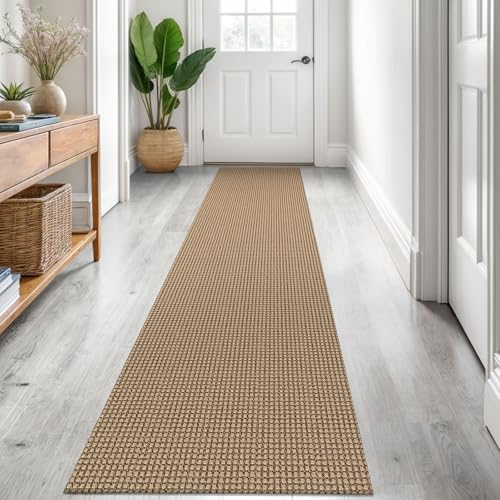
KOZYFLY Boho Cotton Runner, 2×8 — Best Long Runner
Big kitchens and open-plan galleys need length, and the KOZYFLY delivers eight feet of it: a washable cotton runner, rubber backed, in a boho pattern that gives large kitchens the visual anchor their scale demands. The listing states the rubber backing plainly, which lets us give the guidance plainly too: that backing is why it grips so well on hardwood, and on vinyl it should ride over a felt pad, with regular lifting, as with any rubber-backed rug.
Strengths
- True 2×8 length — the only pick here that covers a long galley lane or an island’s working side in one piece.
- Cotton face with a washable build: the natural-fiber feel with machine care.
- Rubber backing gives the strongest stated grip story on this list for hardwood kitchens.
Trade-offs
- Rubber backing on vinyl requires the pad-and-lift discipline described in this guide; vinyl owners who want zero backing management should choose the IOHOUZE instead.
- Eight feet of wet cotton is a heavy wash load; large-capacity machines handle it best.
- The boho pattern is a style position — wonderful in eclectic kitchens, busy in minimal ones.
Spec box (from the listing): Size: 2 x 8 feet · Material: cotton · Backing: rubber backed (per listing) · Properties: washable, non-slip · Format: runner
Length is an underrated kitchen-rug property because it is really a safety and cleanliness property: a lane covered end to end means no bare-floor gap at the dishwasher where drips land, no rug edge to catch a toe mid-carry, and one washable surface instead of a patchwork. If your kitchen’s work lane measures past six feet, this is your pick and the standard sizes are not.
Best for: long galleys, island kitchens, and hardwood floors wanting maximum grip. / Not suited for: vinyl owners unwilling to use a pad, or compact kitchens. Check the current price on Amazon

Ileading Kitchen Rugs Set, 3 Piece — Best Coordinated Set
Some kitchens are not one lane but three zones — sink, stove, and the door or fridge — and piecing together matching rugs for them from separate listings is how clashing patterns happen. The Ileading set solves it in one box: three washable, non-slip, stain-resistant pieces in a coordinated farmhouse blue boho design. Sets also age together, fading and wearing at the same rate, which keeps a kitchen looking intentional in year two.
Strengths
- Three coordinated pieces cover the kitchen’s real zones in a single purchase and a single design language.
- Washable and stain resistant across the set — the maintenance story is uniform, which makes the wash-day routine simple.
- Farmhouse styling is the most forgiving aesthetic in a working kitchen; the pattern hides the evidence between washes.
Trade-offs
- The listing title does not state the individual piece dimensions or the backing material — confirm both on the listing page against your zones before ordering, and plan felt pads for vinyl.
- A set is all-or-nothing: kitchens needing only one zone covered pay for pieces they may not place.
- Three pieces means three edges to keep flat and three rugs to lift on cleaning day.
Spec box (from the listing): Format: 3-piece set · Properties: non-slip, washable, stain resistant · Design: farmhouse blue boho · Piece dimensions: not stated in title · Backing material: not stated
We flag the unstated dimensions prominently because set-buying is where measurement mistakes concentrate: a set photographed in a large kitchen can arrive comically small in yours. Measure your three zones, read the listing’s stated dimensions on the product page, and only then enjoy the set’s real virtues — coordination, coverage, and one wash routine for the whole room.
Best for: multi-zone kitchens that want one design and one wash routine. / Not suited for: single-lane kitchens, or buyers who have not measured their zones. Check the current price on Amazon
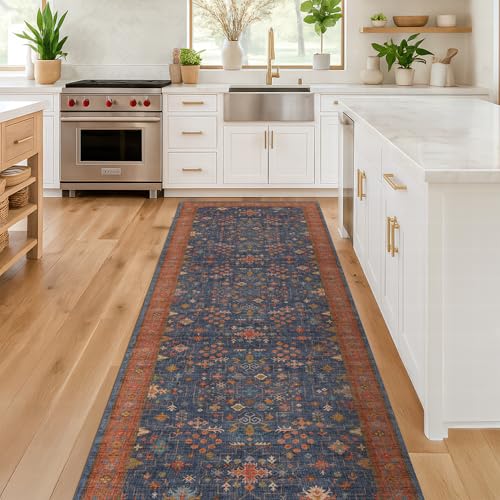
Hazo Haus Runner Rug, 2×6 — Best Washable Workhorse
The Hazo Haus runner’s listing reads like a mudroom manifesto — kitchen, hallway, mudroom, laundry, bathroom — and that breadth is its identity: a 2×6 washable runner with a rubber backing, in navy, built to be washed often and to grip hard. In a kitchen that doubles as the house’s working entrance, with wet boots and dog traffic crossing the cooking zone, this is the pick that treats that reality as normal.
Strengths
- Washable with a stated rubber non-skid backing: the grip-and-wash combination for high-traffic, wet-traffic kitchens.
- The multi-room positioning reflects a genuinely hard-wearing brief — this runner is built for the house’s worst floor, wherever it is.
- Navy hides the working evidence between washes better than any light colorway.
Trade-offs
- Rubber backing plus vinyl equals the pad discipline again — on vinyl, felt pad underneath and regular lifting are part of this pick’s ownership, full stop.
- The utilitarian design prioritizes function; formal kitchens may find it plain.
- Rubber-backed rugs should be fully dry before going back down — a damp backing against wood or vinyl is exactly the trapped-moisture scenario this guide warns about.
Spec box (from the listing): Size: 2 x 6 feet · Backing: rubber, non-slip/non-skid (per listing) · Properties: washable · Color shown: navy blue · Format: runner
The workhorse framing is a compliment. Most kitchen rugs are designed for kitchens as photographed; this one is designed for kitchens as lived in by households with mud seasons. If your kitchen floor’s enemies include weather, this is the rug that signed up for the fight.
Best for: high-traffic kitchens, mudroom-kitchen combinations, and hardwood needing maximum grip. / Not suited for: vinyl without a pad, or formal kitchen aesthetics. Check the current price on Amazon

COSTWAY Bamboo Area Rug, 5’x8′ — Best Hard-Surface Alternative
Not every cook wants a textile underfoot. The COSTWAY bamboo rug is a slatted bamboo mat at a full 5×8, with an anti-slip backing, that rolls up for storage or cleaning and wipes down instead of washing. On vinyl and hardwood it offers a distinct proposition: a hard, cool, non-absorbent surface that spills cannot soak into, in a natural material that suits the warm-minimal kitchen aesthetic. It is a rug in format and placement, a mat in behavior — and for some kitchens that hybrid is exactly right.
Strengths
- Wipe-clean and non-absorbent: spills sit on the surface to be mopped, never soaking toward the floor beneath.
- The 5×8 coverage suits eat-in kitchens and large open floors where a runner leaves too much floor exposed.
- Rolls up — for deep floor cleaning, for seasonal changes, for moving — which no textile rug of this size does gracefully.
Trade-offs
- Hard underfoot: no cushioning for long standing sessions, and dropped glassware gets no forgiveness from bamboo.
- The anti-slip backing’s composition is not specified beyond its function in the listing; the vinyl pad guidance applies as a precaution, and the roll-up design makes lifting it for checks effortless.
- Bamboo slats and chair legs are a workable but imperfect pairing; felt chair glides are a wise companion.
Spec box (from the listing): Size: 5′ x 8′ (96″ x 60″) · Material: natural bamboo · Backing: anti-slip (composition not stated) · Format: roll-up mat rug
Choose bamboo when your kitchen’s problem is liquid and heat rather than fatigue — the cook who cans, brews, and spills, in a kitchen where a textile would live permanently damp at the edges. It is also the allergy-conscious pick in spirit: a surface that holds no pile holds no pile’s worth of dust either, and a weekly wipe keeps it honest.
Best for: spill-heavy kitchens, eat-in layouts, and cooks who prefer a hard wipe-clean surface. / Not suited for: long standing sessions or anyone wanting cushioning. Check the current price on Amazon
Comparison Table
| Pick | Badge | Key spec | Best for |
|---|---|---|---|
| BEQHAUSE Runner 24×60 | Best Overall Runner | Washable, absorbent, stain resistant; backing not stated | The standard sink-stove lane |
| IOHOUZE Woven Cotton 2×6 | Best for Vinyl Floors | Woven cotton, no rubber backing claimed | Vinyl owners avoiding backing risk |
| KOZYFLY Runner 2×8 | Best Long Runner | Cotton, rubber backed, washable | Long galleys and islands |
| Ileading Set, 3 Piece | Best Coordinated Set | Washable, stain resistant, farmhouse design | Multi-zone kitchens |
| Hazo Haus Runner 2×6 | Best Washable Workhorse | Rubber backing, washable, multi-room | High and wet traffic |
| COSTWAY Bamboo 5×8 | Best Hard-Surface Alternative | Bamboo slats, anti-slip backing, roll-up | Spill-heavy, wipe-clean kitchens |
How to Choose a Kitchen Rug That Is Safe for Vinyl and Hardwood
Start with the backing, because on these two floors the backing is the risk. Vinyl flooring’s finish can react with certain rubber and latex compounds over months of contact — a process sometimes called plasticizer migration — and the evidence appears as a discolored rug-shaped patch when the rug is finally lifted. The defenses are simple and total: put a felt rug pad between any backed rug and a vinyl floor, choose pads and rugs whose makers confirm vinyl compatibility where stated, and lift the rug regularly so contact is interrupted and inspected. Hardwood’s version of the same problem is abrasion and moisture: grit under a rug is sandpaper under load, and a spill that soaks through and sits against wood under a non-breathing backing can mark the finish. The defenses rhyme — pads, lifting, prompt drying — which is why this guide repeats them until they become habit.
Read backing language with the same label discipline this site applies everywhere. “Rubber backed” is a stated fact; plan around it. “Non-slip” with no material named is a performance claim, not a composition — the grip might come from a backing, a weave, or a texture, and on vinyl the safe assumption is to pad it anyway. “Woven cotton” with no backing claim, like the IOHOUZE pick, is the inherently gentle construction. And no backing at all means the rug will move; a felt pad is then doing two jobs, grip and protection, and is not optional equipment.
Next, size the coverage to the work, not the room’s photograph. The kitchen’s true rug territory is the lane between sink and stove, plus the standing zone at each. Measure that lane’s length and buy the runner that covers it in one piece where possible; two short rugs with a gap at the dishwasher — the wettest appliance in the room — is the classic mis-buy. Check door and dishwasher clearance with the rug plus pad thickness combined, because the pair is what the door actually meets.
Then choose the surface for your spill profile. Absorbent washable textiles (BEQHAUSE, IOHOUZE, the Ileading set) suit kitchens whose spills are mostly water and crumbs and whose owners will actually run the wash cycle. Rubber-backed washables (KOZYFLY, Hazo Haus) suit traffic and grip priorities. Bamboo suits liquid-heavy cooking and anyone who would rather mop than launder. There is no universal winner — there is the match between a rug’s stated properties and a household’s real habits, and the most expensive rug in this guide will fail a household whose habits it does not fit.
Finally, budget the pad into the purchase from the start. On vinyl and hardwood, the pad is not an accessory; it is half the floor-protection system, and a rug bought without one is a system half installed. Felt or felt-combination pads are the default recommendation for these floors; avoid cheap foam pads that crumble, and confirm vinyl compatibility on the pad’s own listing when your floor is vinyl.
How to Place, Wash, and Maintain a Kitchen Rug on a Hard Floor
Placement day sets the rug’s whole life. Start with a clean, fully dry floor — grit sealed under a new rug begins its sandpaper work immediately. Lay the pad first, trimmed an inch inside the rug’s outline, then the rug, then walk the edges down and check every door swing and the dishwasher’s full open arc. Photograph the floor before the rug goes down if your vinyl is new; a dated photo is the baseline that makes any future change visible and attributable.
The weekly rhythm is short: lift the rug (or fold back half at a time), sweep or vacuum the grit beneath, check the floor for moisture or marks, and put everything back only when the floor is dry. This five-minute habit is the actual floor-protection program; the rug and pad are just its equipment. Spills get the emergency version of the same routine the day they happen if they soak through — lift, dry the floor, dry the rug fully before it goes back, because a damp rug returned to a wood floor manufactures the exact damage owners fear from rugs.
Washing follows each product’s label, with two cross-cutting rules: washable rugs should be washed before they look dirty, because ground-in kitchen grease shortens fiber life and sets stains; and every washed rug must be completely dry — backing included — before it returns to the floor. The bamboo pick replaces washing with wiping and an occasional full roll-up floor clean beneath it, the lowest-maintenance routine in this guide. Rotate runners end-to-end seasonally so the sink-end wear distributes, and retire any rug whose backing has begun to crack, crumble, or stick to the floor — a degrading backing is both a floor hazard and the rug’s own retirement notice.
Common Buying Mistakes
Putting a rubber-backed rug directly on vinyl for a year. The discoloration, when it comes, is discovered at moving day. Felt pad underneath, regular lifting — the whole defense costs little and works completely.
Buying by the room photo instead of the lane measurement. Kitchen rugs fail by fit more than by quality. Measure the sink-to-stove lane, the door swings, and the dishwasher arc before choosing a size or a set.
Assuming “non-slip” describes the backing material. It describes a performance hope. Composition is stated separately or not at all — and where it is not stated, this guide says so and pads anyway.
Never lifting the rug. Grit abrasion and trapped moisture are both invisible until they are not. The weekly lift is the cheapest insurance in this entire category.
Returning a damp rug to the floor. After washing or a soak-through spill, a rug that feels dry on top can hold a wet backing. On hardwood especially, that trapped moisture is the damage mechanism itself.
Final Recommendation
For the typical kitchen, the BEQHAUSE 24×60 runner over a felt pad is the default answer — right size, right properties, one wash routine. Vinyl owners who want the gentlest possible contact should start with the woven cotton IOHOUZE and its pad. Long galleys belong to the KOZYFLY 2×8, multi-zone kitchens to the Ileading set, wet-traffic households to the Hazo Haus workhorse, and spill-heavy cooks who hate laundry to the COSTWAY bamboo. In every case: pad on vinyl, lift weekly, dry fully, and check the current price on Amazon for your exact size through the links above before you order.
Furnishing the rest of the floor? These guides from our rug program cover the neighboring decisions: Best Kitchen Rugs For Wood Floors · Best Kitchen Rugs For Standing · Best Non Skid Kitchen Rugs · Best Blue Kitchen Rugs · Best Jute Rugs That Don T Shed
Anti-Fatigue Mats vs. Kitchen Rugs: Knowing Which Product You Are Actually Buying
Our searches for this guide surfaced many cushioned anti-fatigue mats wearing the word “rug,” and the distinction deserves a clear paragraph because the two products solve different problems. An anti-fatigue mat is a thick foam pad for one standing spot — in front of the sink, say — and its virtue is cushion under a stationary cook. A kitchen rug is a floor covering for a lane or a room, and its virtues are coverage, spill management, and floor protection. Mats do not protect the floor beyond their own footprint and cannot be thrown in a wash the way these textile picks can; rugs do not cushion a standing cook the way a foam mat does. Households with both problems often own both products — a runner for the lane and a mat at the sink — and there is no contradiction in that, only in expecting either product to do the other’s job. This guide’s picks are rugs, judged as rugs; the bamboo pick is the closest bridge, trading cushion entirely for wipe-clean coverage. If standing fatigue is your primary complaint, buy the mat category proudly and separately — and if floor coverage is the complaint, you are in the right guide.
Runners, Mats, and Sets: Matching Format to Kitchen Architecture
Kitchen architecture decides format more honestly than taste does. The galley kitchen — two counters facing — is runner country end to end, and its only real question is length: the 24×60 for standard lanes, the 2×6 for longer ones, the 2×8 when an island joins the plan. The L-shaped kitchen splits into a main lane and a short leg, which is where a runner plus one set piece, or a three-piece set deployed asymmetrically, earns its flexibility. The eat-in kitchen adds a table zone whose floor needs are different — chair legs, dropped food, a larger rectangle — and that is the bamboo 5×8’s natural habitat or a spot for a second, larger rug outside this guide’s runner focus. Open-plan kitchens need the rug to do visual work as well as kitchen work, defining the cooking zone inside a larger room; there, the coordinated set or the long patterned runner carries a design load that a purely functional mat cannot. Walk your own kitchen’s traffic for one cooking session before ordering — where you stand, where water lands, where the dog crosses — and the format usually chooses itself. The picks above were assembled so that whichever format your walk reveals, a floor-safe version of it is waiting in the list.
Color and Pattern Strategy for a Working Kitchen
A kitchen rug’s color is not a decorating afterthought; it is a maintenance decision wearing a decorating costume. The working zones of a kitchen deposit a predictable palette — coffee, tomato, turmeric, grease, mud — and the rug that hides its life between washes is the one whose pattern is busy at the scale of a splash and whose colors sit in the same tonal family as the evidence. That is the practical reason farmhouse patterns, boho prints, and deep blues recur across this guide’s picks: they are camouflage that happens to be charming. Pale solids in a working kitchen are a commitment to a wash schedule most households will not keep, and the rug then spends its life looking dirty in the week before laundry day — a daily visual tax that has nothing to do with hygiene. The counter-consideration is light: a small, dark kitchen may genuinely need a lighter floor to feel habitable, and in that case the honest trade is a lighter rug plus a stricter wash rhythm, chosen knowingly. Pattern scale matters too — a large, sparse motif shows every spot as an event, while a dense, small-scale pattern dissolves spots into texture. Choose the rug whose pattern works at the distance of a spill, not the one that photographs best at the distance of a doorway, and your kitchen will look cleaner every ordinary day in between washes.
Seasonal and Holiday Duty: When the Kitchen Works Hardest
A kitchen rug’s hardest weeks are predictable — the holiday cooking season, canning and preserving days, the muddy shoulder months when every entrance is a kitchen entrance — and a rug chosen for ordinary weeks can fail the extraordinary ones in instructive ways. Holiday cooking multiplies standing hours, spills per hour, and the number of cooks sharing the lane; it is the season when an absorbent washable runner earns its entire price and when a too-short rug’s bare gap at the dishwasher becomes a slip story. It is also the season when a second, sacrificial runner — bought cheaply, rotated in for the heavy weeks, washed without ceremony — extends the life of the primary rug by years, a two-rug rotation strategy borrowed from the slipper logic elsewhere in this program. Mud season argues for the workhorse end of this guide and for placing the Hazo Haus logic at the door the weather actually uses, whatever the floor plan calls that door. Canning and brewing days, with their sustained boiling and splashing, are the bamboo mat’s finest hours, when a textile would live damp at the edges for a week. Planning the rug wardrobe around the kitchen’s calendar rather than its photograph is the final step from buying a product to running a system — and it is why this guide’s picks span constructions instead of crowning one material for all seasons.
What to Do in the First Week With a New Kitchen Rug
A short onboarding routine locks in every advantage this guide has promised. On day one, photograph the bare floor, lay the pad, lay the rug, and run every door and the dishwasher through their full swings. On day two, cook something honest — the rug’s first spill should happen while you are still in the habit of lifting it immediately, blotting correctly, and checking the floor beneath, because that first response sets the pattern the next hundred spills will follow. By the end of the first week, run the first wash on washable picks even if the rug looks clean: it removes manufacturing residues and loose surface fiber, confirms the rug survives your machine and your water, and teaches you the drying time your laundry setup actually needs — knowledge worth having before the first emergency wash. Note that drying time somewhere you will see it. From week two onward, the routine is the quiet one this guide has repeated: lift weekly, wash on rhythm, dry fully, rotate seasonally. A kitchen rug system that survives its first week with these habits intact tends to keep them, and the floor beneath it tends to look, years later, like the floor the rug was bought to protect.
A Note on Renters and Temporary Kitchens
Renters face a version of this purchase with the stakes inverted: the floor is someone else’s, the deposit remembers everything, and the rug system — rug plus pad plus the weekly lift — is less a comfort choice than a deposit-protection strategy. For a rental kitchen on vinyl or hardwood, the woven cotton pick over a felt pad is the lowest-risk configuration in this guide, the weekly floor check is non-negotiable, and the day-one floor photograph recommended earlier doubles as move-in documentation. Everything in this guide applies to owners; for renters, it applies with interest.
Frequently Asked Questions
Can a rug damage vinyl flooring?
Yes, in a specific way: certain rubber and latex backings can react with vinyl finishes over long, uninterrupted contact and leave a discolored patch. The prevention is straightforward — a felt pad between rug and floor, pads and rugs confirmed vinyl-compatible where the maker states it, and lifting the rug regularly to interrupt contact and inspect. Woven cotton rugs with no rubber backing, like the IOHOUZE pick, carry the least inherent risk.
Are kitchen rugs bad for hardwood floors?
Rugs protect hardwood from dropped pans, chair legs, and traffic wear — the damage attributed to rugs comes from grit trapped beneath them grinding into the finish, and from moisture trapped under non-breathing backings. A pad, a weekly lift-and-sweep, and never returning a damp rug to the floor eliminate both mechanisms, and a padded kitchen rug is then a net protector of the wood.
What size kitchen rug should I buy?
Size to the work lane: the run between sink and stove where you stand and where water lands. A 24×60 runner fits most standard lanes; 2×6 and 2×8 runners fit longer galleys and islands; sets cover multi-zone kitchens. Measure door and dishwasher clearance including the pad’s thickness before ordering.
How often should a kitchen rug be washed?
Wash washable kitchen rugs on a rhythm rather than on appearance — in an active kitchen, every few weeks keeps grease from setting and fibers from degrading, and always wash promptly after a major spill. The rug must be completely dry, backing included, before it goes back onto a hard floor.
Is bamboo a good kitchen rug material?
For the right kitchen, yes: bamboo is non-absorbent and wipe-clean, so spills never soak toward the floor, and the roll-up format makes deep cleaning easy. Its trade-offs are a hard feel underfoot with no standing cushion, and less forgiveness for dropped glassware. Cooks whose main enemy is liquid tend to love it; cooks whose main enemy is standing fatigue should choose a textile.
Can I layer a kitchen rug over an anti-fatigue mat?
Households sometimes try to stack the two categories — a mat for cushion under a rug for coverage — but the combination usually disappoints: the rug creeps on the mat’s smooth surface, the stack raises a trip edge in the work lane, and neither product can be washed properly while layered. Choose per zone instead — a rug for the lane, a mat alone at the single standing spot if fatigue demands it — and let each product do its own job on the floor.
Do I really need a rug pad if the rug is already non-slip?
On vinyl and hardwood, yes. The pad’s job on these floors is only partly grip — its larger job is to stand between the rug’s backing and your floor’s finish, and to cushion the grit layer. Even a rug that never slides benefits from that barrier, and on vinyl it is the main defense against backing discoloration.


