Disclosure: airfryerkitchensupply.com is reader-supported. When you buy through links on our site, we may earn an affiliate commission at no extra cost to you.
Where to buy
Each verified pick below links to its Amazon listing — use check price on Amazon on the listing page for the current figure, and confirm size, colour and configuration there before ordering, because listings carry variants the headline does not always make obvious.
Durability in slippers is not a material, it is a strategy — and the best durable slippers are the ones whose strategy matches the way your last pair died. This guide assembles all six honest strategies from cache-verified listings: a slipper whose own product name claims durability and states machine washability, a washable non-slip workhorse, a footwear-grade moccasin construction, an adjustable supportive build, a bootie whose listing states tough materials outright, and a wide-width pick that treats fit itself as a durability feature. Claims are reported at exactly the strength of each listing — including one pick where the guide openly notes that the cached title states no material at all, and claims none. No prices, no ratings, no invented specifications: just six different answers to the question of how a slipper survives.
In this guide
Quick Picks
VeraCosy Men’s Durable Slippers, Memory Foam, Matt Black — Best Overall Durability: The only pick that puts durability in its own product name — a memory foam slipper the listing itself calls durable, and states is machine-washable. — Check on Amazon
RockDove Men’s Original Two-Tone Memory Foam Slipper — Best Washable Workhorse: A slip-on memory foam slipper whose listing states non-slip, machine washable and indoor/outdoor duty — the workhorse specification. — Check on Amazon
UGG Men’s Ascot Slipper, Chestnut — Best Premium Build: The premium construction pick: UGG’s Ascot, a moccasin-style slipper from a brand whose footwear is built to a footwear — not novelty — standard. — Check on Amazon
Orthofeet Asheville Orthopedic Men House Slippers, Brown — Best Supportive Durability: A supportive house slipper whose listing states hands-free slip-on design, adjustability and a wide toe box, with arch support in its stated brief. — Check on Amazon
LongBay Men’s Bootie Slippers, Indoor Outdoor — Best Bootie Durability: A bootie slipper whose listing leads with tough nylon uppers and a non-slip rubber outsole — durability stated in materials, not adjectives. — Check on Amazon
Dearfoams Men’s Brendan Memory Foam Clog, Wide Widths — Best Wide-Fit Durability: A clog-format slipper offered in stated wide widths — because a slipper that fits is a slipper that survives. — Check on Amazon
How These Picks Were Chosen
Picks were selected from cache-verified listings of complete house slippers — no sandals, slides, flip-flops, massage footwear or medical-pitch products. Each pick had to state at least one concrete durability property in its listing: washability, a named shell material, a rubber outsole, adjustability, a wide fit, or footwear-grade construction. The set was balanced across men’s and unisex-leaning formats and across the four ways slippers actually die: soles, seams, foam and grime.
Judge value over the whole ownership period, not the first week. A cheaper option replaced twice costs more — in money, time and waste — than a mid-range option that lasts. Look for the construction details that predict longevity in the listing itself: stitching, backing, frame material, washability and whether wear parts can be replaced. Where a listing is silent on a detail that matters to you, treat that silence as information and choose a listing that states it plainly instead.
The 6 Best Options for Best Durable Slippers

VeraCosy Men’s Durable Slippers, Memory Foam, Matt Black — Best Overall Durability
Durability in the product’s own name, with stated washability behind it.
Strengths
- Durability claimed by the listing itself
- Machine-washable stated — washable slippers outlive unwashable ones
- Supportive, breathable positioning stated
Trade-offs
- Men’s sizing in this listing
- Memory foam eventually compresses — rotation extends its life
- Matt black only in this listing
Key specs (from the listing title):
- Name claim: durable, in the listing title
- Care: machine-washable stated (listing)
- Fit: men’s, matt black (listing)
Durability is usually a reviewer’s adjective; here it is the manufacturer’s own product name, which makes it a claim the maker must live with — and this guide reports it at exactly that strength. The stated machine washability is the deeper durability feature: slippers die by accumulated grime and odour as often as by worn soles, and a slipper that can be washed resets that clock repeatedly. The memory foam will still compress over a long life — all foam does — so rotate with a second pair if the budget allows and this pick’s service stretches further.
Best for: daily-wear households wanting one dependable pair / Not suited for: anyone wanting a leather or wool premium build
Check the current price on Amazon
[‘Rotate two pairs if you can: foam needs rest days to recover loft, and a rotated pair of mid-range slippers outlasts a single premium pair worn daily.’, ‘Wash washable picks before they smell, not after — the wash that maintains is gentler than the wash that rescues, and gentler washes are what the materials signed up for.’, ‘A moccasin like the Ascot should be brushed and aired rather than soaked; its durability strategy is construction, and water is not its friend.’, ‘Adjustable picks like the Orthofeet should be re-fitted monthly — feet change across a day and a season, and the adjustment is the feature.’, ‘Booties earn a weekly shake-out over the bin; grit that lives in a bootie grinds its lining from the inside.’, ‘Wide-fit wearers: order your stated width, not a size up. Length is not width, and the Brendan exists precisely so you do not have to compromise.’]

RockDove Men’s Original Two-Tone Memory Foam Slipper — Best Washable Workhorse
The washable, non-slip, indoor/outdoor workhorse specification.
Strengths
- Machine washable stated in the listing
- Non-slip sole stated
- Indoor/outdoor positioning stated
Trade-offs
- Two-tone styling is casual
- Foam compression over time applies here too
- Sizing runs in ranges in this listing
Key specs (from the listing title):
- Grip: non-slip stated (listing)
- Care: machine washable stated (listing)
- Use: indoor/outdoor stated (listing)
If durability means surviving real life — the wash cycle, the wet porch step, the thousand hard-floor days — this listing states the three properties that predict it. The guide’s durability logic is stated plainly so you can check it: a washable slipper gets washed, a washed slipper does not rot from the inside, and a non-slip sole that survives washing keeps its grip. RockDove’s two-tone original has become a default recommendation in this category across many guides; here it earns its slot on stated properties, not reputation.
Best for: hard floors, quick outdoor steps, daily wear / Not suited for: formal-looking house footwear
Check the current price on Amazon

UGG Men’s Ascot Slipper, Chestnut — Best Premium Build
Footwear-grade moccasin construction for the build-quality strategy.
Strengths
- Moccasin construction from an established footwear brand
- A repairable-class build compared with foam slippers
- Chestnut finish suits most wardrobes
Trade-offs
- Listing title states no material — this guide claims none for it
- Premium tier pricing territory (check price on Amazon)
- Not a machine-wash product — follow the maker’s care
Key specs (from the listing title):
- Model: Men’s Ascot, chestnut (listing)
- Material: not stated in cached title — see review
- Class: footwear-brand construction
A deliberate honesty note: this listing’s cached title states the model and colour and nothing else — no material, no lining claim — so this guide makes none, and directs you to the listing page for the construction details. What justifies the slot is the category logic: a moccasin-built slipper from a dedicated footwear maker is constructed like a shoe, and shoe construction is what outlasts seasonal foam slippers. If your durability strategy is build quality rather than washability, this is your pick; if it is washability, take the VeraCosy or RockDove and spend the difference on a second pair.
Best for: buyers wanting the longest-lived construction / Not suited for: anyone whose durability strategy is washability
Check the current price on Amazon

Orthofeet Asheville Orthopedic Men House Slippers, Brown — Best Supportive Durability
Adjustable supportive fit — the durability of being worn correctly.
Strengths
- Adjustable fit — a repairable fit is a durable fit
- Hands-free entry stated
- Wide toe box stated
Trade-offs
- Orthopedic styling is functional, not sleek
- Comfort framing only — no medical claims are made here
- Size-specific listing; confirm your size on the page
Key specs (from the listing title):
- Fit: adjustable, hands-free stated (listing)
- Toe box: wide, stated (listing)
- Support: arch support in listing brief
Support and durability meet in one mechanism: a slipper that fits adjustably keeps being worn correctly, and a slipper worn correctly wears evenly. The listing states its hands-free design, adjustability, arch support and wide toe box, and this guide reports them as product features in a comfort frame — it makes no medical claim for the product and treats its orthopedic naming as the maker’s own product language. For a household member on their feet at home all day, this is the durability that matters: the pair still being worn, comfortably, in year two.
Best for: all-day house wear on hard floors / Not suited for: minimalist slipper tastes
Check the current price on Amazon

LongBay Men’s Bootie Slippers, Indoor Outdoor — Best Bootie Durability
Tough stated materials: nylon uppers and a rubber outsole.
Strengths
- Tough nylon uppers stated in the listing
- Rubber outsole stated
- Memory foam insole stated
Trade-offs
- Bootie warmth is too much for summer
- Nylon shell looks sporty, not classic
- Sports-lounge styling per the listing
Key specs (from the listing title):
- Uppers: tough nylon stated (listing)
- Outsole: rubber, non-slip stated (listing)
- Insole: memory foam stated (listing)
This is the listing-as-evidence pick: instead of claiming durability, it states the two components that deliver it — a tough shell material and a real rubber outsole — and lets you draw the conclusion. Bootie coverage adds ankle warmth and keeps the slipper on during active use, which is when slippers actually get destroyed: carrying laundry, chasing dogs, stepping into the garage. The listing frames it for indoor and outdoor wear, and its stated construction supports exactly that double duty.
Best for: cold houses, garage and workshop steps / Not suited for: warm-climate households
Check the current price on Amazon
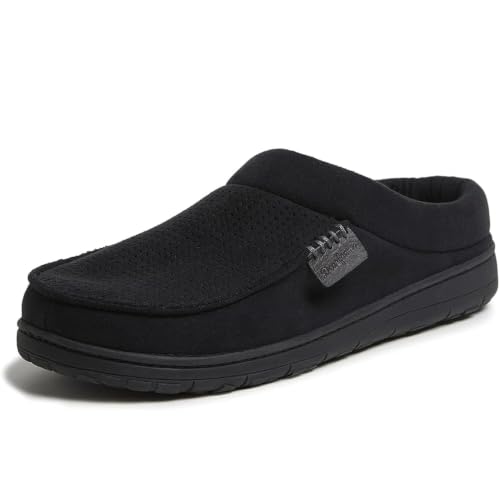
Dearfoams Men’s Brendan Memory Foam Clog, Wide Widths — Best Wide-Fit Durability
Stated wide widths — fit treated as the durability feature it is.
Strengths
- Wide widths stated — fit is durability
- Indoor/outdoor positioning stated
- Breathable memory foam clog stated
Trade-offs
- Clog shape will not suit heel-huggers
- Range sizing in this listing
- Perforated finish is a warm-weather lean
Key specs (from the listing title):
- Widths: wide widths stated (listing)
- Use: indoor/outdoor stated (listing)
- Style: breathable clog (listing)
Fit is the forgotten durability variable: a too-narrow slipper bursts its seams, a too-long one folds and cracks its sole, and both failures get blamed on materials. This listing states wide widths outright, which is why it closes the guide — for wide-footed wearers it is not the sixth pick but the first. The clog format adds step-in ease and a stated indoor/outdoor brief, and the breathable perforated finish suits the warm end of the year better than the bootie above.
Best for: wide feet and clog lovers / Not suited for: narrow feet wanting a snug moccasin
Check the current price on Amazon
Comparison Table
| Pick | Badge | Key spec (listing) | Best for |
|---|---|---|---|
| VeraCosy Men’s Durable Slippers, Memory Foam, Matt Black | Best Overall Durability | Durable in the listing name, machine-washable stated (listing) | daily-wear households wanting one dependable pair |
| RockDove Men’s Original Two-Tone Memory Foam Slipper | Best Washable Workhorse | Non-slip, machine washable, indoor/outdoor stated (listing) | hard floors, quick outdoor steps, daily wear |
| UGG Men’s Ascot Slipper, Chestnut | Best Premium Build | Men’s Ascot slipper, chestnut (listing) | buyers wanting the longest-lived construction |
| Orthofeet Asheville Orthopedic Men House Slippers, Brown | Best Supportive Durability | Orthopedic, hands-free, adjustable stated (listing) | all-day house wear on hard floors |
| LongBay Men’s Bootie Slippers, Indoor Outdoor | Best Bootie Durability | Tough nylon uppers, rubber outsole stated (listing) | cold houses, garage and workshop steps |
| Dearfoams Men’s Brendan Memory Foam Clog, Wide Widths | Best Wide-Fit Durability | Wide widths, indoor/outdoor, breathable stated (listing) | wide feet and clog lovers |
Key Takeaways
- Match the product to the exact job and space first; headline features come second.
- Only buy claims the listing itself states — anything unstated is unproven.
- Measure first, and re-check variant, size and configuration on the listing page.
- Care and rotation habits extend life more than any single premium feature.
How to Choose the Best Durable Slippers
Diagnose your last pair first: sole, seam, foam or grime — then buy the strategy that prevents that death. Washability defeats grime, construction defeats soles and seams, rotation defeats foam compression, and stated fit features defeat the uneven wear that fit problems cause. If two deaths compete, prioritise the one that arrived first last time.
Why This Guide Mixes Price Tiers Without Printing Prices
Durability per purchase is not the same as durability per dollar, and since no static prices are printed here, the honest comparison is strategic: a washable mid-range pair rotated with a second pair commonly out-serves a single premium pair, while a premium construction out-serves everything for the owner who will not wash or rotate. Check price on Amazon for the current figures and run your own arithmetic with your own habits as the inputs.
How to Make Any Slipper Last Longer
Rotate pairs if you own two, wash washable pairs early and gently and dry them fully, brush and air non-washable pairs instead of soaking them, and keep slippers for their stated territory — house and porch, not pavement. Shake out grit weekly, because grit inside a slipper is sandpaper with a grudge, and re-check fit features monthly on adjustable models.
Care routines decide lifespan more than first impressions do. Follow the maker’s washing or spot-clean guidance, rotate or shake out the item on a regular rhythm, and store it dry and out of direct sun when it is out of rotation. Small habits — dealing with spills the day they happen, airing fibres before storage, keeping spare covers or cases washed and ready — prevent the slow build-up of odour and wear that makes people replace a sound product early. When something does wear, judge whether the worn part is replaceable before replacing the whole item.
Measure before you order, and measure the space the item will actually live in rather than the space you imagine. Door widths, bed sizes, tub footprints and foot length all punish guesswork. Write the numbers down, compare them against the dimensions stated in the listing, and leave a margin for real life: bedding that shrinks slightly, rugs that need clearance under a swinging door, chairs that need room to recline or swivel. A two-minute tape-measure check prevents most returns in this category.
Common Buying Mistakes
- Blaming materials for what was actually a fit failure.
- Wearing one foam pair daily for a year, then concluding foam is fragile.
- Never washing a washable slipper until the rescue wash destroys it.
- Using house slippers as outdoor shoes and grading them as shoes.
- Ignoring a listing that states no material — and imagining one instead.
Final Recommendation
Start with the VeraCosy for the most complete stated durability package, the LongBay for stated tough materials, and the Dearfoams if width has killed your slippers before. Diagnose honestly, buy the matching strategy, and rotate or wash as the strategy demands.
Frequently Asked Questions
Which pick lasts longest overall?
It depends on the death you are preventing: the UGG construction for build, the VeraCosy and RockDove for washable service, the LongBay for stated tough materials. The guide’s reviews map each pick to its strategy.
Does machine washable really extend a slipper’s life?
Yes — most slippers are retired for grime and odour before structural failure. A washable pair resets that clock repeatedly, washed gently and dried fully.
What material is the UGG Ascot pick made from?
The cached listing title states the model and colour only, so this guide claims no material for it. The full listing page carries the construction details — check there before ordering.
Are orthopedic slippers a medical product?
The Orthofeet pick is presented here as a supportive comfort house slipper, with its features reported as its listing states them. This guide makes no medical claims for any pick.
One premium pair or two mid-range pairs?
For foam slippers, two rotated pairs usually win. For a construction-led pick like the moccasin, one pair properly cared for is the strategy working as designed.
Can durable slippers go outdoors?
The picks whose listings state indoor/outdoor are built for porches, garages and garden steps. None of these are walking shoes, and pavement mileage will retire any of them early.
A Note on the Word Durable
One pick claims durability in its own product name; the others earn the word through stated properties — washability, materials, construction, fit. This guide distinguishes the two, because a claimed property and a demonstrated one are both useful, and they are not the same thing.
What Durability Actually Means in a Slipper
A slipper can die four deaths: the sole smooths or splits, the upper tears or bursts a seam, the foam compresses into cardboard, or the whole thing becomes unwearably grubby. A durable slipper is simply one engineered against all four — a real outsole, a stated shell material or construction, foam treated as a consumable to be rotated or washed back to life, and a care route the owner will actually use. That is why this guide mixes strategies instead of crowning one material: washable foam slippers defeat the fourth death, moccasin construction defeats the first two, adjustable supportive builds defeat uneven wear, and a stated tough shell with a rubber outsole defeats nearly everything except summer. Read each pick by asking which deaths it prevents, and choose the pick whose prevented deaths match how your last pair actually died.
The Washability Doctrine
Across years of slipper ownership, the single strongest predictor of a long-lived pair is whether it can be washed — not because washing is magic, but because unwashable slippers accumulate a reason to be replaced that has nothing to do with their structure. Three picks here state machine washability or sit in washable product families, and their listings’ wording is quoted as stated. Wash on the maker’s terms, dry fully, and wash early and gently rather than late and desperately. For the non-washable premium pick, the doctrine inverts: protect it from the situations that would need washing, brush and air it, and its construction does the rest. Either way, care is not an afterthought to durability — care is durability, expressed as a habit instead of a material.
Foam, Honestly: Compression and Rotation
Every memory foam pick in this guide will compress over time; that is physics, not a defect, and any guide promising otherwise is selling something. What separates a good foam slipper from a bad one is the rate of compression and what surrounds the foam — a real sole, a washable build, a supportive shape that keeps weight distributed. Rotation is the owner’s countermeasure: two pairs alternated daily rest their foam on off-days and commonly deliver more total service than the same two pairs worn sequentially. If you buy one pair only, buy the pick whose other durability features — washability, shell, sole — are strongest, because its foam will carry the full daily load and needs the best support around it.
Fit as a Durability Feature
The wide-width pick closes this guide because fit failures masquerade as durability failures across the whole category. A narrow foot in a standard slipper is fine; a wide foot in a standard slipper is a seam under constant strain, a sole edge worn at an angle, and a lining abraded by a heel that never sits where the maker intended. The stated wide widths on the Dearfoams pick, the stated adjustability on the Orthofeet pick, and the stated wide toe box in its listing are all the same idea in different dialects: the slipper that matches the foot stops fighting the foot, and the fight is what wears slippers out. Measure, choose the stated fit feature that matches your foot, and half of durability is bought before materials are even considered.
House Slippers, and the Boundary of This Guide
These are house slippers — including the indoor/outdoor picks, whose stated brief extends to porches, garages and garden steps, not to pavements and trails. The guide excludes sandals, slides and flip-flops, which are different footwear; excludes massage and medical-pitch products, because this article makes comfort claims only; and excludes novelty slippers whose construction cannot survive a season. Within the boundary, the six picks span the honest strategies — washable foam, footwear-grade construction, adjustable support, stated tough materials, and stated wide fit. If your last pair died a death none of these strategies prevents, that is useful information too: it usually means the slipper was being used as a shoe, and the correct purchase is a shoe.
A Longer View on Ownership Costs
Ownership cost is the purchase repeated over time. Judge value over the whole ownership period, not the first week. A cheaper option replaced twice costs more — in money, time and waste — than a mid-range option that lasts. Look for the construction details that predict longevity in the listing itself: stitching, backing, frame material, washability and whether wear parts can be replaced. Where a listing is silent on a detail that matters to you, treat that silence as information and choose a listing that states it plainly instead. Care routines decide lifespan more than first impressions do. Follow the maker’s washing or spot-clean guidance, rotate or shake out the item on a regular rhythm, and store it dry and out of direct sun when it is out of rotation. Small habits — dealing with spills the day they happen, airing fibres before storage, keeping spare covers or cases washed and ready — prevent the slow build-up of odour and wear that makes people replace a sound product early. When something does wear, judge whether the worn part is replaceable before replacing the whole item. Measure before you order, and measure the space the item will actually live in rather than the space you imagine. Door widths, bed sizes, tub footprints and foot length all punish guesswork. Write the numbers down, compare them against the dimensions stated in the listing, and leave a margin for real life: bedding that shrinks slightly, rugs that need clearance under a swinging door, chairs that need room to recline or swivel. A two-minute tape-measure check prevents most returns in this category.
Matching the Product to Your Household
Households differ in traffic, pets, children, climate and storage, and the right choice follows those facts rather than a generic ranking. Measure before you order, and measure the space the item will actually live in rather than the space you imagine. Door widths, bed sizes, tub footprints and foot length all punish guesswork. Write the numbers down, compare them against the dimensions stated in the listing, and leave a margin for real life: bedding that shrinks slightly, rugs that need clearance under a swinging door, chairs that need room to recline or swivel. A two-minute tape-measure check prevents most returns in this category. Judge value over the whole ownership period, not the first week. A cheaper option replaced twice costs more — in money, time and waste — than a mid-range option that lasts. Look for the construction details that predict longevity in the listing itself: stitching, backing, frame material, washability and whether wear parts can be replaced. Where a listing is silent on a detail that matters to you, treat that silence as information and choose a listing that states it plainly instead. Care routines decide lifespan more than first impressions do. Follow the maker’s washing or spot-clean guidance, rotate or shake out the item on a regular rhythm, and store it dry and out of direct sun when it is out of rotation. Small habits — dealing with spills the day they happen, airing fibres before storage, keeping spare covers or cases washed and ready — prevent the slow build-up of odour and wear that makes people replace a sound product early. When something does wear, judge whether the worn part is replaceable before replacing the whole item.
When to Replace Rather Than Repair
Replace when the core function has gone — support, grip, absorbency or structural soundness — rather than when the surface merely looks tired. Care routines decide lifespan more than first impressions do. Follow the maker’s washing or spot-clean guidance, rotate or shake out the item on a regular rhythm, and store it dry and out of direct sun when it is out of rotation. Small habits — dealing with spills the day they happen, airing fibres before storage, keeping spare covers or cases washed and ready — prevent the slow build-up of odour and wear that makes people replace a sound product early. When something does wear, judge whether the worn part is replaceable before replacing the whole item. Judge value over the whole ownership period, not the first week. A cheaper option replaced twice costs more — in money, time and waste — than a mid-range option that lasts. Look for the construction details that predict longevity in the listing itself: stitching, backing, frame material, washability and whether wear parts can be replaced. Where a listing is silent on a detail that matters to you, treat that silence as information and choose a listing that states it plainly instead. Measure before you order, and measure the space the item will actually live in rather than the space you imagine. Door widths, bed sizes, tub footprints and foot length all punish guesswork. Write the numbers down, compare them against the dimensions stated in the listing, and leave a margin for real life: bedding that shrinks slightly, rugs that need clearance under a swinging door, chairs that need room to recline or swivel. A two-minute tape-measure check prevents most returns in this category.
Reading a Listing Like an Inspector
Work through any listing in a fixed order: first the exact product name and what the item actually is, then the dimensions and any stated capacity, then the materials and certifications exactly as worded, and only then the marketing adjectives. Adjectives are free; stated specifications are commitments. If a feature you care about appears only in a photograph and never in words, treat it as unconfirmed. If a title is cut short in a search result or a cache, open the full listing page and read the complete title and description before deciding — the missing words are precisely the ones that change decisions.
Seasonal and Household Changes
The right product in January can be the wrong one in July, and the right product for a single adult can be wrong for a household with toddlers, teenagers or pets. Before buying, run the item mentally through your hardest season and your busiest week: the muddy month, the allergy month, the house-guest month, the month the heating runs all day. Products that offer a configuration choice — a size, a finish, a firmness, a pack quantity — usually repay choosing the configuration for your hardest case rather than your average case, because average cases forgive almost anything.
Returns, Spares and Second Purchases
Keep the packaging until the product has survived its first real week of use, photograph how it arrived, and note the exact variant you ordered so a second purchase matches the first. For consumable-adjacent products, buying a spare cover, case or second unit at the same time is often cheaper than reordering later and risking a discontinued variant. And when you do reorder, re-read the listing: manufacturers revise products under the same listing, so the title you trusted last year deserves a fresh read this year.
Testing the Product in Its First Week
Treat the first week as a structured trial rather than a honeymoon. Use the product for its hardest real job, not its easiest: the longest session, the muddiest day, the fullest load, the most sensitive sleeper. Note what you adjust, what you avoid, and what you wish were different, because those small frictions grow with time. Check fixings, seams, backs and bases again at the end of the week, while returning or exchanging is still simple. A product that passes its hardest week almost always serves for years. Measure before you order, and measure the space the item will actually live in rather than the space you imagine. Door widths, bed sizes, tub footprints and foot length all punish guesswork. Write the numbers down, compare them against the dimensions stated in the listing, and leave a margin for real life: bedding that shrinks slightly, rugs that need clearance under a swinging door, chairs that need room to recline or swivel. A two-minute tape-measure check prevents most returns in this category. Care routines decide lifespan more than first impressions do. Follow the maker’s washing or spot-clean guidance, rotate or shake out the item on a regular rhythm, and store it dry and out of direct sun when it is out of rotation. Small habits — dealing with spills the day they happen, airing fibres before storage, keeping spare covers or cases washed and ready — prevent the slow build-up of odour and wear that makes people replace a sound product early. When something does wear, judge whether the worn part is replaceable before replacing the whole item.
What Good Looks Like a Year From Now
Picture the product after a year of your real life, not a showroom life. Colours soften, fibres settle, mechanisms develop a familiar feel, and well-chosen products become invisible — they simply work every day without negotiation. That invisibility is the true test of any buying decision: not excitement at delivery, but the absence of complaints in month twelve. Choosing stated specifications over adjectives, measuring instead of guessing, and caring for the product on a simple rhythm are the three habits that separate purchases you forget about, in the best way, from the ones you replace. Judge value over the whole ownership period, not the first week. A cheaper option replaced twice costs more — in money, time and waste — than a mid-range option that lasts. Look for the construction details that predict longevity in the listing itself: stitching, backing, frame material, washability and whether wear parts can be replaced. Where a listing is silent on a detail that matters to you, treat that silence as information and choose a listing that states it plainly instead. Care routines decide lifespan more than first impressions do. Follow the maker’s washing or spot-clean guidance, rotate or shake out the item on a regular rhythm, and store it dry and out of direct sun when it is out of rotation. Small habits — dealing with spills the day they happen, airing fibres before storage, keeping spare covers or cases washed and ready — prevent the slow build-up of odour and wear that makes people replace a sound product early. When something does wear, judge whether the worn part is replaceable before replacing the whole item.
One Last Check Before You Order
Run this final pass on whichever pick you have chosen: re-read its full listing title on the listing page, confirm the size, colour and configuration in the variant selector rather than the headline, check the dimensions against the measurements you took, and confirm that every feature you are relying on is stated in words somewhere in the listing. If any answer is a guess, pause — the right response to a guess is a different, clearer listing, not optimism. Five minutes of checking is the cheapest insurance in the whole purchase. Measure before you order, and measure the space the item will actually live in rather than the space you imagine. Door widths, bed sizes, tub footprints and foot length all punish guesswork. Write the numbers down, compare them against the dimensions stated in the listing, and leave a margin for real life: bedding that shrinks slightly, rugs that need clearance under a swinging door, chairs that need room to recline or swivel. A two-minute tape-measure check prevents most returns in this category. Judge value over the whole ownership period, not the first week. A cheaper option replaced twice costs more — in money, time and waste — than a mid-range option that lasts. Look for the construction details that predict longevity in the listing itself: stitching, backing, frame material, washability and whether wear parts can be replaced. Where a listing is silent on a detail that matters to you, treat that silence as information and choose a listing that states it plainly instead.
How This Guide Handles Claims
Every product claim in this article is tied to the wording of a verified listing: the product name, the stated size or capacity, the stated materials and the stated certifications are reported as written, and anything a listing does not state is treated as not stated rather than filled in by assumption. That discipline is why some picks carry explicit honesty notes — a density that is medium rather than soft, a hypoallergenic claim that is absent rather than implied, a title that is truncated rather than completed. It is also why no prices, star ratings or review counts appear anywhere in the article: those numbers change constantly, and a guide that prints them is quietly going out of date from the day it is published. What does not change is the fit between a stated specification and a real household need, and that fit is what the recommendations here are built on. If you check only one thing before ordering, check that the listing page still matches the description quoted here — listings are revised, and the current page always outranks any guide, including this one. Judge value over the whole ownership period, not the first week. A cheaper option replaced twice costs more — in money, time and waste — than a mid-range option that lasts. Look for the construction details that predict longevity in the listing itself: stitching, backing, frame material, washability and whether wear parts can be replaced. Where a listing is silent on a detail that matters to you, treat that silence as information and choose a listing that states it plainly instead.
Putting the Whole Purchase Together
Step back and assemble the decision in the order a careful buyer actually makes it. First, the job: write down, in one sentence, what this product must do in your home and for whom — that sentence eliminates half of any catalogue immediately. Second, the space: the measurements you took, the door it must pass, the surface it will sit on, the people or animals who share it. Third, the specification: only the picks whose listings state what your first two steps require stay on the list, and between those, prefer the listing that states the most, because stated facts are the only ones you can hold anyone to. Fourth, the system around the product: the protector, the spare, the storage, the cleaning rhythm — the unglamorous purchases that decide whether the main purchase still pleases you in a year. Run those four steps honestly and the ranking in this guide becomes almost a formality: one pick will match your sentence, your space and your system, and that is the one to buy. Care routines decide lifespan more than first impressions do. Follow the maker’s washing or spot-clean guidance, rotate or shake out the item on a regular rhythm, and store it dry and out of direct sun when it is out of rotation. Small habits — dealing with spills the day they happen, airing fibres before storage, keeping spare covers or cases washed and ready — prevent the slow build-up of odour and wear that makes people replace a sound product early. When something does wear, judge whether the worn part is replaceable before replacing the whole item. Measure before you order, and measure the space the item will actually live in rather than the space you imagine. Door widths, bed sizes, tub footprints and foot length all punish guesswork. Write the numbers down, compare them against the dimensions stated in the listing, and leave a margin for real life: bedding that shrinks slightly, rugs that need clearance under a swinging door, chairs that need room to recline or swivel. A two-minute tape-measure check prevents most returns in this category.


