Disclosure: airfryerkitchensupply.com is reader-supported. When you buy through links on our site, we may earn an affiliate commission at no extra cost to you.
Where to buy
Each verified pick below links to its Amazon listing — use check price on Amazon on the listing page for the current figure, and confirm size, colour and configuration there before ordering, because listings carry variants the headline does not always make obvious.
Choosing the best indoor rugs is really three decisions wearing one coat: a size that fits your furniture, a fibre whose care contract you will honour, and a pile that coexists with your doors, chairs and vacuum. This guide makes those decisions in that order. Every pick was verified against this site’s product cache, and every material, pile and performance word is reported exactly as its listing states it — jute is jute, polypropylene is named, water repellent is never upgraded to waterproof, and washable means the listing says the rug itself can be washed. Whether your room needs a natural-fibre anchor, a vintage 8×10 stage, or a washable surface that forgives family life, the six picks below are specified plainly enough to choose between without guesswork.
In this guide
Quick Picks
SAFAVIEH Natural Fiber Area Rug, 5×8, Jute Knotted NF447A — Best Natural Fibre: A knotted jute rug with a stated three-quarter-inch pile, positioned by its listing for entryway, living room and office, and described as durable and kid and pet friendly. — Check on Amazon
JONATHAN Y Moroccan Boho Vintage Diamond Area Rug, 8×10, Cream/Gray — Best Large Vintage Look: A large power-loomed rug with a stated thickness, described in its listing as high-traffic, easy-cleaning, durable and soft. — Check on Amazon
JONATHAN Y Haze Solid Low-Pile Area Rug, 5×8, Ivory — Best Quiet Solid: A solid ivory low-pile rug in stated polypropylene, described as pet-friendly, easy-cleaning and durable, with a stated thickness. — Check on Amazon
Lahome Dark Olive Green Bedroom Rug, 8×10, Washable — Best Washable Large Rug: A large washable area rug with a stated rubber backing, described as non-slip and non-shedding, in a deep olive tone. — Check on Amazon
AMADA Area Rug, 8×10, Washable, Blue — Best Washable Vintage: A washable vintage-look rug in blue, described as non-slip, low-profile, soft-textured and pet friendly in its listing. — Check on Amazon
RELEANY Washable Area Rug, 5×7, Brick/Brown/Green — Best Mid-Size Washable: A mid-size washable rug whose listing states water repellent and non-slip character, in a vintage floral boho palette. — Check on Amazon
How These Picks Were Chosen
Picks were selected from cache-verified listings of complete indoor area rugs — no rug pads, tapes or outdoor-only rugs. A stated size was required for every pick, and fibre, pile, backing and care claims are quoted only where the listing’s title states them. The set was balanced across natural and synthetic fibres, washable and clean-in-place constructions, and the three sizes that fit real furniture: 5×7, 5×8 and 8×10.
Judge value over the whole ownership period, not the first week. A cheaper option replaced twice costs more — in money, time and waste — than a mid-range option that lasts. Look for the construction details that predict longevity in the listing itself: stitching, backing, frame material, washability and whether wear parts can be replaced. Where a listing is silent on a detail that matters to you, treat that silence as information and choose a listing that states it plainly instead.
The 6 Best Options for Best Indoor Rugs

SAFAVIEH Natural Fiber Area Rug, 5×8, Jute Knotted NF447A — Best Natural Fibre
Natural jute texture with a stated substantial pile, for calm dry rooms.
Strengths
- Natural jute fibre stated
- Substantial stated pile for a natural rug
- Durable positioning in the listing
Trade-offs
- Jute dislikes soaking — spot clean, do not saturate
- Natural fibres shed early on
- Texture is rustic, not plush
Key specs (from the listing title):
- Size: 5×8 (listing)
- Fibre: jute, knotted (listing)
- Pile: 3/4 inch stated (listing)
Jute is the honest material of this category: plant fibre, visible texture, and a care contract that forbids drowning it. The listing states the fibre, the pile height and the rooms it suits, and describes it as durable and friendly to kids and pets — claims reported here exactly as stated. In return for spot-clean discipline you get a rug that grounds a room like no synthetic can, aging into its setting rather than wearing out of it. Put it where shoes are already clean-ish; jute at a muddy threshold is a misuse this guide warns against in its own entry-rug companion article.
Best for: living rooms and offices wanting natural texture / Not suited for: homes needing a machine-washable rug
Check the current price on Amazon
[‘Jute rewards a rug pad: it stops creep, adds the cushion jute itself does not provide, and keeps the knotted back off gritty floors.’, ‘With an 8×10 like the Jonathan Y vintage, vacuum in sections weekly and rotate the rug twice a year so traffic lanes do not become permanent.’, ‘The Haze solid shows its traffic lanes first at door thresholds; a washable runner in the doorway extends its clean look considerably.’, ‘Wash the Lahome rug before a sunny day or a laundry trip — an 8×10 takes real time to dry, and it must dry fully before furniture returns.’, ‘Low-profile washables like the AMADA are the robot-vacuum friendship tier; schedule the vacuum while you are out and the rug earns its keep daily.’, ‘Blot spills on the RELEANY immediately — water repellent buys you minutes, and minutes are exactly what it promises. Spend them.’]
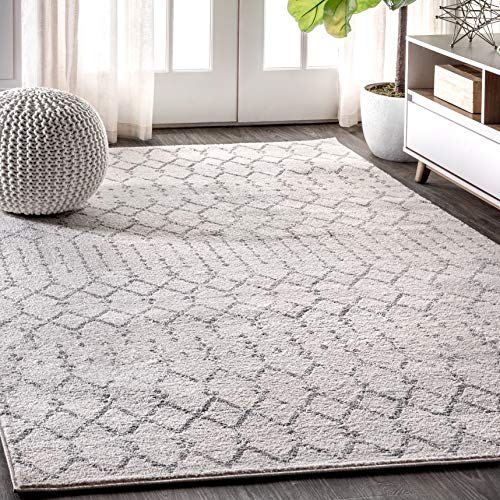
JONATHAN Y Moroccan Boho Vintage Diamond Area Rug, 8×10, Cream/Gray — Best Large Vintage Look
A room-defining vintage 8×10, specified for high traffic.
Strengths
- Room-defining 8×10 size
- Stated thickness and construction
- High-traffic positioning in the listing
Trade-offs
- 8×10 needs a large room and a large vacuum routine
- Vintage pattern is a commitment
- Power-loomed synthetic feel differs from wool
Key specs (from the listing title):
- Size: 8×10 (listing)
- Thickness: 0.31 inch stated (listing)
- Build: power loomed (listing)
Scale is the specification here: an 8×10 rug redraws a room, anchoring sofa, chairs and table into one conversation. The listing states its thickness and power-loomed construction and positions it for high traffic with easy cleaning — the practical pairing a large rug needs, because a rug this size is cleaned in place, not carried to a machine. The cream and gray vintage diamond pattern hides the evidence of daily life between cleans, which is precisely what a living-room rug is for.
Best for: open-plan living rooms / Not suited for: small rooms it would swallow
Check the current price on Amazon

JONATHAN Y Haze Solid Low-Pile Area Rug, 5×8, Ivory — Best Quiet Solid
A quiet solid in stated polypropylene, for bedrooms and calm spaces.
Strengths
- Solid colour calms a busy room
- Stated material and thickness
- Pet-friendly positioning in the listing
Trade-offs
- Ivory shows what a pattern would hide
- Low pile is not a plush feel
- Synthetic fibre feel underfoot
Key specs (from the listing title):
- Size: 5×8 (listing)
- Fibre: polypropylene stated (listing)
- Thickness: 0.4 inch stated (listing)
The solid rug is the decorator’s quiet tool: no pattern to negotiate with, just texture, light and a stated low pile that lets furniture legs and robot vacuums move freely. The listing states polypropylene — a hard-wearing, easy-cleaning fibre — and a 0.4-inch thickness, and positions the rug as pet-friendly. The honest trade is visibility: ivory displays life as it happens, so this pick suits households whose traffic is moderate and whose cleaning rhythm is real.
Best for: bedrooms and calm living spaces / Not suited for: mud-heavy households wanting camouflage
Check the current price on Amazon

Lahome Dark Olive Green Bedroom Rug, 8×10, Washable — Best Washable Large Rug
Washability at full 8×10 scale, with a stated rubber backing.
Strengths
- Machine washable at 8×10 — the headline act
- Rubber backed, non-slip stated
- Non-shedding stated in the listing
Trade-offs
- Washing an 8×10 needs a large machine or a laundry service
- Low-profile washable rugs feel thinner than plush rugs
- Dark olive is a strong colour decision
Key specs (from the listing title):
- Size: 8×10 (listing)
- Backing: rubber backed stated (listing)
- Care: washable (listing)
Washability at this size rewrites the ownership contract: spills, pet accidents and the annual mystery stain stop being permanent. The listing states the rubber backing and non-slip, non-shedding character, and the guide reports them as stated. The trade is pile — washable rugs are built low and dense rather than deep — so judge this pick as a practical surface with a handsome colour, not as a luxury texture. For dining rooms, where chairs slide and food falls, that is the correct priority order.
Best for: family living rooms and dining rooms / Not suited for: anyone wanting a thick plush pile
Check the current price on Amazon

AMADA Area Rug, 8×10, Washable, Blue — Best Washable Vintage
A washable vintage in blue, for pet households.
Strengths
- Washable with a vintage pattern that hides life
- Low-profile stated — doors and vacuums approve
- Pet friendly positioning in the listing
Trade-offs
- Blue vintage palette must match the room
- Low profile means minimal cushion
- Soft texture is a surface feel, not a deep pile
Key specs (from the listing title):
- Size: 8×10 (listing)
- Profile: low-profile stated (listing)
- Care: washable (listing)
This pick pairs the two properties family rooms actually need — a pattern that forgives, and a construction that washes — in the large 8×10 format. Its listing states low-profile and describes a soft texture; both are reported as stated, and the distinction matters: surface softness is not cushioning, and anyone wanting to sit on the floor for hours should add a pad or choose a deeper rug. As a washable stage for daily life with animals, it is specified exactly right.
Best for: pet households wanting pattern plus washability / Not suited for: plush-pile seekers
Check the current price on Amazon

RELEANY Washable Area Rug, 5×7, Brick/Brown/Green — Best Mid-Size Washable
A mid-size washable whose water-repellent claim is kept at its exact strength.
Strengths
- Water repellent stated — in those words, not upgraded here
- Washable and non-slip stated
- 5×7 suits bedrooms and dining nooks
Trade-offs
- Water repellent is not waterproof — the guide keeps the distinction
- Floral boho palette is style-specific
- Mid-size will under-serve a large open plan
Key specs (from the listing title):
- Size: 5×7 (listing)
- Claim: water repellent stated (listing)
- Care: washable, non-slip stated (listing)
This listing gives the guide an opportunity to model honest language: it states water repellent, which means the surface sheds spills long enough to blot them — genuinely useful — and it does not mean waterproof, and the rug is not described as waterproof anywhere in this article. Within that honest claim sits a well-judged rug: washable, non-slip as stated, in a forgiving vintage palette at the most versatile size in the category.
Best for: bedrooms, dining rooms and offices / Not suited for: anyone needing a waterproof barrier
Check the current price on Amazon
Comparison Table
| Pick | Badge | Key spec (listing) | Best for |
|---|---|---|---|
| SAFAVIEH Natural Fiber Area Rug, 5×8, Jute Knotted NF447A | Best Natural Fibre | 5×8, jute, 3/4in pile stated (listing) | living rooms and offices wanting natural texture |
| JONATHAN Y Moroccan Boho Vintage Diamond Area Rug, 8×10, Cream/Gray | Best Large Vintage Look | 8×10, 0.31in thick, power loomed (listing) | open-plan living rooms |
| JONATHAN Y Haze Solid Low-Pile Area Rug, 5×8, Ivory | Best Quiet Solid | 5×8, polypropylene, 0.4in thick stated (listing) | bedrooms and calm living spaces |
| Lahome Dark Olive Green Bedroom Rug, 8×10, Washable | Best Washable Large Rug | 8×10, washable, rubber backed stated (listing) | family living rooms and dining rooms |
| AMADA Area Rug, 8×10, Washable, Blue | Best Washable Vintage | 8×10, washable, low-profile stated (listing) | pet households wanting pattern plus washability |
| RELEANY Washable Area Rug, 5×7, Brick/Brown/Green | Best Mid-Size Washable | 5×7, washable, water repellent stated (listing) | bedrooms, dining rooms and offices |
Key Takeaways
- Match the product to the exact job and space first; headline features come second.
- Only buy claims the listing itself states — anything unstated is unproven.
- Measure first, and re-check variant, size and configuration on the listing page.
- Care and rotation habits extend life more than any single premium feature.
How to Choose the Best Indoor Rugs
Start with the furniture rule — front legs of every seat on the rug — and tape the outline on your floor for a day. Then choose fibre by care contract: jute for dry calm rooms, polypropylene for clean-in-place practicality, washable constructions for spill-prone family life. Finally check pile against your doors and your vacuum, and budget the pad in the same purchase.
Washable Versus Clean-in-Place
A washable rug moves the cleaning to a machine; a clean-in-place rug is vacuumed and spot-treated where it lies. Large plush rugs are necessarily the second kind; the washable generation trades pile depth for that machine freedom. Neither is superior — the right choice is the one whose cleaning you will actually do at the size you actually need.
How to Lay, Pad and Maintain an Indoor Rug
Unroll the rug and let it relax flat before placing furniture, fit a pad a fraction smaller than the rug beneath it, and vacuum weekly in the direction of traffic. Spot-clean spills by blotting, never scrubbing; wash washable rugs as their listings direct and dry them fully; spot-clean jute without saturating it. Rotate the rug at each season change so light and wear distribute evenly.
Care routines decide lifespan more than first impressions do. Follow the maker’s washing or spot-clean guidance, rotate or shake out the item on a regular rhythm, and store it dry and out of direct sun when it is out of rotation. Small habits — dealing with spills the day they happen, airing fibres before storage, keeping spare covers or cases washed and ready — prevent the slow build-up of odour and wear that makes people replace a sound product early. When something does wear, judge whether the worn part is replaceable before replacing the whole item.
Measure before you order, and measure the space the item will actually live in rather than the space you imagine. Door widths, bed sizes, tub footprints and foot length all punish guesswork. Write the numbers down, compare them against the dimensions stated in the listing, and leave a margin for real life: bedding that shrinks slightly, rugs that need clearance under a swinging door, chairs that need room to recline or swivel. A two-minute tape-measure check prevents most returns in this category.
Common Buying Mistakes
- Buying for the floor’s dimensions instead of the furniture’s arrangement.
- Saturating a jute rug in a well-meant deep clean.
- Reading water repellent as waterproof.
- Skipping the pad, then blaming the rug for sliding and thinness.
- Choosing a solid ivory rug for a mud-season household with no cleaning rhythm.
Final Recommendation
For most living rooms the washable Lahome or AMADA at 8×10 is the practical centre of gravity, the SAFAVIEH jute is the texture connoisseur’s choice, and the Jonathan Y vintage is the room-defining statement. Tape your outline, choose your fibre honestly, and buy the pad in the same order.
Best Door Entry Rugs To Protect Floor
Frequently Asked Questions
What size rug does a living room need?
Big enough for the front legs of every seat to rest on it — commonly 8×10 in an open plan, 5×8 in a compact room. Tape the outline first and live with it for a day.
Can I really machine wash an 8×10 rug?
The washable picks state washability in their listings; you will need a large-capacity machine or a laundry service, and full drying time afterwards.
Is jute a good choice with pets?
Its listing describes it as kid and pet friendly and durable. The practical caveat is care: jute spot-cleans and must not be soaked, so mud-season dog homes may prefer a washable pick.
What is the difference between water repellent and waterproof in rugs?
Water repellent sheds spills briefly so you can blot them. Waterproof would block water entirely. This guide credits only the word each listing uses.
Do I need a rug pad indoors?
Yes — for grip, cushion and floor protection. Low-profile washable rugs in particular are designed to be paired with one.
Why do new rugs shed?
Loose fibre from manufacture works free in the first weeks, especially in natural fibres. Gentle frequent vacuuming settles it; it is not a defect.
A Note on Performance Words
Washable, water repellent, non-slip and non-shedding appear in this guide only where a listing states them, at exactly the strength stated. A rug that repels a spill for blotting is a good rug; it simply is not a waterproof one, and it is not described as one here.
Sizing a Rug to the Room, Not the Catalogue
Rug sizing follows furniture, not floor area. In a living room, the front legs of every seat should land on the rug — that rule alone eliminates most undersized purchases — and in a dining room the rug must extend beyond the table far enough that pulled-out chairs stay on it. Bedrooms want the rug to emerge generously on both sides of the bed, because the first step of the morning is the rug’s whole job. The sizes in this guide cluster at 5×7, 5×8 and 8×10 because those are the sizes that satisfy real furniture. Measure your arrangement, tape the rug’s outline on the floor with painter’s tape, and live with the outline for a day before ordering; a taped rectangle has prevented more returns than any review ever written.
Fibre Honesty: Jute, Polypropylene and the Washable Generation
The fibres in this guide are reported exactly as listed, because fibre decides care, feel and lifespan more than pattern ever will. Jute is a natural plant fibre — textured, durable as its listing states, and intolerant of soaking. Polypropylene is a synthetic workhorse — easy-cleaning and hard-wearing as stated, with a smoother, less organic hand. The washable rugs represent a construction generation rather than a fibre: low, dense piles on grippy backings, designed to survive a machine. None is best in the abstract. Jute suits the calm, dry, adult room; polypropylene suits the busy room cleaned in place; washables suit the room where life is spilled regularly. Choose the fibre whose care contract you will actually honour, because a rug’s real lifespan is set by the match between its needs and your habits.
Pile Height and the Doors, Chairs and Robots in Your Life
Pile is a practical specification disguised as a comfort one. The stated piles in this guide run from low-profile washables to the jute’s stated three-quarter inch, and each interacts with your household machinery: doors need clearance, dining chairs need to slide without catching, robot vacuums climb low piles and surrender on deep ones, and bare feet have their own vote. A household that runs a robot daily should shop the low end of this guide without apology — a clean low rug beats a dusty plush one by month two. A household that sits on the floor for film nights should weight pile and pad more heavily. There is no universal right answer, only the answer your furniture and habits dictate, which is why this guide states pile and profile for every pick rather than burying them.
Pattern, Colour and the Evidence of Daily Life
A rug’s pattern is a camouflage decision. Vintage and distressed designs — two picks here — are engineered forgiveness: crumbs, pet hair and the faint traffic lane all disappear into the intentional irregularity. Solids, like the ivory Haze, offer calm and light at the price of visibility; they suit lower-traffic rooms and households with a real cleaning rhythm. Colour temperature matters as much as pattern: the olive and blue picks here will anchor a room’s palette, while the natural jute and ivory act as neutrals that let other pieces speak. Decide which job you are hiring the rug to do — stage or actor — before you shop, because a rug hired as a stage and delivered as an actor will annoy you for years, and the reverse is equally true.
Pads, Placement and the First Month
A rug pad is not an upsell; it is the difference between a rug and a skating rink, and it adds the cushion that low-profile rugs deliberately omit. Buy the pad with the rug, sized a fraction smaller, every time. Placement deserves a day of patience: unroll the rug, let it relax, walk the edges flat, and only then position furniture. New rugs shed — natural fibres especially — and the first month’s fluff is the rug settling, not failing; vacuum gently and often rather than aggressively and rarely. Rotate the rug at the season change so light and traffic even out. These small disciplines, none of which cost money after the pad, are what separate the rug that looks chosen in year three from the rug that looks endured.
A Longer View on Ownership Costs
Ownership cost is the purchase repeated over time. Judge value over the whole ownership period, not the first week. A cheaper option replaced twice costs more — in money, time and waste — than a mid-range option that lasts. Look for the construction details that predict longevity in the listing itself: stitching, backing, frame material, washability and whether wear parts can be replaced. Where a listing is silent on a detail that matters to you, treat that silence as information and choose a listing that states it plainly instead. Care routines decide lifespan more than first impressions do. Follow the maker’s washing or spot-clean guidance, rotate or shake out the item on a regular rhythm, and store it dry and out of direct sun when it is out of rotation. Small habits — dealing with spills the day they happen, airing fibres before storage, keeping spare covers or cases washed and ready — prevent the slow build-up of odour and wear that makes people replace a sound product early. When something does wear, judge whether the worn part is replaceable before replacing the whole item. Measure before you order, and measure the space the item will actually live in rather than the space you imagine. Door widths, bed sizes, tub footprints and foot length all punish guesswork. Write the numbers down, compare them against the dimensions stated in the listing, and leave a margin for real life: bedding that shrinks slightly, rugs that need clearance under a swinging door, chairs that need room to recline or swivel. A two-minute tape-measure check prevents most returns in this category.
Matching the Product to Your Household
Households differ in traffic, pets, children, climate and storage, and the right choice follows those facts rather than a generic ranking. Measure before you order, and measure the space the item will actually live in rather than the space you imagine. Door widths, bed sizes, tub footprints and foot length all punish guesswork. Write the numbers down, compare them against the dimensions stated in the listing, and leave a margin for real life: bedding that shrinks slightly, rugs that need clearance under a swinging door, chairs that need room to recline or swivel. A two-minute tape-measure check prevents most returns in this category. Judge value over the whole ownership period, not the first week. A cheaper option replaced twice costs more — in money, time and waste — than a mid-range option that lasts. Look for the construction details that predict longevity in the listing itself: stitching, backing, frame material, washability and whether wear parts can be replaced. Where a listing is silent on a detail that matters to you, treat that silence as information and choose a listing that states it plainly instead. Care routines decide lifespan more than first impressions do. Follow the maker’s washing or spot-clean guidance, rotate or shake out the item on a regular rhythm, and store it dry and out of direct sun when it is out of rotation. Small habits — dealing with spills the day they happen, airing fibres before storage, keeping spare covers or cases washed and ready — prevent the slow build-up of odour and wear that makes people replace a sound product early. When something does wear, judge whether the worn part is replaceable before replacing the whole item.
When to Replace Rather Than Repair
Replace when the core function has gone — support, grip, absorbency or structural soundness — rather than when the surface merely looks tired. Care routines decide lifespan more than first impressions do. Follow the maker’s washing or spot-clean guidance, rotate or shake out the item on a regular rhythm, and store it dry and out of direct sun when it is out of rotation. Small habits — dealing with spills the day they happen, airing fibres before storage, keeping spare covers or cases washed and ready — prevent the slow build-up of odour and wear that makes people replace a sound product early. When something does wear, judge whether the worn part is replaceable before replacing the whole item. Judge value over the whole ownership period, not the first week. A cheaper option replaced twice costs more — in money, time and waste — than a mid-range option that lasts. Look for the construction details that predict longevity in the listing itself: stitching, backing, frame material, washability and whether wear parts can be replaced. Where a listing is silent on a detail that matters to you, treat that silence as information and choose a listing that states it plainly instead. Measure before you order, and measure the space the item will actually live in rather than the space you imagine. Door widths, bed sizes, tub footprints and foot length all punish guesswork. Write the numbers down, compare them against the dimensions stated in the listing, and leave a margin for real life: bedding that shrinks slightly, rugs that need clearance under a swinging door, chairs that need room to recline or swivel. A two-minute tape-measure check prevents most returns in this category.
Reading a Listing Like an Inspector
Work through any listing in a fixed order: first the exact product name and what the item actually is, then the dimensions and any stated capacity, then the materials and certifications exactly as worded, and only then the marketing adjectives. Adjectives are free; stated specifications are commitments. If a feature you care about appears only in a photograph and never in words, treat it as unconfirmed. If a title is cut short in a search result or a cache, open the full listing page and read the complete title and description before deciding — the missing words are precisely the ones that change decisions.
Seasonal and Household Changes
The right product in January can be the wrong one in July, and the right product for a single adult can be wrong for a household with toddlers, teenagers or pets. Before buying, run the item mentally through your hardest season and your busiest week: the muddy month, the allergy month, the house-guest month, the month the heating runs all day. Products that offer a configuration choice — a size, a finish, a firmness, a pack quantity — usually repay choosing the configuration for your hardest case rather than your average case, because average cases forgive almost anything.
Returns, Spares and Second Purchases
Keep the packaging until the product has survived its first real week of use, photograph how it arrived, and note the exact variant you ordered so a second purchase matches the first. For consumable-adjacent products, buying a spare cover, case or second unit at the same time is often cheaper than reordering later and risking a discontinued variant. And when you do reorder, re-read the listing: manufacturers revise products under the same listing, so the title you trusted last year deserves a fresh read this year.
Testing the Product in Its First Week
Treat the first week as a structured trial rather than a honeymoon. Use the product for its hardest real job, not its easiest: the longest session, the muddiest day, the fullest load, the most sensitive sleeper. Note what you adjust, what you avoid, and what you wish were different, because those small frictions grow with time. Check fixings, seams, backs and bases again at the end of the week, while returning or exchanging is still simple. A product that passes its hardest week almost always serves for years. Measure before you order, and measure the space the item will actually live in rather than the space you imagine. Door widths, bed sizes, tub footprints and foot length all punish guesswork. Write the numbers down, compare them against the dimensions stated in the listing, and leave a margin for real life: bedding that shrinks slightly, rugs that need clearance under a swinging door, chairs that need room to recline or swivel. A two-minute tape-measure check prevents most returns in this category. Care routines decide lifespan more than first impressions do. Follow the maker’s washing or spot-clean guidance, rotate or shake out the item on a regular rhythm, and store it dry and out of direct sun when it is out of rotation. Small habits — dealing with spills the day they happen, airing fibres before storage, keeping spare covers or cases washed and ready — prevent the slow build-up of odour and wear that makes people replace a sound product early. When something does wear, judge whether the worn part is replaceable before replacing the whole item.
What Good Looks Like a Year From Now
Picture the product after a year of your real life, not a showroom life. Colours soften, fibres settle, mechanisms develop a familiar feel, and well-chosen products become invisible — they simply work every day without negotiation. That invisibility is the true test of any buying decision: not excitement at delivery, but the absence of complaints in month twelve. Choosing stated specifications over adjectives, measuring instead of guessing, and caring for the product on a simple rhythm are the three habits that separate purchases you forget about, in the best way, from the ones you replace. Judge value over the whole ownership period, not the first week. A cheaper option replaced twice costs more — in money, time and waste — than a mid-range option that lasts. Look for the construction details that predict longevity in the listing itself: stitching, backing, frame material, washability and whether wear parts can be replaced. Where a listing is silent on a detail that matters to you, treat that silence as information and choose a listing that states it plainly instead. Care routines decide lifespan more than first impressions do. Follow the maker’s washing or spot-clean guidance, rotate or shake out the item on a regular rhythm, and store it dry and out of direct sun when it is out of rotation. Small habits — dealing with spills the day they happen, airing fibres before storage, keeping spare covers or cases washed and ready — prevent the slow build-up of odour and wear that makes people replace a sound product early. When something does wear, judge whether the worn part is replaceable before replacing the whole item.
One Last Check Before You Order
Run this final pass on whichever pick you have chosen: re-read its full listing title on the listing page, confirm the size, colour and configuration in the variant selector rather than the headline, check the dimensions against the measurements you took, and confirm that every feature you are relying on is stated in words somewhere in the listing. If any answer is a guess, pause — the right response to a guess is a different, clearer listing, not optimism. Five minutes of checking is the cheapest insurance in the whole purchase. Measure before you order, and measure the space the item will actually live in rather than the space you imagine. Door widths, bed sizes, tub footprints and foot length all punish guesswork. Write the numbers down, compare them against the dimensions stated in the listing, and leave a margin for real life: bedding that shrinks slightly, rugs that need clearance under a swinging door, chairs that need room to recline or swivel. A two-minute tape-measure check prevents most returns in this category. Judge value over the whole ownership period, not the first week. A cheaper option replaced twice costs more — in money, time and waste — than a mid-range option that lasts. Look for the construction details that predict longevity in the listing itself: stitching, backing, frame material, washability and whether wear parts can be replaced. Where a listing is silent on a detail that matters to you, treat that silence as information and choose a listing that states it plainly instead.
How This Guide Handles Claims
Every product claim in this article is tied to the wording of a verified listing: the product name, the stated size or capacity, the stated materials and the stated certifications are reported as written, and anything a listing does not state is treated as not stated rather than filled in by assumption. That discipline is why some picks carry explicit honesty notes — a density that is medium rather than soft, a hypoallergenic claim that is absent rather than implied, a title that is truncated rather than completed. It is also why no prices, star ratings or review counts appear anywhere in the article: those numbers change constantly, and a guide that prints them is quietly going out of date from the day it is published. What does not change is the fit between a stated specification and a real household need, and that fit is what the recommendations here are built on. If you check only one thing before ordering, check that the listing page still matches the description quoted here — listings are revised, and the current page always outranks any guide, including this one. Judge value over the whole ownership period, not the first week. A cheaper option replaced twice costs more — in money, time and waste — than a mid-range option that lasts. Look for the construction details that predict longevity in the listing itself: stitching, backing, frame material, washability and whether wear parts can be replaced. Where a listing is silent on a detail that matters to you, treat that silence as information and choose a listing that states it plainly instead.
Putting the Whole Purchase Together
Step back and assemble the decision in the order a careful buyer actually makes it. First, the job: write down, in one sentence, what this product must do in your home and for whom — that sentence eliminates half of any catalogue immediately. Second, the space: the measurements you took, the door it must pass, the surface it will sit on, the people or animals who share it. Third, the specification: only the picks whose listings state what your first two steps require stay on the list, and between those, prefer the listing that states the most, because stated facts are the only ones you can hold anyone to. Fourth, the system around the product: the protector, the spare, the storage, the cleaning rhythm — the unglamorous purchases that decide whether the main purchase still pleases you in a year. Run those four steps honestly and the ranking in this guide becomes almost a formality: one pick will match your sentence, your space and your system, and that is the one to buy. Care routines decide lifespan more than first impressions do. Follow the maker’s washing or spot-clean guidance, rotate or shake out the item on a regular rhythm, and store it dry and out of direct sun when it is out of rotation. Small habits — dealing with spills the day they happen, airing fibres before storage, keeping spare covers or cases washed and ready — prevent the slow build-up of odour and wear that makes people replace a sound product early. When something does wear, judge whether the worn part is replaceable before replacing the whole item. Measure before you order, and measure the space the item will actually live in rather than the space you imagine. Door widths, bed sizes, tub footprints and foot length all punish guesswork. Write the numbers down, compare them against the dimensions stated in the listing, and leave a margin for real life: bedding that shrinks slightly, rugs that need clearance under a swinging door, chairs that need room to recline or swivel. A two-minute tape-measure check prevents most returns in this category.


