Disclosure: airfryerkitchensupply.com is reader-supported. When you buy through links on our site, we may earn an affiliate commission at no extra cost to you.
Where to buy
All six rugs in this guide are sold on Amazon, and each carries a buy link because its listing was verified against Amazon listing data — the sizes, materials and care claims below are the ones the listings themselves declare. Entry hall rugs are mostly runners, and the verified field is: KOZYFLY Boho Runner 2×8, HUGEAR Vintage Floral Runner 2×6, Restydon Runner 2×8, SAFAVIEH Natural Fiber Jute Runner 2’6″ x 10′, the 2×6 Hallway Washable Runner in vintage farmhouse style and Weidear Hallway Runner 3 x 12 ft. Check the current price on Amazon for the size your hall needs, and measure your floor before ordering — runner length is the dimension buyers most often guess wrong.
Key Takeaways
- Entry hall rugs work three jobs at once: they trap what shoes bring in, protect the floor beneath, and set the visual tone of the whole house in the first three steps.
- Washable low-pile runners with rubber backing are the practical default for most halls; natural jute is the durable, textured alternative where washing is less critical.
- Size by the hall, not by the photograph: leave a border of visible floor on all sides, and keep the runner clear of door swings.
- Non-slip backing is a safety feature in an entry, where wet shoes meet hard floors — prioritise it over pattern.
- Every pick below is an verified listing; dimensions and care claims are printed exactly as the listings state them.
Introduction: the best entry hall rugs earn their floor space three ways
The best entry hall rugs are the hardest-working textiles in the house. A living room rug is mostly looked at; an entry hall rug is walked on by every person, dog, delivery, muddy boot and wet umbrella that crosses the threshold, in all weathers, several times a day. It has to catch grit before the grit reaches the rest of your floors — grit being the silent destroyer of hardwood finishes and the reason hall floors dull years before bedroom floors do. It has to stay put while doing it, because a runner that migrates is a trip hazard in the one place people walk while carrying groceries, children and luggage. And it has to do all of this while being the first design statement every guest reads about your home. This guide treats those three jobs — trapping, staying, and looking right — as the criteria every pick had to satisfy.
We verified each pick, matching brand and model against the listing titles the listed, so the dimensions and constructions below are the listings’ own words. The field splits into two honest families. Five picks are low-pile washable runners with non-slip or rubber backing — the modern default, built for machine washing and daily traffic. One pick, the Safavieh, is a hand-knotted-look natural jute runner for households that prefer fibre texture and durability over washability. Neither family is “better”; they answer different hallways. A hall that receives muddy dogs wants washing. A hall that receives mostly dry shoes and wants a decade of service wants jute. Read the profiles with your own front door in mind.
A word on sizing before the picks, because it decides satisfaction more than pattern does. A runner should leave a visible border of floor — roughly two to four inches on each side in most halls — and should run long enough that a person takes at least two full steps on it after entering; that two-step rule is what actually traps debris. Doors must swing clear of the pile, which is why every pick here is low profile or explicitly low pile. Measure the hall, note the door swings, then choose from the profiles below.
In this guide
Quick Picks
Best Overall — KOZYFLY Boho Runner for Hallways, 2×8 ft. Washable cotton runner with a non-slip rubber backing, sized for real halls, in a warm boho palette the listing describes as orange beige/tan/brown.
Best Vintage Look — HUGEAR Washable Runner Rug, 2×6. Brown vintage floral design, low pile, non-slip, with a soft distressed finish that hides traffic patterns between washes.
Best Neutral — Restydon Runner Rug, 2×8. Beige, thin and soft, washable and stain resistant — the quietest pick, for halls that already have plenty going on.
Best Natural Fiber — SAFAVIEH Natural Fiber Runner, 2’6″ x 10′. Knotted natural jute with a stated 3/4-inch pile; the durable, textured, dry-traffic choice. Its listing claims easy care, not machine washing, and we present it that way.
Best Farmhouse — Hallway Washable Runner Rug, 2×6. Vintage farmhouse styling, non-slip backing, stain resistant — built for kitchen-adjacent halls and busy family traffic.
Best Extra Long — Weidear Hallway Runner Rug, 3 x 12 ft. A wide, long non-slip runner with rubber backing for the halls and entryways that standard 8-foot runners leave unfinished.
How These Picks Were Chosen
We set four gates. First, format: an entry hall rug must be a runner or a runner-like proportion, because square area rugs in a hall leave the traffic path — the strip where shoes actually land — half uncovered. Second, stability: every synthetic pick had to state non-slip or rubber backing in its listing, because an entry is where households can least afford a sliding rug. Third, care honesty: washable picks are described as washable only where the listing says so; the jute pick is presented as easy care, which is what its listing claims, and never upgraded to “washable” in our text. Fourth, verification: each product was matched by brand and model, and the ASIN in every link comes from the listing response, not from a search result or a guess.
Standing rules applied throughout: no static prices anywhere (check the current price on Amazon), no fixed star ratings or review counts, and no specification printed that the listing title does not contain. Where a listing states a dimension, we print it exactly — note the Safavieh is listed at 2 feet 6 inches by 10 feet with a 3/4-inch pile, an unusually specific title, and we keep its numbers intact rather than rounding them into the pack.
The 6 Best Entry Hall Rugs
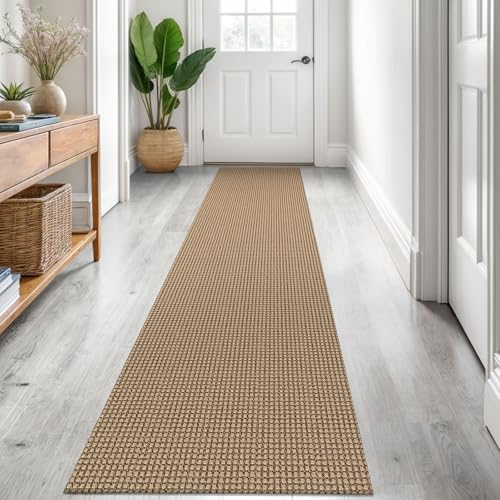
1. KOZYFLY Boho Runner for Hallways, 2×8 ft — Best Overall
The KOZYFLY runner takes the top slot because it satisfies all three entry jobs in one listing: a washable cotton construction for the trapping-and-cleaning job, a non-slip rubber backing for the staying job, and a warm boho pattern — the listing names its palette as orange beige/tan/brown — for the looking-right job. The 2×8 foot format is the most useful runner size in real housing stock: long enough for the two-step trap rule in a standard hall, narrow enough to leave the floor border that makes a runner look placed rather than wall-to-wall. Cotton as a face fibre is a thoughtful choice for an entry; it absorbs a meaningful amount of the moisture shoes carry in, and it tolerates washing without the stiffness some synthetic faces develop. Check the current price on Amazon.
Strengths
- Washable cotton face absorbs entry moisture and resets fully in the laundry.
- Non-slip rubber backing keeps the runner planted under turning, laden foot traffic.
- 2×8 format fits the standard hall and satisfies the two-step debris-trap rule.
Trade-offs
- Cotton dries slower than synthetic faces after washing; plan wash day accordingly.
- The warm boho palette will fight very cool, grey-toned hall schemes.
- Boho patterning shows less soil than a plain rug but more than a dark vintage distress.
Mini spec box (from the verified listing title): Size: 2×8 ft · Face: cotton · Backing: non-slip rubber · Care: washable · Palette as listed: orange beige/tan/brown · Pile height: not stated in title.
Who it suits: the majority of halls — family entries, back doors that open into a hall, and any household that wants one purchase to handle mud season and guests alike. The cotton face also suits homes with dogs, whose paws bring in more moisture than grit. Who should skip it: households in very wet climates whose entry sees standing water daily — the wet-weather mats in our companion guide work harder there — and minimalists who find boho patterning busy.
Best for: the standard family hall, all seasons. / Not suited for: standing-water entries or strict minimalist schemes.

2. HUGEAR Washable Runner Rug, 2×6 — Best Vintage Look
The HUGEAR runner’s argument is camouflage. Its brown vintage floral design is deliberately distressed, which means the traffic lane — the lighter-wearing path every runner eventually develops — blends into the pattern instead of announcing itself. The listing specifies low pile and non-slip construction, and a retro softness to the design that pairs with wood floors and traditional trim. At 2×6 feet it suits shorter halls, entry vestibules, and the stretch between a front door and the first doorway. For households whose halls are more formal than boho, this is the pattern language that fits. Check the current price on Amazon.
Strengths
- Distressed vintage pattern hides the traffic lane and everyday soil between washes.
- Low pile clears door swings and vacuums easily.
- Non-slip build keeps a shorter runner from skating in a compact vestibule.
Trade-offs
- 2×6 length is short for long halls; the two-step rule barely fits in a straight entry.
- Brown vintage tones can darken an already dim hall.
- Floral patterning is a style commitment that will not suit modern minimal entries.
Mini spec box (from the verified listing title): Size: 2×6 ft · Design: brown vintage floral · Pile: low · Backing: non-slip · Care: washable · Face fibre: not stated in title.
Who it suits: traditional homes, wood-floored halls, and anyone whose previous plain runner showed a traffic stripe within a year. Who should skip it: long halls (choose the KOZYFLY 2×8 or the Weidear 3×12) and bright modern entries where brown vintage will read as a generation gap.
Best for: traditional halls that need soil camouflage. / Not suited for: long halls or bright modern entries.

3. Restydon Runner Rug, 2×8 — Best Neutral
The Restydon is the quiet professional of the group: beige, thin, soft, washable, stain resistant, and explicitly low-key in its listing language. In halls that already carry visual weight — patterned wallpaper, a gallery wall, a bold front door colour — a neutral runner is not a boring choice but the correct one, because the eye needs somewhere to rest and the floor border needs to read as one calm field. The thin profile is also the most forgiving under doors with minimal clearance, a common constraint in older houses where doors were hung close to the floor. Check the current price on Amazon.
Strengths
- Beige neutrality supports patterned or colourful halls without competing.
- Thin, soft profile clears low-hung doors that defeat thicker runners.
- Washable and stain resistant per the listing — the full practical package.
Trade-offs
- Light beige shows dark soil sooner than patterned picks; wash frequency rises.
- Thin profile offers little cushion underfoot on hard floors.
- Understated looks can read plain in a hall that has no other visual interest.
Mini spec box (from the verified listing title): Size: 2×8 ft · Colour: beige · Profile: thin, soft · Backing: non-slip · Care: washable, stain resistant · Face fibre: not stated in title.
Who it suits: busy-looking halls, older homes with tight door clearances, and renters who need a runner that will match the next apartment too. Who should skip it: mud-heavy households, for whom a light plain colour is a weekly laundry sentence, and anyone wanting the runner itself to be the hall’s design event.
Best for: calm support in visually busy halls. / Not suited for: mud-heavy entries or design-led halls.

4. SAFAVIEH Natural Fiber Runner, 2’6″ x 10′ — Best Natural Fiber
The Safavieh Natural Fiber runner is the traditionalist’s pick: knotted natural jute fibres, a stated 3/4-inch pile, and a 2-foot-6 by 10-foot format that covers long halls in one piece. Jute’s virtues are texture, durability and grip — the fibre is naturally grippy underfoot and famously hard-wearing in dry traffic, and its listing positions it as kid and pet friendly with easy care. Honesty requires the boundary to be stated plainly: this is not a machine-washable rug, and its listing does not claim otherwise. Jute and soaking are enemies; this runner is cleaned by vacuuming and prompt blotting, and it belongs in entries where shoes arrive damp at worst, not dripping. Within that boundary, it may outlast every synthetic pick in this guide. Check the current price on Amazon.
Strengths
- Natural jute fibre is exceptionally hard-wearing in dry, high-traffic halls.
- Textured 3/4-inch pile (as listed) scrapes soles effectively and feels substantial.
- Long 10-foot format covers extended halls without a seam or a second rug.
Trade-offs
- Not machine washable; care is vacuuming and blotting, per its easy-care positioning.
- Jute dislikes standing moisture — wrong choice for dripping-wet entries.
- The 3/4-inch pile needs door clearance checked before ordering.
Mini spec box (from the verified listing title): Size: 2’6″ x 10′ · Fibre: natural jute, knotted · Pile: 3/4 in, as listed · Care: easy care (not stated as washable) · Positioning: kid & pet friendly per listing · Backing: not stated in title — consider a rug pad.
Who it suits: dry-climate entries, long halls, natural-material households, and anyone who prefers buying once for a decade. Who should skip it: wet-weather entries, households with puppies in training, and doors with minimal floor clearance.
Best for: dry, long, high-traffic halls. / Not suited for: wet entries or wash-everything households.

5. Hallway Washable Runner Rug, 2×6 (Vintage Farmhouse) — Best Farmhouse
This 2×6 washable runner brings the farmhouse dialect — vintage patterning, warm distressing — to the same practical platform as the other synthetic picks: non-slip backing, stain resistance, machine washing. Its listing spans kitchen, entryway, laundry and bedroom duty, which reflects how farmhouse runners actually live: bought for the hall, rotated to the kitchen sink run, back to the hall after a wash. That versatility is its charm. In a farmhouse or country scheme it will look intentional in any of those rooms, and the distressed vintage face forgives the flour, soil and paw prints that define the style’s real households. Check the current price on Amazon.
Strengths
- Vintage farmhouse pattern hides the soil of country and family traffic.
- Washable, stain resistant, non-slip — full practical specification.
- Room-to-room versatility across hall, kitchen and laundry.
Trade-offs
- 2×6 is a modest footprint for a grand entry; scale it honestly.
- Farmhouse styling is a strong dialect that clashes with contemporary schemes.
- Brand is not named in the listing title, so maker research is limited to the listing itself.
Mini spec box (from the verified listing title): Size: 2×6 ft · Style: vintage farmhouse · Backing: non-slip · Care: washable, stain resistant · Face fibre and pile height: not stated in title.
Who it suits: farmhouse, cottage and country homes, and households that rotate textiles between rooms. Who should skip it: formal or contemporary entries, and long halls needing the 2×8 or 3×12 formats.
Best for: farmhouse halls and multi-room rotation. / Not suited for: contemporary entries or long halls.

6. Weidear Hallway Runner Rug, 3 x 12 ft — Best Extra Long
Some halls defeat standard runners entirely: the long gallery entry, the combined entry-and-corridor of a ranch house, the garage-to-kitchen gauntlet. The Weidear answers with a 3 by 12 foot non-slip runner with rubber backing — wider as well as longer than standard, which matters because wide halls with narrow runners look like the rug shrank. The listing also positions it for entryway, balcony, kitchen and garage duty, and that utility character is honest: this is a working runner for working floors, in black, where appearance serves durability. For the right floor plan it is the only pick in this guide that finishes the job in one piece. Check the current price on Amazon.
Strengths
- 3 x 12 ft format covers long, wide halls in a single piece.
- Rubber backing keeps a long runner from creeping along its length.
- Black, utility-grade presentation hides heavy soil between cleanings.
Trade-offs
- Oversized for standard halls; measure twice, because returns of 12-foot runners are nobody’s fun.
- Utilitarian looks will not satisfy a design-led entry.
- Washability is not stated in the listing title — plan on hose-and-air or spot care, and confirm care on the listing page.
Mini spec box (from the verified listing title): Size: 3 x 12 ft · Backing: rubber, non-slip · Colour: black · Positioning: entryway, kitchen, garage, balcony · Care: not stated in title — verify on listing page.
Who it suits: long ranch entries, garage-adjacent halls, and commercial-feeling traffic paths at home. Who should skip it: standard 8-foot halls, design-first entries, and anyone who needs stated machine washability.
Best for: very long or wide halls in one piece. / Not suited for: standard halls or wash-first households.
Comparison Table
| Pick | Badge | Key spec (from listing title) | Best for |
|---|---|---|---|
| KOZYFLY Boho Runner 2×8 | Best Overall | Cotton face, rubber non-slip backing, washable | The standard family hall |
| HUGEAR Runner 2×6 | Best Vintage Look | Brown vintage floral, low pile, washable, non-slip | Traditional halls, soil camouflage |
| Restydon Runner 2×8 | Best Neutral | Beige, thin and soft, washable, stain resistant | Visually busy halls, low doors |
| SAFAVIEH Natural Fiber Runner 2’6″x10′ | Best Natural Fiber | Knotted jute, 3/4 in pile as listed, easy care | Dry, long, high-traffic halls |
| Hallway Washable Runner 2×6 | Best Farmhouse | Vintage farmhouse, washable, stain resistant, non-slip | Farmhouse halls, room rotation |
| Weidear Runner 3×12 | Best Extra Long | Rubber backing, non-slip, black, 3 x 12 ft | Very long or wide halls |
How to Choose an Entry Hall Rug
Measure first, and measure the right things: the hall’s length and width, the swing of every door that opens over the rug’s territory, and the distance from the door to the first turn or doorway, which is the stretch that must catch debris. Leave a floor border of roughly two to four inches on the runner’s sides — wall-to-wall runners in a hall look like carpet remnants, while a bordered runner looks chosen. Then apply the two-step rule: the runner should be long enough that an entering person takes at least two full steps on it, because the first step carries the worst of the grit and the second step is what keeps it from reaching your other floors.
Choose the care model before the pattern. If your entry receives wet, mud or dogs daily, machine-washable low-pile synthetics or cotton — the KOZYFLY, HUGEAR, Restydon and farmhouse picks — will save the rug and your temper; pair them with a heavy-duty mat at the door itself in the worst months, as our wet-weather guide describes. If your entry is mostly dry and you value longevity and texture, the jute Safavieh is the connoisseur’s answer. Match pattern to soil: distressed vintage patterns hide the traffic lane best, mid-tone patterns second, and plain light colours last — buy the plain beige only if you genuinely enjoy laundry. Finally, treat backing as non-negotiable in an entry: rubber or stated non-slip backing on hard floors, or a quality rug pad under anything without it, because the entry is where a sliding rug meets a person carrying something heavy.
How to Install and Care for an Entry Hall Runner
Installation is mostly patience. Unroll the runner and let it relax for a day — shipping folds telegraph through low-pile rugs and then vanish on their own; weighting the corners with books overnight speeds the process honestly. Position it with the border even on both sides and the near end a few inches inside the door’s swing, then walk it in: a dozen passes in socks settles the backing against the floor. For a runner without rubber backing, like the jute pick, a non-slip rug pad cut an inch smaller than the rug on every side is the correct foundation — it also adds a whisper of cushion and extends the rug’s life by absorbing shear.
Care divides by family. Washable runners: shake outside weekly (the shake removes more grit than the vacuum does), vacuum with suction rather than a beater bar on the edges, and machine wash on the schedule the care label allows, drying fully before it returns to the floor — a damp runner on wood is a finish problem in the making. Jute: vacuum with suction only, blot spills immediately with a dry cloth, never soak, and rotate the runner end-for-end seasonally so the traffic lane distributes across both halves. For every runner, lift it monthly and sweep beneath: the grit that migrates under a rug grinds the floor finish with every step, and the monthly lift is the cheapest floor protection in this entire guide.
Common Buying Mistakes
The first mistake is buying by photograph scale — runners in listing photos sit in grand halls, and a 2×6 that looks generous on screen can look like a bath mat in a real entry; measure. The second is ignoring door clearance, then living with a door that shaves the pile or a runner banished to a crooked angle. The third is choosing a plain light colour for a mud-season entry. The fourth is skipping the backing question and discovering runner migration across a polished floor. The fifth is treating a jute rug as washable because it is “natural” — natural fibres and soaking are enemies. The sixth is buying two short runners for a long hall with a gap between them, which traps nothing and trips everyone; one long runner, like the Weidear, is the honest fix. The seventh is forgetting the floor underneath: grit under any rug is sandpaper, so the monthly lift-and-sweep is part of owning the rug, not an optional extra.
Final Recommendation
For the typical hall, start with the KOZYFLY 2×8: washable cotton, rubber backing, the right size, done. Whichever pick you choose, lay it, live with it for a week of real traffic, and judge it by what the floor beneath looks like at the first monthly lift — that is the entry rug’s true report card. Traditional rooms should take the HUGEAR vintage floral for its soil camouflage; visually busy or low-doored halls should take the Restydon beige. Dry, long halls deserve the Safavieh jute, farmhouse homes the 2×6 vintage farmhouse runner, and the longest halls the Weidear 3×12. For the door zone itself in bad weather, pair any of these with the mats in Best Entry Rugs For Wet Weather; see also Best Washable Entry Rugs, Best Indoor Entry Rugs, Best Door Entry Rugs To Protect Floor and Best Type Of Rugs For Entryway.
Choosing an Entry Hall Rug by Floor Type
The floor under the runner changes what the runner must do. On hardwood, the runner’s first job is protection: grit trapped in the pile is grit that is not grinding the finish, but only if the backing is finish-safe and the monthly lift-and-sweep actually happens. Rubber backings should be checked for the floor manufacturer’s guidance, because some finishes react to prolonged rubber contact; a felt-and-rubber pad under a backed runner is the belt-and-braces answer in a prized hall. On tile and stone, the entry problem is slipperiness rather than abrasion — wet soles on glazed tile are the classic household fall — so backing grip moves to first priority, and a slightly plusher face that interrupts the slide is worth more than pattern. On laminate and luxury vinyl, avoid backings that can trap moisture against the surface after wet entries; lift the runner to dry the floor beneath during the wettest weeks, a thirty-second habit that prevents the one failure these floors cannot forgive.
Carpeted halls are the overlooked case: a runner over carpet needs a pad designed for carpet-on-carpet grip, or it will creep in the direction of traffic no matter how it is placed, and low-pile runners behave better than plush ones because the piles interlock less. Radiant-heated floors add one more consideration — thick, dense runners insulate the floor and create a warm stripe the heating system did not plan for; the thin Restydon profile is the considerate choice there. In every case the runner is part of a flooring system, not a decoration laid on top of one, and the picks above were chosen with backing and profile specifications stated precisely so you can match them to your floor with open eyes.
The Two-Layer Entry: Mat at the Door, Runner in the Hall
Professional buildings separate the entry into zones, and homes that copy the idea keep their halls dramatically cleaner. The first zone is outside or immediately inside the door: a scraper surface whose job is the coarse work — mud, snow, gravel. The second zone is the runner’s: the finer grit and moisture that survive the first zone, spread over the two-step path into the house. Households that ask one product to do both jobs get a runner that is filthy by February and a hall floor that dulls anyway. Households that split the jobs find each product lasts longer and the runner — the visible, decorative element — stays presentable between washes. Our companion guide to wet-weather entry rugs covers the first zone in depth; this guide’s runners are optimised for the second.
The layering also solves the seasonal problem elegantly. In dry months the runner alone suffices and the entry looks spare and intentional. When the weather turns, the door mat joins it — a heavy absorbent or waterproof mat sized to the door — and the runner’s washing interval stretches because the mat is absorbing the assault. When spring returns, the mat is hosed, dried and stored, and the hall goes back to its fair-weather face. If your entry is small, choose the mat and runner in the same tonal family so the layered season looks designed rather than improvised; the beige Restydon and the vintage HUGEAR both have natural partners among the mats in the wet-weather guide. Think of the runner as the hall’s permanent resident and the mat as its seasonal bodyguard, and both purchases get easier.
Pattern, Colour and Light: Making the Hall Feel Bigger and Brighter
Halls are usually the darkest, narrowest rooms in the house, and the runner is their largest single surface after the floor itself — which makes it a lighting tool as much as a textile. A mid-tone runner with pattern movement, like the KOZYFLY’s boho geometry or the HUGEAR’s vintage floral, breaks up the corridor effect by giving the eye incidents to travel between; a plain dark runner in a dark hall reads as a trench, and a plain pale runner reads as a runway that shows every footprint. Direction matters too: pattern that runs along the hall’s length emphasises length, which flatters short halls that want to feel grander; pattern with strong crosswise elements slows the eye and suits halls that feel like bowling alleys. The floor border you leave around the runner is part of the composition — on dark wood floors a mid-tone runner lifts the whole passage, while on pale floors the same runner grounds it.
Coordinate the runner with the front door’s interior face, because the two are always seen together. A painted door in a strong colour wants a runner that either echoes one of its tones quietly or stays neutral like the Restydon; a white or wood door gives the runner freedom to be the colour event, which is where the warm boho palette earns its place. Then check the runner against your hall’s actual light, not the listing’s studio light: order with the intention of judging it at the hour your hall is darkest, and lay it for a full day before deciding, because entry light swings from morning glare to evening gloom more dramatically than any other room’s. The picks in this guide were specified with their palettes stated in their titles precisely so this judgement starts from honest information.
Entry Hall Rugs for Households with Dogs
Dogs change the entry brief in three ways: volume, moisture and nails. Volume, because a dog crosses the threshold more often than any human and brings the garden in on four feet instead of two. Moisture, because paws are unshod and unembarrassed. Nails, because a dog launching toward a doorbell tests a runner’s grip in ways human traffic never does. The washable cotton KOZYFLY is the natural dog-household pick in this guide — absorbent face, rubber grip, full machine washing — with the farmhouse 2×6 as the rotation partner so one runner can be in the wash while the other is on duty. That two-runner rotation is the single best upgrade a dog household can make to its entry: the washing stops being an event that leaves the hall bare, and each runner lives twice as long.
Size the dog entry generously. A runner that covers the door zone plus the turn toward the kitchen catches the shake — the full-body shake every wet dog performs at the exact moment of maximum indoor coverage — and a mat layered at the door, per the two-layer system above, takes the first and worst of it. Avoid loop piles that nails can snag and lift, and avoid the jute pick for puppies, whose accidents are a soaking problem jute cannot forgive. For senior dogs the calculus flips toward grip and cushion: a non-slip runner is a mobility aid on hard floors, and several households buy the hall runner primarily so an old dog can cross the entry with confidence. Whichever pick you choose, wash on the dog’s schedule rather than the calendar’s, and the entry will smell like a house instead of a kennel.
How Long an Entry Runner Should Last, and When to Replace It
An entry runner lives the hardest life of any rug in the house, so judge its lifespan by traffic, not by the calendar promises of other rooms. A washable synthetic or cotton runner in a family entry typically gives several years of presentable service before the traffic lane thins, the pattern dulls in the centre, or the backing loses its grip — and loss of grip is the retirement trigger that matters most, because a runner that slides in an entry is a hazard wearing a rug costume. Jute in a dry hall can outlast the synthetics substantially, retiring instead when the fibres dry, shed or stain beyond blotting. In both families, rotate end-for-end seasonally and the centre wear spreads across the whole length, which is the cheapest lifespan extension available.
Replace on evidence: backing that cracks or flakes, edges that curl despite relaxing and weighting, a traffic lane that stays visibly grey after a proper wash, or any slide that survives repositioning and a fresh pad. Retired entry runners have honourable second lives — the garage workbench zone, the basement laundry run, the dog’s feeding station — where their remaining grip and absorbency still serve and their appearance no longer represents the house. Keep one retired runner rolled in the garage for moving days and delivery days, when temporary protection matters more than looks. What they should not do is linger in the entry past their evidence, because the entry is the room every guest reads first, and a tired runner tells a story you did not choose.
Entry Hall Rugs for Apartments and Rentals
Renters face a specific entry problem: the floor is someone else’s asset, the deposit remembers every scratch, and the hall is often a corridor shared visually with the living space. A washable runner is close to mandatory equipment here — it intercepts the grit that would otherwise sand a landlord’s finish, it launders in the building’s machines, and it leaves with you. The Restydon’s beige neutrality is the renter’s friend precisely because it will match the next apartment’s hall as reliably as this one’s, and the KOZYFLY’s rubber backing protects without adhesives, tapes or any of the fixings that deposits are lost over. Measure the door swing twice in a rental, because rental doors are frequently hung lower over added flooring layers, and a runner that a door shaves will shed fibres across the whole flat. When you move, the runner rolls, travels, and becomes the first thing laid in the new hall — before the furniture, before the boxes — because the move itself is the grittiest traffic the new floor will ever see, and the runner you already own is the protection it needs.
Frequently Asked Questions
Can I use two runners instead of one long runner?
You can, but a single long runner works better: two runners leave a gap exactly where traffic is heaviest, and the gap becomes the grit path into the house. If your hall turns a corner, two runners — one per leg of the turn — is the sensible exception; for straight long halls, choose a long format like the 3×12 Weidear.
Do I need a rug pad under a rubber-backed runner?
Usually not on hard floors — the rubber backing is the grip layer. A pad still helps on very smooth tile, under runners whose backing has aged, and under unbacked rugs like the jute pick, where a pad is effectively mandatory for both grip and floor protection.
What size rug is best for an entry hall?
A runner that leaves roughly two to four inches of visible floor on each side and runs long enough for two full steps after entering. For most halls that means 2×8 feet; shorter vestibules suit 2×6, and long gallery halls need formats like the 3×12 Weidear in this guide.
Should an entry hall rug be washable?
If your entry sees mud, wet shoes or dogs regularly, yes — machine-washable low-pile runners are the practical default. If your entry is mostly dry, a durable natural-fibre runner like the jute Safavieh can serve for years with vacuuming and blotting instead.
How do I stop a hall runner from sliding?
Choose a runner with rubber or stated non-slip backing for hard floors, or place a non-slip rug pad cut slightly smaller than the rug beneath it. Let new runners relax flat for a day, and re-check position after the first week of traffic.
Are entry hall rugs worth it on carpeted halls?
Yes, with the right expectations. A low-pile runner over hall carpet protects the highest-wear strip of a carpet that is expensive to replace, and it gives the eye a designed path through the house. Use a carpet-on-carpet pad to stop creep, and expect to lift and vacuum beneath it regularly, because grit migrates through both layers.
Can I put a jute runner in an entryway?
Yes, in a dry entry. Jute is hard-wearing and grippy, but it dislikes soaking and is not machine washable. Entries with standing water, snow melt or puppies in training are better served by the washable synthetic and cotton picks, or by a dedicated wet-weather mat at the door.
How often should an entry runner be cleaned?
Shake it outside weekly, vacuum regularly, lift and sweep beneath it monthly, and wash washable runners whenever soil stops shaking out — typically every few weeks in mud season for family entries. Rotating the runner end-for-end seasonally evens out the traffic lane.
Should the entry runner match the living room rug?
It should coordinate, not match. In open sightlines, echo one colour or the pattern scale of the living room rug so the two read as relatives; an exact match across a threshold usually looks like offcuts. In closed halls, the runner can be its own statement entirely.
What pile height works under a front door?
Low pile is the safe default, because most doors are hung with minimal clearance. Check the swing before ordering anything thicker: the jute pick in this guide lists a 3/4-inch pile, which is substantial and beautiful but needs the clearance to prove it.


