Disclosure: airfryerkitchensupply.com is reader-supported. When you buy through links on our site, we may earn an affiliate commission at no extra cost to you.
Where to buy
Every verified pick in this guide to the best women’s non skid slippers for elderly is sold through Amazon, and that is where we recommend buying: the listing page shows the current size, colour and configuration options, and returns are straightforward if a pick arrives different from its listing description. The verified picks are: ULTRAIDEAS Women’s Indoor Bedroom Slipper with Memory Foam, Grey, EverFoams Women’s Bootie Slippers with Warm Collar, Acorn Women’s Chinchilla Bootie Slipper, HomeTop Women’s Closed-Back Fuzzy Slipper, Chestnut, Dearfoams Women’s Rebecca Closed Back Slipper, Peacoat, Fadezar Japanese Slippers, Machine Washable, Brown. Check the current price on Amazon for the one that fits your space, because options and availability change more often than product names do.
One honest note before the list, in plain language: no slipper can prevent a fall, and nothing in this guide claims one can. What a well-chosen house slipper can do is remove its own risks from the picture — a sole whose listing states non-slip or anti-skid grip, a shape that stays on the foot without gripping or shuffling, and a fit that does not swim. The picks below were chosen on exactly those terms, described in comfort and security-of-fit language only, and this guide deliberately makes no medical claims of any kind for any of them.
The best women’s non skid slippers for elderly wearers are chosen differently from ordinary slippers, and the difference is respect for the details. A sole must state its grip, not imply it. A shape must stay on the foot by itself — no toe-gripping to keep a backless scuff aboard, no loose heel to catch on a stair edge. The opening must admit a foot without a wrestling match, and the whole slipper must be light enough that the foot lifts it cleanly with every step. The six verified picks below were chosen on those criteria alone: house slippers whose listings state non-slip, anti-skid or rubber soles, in bootie, closed-back and moccasin shapes that hold the heel, described honestly — including where a listing’s sole wording is thinner than the others, which this guide flags rather than hides.
Key Takeaways
- No slipper prevents falls and none is claimed to here; the goal is a slipper that adds no risks of its own — stated grip, a heel that stays covered, a fit that does not swim.
- Sole wording is graded pick by pick: anti-skid rubber sole (ULTRAIDEAS), non-slip (EverFoams Bootie, Fadezar), rubber sole (Acorn Bootie), textured TPR sole (HomeTop) — and one closed-back pick whose listing does not headline grip, flagged openly.
- Bootie and closed-back shapes dominate this list on purpose: a covered heel cannot slip off mid-step the way a backless scuff can.
- Easy entry matters as much as grip: slip-on shapes with roomy openings beat anything that must be pulled, tugged or tied.
- Lightness is a safety feature — a slipper the foot lifts cleanly is a slipper that does not drag, catch or trip its own wearer.
In this guide
Quick Picks
Best Anti-Skid Sole — ULTRAIDEAS Women’s Indoor Bedroom Slipper with Memory Foam, Grey
A women’s indoor slipper whose listing states an anti-skid rubber sole outright, with memory foam and a wool-like upper — the most explicit sole claim in this guide, grey, size 7-8.
Best Bootie Coverage — EverFoams Women’s Bootie Slippers with Warm Collar
Women’s bootie slippers with a warm collar whose listing states non-slip, memory foam and a fuzzy faux fur build — the highest coverage in this guide, purple, size 8.
Best Rubber Sole Bootie — Acorn Women’s Chinchilla Bootie Slipper
A women’s bootie slipper whose listing describes a plush faux fur upper, a multi-layer memory foam footbed and a rubber sole — the established maker’s bootie, on a stated rubber base.
Best Closed Back — HomeTop Women’s Closed-Back Fuzzy Slipper, Chestnut
A women’s closed-back slipper whose listing describes a textured TPR sole, dense foam cushioning and an ankle wrap — the step-in shape with a closed heel, chestnut, size 7-8.
Best Wide-Width Closed Back — Dearfoams Women’s Rebecca Closed Back Slipper, Peacoat
A lightweight closed-back slipper with memory foam, offered in wide widths in its listing — included for shape and fit, with its listing’s lack of a headline sole claim stated openly, peacoat, size 9-10.
Best Lightweight Washable — Fadezar Japanese Slippers, Machine Washable, Brown
Japanese-style house slippers whose listing states non-slip, machine washable, lightweight and a breathable lining — the light, washable, quiet option, brown, women’s size 10-11 listing.
How These Picks Were Chosen
We chose these six from women’s house slippers verified through Amazon’s product data, under the programme’s slippers rule — house slippers only, no sandals, slides, flip-flops or novelty footwear — and then under this search’s own stricter fence. Every pick had to be a shape that holds the foot: bootie, closed-back or moccasin. Backless scuffs and clogs, however grippy their soles, were excluded from this list on shape alone, because a slipper that must be gripped by the toes to stay on is the wrong tool for the wearer this search names.
Sole evidence came next, read from the listings word by word. Five of the six picks carry explicit sole language in their verified titles — anti-skid, non-slip, rubber sole, textured TPR — and each review repeats its pick’s exact wording. The sixth, a closed-back Dearfoams chosen for its shape and wide-width fit, does not headline a sole claim in its listing; its review says so in plain terms and explains the basis on which it is included, so a careful reader can weigh it accordingly. That transparency is deliberate: in this category, overstated grip is worse than honestly described grip.
Finally, medical language was excluded by policy, not by editing. Several slippers in the wider verified data carry medical and treatment wording in their titles; none of those products appears in this guide, and no medical benefit is claimed for any pick. Where a listing’s title itself contains comfort-adjacent wording, the review describes the slipper in fit and comfort terms only. What remains is a list a family can shop from with clear eyes: stated grip, covered heels, honest gaps.
The 6 Best Women’s Non Skid Slippers for Elderly Wearers

ULTRAIDEAS Women’s Indoor Bedroom Slipper with Memory Foam, Grey — Best Anti-Skid Sole
Start where this search starts: the sole. This listing states an anti-skid rubber sole in so many words — the clearest grip claim among the verified picks — under a memory foam footbed in a wool-like house shoe shape that covers the foot properly. The verified colourway is grey in size 7-8. For a buyer who wants the grip sentence written down by the maker before anything else is considered, this is the pick the rest of the list is measured against.
Strengths
- Listing states an anti-skid rubber sole — the headline requirement, in writing
- Memory foam footbed for a soft, even landing at each step
- Covered house-shoe shape; no backless shuffle
Trade-offs
- Slip-on coverage is lower than the bootie picks; the heel is held by shape, not by a high back
- Wool-like upper is a warm construction; summer feet may prefer the Fadezar pick
- Verified listing is size 7-8 in grey; confirm the wearer’s size on the listing
| Style | Indoor bedroom slipper / house shoe |
|---|---|
| Footbed (per listing) | Memory foam |
| Sole (per listing) | Anti-skid rubber sole |
| Verified listing | Grey, size 7-8 |
Rubber is the sole material this category trusts, because rubber grips by deforming against the floor, and an anti-skid tread gives that grip a pattern to work with on smooth boards and tiles. Paired with a covered shape, it addresses the two slipper-specific risks this guide is allowed to talk about: the sole sliding, and the slipper leaving the foot. The memory foam’s role is comfort that encourages wear — a slipper that feels good is a slipper that stays on, and a slipper that stays on is doing its quiet work all day. If the family buys one pair from this guide on the strength of a written claim, this is the claim to buy.
A marking note for shared households: when several similar pairs live in one home, mark the wearer’s pair discreetly — a stitch of coloured thread inside the heel. The right size on the right foot is a fit feature, and a household system for telling pairs apart protects it.
Best for: buyers who want the most explicit anti-skid wording in the listing / Not suited for: anyone wanting a high bootie back or a summer-weight slipper
Check the current price on Amazon

EverFoams Women’s Bootie Slippers with Warm Collar — Best Bootie Coverage
The bootie is this category’s most reassuring shape: the foot is covered to the ankle, the heel cannot walk out of it, and there is nothing to grip or shuffle. EverFoams’ listing describes a bootie with a warm collar, memory foam, a non-slip sole stated in the listing, and a fuzzy faux fur finish, in the purple colourway verified here, size 8. On a cold floor in the early morning — the hour slippers matter most — this is the construction that asks the least of its wearer.
Strengths
- Bootie coverage to the ankle: the heel stays in, by design
- Listing states a non-slip sole under the memory foam footbed
- Warm collar suits cold floors and draughty houses
Trade-offs
- Warmest pick here; too warm for heated floors in summer
- Bootie entry asks a little more of stiff hands than a low slip-on
- Verified listing is purple in size 8; other options are listing variants
| Style | Bootie slipper with warm collar |
|---|---|
| Footbed (per listing) | Memory foam |
| Sole (per listing) | Non-slip |
| Verified listing | Purple, size 8 |
Coverage is a philosophy before it is a feature: the safest slipper is the one that behaves like a shoe while feeling like a slipper, and the bootie is that compromise at its best. The warm collar does double duty — it is the comfort that makes the pair a pleasure in winter, and it is the cuff that keeps the bootie seated when its wearer rises from a chair, which is the moment loose slippers choose to leave. The stated non-slip sole completes the sentence the shape begins. For a wearer whose mornings are cold and whose floors are smooth, this is the guide’s warmest and most covered answer.
A dressing note: seat this bootie’s first fitting on the edge of the bed and roll the collar down, slip the foot in, roll the collar up. Once the wearer owns that small ritual, the warmest shape in the guide is also an easy one — and rituals, not struggles, are what morning footwear should be.
Best for: cold houses, early risers, and anyone wanting maximum coverage / Not suited for: warm climates, or wearers who struggle to pull on a bootie shape
Check the current price on Amazon

Acorn Women’s Chinchilla Bootie Slipper — Best Rubber Sole Bootie
Acorn’s bootie pairs the shape this guide favours with the sole material it trusts, stated plainly in the listing: a rubber sole. Above it sit a plush faux fur upper and a multi-layer memory foam footbed — ‘multi-layer’ being the listing’s own description of a footbed built from more than a single foam sheet, which in practice means a landing that stays composed rather than bottoming out. It is the established-maker option in a list of specialists, and its specification reads like the category’s checklist written by someone who has made slippers for a long time.
Strengths
- Rubber sole stated in the listing — the trusted grip material
- Multi-layer memory foam footbed, per the listing’s description
- Bootie shape holds the heel without any effort from the wearer
Trade-offs
- Plush faux fur is a winter-weight upper
- Listing does not add the words non-slip to its rubber sole; we report the sole as the listing states it — rubber — and credit the material accordingly
- Bootie entry, like all booties, is a pull-on rather than a step-in
| Style | Bootie slipper |
|---|---|
| Upper (per listing) | Plush faux fur |
| Footbed (per listing) | Multi-layer memory foam |
| Sole (per listing) | Rubber sole |
This review models the guide’s honesty rule at its most granular: the listing says ‘rubber sole’, not ‘non-slip rubber sole’, and we print what it says. Rubber is the material whose grip on household floors is a property, not a promise — it is why the anti-skid pick above is rubber too — and a buyer is entitled to the maker’s exact words rather than our upgrade of them. What the Acorn adds is depth of footbed and a bootie shape from a specialist maker. For a family buying for a parent and wanting a name with a track record under a properly covered foot, this is the reassuring purchase.
A longevity note: a rubber sole rewards a monthly wipe-down more than any other part of any pick here. Dust and polish film are the enemies of rubber’s grip; a damp cloth across the tread, dried before wear, keeps the stated material doing its stated work.
Best for: buyers wanting a specialist maker’s bootie on a stated rubber sole / Not suited for: anyone needing the words non-slip printed in the listing itself
Check the current price on Amazon

HomeTop Women’s Closed-Back Fuzzy Slipper, Chestnut — Best Closed Back
The closed back is the quiet hero of this category: a slipper you step into that then holds your heel, combining a scuff’s easy entry with a shoe’s loyalty. HomeTop’s listing describes the full build — a closed-back fuzzy slipper with an ankle wrap, dense foam cushioning and a textured TPR sole, in the chestnut colourway verified here, size 7-8. Texture is the grip word to notice: a textured TPR sole grips by pattern as well as material, and TPR is the rubber-family compound most house soles in this class are made from.
Strengths
- Closed back with ankle wrap: step-in entry, held heel
- Textured TPR sole stated in the listing — grip by pattern and compound
- Dense foam cushioning in the listing’s description
Trade-offs
- Fuzzy warmth is a cool-season virtue
- Closed back sits lower than a bootie; ankle coverage is partial
- Verified listing is chestnut in size 7-8
| Style | Closed-back slipper with ankle wrap |
|---|---|
| Cushioning (per listing) | Dense foam |
| Sole (per listing) | Textured TPR sole |
| Verified listing | Chestnut, size 7-8 |
For many wearers this shape is the sweet spot of the whole guide. A bootie asks to be pulled on; a scuff asks to be gripped; a closed-back asks nothing — step in, and the heel cup and ankle wrap take it from there. That matters at the exact moments slippers matter: the night-time trip across a dark hallway, the morning’s first steps before hands are fully awake. The textured TPR sole is the right partner for the shape, a stated, patterned grip surface under a foot that is properly held. If the booties feel like too much slipper and the scuffs too little, this is the considered middle, and for many families it will be the pair that gets worn every single day.
A nightstand note: this is the pair to stage by the bed, openings facing out, toes pointing at the room. A closed-back that can be stepped into half-asleep, in the dark, without a hand ever leaving the mattress edge, is the shape fulfilling its entire design brief.
Best for: wearers wanting step-in ease with a held heel, day and night / Not suited for: anyone wanting full ankle-high bootie coverage
Check the current price on Amazon

Dearfoams Women’s Rebecca Closed Back Slipper, Peacoat — Best Wide-Width Closed Back
This pick is in the guide for two stated virtues — a closed-back shape and wide widths in the listing, over a lightweight memory foam build, in the peacoat colourway verified here, size 9-10 — and it carries this guide’s most important honesty note: its listing does not headline a non-slip or anti-skid sole claim, and we will not write one for it. It is included because fit is a safety property too — a slipper that accommodates a wide foot without squeezing or swimming is a slipper that stays where it belongs — and because a closed back holds a heel regardless of sole wording. A buyer for whom the written grip claim is non-negotiable should choose the ULTRAIDEAS, EverFoams or HomeTop picks, whose listings state theirs.
Strengths
- Closed-back shape holds the heel; lightweight build lifts cleanly
- Wide widths offered in the listing — a genuine fit virtue, rarely stated
- Memory foam comfort in a low-effort slip-on form
Trade-offs
- Listing does not state a non-slip sole claim — the open caveat of this guide
- Lightweight build is a thinner landing than the bootie picks
- Verified listing is peacoat in size 9-10
| Style | Closed-back slipper |
|---|---|
| Footbed (per listing) | Memory foam, lightweight |
| Fit (per listing) | Wide widths offered |
| Verified listing | Peacoat, size 9-10 |
| Sole note | No sole grip claim headlined in the verified listing |
Why include a pick with a caveat this size? Because families shop in the real world, where the wearer’s foot is wide, the budget is finite, and the perfect listing does not always exist in her size — and because a guide that only prints its strongest claims teaches nothing. The Rebecca’s case is fit and shape: wide widths stated, a heel that is held, a featherweight build that an unsteady step lifts without dragging. Bought with its caveat understood — and perhaps tested first on the wearer’s own floors at home pace, as this guide advises for every pair — it can be the right purchase. Bought as if it claimed what it does not, it would be the wrong one. The distinction is the guide’s whole method, printed on its sleeve.
A testing note specific to this pick: because its listing headlines fit rather than grip, give it the full home test from this guide’s how-to — every floor, every transition, at home pace — and let the wearer’s own floors cast the deciding vote while the return window is open.
Best for: wide feet needing a closed back, bought with the sole caveat understood / Not suited for: any buyer for whom a written non-slip claim is the first requirement
Check the current price on Amazon
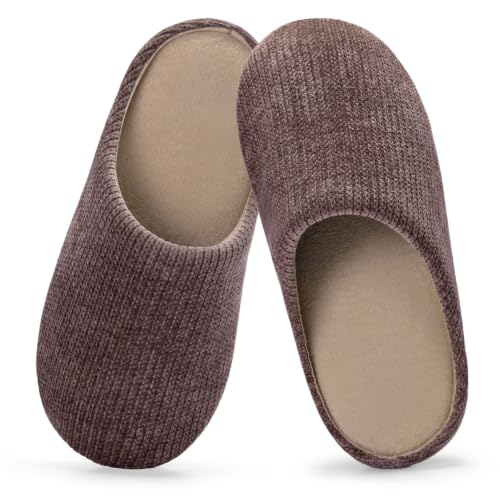
Fadezar Japanese Slippers, Machine Washable, Brown — Best Lightweight Washable
Close with the slipper for the wearer who dislikes slippers. Fadezar’s Japanese-style listing states its virtues in a row — non-slip, machine washable, lightweight, breathable lining — in a low, quiet house slipper verified here in brown. Lightness is this pick’s argument: a slipper that weighs almost nothing is lifted cleanly with every step, never dragged, never caught, and its stated non-slip sole addresses the smooth-floor question in the listing’s own words. Machine washability keeps that sole honest, because a clean sole grips and a filmed one slides.
Strengths
- Listing states non-slip and lightweight together — the clean-lift combination
- Machine washable: the sole can be kept in gripping condition
- Breathable lining suits warmer houses and summer wear
Trade-offs
- Low Japanese style is the least covered shape here; the heel is held lightly, not wrapped
- Soft, light build is a house-only slipper
- Verified listing is the brown colourway in a women’s 10-11 size run
| Style | Japanese-style house slipper |
|---|---|
| Lining (per listing) | Breathable |
| Sole (per listing) | Non-slip |
| Care (per listing) | Machine washable |
| Verified listing | Brown, women’s 10-11 |
Place this pick where its virtues compound: a warm house, a wearer who finds booties stifling, a household where slippers are washed as routinely as towels. Its honesty item is coverage — this is a low slipper, held by fit rather than by a wrap or a collar — and for a wearer whose heel tends to wander, the closed-back and bootie picks above are the safer shapes. For the steady wearer who wants the least slipper that still states its grip, washes clean and weighs nothing, it is the right end to this list: proof that in this category, sometimes the safest-feeling choice is the one that gets out of the foot’s way.
A laundry note: wash this pair with the household towels and dry it fully before it returns to service — a damp sole on a polished floor is the one combination this guide warns about in every article it touches. Dry, it is the lightest stated-grip option here; damp, it is a different and worse product.
Best for: warm houses and wearers who want the lightest stated-grip option / Not suited for: wearers whose heels wander, who should take a bootie or closed back instead
Check the current price on Amazon
Comparison Table
| Pick | Badge | Key spec | Best for |
|---|---|---|---|
| ULTRAIDEAS Women’s Indoor Bedroom Slipper with Memory Foam, Grey | Best Anti-Skid Sole | Memory foam house shoe; listing: anti-skid rubber sole | buyers who want the most explicit anti-skid wording in the listing |
| EverFoams Women’s Bootie Slippers with Warm Collar | Best Bootie Coverage | Bootie with warm collar, memory foam; listing: non-slip | cold houses, early risers, and anyone wanting maximum coverage |
| Acorn Women’s Chinchilla Bootie Slipper | Best Rubber Sole Bootie | Bootie, multi-layer memory foam; listing: rubber sole | buyers wanting a specialist maker’s bootie on a stated rubber sole |
| HomeTop Women’s Closed-Back Fuzzy Slipper, Chestnut | Best Closed Back | Closed-back, dense foam; listing: textured TPR sole | wearers wanting step-in ease with a held heel, day and night |
| Dearfoams Women’s Rebecca Closed Back Slipper, Peacoat | Best Wide-Width Closed Back | Closed-back, wide widths, lightweight memory foam; no sole claim in listing | wide feet needing a closed back, bought with the sole caveat understood |
| Fadezar Japanese Slippers, Machine Washable, Brown | Best Lightweight Washable | Japanese-style, breathable; listing: non-slip, machine washable, lightweight | warm houses and wearers who want the lightest stated-grip option |
How to Choose Non Skid Slippers for an Elderly Wearer
Buy in this order: sole, shape, fit, comfort — and do not let the order shuffle, however soft the fleece looks. The sole comes first because it is the keyword: read the listing for its grip sentence. ‘Anti-skid rubber sole’, ‘non-slip’, ‘textured TPR sole’ and ‘rubber sole’ are statements you can weigh; their absence — which this guide flags openly on one pick — is information to price in, not a detail to skip. Rubber-family soles grip household floors by material and tread; that is the entire technical basis of the category, and any claim beyond it should be treated as marketing.
Shape comes second, and here the rule is coverage. A covered heel — bootie, closed back, moccasin — cannot leave the foot mid-step, asks nothing of the toes, and behaves the same at 3 p.m. and 3 a.m. Backless shapes fail this test structurally, which is why none appears in this guide despite many having fine soles. Entry matters within coverage: the wearer should be able to get the pair on seated, without tugging, tools or balance-testing reaches — a closed back she steps into beats a bootie she must wrestle, if wrestling is what it would take.
Fit is third and unforgiving: the slipper should hold the foot closely without squeezing, with no heel lift inside the shoe and no length swimming beyond the toes. Wide feet should be bought wide — two picks here state wide widths or roomy builds in their listings — rather than sized up into sloppiness. Comfort comes last not because it is unimportant but because it is the reward for the other three: memory foam and fleece on a stated-grip, covered, well-fitted slipper is the complete purchase; the same foam on a loose backless scuff is a hazard wearing a cushion.
What ‘Non Skid’ Can and Cannot Mean
Plain language, because this search deserves it. A non-skid sole reduces the chance of the slipper itself sliding on a smooth floor, by gripping with rubber-family material and tread. That is all it does. It does not anchor a wearer, compensate for a loose fit, help on wet bathroom tile the way it helps on dry wood, or substitute for handrails, lighting, cleared walkways and the other unglamorous things that actually govern safety in a home. Any product language that drifts further — and several listings in the wider market drift much further — should be read as the comfort-and-grip claim it can support and no more. This guide makes no medical claims for any pick, deliberately.
Conditions change grip, so manage conditions. A sole grips the floor it touches: dust, spilled water and polish film all sit between tread and board. The habits that keep a stated-grip sole gripping are humble — wipe soles when they have been anywhere damp, wash washable pairs on schedule, retire pairs whose tread has worn smooth, and keep the hallway floor itself clean and dry. A worn-smooth non-slip sole is a historical document, not a safety device.
Test every new pair the same way: on the wearer’s own floors, in daylight, at home pace, with a chair or counter within reach for the first circuits. Walk the real routes — bedroom to bathroom, kitchen triangle, the turn at the stairs without using the stairs themselves as the test. Any pair that feels uncertain on its home floor goes back while returns are easy, whatever its listing said. The floor is the referee; listings are only the application form.
Fit, Foot Shape and the Daily Life of the Pair
Feet change across a lifetime — wider, sometimes swollen by evening, sometimes tender — and a good elderly slipper is bought for the foot at its largest honest hour. Try and judge fit in the evening, when feet are at their daily maximum; a pair that is perfect at 9 a.m. and tight at 7 p.m. is a pair that will be kicked off by 7 p.m., and a kicked-off slipper protects nothing. Listings that state wide widths are worth seeking out for exactly this reason, and a roomy toe with a held heel is the combination to aim for: space where the foot spreads, security where the slipper could leave.
Openings and weight are daily-life specs. A wide, low opening that admits the foot without a shoehorn or a struggle respects stiff hands and seated dressing; a light build respects the lift of every step. Fastenings that need tying, buckling or adjusting belong to shoes, not to this category — every pick here is a slip-on, and that is a criterion, not a coincidence. If a wearer uses a long-handled shoehorn happily, a bootie opens up as an option; if not, closed backs and low shapes are the honest shortlist.
Keep the pair singular and central. One pair, kept in one place — by the bed, opening facing the room — beats three pairs scattered across floors, because the worn pair is the one that was found in the dark. Wash or wipe them on a rhythm, inspect the tread when you do, and replace on condition: tread smooth, foam flat, heel counter collapsed. In this category, a fresh mid-priced pair is a better purchase than a tired premium one, every time.
The Home Around the Slippers: Making the Pair’s Job Possible
A slipper works inside a system, and this last section is about the rest of the system — offered plainly, as household practice rather than product promise. Light the routes: the bedroom-to-bathroom path is the most-travelled night route in any home, and a low night-light along it does more than any tread ever made. Clear the routes: the hallway that hosts shoes, bags and a sleeping cat is a course no sole was designed for. A pair of slippers chosen from this guide deserves a floor that lets its stated grip do its stated job.
Rugs deserve a sentence of their own, because they are where slippers and homes most often disagree. A loose rug on a hard floor is a sled with a pattern; either back it, tape it or lift it on the night routes. Rug edges and thresholds — the transitions this guide’s home test walks deliberately — are where a dragging toe catches, which is one more reason lightness and a clean lift matter in the pair itself. If a beloved rug cannot be secured, route around it after dark and let it be a daytime pleasure.
Water is the other honest enemy. A non-skid claim earned on dry wood is not transferable to a wet bathroom floor, and the wise household treats bathroom trips as their own case: a dry mat inside the door, a habit of drying feet and soles after washing, and patience with the one room where every sole is humbled. The slippers in this guide are house slippers; the bathroom is a guest in their territory, and it should be visited accordingly.
And keep the conversation open, because the wearer is the expert on her own feet. Ask which pair she actually reaches for, whether the heel ever feels loose, whether the morning floor feels sure. A family that asks gets the truth early, while it is still a shopping note; a family that assumes finds out from an incident. The best outcome this guide can produce is not a purchase — it is that conversation, held kindly and in time.
How to Fit and Test New Slippers at Home
Step 1 — Unbox and inspect before the first step. Check the tread with a thumb: it should feel definite, not glazed. Check the heel: covered, structured, holding its shape. Check the weight in the hand: light enough to lift without thinking about it.
Step 2 — Fit in the evening, seated. Put the pair on sitting down, at the hour feet are largest. Stand, and check three things: toes have room, the heel does not lift out of the slipper when you walk in place, and nothing squeezes across the widest part of the foot.
Step 3 — Walk the real routes at home pace. Bedroom to bathroom, the kitchen triangle, the hallway turn — in daylight, unhurried, with furniture within reach for the first circuits. The pair should feel boring: no sliding, no gripping with the toes, no catching.
Step 4 — Test the floors that matter. Cross from wood to tile to any rug edges the wearer actually traverses. Rug edges and thresholds are where slippers misbehave; a pair that handles them calmly at test pace has earned its place.
Step 5 — Decide within the return window, not after it. If anything felt uncertain — a slide, a swim, a struggle to put on — send the pair back and take the next pick on the list. In this category, ‘probably fine’ is the wrong standard; ‘noticeably secure’ is the right one.
Step 6 — Set the routine that keeps them honest. One home by the bed. Soles wiped when damp. Washable pairs washed on schedule. Tread inspected monthly, and the pair retired when the tread smooths or the heel collapses — replaced, not mourned.
Common Buying Mistakes
Believing any slipper can prevent a fall. It cannot, and this guide claims nothing of the kind. A good pair removes its own risks — sliding sole, escaping heel, swimming fit. The rest of safety is rails, light, clear floors and time. Buy the slipper for what it does, and do the rest separately.
Choosing a backless scuff for its grippy sole. A sole cannot help a slipper that is not on the foot. Backless shapes demand toe-gripping and leave heels free to wander; for this wearer, coverage comes before tread in the order of operations — which is why this list contains none.
Sizing up instead of buying wide. A longer slipper swims, catches its toe and trips its wearer. Wide feet need stated wide widths or roomy builds — both present in this guide — fitted at the foot’s own length.
Keeping a pair until the tread is smooth. Non-skid is a condition, not a birthright. Foam flattens, tread polishes, heel counters collapse. Inspect monthly and retire on condition; in this category a fresh pair is maintenance, not indulgence.
Testing new slippers on the stairs. The stairs are the last place a new pair should be evaluated. Test on flat routes in daylight with support at hand, and let a pair earn the stairs over days of boring success.
Scattering pairs around the house. The pair that matters is the one found in the dark at 3 a.m. One pair, one home by the bed, opening facing out — a system a tired wearer can run without thinking.
Final Recommendation
If the family buys on the strength of written claims, buy the ULTRAIDEAS for its stated anti-skid rubber sole, the EverFoams bootie for coverage with a stated non-slip sole, or the HomeTop closed back for step-in ease over a textured TPR sole. The Acorn bootie is the specialist maker’s option on a stated rubber sole; the Fadezar is the light, washable choice for a steady wearer in a warm house; and the Dearfoams Rebecca serves wide feet in a closed back, bought with its openly stated caveat — no headline grip claim in its listing — fully understood.
Whichever pair arrives, run the home test in this guide before the return window closes, keep the tread clean and inspected, and replace on condition without sentimentality. That discipline — stated grip, covered heel, honest fit, fresh tread — is everything a slipper can honestly offer, and offered consistently, it is enough to ask of a pair of slippers.
Related guides in this series: Best Women’s House Slippers For Hardwood Floors; Best Bedroom Slippers For Grandma; Best Bootie Slippers Womens; Best Arch Support Womens Slippers; Best Comfortable Ladies Slippers.
Frequently Asked Questions
Can non skid slippers prevent falls?
No, and this guide does not claim they can. A non-skid sole reduces the chance of the slipper itself sliding on a smooth floor, and a covered, well-fitted shape keeps the slipper on the foot — those are the slipper’s own risks, removed. Home safety itself rests on handrails, lighting, clear walkways and unhurried movement, which no footwear replaces.
What sole should I look for in a non skid slipper?
A listing that states its grip: anti-skid or non-slip wording, ideally over a rubber or TPR sole, whose material grips household floors by tread and compound. This guide grades each pick by its listing’s exact words — including one pick whose listing makes no headline sole claim, flagged openly so you can weigh it. A worn-smooth tread, whatever it once claimed, should be retired.
Why does this guide contain no backless slippers?
Because shape is half the safety story. A backless scuff must be held on by the toes and can leave the heel mid-step; bootie, closed-back and moccasin shapes hold the foot by construction. For the wearer this search names, that structural loyalty outranks any single sole claim, so every pick here covers the heel.
How should elderly slippers fit?
Closely without squeezing, judged in the evening when feet are at their largest: room for toes to lie flat, a heel that does not lift inside the slipper, and no swimming length. Wide feet should be bought in stated wide widths rather than a size up. The wearer should be able to put the pair on seated, without tugging or tools.
How often should non skid slippers be replaced?
On condition, not calendar: when the tread has worn smooth, the foam has packed flat, or the heel structure has collapsed. Inspect monthly — a thumb across the tread tells the story — and expect a daily-worn pair to need replacing well before it looks worn out. In this category, freshness is a feature.
Are washable slippers better for grip?
They are easier to keep gripping. Dust, damp and household film coat a sole and lubricate it; a machine-washable pair — two picks here state it — can be reset to clean on schedule. Wash as the label directs, dry fully, and the stated tread meets a clean floor with its grip intact.
Should elderly slippers have a back or be backless?
A back — for the reasons this guide is built on. A covered heel keeps the slipper on the foot without any effort or toe-gripping from the wearer, at every hour including the tired ones. Backless styles have their place for other wearers, but for this search the shape question is settled first, and every pick here — bootie, closed-back or house shoe — answers it the same way.


